
MST 111 Introduction to Business Lecture 01 DEFINITION
MST 111 Introduction to Business Lecture 01
DEFINITION n. Any activity to earn profit. n. The word “business” is derived from the term “busyness. ”

Characteristics of Business a) Production or acquisition of goods: b) Sale or transfer of title: c) Dealings in goods and services: d) Regularity of dealings: e) Profits as reward for service rendered: f) Uncertainty or risk about future:
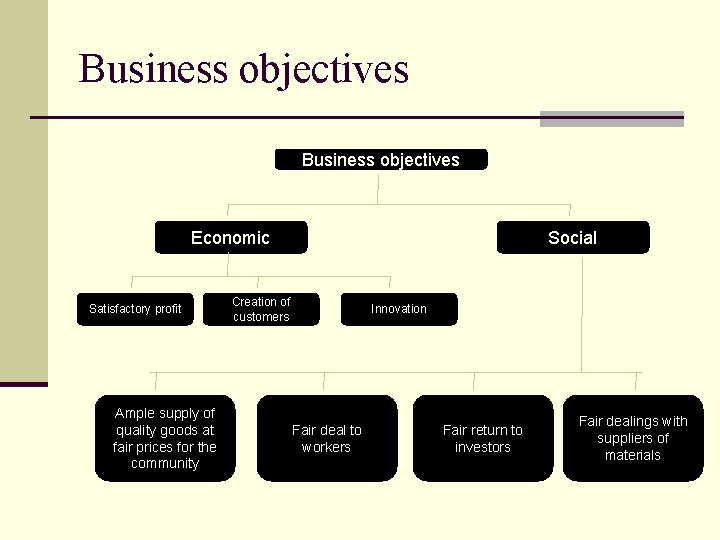
Business objectives Economic Satisfactory profit Ample supply of quality goods at fair prices for the community Social Creation of customers Innovation Fair deal to workers Fair return to investors Fair dealings with suppliers of materials
Entrepreneurship n A phenomenon in which a person searches for an opportunity and try to avail it. n The process of organizing, managing and assuming the risks of a business. n Entrepreneurship is the capacity for innovation, investment and expansion in new markets, products and techniques. n The act of starting a business.
Entrepreneur n As the individual who bears the risk of operating a business in the face of uncertainty about future conditions and who is rewarded accordingly by his profit or losses. n A person who takes the risks necessary to organize and manage a business and receives the financial profits and nonmonetary rewards.
Components of business n Industry n Commerce
Industry n Conversion of raw material into finished goods. n This is a form utility.
Types of Industry n Primary Industry n Extractive Industry _ Extraction of underground resources. n Genetics _ People doing business by changing genes. Example: human skill and knowledge related
Types of industries n Secondary Industry n Construction _ Construction of buildings, roads, bridges etc. n Manufacturing _ Conversion of raw material into final goods. n Services _ Banking, consultancy, accountant, Lawyer, Interior decorator, designer, music composer etc.
Commerce n All those activities which start from the warehouse of the manufacturer to the buyer. There are some hindrances/ obstacles which created business opportunity – -Hindrances of persons -Hindrances of exchange - Hindrances of place - Hindrances of time - Hindrances of information
Types of commerce n Trade means buying and selling Types of trade: 1. Internal trade 2. Foreign or international trade 3. Wholesale trade 4. Retail trade n n Aid to trade n Institutions that are meant and build to assist and support the trading process.
Factors of production n Labor _ People working in an organization. n Capital _ Amount invested by investor in the business. n Entrepreneurship _ Management ability of the people who are running the business. n Physical Resources _ Land, labor, building, vehicles, machinery etc.
SWOT Analysis n Strengths n Weaknesses n Opportunities n Threats
- Slides: 14