
MSQH Hospital Accreditation Standards 5 th Edition Standards







- Slides: 99
MSQH Hospital Accreditation Standards 5 th Edition- Standards 2 & 3 Ir. Al-Khairi Mohd Daud Ir. Gnana Sakaran. R MSQH Surveyor
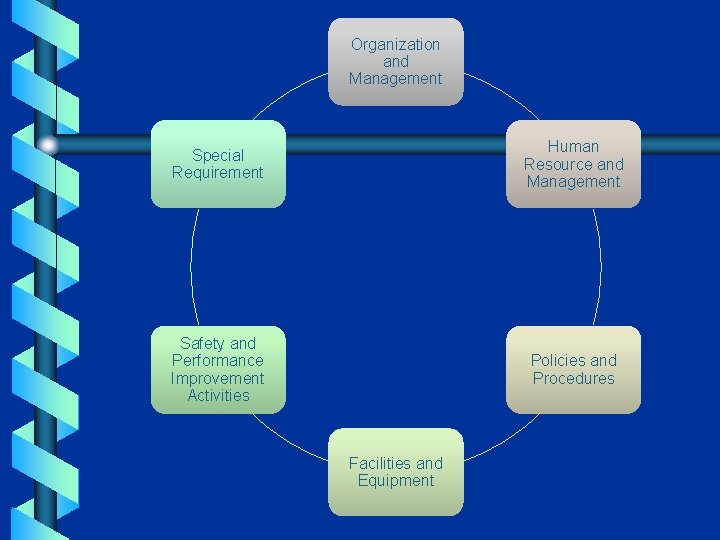
Organization and Management Special Requirement Human Resource and Management Safety and Performance Improvement Activities Policies and Procedures Facilities and Equipment
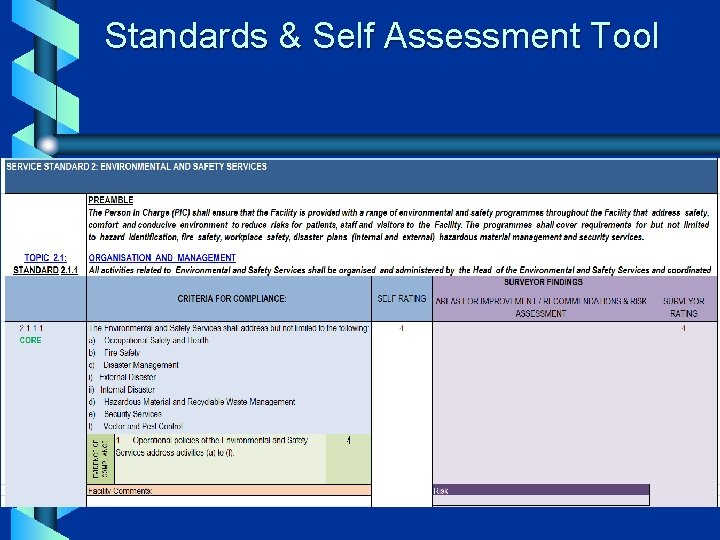
Standards & Self Assessment Tool
What is the Goal of MSQH accreditation? �Patient, Staff, Visitor, Vendor, Owner Safety �It is all about Risk Management �Making the risk as low as reasonably practical (ALARP)
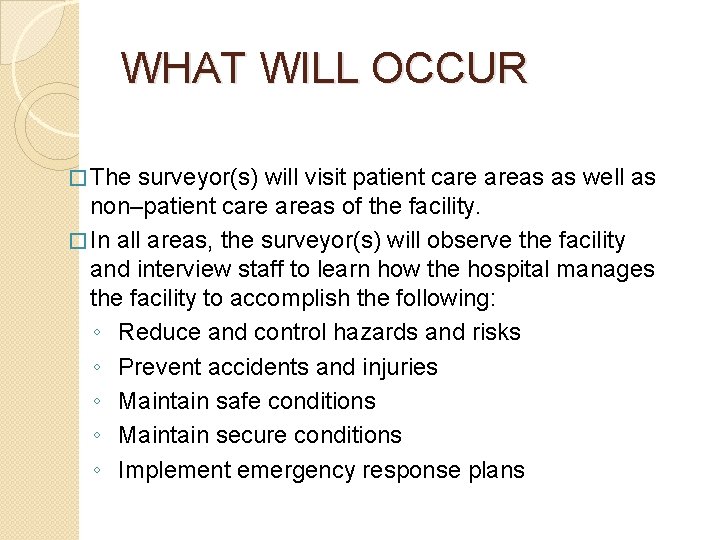
WHAT WILL OCCUR � The surveyor(s) will visit patient care areas as well as non–patient care areas of the facility. � In all areas, the surveyor(s) will observe the facility and interview staff to learn how the hospital manages the facility to accomplish the following: ◦ Reduce and control hazards and risks ◦ Prevent accidents and injuries ◦ Maintain safe conditions ◦ Maintain secure conditions ◦ Implement emergency response plans
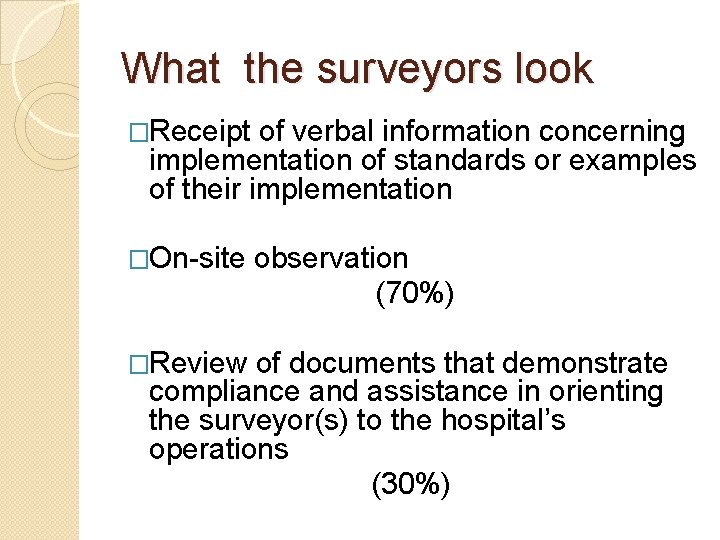
What the surveyors look �Receipt of verbal information concerning implementation of standards or examples of their implementation �On-site observation (70%) �Review of documents that demonstrate compliance and assistance in orienting the surveyor(s) to the hospital’s operations (30%)
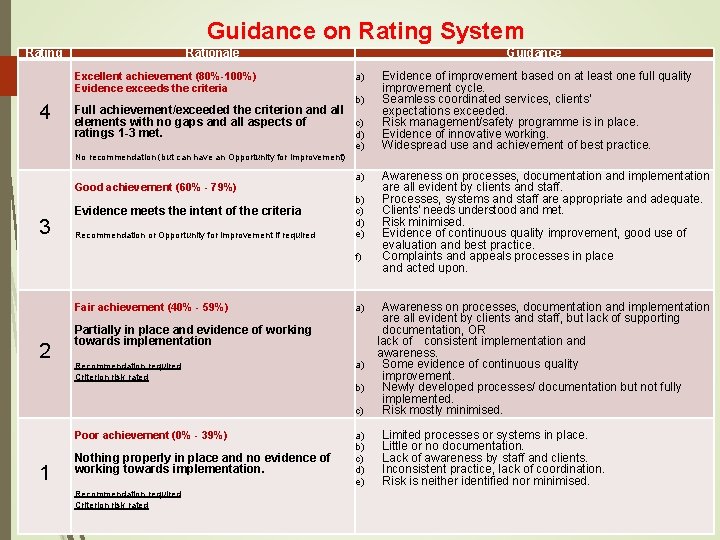
Guidance on Rating System Rating Rationale Excellent achievement (80%-100%) Evidence exceeds the criteria 4 Guidance a) b) Full achievement/exceeded the criterion and all elements with no gaps and all aspects of c) ratings 1 -3 met. d) e) Evidence of improvement based on at least one full quality improvement cycle. Seamless coordinated services, clients’ expectations exceeded. Risk management/safety programme is in place. Evidence of innovative working. Widespread use and achievement of best practice. No recommendation (but can have an Opportunity for Improvement) Good achievement (60% - 79%) 3 Evidence meets the intent of the criteria Recommendation or Opportunity for improvement if required a) b) c) d) e) f) Fair achievement (40% - 59%) 2 a) Partially in place and evidence of working towards implementation Recommendation required Criterion risk rated a) b) c) Poor achievement (0% - 39%) 1 Nothing properly in place and no evidence of working towards implementation. Recommendation required Criterion risk rated a) b) c) d) e) Awareness on processes, documentation and implementation are all evident by clients and staff. Processes, systems and staff are appropriate and adequate. Clients’ needs understood and met. Risk minimised. Evidence of continuous quality improvement, good use of evaluation and best practice. Complaints and appeals processes in place and acted upon. Awareness on processes, documentation and implementation are all evident by clients and staff, but lack of supporting documentation, OR lack of consistent implementation and awareness. Some evidence of continuous quality improvement. Newly developed processes/ documentation but not fully implemented. Risk mostly minimised. Limited processes or systems in place. Little or no documentation. Lack of awareness by staff and clients. Inconsistent practice, lack of coordination. Risk is neither identified nor minimised.
GAP ASSESSMENT
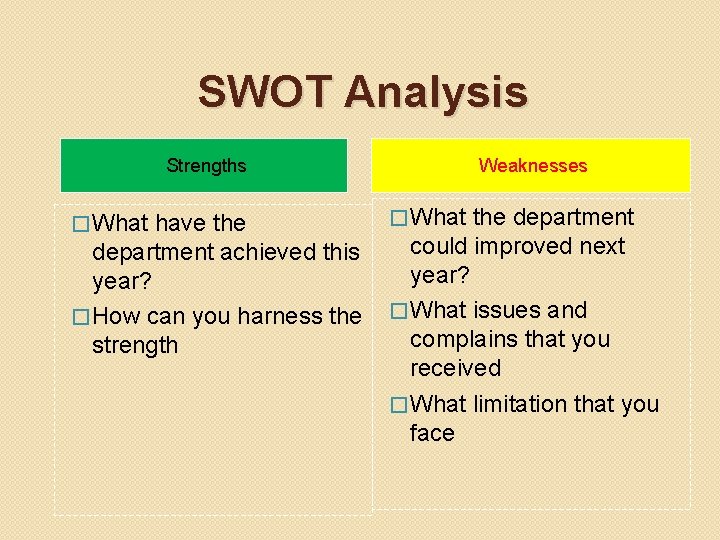
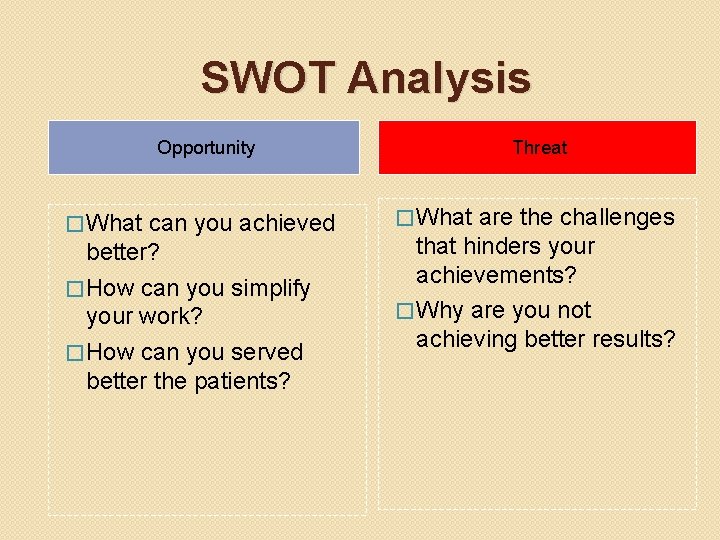
SWOT Analysis Strengths � What have the Weaknesses � What the department could improved next department achieved this year? � How can you harness the � What issues and complains that you strength received � What limitation that you face
SWOT Analysis Opportunity Threat � What can you achieved � What are the challenges better? � How can you simplify your work? � How can you served better the patients? that hinders your achievements? � Why are you not achieving better results?
Closing the Gaps �What policies, manuals, procedures, work instructions, checklist, guidelines that we need to established to ensure that the process is permanent
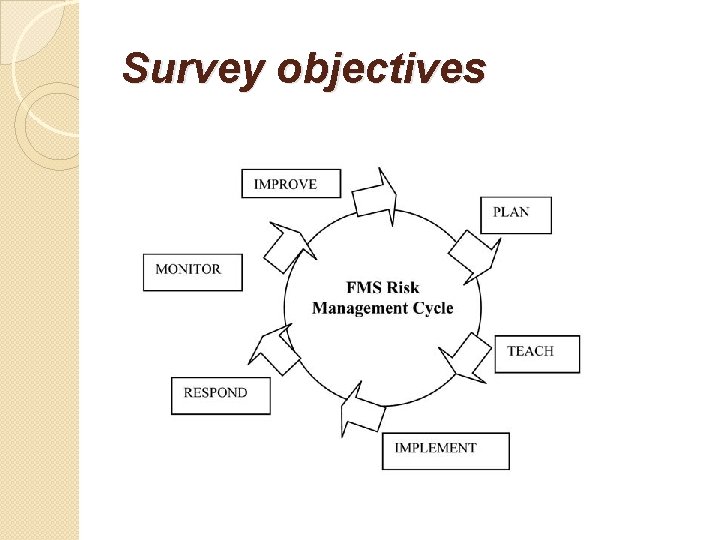
Survey objectives
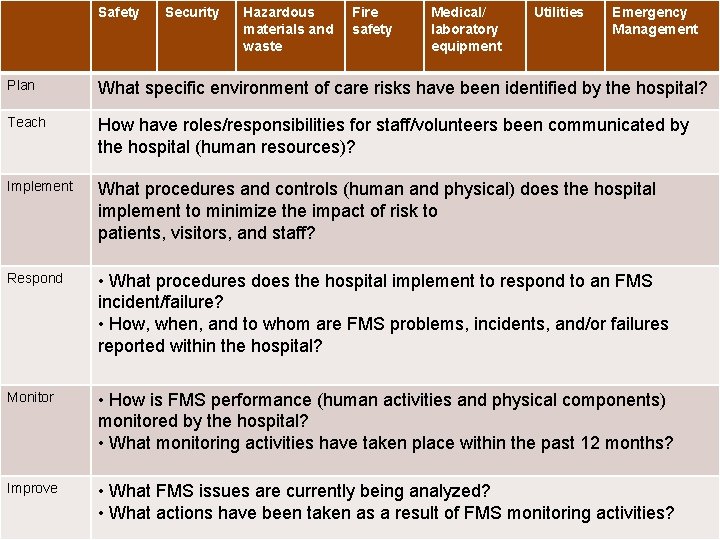
Safety Security Hazardous materials and waste Fire safety Medical/ laboratory equipment Utilities Emergency Management Plan What specific environment of care risks have been identified by the hospital? Teach How have roles/responsibilities for staff/volunteers been communicated by the hospital (human resources)? Implement What procedures and controls (human and physical) does the hospital implement to minimize the impact of risk to patients, visitors, and staff? Respond • What procedures does the hospital implement to respond to an FMS incident/failure? • How, when, and to whom are FMS problems, incidents, and/or failures reported within the hospital? Monitor • How is FMS performance (human activities and physical components) monitored by the hospital? • What monitoring activities have taken place within the past 12 months? Improve • What FMS issues are currently being analyzed? • What actions have been taken as a result of FMS monitoring activities?
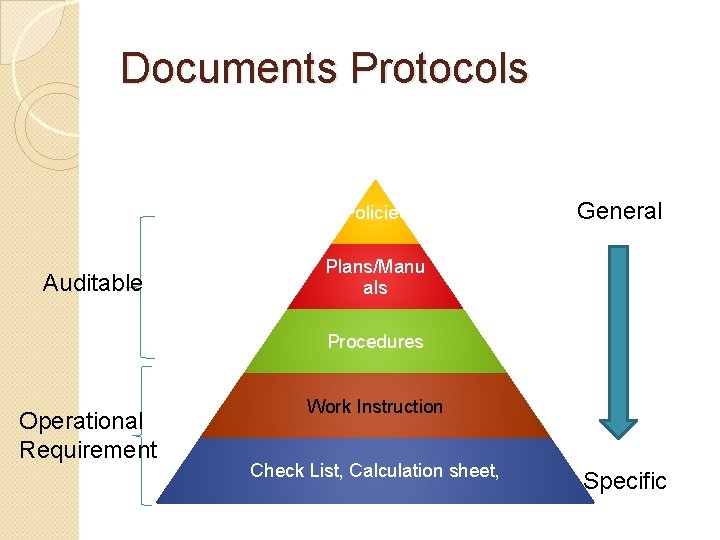
Documents Protocols Policies Auditable General Plans/Manu als Procedures Operational Requirement Work Instruction Check List, Calculation sheet, Specific
Department Policies �Check your policies �Does it describes the fundamentals of what you want to achieve?
Basic Requirements �Plan – The document �Teach – The training and awareness �Implement – Actual practice �Check – Regular audit and inspection �Review – Set performance indicators �Improve – Regular updates of the practice
Things to remember �Plans must be practice �Drills and trainings must be regularly trained. �Performance must be recorded with statistics �Learning lessons and improvement need to be institutionalized and disseminated to relevant parties. �Review must involve all parties
General Requirement in the plans Rules and Regulations 1. Occupational Safety & Health Act 1994 & its regulations �Use and Standard of Exposure of Chemical Hazardous to Health Regulation 2000 (USECHH Regulation) �Classification, Packaging And Labeling Hazardous Chemicals 1997 Regulations (CPL) 2. Factories & Machineries Act 1967 3. Environmental Quality Act 1974 & its regulations 4. Private Healthcare Facility and Services Act 2006. & its regulation �Private Healthcare Facilities and Services (Private hospitals and other private healthcare facilities) Regulation 2006 �Private Healthcare Facilities and Services (Official identification card) Order 2006
General Requirement in the plans 5. Atomic Energy Licensing Act 1984 (Act 304) �Radiation Protection (Licensing) Regulation 1986 �Radiation Protection (Basic Safety Standards) Regulation 1986 �Radiation Protection (Transportation) Regulation 1989 6. Medical Device Acts 7. Uniform Building By laws 8. Fire Service Act 9. Electricity Supply Act �Efficient Management of Electrical Energy Regulations �Gas Supply Act
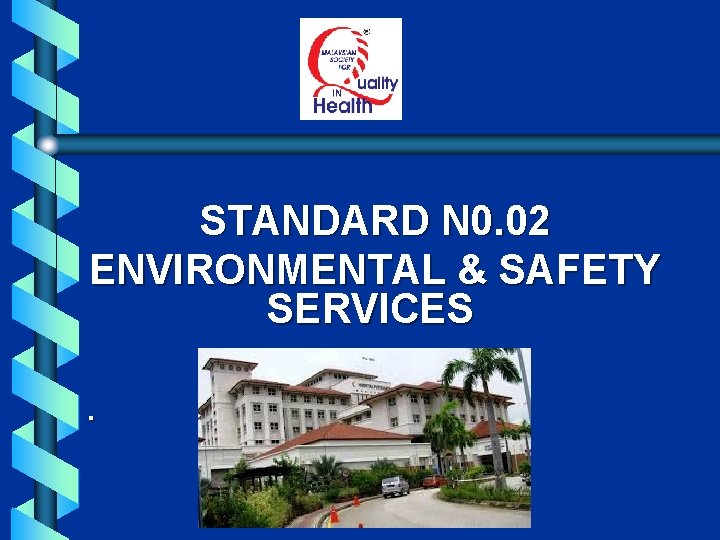
STANDARD N 0. 02 ENVIRONMENTAL & SAFETY SERVICES .
Preamble b b The Person In Charge (PIC) shall ensure that the Facility is provided with a range of environmental and safety programmes throughout the Facility that address safety, comfort and conducive environment to reduce risks for patients, staff and visitors to the Facility. The programmes shall cover requirements for but not limited to hazard identification, fire safety, workplace safety, disaster plans (internal and external) hazardous material management and security services.
Organization and Management The Environmental and Safety Services shall address but not limited to the following: a) Occupational Safety and Health b) Fire Safety c) Disaster Management i) External Disaster ii) Internal Disaster d)Hazardous Material and Recyclable Waste Management e) Security Services f) Vector and Pest Control
Organization and Management The PIC shall designate various Committees to monitor, execute and manage various aspects of the Environment and Safety Services. The number of Committees shall be based on the complexity of the Facility. Each of the Committee shall have an appointed Chairperson as well as adequate number of appropriately qualified Committee members. Each Committee shall have clearly defined Terms of Reference, scope of activities, and tenure of membership. EVIDENCE OF COMPLIANCE 1. The Committees have: a) Appointment of a Chairperson b) Terms of Reference c) Committee members d) Tenure of membership e) Frequency of meetings f) Minutes of meetings
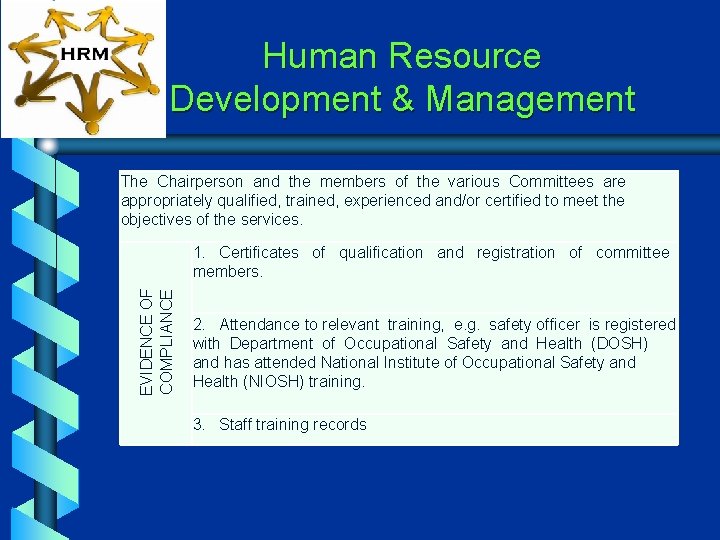
Human Resource Development & Management The Chairperson and the members of the various Committees are appropriately qualified, trained, experienced and/or certified to meet the objectives of the services. EVIDENCE OF COMPLIANCE 1. Certificates of qualification and registration of committee members. 2. Attendance to relevant training, e. g. safety officer is registered with Department of Occupational Safety and Health (DOSH) and has attended National Institute of Occupational Safety and Health (NIOSH) training. 3. Staff training records
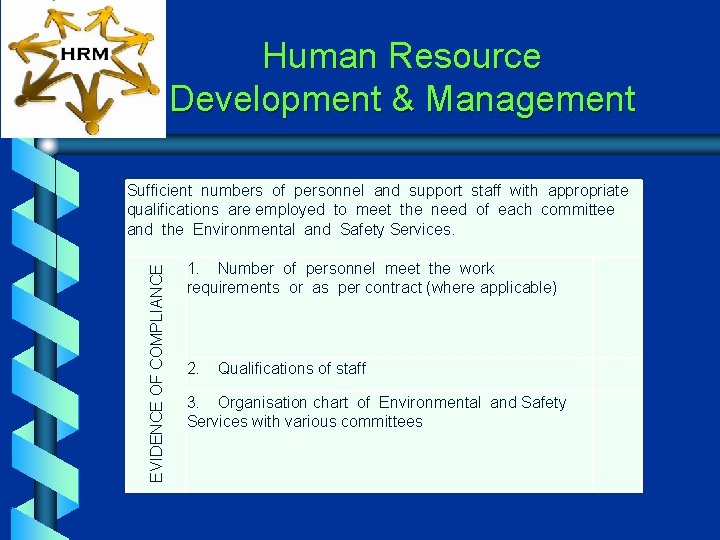
Human Resource Development & Management EVIDENCE OF COMPLIANCE Sufficient numbers of personnel and support staff with appropriate qualifications are employed to meet the need of each committee and the Environmental and Safety Services. 1. Number of personnel meet the work requirements or as per contract (where applicable) 2. Qualifications of staff 3. Organisation chart of Environmental and Safety Services with various committees
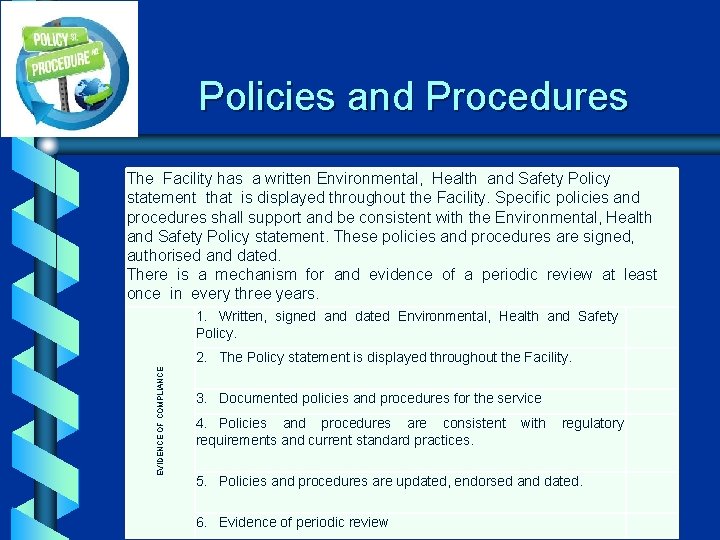
Policies and Procedures The Facility has a written Environmental, Health and Safety Policy statement that is displayed throughout the Facility. Specific policies and procedures shall support and be consistent with the Environmental, Health and Safety Policy statement. These policies and procedures are signed, authorised and dated. There is a mechanism for and evidence of a periodic review at least once in every three years. 1. Written, signed and dated Environmental, Health and Safety Policy. EVIDENCE OF COMPLIANCE 2. The Policy statement is displayed throughout the Facility. 3. Documented policies and procedures for the service 4. Policies and procedures are consistent with regulatory requirements and current standard practices. 5. Policies and procedures are updated, endorsed and dated. 6. Evidence of periodic review
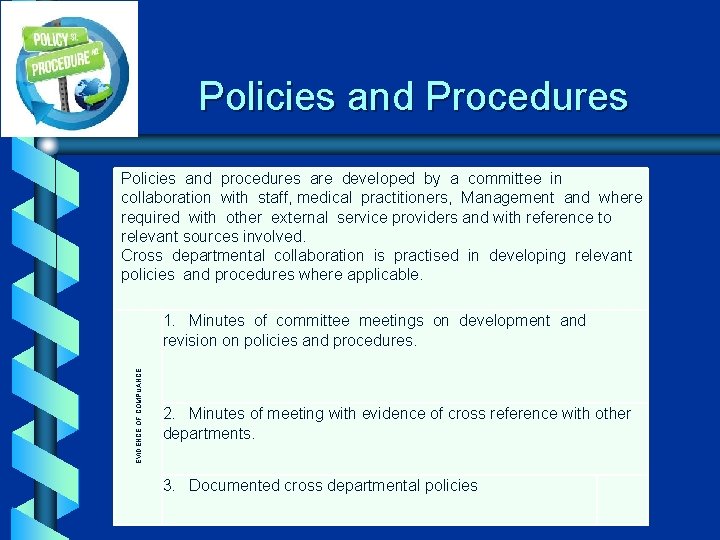
Policies and Procedures Policies and procedures are developed by a committee in collaboration with staff, medical practitioners, Management and where required with other external service providers and with reference to relevant sources involved. Cross departmental collaboration is practised in developing relevant policies and procedures where applicable. EVIDENCE OF COMPLIANCE 1. Minutes of committee meetings on development and revision on policies and procedures. 2. Minutes of meeting with evidence of cross reference with other departments. 3. Documented cross departmental policies
Policies and Procedures There is evidence of compliance with policies and procedures. EVIDENCE OF COMPLIANCE 1. Compliance with policies and procedures through: a) interview of staff on practices; b) verify with observation on practices; c) results of audit on practices; d) practices in line with established policies and procedures.
Facilities and Equipment -
Facilities and Equipment 1. Testing, commissioning and calibration records (certificates or stickers) EVIDENCE OF COMPLIANCE There is documented evidence that equipment complies with relevant national/international standards and current statutory requirements. 2. Certificates of calibration, e. g. Standards and Industrial Research Institute of Malaysia (SIRIM), etc. 3. Certification of equipment - Certificate of fitness (Department of Occupational Safety and Health certification, Fire Authority)
Facilities and Equipment Where specialised equipment is used, there is evidence that only staff who are trained and authorised by the Facility operate such equipment. 1. List of personnel authorised by the Person In Charge (PIC) to operate specialised equipment. EVIDENCE OF COMPLIANCE 2. Letter of authorisation 3. Training records 4. Staff profile of authorised personnel 5. Competency assessment records 6. Certificate/registration of competent person as required.
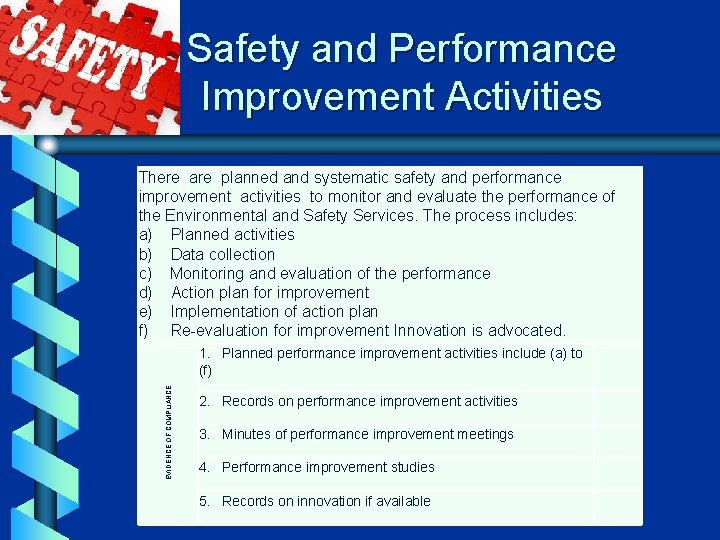
Safety and Performance Improvement Activities There are planned and systematic safety and performance improvement activities to monitor and evaluate the performance of the Environmental and Safety Services. The process includes: a) Planned activities b) Data collection c) Monitoring and evaluation of the performance d) Action plan for improvement e) Implementation of action plan f) Re-evaluation for improvement Innovation is advocated. EVIDENCE OF COMPLIANCE 1. Planned performance improvement activities include (a) to (f) 2. Records on performance improvement activities 3. Minutes of performance improvement meetings 4. Performance improvement studies 5. Records on innovation if available
Safety and Performance Improvement Activities The Head of Environmental and Safety Services shall ensure that the staff are trained and complete incident reports involving patients, staff, visitors and outsourced service providers which are promptly reported, investigated, discussed by the staff with learning objectives and forwarded to the Person In Charge (PIC) of the Facility. Incidents reported have had Root Cause Analysis done and action taken within the agreed time frame to prevent recurrence. 1. System for incident reporting is in place, which include: a) Training of staff b) Policy on incident reporting EVIDENCE OF COMPLIANCE c) Methodology of incident reporting d) Register/records of incidents 2. Completed incident reports 3. Root Cause Analysis 4. Corrective and preventive action plans 5. Remedial measure 6. Minutes of meetings 7. Acknowledgment by Head of Service and PIC/Hospital Director 8. Feedback given to staff regarding incident reporting.
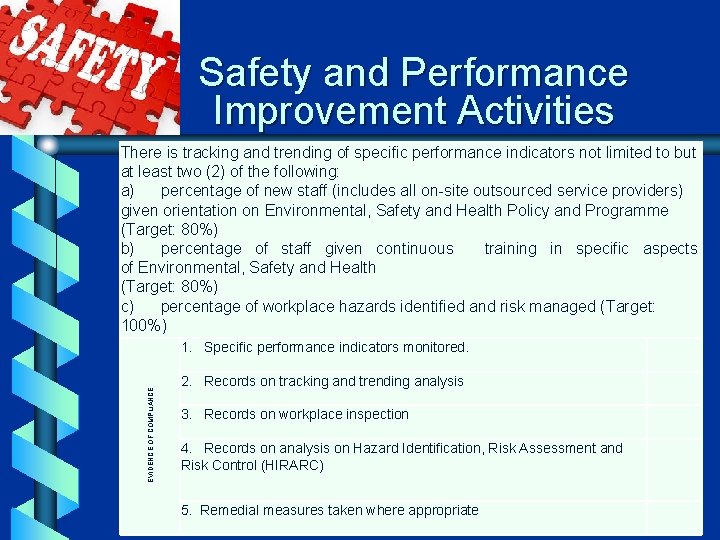
Safety and Performance Improvement Activities There is tracking and trending of specific performance indicators not limited to but at least two (2) of the following: a) percentage of new staff (includes all on-site outsourced service providers) given orientation on Environmental, Safety and Health Policy and Programme (Target: 80%) b) percentage of staff given continuous training in specific aspects of Environmental, Safety and Health (Target: 80%) c) percentage of workplace hazards identified and risk managed (Target: 100%) EVIDENCE OF COMPLIANCE 1. Specific performance indicators monitored. 2. Records on tracking and trending analysis 3. Records on workplace inspection 4. Records on analysis on Hazard Identification, Risk Assessment and Risk Control (HIRARC) 5. Remedial measures taken where appropriate
Safety and Performance Improvement Activities There are safety and performance improvement activities that address staff safety of the outsourced service providers. 1. Staff health screening EVIDENCE OF COMPLIANCE 2. Identification of health risk factors 3. Infectious diseases prevention programme/activities 4. Anti-smoking programme 5. Healthy life style campaign a) sharps and needle stick injury management; b) Occupational Safety and Health; c) ergonomics; d) biohazard waste disposal. 7. Medical check-up record. 8. Post exposure management 9. Universal/standard precautions
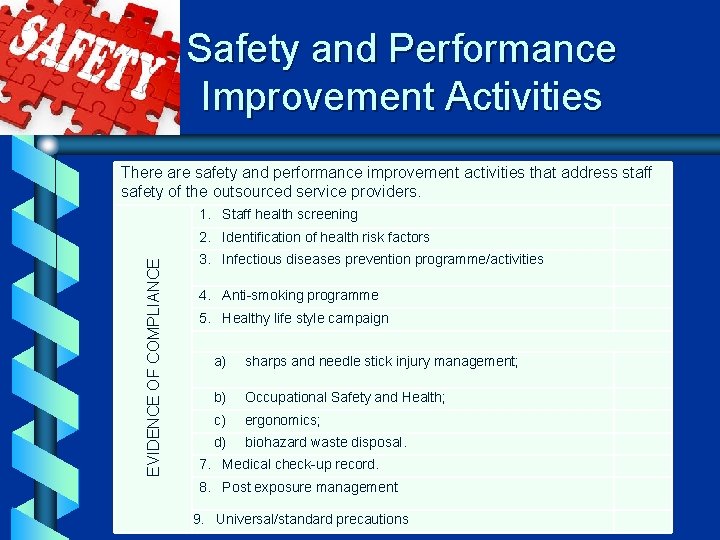
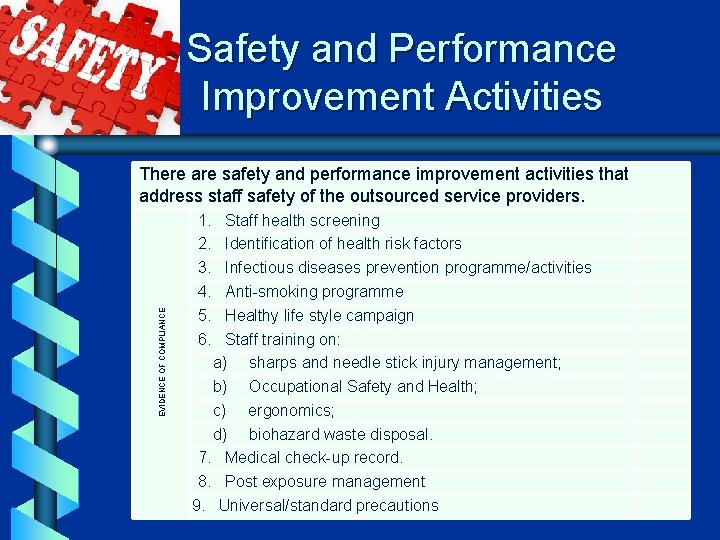
Safety and Performance Improvement Activities EVIDENCE OF COMPLIANCE There are safety and performance improvement activities that address staff safety of the outsourced service providers. 1. Staff health screening 2. Identification of health risk factors 3. Infectious diseases prevention programme/activities 4. Anti-smoking programme 5. Healthy life style campaign 6. Staff training on: a) sharps and needle stick injury management; b) Occupational Safety and Health; c) ergonomics; d) biohazard waste disposal. 7. Medical check-up record. 8. Post exposure management 9. Universal/standard precautions
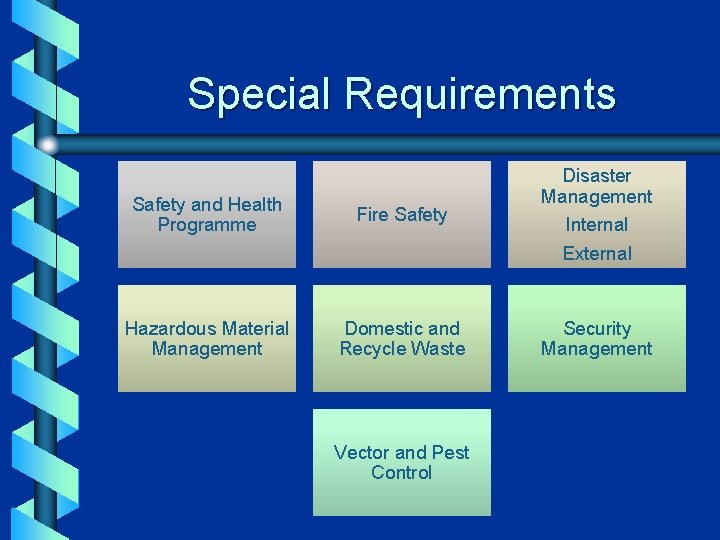
Special Requirements Safety and Health Programme Fire Safety Hazardous Material Management Domestic and Recycle Waste Vector and Pest Control Disaster Management Internal External Security Management
Fire Safety EVIDENCE OF COMPLIANCE The building shall be equipped with active and passive protection system such as fire detection and suppression system, in compliance with statutory regulations, standards and professional best practices relating to fire safety. For buildings built after 1990, the fire detection systems shall be integrated and linked to the nearest fire station designated by the Fire Authority. Note: Refer to Fire Services Act 1988 1. Building drawing approved by Fire Authority for buildings built after 1990. 2. Continuous Monitoring Information System (CMIS) is functional and linked to the fire station where applicable.
Fire Safety EVIDENCE OF COMPLIANCE For all new buildings, renovation works and alterations to systems, there has to be documented evidence that the Fire Authority has approved the layout plan for fire safety. The drawings and design calculations shall be endorsed by Professional Engineer and/or Registered Architect. 1. Approved as built drawings by relevant professionals.
Fire Safety There is documented evidence that all buildings have been inspected by the Fire Authority annually and all risk issues identified during the inspections have been rectified to the satisfaction of the Fire Authority concerned. Note: Refer to Fire Service Act 1988 EVIDENCE OF COMPLIANCE 1. Annual fire inspection report by Fire Authority 2. Current Fire Safety Certificate is available for buildings built after 1990. 3. Facility’s report on rectification of recommendations by Fire Authority where required.
Fire Safety EVIDENCE OF COMPLIANCE Fire fighting equipment/system, such as fire extinguishers, hydrants, hose reels, fire blankets and fire suppression system are located at appropriate locations as per Fire Authority’s requirements. The systems are in proper functioning condition, and are being maintained and tested regularly, at least once every three (3) months or as required. 1. Fire extinguishers have valid inspection certificates. 2. Testing of fire extinguishers 3. Maintenance records
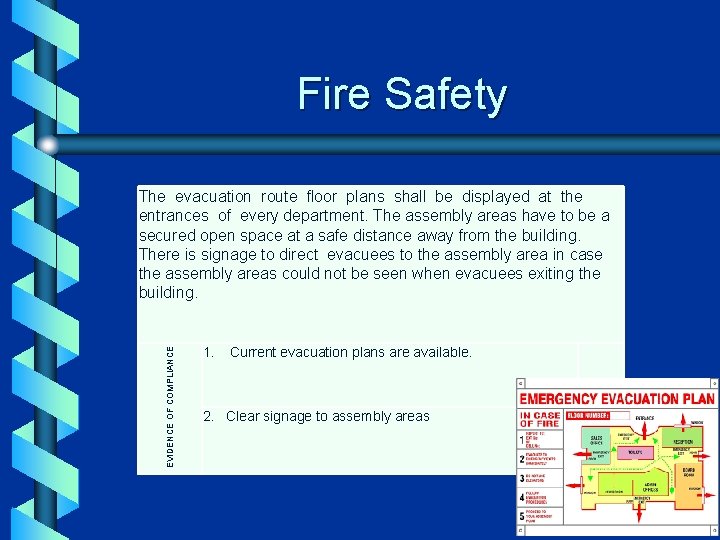
Fire Safety EVIDENCE OF COMPLIANCE The evacuation route floor plans shall be displayed at the entrances of every department. The assembly areas have to be a secured open space at a safe distance away from the building. There is signage to direct evacuees to the assembly area in case the assembly areas could not be seen when evacuees exiting the building. 1. Current evacuation plans are available. 2. Clear signage to assembly areas
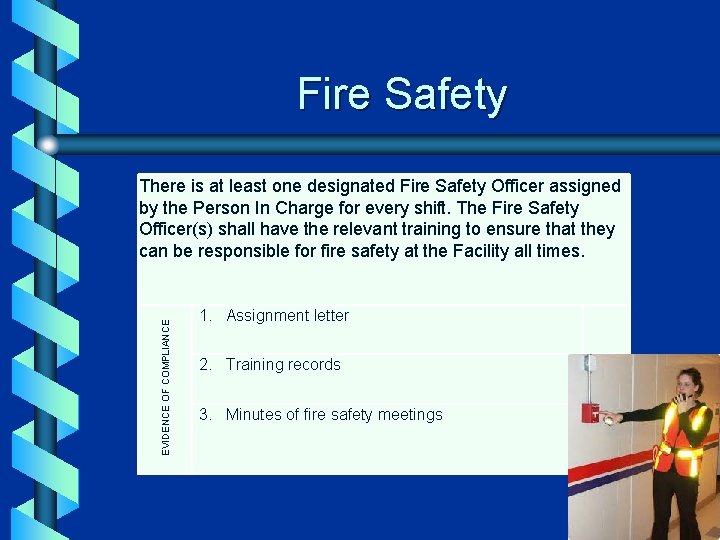
Fire Safety EVIDENCE OF COMPLIANCE There is at least one designated Fire Safety Officer assigned by the Person In Charge for every shift. The Fire Safety Officer(s) shall have the relevant training to ensure that they can be responsible for fire safety at the Facility all times. 1. Assignment letter 2. Training records 3. Minutes of fire safety meetings
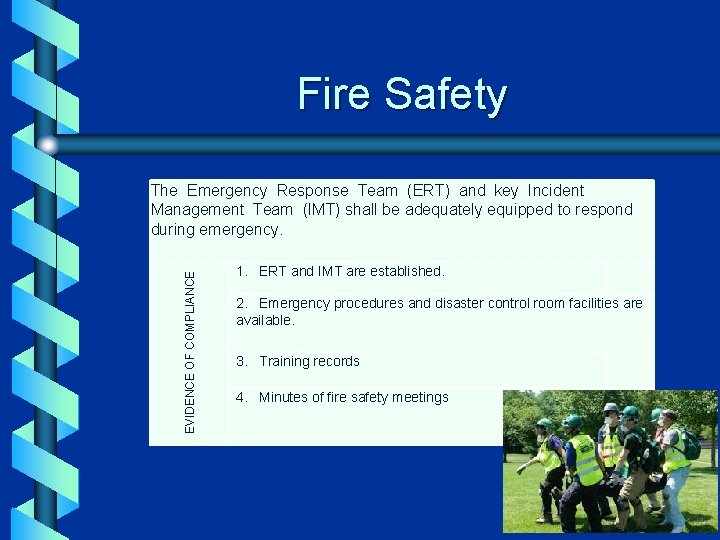
Fire Safety EVIDENCE OF COMPLIANCE The Emergency Response Team (ERT) and key Incident Management Team (IMT) shall be adequately equipped to respond during emergency. 1. ERT and IMT are established. 2. Emergency procedures and disaster control room facilities are available. 3. Training records 4. Minutes of fire safety meetings
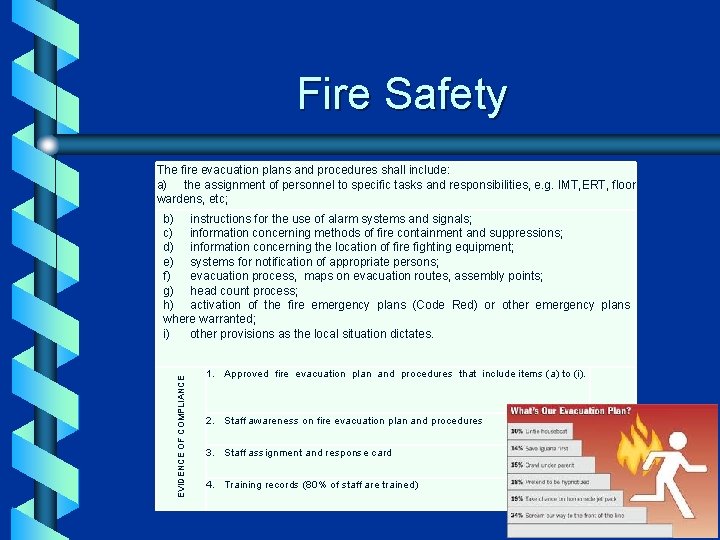
Fire Safety The fire evacuation plans and procedures shall include: a) the assignment of personnel to specific tasks and responsibilities, e. g. IMT, ERT, floor wardens, etc; EVIDENCE OF COMPLIANCE b) instructions for the use of alarm systems and signals; c) information concerning methods of fire containment and suppressions; d) information concerning the location of fire fighting equipment; e) systems for notification of appropriate persons; f) evacuation process, maps on evacuation routes, assembly points; g) head count process; h) activation of the fire emergency plans (Code Red) or other emergency plans where warranted; i) other provisions as the local situation dictates. 1. Approved fire evacuation plan and procedures that include items (a) to (i). 2. Staff awareness on fire evacuation plan and procedures 3. Staff assignment and response card 4. Training records (80% of staff are trained)
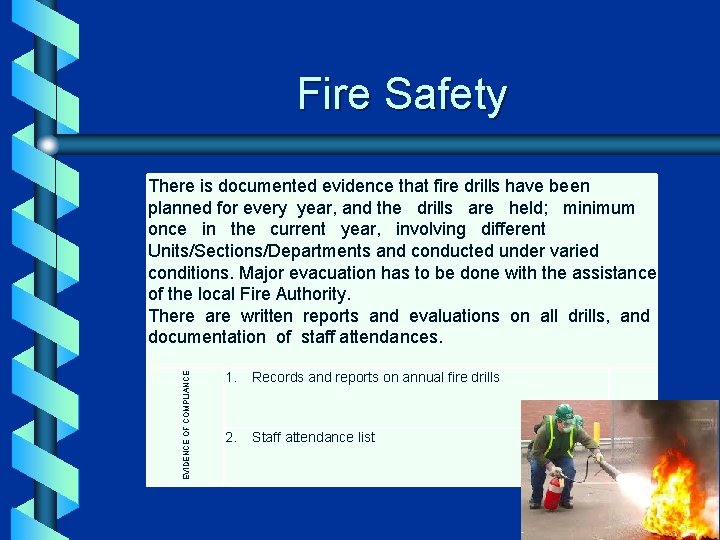
Fire Safety EVIDENCE OF COMPLIANCE There is documented evidence that fire drills have been planned for every year, and the drills are held; minimum once in the current year, involving different Units/Sections/Departments and conducted under varied conditions. Major evacuation has to be done with the assistance of the local Fire Authority. There are written reports and evaluations on all drills, and documentation of staff attendances. 1. Records and reports on annual fire drills 2. Staff attendance list
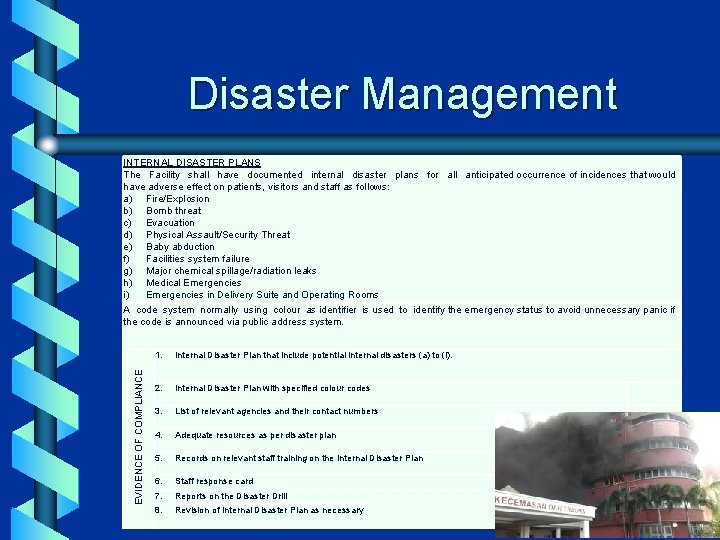
Disaster Management INTERNAL DISASTER PLANS The Facility shall have documented internal disaster plans for all anticipated occurrence of incidences that would have adverse effect on patients, visitors and staff as follows: a) Fire/Explosion b) Bomb threat c) Evacuation d) Physical Assault/Security Threat e) Baby abduction f) Facilities system failure g) Major chemical spillage/radiation leaks h) Medical Emergencies i) Emergencies in Delivery Suite and Operating Rooms A code system normally using colour as identifier is used to identify the emergency status to avoid unnecessary panic if the code is announced via public address system. EVIDENCE OF COMPLIANCE 1. Internal Disaster Plan that include potential internal disasters (a) to (i). 2. Internal Disaster Plan with specified colour codes 3. List of relevant agencies and their contact numbers 4. Adequate resources as per disaster plan 5. Records on relevant staff training on the Internal Disaster Plan 6. Staff response card 7. Reports on the Disaster Drill 8. Revision of Internal Disaster Plan as necessary
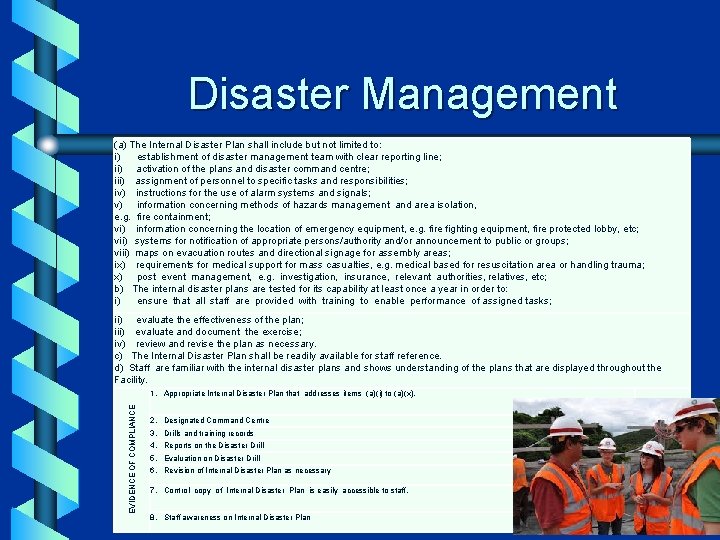
Disaster Management (a) The Internal Disaster Plan shall include but not limited to: i) establishment of disaster management team with clear reporting line; ii) activation of the plans and disaster command centre; iii) assignment of personnel to specific tasks and responsibilities; iv) instructions for the use of alarm systems and signals; v) information concerning methods of hazards management and area isolation, e. g. fire containment; vi) information concerning the location of emergency equipment, e. g. fire fighting equipment, fire protected lobby, etc; vii) systems for notification of appropriate persons/authority and/or announcement to public or groups; viii) maps on evacuation routes and directional signage for assembly areas; ix) requirements for medical support for mass casualties, e. g. medical based for resuscitation area or handling trauma; x) post event management, e. g. investigation, insurance, relevant authorities, relatives, etc; b) The internal disaster plans are tested for its capability at least once a year in order to: i) ensure that all staff are provided with training to enable performance of assigned tasks; ii) evaluate the effectiveness of the plan; iii) evaluate and document the exercise; iv) review and revise the plan as necessary. c) The Internal Disaster Plan shall be readily available for staff reference. d) Staff are familiar with the internal disaster plans and shows understanding of the plans that are displayed throughout the Facility. EVIDENCE OF COMPLIANCE 1. Appropriate Internal Disaster Plan that addresses items (a)(i) to (a)(x). 2. Designated Command Centre 3. Drills and training records 4. Reports on the Disaster Drill 5. Evaluation on Disaster Drill 6. Revision of Internal Disaster Plan as necessary 7. Control copy of Internal Disaster Plan is easily accessible to staff. 8. Staff awareness on Internal Disaster Plan
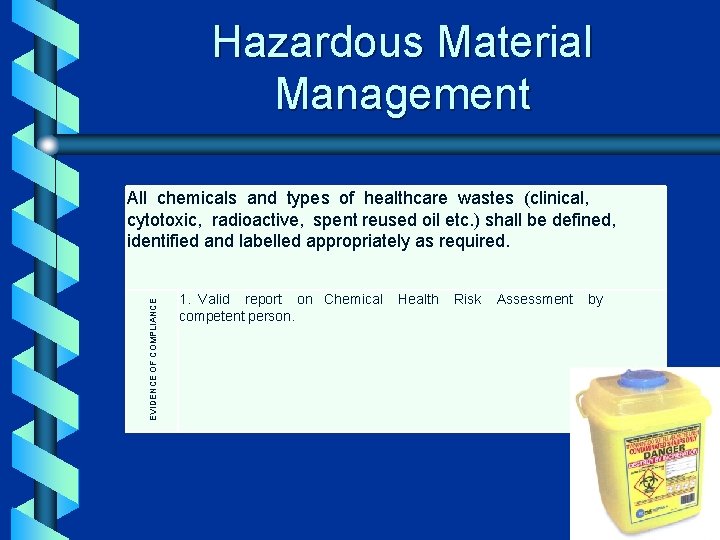
Hazardous Material Management EVIDENCE OF COMPLIANCE All chemicals and types of healthcare wastes (clinical, cytotoxic, radioactive, spent reused oil etc. ) shall be defined, identified and labelled appropriately as required. 1. Valid report on Chemical Health Risk Assessment by competent person.
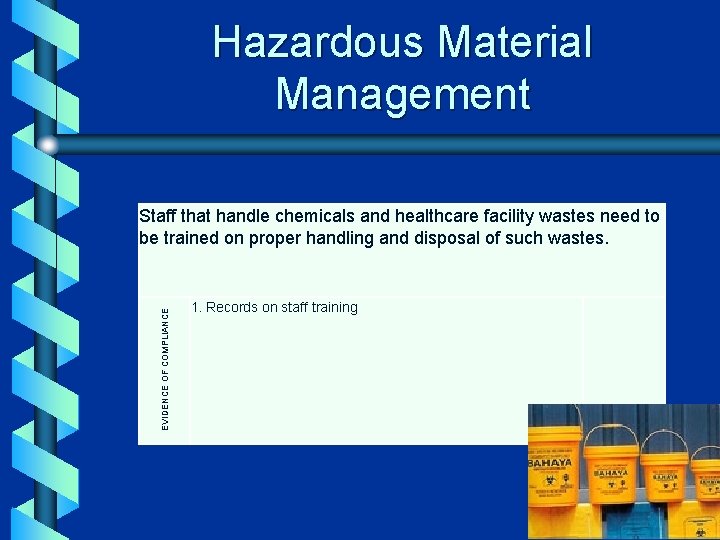
Hazardous Material Management EVIDENCE OF COMPLIANCE Staff that handle chemicals and healthcare facility wastes need to be trained on proper handling and disposal of such wastes. 1. Records on staff training
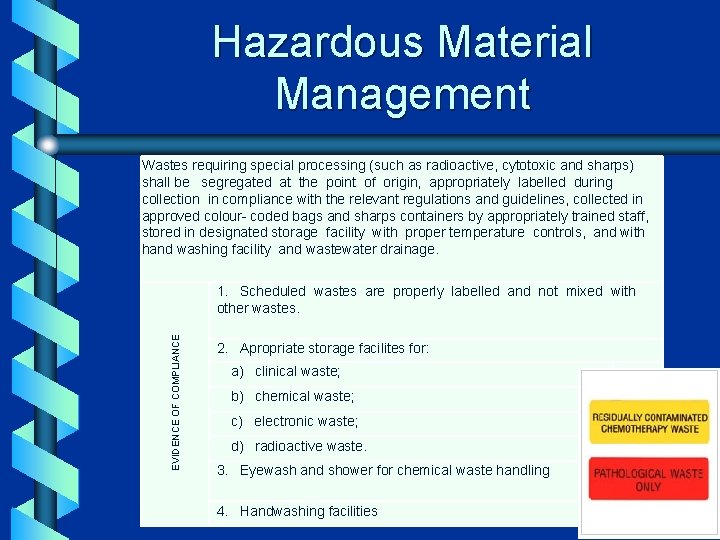
Hazardous Material Management Wastes requiring special processing (such as radioactive, cytotoxic and sharps) shall be segregated at the point of origin, appropriately labelled during collection in compliance with the relevant regulations and guidelines, collected in approved colour- coded bags and sharps containers by appropriately trained staff, stored in designated storage facility with proper temperature controls, and with hand washing facility and wastewater drainage. EVIDENCE OF COMPLIANCE 1. Scheduled wastes are properly labelled and not mixed with other wastes. 2. Apropriate storage facilites for: a) clinical waste; b) chemical waste; c) electronic waste; d) radioactive waste. 3. Eyewash and shower for chemical waste handling 4. Handwashing facilities
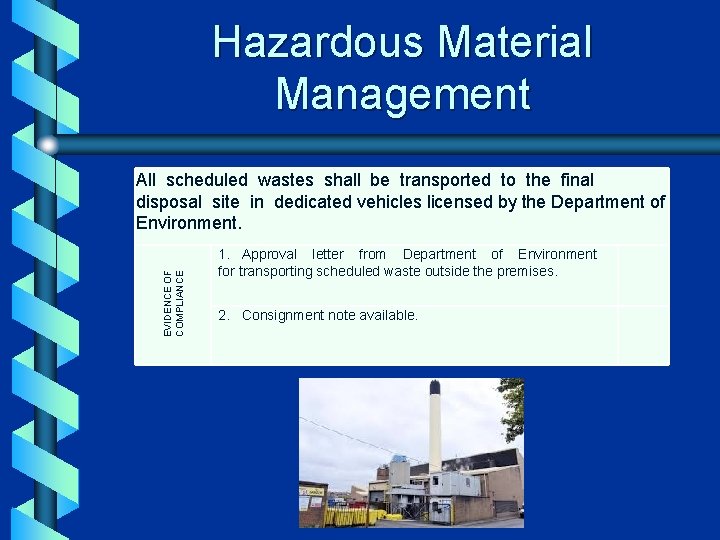
Hazardous Material Management EVIDENCE OF COMPLIANCE All scheduled wastes shall be transported to the final disposal site in dedicated vehicles licensed by the Department of Environment. 1. Approval letter from Department of Environment for transporting scheduled waste outside the premises. 2. Consignment note available.
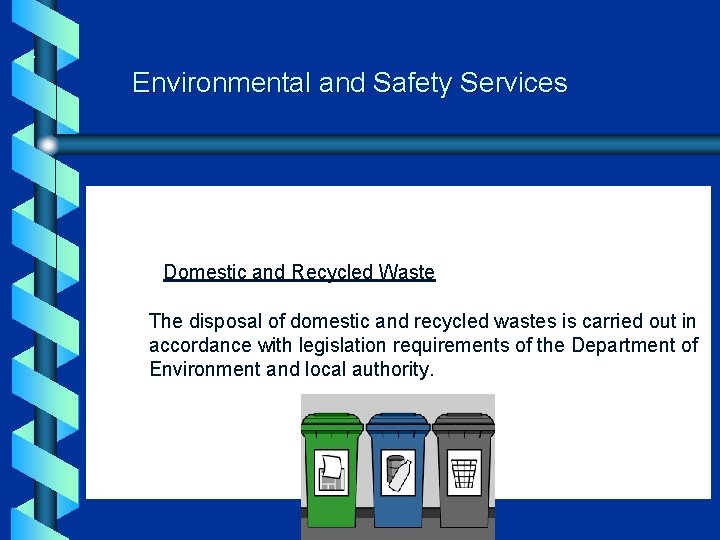
. Environmental and Safety Services Domestic and Recycled Waste The disposal of domestic and recycled wastes is carried out in accordance with legislation requirements of the Department of Environment and local authority.
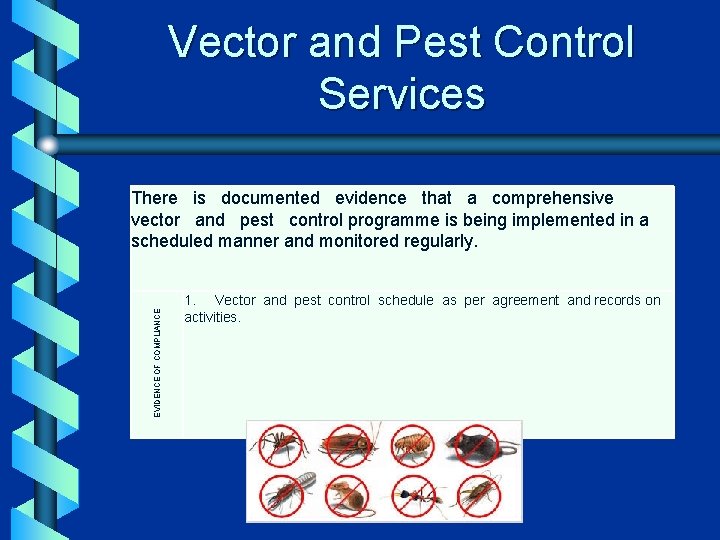
Vector and Pest Control Services EVIDENCE OF COMPLIANCE There is documented evidence that a comprehensive vector and pest control programme is being implemented in a scheduled manner and monitored regularly. 1. Vector and pest control schedule as per agreement and records on activities.
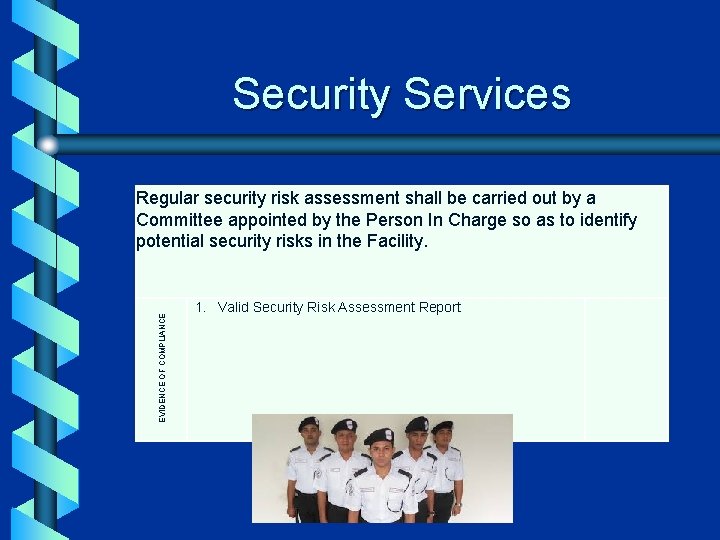
Security Services EVIDENCE OF COMPLIANCE Regular security risk assessment shall be carried out by a Committee appointed by the Person In Charge so as to identify potential security risks in the Facility. 1. Valid Security Risk Assessment Report
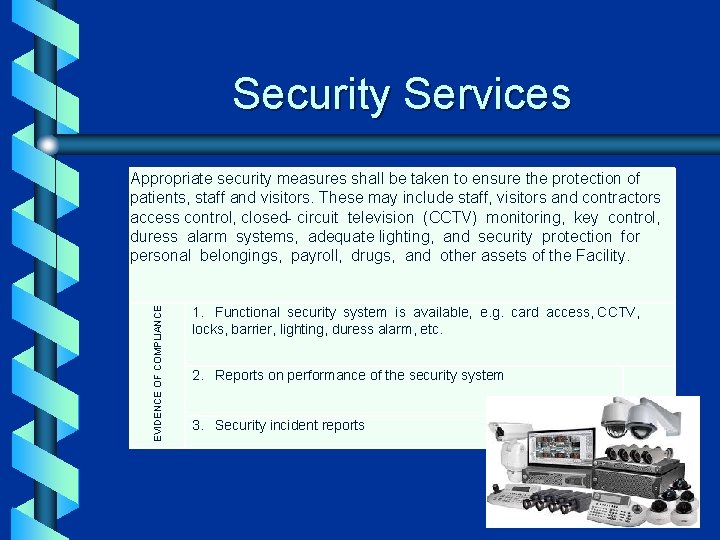
Security Services EVIDENCE OF COMPLIANCE Appropriate security measures shall be taken to ensure the protection of patients, staff and visitors. These may include staff, visitors and contractors access control, closed- circuit television (CCTV) monitoring, key control, duress alarm systems, adequate lighting, and security protection for personal belongings, payroll, drugs, and other assets of the Facility. 1. Functional security system is available, e. g. card access, CCTV, locks, barrier, lighting, duress alarm, etc. 2. Reports on performance of the security system 3. Security incident reports
STANDARD N 0. 03 FACILITY & BIOMEDICAL ENGINEERING SERVICES .
Preamble b b The Person In Charge (PIC) shall ensure that the Healthcare Facility is provided with safe, functional and support facilities and equipment for its patients, families, staff and visitors. The facilities, equipment and maintenance staff shall be effectively managed to reduce and control hazards and risks, and prevent accidents and injuries. These services may be provided from within the Facility by either its own staff or contract staff, or contracted to qualified external contractors.
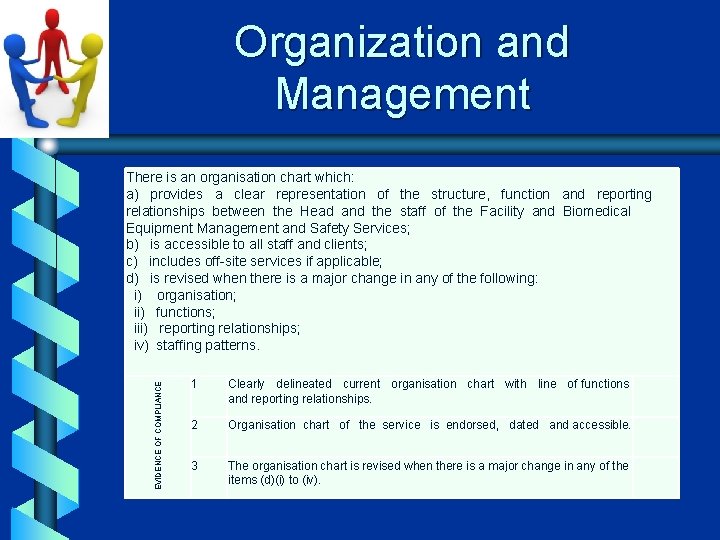
Organization and Management EVIDENCE OF COMPLIANCE There is an organisation chart which: a) provides a clear representation of the structure, function and reporting relationships between the Head and the staff of the Facility and Biomedical Equipment Management and Safety Services; b) is accessible to all staff and clients; c) includes off-site services if applicable; d) is revised when there is a major change in any of the following: i) organisation; ii) functions; iii) reporting relationships; iv) staffing patterns. 1 Clearly delineated current organisation chart with line of functions and reporting relationships. 2 Organisation chart of the service is endorsed, dated and accessible. 3 The organisation chart is revised when there is a major change in any of the items (d)(i) to (iv).
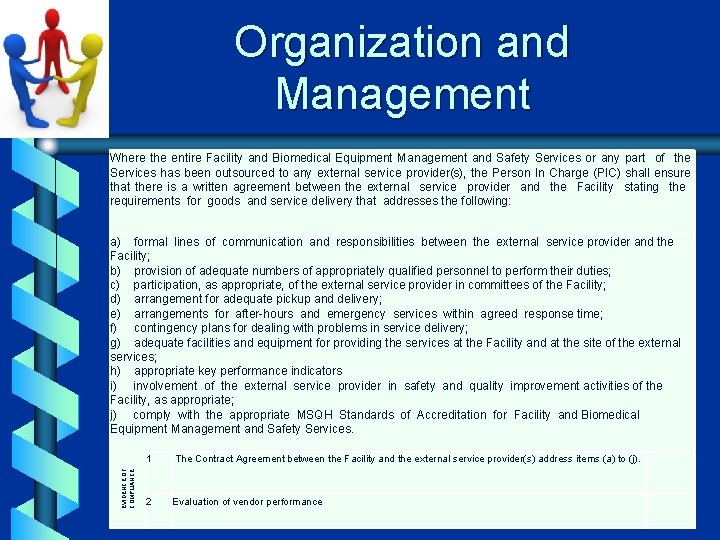
Organization and Management Where the entire Facility and Biomedical Equipment Management and Safety Services or any part of the Services has been outsourced to any external service provider(s), the Person In Charge (PIC) shall ensure that there is a written agreement between the external service provider and the Facility stating the requirements for goods and service delivery that addresses the following: EVIDENCE OF COMPLIANCE a) formal lines of communication and responsibilities between the external service provider and the Facility; b) provision of adequate numbers of appropriately qualified personnel to perform their duties; c) participation, as appropriate, of the external service provider in committees of the Facility; d) arrangement for adequate pickup and delivery; e) arrangements for after-hours and emergency services within agreed response time; f) contingency plans for dealing with problems in service delivery; g) adequate facilities and equipment for providing the services at the Facility and at the site of the external services; h) appropriate key performance indicators i) involvement of the external service provider in safety and quality improvement activities of the Facility, as appropriate; j) comply with the appropriate MSQH Standards of Accreditation for Facility and Biomedical Equipment Management and Safety Services. 1 The Contract Agreement between the Facility and the external service provider(s) address items (a) to (j). 2 Evaluation of vendor performance
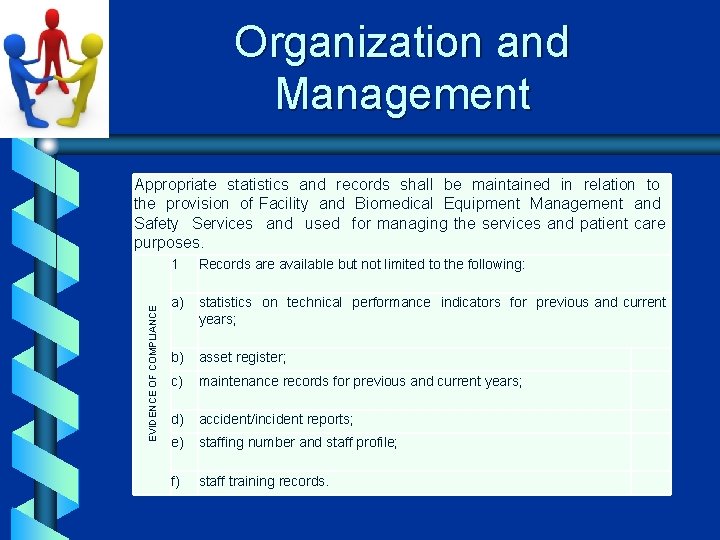
Organization and Management EVIDENCE OF COMPLIANCE Appropriate statistics and records shall be maintained in relation to the provision of Facility and Biomedical Equipment Management and Safety Services and used for managing the services and patient care purposes. 1 Records are available but not limited to the following: a) statistics on technical performance indicators for previous and current years; b) asset register; c) maintenance records for previous and current years; d) accident/incident reports; e) staffing number and staff profile; f) staff training records.
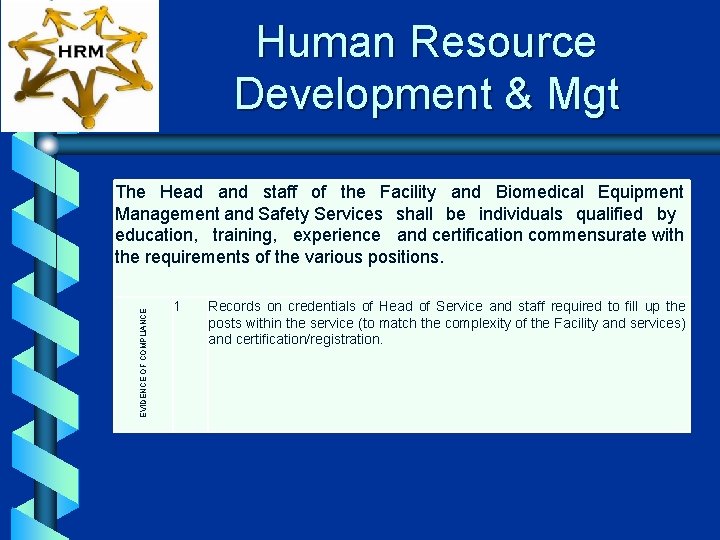
Human Resource Development & Mgt EVIDENCE OF COMPLIANCE The Head and staff of the Facility and Biomedical Equipment Management and Safety Services shall be individuals qualified by education, training, experience and certification commensurate with the requirements of the various positions. 1 Records on credentials of Head of Service and staff required to fill up the posts within the service (to match the complexity of the Facility and services) and certification/registration.
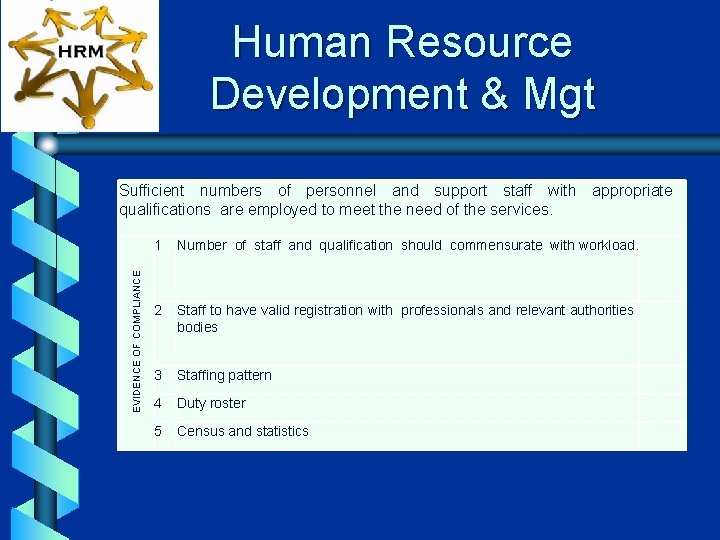
Human Resource Development & Mgt EVIDENCE OF COMPLIANCE Sufficient numbers of personnel and support staff with appropriate qualifications are employed to meet the need of the services. 1 Number of staff and qualification should commensurate with workload. 2 Staff to have valid registration with professionals and relevant authorities bodies 3 Staffing pattern 4 Duty roster 5 Census and statistics
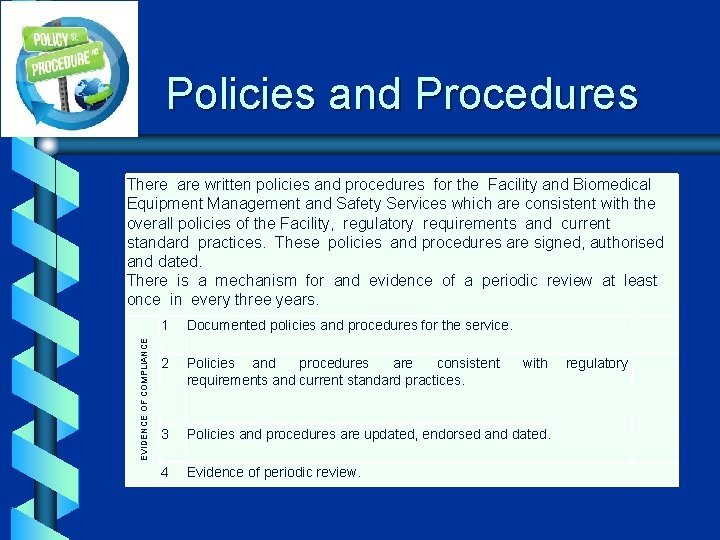
Policies and Procedures EVIDENCE OF COMPLIANCE There are written policies and procedures for the Facility and Biomedical Equipment Management and Safety Services which are consistent with the overall policies of the Facility, regulatory requirements and current standard practices. These policies and procedures are signed, authorised and dated. There is a mechanism for and evidence of a periodic review at least once in every three years. 1 Documented policies and procedures for the service. 2 Policies and procedures are consistent with regulatory requirements and current standard practices. 3 Policies and procedures are updated, endorsed and dated. 4 Evidence of periodic review.
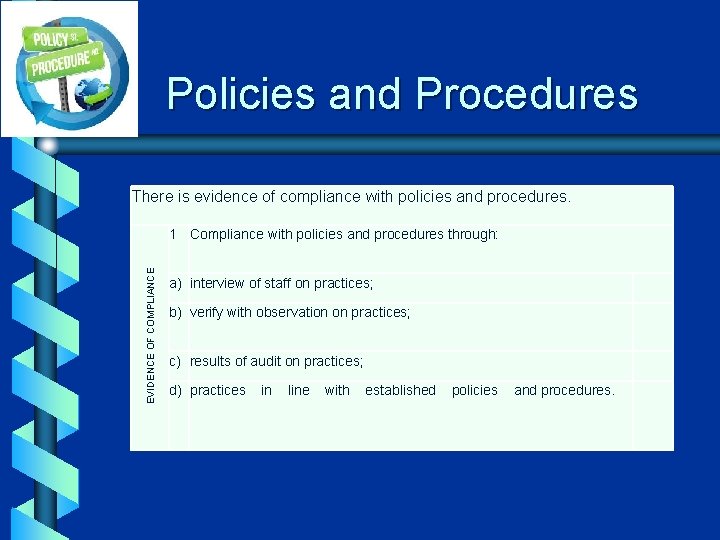
Policies and Procedures There is evidence of compliance with policies and procedures. EVIDENCE OF COMPLIANCE 1 Compliance with policies and procedures through: a) interview of staff on practices; b) verify with observation on practices; c) results of audit on practices; d) practices in line with established policies and procedures.
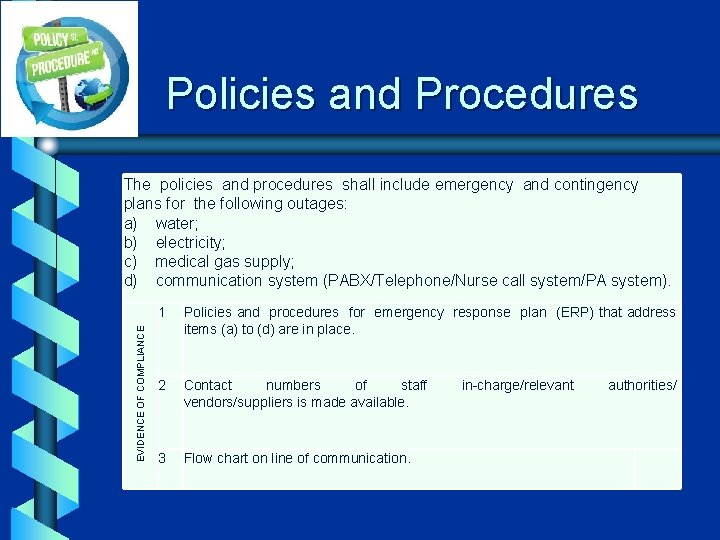
Policies and Procedures EVIDENCE OF COMPLIANCE The policies and procedures shall include emergency and contingency plans for the following outages: a) water; b) electricity; c) medical gas supply; d) communication system (PABX/Telephone/Nurse call system/PA system). 1 Policies and procedures for emergency response plan (ERP) that address items (a) to (d) are in place. 2 Contact numbers of staff in-charge/relevant authorities/ vendors/suppliers is made available. 3 Flow chart on line of communication.
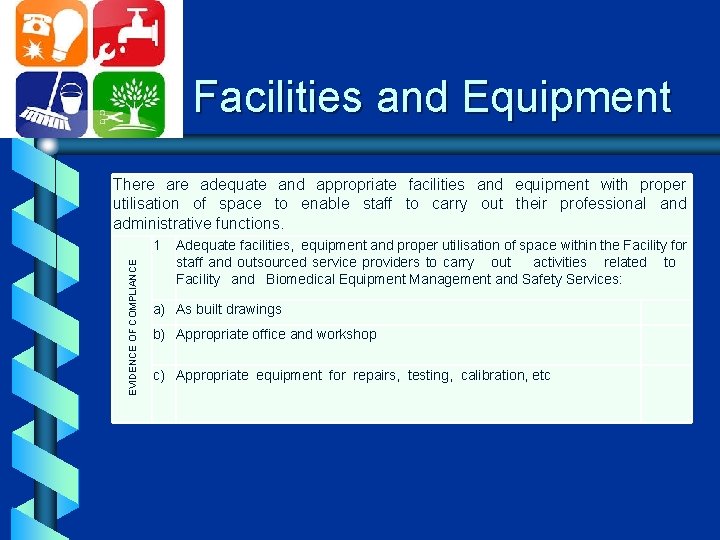
Facilities and Equipment There adequate and appropriate facilities and equipment with proper utilisation of space to enable staff to carry out their professional and administrative functions. EVIDENCE OF COMPLIANCE 1 Adequate facilities, equipment and proper utilisation of space within the Facility for staff and outsourced service providers to carry out activities related to Facility and Biomedical Equipment Management and Safety Services: a) As built drawings b) Appropriate office and workshop c) Appropriate equipment for repairs, testing, calibration, etc
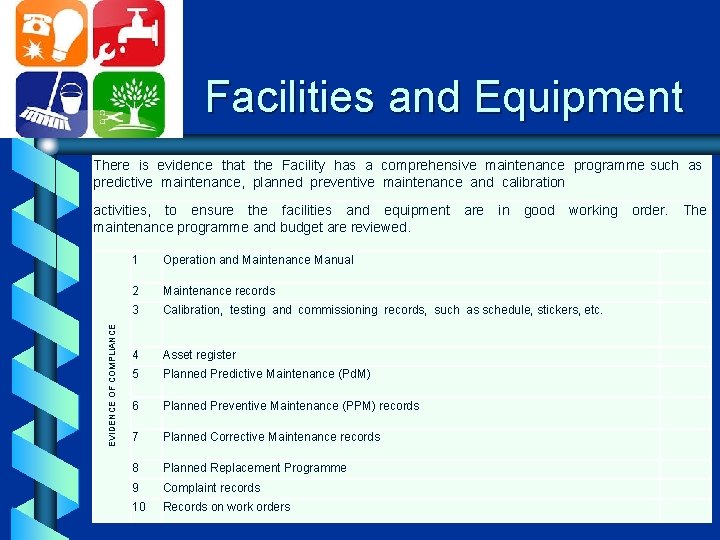
Facilities and Equipment There is evidence that the Facility has a comprehensive maintenance programme such as predictive maintenance, planned preventive maintenance and calibration EVIDENCE OF COMPLIANCE activities, to ensure the facilities and equipment are in good working order. The maintenance programme and budget are reviewed. 1 Operation and Maintenance Manual 2 Maintenance records 3 Calibration, testing and commissioning records, such as schedule, stickers, etc. 4 Asset register 5 Planned Predictive Maintenance (Pd. M) 6 Planned Preventive Maintenance (PPM) records 7 Planned Corrective Maintenance records 8 Planned Replacement Programme 9 Complaint records 10 Records on work orders
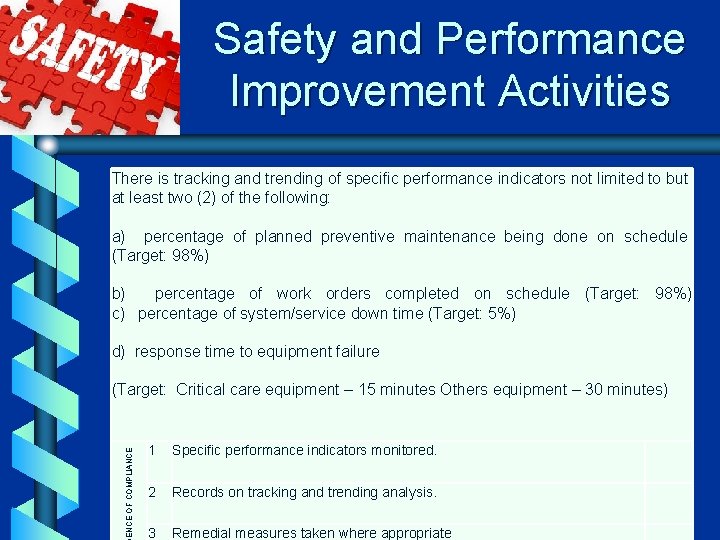
Safety and Performance Improvement Activities There is tracking and trending of specific performance indicators not limited to but at least two (2) of the following: a) percentage of planned preventive maintenance being done on schedule (Target: 98%) b) percentage of work orders completed on schedule (Target: 98%) c) percentage of system/service down time (Target: 5%) d) response time to equipment failure ENCE OF COMPLIANCE (Target: Critical care equipment – 15 minutes Others equipment – 30 minutes) 1 Specific performance indicators monitored. 2 Records on tracking and trending analysis. 3 Remedial measures taken where appropriate
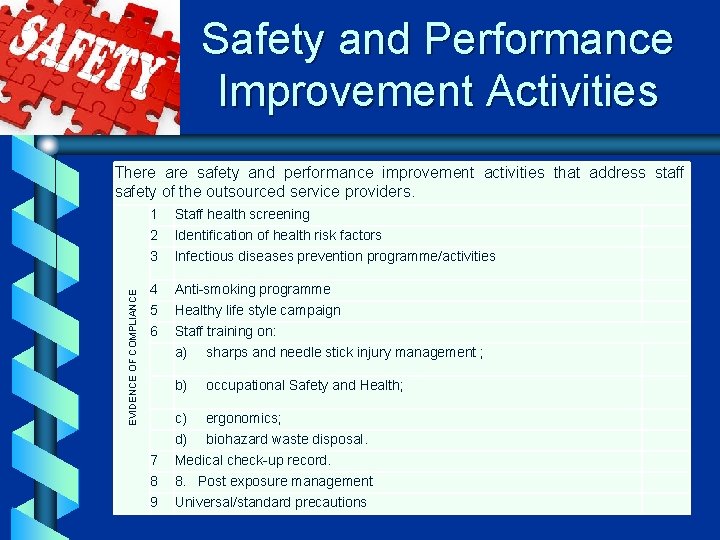
Safety and Performance Improvement Activities EVIDENCE OF COMPLIANCE There are safety and performance improvement activities that address staff safety of the outsourced service providers. 1 2 3 Staff health screening Identification of health risk factors Infectious diseases prevention programme/activities 4 5 6 Anti-smoking programme Healthy life style campaign Staff training on: a) sharps and needle stick injury management ; b) occupational Safety and Health; 7 8 9 c) ergonomics; d) biohazard waste disposal. Medical check-up record. 8. Post exposure management Universal/standard precautions
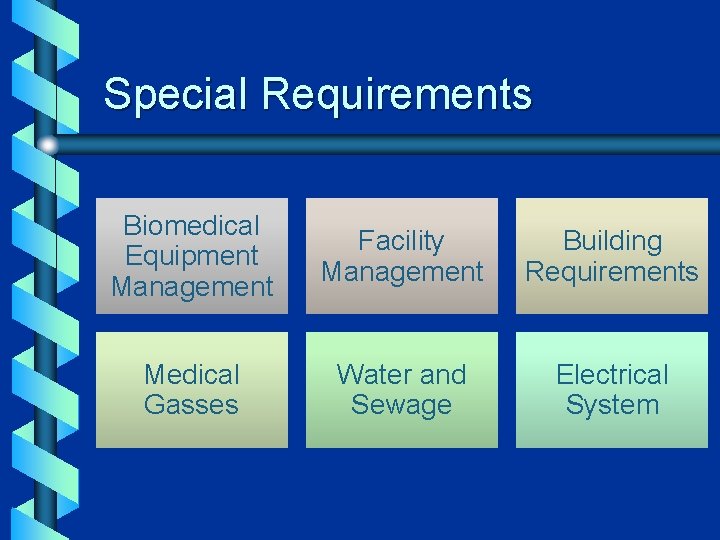
Special Requirements Biomedical Equipment Management Facility Management Building Requirements Medical Gasses Water and Sewage Electrical System
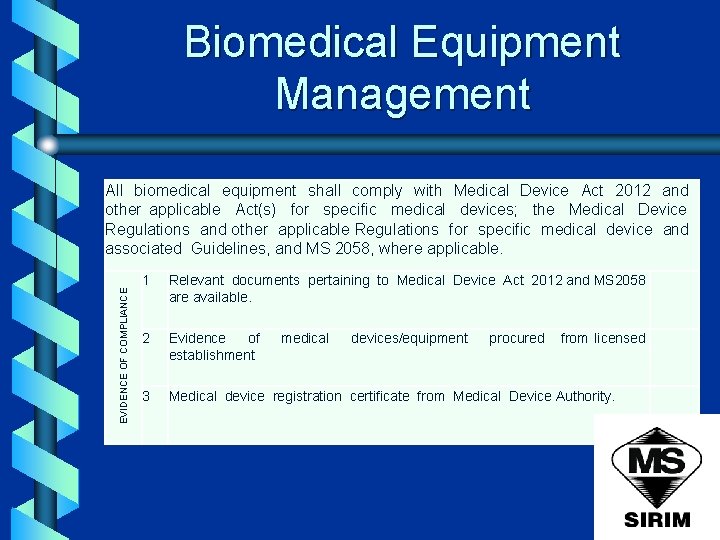
Biomedical Equipment Management EVIDENCE OF COMPLIANCE All biomedical equipment shall comply with Medical Device Act 2012 and other applicable Act(s) for specific medical devices; the Medical Device Regulations and other applicable Regulations for specific medical device and associated Guidelines, and MS 2058, where applicable. 1 Relevant documents pertaining to Medical Device Act 2012 and MS 2058 are available. 2 Evidence of medical devices/equipment procured from licensed establishment 3 Medical device registration certificate from Medical Device Authority.
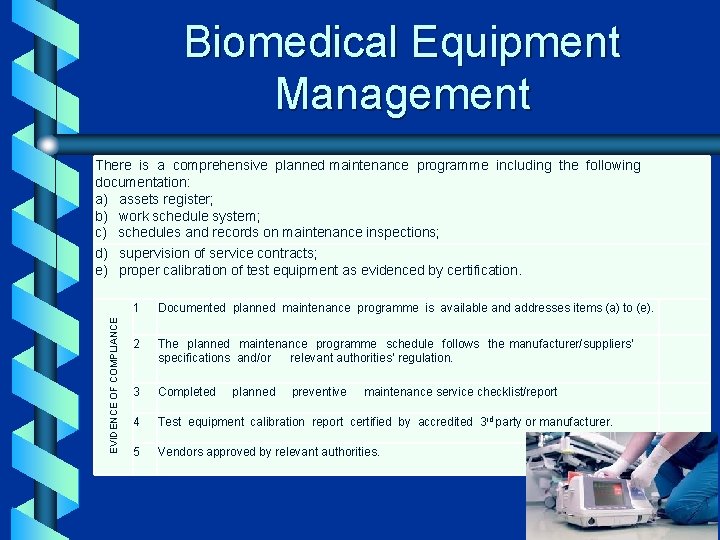
Biomedical Equipment Management There is a comprehensive planned maintenance programme including the following documentation: a) assets register; b) work schedule system; c) schedules and records on maintenance inspections; EVIDENCE OF COMPLIANCE d) supervision of service contracts; e) proper calibration of test equipment as evidenced by certification. 1 Documented planned maintenance programme is available and addresses items (a) to (e). 2 The planned maintenance programme schedule follows the manufacturer/suppliers’ specifications and/or relevant authorities’ regulation. 3 Completed planned preventive maintenance service checklist/report 4 Test equipment calibration report certified by accredited 3 rd party or manufacturer. 5 Vendors approved by relevant authorities.
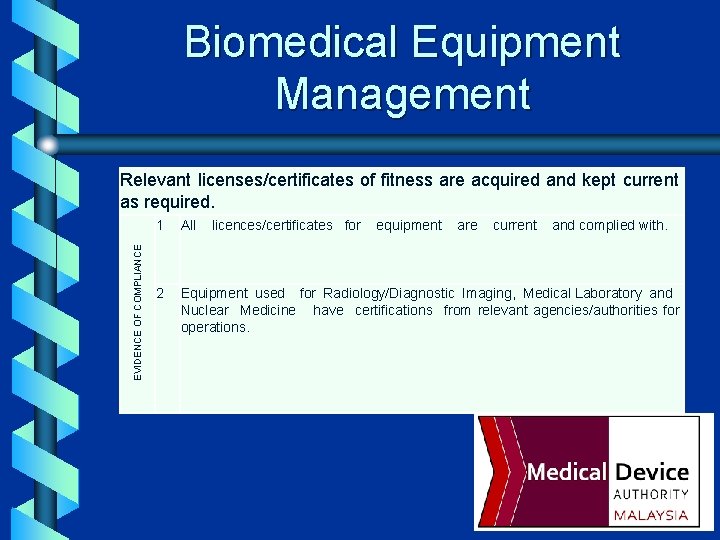
Biomedical Equipment Management EVIDENCE OF COMPLIANCE Relevant licenses/certificates of fitness are acquired and kept current as required. 1 All licences/certificates for equipment are current and complied with. 2 Equipment used for Radiology/Diagnostic Imaging, Medical Laboratory and Nuclear Medicine have certifications from relevant agencies/authorities for operations.
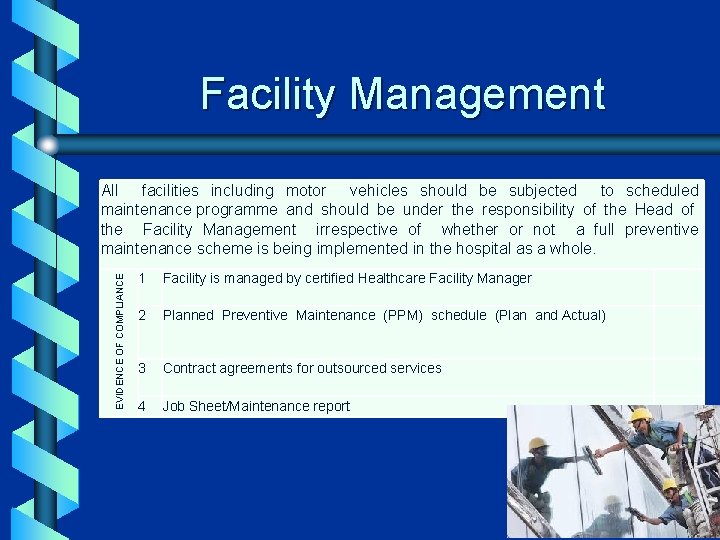
Facility Management EVIDENCE OF COMPLIANCE All facilities including motor vehicles should be subjected to scheduled maintenance programme and should be under the responsibility of the Head of the Facility Management irrespective of whether or not a full preventive maintenance scheme is being implemented in the hospital as a whole. 1 Facility is managed by certified Healthcare Facility Manager 2 Planned Preventive Maintenance (PPM) schedule (Plan and Actual) 3 Contract agreements for outsourced services 4 Job Sheet/Maintenance report
Facility Management EVIDENCE OF COMPLIANCE Relevant licences/certificates of fitness are acquired and kept current as required. 1 All licences/certificates should be current and complied with.
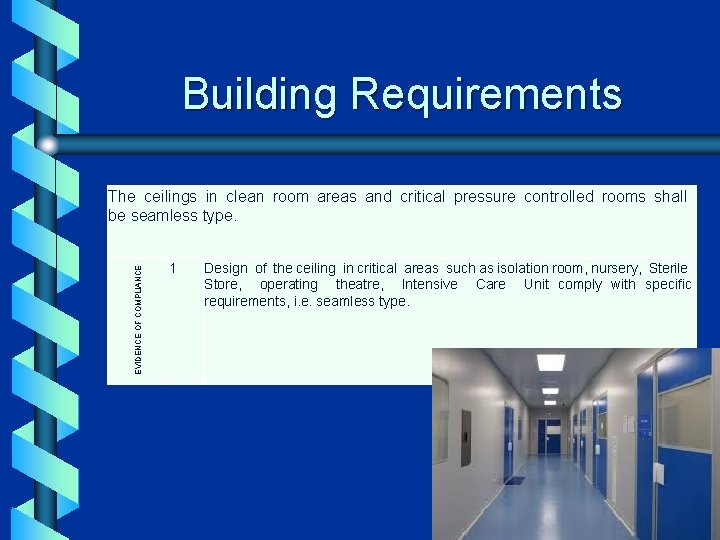
Building Requirements EVIDENCE OF COMPLIANCE The ceilings in clean room areas and critical pressure controlled rooms shall be seamless type. 1 Design of the ceiling in critical areas such as isolation room, nursery, Sterile Store, operating theatre, Intensive Care Unit comply with specific requirements, i. e. seamless type.
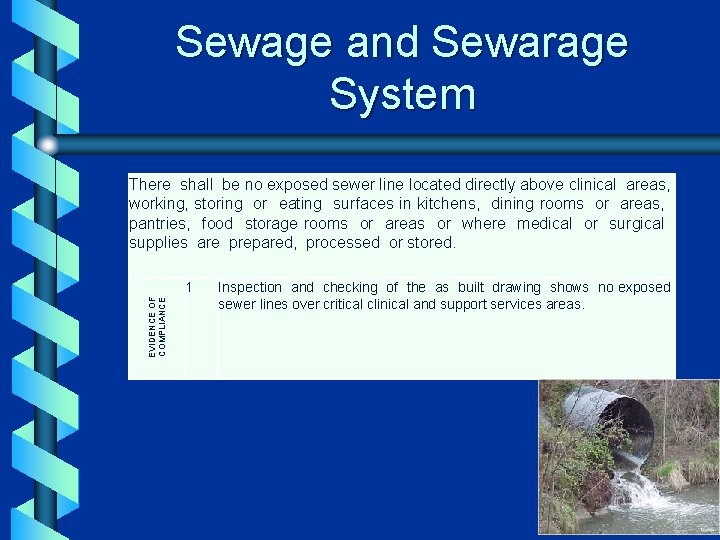
Sewage and Sewarage System EVIDENCE OF COMPLIANCE There shall be no exposed sewer line located directly above clinical areas, working, storing or eating surfaces in kitchens, dining rooms or areas, pantries, food storage rooms or areas or where medical or surgical supplies are prepared, processed or stored. 1 Inspection and checking of the as built drawing shows no exposed sewer lines over critical clinical and support services areas.
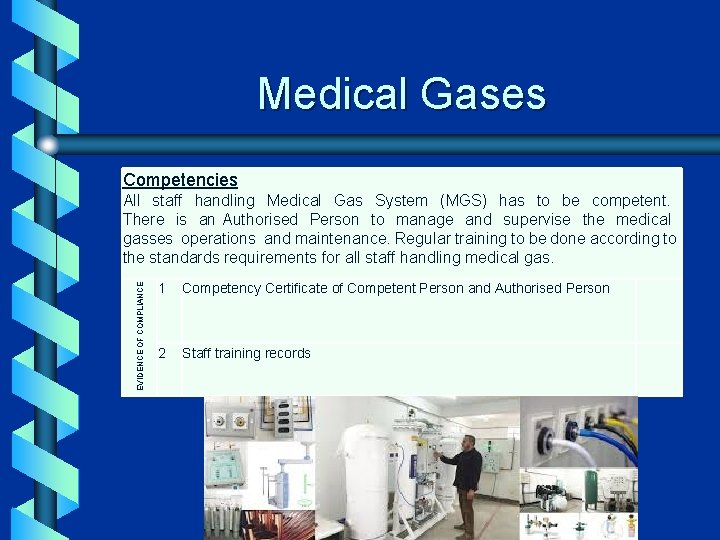
Medical Gases Competencies EVIDENCE OF COMPLIANCE All staff handling Medical Gas System (MGS) has to be competent. There is an Authorised Person to manage and supervise the medical gasses operations and maintenance. Regular training to be done according to the standards requirements for all staff handling medical gas. 1 Competency Certificate of Competent Person and Authorised Person 2 Staff training records
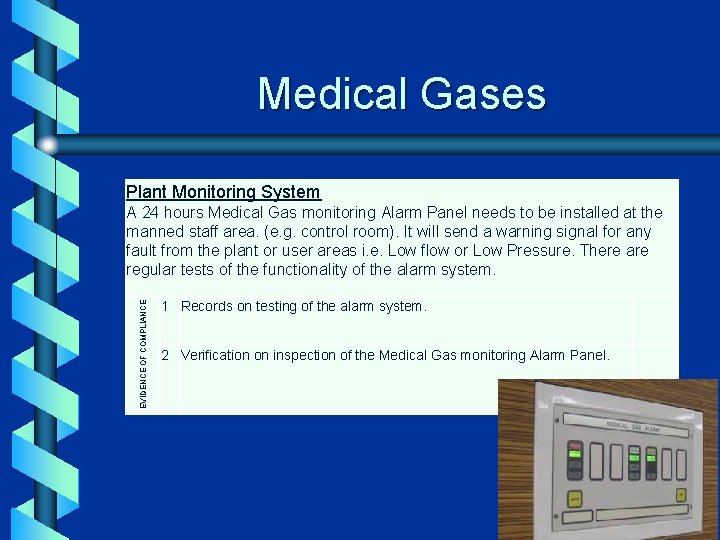
Medical Gases Plant Monitoring System EVIDENCE OF COMPLIANCE A 24 hours Medical Gas monitoring Alarm Panel needs to be installed at the manned staff area. (e. g. control room). It will send a warning signal for any fault from the plant or user areas i. e. Low flow or Low Pressure. There are regular tests of the functionality of the alarm system. 1 Records on testing of the alarm system. 2 Verification on inspection of the Medical Gas monitoring Alarm Panel.
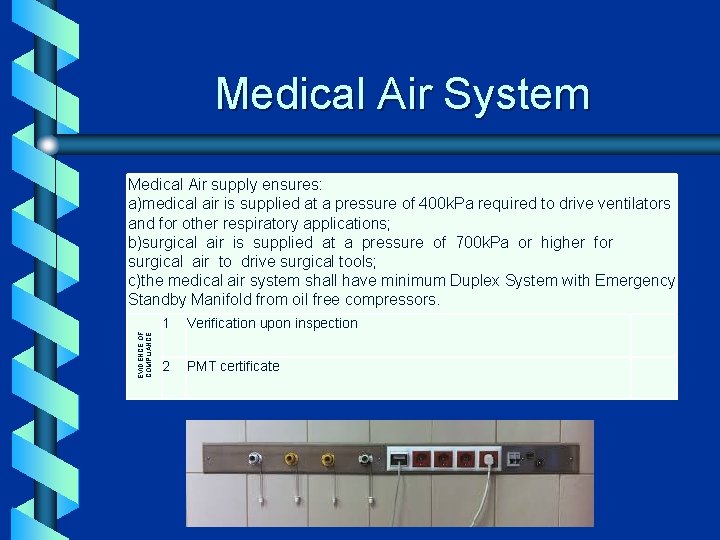
Medical Air System EVIDENCE OF COMPLIANCE Medical Air supply ensures: a)medical air is supplied at a pressure of 400 k. Pa required to drive ventilators and for other respiratory applications; b)surgical air is supplied at a pressure of 700 k. Pa or higher for surgical air to drive surgical tools; c)the medical air system shall have minimum Duplex System with Emergency Standby Manifold from oil free compressors. 1 Verification upon inspection 2 PMT certificate
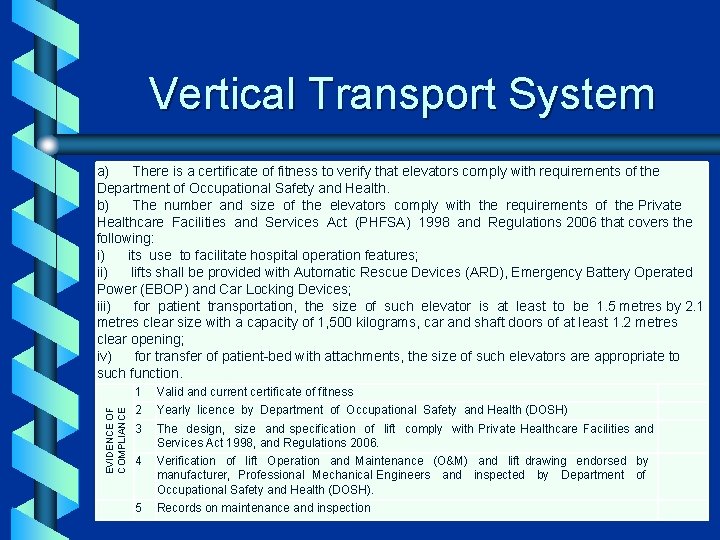
Vertical Transport System EVIDENCE OF COMPLIANCE a) There is a certificate of fitness to verify that elevators comply with requirements of the Department of Occupational Safety and Health. b) The number and size of the elevators comply with the requirements of the Private Healthcare Facilities and Services Act (PHFSA) 1998 and Regulations 2006 that covers the following: i) its use to facilitate hospital operation features; ii) lifts shall be provided with Automatic Rescue Devices (ARD), Emergency Battery Operated Power (EBOP) and Car Locking Devices; iii) for patient transportation, the size of such elevator is at least to be 1. 5 metres by 2. 1 metres clear size with a capacity of 1, 500 kilograms, car and shaft doors of at least 1. 2 metres clear opening; iv) for transfer of patient-bed with attachments, the size of such elevators are appropriate to such function. 1 Valid and current certificate of fitness 2 Yearly licence by Department of Occupational Safety and Health (DOSH) 3 The design, size and specification of lift comply with Private Healthcare Facilities and Services Act 1998, and Regulations 2006. 4 Verification of lift Operation and Maintenance (O&M) and lift drawing endorsed by manufacturer, Professional Mechanical Engineers and inspected by Department of Occupational Safety and Health (DOSH). 5 Records on maintenance and inspection
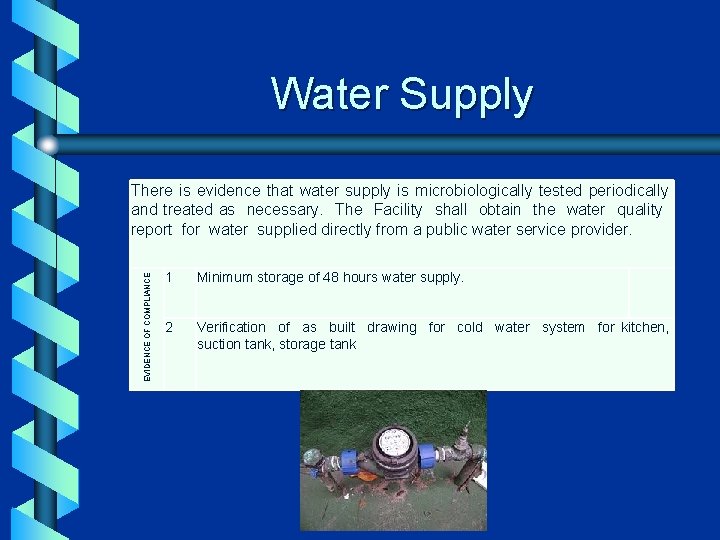
Water Supply EVIDENCE OF COMPLIANCE There is evidence that water supply is microbiologically tested periodically and treated as necessary. The Facility shall obtain the water quality report for water supplied directly from a public water service provider. 1 Minimum storage of 48 hours water supply. 2 Verification of as built drawing for cold water system for kitchen, suction tank, storage tank
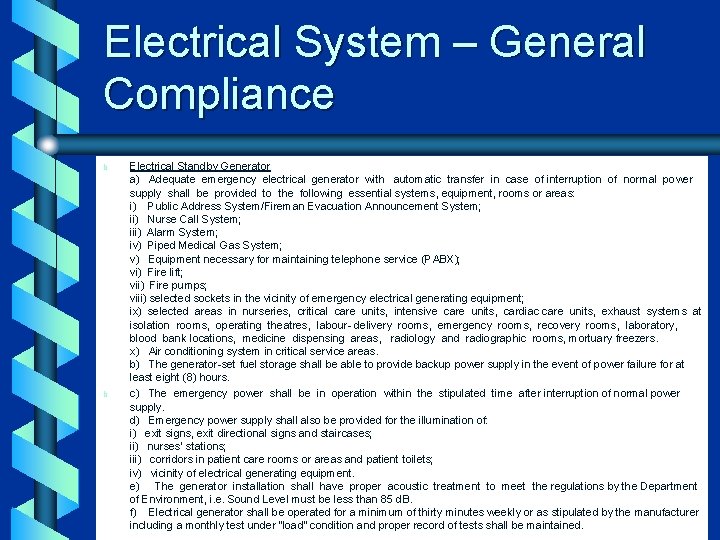
Electrical System – General Compliance b b Electrical Standby Generator a) Adequate emergency electrical generator with automatic transfer in case of interruption of normal power supply shall be provided to the following essential systems, equipment, rooms or areas: i) Public Address System/Fireman Evacuation Announcement System; ii) Nurse Call System; iii) Alarm System; iv) Piped Medical Gas System; v) Equipment necessary for maintaining telephone service (PABX); vi) Fire lift; vii) Fire pumps; viii) selected sockets in the vicinity of emergency electrical generating equipment; ix) selected areas in nurseries, critical care units, intensive care units, cardiac care units, exhaust systems at isolation rooms, operating theatres, labour- delivery rooms, emergency rooms, recovery rooms, laboratory, blood bank locations, medicine dispensing areas, radiology and radiographic rooms, mortuary freezers. x) Air conditioning system in critical service areas. b) The generator-set fuel storage shall be able to provide backup power supply in the event of power failure for at least eight (8) hours. c) The emergency power shall be in operation within the stipulated time after interruption of normal power supply. d) Emergency power supply shall also be provided for the illumination of: i) exit signs, exit directional signs and staircases; ii) nurses’ stations; iii) corridors in patient care rooms or areas and patient toilets; iv) vicinity of electrical generating equipment. e) The generator installation shall have proper acoustic treatment to meet the regulations by the Department of Environment, i. e. Sound Level must be less than 85 d. B. f) Electrical generator shall be operated for a minimum of thirty minutes weekly or as stipulated by the manufacturer including a monthly test under “load” condition and proper record of tests shall be maintained.
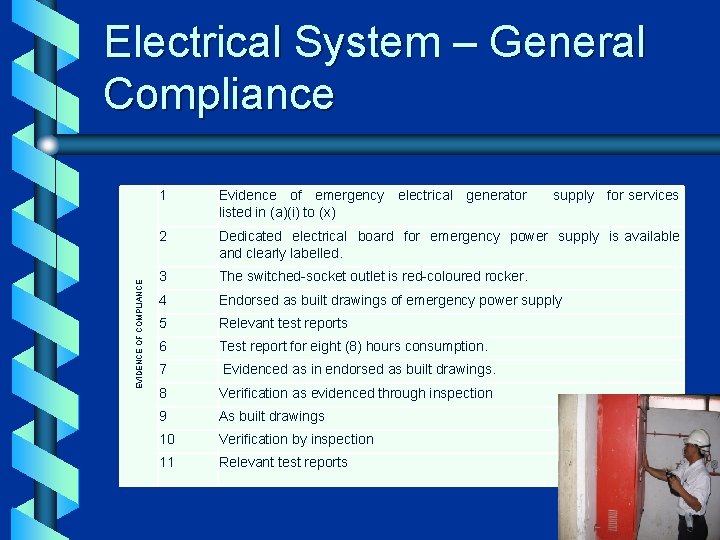
EVIDENCE OF COMPLIANCE Electrical System – General Compliance 1 Evidence of emergency electrical generator supply for services listed in (a)(i) to (x) 2 Dedicated electrical board for emergency power supply is available and clearly labelled. 3 The switched-socket outlet is red-coloured rocker. 4 Endorsed as built drawings of emergency power supply 5 Relevant test reports 6 Test report for eight (8) hours consumption. 7 Evidenced as in endorsed as built drawings. 8 Verification as evidenced through inspection 9 As built drawings 10 Verification by inspection 11 Relevant test reports
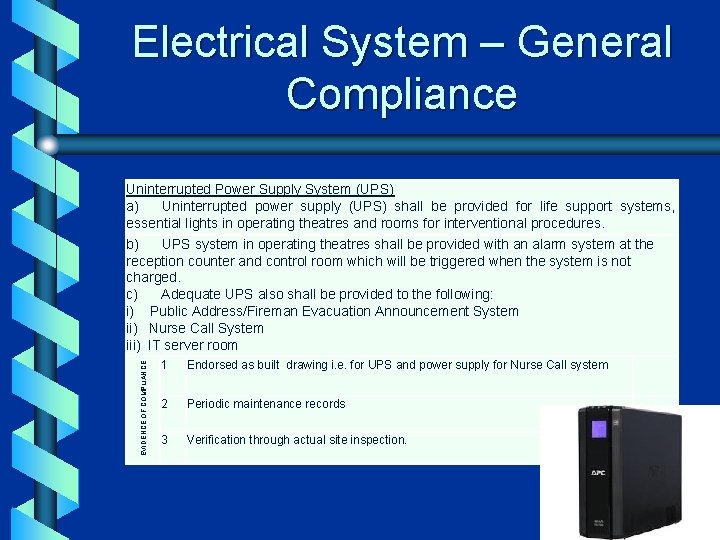
Electrical System – General Compliance Uninterrupted Power Supply System (UPS) a) Uninterrupted power supply (UPS) shall be provided for life support systems, essential lights in operating theatres and rooms for interventional procedures. EVIDENCE OF COMPLIANCE b) UPS system in operating theatres shall be provided with an alarm system at the reception counter and control room which will be triggered when the system is not charged. c) Adequate UPS also shall be provided to the following: i) Public Address/Fireman Evacuation Announcement System ii) Nurse Call System iii) IT server room 1 Endorsed as built drawing i. e. for UPS and power supply for Nurse Call system 2 Periodic maintenance records 3 Verification through actual site inspection.
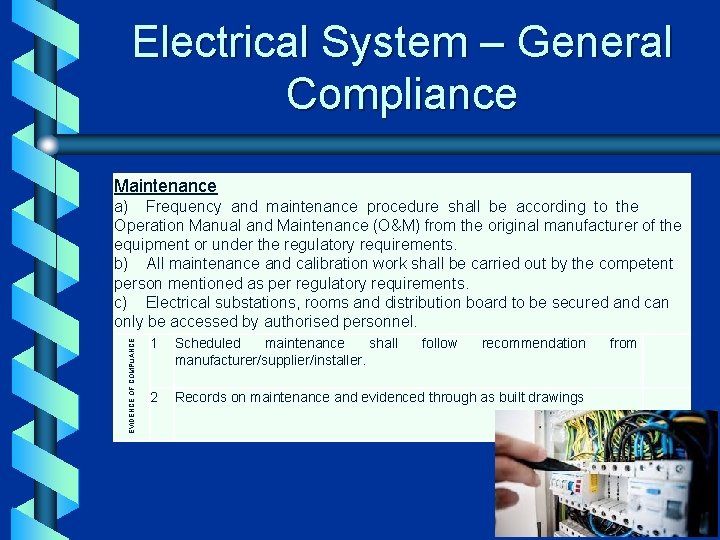
Electrical System – General Compliance Maintenance EVIDENCE OF COMPLIANCE a) Frequency and maintenance procedure shall be according to the Operation Manual and Maintenance (O&M) from the original manufacturer of the equipment or under the regulatory requirements. b) All maintenance and calibration work shall be carried out by the competent person mentioned as per regulatory requirements. c) Electrical substations, rooms and distribution board to be secured and can only be accessed by authorised personnel. 1 Scheduled maintenance shall follow recommendation from manufacturer/supplier/installer. 2 Records on maintenance and evidenced through as built drawings
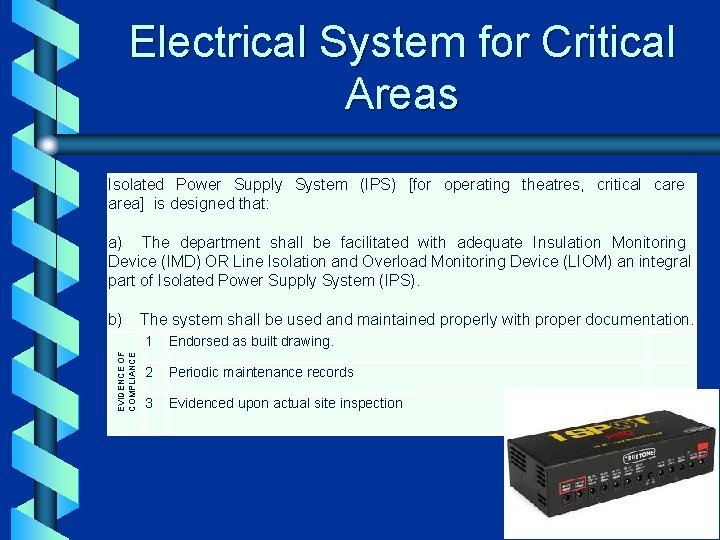
Electrical System for Critical Areas Isolated Power Supply System (IPS) [for operating theatres, critical care area] is designed that: a) The department shall be facilitated with adequate Insulation Monitoring Device (IMD) OR Line Isolation and Overload Monitoring Device (LIOM) an integral part of Isolated Power Supply System (IPS). EVIDENCE OF COMPLIANCE b) The system shall be used and maintained properly with proper documentation. 1 Endorsed as built drawing. 2 Periodic maintenance records 3 Evidenced upon actual site inspection
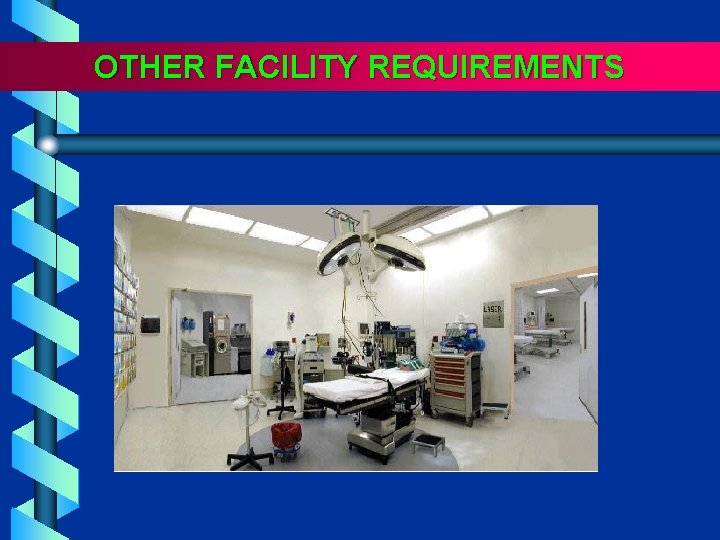
OTHER FACILITY REQUIREMENTS -
SAFETY REQUIREMENTS FOR HAZARDOUS AREAS
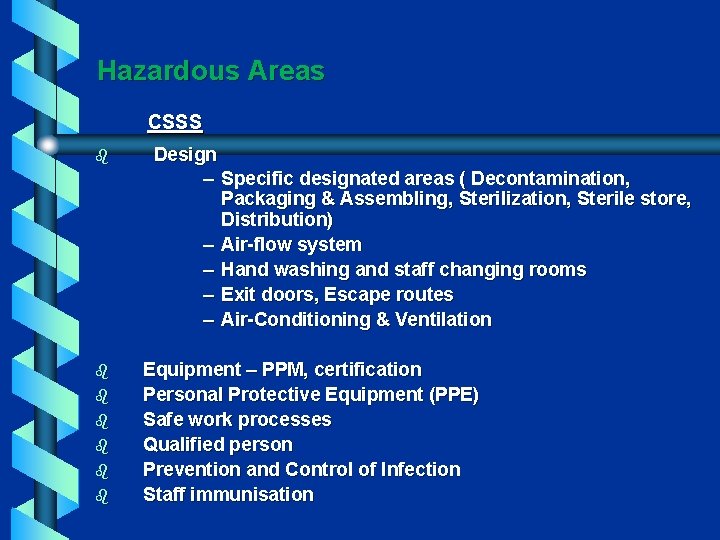
Hazardous Areas CSSS b b b b Design – Specific designated areas ( Decontamination, Packaging & Assembling, Sterilization, Sterile store, Distribution) – Air-flow system – Hand washing and staff changing rooms – Exit doors, Escape routes – Air-Conditioning & Ventilation Equipment – PPM, certification Personal Protective Equipment (PPE) Safe work processes Qualified person Prevention and Control of Infection Staff immunisation
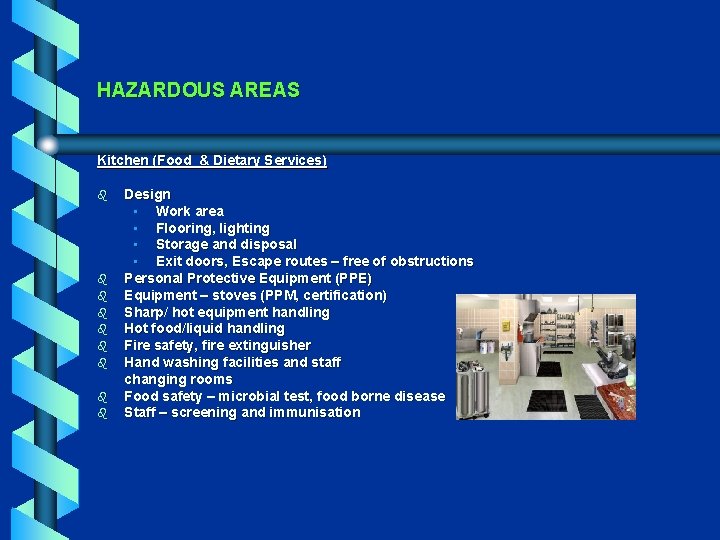
HAZARDOUS AREAS Kitchen (Food & Dietary Services) b b b b b Design • Work area • Flooring, lighting • Storage and disposal • Exit doors, Escape routes – free of obstructions Personal Protective Equipment (PPE) Equipment – stoves (PPM, certification) Sharp/ hot equipment handling Hot food/liquid handling Fire safety, fire extinguisher Hand washing facilities and staff changing rooms Food safety – microbial test, food borne disease Staff – screening and immunisation
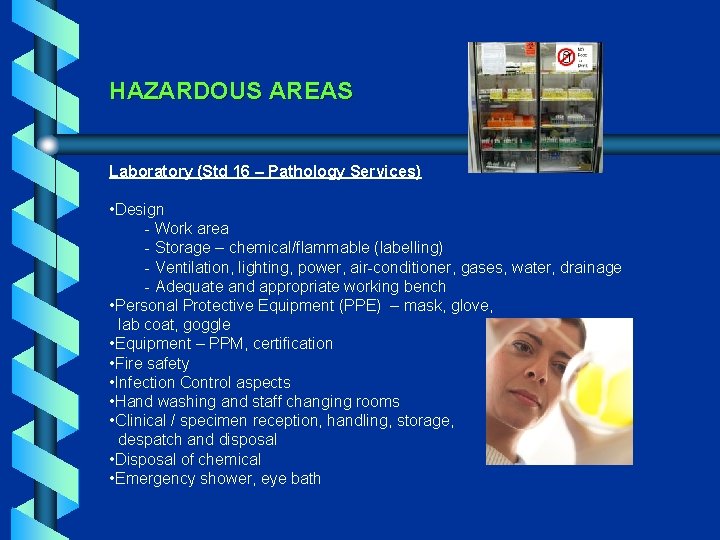
HAZARDOUS AREAS Laboratory (Std 16 – Pathology Services) • Design - Work area - Storage – chemical/flammable (labelling) - Ventilation, lighting, power, air-conditioner, gases, water, drainage - Adequate and appropriate working bench • Personal Protective Equipment (PPE) – mask, glove, lab coat, goggle • Equipment – PPM, certification • Fire safety • Infection Control aspects • Hand washing and staff changing rooms • Clinical / specimen reception, handling, storage, despatch and disposal • Disposal of chemical • Emergency shower, eye bath
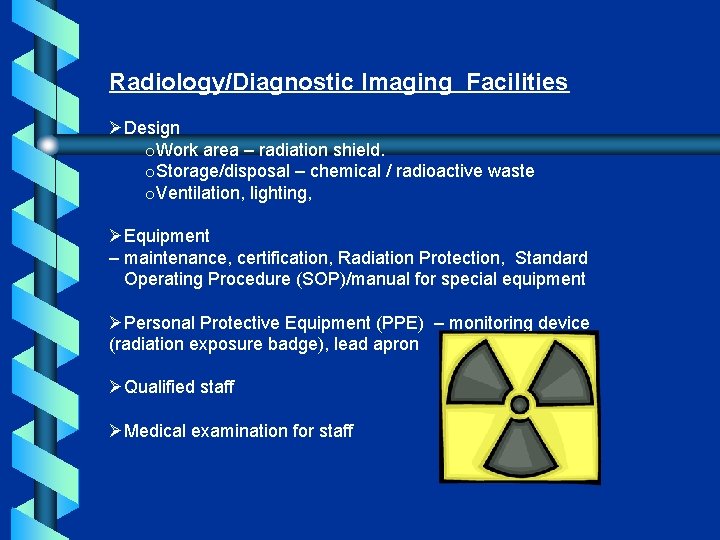
Radiology/Diagnostic Imaging Facilities Design o. Work area – radiation shield. o. Storage/disposal – chemical / radioactive waste o. Ventilation, lighting, Equipment – maintenance, certification, Radiation Protection, Standard Operating Procedure (SOP)/manual for special equipment Personal Protective Equipment (PPE) – monitoring device (radiation exposure badge), lead apron Qualified staff Medical examination for staff
Isolation Rooms • Design, ventilation as per standard requirements • Personal Protective Equipment (PPE) • Hand washing facilities • Infection Control process – standard precautions
Operating Theatre • • Design Flooring, lighting, ventilation Exit doors, Escape routes – free of obstructions Equipment – maintenance and calibration, Personal Protective Equipment (PPE) – radiation protection, Dirty instrument handling Qualified and trained staff
Operating Theatre • Policies and Procedures/Guidelines on: – radiation hazard – drug errors – Sharps handling n disposal – scavenging equipment – vapours and waste anaesthetic gases – notification of biohazard – patient transport – electrical hazards – patient positioning
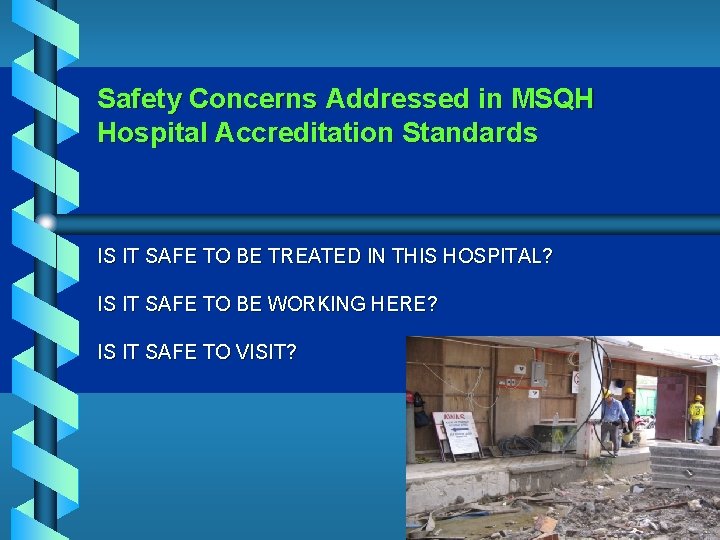
Safety Concerns Addressed in MSQH Hospital Accreditation Standards IS IT SAFE TO BE TREATED IN THIS HOSPITAL? IS IT SAFE TO BE WORKING HERE? IS IT SAFE TO VISIT?
www. msqh. com. my msqh@msqh. com. my