
MSOffice Power Point Part 1 Microsoft Office 2010
- Slides: 36
MSOffice Power. Point Part 1 Microsoft® Office 2010: Illustrated Introductory ® 1
Objectives • • • Plan and create a new presentation Create a title slide and slides with bulleted lists Change theme Edit and format text in the Slide pane Use Auto. Correct Microsoft® Office 2010: Illustrated Introductory 2
Objectives • Rearrange slides in Normal and Slide Sorter view • Delete slides • View a slide show • Animate slide titles and bulleted lists Microsoft® Office 2010: Illustrated Introductory 3
Objectives • Apply transitions • Insert footer text, slide numbers, and the date on slides • Create speaker notes • Check the spelling in a presentation • Preview and print slides, handouts, speaker notes, and the outline Microsoft® Office 2010: Illustrated Introductory 4
MSOffice Power. Point • Microsoft Power. Point 2010 is a powerful computer software program that enables you to create visually dynamic presentations. Microsoft® Office 2010: Illustrated Introductory 5
Defining Presentation Software • Presentation software is a computer program you use to organize and present information to others. • Whether you are explaining a new product or moderating a meeting, presentation software can help you effectively communicate your ideas. Microsoft® Office 2010: Illustrated Introductory 6
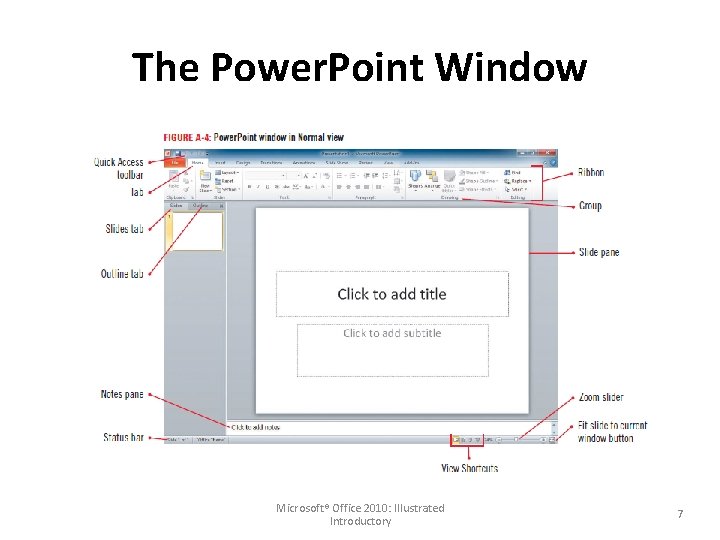
The Power. Point Window Microsoft® Office 2010: Illustrated Introductory 7
Planning a Presentation • Planning a presentations – What is the purpose of your presentation? – Who is your audience? – How much time do you have for the presentation? – Will your audience benefit from printed output? Microsoft® Office 2010: Illustrated Introductory 8
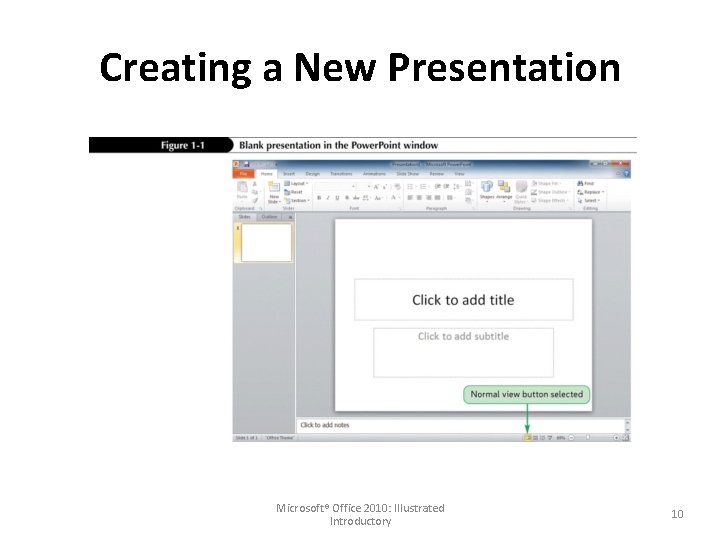
Creating a New Presentation • Click the Start button, point to All programs, click Microsoft Office, and then click Microsoft Power. Point 2013 Microsoft® Office 2010: Illustrated Introductory 9
Creating a New Presentation Microsoft® Office 2010: Illustrated Introductory 10
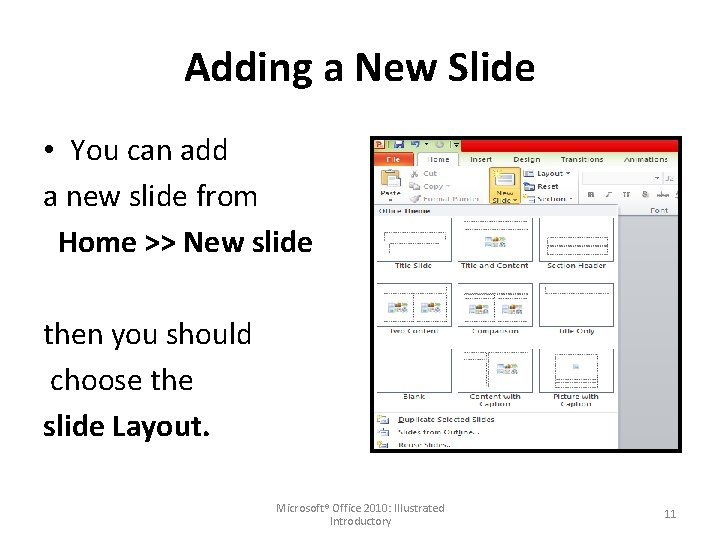
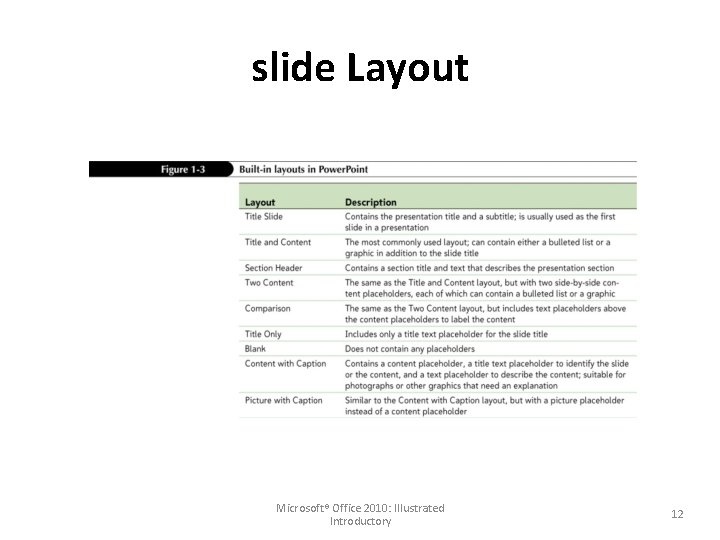
Adding a New Slide • You can add a new slide from Home >> New slide then you should choose the slide Layout. Microsoft® Office 2010: Illustrated Introductory 11
slide Layout Microsoft® Office 2010: Illustrated Introductory 12
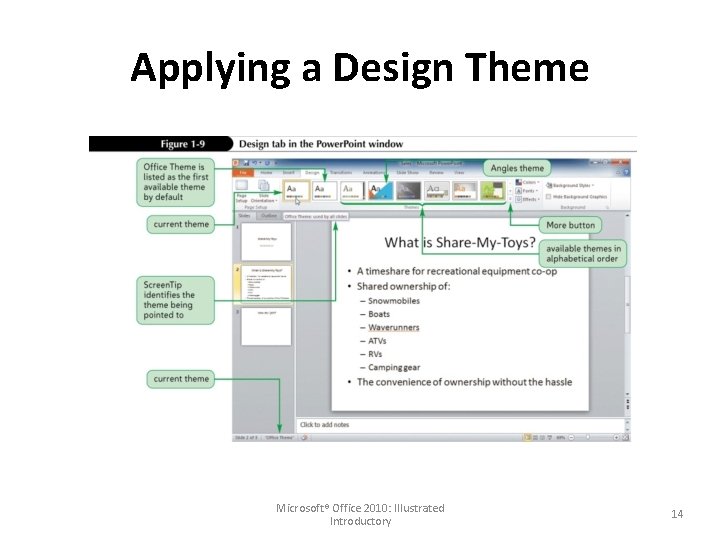
Applying a Design Theme • Theme colors are the colors used for the background, title text, body text, accents, background colors and objects, and graphics in a presentation • Theme fonts are two fonts or font styles, one for the titles (or headings) and one for text in content placeholders • A graphic is a picture, shape, design, graph, chart, or diagram Microsoft® Office 2010: Illustrated Introductory 13
Applying a Design Theme Microsoft® Office 2010: Illustrated Introductory 14
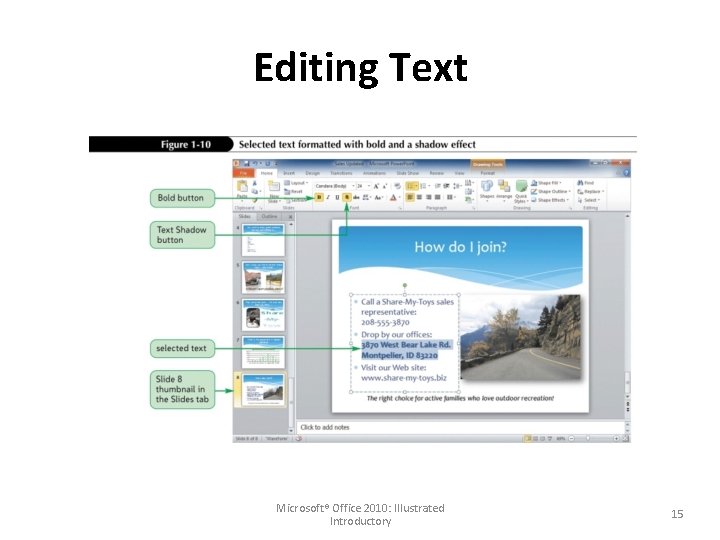
Editing Text Microsoft® Office 2010: Illustrated Introductory 15
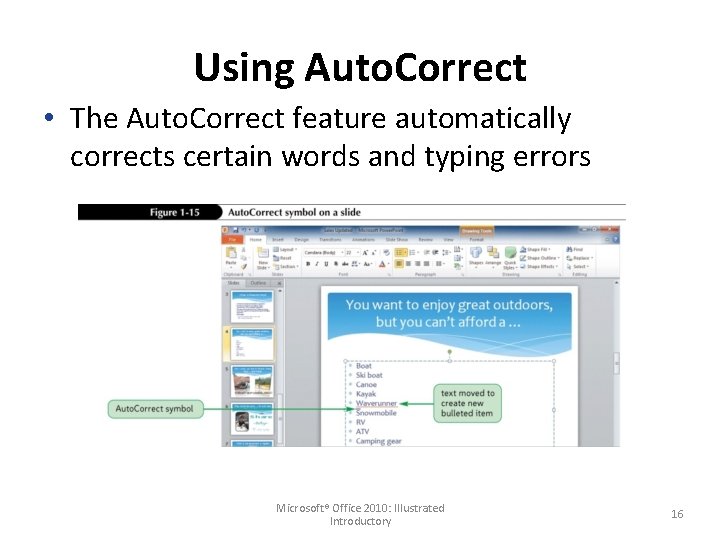
Using Auto. Correct • The Auto. Correct feature automatically corrects certain words and typing errors Microsoft® Office 2010: Illustrated Introductory 16
Deleting Slides • In Slide Sorter view or in the Slides tab in Normal view, right-click the slide thumbnail of the slide you want to delete; or in the Outline tab in Normal view, right-click the slide title of the slide you want to delete • On the shortcut menu, click Delete Slide or • In Slide Sorter view or in the Slides tab in Normal view, click the slide thumbnail of the slide you want to delete; or in the Outline tab in Normal view, click the slide icon of the slide you want to delete • Press the Delete key Microsoft® Office 2010: Illustrated Introductory 17
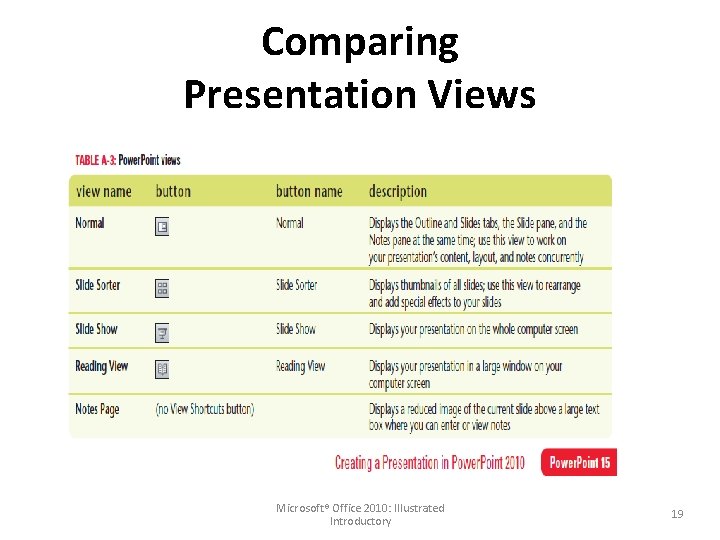
Comparing Presentation Views • Power. Point has five primary views: Normal view, Slide Sorter view, Notes Page view, Slide Show view, and Reading view. • Each Power. Point view displays your presentation in a different way and is used for different purposes. • Normal view is the primary editing view where you add text, graphics, and other elements to the slides. Microsoft® Office 2010: Illustrated Introductory 18
Comparing Presentation Views Microsoft® Office 2010: Illustrated Introductory 19
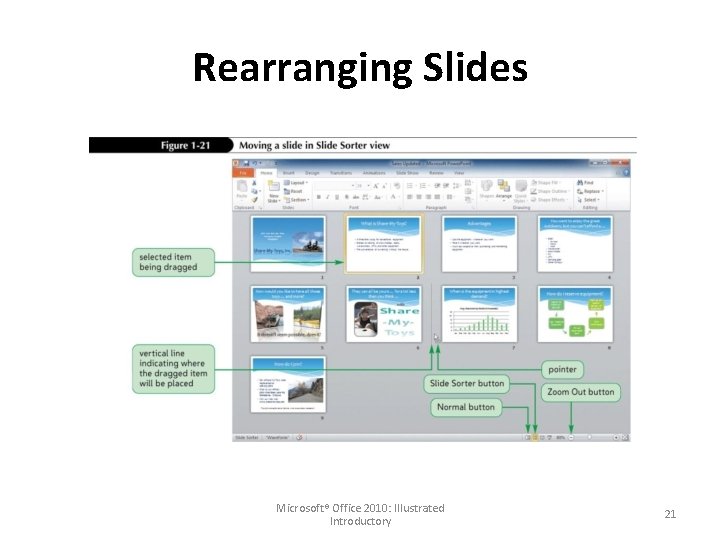
Rearranging Slides • • • In Slide Sorter view, Power. Point displays all the slides as thumbnails On the status bar, click the Slide Sorter button Dragging and dropping slides in Slide Sorter view will rearrange them in the presentation Microsoft® Office 2010: Illustrated Introductory 20
Rearranging Slides Microsoft® Office 2010: Illustrated Introductory 21
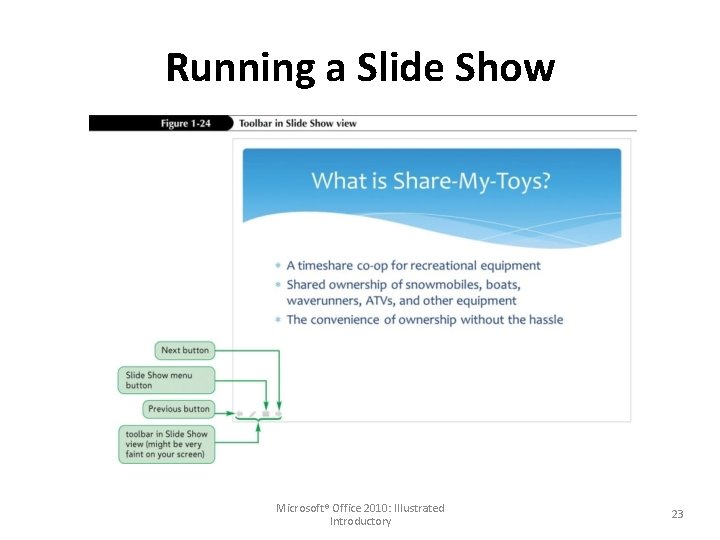
Running a Slide Show • Slide Show view displays each slide so that it fills the entire screen with no toolbars or other Windows elements visible on the screen • When you click the Slide Show button on the status bar, the slide show starts beginning with the current slide • To start a slide show from the beginning, click the Slide Show tab on the Ribbon, and then in the Start then Slide Show group, click the From Beginning button • In Slide Show view, you move from one slide to the next by pressing the Spacebar, the Enter key, the key, or the Page Down key Microsoft® Office 2010: Illustrated Introductory 22
Running a Slide Show Microsoft® Office 2010: Illustrated Introductory 23
Using Animations and Transitions Microsoft® Office 2010: Illustrated Introductory 24
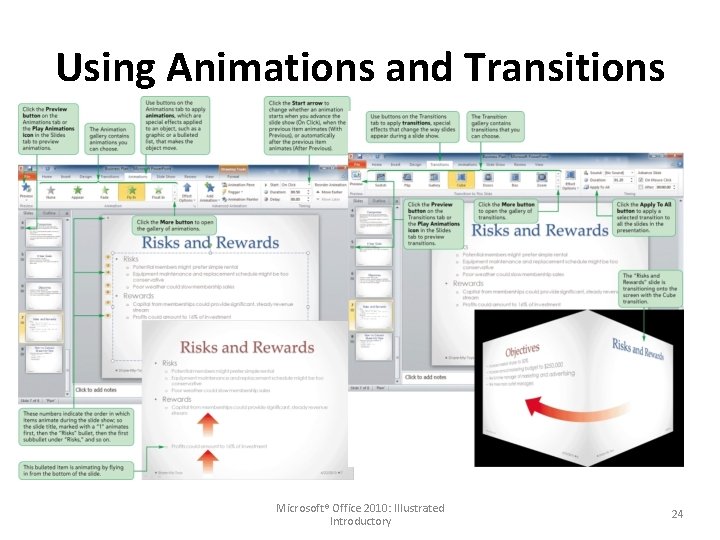
Animating Objects • Animations let you control how objects and text appear on the screen during a slide show and allow you to manage the flow of information and emphasize specific facts. Microsoft® Office 2010: Illustrated Introductory 25
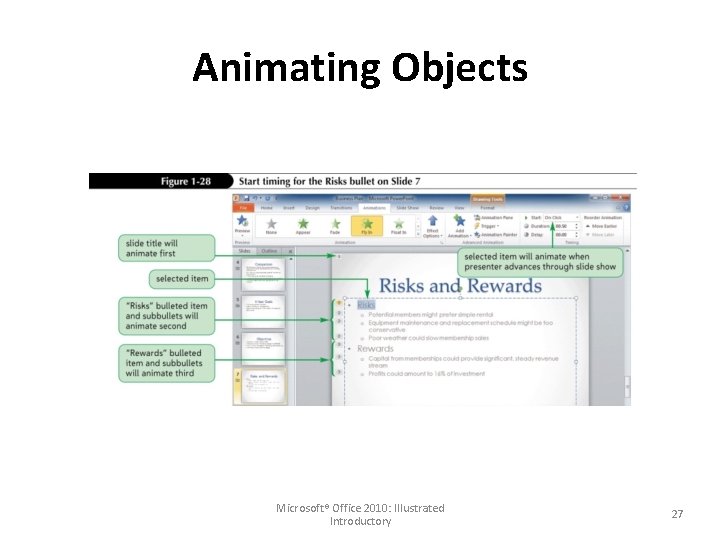
Animating Objects • Modifying the Start Timing of the Animation of Subbullets – In the Slide pane, click anywhere in the text box containing the subbullets to make it active – Click the Animations tab on the Ribbon, and then apply an animation to the active text box – In the Slide pane, select all the subbullets on the slide, or select all the bulleted items on the slide, or click the dashed line box surrounding the text box so it changes to a solid line – On the Animations tab, in the Timing group, click the Start button arrow, and then click On Click or After Previous Microsoft® Office 2010: Illustrated Introductory 26
Animating Objects Microsoft® Office 2010: Illustrated Introductory 27
Adding Transitions • Slide transitions are the special visual and audio effects you apply to a slide that determine how it moves on and off the screen during the slide show. • Slide timing refers to the amount of time a slide is visible on the screen. Microsoft® Office 2010: Illustrated Introductory 28
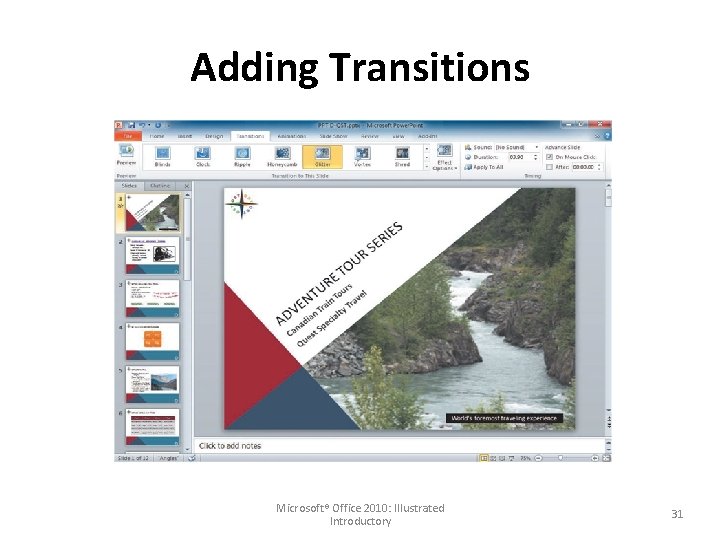
Adding Transitions • In the Slides tab or the Outline tab in Normal view or in Slide Sorter view, select the slide(s) to which you want to add a transition, or, if applying to all the slides, select any slide • Click the Transitions tab on the Ribbon • In the Transition to This Slide group, click the More button to display the gallery of transition effects • Click the desired transition effect in the gallery Microsoft® Office 2010: Illustrated Introductory 29
Adding Transitions • If desired, in the Timing group, click the Transition Sound button arrow to insert a sound effect to accompany each transition • If desired, in the Timing group, click the Transition Speed button arrow to modify the speed of the transition • To apply the transition to all of the slides in the presentation, in the Timing group, click the Apply to All button Microsoft® Office 2010: Illustrated Introductory 30
Adding Transitions Microsoft® Office 2010: Illustrated Introductory 31
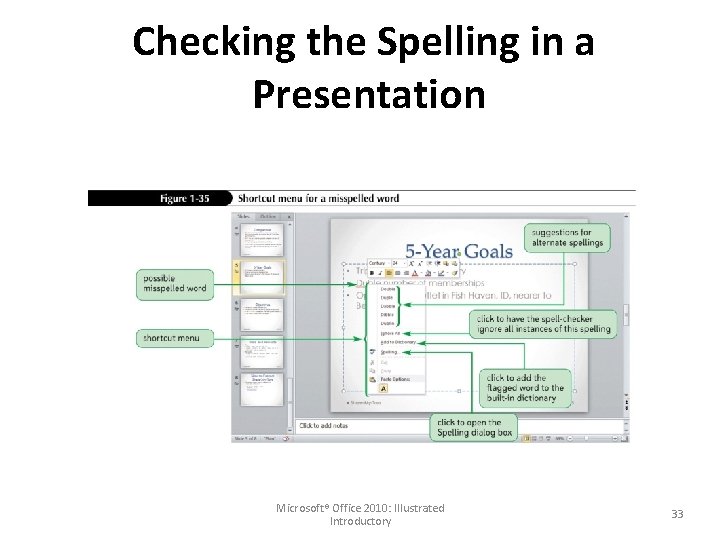
Checking the Spelling in a Presentation • Before you print or present a slide show, you should always perform a final check of the spelling of all the slides in your presentation • Power. Point does two types of spell-checking: – The regular type is when Power. Point finds a word that’s not in its dictionary – The other type is called contextual spellchecking, which checks the context in which a word is used Microsoft® Office 2010: Illustrated Introductory 32
Checking the Spelling in a Presentation Microsoft® Office 2010: Illustrated Introductory 33
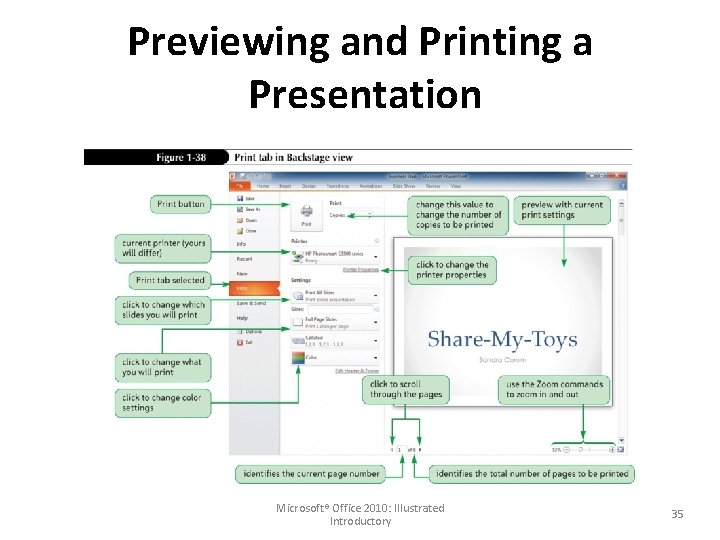
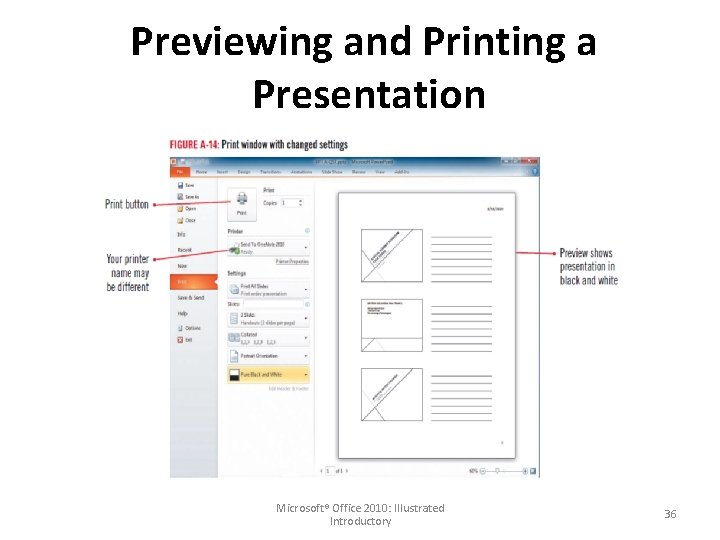
Previewing and Printing a Presentation • Power. Point provides several printing options: – Colour, grayscale, or pure black and white – Full page slides – Notes pages – Outline – Hand-outs Microsoft® Office 2010: Illustrated Introductory 34
Previewing and Printing a Presentation Microsoft® Office 2010: Illustrated Introductory 35
Previewing and Printing a Presentation Microsoft® Office 2010: Illustrated Introductory 36