
MSF and Teamwork Eric S Holmboe Multisource Feedback
MSF and Teamwork Eric S. Holmboe
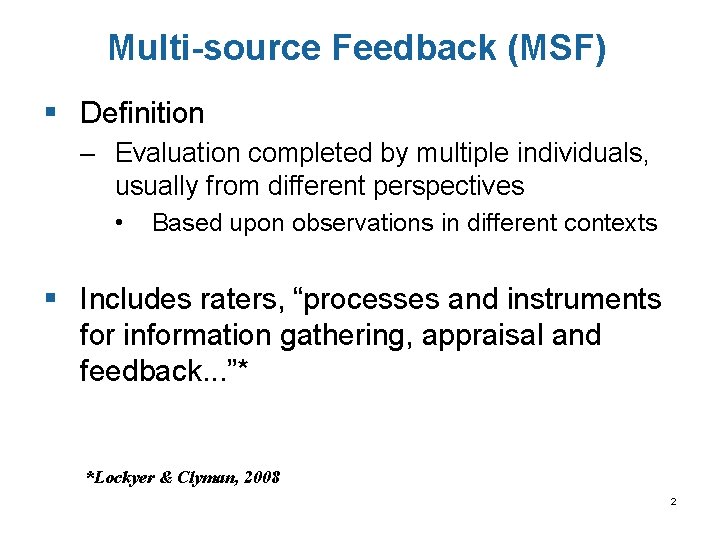
Multi-source Feedback (MSF) § Definition – Evaluation completed by multiple individuals, usually from different perspectives • Based upon observations in different contexts § Includes raters, “processes and instruments for information gathering, appraisal and feedback. . . ”* *Lockyer & Clyman, 2008 2
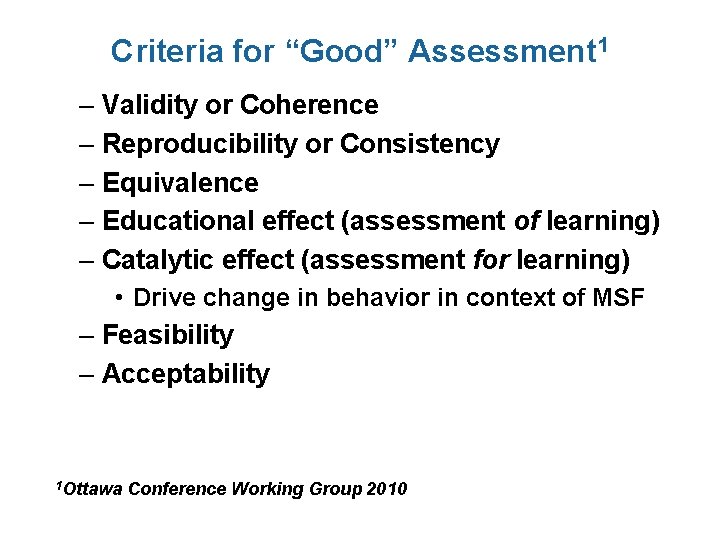
Criteria for “Good” Assessment 1 – Validity or Coherence – Reproducibility or Consistency – Equivalence – Educational effect (assessment of learning) – Catalytic effect (assessment for learning) • Drive change in behavior in context of MSF – Feasibility – Acceptability 1 Ottawa Conference Working Group 2010
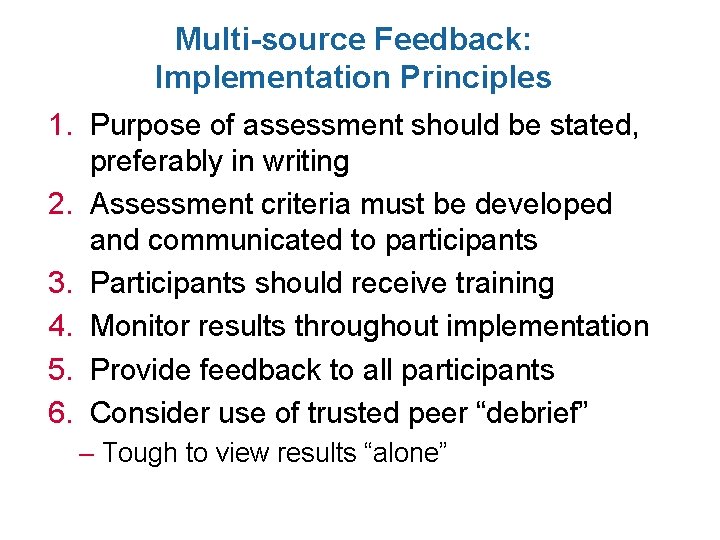
Multi-source Feedback: Implementation Principles 1. Purpose of assessment should be stated, preferably in writing 2. Assessment criteria must be developed and communicated to participants 3. Participants should receive training 4. Monitor results throughout implementation 5. Provide feedback to all participants 6. Consider use of trusted peer “debrief” – Tough to view results “alone”
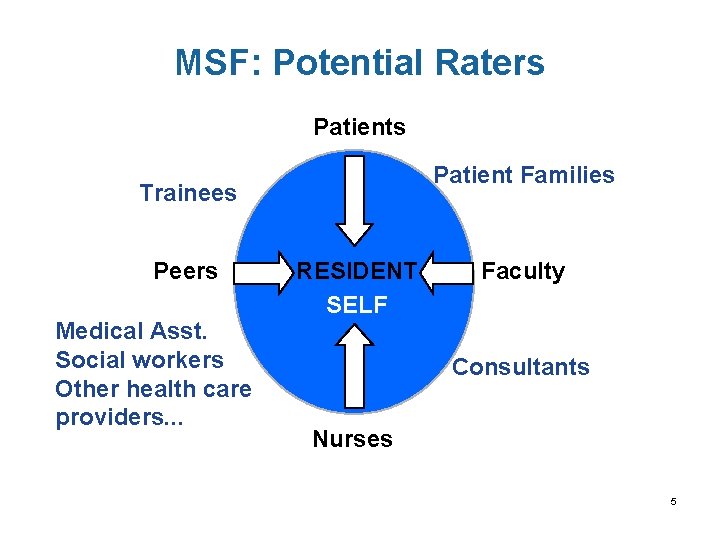
MSF: Potential Raters Patient Families Trainees Peers Medical Asst. Social workers Other health care providers. . . RESIDENT SELF Faculty Consultants Nurses 5
MSF: Reliability and Validity § Limited information in medical education § Limitations similar to other rating scales § Validity – Variable correlations between groups – Nurse ratings – depends upon rating site and rater background § Uses – Formative assessment and feedback; not currently suitable for summative assessments § Reliability – Depends to some degree on the rater group 6
MSF: Peers § Issues in peer assessment – Assessment of task versus global rating – Performance of specific actions versus “quality” of those actions • Do they have the requisite experience and skill to make such judgments? – Ability to make distinctions
MSF: Nurses § Data exists to suggest very good reliability with fewer nursing evaluations compared to patient satisfaction ratings – Study by Butterfield found that 3 -5 nursing evaluations could identify “outlier” physicians 90% of the time – Study by Wenrich, et al found that 10 -15 nursing evals required for sufficient reliability
MSF: Nurses § Factor analysis, however, shows 2 main things drive ratings: – Perceived cognitive skill – Humanistic qualities • Thus perhaps a “good thing” for this competency § Nursing and faculty ratings of “humanism” do not always correlate
MSF: Patients § Surveys should target patient experience, not just satisfaction – Should possess sufficient reliability • Provider-level CAHPS: 45 per physician for higher stakes decisions § Recent studies: some correlation between patient experience ratings and physician performance (practicing docs) § Patient experience surveys best used as a formative assessment tool in training
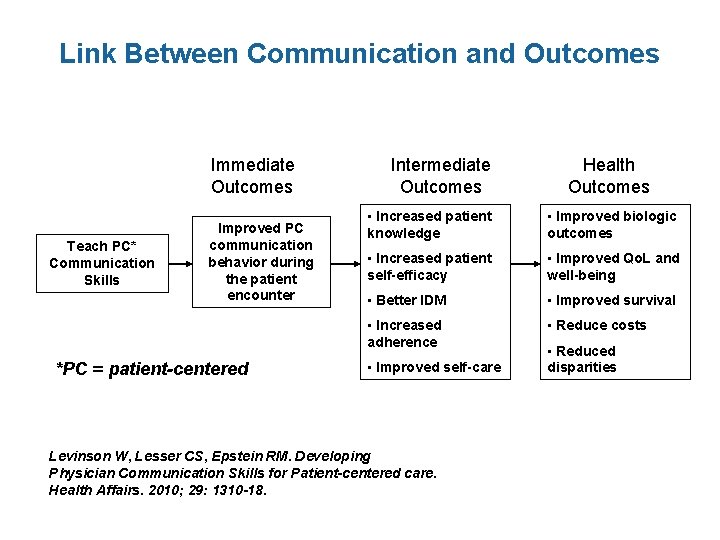
Link Between Communication and Outcomes Immediate Outcomes Teach PC* Communication Skills Improved PC communication behavior during the patient encounter *PC = patient-centered Intermediate Outcomes Health Outcomes • Increased patient knowledge • Improved biologic outcomes • Increased patient self-efficacy • Improved Qo. L and well-being • Better IDM • Improved survival • Increased adherence • Reduce costs • Improved self-care Levinson W, Lesser CS, Epstein RM. Developing Physician Communication Skills for Patient-centered care. Health Affairs. 2010; 29: 1310 -18. • Reduced disparities
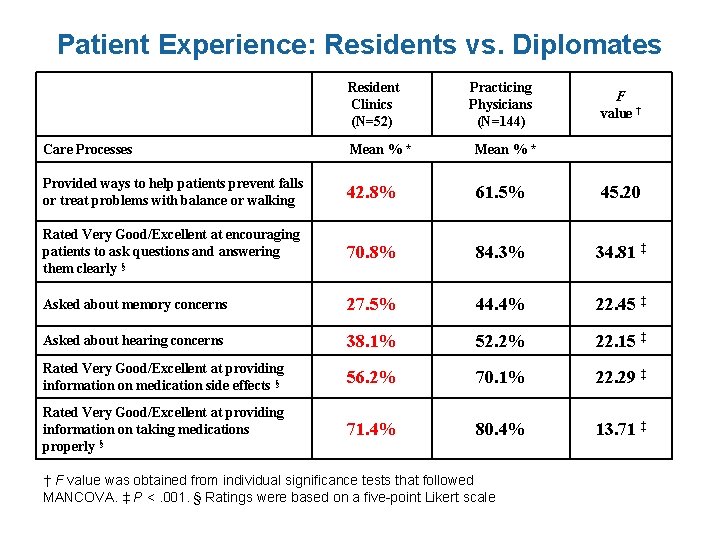
Patient Experience: Residents vs. Diplomates Resident Clinics (N=52) Practicing Physicians (N=144) F value † Care Processes Mean % * Provided ways to help patients prevent falls or treat problems with balance or walking 42. 8% 61. 5% 45. 20 Rated Very Good/Excellent at encouraging patients to ask questions and answering them clearly § 70. 8% 84. 3% 34. 81 ‡ Asked about memory concerns 27. 5% 44. 4% 22. 45 ‡ Asked about hearing concerns 38. 1% 52. 2% 22. 15 ‡ Rated Very Good/Excellent at providing information on medication side effects § 56. 2% 70. 1% 22. 29 ‡ Rated Very Good/Excellent at providing information on taking medications properly § 71. 4% 80. 4% 13. 71 ‡ † F value was obtained from individual significance tests that followed MANCOVA. ‡ P <. 001. § Ratings were based on a five-point Likert scale
NBME Assessment of Professional Behaviors § Uses MSF approach to assess “professional behaviors – Piloted in a number of schools and residency programs – Designed to be used as a “program” • Does require a fee • Reportedly paper based. – Now available to all interested programs • Access at http: //www. nbme. org/Schools/APB/index. html
NBME Assessment of Professional Behaviors § Examples of items on NBME instrument: – Discusses patients in a respectful manner – Solicits input from nurses and other health care providers – Maintains composure during difficult interactions – Shows initiative for own learning
Additional Instruments § CAHPS (patients only) § ABIM peer and patient surveys – Specific patient survey in Co. VE PIM § PAR MSF surveys – Alberta and Nova Scotia, Canada § UK peer and patient surveys (GMC; SPRAT) § Commercial – Voices 360
Clinimetric Approach § Concato and Feinstein 1 – Three simple questions at end of visit: • What do you like the most? • What did you like least? • What one thing would you like to see change? – Interviews took 5 minutes or less as part of “sign-out” – Uncovered a number of issues not detected by VA psychometric instrument: • “For example, problems with parking emerged as the most common source of dissatisfaction, and plans for a shuttle bus to transport patients were developed. ” 1 Concato J, Feinstein AR. Asking patients what they like: overlooked attributes of patient satisfaction with primary care. Am J Med. 1997 102: 399 -406
MSF: Exercise § With a colleague: – How could MSF improve geriatric training in your institution? • How can these MSF raters help a trainee to improve their care of older adults through MSF? 17
Self assessment § Important aspect of self reflection – Essential for life long learning – Needed to be effective member of interdisciplinary teams – Needed to understand how communication patterns and actions affect interpersonal relationships
Self-Assessment Skills § Systematic review (Davis, JAMA, 2006) – Accuracy of self-assessment compared to external observation – 17 studies included; 20 total comparisons • 13 demonstrated little, no or inverse relationship – Worst accuracy of self-assessment among least skilled physicians
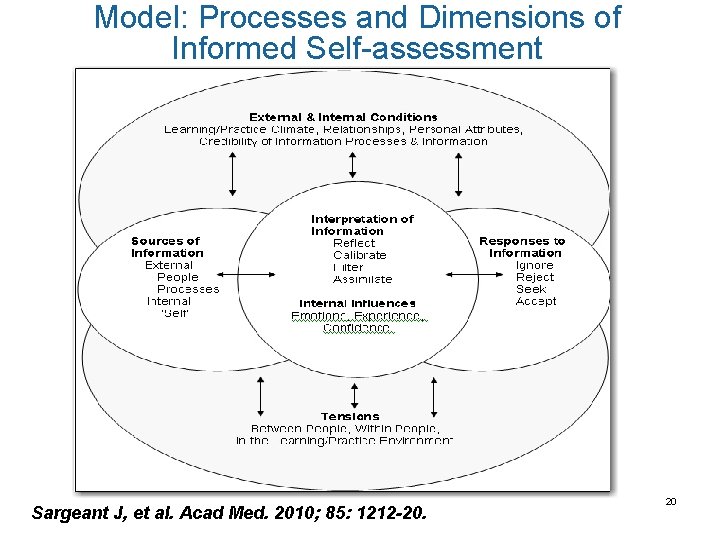
Model: Processes and Dimensions of Informed Self-assessment Sargeant J, et al. Acad Med. 2010; 85: 1212 -20. 20
Teamwork Competencies § Baker (AHRQ, 2005) – Systematic review of literature on teamwork competencies • Most evidence from other fields – Crew resource management (aviation) – Surprisingly little information from medicine
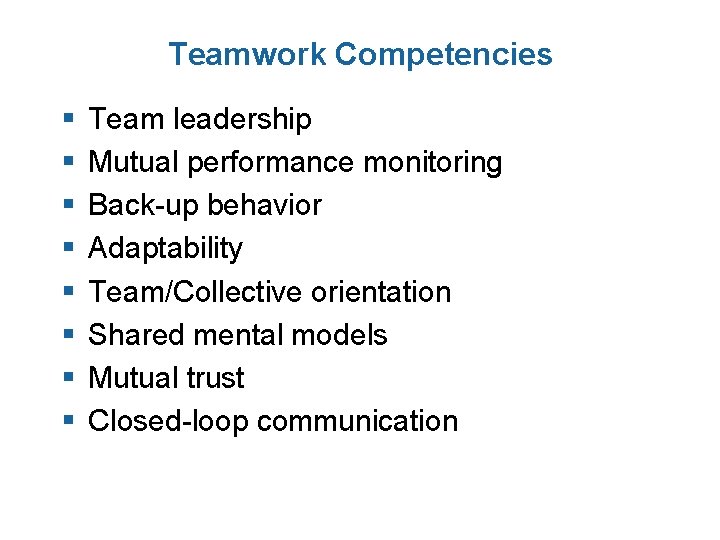
Teamwork Competencies § § § § Team leadership Mutual performance monitoring Back-up behavior Adaptability Team/Collective orientation Shared mental models Mutual trust Closed-loop communication
Back-up Behavior § Ability to anticipate other team member’s needs to shift workload among members to achieve balance during high periods of workload – Recognition by potential back-up providers there is a workload distribution problem – Shifting of work responsibilities to underutilized team members
Closed-loop Communication § The exchange of information between a sender and a receiver irrespective of the medium – Following up with the team members to ensure message was received – Acknowledging that a message was received – Clarifying with the sender of the message that the message received is the same as the intended message sent.
The “I” in “team” Healthcare systems = “loosely coupled” Individual providers need ↑ teamwork competency to ensure safe, effective care Hard to give/get feedback, esp. across professions Hospitalists: unique role, unique challenges
Conceptual model Interprofessional teamwork: meeting everyday obligations to other providers with whom one cares for patients 4 overlapping areas: • Communication (clear, timely, respectful) • Collaboration (sharing decisions as appropriate) • Dealing with hierarchy (mitigating bad effects) • Awareness of shared context and resources
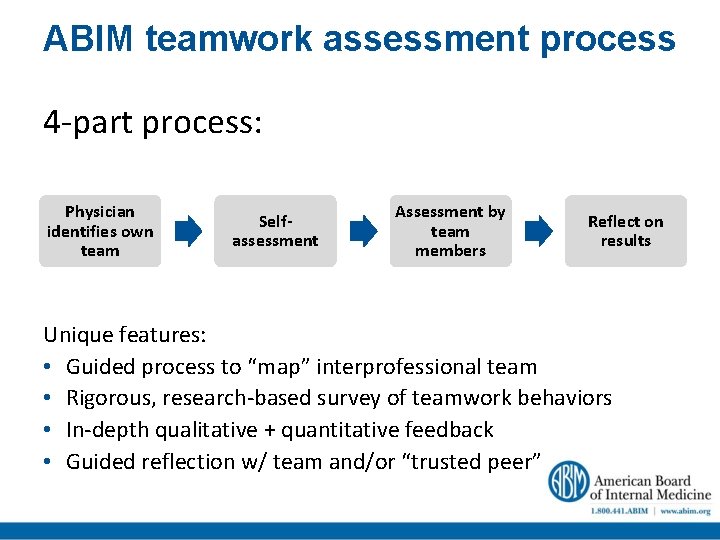
ABIM teamwork assessment process 4 -part process: Physician identifies own team Selfassessment Assessment by team members Reflect on results Unique features: • Guided process to “map” interprofessional team • Rigorous, research-based survey of teamwork behaviors • In-depth qualitative + quantitative feedback • Guided reflection w/ team and/or “trusted peer”
Pilot test Tested with self-selected sample of 25 hospitalists: • 20 of 25 completed assessment process • Follow-up interviews with all 25 hospitalists • Analyzing data Results: • Very promising, even in challenging context • Hospitalists found feedback valuable and actionable • Guided debrief with peer taken seriously • Raters asked to rate other physicians (e. g. , surgeons)
MSF: Strengths § Focuses on actual “workplace” performance § Captures different perspectives: – Patients and nurses - evaluate humanism, professionalism, communication – Peers – work ethic, team approach, professionalism – Others – unique observations on key attributes § Adaptable: – Ideal approach to assessment of professionalism – Supplementary assessment of: • Communication / IPS, Patient Care, SBP 29
MSF: Limitations § Limited information in medical education and practice § Measurement issues: – Uncontrolled environment – Usual limitations of global rating forms: • Reliability and validity § Feasibility issues: logistics of data collection, entry, analysis and reporting results § Cultural issues: – Personal feedback, rater and learner resistance, confidentiality 30
MSF: Conclusions § Uses – Professionalism; Systems-based Practice, Interpersonal and Communication Skills § Raters should be appropriately trained to provide ratings based upon the context of observation and qualifications § Communication of objectives through MSF assessment – Reinforces importance of team approach and patientcenteredness 31

Questions
- Slides: 32