
MSEG 667 Nanophotonics Materials and Devices 7 Optical
- Slides: 43
MSEG 667 Nanophotonics: Materials and Devices 7: Optical Scattering Prof. Juejun (JJ) Hu hujuejun@udel. edu
References n n n Principles of Nano-optics, Ch. 12 Electromagnetic Wave Theory, Ch. 6 Light Scattering by Small Particles ¨ n H. van de Hulst, Dover Publications Absorption and Scattering of Light by Small Particles ¨ C. Bohren and D. Huffman, Wiley-VCH
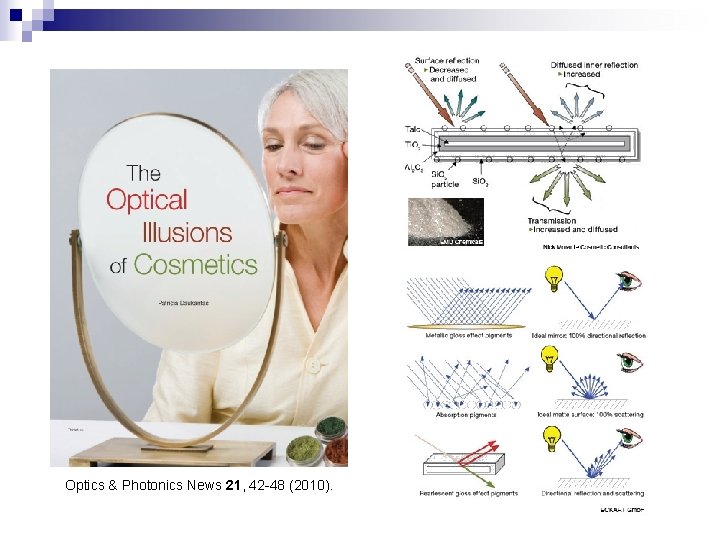
Optics & Photonics News 21, 42 -48 (2010).
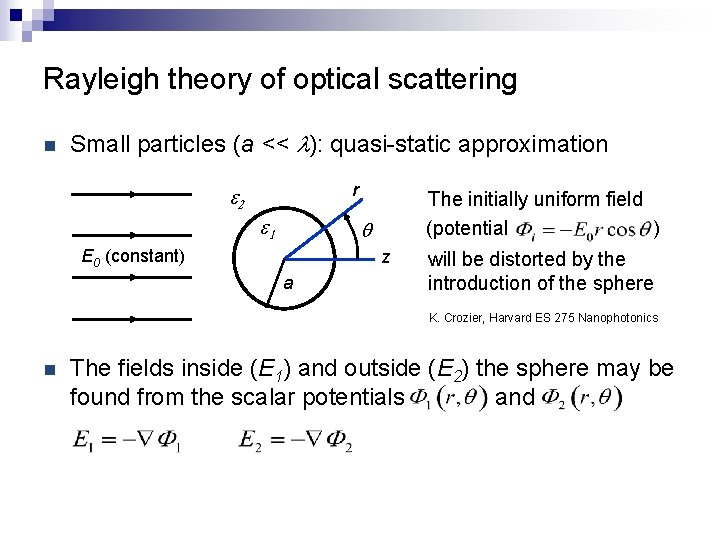
Rayleigh theory of optical scattering n Small particles (a << l): quasi-static approximation r e 2 e 1 The initially uniform field (potential ) q E 0 (constant) z a will be distorted by the introduction of the sphere K. Crozier, Harvard ES 275 Nanophotonics n The fields inside (E 1) and outside (E 2) the sphere may be found from the scalar potentials and
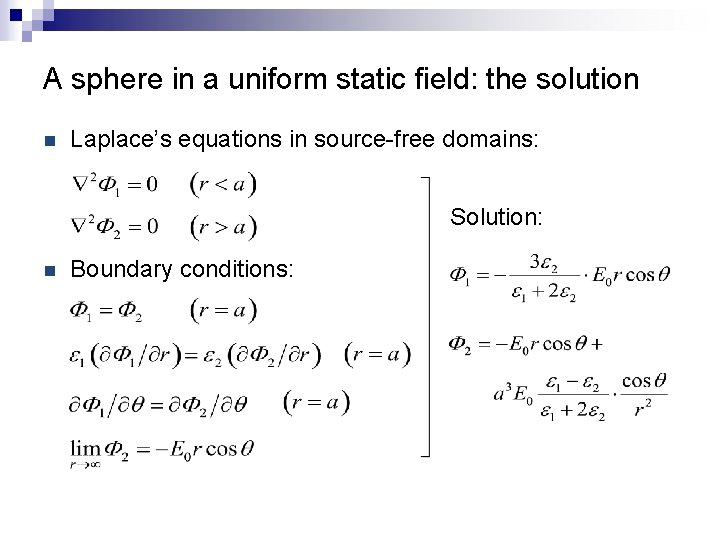
A sphere in a uniform static field: the solution n Laplace’s equations in source-free domains: Solution: n Boundary conditions:
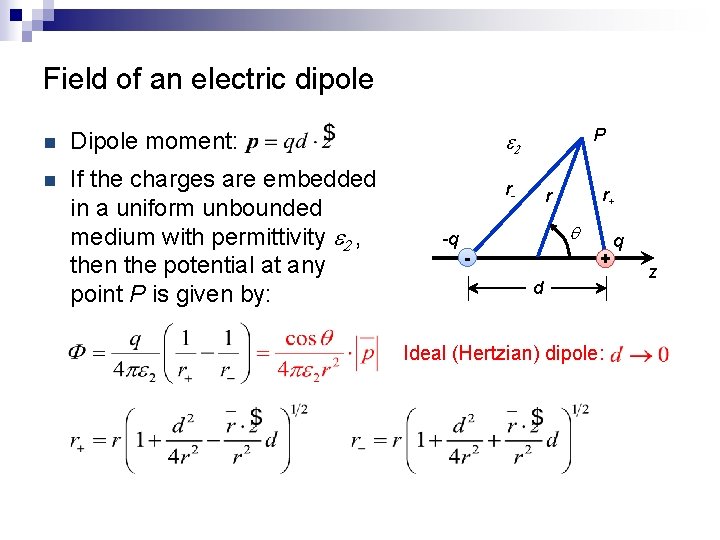
Field of an electric dipole n Dipole moment: n If the charges are embedded in a uniform unbounded medium with permittivity e 2 , then the potential at any point P is given by: P e 2 r-q r+ r q - + d Ideal (Hertzian) dipole: q z
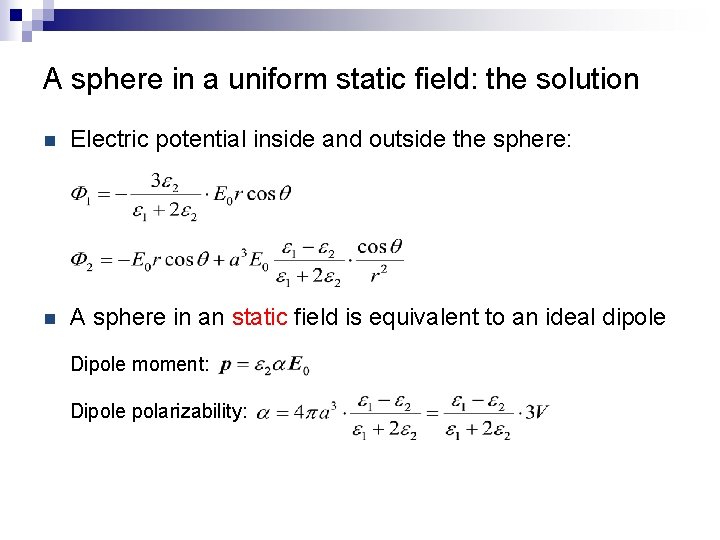
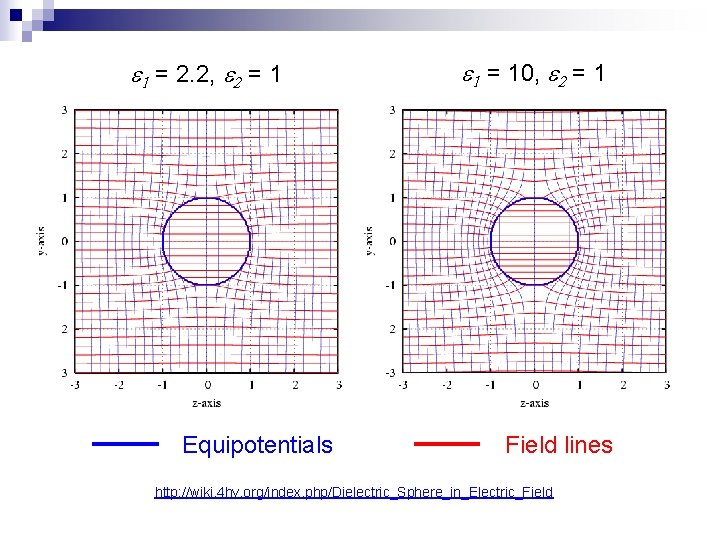
A sphere in a uniform static field: the solution n Electric potential inside and outside the sphere: n A sphere in an static field is equivalent to an ideal dipole Dipole moment: Dipole polarizability:
e 1 = 2. 2, e 2 = 1 Equipotentials e 1 = 10, e 2 = 1 Field lines http: //wiki. 4 hv. org/index. php/Dielectric_Sphere_in_Electric_Field
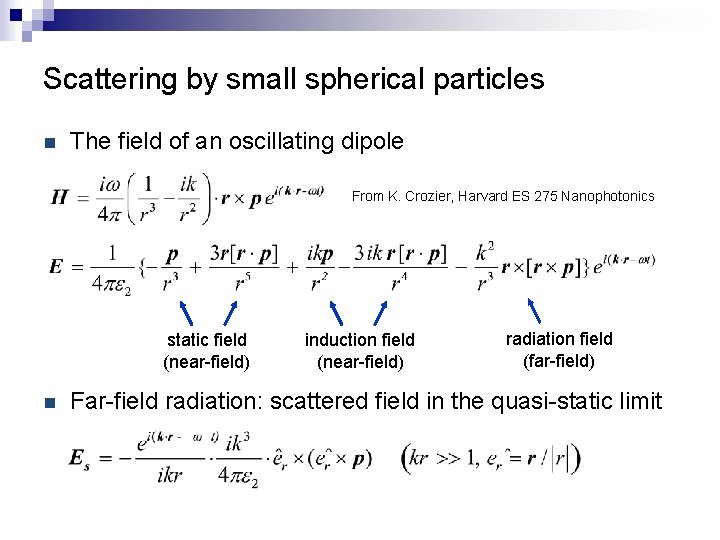
Scattering by small spherical particles n The field of an oscillating dipole From K. Crozier, Harvard ES 275 Nanophotonics static field (near-field) n induction field (near-field) radiation field (far-field) Far-field radiation: scattered field in the quasi-static limit
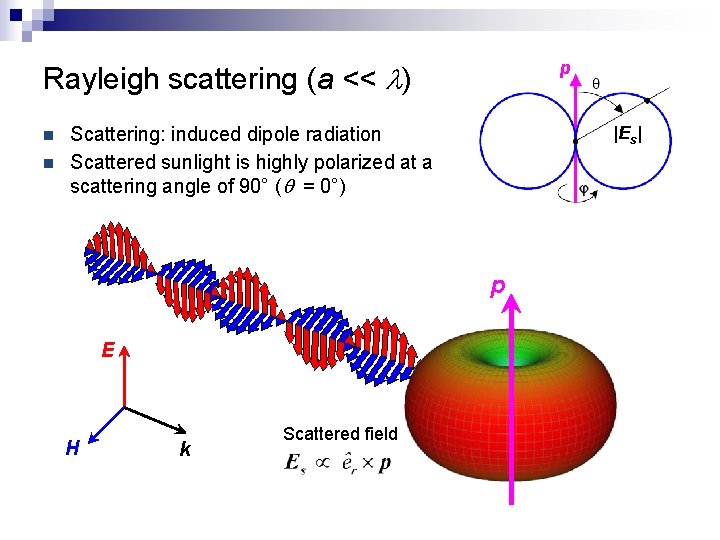
Rayleigh scattering (a << l) n n p Scattering: induced dipole radiation Scattered sunlight is highly polarized at a scattering angle of 90° (q = 0°) |Es| p E H k Scattered field Particle
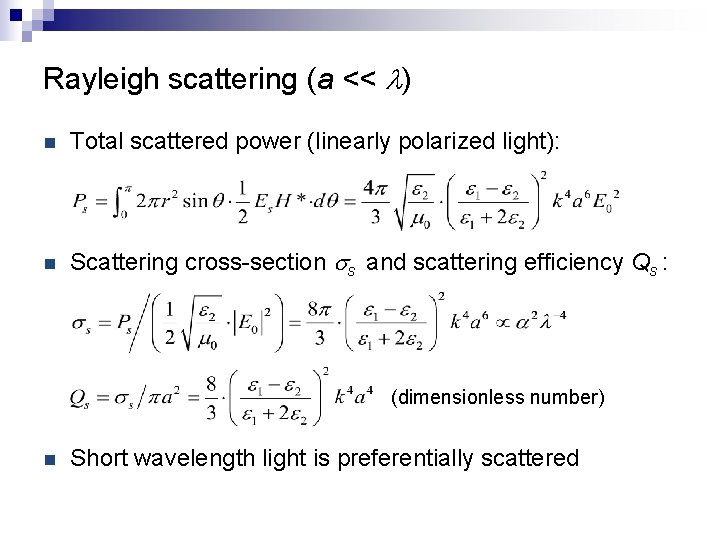
Rayleigh scattering (a << l) n Total scattered power (linearly polarized light): n Scattering cross-section ss and scattering efficiency Qs : (dimensionless number) n Short wavelength light is preferentially scattered
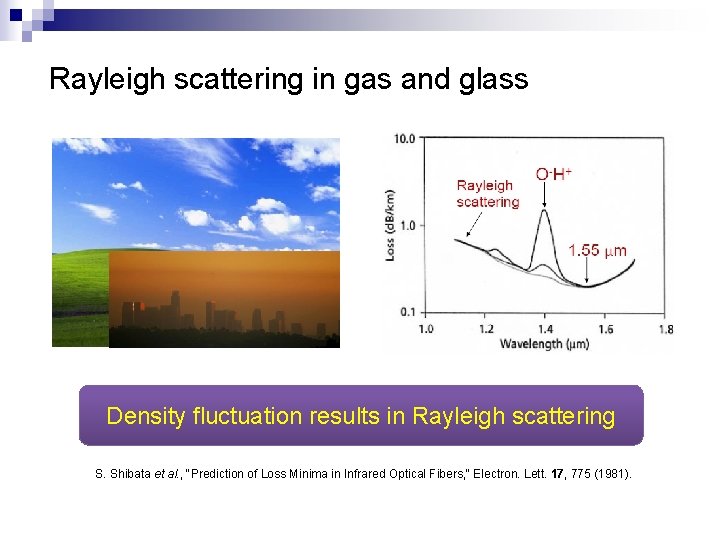
Rayleigh scattering in gas and glass Density fluctuation results in Rayleigh scattering S. Shibata et al. , "Prediction of Loss Minima in Infrared Optical Fibers, " Electron. Lett. 17, 775 (1981).
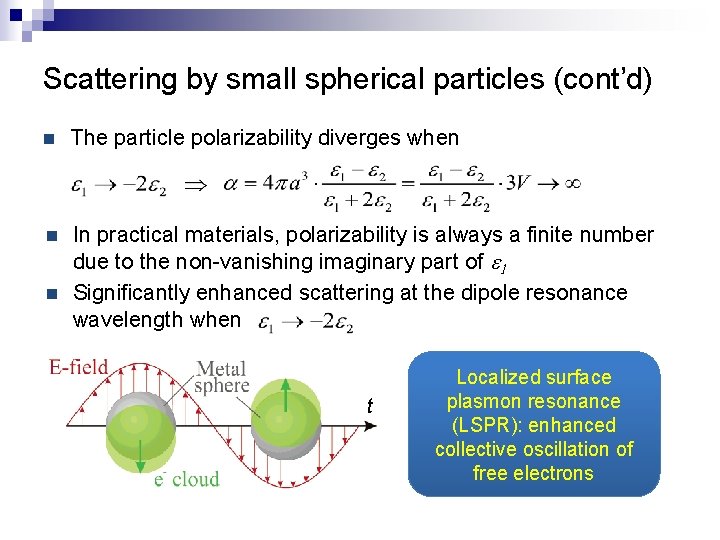
Scattering by small spherical particles (cont’d) n The particle polarizability diverges when n In practical materials, polarizability is always a finite number due to the non-vanishing imaginary part of e 1 Significantly enhanced scattering at the dipole resonance wavelength when n t Localized surface plasmon resonance (LSPR): enhanced collective oscillation of free electrons
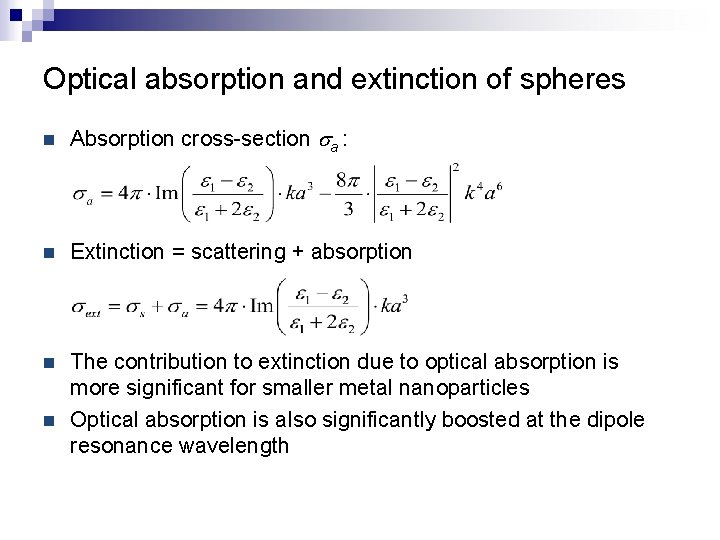
Optical absorption and extinction of spheres n Absorption cross-section sa : n Extinction = scattering + absorption n The contribution to extinction due to optical absorption is more significant for smaller metal nanoparticles Optical absorption is also significantly boosted at the dipole resonance wavelength n
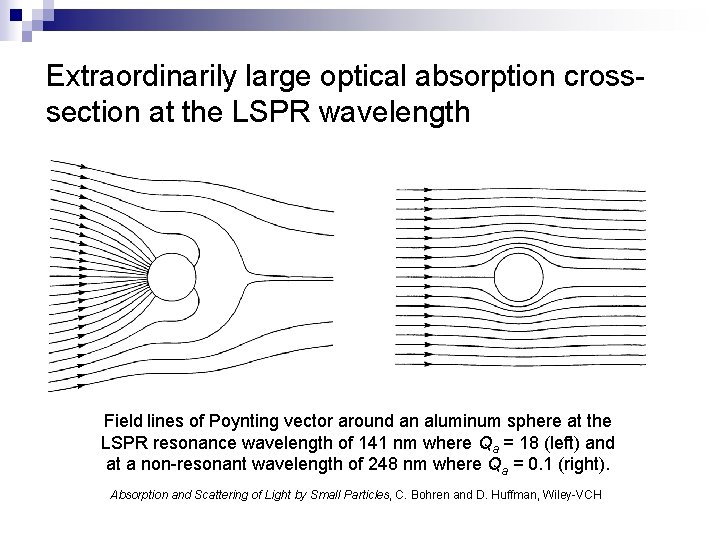
Extraordinarily large optical absorption crosssection at the LSPR wavelength Field lines of Poynting vector around an aluminum sphere at the LSPR resonance wavelength of 141 nm where Qa = 18 (left) and at a non-resonant wavelength of 248 nm where Qa = 0. 1 (right). Absorption and Scattering of Light by Small Particles, C. Bohren and D. Huffman, Wiley-VCH
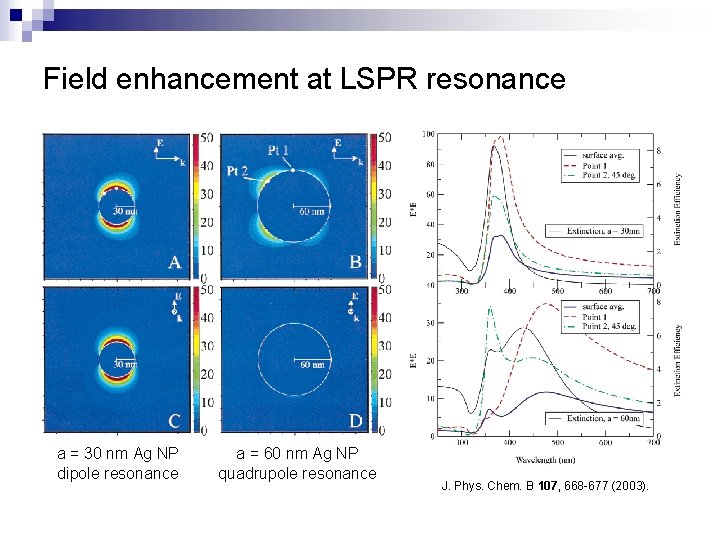
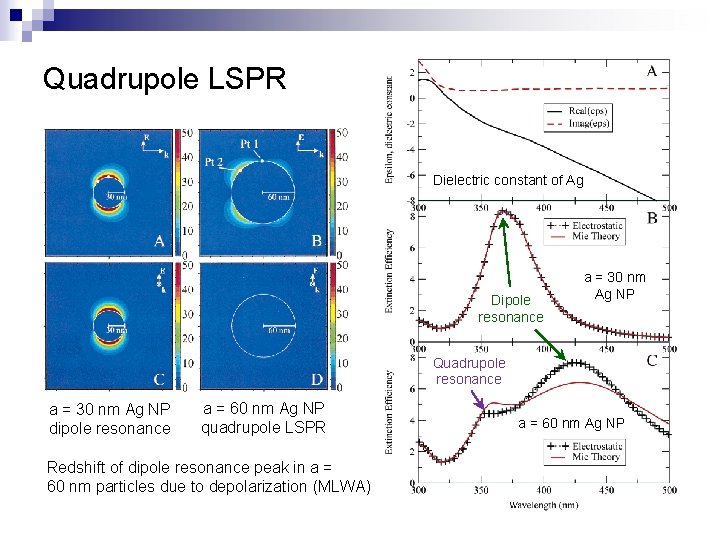
Field enhancement at LSPR resonance a = 30 nm Ag NP dipole resonance a = 60 nm Ag NP quadrupole resonance J. Phys. Chem. B 107, 668 -677 (2003).
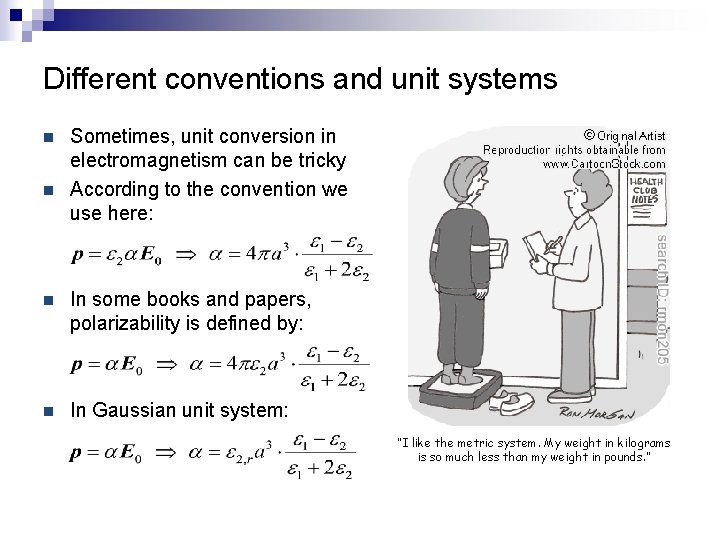
Different conventions and unit systems n n Sometimes, unit conversion in electromagnetism can be tricky According to the convention we use here: n In some books and papers, polarizability is defined by: n In Gaussian unit system: “I like the metric system. My weight in kilograms is so much less than my weight in pounds. ”
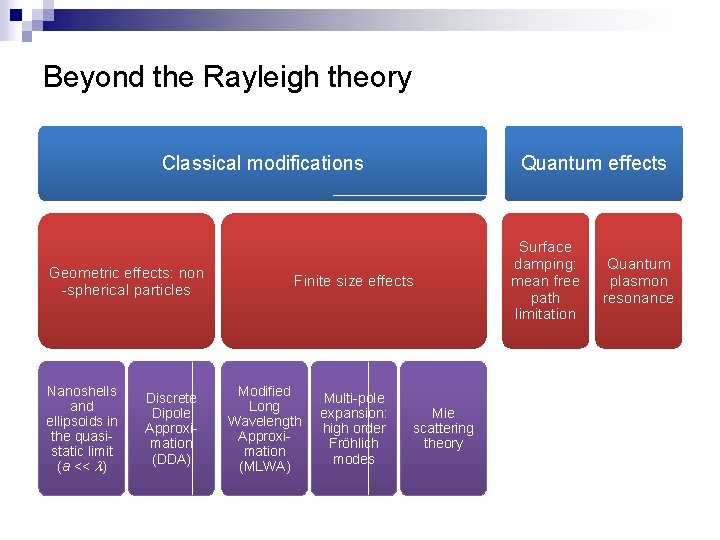
Beyond the Rayleigh theory Quantum effects Classical modifications Geometric effects: non -spherical particles Nanoshells and ellipsoids in the quasistatic limit (a << l) Discrete Dipole Approximation (DDA) Finite size effects Modified Long Wavelength Approximation (MLWA) Multi-pole expansion: high order Fröhlich modes Mie scattering theory Surface damping: mean free path limitation Quantum plasmon resonance
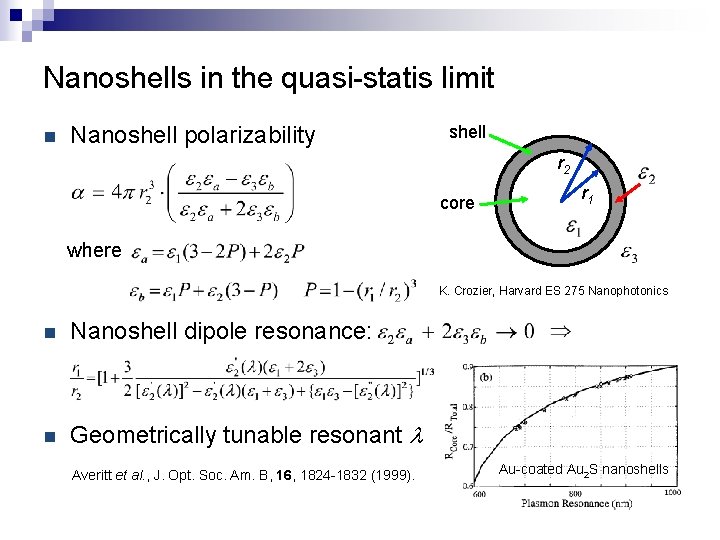
Nanoshells in the quasi-statis limit n Nanoshell polarizability shell r 2 core r 1 where K. Crozier, Harvard ES 275 Nanophotonics n Nanoshell dipole resonance: n Geometrically tunable resonant l Averitt et al. , J. Opt. Soc. Am. B, 16, 1824 -1832 (1999). Au-coated Au 2 S nanoshells
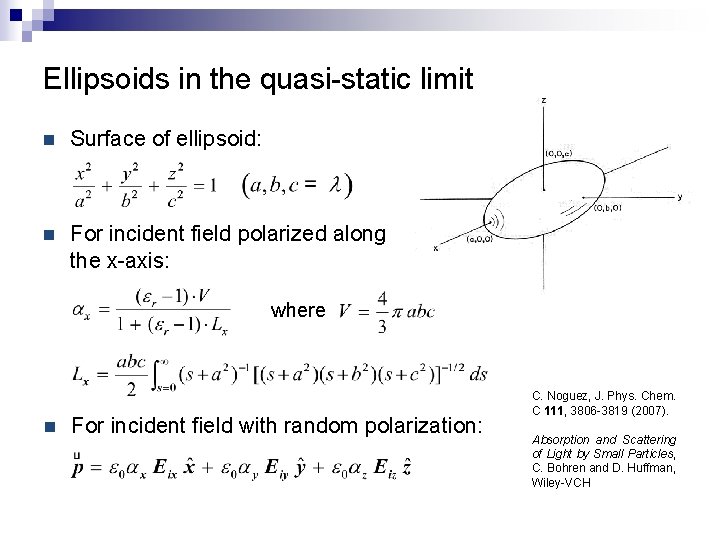
Ellipsoids in the quasi-static limit n Surface of ellipsoid: n For incident field polarized along the x-axis: where n For incident field with random polarization: C. Noguez, J. Phys. Chem. C 111, 3806 -3819 (2007). Absorption and Scattering of Light by Small Particles, C. Bohren and D. Huffman, Wiley-VCH
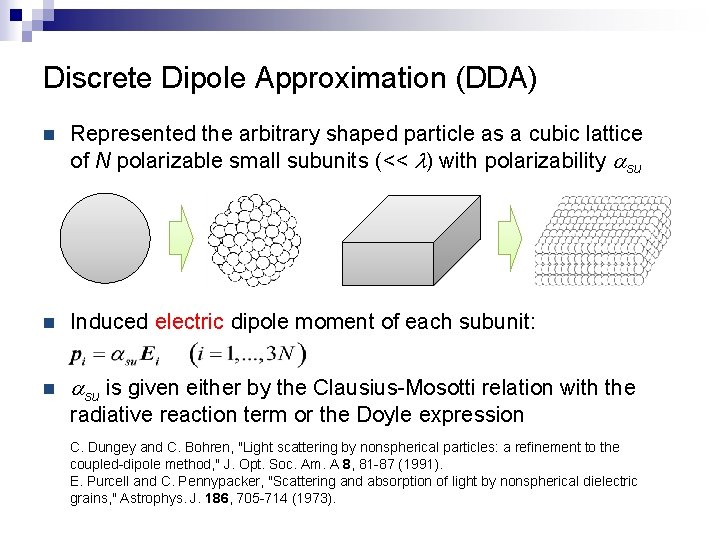
Discrete Dipole Approximation (DDA) n Represented the arbitrary shaped particle as a cubic lattice of N polarizable small subunits (<< l) with polarizability asu n Induced electric dipole moment of each subunit: n asu is given either by the Clausius-Mosotti relation with the radiative reaction term or the Doyle expression C. Dungey and C. Bohren, "Light scattering by nonspherical particles: a refinement to the coupled-dipole method, " J. Opt. Soc. Am. A 8, 81 -87 (1991). E. Purcell and C. Pennypacker, "Scattering and absorption of light by nonspherical dielectric grains, " Astrophys. J. 186, 705 -714 (1973).
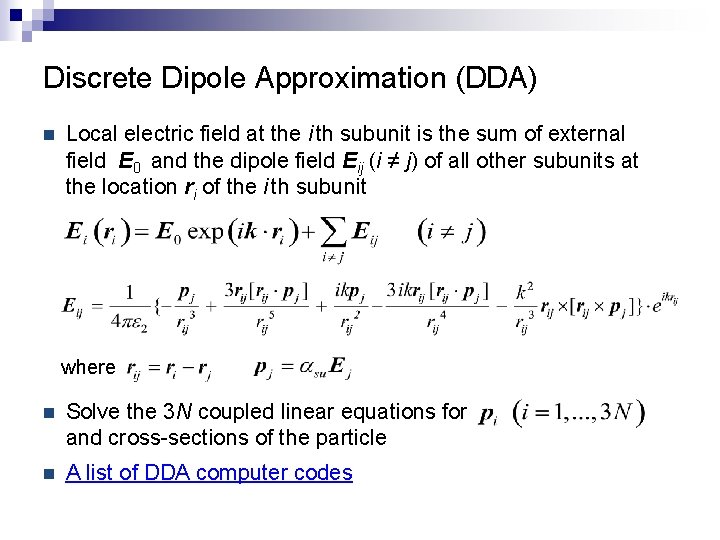
Discrete Dipole Approximation (DDA) n Local electric field at the i th subunit is the sum of external field E 0 and the dipole field Eij (i ≠ j) of all other subunits at the location ri of the i th subunit where n Solve the 3 N coupled linear equations for and cross-sections of the particle n A list of DDA computer codes
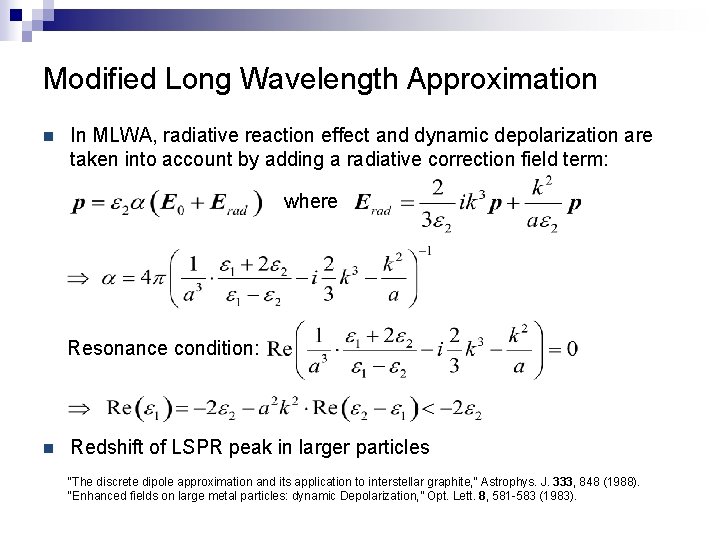
Modified Long Wavelength Approximation n In MLWA, radiative reaction effect and dynamic depolarization are taken into account by adding a radiative correction field term: where Resonance condition: n Redshift of LSPR peak in larger particles “The discrete dipole approximation and its application to interstellar graphite, " Astrophys. J. 333, 848 (1988). “Enhanced fields on large metal particles: dynamic Depolarization, ” Opt. Lett. 8, 581 -583 (1983).
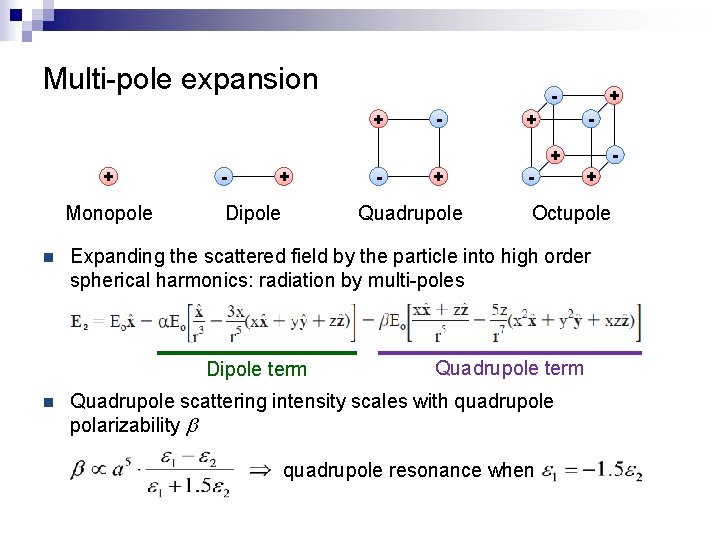
Multi-pole expansion + - + - + + Monopole n - + Dipole + Quadrupole - + Octupole Expanding the scattered field by the particle into high order spherical harmonics: radiation by multi-poles Dipole term n - Quadrupole term Quadrupole scattering intensity scales with quadrupole polarizability b quadrupole resonance when
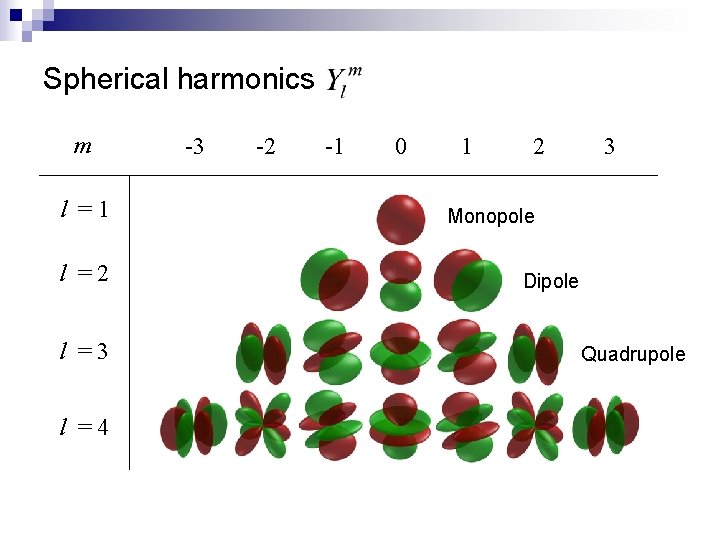
Spherical harmonics m l =1 l =2 l =3 l =4 -3 -2 -1 0 1 2 3 Monopole Dipole Quadrupole
Quadrupole LSPR Dielectric constant of Ag Dipole resonance a = 30 nm Ag NP Quadrupole resonance a = 30 nm Ag NP dipole resonance a = 60 nm Ag NP quadrupole LSPR Redshift of dipole resonance peak in a = 60 nm particles due to depolarization (MLWA) a = 60 nm Ag NP
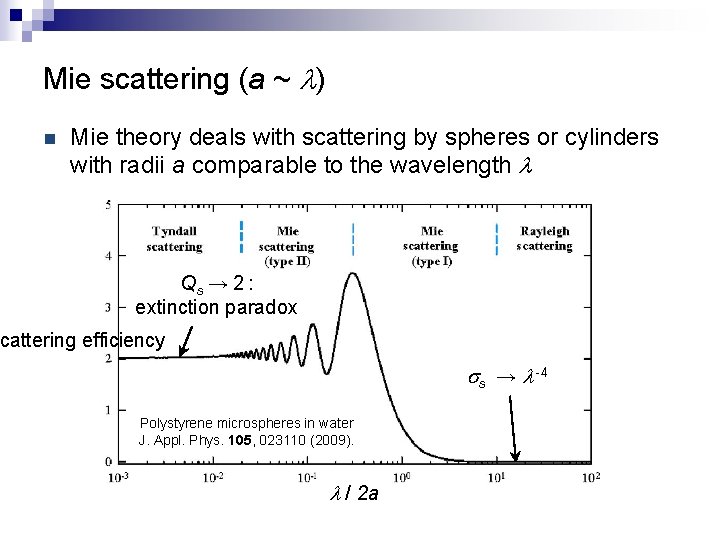
Mie scattering (a ~ l) n Mie theory deals with scattering by spheres or cylinders with radii a comparable to the wavelength l Qs → 2 : extinction paradox cattering efficiency ss → l -4 Polystyrene microspheres in water J. Appl. Phys. 105, 023110 (2009). l / 2 a
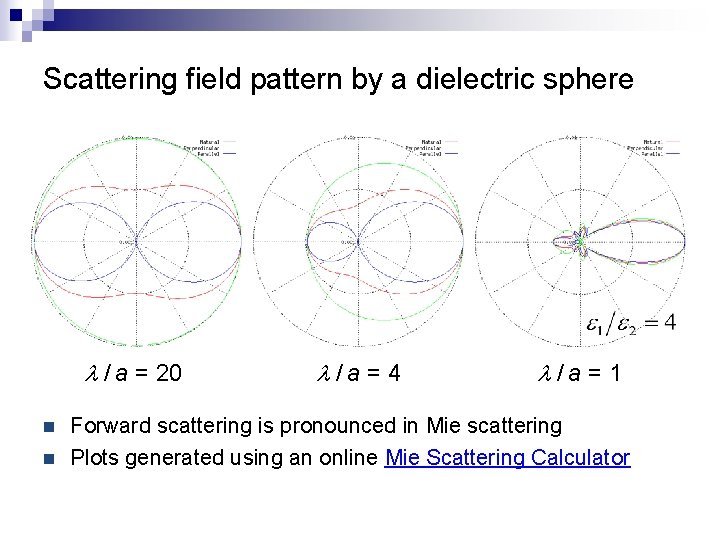
Scattering field pattern by a dielectric sphere l / a = 20 n n l /a = 4 l /a = 1 Forward scattering is pronounced in Mie scattering Plots generated using an online Mie Scattering Calculator
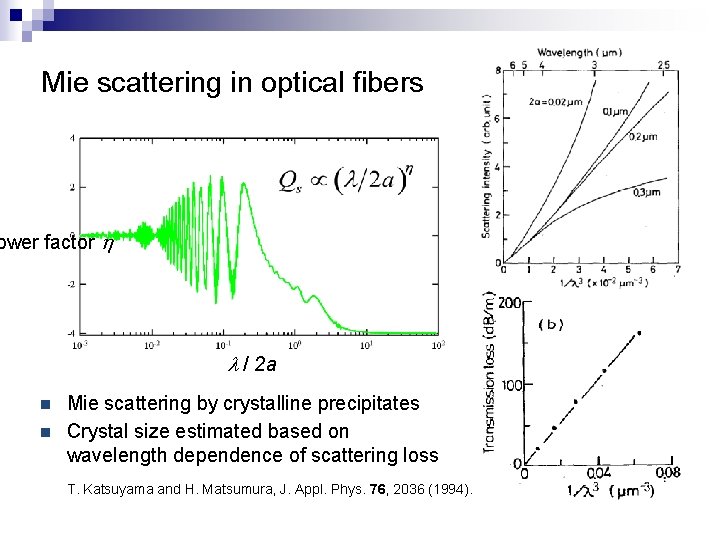
Mie scattering in optical fibers ower factor h l / 2 a n n Mie scattering by crystalline precipitates Crystal size estimated based on wavelength dependence of scattering loss T. Katsuyama and H. Matsumura, J. Appl. Phys. 76, 2036 (1994).
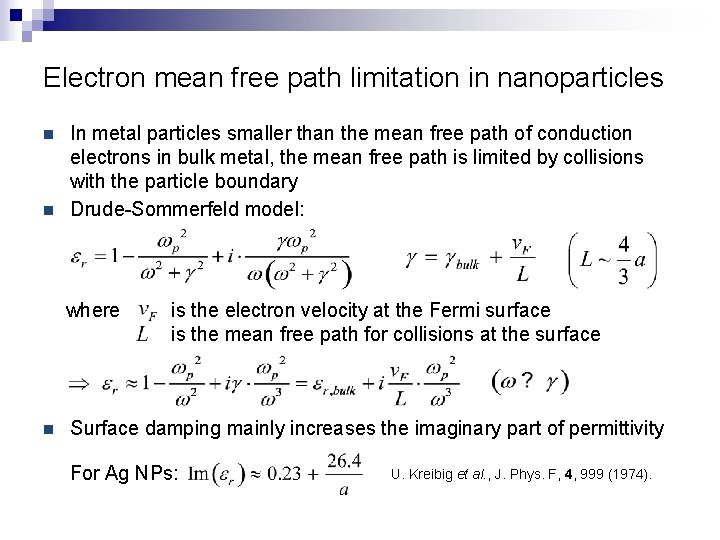
Electron mean free path limitation in nanoparticles n n In metal particles smaller than the mean free path of conduction electrons in bulk metal, the mean free path is limited by collisions with the particle boundary Drude-Sommerfeld model: where n is the electron velocity at the Fermi surface is the mean free path for collisions at the surface Surface damping mainly increases the imaginary part of permittivity For Ag NPs: U. Kreibig et al. , J. Phys. F, 4, 999 (1974).
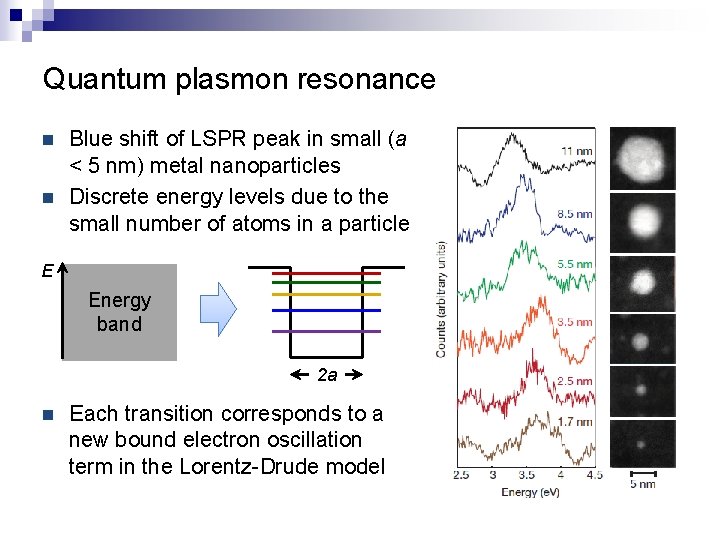
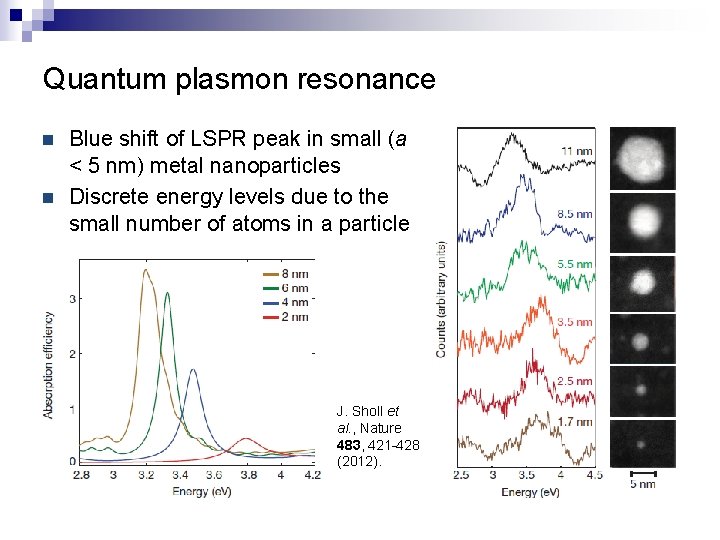
Quantum plasmon resonance n n Blue shift of LSPR peak in small (a < 5 nm) metal nanoparticles Discrete energy levels due to the small number of atoms in a particle E Energy band 2 a n Each transition corresponds to a new bound electron oscillation term in the Lorentz-Drude model
Quantum plasmon resonance n n Blue shift of LSPR peak in small (a < 5 nm) metal nanoparticles Discrete energy levels due to the small number of atoms in a particle J. Sholl et al. , Nature 483, 421 -428 (2012).
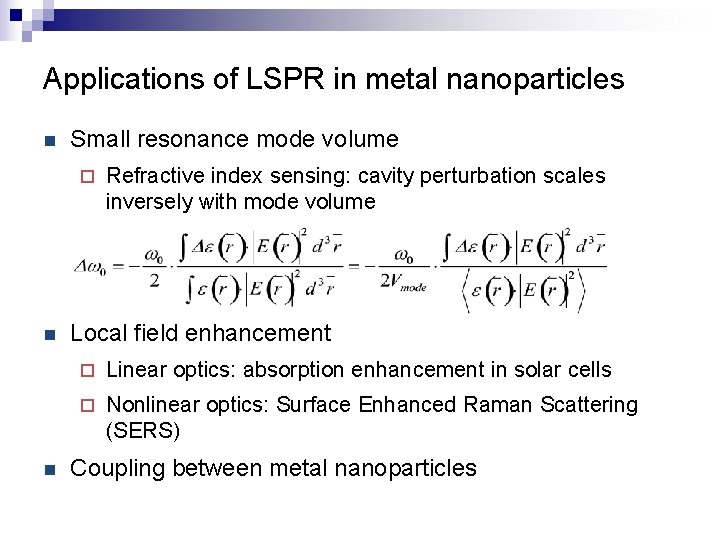
Applications of LSPR in metal nanoparticles n Small resonance mode volume ¨ n n Refractive index sensing: cavity perturbation scales inversely with mode volume Local field enhancement ¨ Linear optics: absorption enhancement in solar cells ¨ Nonlinear optics: Surface Enhanced Raman Scattering (SERS) Coupling between metal nanoparticles
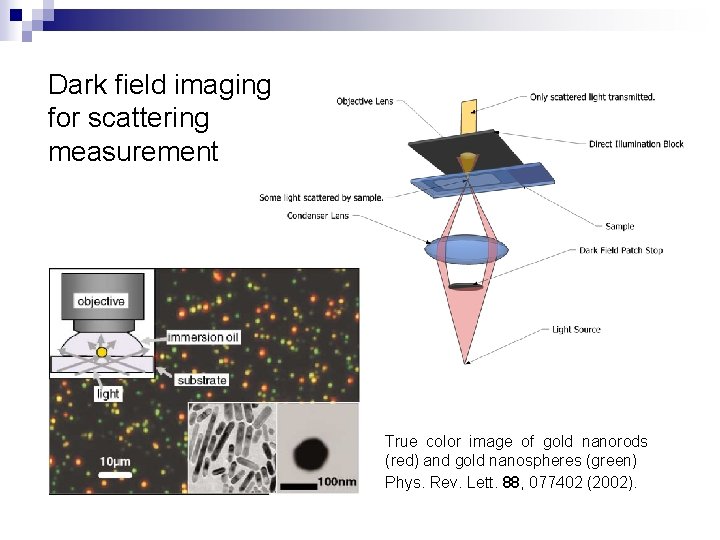
Dark field imaging for scattering measurement True color image of gold nanorods (red) and gold nanospheres (green) Phys. Rev. Lett. 88, 077402 (2002).
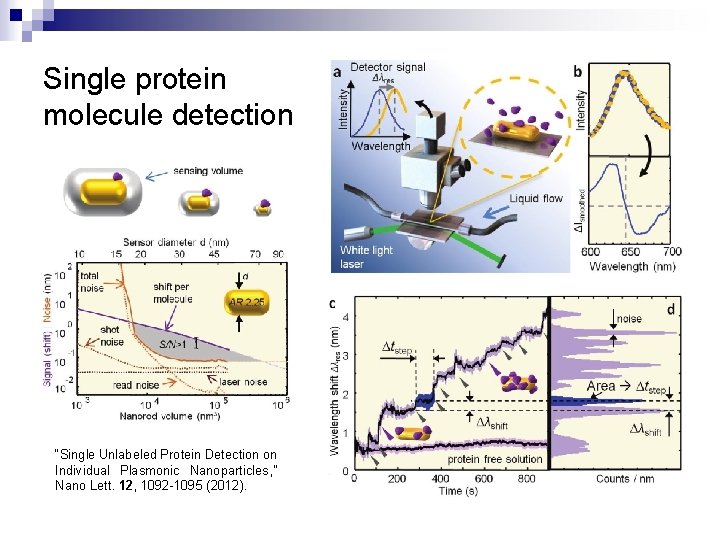
Single protein molecule detection “Single Unlabeled Protein Detection on Individual Plasmonic Nanoparticles, ” Nano Lett. 12, 1092 -1095 (2012).
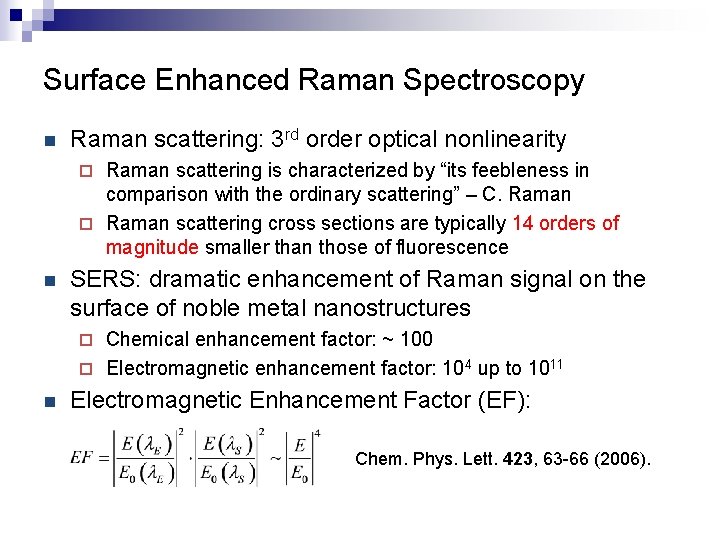
Surface Enhanced Raman Spectroscopy n Raman scattering: 3 rd order optical nonlinearity Raman scattering is characterized by “its feebleness in comparison with the ordinary scattering” – C. Raman ¨ Raman scattering cross sections are typically 14 orders of magnitude smaller than those of fluorescence ¨ n SERS: dramatic enhancement of Raman signal on the surface of noble metal nanostructures Chemical enhancement factor: ~ 100 ¨ Electromagnetic enhancement factor: 104 up to 1011 ¨ n Electromagnetic Enhancement Factor (EF): Chem. Phys. Lett. 423, 63 -66 (2006).
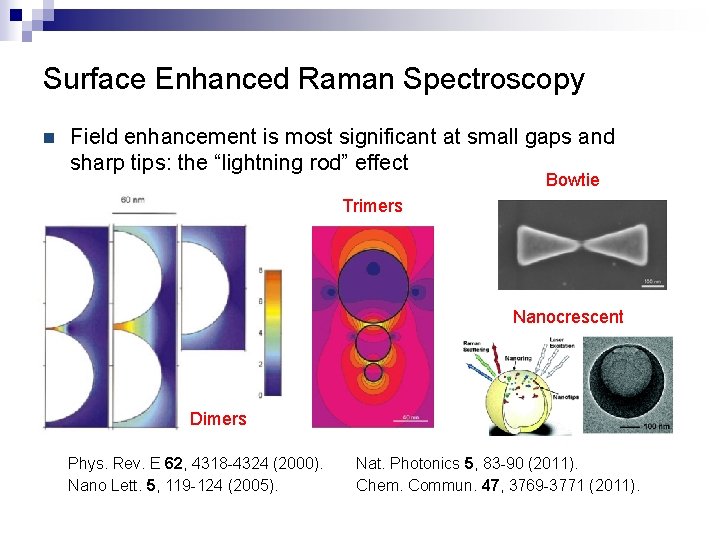
Surface Enhanced Raman Spectroscopy n Field enhancement is most significant at small gaps and sharp tips: the “lightning rod” effect Bowtie Trimers Nanocrescent Dimers Phys. Rev. E 62, 4318 -4324 (2000). Nano Lett. 5, 119 -124 (2005). Nat. Photonics 5, 83 -90 (2011). Chem. Commun. 47, 3769 -3771 (2011).
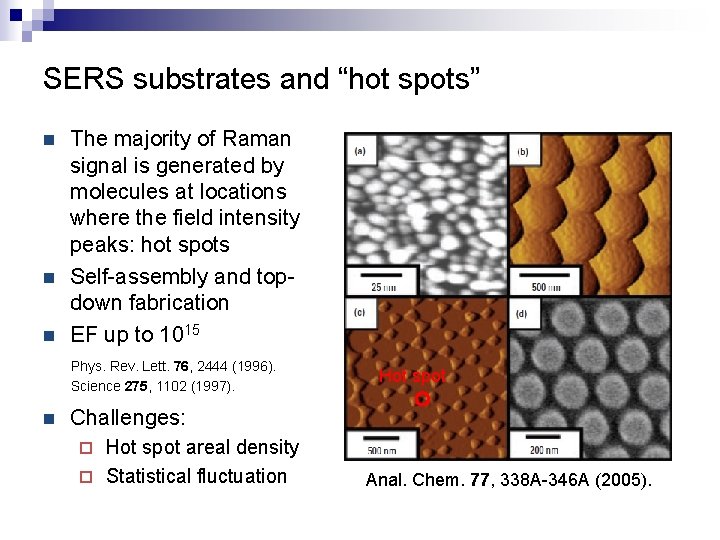
SERS substrates and “hot spots” n n n The majority of Raman signal is generated by molecules at locations where the field intensity peaks: hot spots Self-assembly and topdown fabrication EF up to 1015 Phys. Rev. Lett. 76, 2444 (1996). Science 275, 1102 (1997). n Hot spot Challenges: Hot spot areal density ¨ Statistical fluctuation ¨ Anal. Chem. 77, 338 A-346 A (2005).
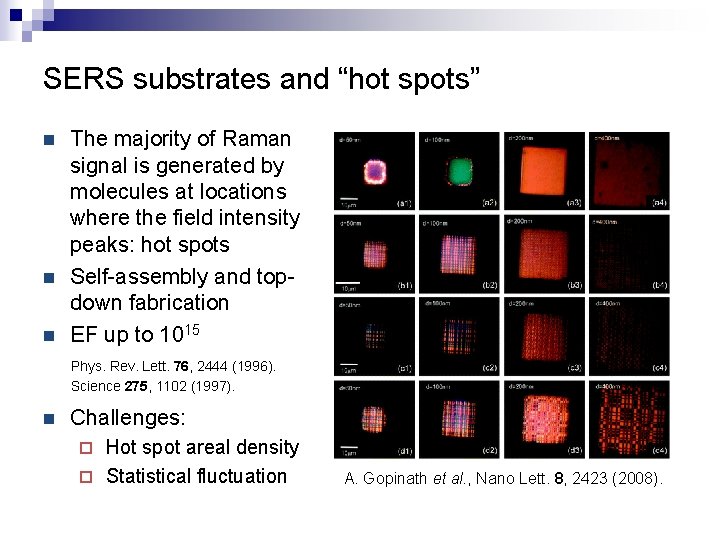
SERS substrates and “hot spots” n n n The majority of Raman signal is generated by molecules at locations where the field intensity peaks: hot spots Self-assembly and topdown fabrication EF up to 1015 Phys. Rev. Lett. 76, 2444 (1996). Science 275, 1102 (1997). n Challenges: Hot spot areal density ¨ Statistical fluctuation ¨ A. Gopinath et al. , Nano Lett. 8, 2423 (2008).
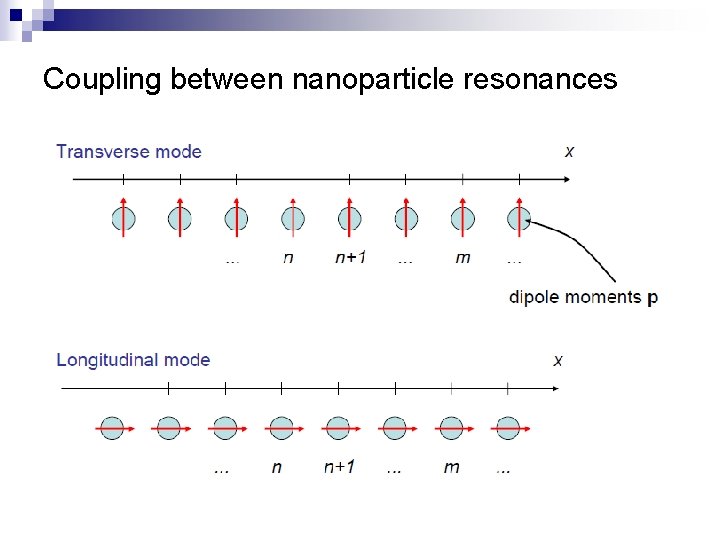
Coupling between nanoparticle resonances
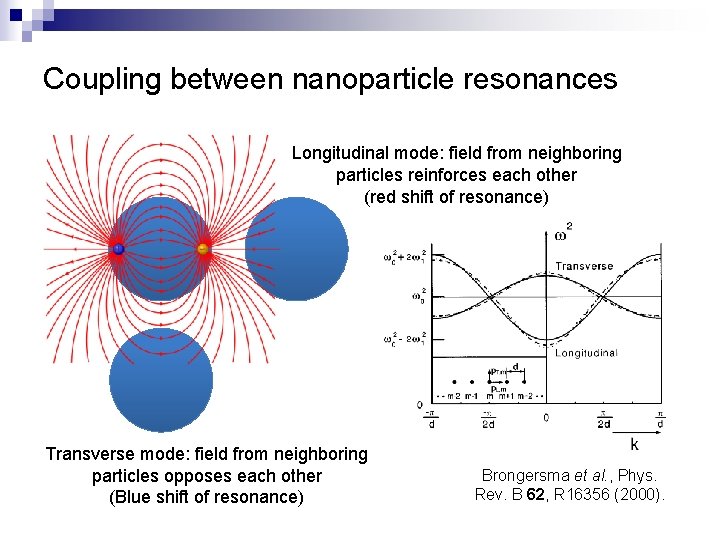
Coupling between nanoparticle resonances Longitudinal mode: field from neighboring particles reinforces each other (red shift of resonance) Transverse mode: field from neighboring particles opposes each other (Blue shift of resonance) Brongersma et al. , Phys. Rev. B 62, R 16356 (2000).
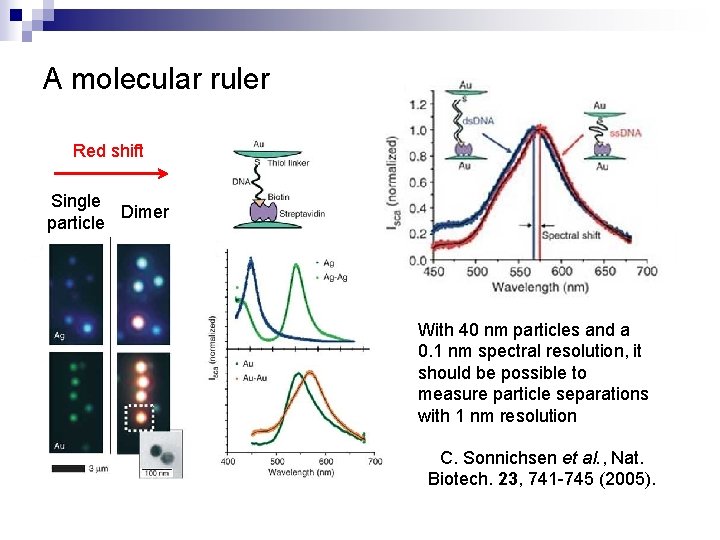
A molecular ruler Red shift Single Dimer particle With 40 nm particles and a 0. 1 nm spectral resolution, it should be possible to measure particle separations with 1 nm resolution C. Sonnichsen et al. , Nat. Biotech. 23, 741 -745 (2005).