
MSEG 667 Nanophotonics Materials and Devices 5 Optical
- Slides: 35
MSEG 667 Nanophotonics: Materials and Devices 5: Optical Resonant Cavities Prof. Juejun (JJ) Hu hujuejun@udel. edu
Optical resonance and resonant cavities n Optical resonant mode A time-invariant, stable electromagnetic field pattern (complex amplitude): an eigen-solution to the Maxwell equations ¨ Discretized resonant frequencies (eigen-values), i. e. these modes appear only at particular frequencies/wavelengths ¨ The modal fields are usually spatially confined in a finite domain ¨ n Optical resonant cavities (resonators) ¨ Devices that support optical resonant modes Guided mode resonance, surface plasmon (polariton) resonance, and spoof surface plasmon resonance all refer to coupling to propagating modes, even though the same term “resonance” is referenced!
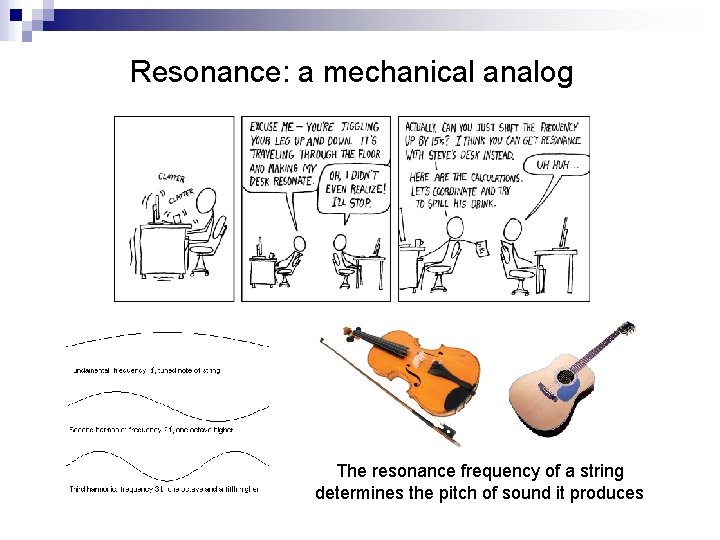
Resonance: a mechanical analog The resonance frequency of a string determines the pitch of sound it produces
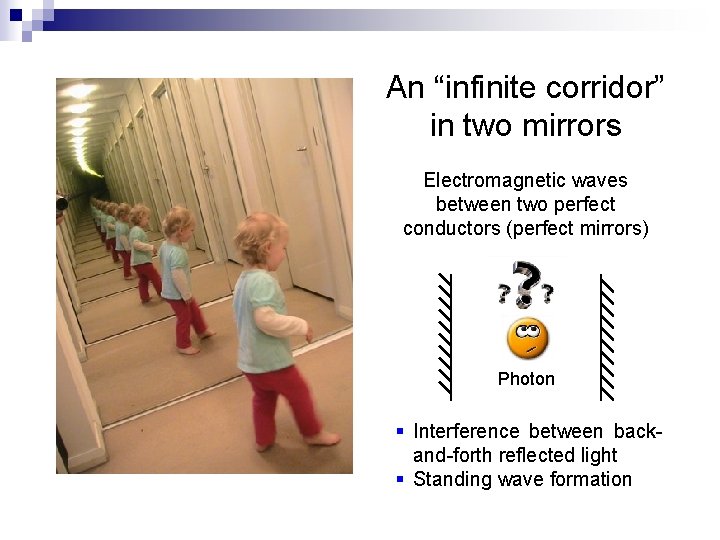
An “infinite corridor” in two mirrors Electromagnetic waves between two perfect conductors (perfect mirrors) Photon § Interference between backand-forth reflected light § Standing wave formation
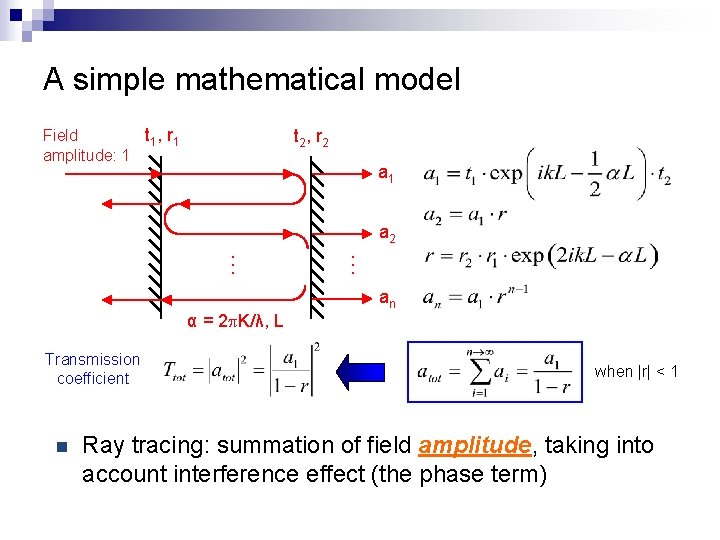
A simple mathematical model t 1, r 1 Field amplitude: 1 t 2, r 2 a 1 a 2 … … an α = 2 p. K/λ, L Transmission coefficient n when |r| < 1 Ray tracing: summation of field amplitude, taking into account interference effect (the phase term)
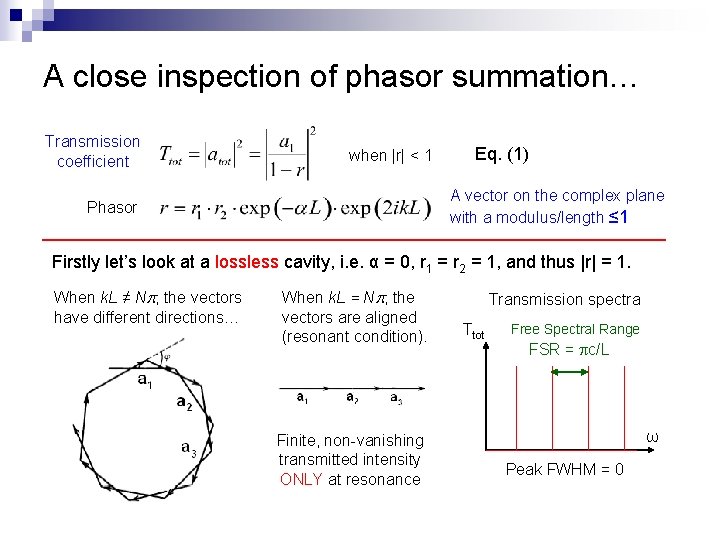
A close inspection of phasor summation… Transmission coefficient when |r| < 1 Eq. (1) A vector on the complex plane with a modulus/length ≤ 1 Phasor Firstly let’s look at a lossless cavity, i. e. α = 0, r 1 = r 2 = 1, and thus |r| = 1. When k. L ≠ Np, the vectors have different directions… When k. L = Np, the vectors are aligned (resonant condition). Finite, non-vanishing transmitted intensity ONLY at resonance Transmission spectra Ttot Free Spectral Range FSR = pc/L ω Peak FWHM = 0
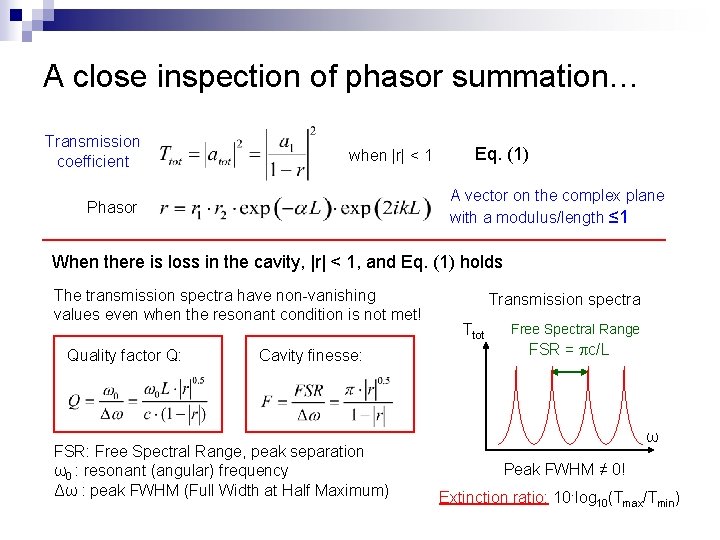
A close inspection of phasor summation… Transmission coefficient when |r| < 1 Eq. (1) A vector on the complex plane with a modulus/length ≤ 1 Phasor When there is loss in the cavity, |r| < 1, and Eq. (1) holds The transmission spectra have non-vanishing values even when the resonant condition is not met! Quality factor Q: Cavity finesse: FSR: Free Spectral Range, peak separation ω0 : resonant (angular) frequency Δω : peak FWHM (Full Width at Half Maximum) Transmission spectra Ttot Free Spectral Range FSR = pc/L ω Peak FWHM ≠ 0! Extinction ratio: 10·log 10(Tmax/Tmin)
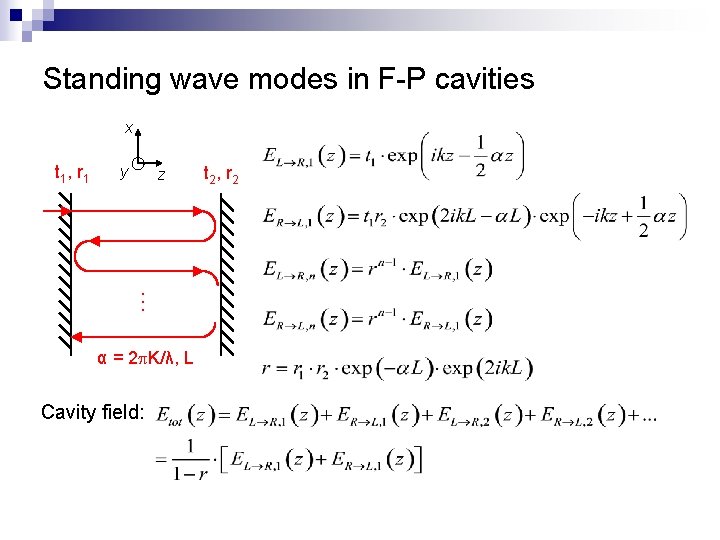
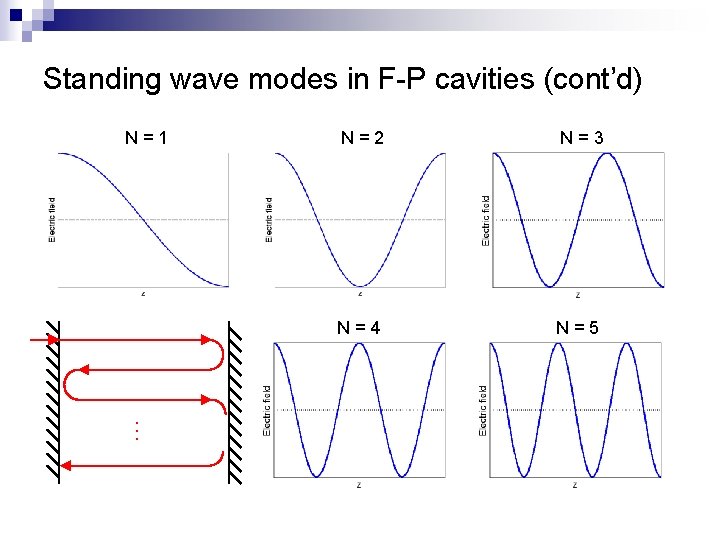
Standing wave modes in F-P cavities x t 1, r 1 y z … α = 2 p. K/λ, L Cavity field: t 2, r 2
Standing wave modes in F-P cavities (cont’d) N = 1 N = 2 N = 3 N = 4 N = 5 …
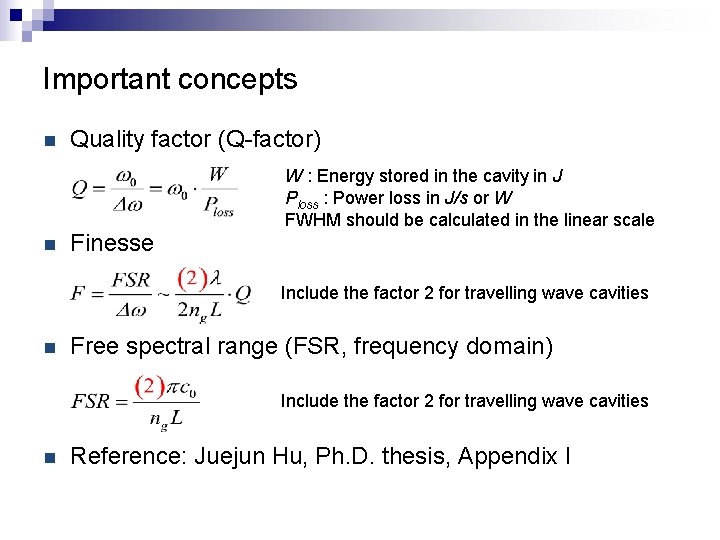
Important concepts n n Quality factor (Q-factor) Finesse W : Energy stored in the cavity in J Ploss : Power loss in J/s or W FWHM should be calculated in the linear scale Include the factor 2 for travelling wave cavities n Free spectral range (FSR, frequency domain) Include the factor 2 for travelling wave cavities n Reference: Juejun Hu, Ph. D. thesis, Appendix I
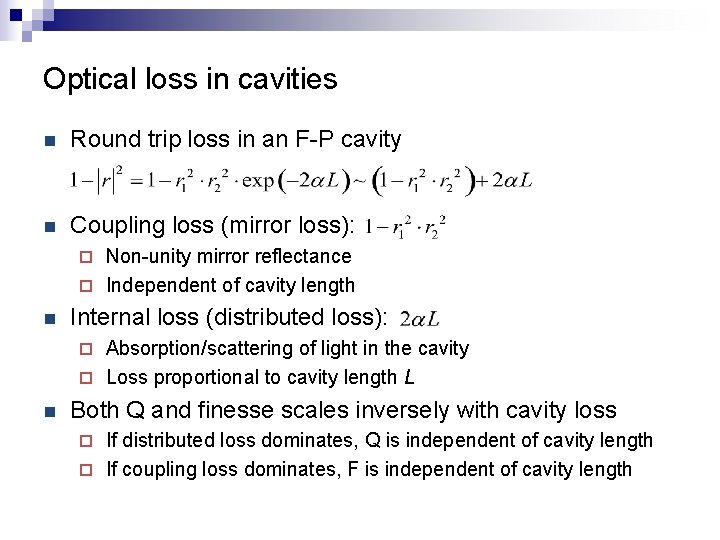
Optical loss in cavities n Round trip loss in an F-P cavity n Coupling loss (mirror loss): Non-unity mirror reflectance ¨ Independent of cavity length ¨ n Internal loss (distributed loss): Absorption/scattering of light in the cavity ¨ Loss proportional to cavity length L ¨ n Both Q and finesse scales inversely with cavity loss If distributed loss dominates, Q is independent of cavity length ¨ If coupling loss dominates, F is independent of cavity length ¨
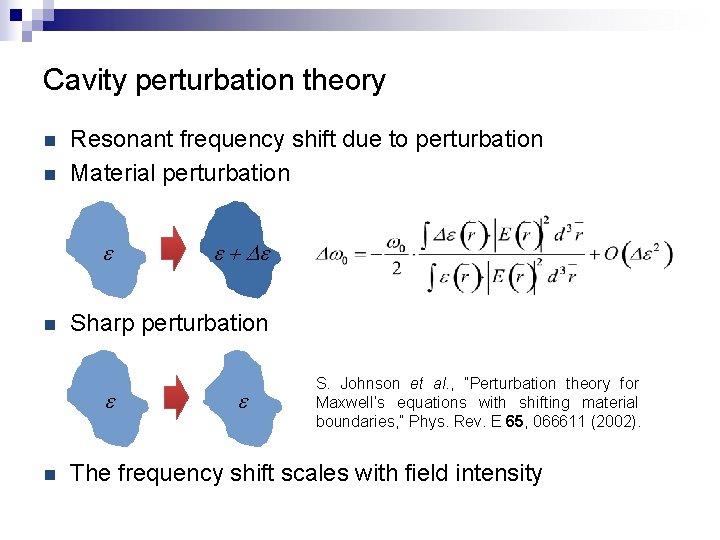
Cavity perturbation theory n n Resonant frequency shift due to perturbation Material perturbation e n Sharp perturbation e + De e S. Johnson et al. , ”Perturbation theory for Maxwell’s equations with shifting material boundaries, ” Phys. Rev. E 65, 066611 (2002). The frequency shift scales with field intensity
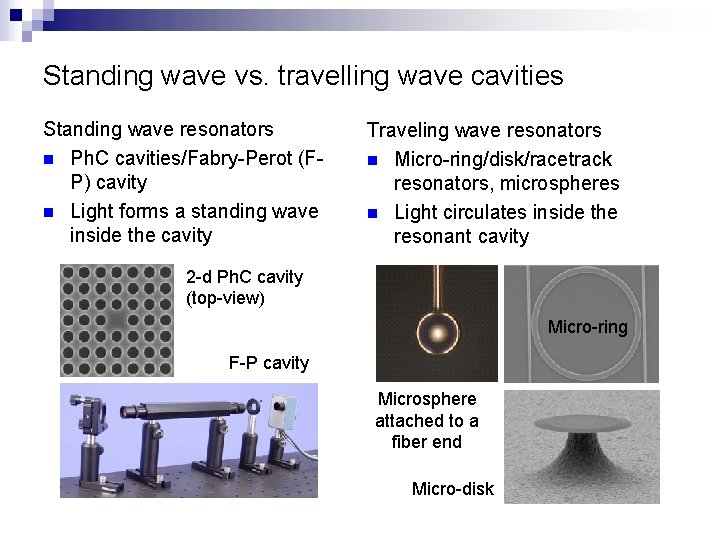
Standing wave vs. travelling wave cavities Standing wave resonators n Ph. C cavities/Fabry-Perot (FP) cavity n Light forms a standing wave inside the cavity Traveling wave resonators n Micro-ring/disk/racetrack resonators, microspheres n Light circulates inside the resonant cavity 2 -d Ph. C cavity (top-view) Micro-ring F-P cavity Microsphere attached to a fiber end Micro-disk
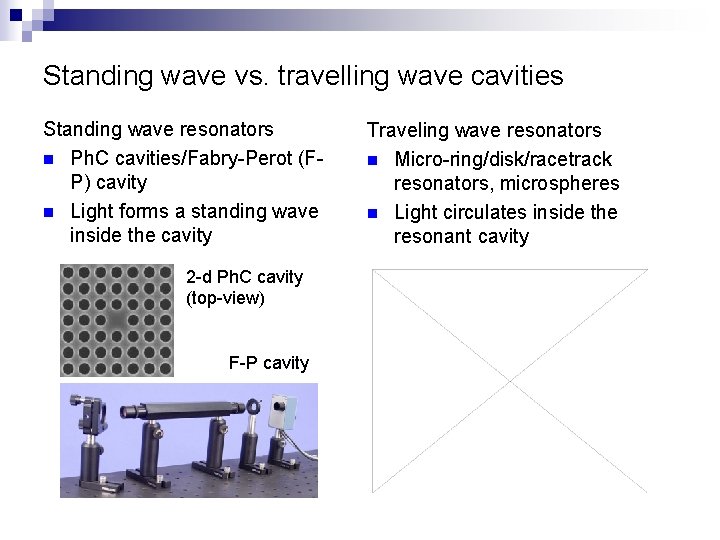
Standing wave vs. travelling wave cavities Standing wave resonators n Ph. C cavities/Fabry-Perot (FP) cavity n Light forms a standing wave inside the cavity 2 -d Ph. C cavity (top-view) F-P cavity Traveling wave resonators n Micro-ring/disk/racetrack resonators, microspheres n Light circulates inside the resonant cavity
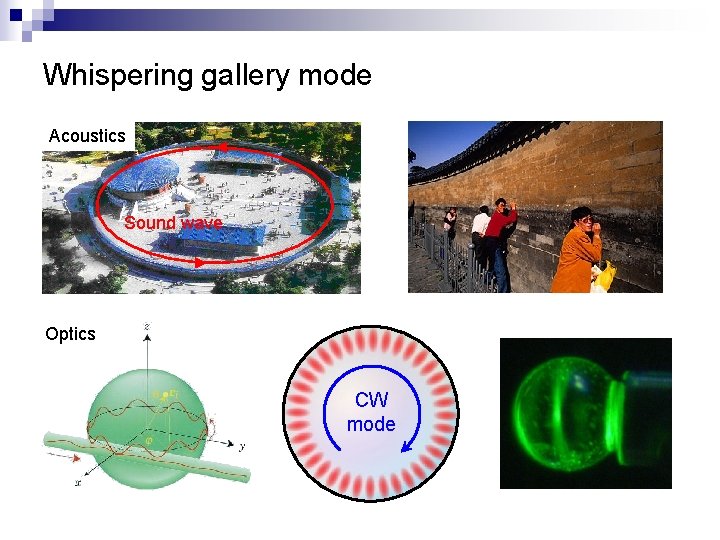
Whispering gallery mode Acoustics Sound wave Optics CW mode
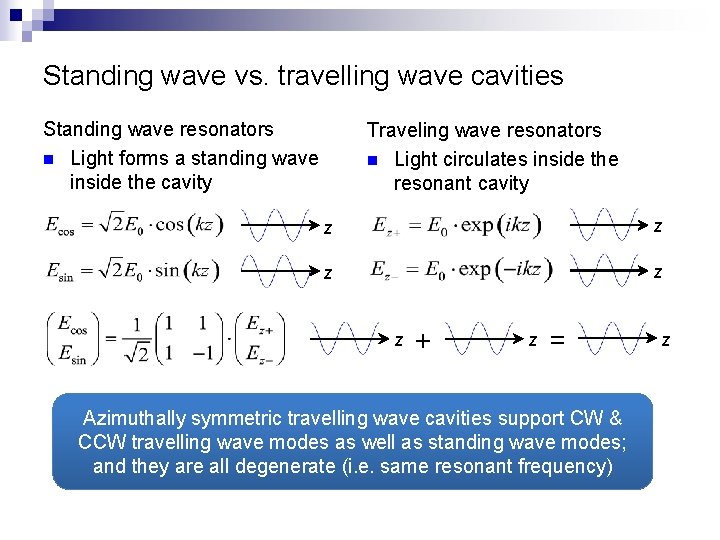
Standing wave vs. travelling wave cavities Standing wave resonators n Light forms a standing wave inside the cavity Traveling wave resonators n Light circulates inside the resonant cavity z z z + z = Azimuthally symmetric travelling wave cavities support CW & CCW travelling wave modes as well as standing wave modes; and they are all degenerate (i. e. same resonant frequency) z
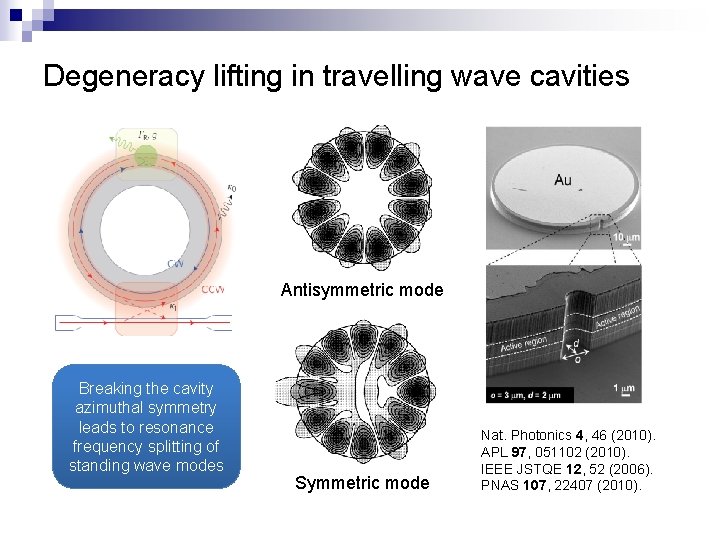
Degeneracy lifting in travelling wave cavities Antisymmetric mode Breaking the cavity azimuthal symmetry leads to resonance frequency splitting of standing wave modes Symmetric mode Nat. Photonics 4, 46 (2010). APL 97, 051102 (2010). IEEE JSTQE 12, 52 (2006). PNAS 107, 22407 (2010).
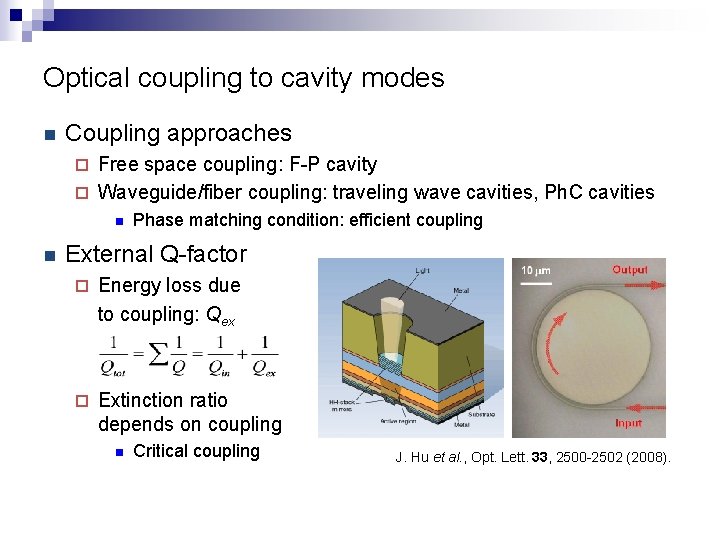
Optical coupling to cavity modes n Coupling approaches Free space coupling: F-P cavity ¨ Waveguide/fiber coupling: traveling wave cavities, Ph. C cavities ¨ n n Phase matching condition: efficient coupling External Q-factor ¨ Energy loss due to coupling: Qex ¨ Extinction ratio depends on coupling n Critical coupling J. Hu et al. , Opt. Lett. 33, 2500 -2502 (2008).
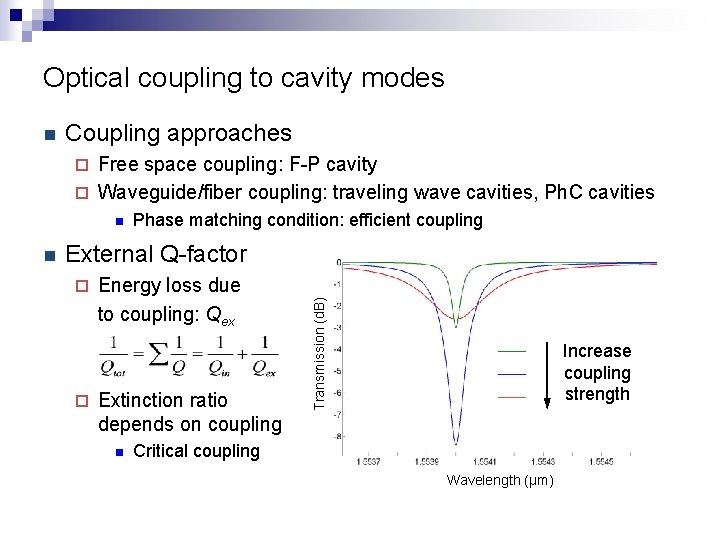
Optical coupling to cavity modes n Coupling approaches Free space coupling: F-P cavity ¨ Waveguide/fiber coupling: traveling wave cavities, Ph. C cavities ¨ n External Q-factor ¨ ¨ Energy loss due to coupling: Qex Extinction ratio depends on coupling n Transmission (d. B) n Phase matching condition: efficient coupling Increase coupling strength Critical coupling Wavelength (μm)
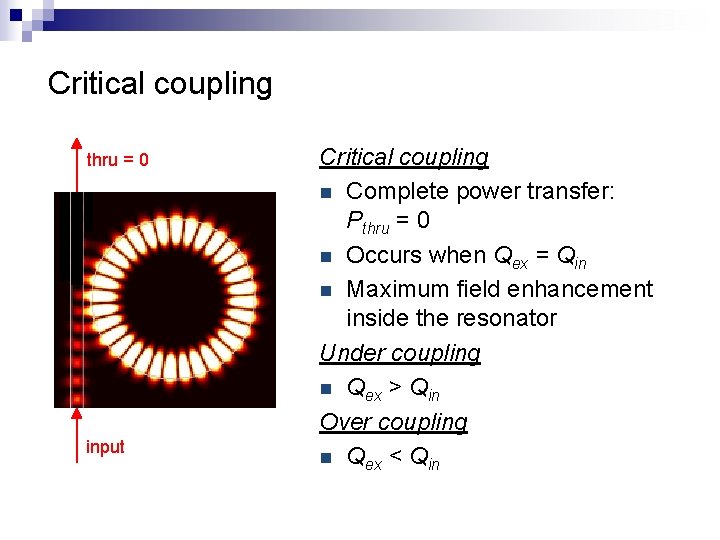
Critical coupling thru = 0 input Critical coupling n Complete power transfer: Pthru = 0 n Occurs when Qex = Qin n Maximum field enhancement inside the resonator Under coupling n Qex > Qin Over coupling n Qex < Qin
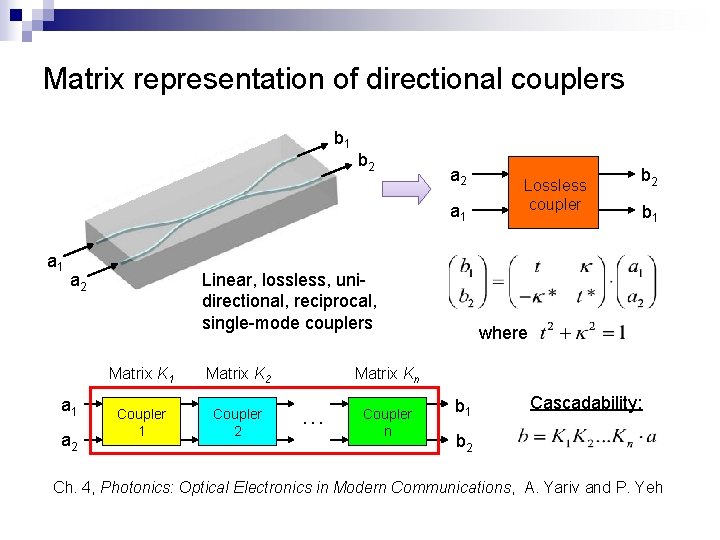
Matrix representation of directional couplers b 1 b 2 a 1 a 1 Linear, lossless, unidirectional, reciprocal, single-mode couplers a 2 a 1 a 2 Matrix K 1 Matrix K 2 Coupler 1 Coupler 2 Lossless coupler b 2 b 1 where Matrix Kn … Coupler n b 1 Cascadability: b 2 Ch. 4, Photonics: Optical Electronics in Modern Communications, A. Yariv and P. Yeh
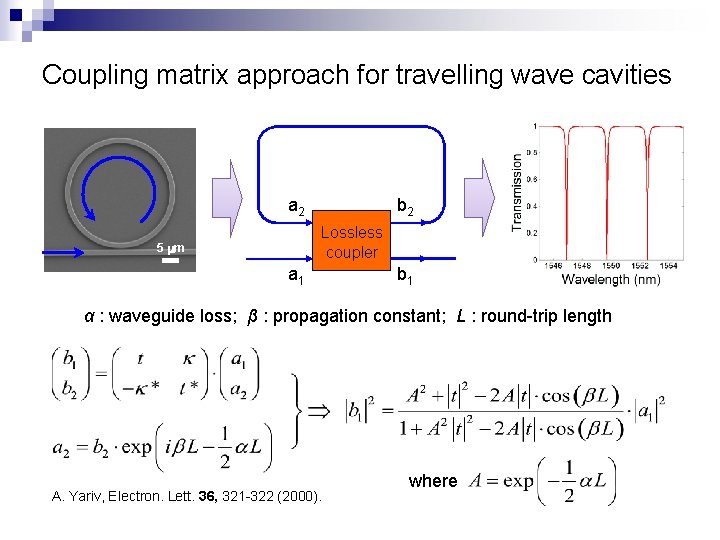
Coupling matrix approach for travelling wave cavities a 2 b 2 Lossless coupler 5 mm a 1 b 1 α : waveguide loss; β : propagation constant; L : round-trip length A. Yariv, Electron. Lett. 36, 321 -322 (2000). where
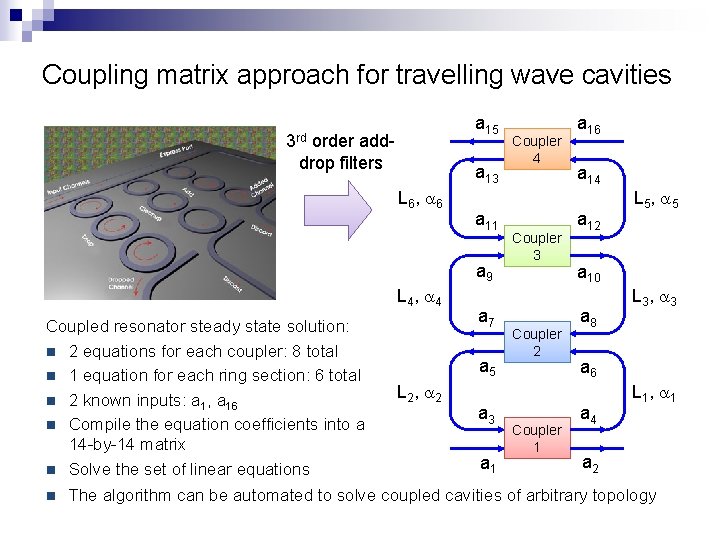
Coupling matrix approach for travelling wave cavities a 15 3 rd order adddrop filters a 13 L 6, a 6 a 11 a 9 L 4, a 4 Coupled resonator steady state solution: n 2 equations for each coupler: 8 total n 1 equation for each ring section: 6 total n 2 known inputs: a 1, a 16 n Compile the equation coefficients into a 14 -by-14 matrix n Solve the set of linear equations n a 7 a 5 L 2, a 2 a 3 a 1 Coupler 4 Coupler 3 Coupler 2 Coupler 1 a 16 a 14 a 12 L 5, a 5 a 10 a 8 L 3, a 3 a 6 a 4 L 1, a 1 a 2 The algorithm can be automated to solve coupled cavities of arbitrary topology
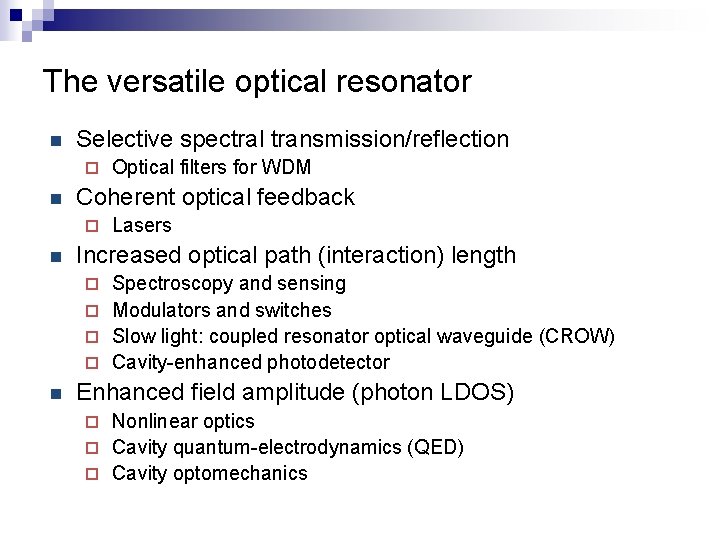
The versatile optical resonator n Selective spectral transmission/reflection ¨ n Coherent optical feedback ¨ n Optical filters for WDM Lasers Increased optical path (interaction) length Spectroscopy and sensing ¨ Modulators and switches ¨ Slow light: coupled resonator optical waveguide (CROW) ¨ Cavity-enhanced photodetector ¨ n Enhanced field amplitude (photon LDOS) Nonlinear optics ¨ Cavity quantum-electrodynamics (QED) ¨ Cavity optomechanics ¨
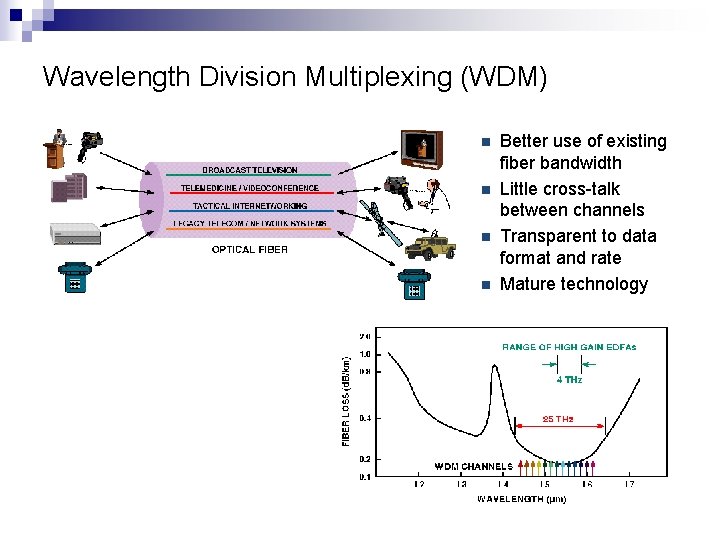
Wavelength Division Multiplexing (WDM) n n Better use of existing fiber bandwidth Little cross-talk between channels Transparent to data format and rate Mature technology
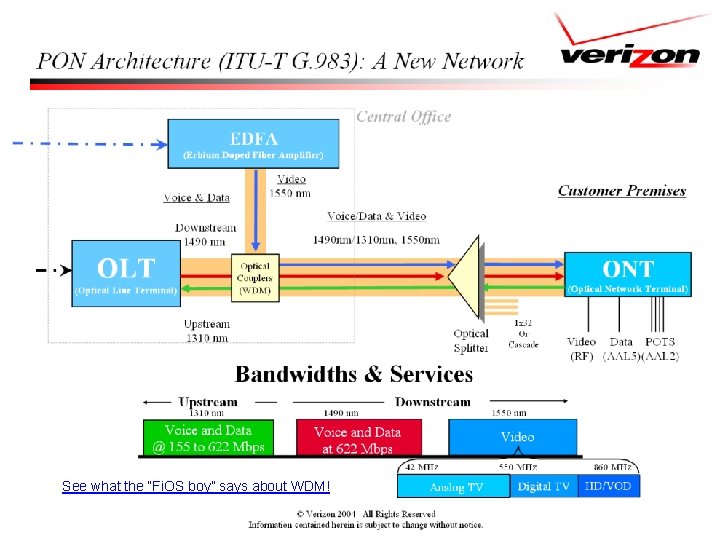
See what the “Fi. OS boy” says about WDM!
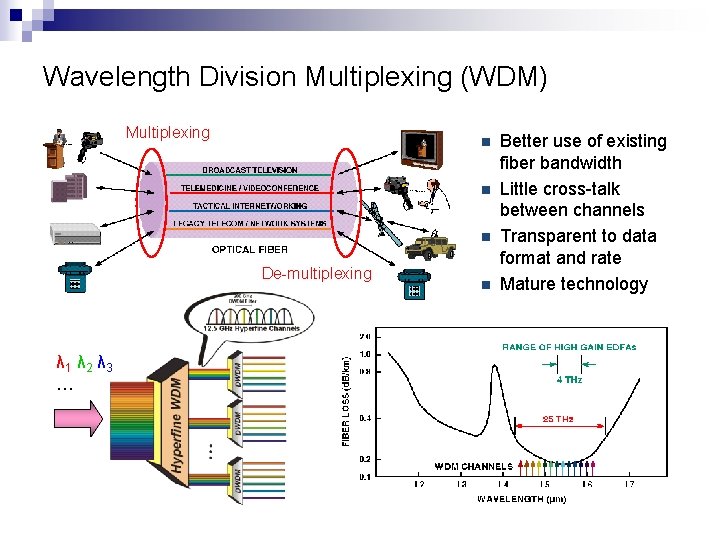
Wavelength Division Multiplexing (WDM) Multiplexing n n n De-multiplexing λ 1 λ 2 λ 3 … n Better use of existing fiber bandwidth Little cross-talk between channels Transparent to data format and rate Mature technology
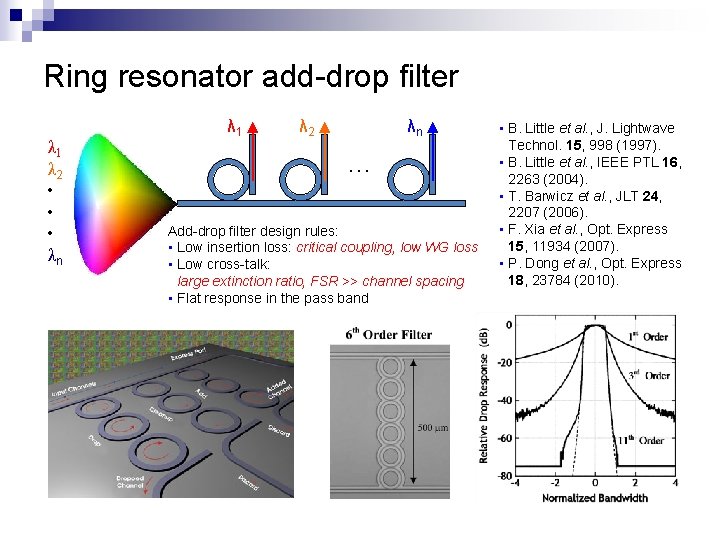
Ring resonator add-drop filter λ 1 λ 2 • • • λn λ 1 λ 2 λn … Add-drop filter design rules: • Low insertion loss: critical coupling, low WG loss • Low cross-talk: large extinction ratio, FSR >> channel spacing • Flat response in the pass band • B. Little et al. , J. Lightwave Technol. 15, 998 (1997). • B. Little et al. , IEEE PTL 16, 2263 (2004). • T. Barwicz et al. , JLT 24, 2207 (2006). • F. Xia et al. , Opt. Express 15, 11934 (2007). • P. Dong et al. , Opt. Express 18, 23784 (2010).
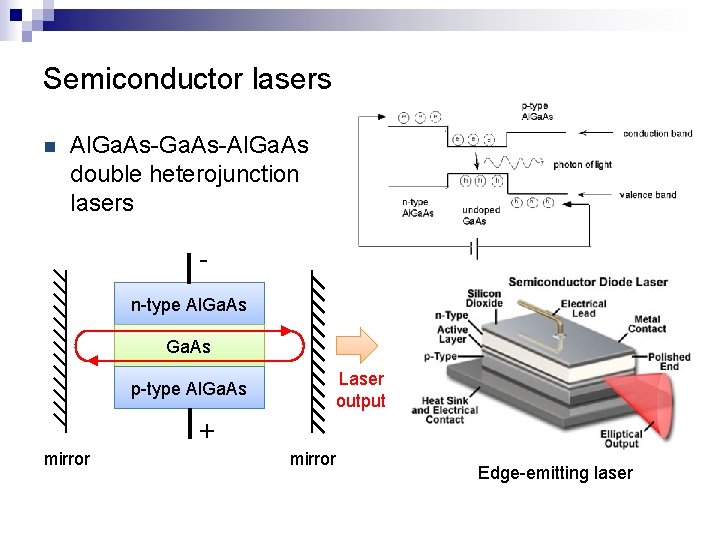
Semiconductor lasers n Al. Ga. As-Al. Ga. As double heterojunction lasers n-type Al. Ga. As p-type Al. Ga. As Laser output + mirror Edge-emitting laser
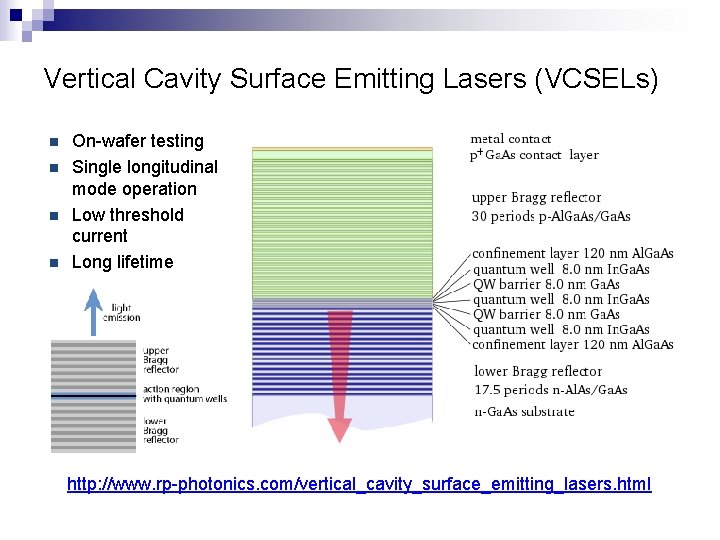
Vertical Cavity Surface Emitting Lasers (VCSELs) n n On-wafer testing Single longitudinal mode operation Low threshold current Long lifetime http: //www. rp-photonics. com/vertical_cavity_surface_emitting_lasers. html
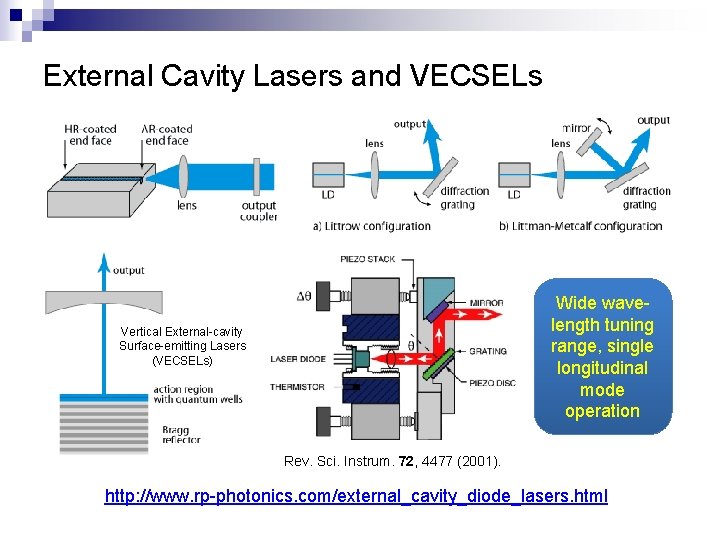
External Cavity Lasers and VECSELs Wide wavelength tuning range, single longitudinal mode operation Vertical External-cavity Surface-emitting Lasers (VECSELs) Rev. Sci. Instrum. 72, 4477 (2001). http: //www. rp-photonics. com/external_cavity_diode_lasers. html
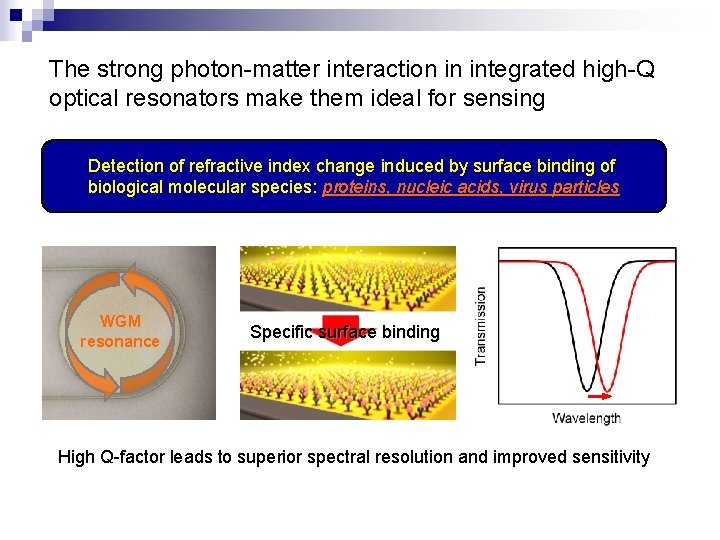
The strong photon-matter interaction in integrated high-Q optical resonators make them ideal for sensing Detection of refractive index change induced by surface binding of biological molecular species: proteins, nucleic acids, virus particles WGM resonance Specific surface binding High Q-factor leads to superior spectral resolution and improved sensitivity
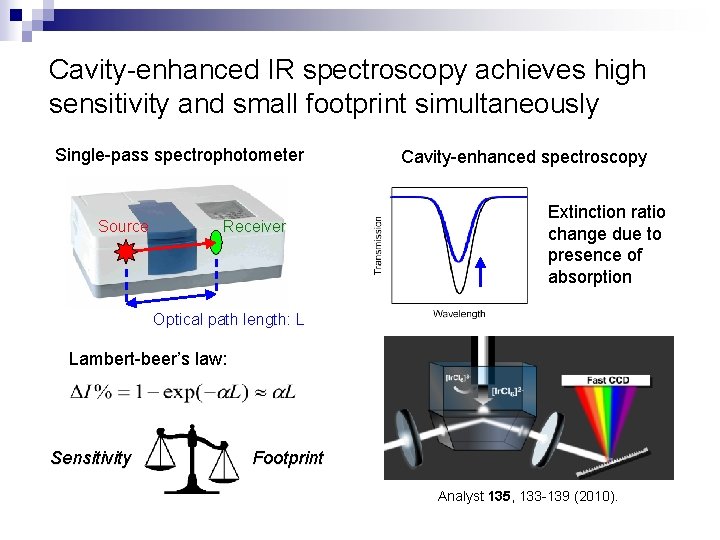
Cavity-enhanced IR spectroscopy achieves high sensitivity and small footprint simultaneously Single-pass spectrophotometer Source Receiver Cavity-enhanced spectroscopy Extinction ratio change due to presence of absorption Optical path length: L Lambert-beer’s law: Sensitivity Footprint Analyst 135, 133 -139 (2010).
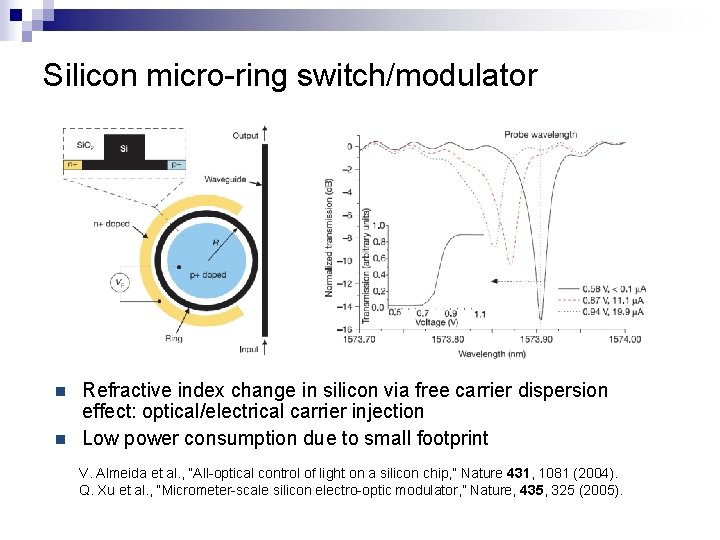
Silicon micro-ring switch/modulator n n Refractive index change in silicon via free carrier dispersion effect: optical/electrical carrier injection Low power consumption due to small footprint V. Almeida et al. , “All-optical control of light on a silicon chip, ” Nature 431, 1081 (2004). Q. Xu et al. , “Micrometer-scale silicon electro-optic modulator, ” Nature, 435, 325 (2005).
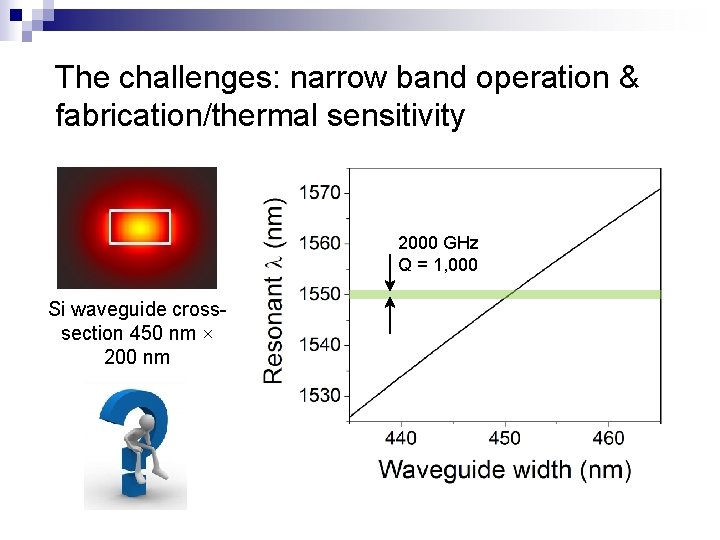
The challenges: narrow band operation & fabrication/thermal sensitivity 2000 GHz Q = 1, 000 Si waveguide crosssection 450 nm × 200 nm