
MSE 101 Introduction to Materials Science Engineering Course





- Slides: 15
MSE 101: Introduction to Materials Science & Engineering Course Objective. . . To introduce students to a wide range of modern materials engineering topics. You will learn about: • material structure • how structure dictates properties • the impact of materials on society This course will help you to: • use materials properly • realize new design opportunities with materials Chapter 1 - 1
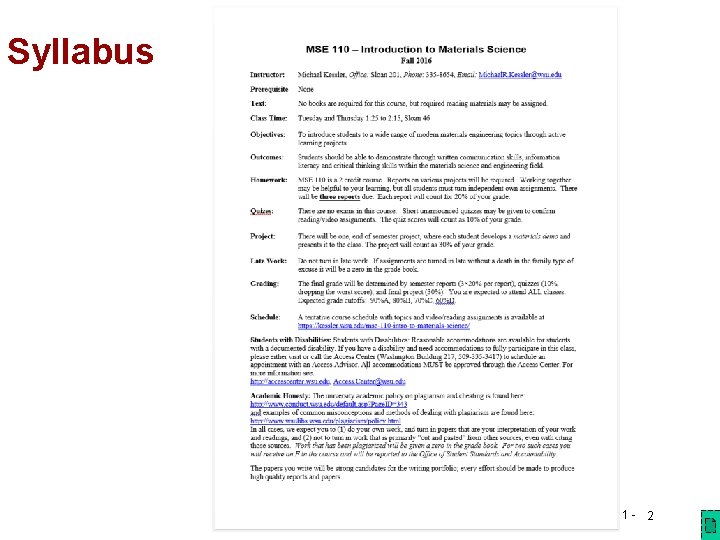
Syllabus Chapter 1 - 2
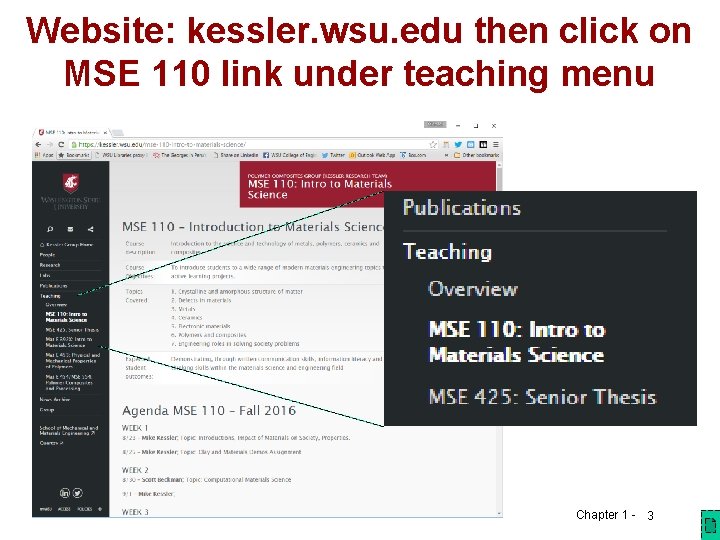
Website: kessler. wsu. edu then click on MSE 110 link under teaching menu Chapter 1 - 3
Introduction • What is materials science? • Why should we know about it? • Materials drive our society – – Stone Age Bronze Age Iron Age Now? • Silicon Age? • Polymer Age? Chapter 1 - 4
Theme of Materials Science Chapter 1 - 5
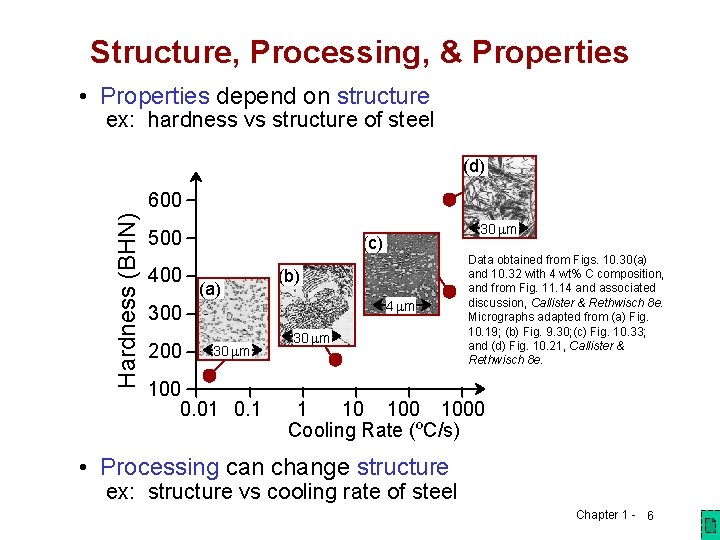
Structure, Processing, & Properties • Properties depend on structure ex: hardness vs structure of steel (d) Hardness (BHN) 600 500 400 (c) (a) (b) 4 mm 300 200 30 mm 100 0. 01 0. 1 30 mm Data obtained from Figs. 10. 30(a) and 10. 32 with 4 wt% C composition, and from Fig. 11. 14 and associated discussion, Callister & Rethwisch 8 e. Micrographs adapted from (a) Fig. 10. 19; (b) Fig. 9. 30; (c) Fig. 10. 33; and (d) Fig. 10. 21, Callister & Rethwisch 8 e. 1 10 1000 Cooling Rate (ºC/s) • Processing can change structure ex: structure vs cooling rate of steel Chapter 1 - 6
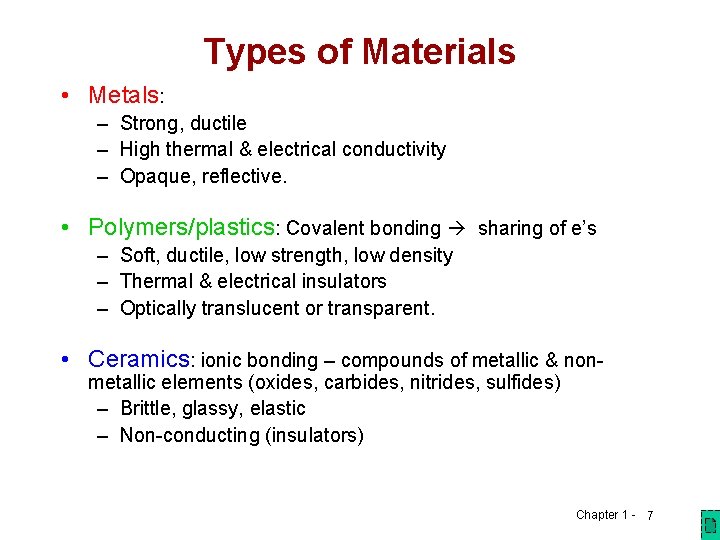
Types of Materials • Metals: – Strong, ductile – High thermal & electrical conductivity – Opaque, reflective. • Polymers/plastics: Covalent bonding sharing of e’s – Soft, ductile, low strength, low density – Thermal & electrical insulators – Optically translucent or transparent. • Ceramics: ionic bonding – compounds of metallic & nonmetallic elements (oxides, carbides, nitrides, sulfides) – Brittle, glassy, elastic – Non-conducting (insulators) Chapter 1 - 7
The Materials Selection Process 1. Pick Application Determine required Properties: mechanical, electrical, thermal, magnetic, optical, deteriorative. 2. Properties Identify candidate Material(s) Material: structure, composition. 3. Material Identify required Processing: changes structure and overall shape ex: casting, sintering, vapor deposition, doping forming, joining, annealing. Chapter 1 - 8
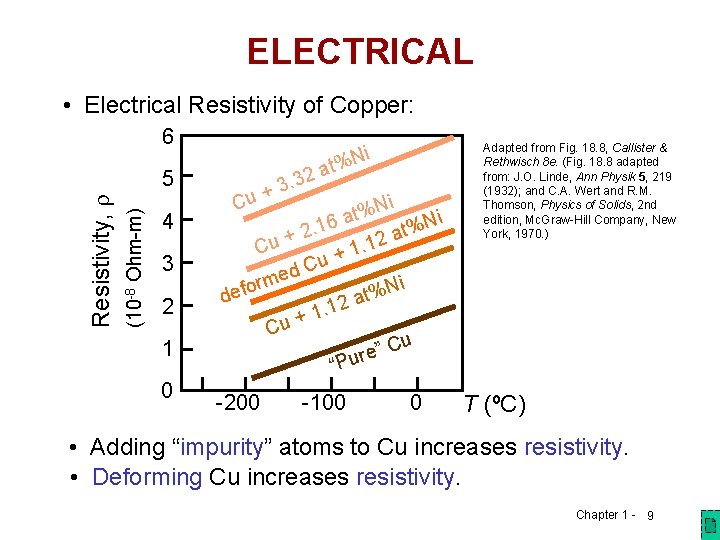
ELECTRICAL • Electrical Resistivity of Copper: 6 (10 -8 Ohm-m) Resistivity, r 5 4 3 2 1 0 Ni Cu + t% a 2 3. 3 Ni % t Ni 16 a. % t 2 a + 2 1. Cu +1 u C d e rm Ni % t defo 12 a. 1 + Cu Cu ” e r “Pu -200 -100 0 Adapted from Fig. 18. 8, Callister & Rethwisch 8 e. (Fig. 18. 8 adapted from: J. O. Linde, Ann Physik 5, 219 (1932); and C. A. Wert and R. M. Thomson, Physics of Solids, 2 nd edition, Mc. Graw-Hill Company, New York, 1970. ) T (ºC) • Adding “impurity” atoms to Cu increases resistivity. • Deforming Cu increases resistivity. Chapter 1 - 9
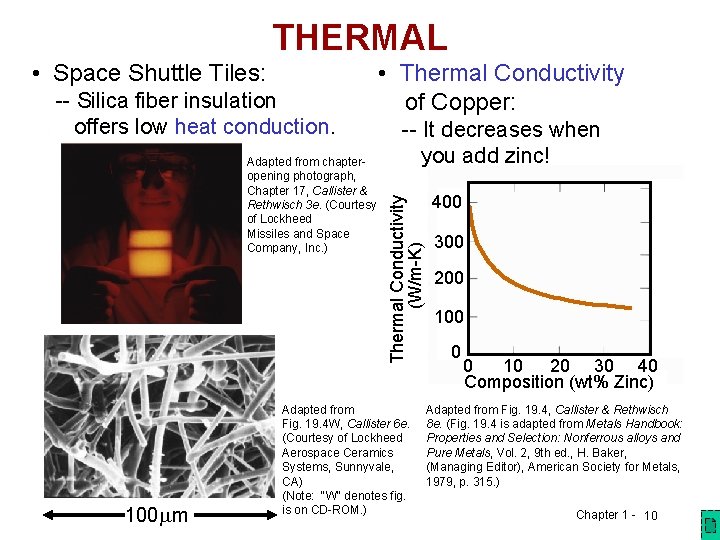
THERMAL -- Silica fiber insulation offers low heat conduction. Adapted from chapteropening photograph, Chapter 17, Callister & Rethwisch 3 e. (Courtesy of Lockheed Missiles and Space Company, Inc. ) 100 mm • Thermal Conductivity of Copper: -- It decreases when you add zinc! Thermal Conductivity (W/m-K) • Space Shuttle Tiles: Adapted from Fig. 19. 4 W, Callister 6 e. (Courtesy of Lockheed Aerospace Ceramics Systems, Sunnyvale, CA) (Note: "W" denotes fig. is on CD-ROM. ) 400 300 200 100 0 0 10 20 30 40 Composition (wt% Zinc) Adapted from Fig. 19. 4, Callister & Rethwisch 8 e. (Fig. 19. 4 is adapted from Metals Handbook: Properties and Selection: Nonferrous alloys and Pure Metals, Vol. 2, 9 th ed. , H. Baker, (Managing Editor), American Society for Metals, 1979, p. 315. ) Chapter 1 - 10
MAGNETIC • Magnetic Storage: vs. Composition: -- Adding 3 atomic % Si makes Fe a better recording medium! Magnetization -- Recording medium is magnetized by recording head. • Magnetic Permeability Fe+3%Si Fe Magnetic Field Fig. 20. 23, Callister & Rethwisch 8 e. Adapted from C. R. Barrett, W. D. Nix, and A. S. Tetelman, The Principles of Engineering Materials, Fig. 1 -7(a), p. 9, 1973. Electronically reproduced by permission of Pearson Education, Inc. , Upper Saddle River, New Jersey. Chapter 1 - 11
OPTICAL • Transmittance: -- Aluminum oxide may be transparent, translucent, or opaque depending on the material structure. single crystal polycrystal: low porosity polycrystal: high porosity Adapted from Fig. 1. 2, Callister & Rethwisch 8 e. (Specimen preparation, P. A. Lessing; photo by S. Tanner. ) Chapter 1 - 12
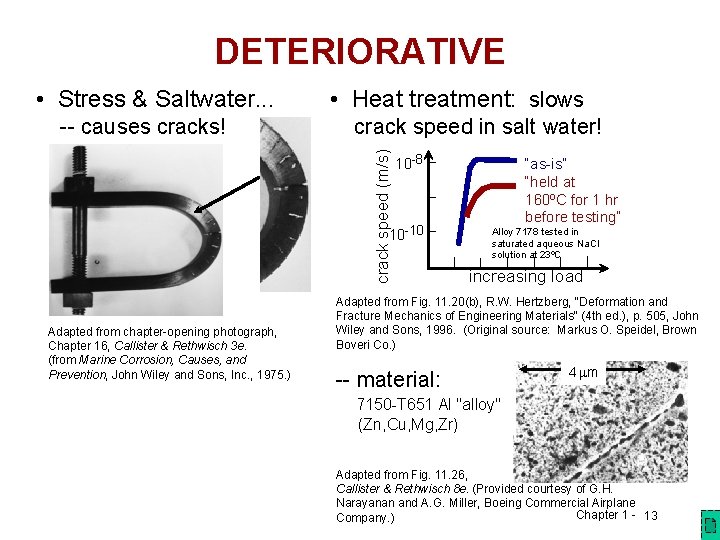
DETERIORATIVE • Stress & Saltwater. . . crack speed in salt water! crack speed (m/s) -- causes cracks! • Heat treatment: slows 10 -8 10 -10 Adapted from chapter-opening photograph, Chapter 16, Callister & Rethwisch 3 e. (from Marine Corrosion, Causes, and Prevention, John Wiley and Sons, Inc. , 1975. ) “as-is” “held at 160ºC for 1 hr before testing” Alloy 7178 tested in saturated aqueous Na. Cl solution at 23ºC increasing load Adapted from Fig. 11. 20(b), R. W. Hertzberg, "Deformation and Fracture Mechanics of Engineering Materials" (4 th ed. ), p. 505, John Wiley and Sons, 1996. (Original source: Markus O. Speidel, Brown Boveri Co. ) -- material: 4 mm 7150 -T 651 Al "alloy" (Zn, Cu, Mg, Zr) Adapted from Fig. 11. 26, Callister & Rethwisch 8 e. (Provided courtesy of G. H. Narayanan and A. G. Miller, Boeing Commercial Airplane Chapter 1 - 13 Company. )
Example/Demo: Environmental Stress Cracking Chapter 1 - 14
SUMMARY Course Goals: • Use the right material for the job. • Understand the relation between properties, structure, and processing. • Recognize new design opportunities offered by materials selection. Chapter 1 - 15