
MSD PROJECT 13022 VAD BREAKAWAY POWER System Level
MSD PROJECT 13022 VAD BREAKAWAY POWER System Level Design Review Joe Tartakoff Customer/Graduate Consultant jat 2704@rit. edu Matthew Myers ISE Project Leader mcm 8294@rit. edu Nick Dominesey ME Lead Engineer njd 3574@rit. edu Jason Inman EE Team Member jpi 7658@g. rit. edu Chris Smith ME Team Member cjs 5192@g. rit. edu Ellie Sanford ME Team Member egs 5491@rit. edu Michael Edson EE Team Member mce 5689@rit. edu

Detailed Design Review 2/8/2013 Agenda 1. 2. 3. 4. 5. 6. 7. 8. 9. Project Overview Customer Needs and Engineering Specifications Chosen Concept Block Diagram Feasibility Analysis Testing Plan Work Breakdown Structure System Design Proposal Bill of Materials MSD Project 13022: Breakaway VAD 2
Detailed Design Review 2/8/2013 Project Background � 6 -10% of all people worldwide over the age of 65 will develop heart failure. � There are 287, 000 deaths per year due to heart failure in the US. � The Thoratec Heartmate II Left Ventricular Assist Device (LVAD) is a bridge-to-transplant device that assists the heart, pumping blood throughout the body for those who are awaiting a heart transplant. MSD Project 13022: Breakaway VAD 3
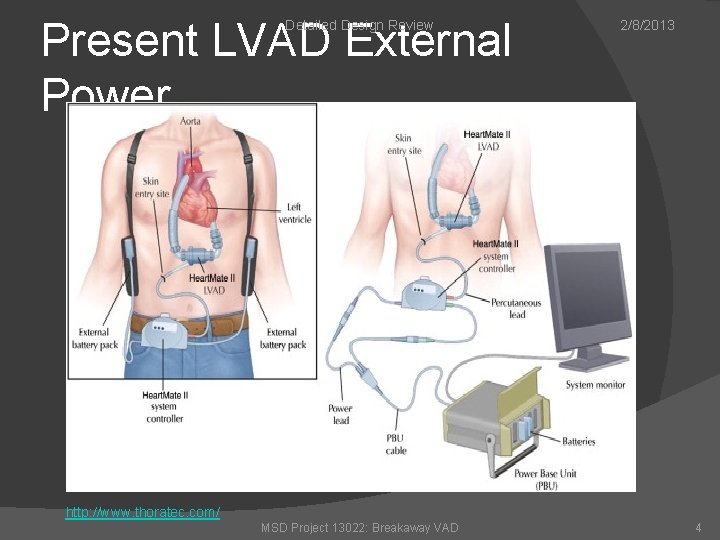
Present LVAD External Power Detailed Design Review 2/8/2013 http: //www. thoratec. com/ MSD Project 13022: Breakaway VAD 4
Detailed Design Review 2/8/2013 Project Summary � The transcutaneous power cord that connects the implanted device to the external motor control unit is often a source of infection. �The cord is only about 1 foot long so it doesn’t catch on things. �When the unit is dropped, the skin around the cord tears and becomes infected. MSD Project 13022: Breakaway VAD 5
Detailed Design Review 2/8/2013 Project Objectives � Create a breakaway port for power cable that will detach with a certain amount of force. �Cable port is implanted where the cable leaves the body �Increase flexibility of cable and reduce stress on surrounding skin � Create an internal power supply and motor control unit for the pump when the cord becomes disconnected. �Backup power should last long enough for the patient to seek assistance if something goes wrong MSD Project 13022: Breakaway VAD 6
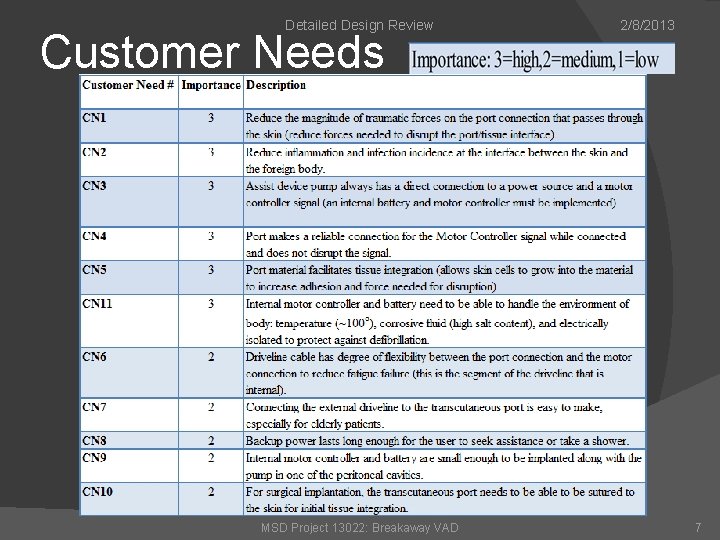
Detailed Design Review Customer Needs MSD Project 13022: Breakaway VAD 2/8/2013 7
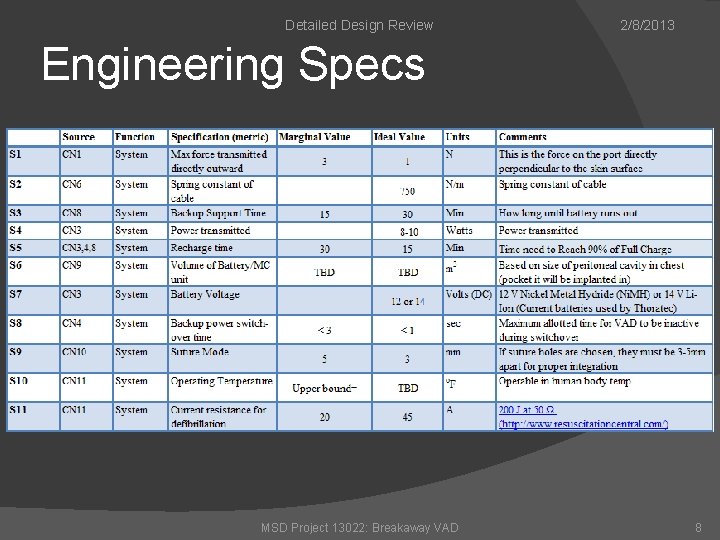
Detailed Design Review 2/8/2013 Engineering Specs MSD Project 13022: Breakaway VAD 8
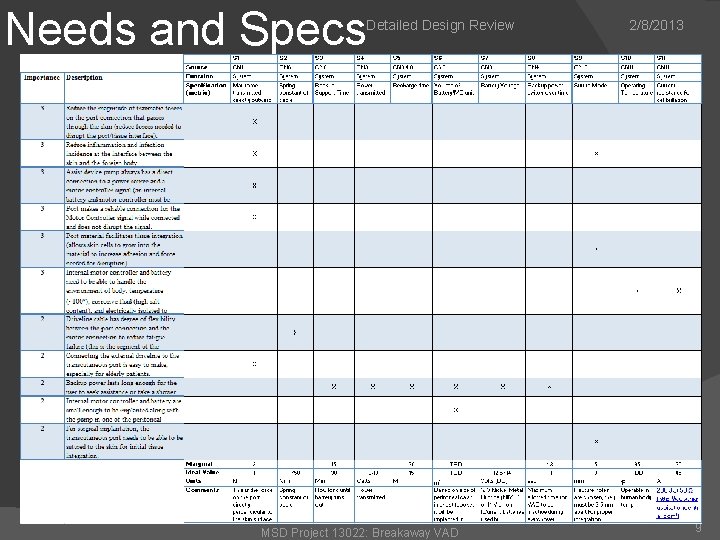
Needs and Specs Detailed Design Review MSD Project 13022: Breakaway VAD 2/8/2013 9

Detailed Design Review 2/8/2013 Notes � � � Is CN 2 a redundant statement of CN 1 and therefore unnecessary? Wouldn’t a reduction of inflammation be accomplished by reduced the force on the port? CN 5 is something that we may not be able to test or implement. Therefore, is it necessary? CN 10 sounds like something that’s left up to the surgeons. We can’t really test or implement this in a practical manner… CN 12 is being removed because it is not our concern. We will assume that there is no fluid or that there are existing methods that can be implemented to solve the situation. S 11 may be removed because it may be completely unnecessary and we can’t test for it. S 2 is may not be considered a concern due to physical observations of the current cord. MSD Project 13022: Breakaway VAD 10
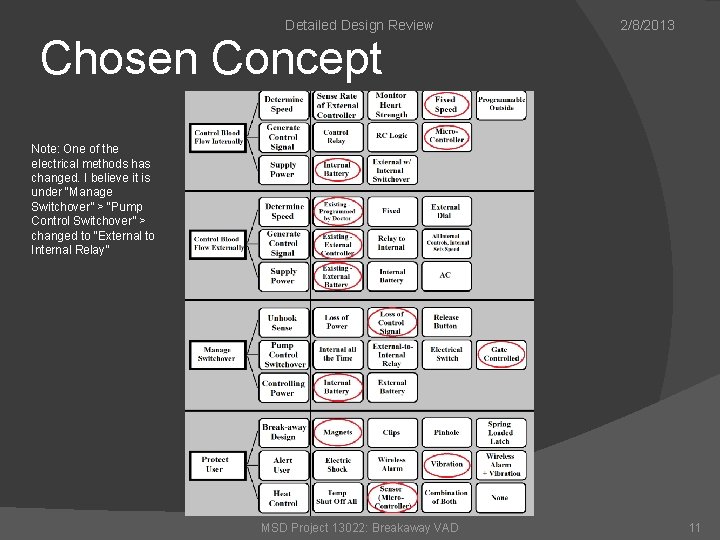
Detailed Design Review Chosen Concept 2/8/2013 Note: One of the electrical methods has changed. I believe it is under “Manage Switchover” > “Pump Control Switchover” > changed to “External to Internal Relay” MSD Project 13022: Breakaway VAD 11
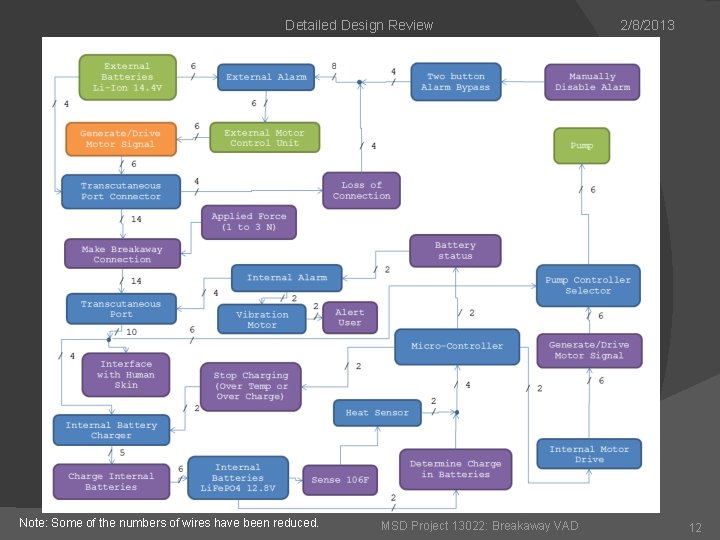
Detailed Design Review 2/8/2013 Block Diagram Note: Some of the numbers of wires have been reduced. MSD Project 13022: Breakaway VAD 12
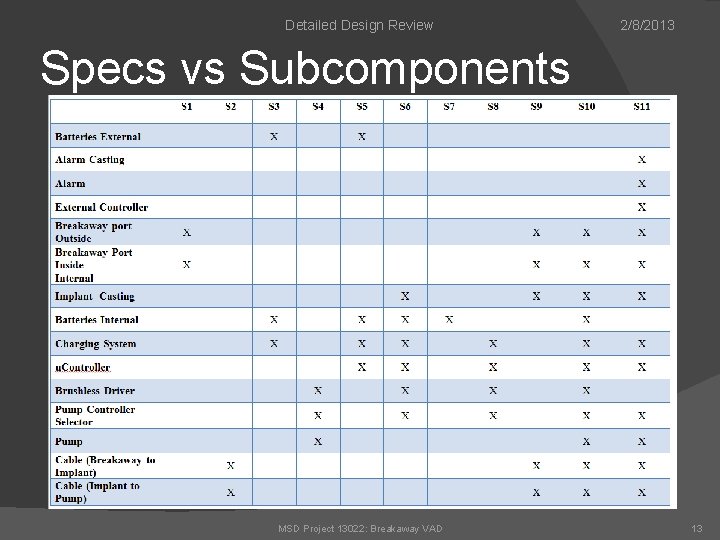
Detailed Design Review 2/8/2013 Specs vs Subcomponents MSD Project 13022: Breakaway VAD 13
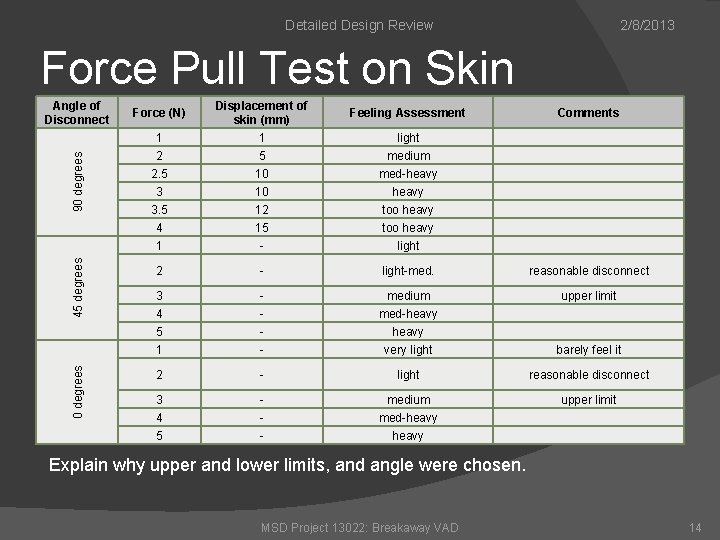
Detailed Design Review 2/8/2013 45 degrees Angle of Disconnect 2 - light-med. reasonable disconnect 3 4 5 1 - medium med-heavy very light upper limit barely feel it 2 - light reasonable disconnect 3 4 5 - medium med-heavy upper limit 90 degrees 1 2 2. 5 3 3. 5 4 1 Displacement of skin (mm) 1 5 10 10 12 15 - 0 degrees Force Pull Test on Skin Force (N) Feeling Assessment Comments light medium med-heavy too heavy light Explain why upper and lower limits, and angle were chosen. MSD Project 13022: Breakaway VAD 14
Heat Analysis - Assumptions Detailed Design Review 2/8/2013 Body Temperature (Environment) is 37˚C � Heat distribution on outside of device will be modeled via FEA � Heat transfer method inside body is conduction � All energy inefficiencies result in heat generation � Device is surrounded my muscle tissue which is at equilibrium between perfusion and heat generation � MSD Project 13022: Breakaway VAD 15

Detailed Design Review 2/8/2013 Heat Analysis – Additional 1 D Assumptions � 1 dimension normal to the skin � Uniform heat generation � Constant Properties � Body is at equilibrium (neglect heat generation effects) � Steady State MSD Project 13022: Breakaway VAD 16
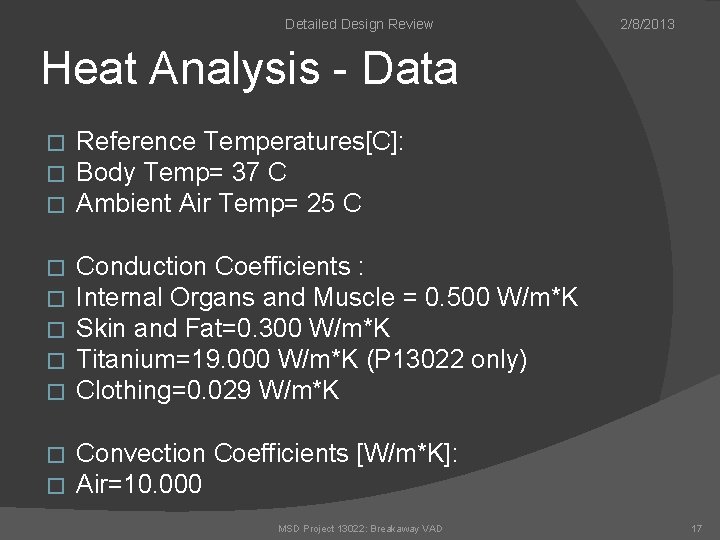
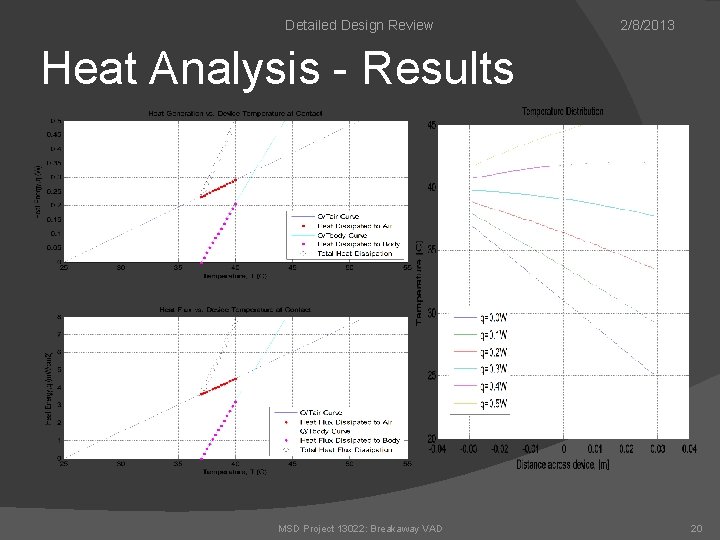
Detailed Design Review 2/8/2013 Heat Analysis - Data � � � Reference Temperatures[C]: Body Temp= 37 C Ambient Air Temp= 25 C � � � Conduction Coefficients : Internal Organs and Muscle = 0. 500 W/m*K Skin and Fat=0. 300 W/m*K Titanium=19. 000 W/m*K (P 13022 only) Clothing=0. 029 W/m*K � � Convection Coefficients [W/m*K]: Air=10. 000 MSD Project 13022: Breakaway VAD 17
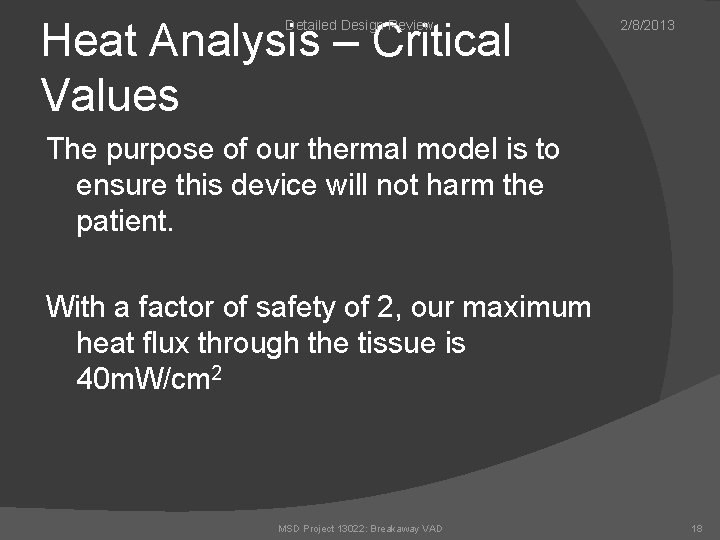
Heat Analysis – Critical Values Detailed Design Review 2/8/2013 The purpose of our thermal model is to ensure this device will not harm the patient. With a factor of safety of 2, our maximum heat flux through the tissue is 40 m. W/cm 2 MSD Project 13022: Breakaway VAD 18
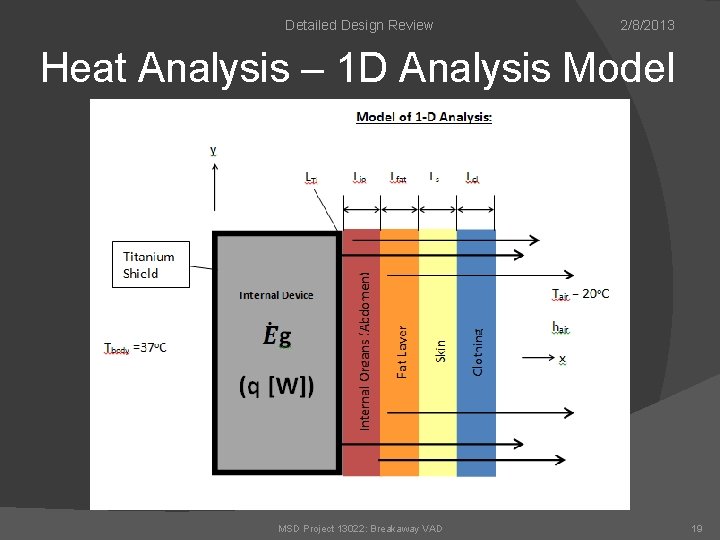
Detailed Design Review 2/8/2013 Heat Analysis – 1 D Analysis Model MSD Project 13022: Breakaway VAD 19
Detailed Design Review 2/8/2013 Heat Analysis - Results MSD Project 13022: Breakaway VAD 20
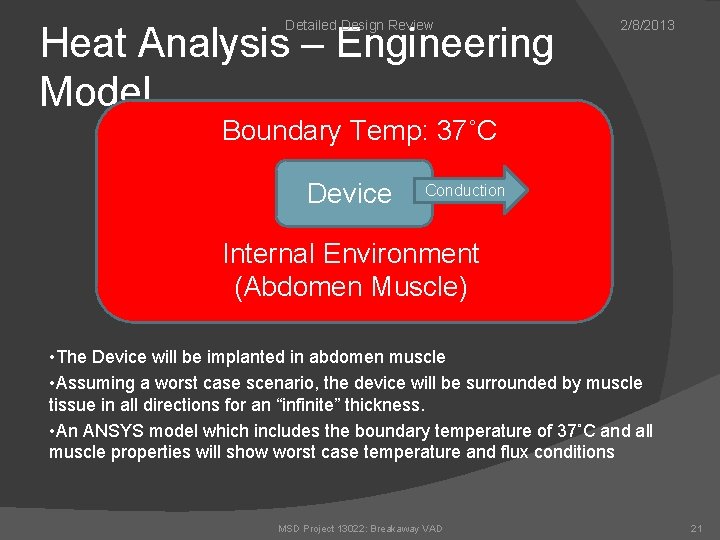
Detailed Design Review Heat Analysis – Engineering Model 2/8/2013 Boundary Temp: 37˚C Device Conduction Internal Environment (Abdomen Muscle) • The Device will be implanted in abdomen muscle • Assuming a worst case scenario, the device will be surrounded by muscle tissue in all directions for an “infinite” thickness. • An ANSYS model which includes the boundary temperature of 37˚C and all muscle properties will show worst case temperature and flux conditions MSD Project 13022: Breakaway VAD 21
Detailed Design Review 2/8/2013 Heat Analysis - Summary � For the given area of 64 cm 2 , 0. 3 W (4. 67 m. W/cm 2) of heat generation will be dissipated before exceeding 40 o. C. � For a surface area of 340 cm 2 we should be allowed to generate up to 13. 6 W of heat energy within the device. � Expected worst case heat generation = 2 W. MSD Project 13022: Breakaway VAD 22
Detailed Design Review 2/8/2013 Heat Analysis - Conclusion � � � The Internal Battery Storage Device is not likely to harm the body through heat generation based upon the of energy flux through the total surface area. Further analysis will be conducted (in ANSYS) to confirm the results. Due to the extreme difficulty of finding a relatively accurate model for the body in relation to the LVAD system, the 1 -D analysis is only useful for worst case results and only provide limited useful data. Further analysis in ANSYS should provide more reliable results. Development of the P 13022 device should continue with minimal design change. MSD Project 13022: Breakaway VAD 23
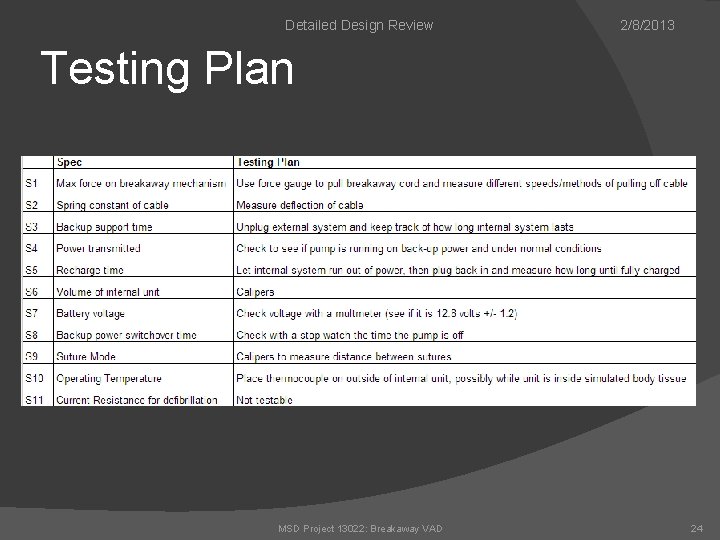
Detailed Design Review 2/8/2013 Testing Plan MSD Project 13022: Breakaway VAD 24

Detailed Design Review 2/8/2013 Work Breakdown Structure MSD Project 13022: Breakaway VAD 25
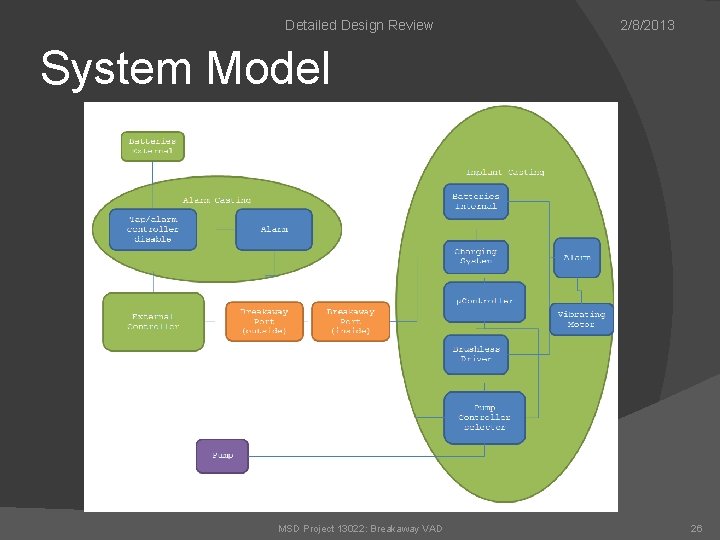
Detailed Design Review 2/8/2013 System Model MSD Project 13022: Breakaway VAD 26
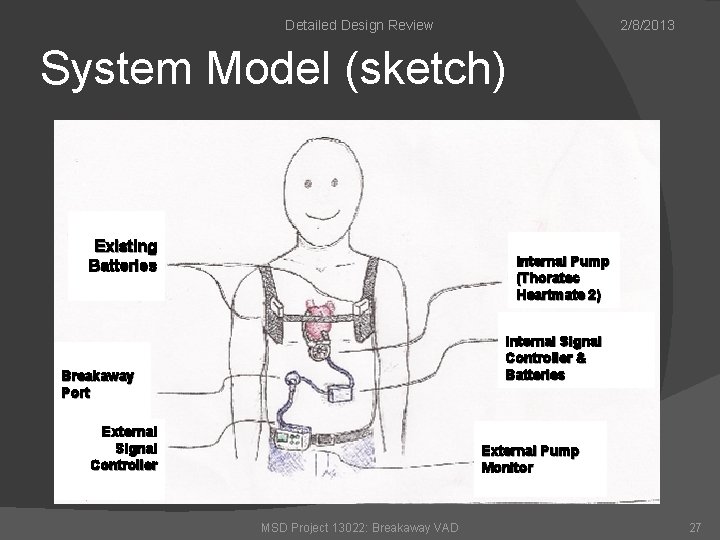
Detailed Design Review 2/8/2013 System Model (sketch) Existing Batteries Internal Pump (Thoratec Heartmate 2) Internal Signal Controller & Batteries Breakaway Port External Signal Controller External Pump Monitor MSD Project 13022: Breakaway VAD 27
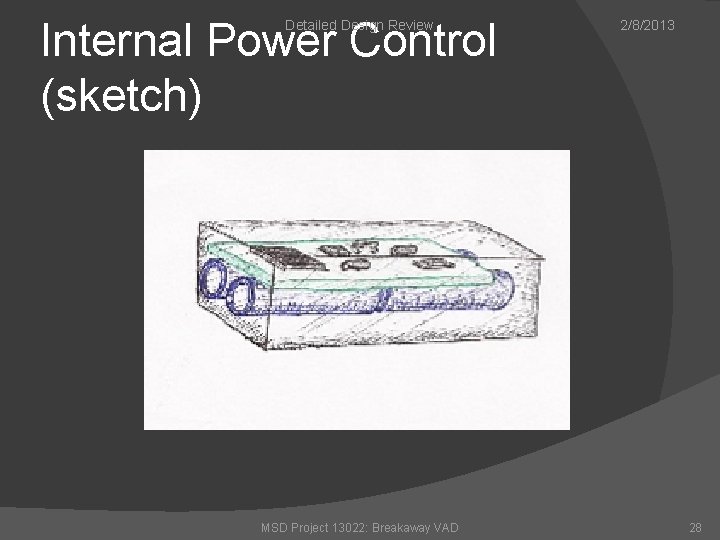
Internal Power Control (sketch) Detailed Design Review MSD Project 13022: Breakaway VAD 2/8/2013 28
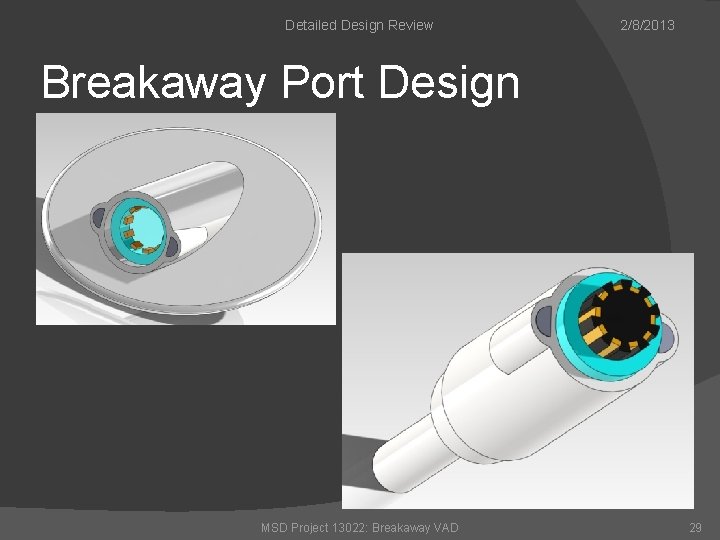
Detailed Design Review 2/8/2013 Breakaway Port Design MSD Project 13022: Breakaway VAD 29
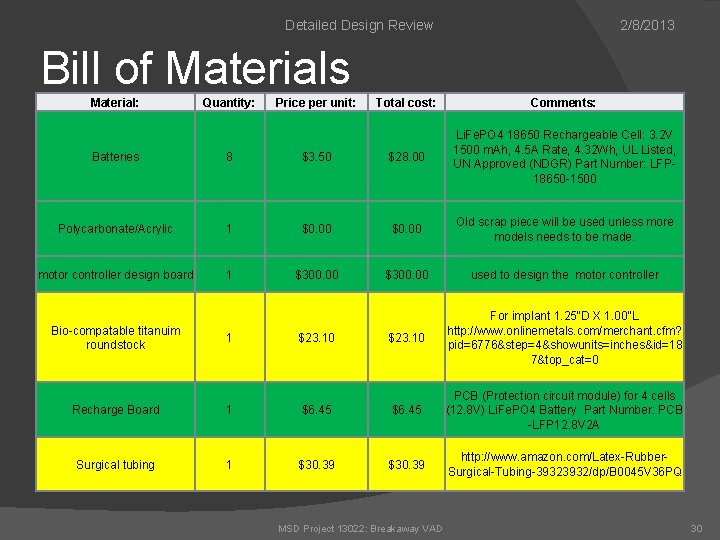
Detailed Design Review 2/8/2013 Bill of Materials Material: Quantity: Price per unit: Total cost: Comments: Batteries 8 $3. 50 $28. 00 Li. Fe. PO 4 18650 Rechargeable Cell: 3. 2 V 1500 m. Ah, 4. 5 A Rate, 4. 32 Wh, UL Listed, UN Approved (NDGR) Part Number: LFP 18650 -1500 Polycarbonate/Acrylic 1 $0. 00 Old scrap piece will be used unless more models needs to be made. motor controller design board 1 $300. 00 used to design the motor controller Bio-compatable titanuim roundstock 1 $23. 10 For implant 1. 25"D X 1. 00"L http: //www. onlinemetals. com/merchant. cfm? pid=6776&step=4&showunits=inches&id=18 7&top_cat=0 Recharge Board 1 $6. 45 PCB (Protection circuit module) for 4 cells (12. 8 V) Li. Fe. PO 4 Battery Part Number: PCB -LFP 12. 8 V 2 A Surgical tubing 1 $30. 39 http: //www. amazon. com/Latex-Rubber. Surgical-Tubing-3932/dp/B 0045 V 36 PQ MSD Project 13022: Breakaway VAD 30
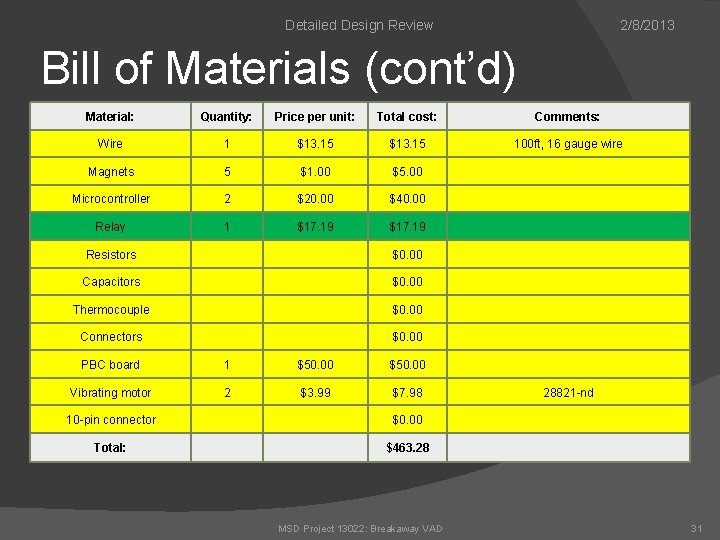
Detailed Design Review 2/8/2013 Bill of Materials (cont’d) Material: Quantity: Price per unit: Total cost: Comments: Wire 1 $13. 15 100 ft, 16 gauge wire Magnets 5 $1. 00 $5. 00 Microcontroller 2 $20. 00 $40. 00 Relay 1 $17. 19 Resistors $0. 00 Capacitors $0. 00 Thermocouple $0. 00 Connectors $0. 00 PBC board 1 $50. 00 Vibrating motor 2 $3. 99 $7. 98 28821 -nd 10 -pin connector $0. 00 Total: $463. 28 MSD Project 13022: Breakaway VAD 31
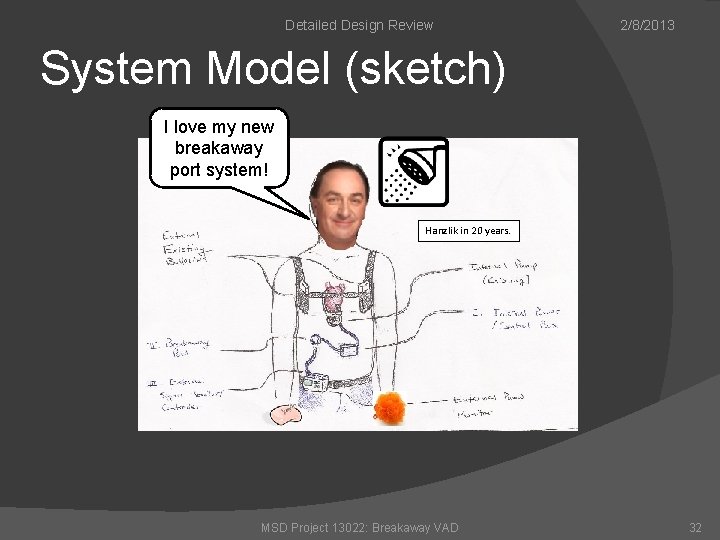
Detailed Design Review 2/8/2013 System Model (sketch) I love my new breakaway port system! Hanzlik in 20 years. MSD Project 13022: Breakaway VAD 32
- Slides: 32