
Ms Isabella Marinaro INDIAN KILLER some critical lines
Ms Isabella Marinaro INDIAN KILLER some critical lines

Ms Isabella Marinaro “ If people start dealing with Indian culture and Indian people truthfully in this country, we’re going to have to start dealing with the genocide that happened here. In order to start dealing truthfully with our cultures, they have to start dealing truthfully with that great sin, the original of this country, and that’s not going to happen. ” Sherman Alexie
Ms Isabella Marinaro Alexie’s position towards present situations American Indians in US

Ms Isabella Marinaro in most of his writings Alexie reshapes readers’ attitude about Natives, in particular ideas based on stereotypes and misinformation: “ No Indian will stand on the roadside singing traditional songs for money. This is what writers do when they put it in books and sell it. ” (Sherman Alexie)
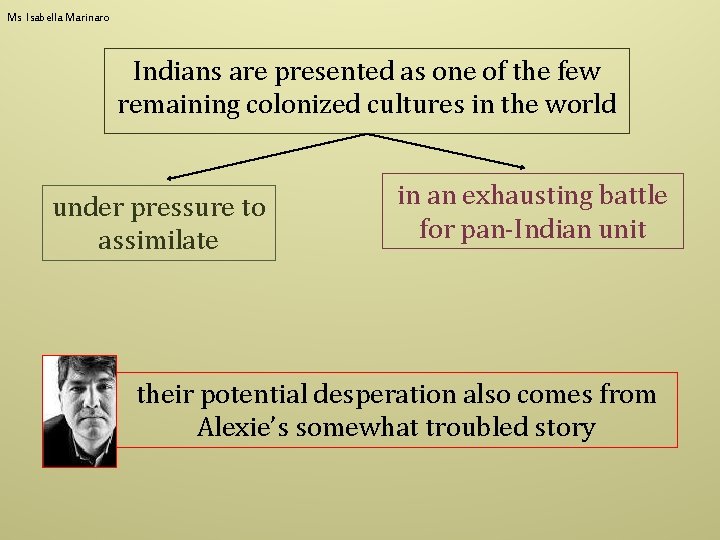
Ms Isabella Marinaro Indians are presented as one of the few remaining colonized cultures in the world under pressure to assimilate in an exhausting battle for pan-Indian unit their potential desperation also comes from Alexie’s somewhat troubled story
Ms Isabella Marinaro Alexie’s characters try to forge their identities form a broken ethnic history and the damaging stereotypes of popular culture they seem to wonder: (a) what does it mean to live as an Indian in this time? (b) what does it actually mean to be an Indian man/woman? (c) what does it mean to live on an Indian “rez”?
Ms Isabella Marinaro those questions are Alexie’s own ones, but projected inside his characters
Ms Isabella Marinaro in his production Alexie carefully and consciously blends elements of popular Indian culture and spirituality the result the drudgery of povertyridden reservation life to create his characters and their worlds various versions of Indian identity neither completely Indian, nor exclusively contemporary American
Ms Isabella Marinaro thus his characters are as likely to listen to Jimi Hendrix as to Buffy Sainte-Marie, or to play basketball and to watch a pow-wow his aim is to turn off the media images of Natives and look at the reality of daily reservation life
Ms Isabella Marinaro Relevance of the Ghost Dance in Indian Killer
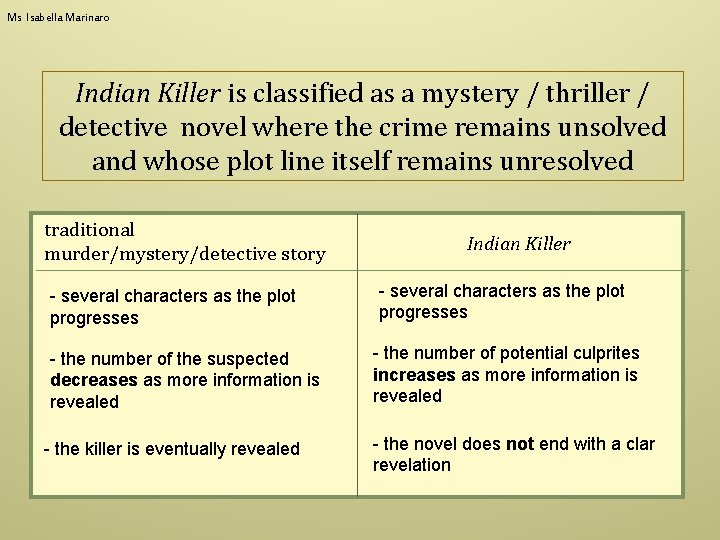
Ms Isabella Marinaro Indian Killer is classified as a mystery / thriller / detective novel where the crime remains unsolved and whose plot line itself remains unresolved traditional murder/mystery/detective story - several characters as the plot progresses - the number of the suspected decreases as more information is revealed - the killer is eventually revealed Indian Killer - several characters as the plot progresses - the number of potential culprites increases as more information is revealed - the novel does not end with a clar revelation
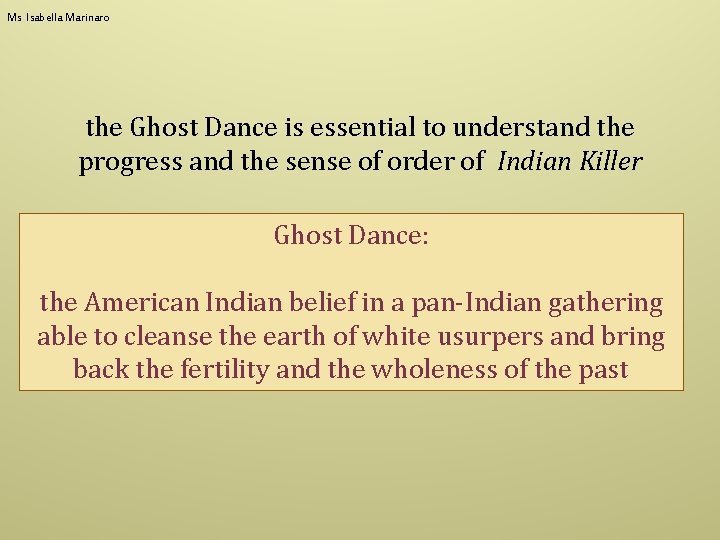
Ms Isabella Marinaro the Ghost Dance is essential to understand the progress and the sense of order of Indian Killer Ghost Dance: the American Indian belief in a pan-Indian gathering able to cleanse the earth of white usurpers and bring back the fertility and the wholeness of the past
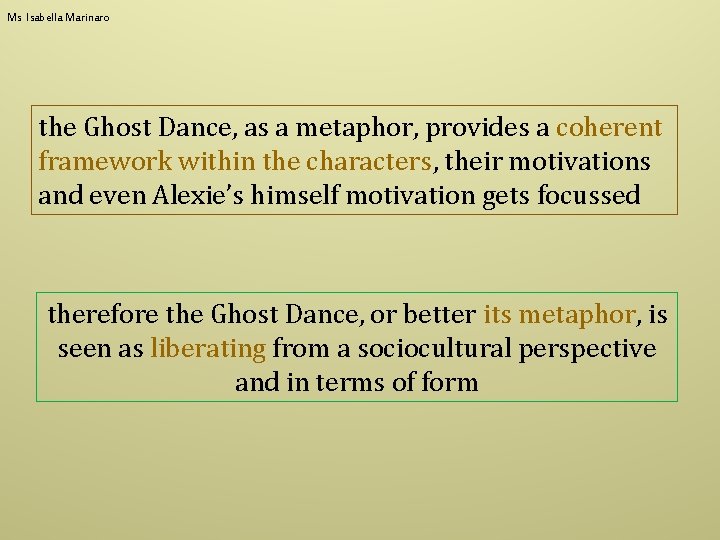
Ms Isabella Marinaro the Ghost Dance, as a metaphor, provides a coherent framework within the characters, their motivations and even Alexie’s himself motivation gets focussed therefore the Ghost Dance, or better its metaphor, is seen as liberating from a sociocultural perspective and in terms of form
Ms Isabella Marinaro Violence and Captivity in Indian Killer
Ms Isabella Marinaro the Ghost Dance, as it is seen in IK, is Alexie’s shifting from the mere reaction to US racism / oppression to a more active, maybe destructive role the action of al alleged demented madman (leaving feathers at the scene of the crimes) provokes violent ripercussions on white and Indian sides this is Alexie’s ability to explore racial violent stereotypes belonging to both sides
Ms Isabella Marinaro these reactions clearly show both “identities” are based on fundamental lies these stereotyped reactions make the characters be perceived as caricatures by readers
Ms Isabella Marinaro the very beginning of IK starts with the violent “adoption” of an Indian baby theme of the violent “adoption” shifts the genre of the novel to the so-called captivity narrative IK is a “modern captivity narrative” novel because of the urban captivity its Native characters are trapped in to be more precise, IK is a “reverse captivity narrative” novel, as young Indians are adopted and “civilised”

Ms Isabella Marinaro John Smith’s situation is referred to the period before the Indian Child Welfare Act (ICWA)
Ms Isabella Marinaro to understand Indian Killer it is necessary to examine: (a) the federal policie s of Indian reforms d uring the late 20 th cent. aimin g at pushing the India ns into urban environments ; e: v i t a r r a n y t i v i t p ca e s r e v e r e h t f o y ity t n e d i (b) the histor r o f t s e u q his d n a e r u t p a c ’s John Smith (c) why the Indian killer is never identified
Ms Isabella Marinaro (a) Alexie criticizes the colonial imposition of “Termination” and “Relocation” projects in the 1950 s they were masked as projects to help Indian people to become part of the mainstream of the American society they eventually left the Indians totally disconnected from their tribal lands and struggling in unwelcoming large cities where they felt as invisible and alienated John Smith is a good example
Ms Isabella Marinaro (b) Indian Killer Seattle, as a large city, is a place of violence and in the novel it soon becomes a symbol of colonization, a place especially built for Whites only that is why John Smith feels at home only in his imaginary reservation of his day-dreaming mind, a happy place with a lovely family, the place of his robbed memories John is the victim of the real captivity
Ms Isabella Marinaro (b) Alexie plays with an anti-captivity novel, being the captivity genre as basic of American literature, to justify the desire to do away with the white culture this is particularly true with the final scene of the Ghost Dance it mus be specified that Indian children were not usually taken away from their reservations in the violent way John Smith was, but Alexie did want to represent the effective and devastating internal violence in taking an Indian baby out of his/her community
Ms Isabella Marinaro (b) by the end of the 1970 s Indians were not perceived as a threat to Whites: a) so the ICWA got acceptance in Congress b) Indian sovereignty issu did not interfere with most government practice c) most Indian lands were gone d) most Indian children had been taught the basic principles of Christianity and made speak English
Ms Isabella Marinaro (b) “ White people no longer feared Indians. Somehow , near the end of the twentieth century, Indians had become invisible, docile” (Indian Killer)
Ms Isabella Marinaro (b) John Smith’s daydream visions and paranoia are the symbol of five hundred-year-old repression of Indian values, especially the sense of belonging to a community in contrast with the White sense of individualism John commits suicide because death is the only way to escape from captivity
Ms Isabella Marinaro (c) John Smith’s suicide does not answer any readers’ questions simply because it should not, for the same reason why readers are not given further clues to identify the killer why?
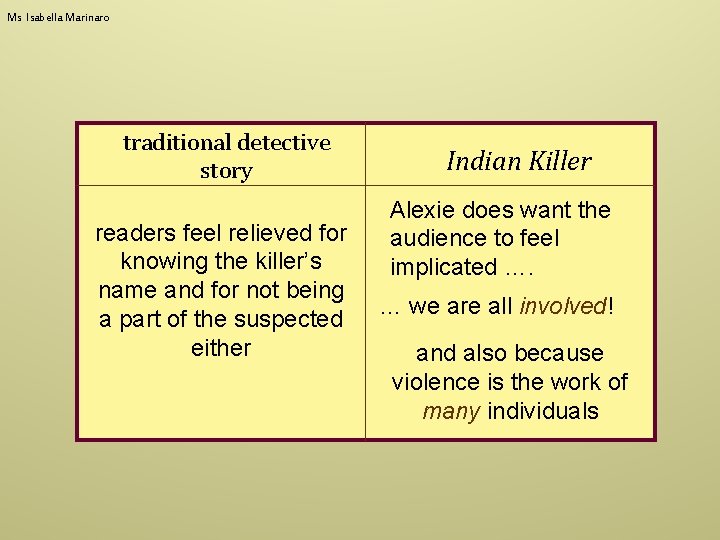
Ms Isabella Marinaro traditional detective story readers feel relieved for knowing the killer’s name and for not being a part of the suspected either Indian Killer Alexie does want the audience to feel implicated …. … we are all involved! and also because violence is the work of many individuals
Ms Isabella Marinaro FINAL MESSAGE * Indian identity nowadays is very complex * Indian people must still fight against government policy / urban landscapes / white academic / anything designed to fragment Indian identity the real focus of IK is the quest for identity in a cultural urban captivity ed e d in , n o ti lu o s ly p im s a not
Ms Isabella Marinaro Focus on Chapter 7: “Introduction to Native American Literature” or: problems with Dr Mather’s Syllabus
Ms Isabella Marinaro Professor Mather is a “wannabe Indian”, a white male anthropologist whose syllabus, lectures and personal interpretation of Indian literature show the typical romantic misconception of Indian culture and literature : m i h s e z i c i t i cr n i k t a l o P e i , r c i t Ma n e h t u a er h t i e n e r a s l a s e l p m his propos a x e e t ria p o r p p a t s o e r nor the m u t a r e t i l n ica r e m A e v i t a of N
Ms Isabella Marinaro through Marie Polatikin’s character, Alexie shows that the Indian struggle for sovereignty is a process of asserting the power Native Americans have got as communities and individuals to make decisions about their lives by decentering professor Mather’s teachings, Marie Polatkin tries to: * subvert his role of authority * promote an agenda of tribal intellectual sovereignty whose central point is that being an Indian mostly means “to survive”
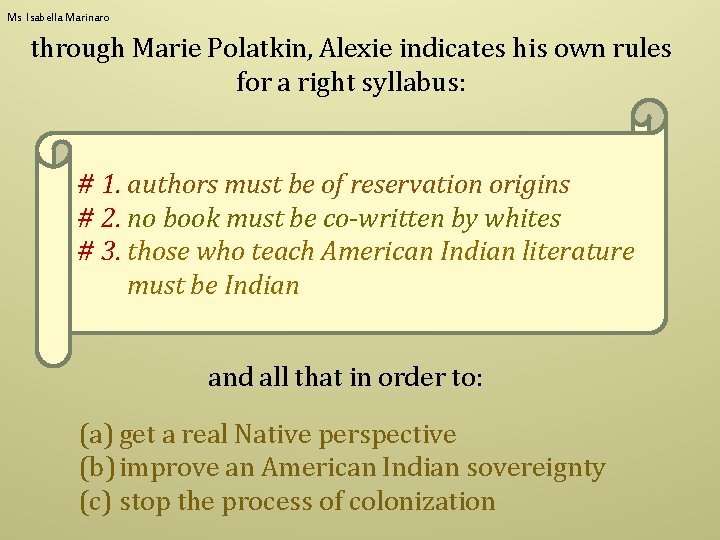
Ms Isabella Marinaro through Marie Polatkin, Alexie indicates his own rules for a right syllabus: # 1. authors must be of reservation origins # 2. no book must be co-written by whites # 3. those who teach American Indian literature must be Indian and all that in order to: (a) get a real Native perspective (b) improve an American Indian sovereignty (c) stop the process of colonization
Ms Isabella Marinaro Alexie often complaints about white people speaking with authority for and about Indians he rejects white writers who believe they understand Native Americans’ lives only by writing about them this is how white writers still go on with colonizing Natives, by telling the reading public what Natives are “really” like

Ms Isabella Marinaro “You’ ve colonized Indian land but I am not about to let colonize my heart and my mind. ” (Sherman Alexie, Dear John Wayne)

Ms Isabella Marinaro Alexie says books written by non-Indians sell more copies than those written by Indians… …so he suggests that white authors writing fiction about Indians should donate 10 percent of their royalties either to American Indian College Fund, or to the tribe about which they write

Ms Isabella Marinaro Alexie does not seem to offer any solution about white scholars once questioned about what he recommended for white scholars who want to study Native American literature, he did not answer
Ms Isabella Marinaro Focus on the last Chapter: “Creation Story” or: the chapter where the Indian Killer’s collecting “trophies” plays a dominant role
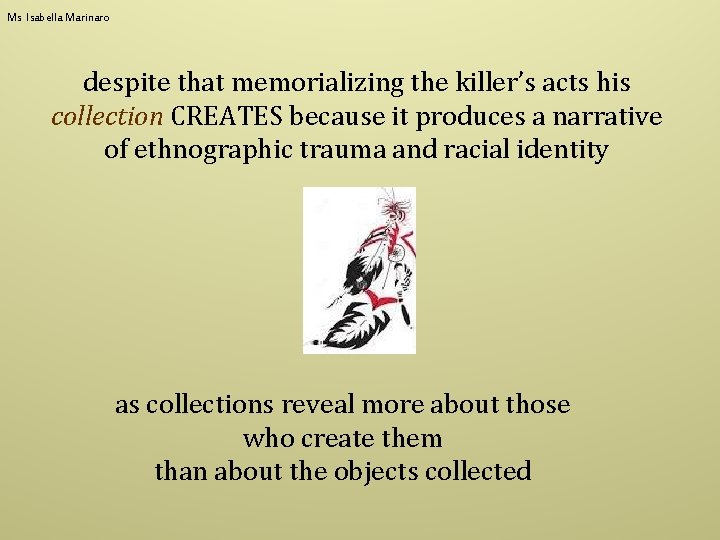
Ms Isabella Marinaro despite that memorializing the killer’s acts his collection CREATES because it produces a narrative of ethnographic trauma and racial identity as collections reveal more about those who create them than about the objects collected
Ms Isabella Marinaro the Indian Killer’s collection reflects Alexie’s penchant for ironic reversal in contrast to the familiar dynamic of Western museums, the Indian Killer’s backpack reveals that: (a) white people are objects of collection rather than collectors (b) Native Americans are the ones reveling in the accumulation of artifacts
Ms Isabella Marinaro the Indian Killer’s backpack/collection is a clear counterbalance to the many collections created by whites to define Native Americans and thus to maintain a racial hierarchy in the modern world it is Alexie’s critique of cultural imperialism in the US as ethnographic collections reinforce white power and undermine indigenous authority collections can do violence to the racial other
Ms Isabella Marinaro as a matter of fact, collecting is a form of: (a) subordination (b) appropriation (c) depersonification
Ms Isabella Marinaro for Alexie, decontextualization and collecting is a cultural violence analogous to the killer’s attacks it is analogous to the cultural violence inflicted upon Native American identity by the academy, the publishing world, the armchair ethnographer it is a form of colonial practice
Ms Isabella Marinaro collecting is a violence analogous to the practice of adopting Native American babies Daniel and Olivia Smith too carry out a form of colonizing as their education, aiming at re-building John’s new false Indian identity, contributes to their son’s confusion…

Ms Isabella Marinaro …just like Daniel Smith’s turning his maps of territories conquered by the US army: Korea, Vietnam and (former Indian) Montana it is meaningful that Daniel studies his maps while listening to Truck Schultz’s conservative and racial talk-show he finally gets his “new order” (= the same of the collector), he finally gets the same authority of the collector
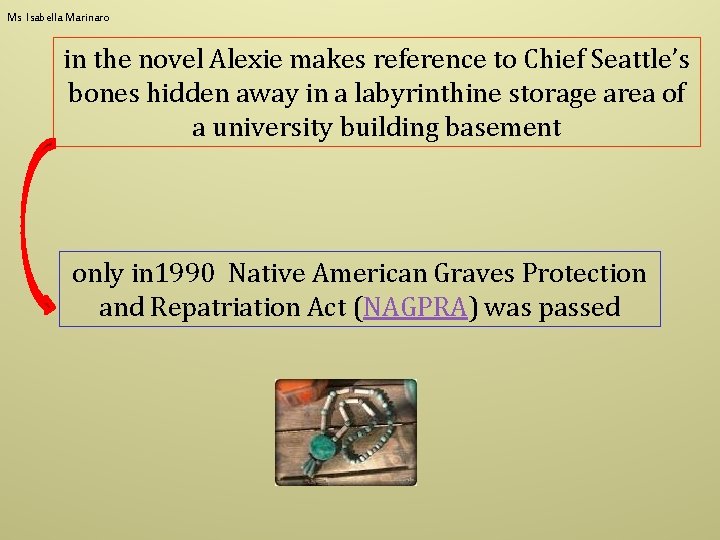
Ms Isabella Marinaro in the novel Alexie makes reference to Chief Seattle’s bones hidden away in a labyrinthine storage area of a university building basement only in 1990 Native American Graves Protection and Repatriation Act (NAGPRA) was passed
Ms Isabella Marinaro the killer is never identified in the text because his identity derives from his collection of murderous artifacts alone the Indian Killer is not a figure of triumph, but a directionless, nameless, faceless product of a violent collection
Ms Isabella Marinaro Alexie indicates there is no triumph in this counter collection, but the danger for Native Americans if perpetuating mutually destructive racial hatred and violence the archives of Native American violence, like the ones of white violence, can only redouble the general schizofrenia of a divided national culture
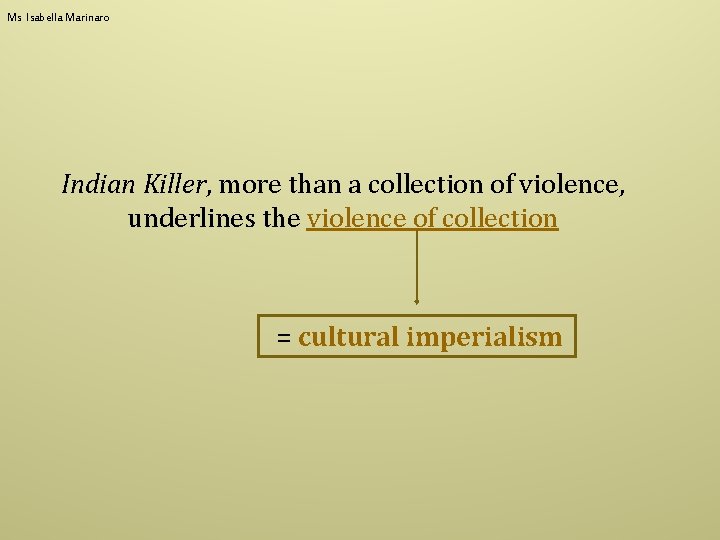
Ms Isabella Marinaro Indian Killer, more than a collection of violence, underlines the violence of collection = cultural imperialism

Ms Isabella Marinaro “Creation story” could not help ending with the Owl Dance the owl is a sacred animal for the Native Americans for its capacity to see by night; it is evoked during ceremonies where an oracle is demanded to show the secrets of the future
- Slides: 49