
MRI Safety Awareness Objectives n n n Identify
MRI Safety Awareness
Objectives n n n Identify hazards surrounding the MRI environment. Discuss safety precautions to protect patients, family members and staff against possible dangers and injury within the MRI suite. Discuss the importance of accurately completing the mandatory MRI pre-screening form.
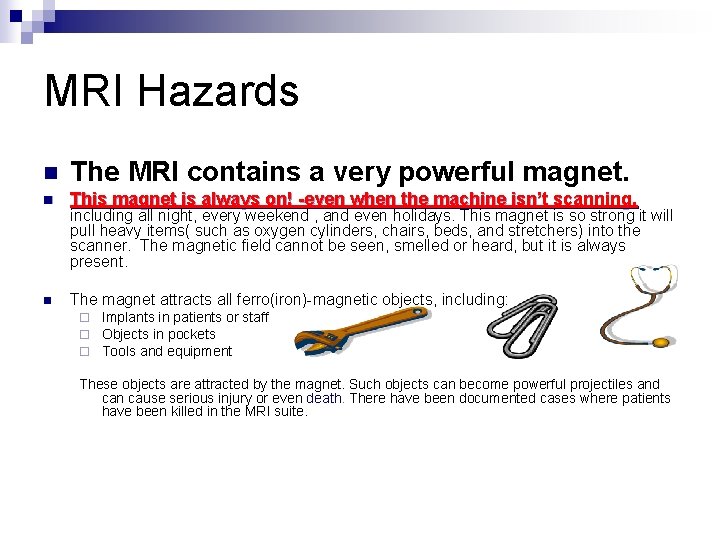
MRI Hazards n The MRI contains a very powerful magnet. n This magnet is always on! -even when the machine isn’t scanning, n The magnet attracts all ferro(iron)-magnetic objects, including: including all night, every weekend , and even holidays. This magnet is so strong it will pull heavy items( such as oxygen cylinders, chairs, beds, and stretchers) into the scanner. The magnetic field cannot be seen, smelled or heard, but it is always present. ¨ ¨ ¨ Implants in patients or staff Objects in pockets Tools and equipment These objects are attracted by the magnet. Such objects can become powerful projectiles and can cause serious injury or even death. There have been documented cases where patients have been killed in the MRI suite.
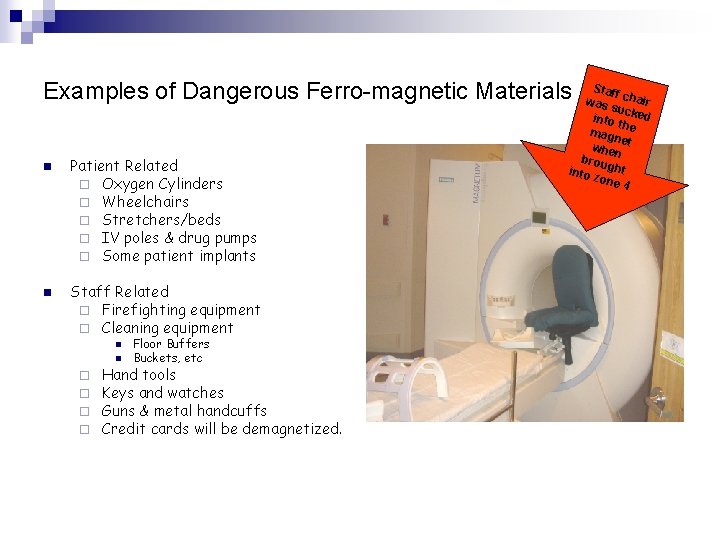
Examples of Dangerous Ferro-magnetic Materials n n Patient Related ¨ Oxygen Cylinders ¨ Wheelchairs ¨ Stretchers/beds ¨ IV poles & drug pumps ¨ Some patient implants Staff Related ¨ Firefighting equipment ¨ Cleaning equipment n n ¨ ¨ Floor Buffers Buckets, etc Hand tools Keys and watches Guns & metal handcuffs Credit cards will be demagnetized. Staff was chair suc into ked th mag e net whe brou n into ght zone 4

Special MRI Equipment n Tools and patient-care equipment that are specially designed for use in the MRI suite are made without ferrous material and they are clearly labeled. If there is no label assume that the item is not safe to enter the MRI suite. Again, if in doubt, leave it out.

MRI Safety Signs n Warning signs at the entrance of the MRI suite, alert you that you are entering an area with special hazards. Always follow all instructions and be aware of your surroundings. The magnet is a powerful and dangerous piece of medical equipment and should be treated accordingly.
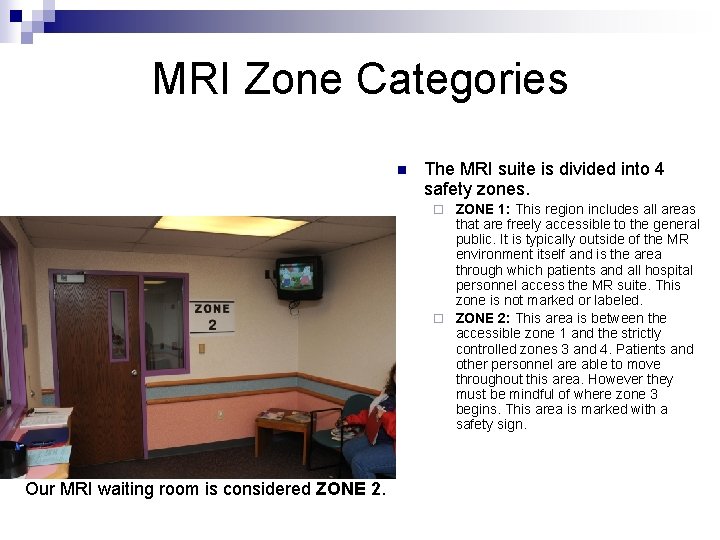
MRI Zone Categories n The MRI suite is divided into 4 safety zones. ZONE 1: This region includes all areas that are freely accessible to the general public. It is typically outside of the MR environment itself and is the area through which patients and all hospital personnel access the MR suite. This zone is not marked or labeled. ¨ ZONE 2: This area is between the accessible zone 1 and the strictly controlled zones 3 and 4. Patients and other personnel are able to move throughout this area. However they must be mindful of where zone 3 begins. This area is marked with a safety sign. ¨ Our MRI waiting room is considered ZONE 2.
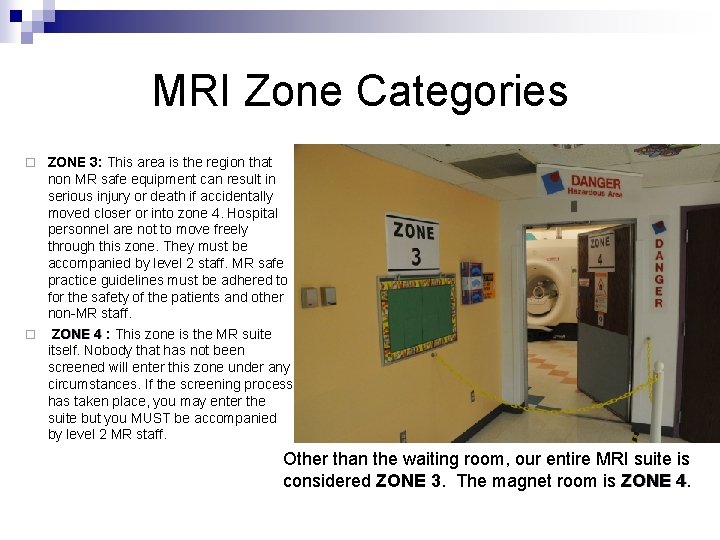
MRI Zone Categories ZONE 3: This area is the region that non MR safe equipment can result in serious injury or death if accidentally moved closer or into zone 4. Hospital personnel are not to move freely through this zone. They must be accompanied by level 2 staff. MR safe practice guidelines must be adhered to for the safety of the patients and other non-MR staff. ¨ ZONE 4 : This zone is the MR suite itself. Nobody that has not been screened will enter this zone under any circumstances. If the screening process has taken place, you may enter the suite but you MUST be accompanied by level 2 MR staff. ¨ Other than the waiting room, our entire MRI suite is considered ZONE 3. The magnet room is ZONE 4. 4
Safety Measures n Most MRI related incidents have been due to deficiencies in screening methods and or lack of properly controlling access to the MRI environment, especially with regard to preventing personal items and other potentially harmful objects into the magnet room.
MRI Safety Measures n The following are measures to protect against possible dangers within the MRI suite: ¨ ¨ ¨ ¨ Staff pre-entry screening Staff awareness MRI safety signs Knowledge of hazards of magnetic field Use of special non-magnetic equipment Follow and respect instructions from MRI staff If in doubt about any object, leave it out Always see MRI staff before entering the suite
What you need to do before entering the MRI suite n Always consult with the MRI staff before entering the MRI suite. Never go into the room unattended.
n Knowledge and understanding of what the hospital MRI safety policy stipulates is a must.
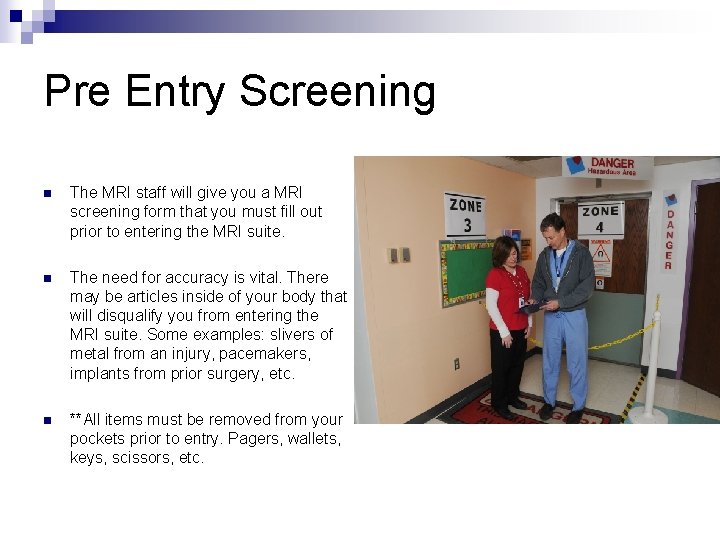
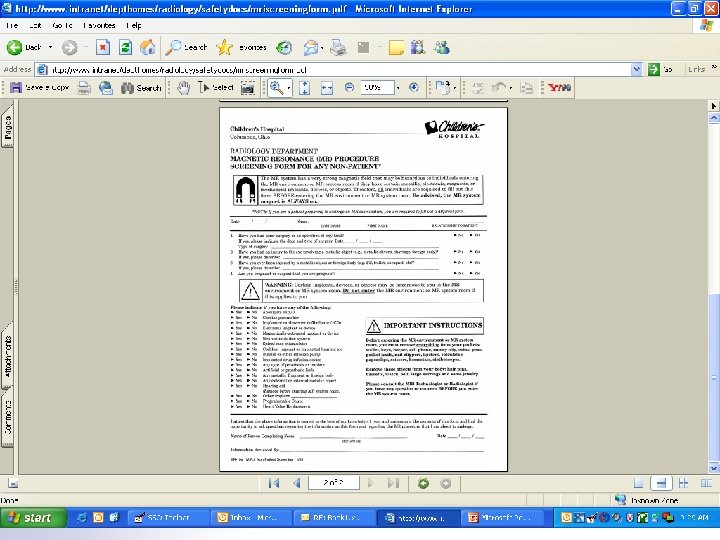
Pre Entry Screening n The MRI staff will give you a MRI screening form that you must fill out prior to entering the MRI suite. n The need for accuracy is vital. There may be articles inside of your body that will disqualify you from entering the MRI suite. Some examples: slivers of metal from an injury, pacemakers, implants from prior surgery, etc. n **All items must be removed from your pockets prior to entry. Pagers, wallets, keys, scissors, etc.
n Completely and accurately fill out the MRI pre screening form
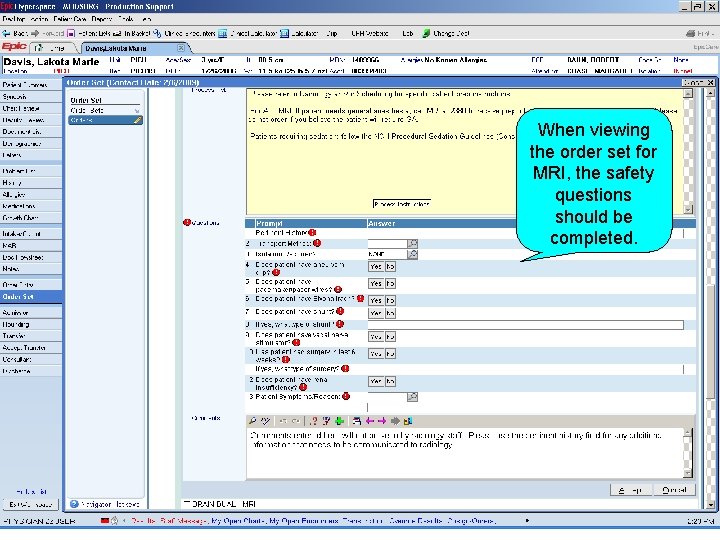
When viewing the order set for MRI, the safety questions should be completed.
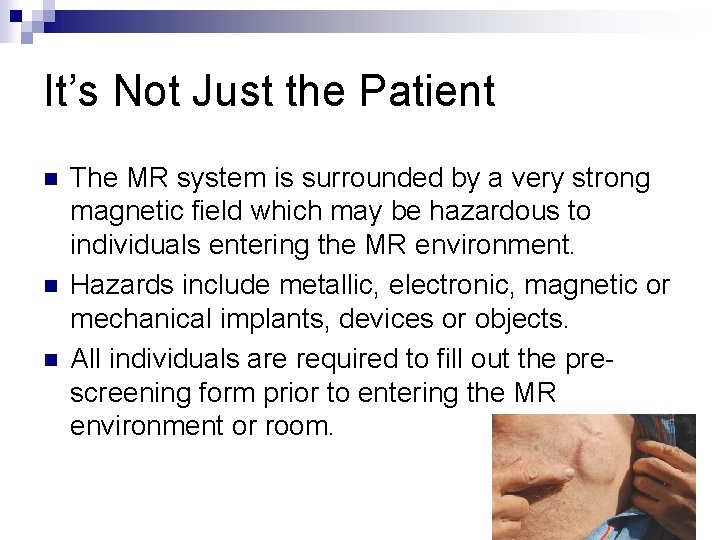
It’s Not Just the Patient n n n The MR system is surrounded by a very strong magnetic field which may be hazardous to individuals entering the MR environment. Hazards include metallic, electronic, magnetic or mechanical implants, devices or objects. All individuals are required to fill out the prescreening form prior to entering the MR environment or room.
n The magnet makes an extremely loud noise while obtaining images. Therefore, if you will be staying in the room during scanning you must wear protection.
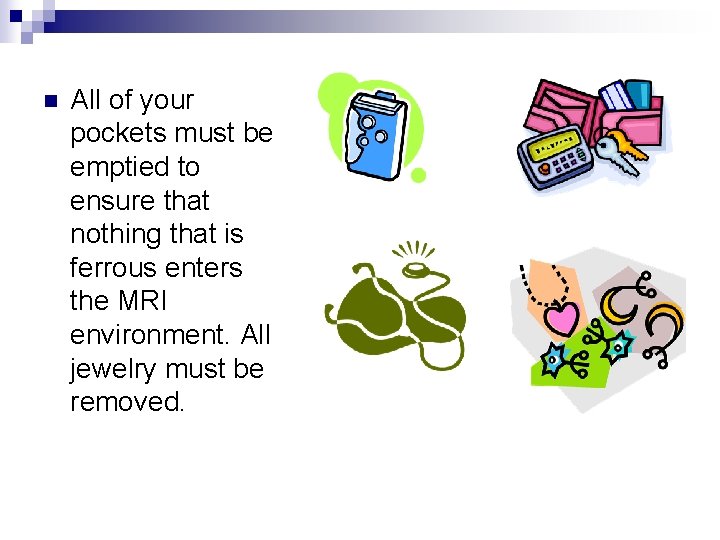
n All of your pockets must be emptied to ensure that nothing that is ferrous enters the MRI environment. All jewelry must be removed.
n Even in an emergency situation, never rush into the MRI suite
Emergency Procedures n n All safety procedures must be followed, even in an emergency situation. An MRI shut down is a lengthy and costly process called a quench. It takes more than just a flick of a switch to shut down the MRI magnet. Dangerous gases are expelled during a quench and all personnel must be moved out of the MRI Suite for their safety. Always report any problems immediately to the MRI staff Once again, if in doubt if something is MRI safe, leave it out and always ask the MRI staff.
- Slides: 21