
MRCPsych General Adult Module Bipolar Disorder2 GA Module
MRCPsych General Adult Module Bipolar Disorder-2
GA Module: Bipolar Disorder Aims and Objectives • Aims – The overall aim is to give an overview of psychopathology and diagnosis of bipolar disorder. • Objectives: – Developed an understanding of the symptoms and psychopathology, diagnostic classification and differential diagnosis of bipolar disorder.
GA Module: Bipolar Disorder To achieve this • • • Case Presentation Journal Club 555 Presentation Expert-Led Session MCQs • Please sign the register and complete the feedback
GA Module: Bipolar Disorder Expert Led Session Bipolar Disorder – Psychopathology & Diagnosis
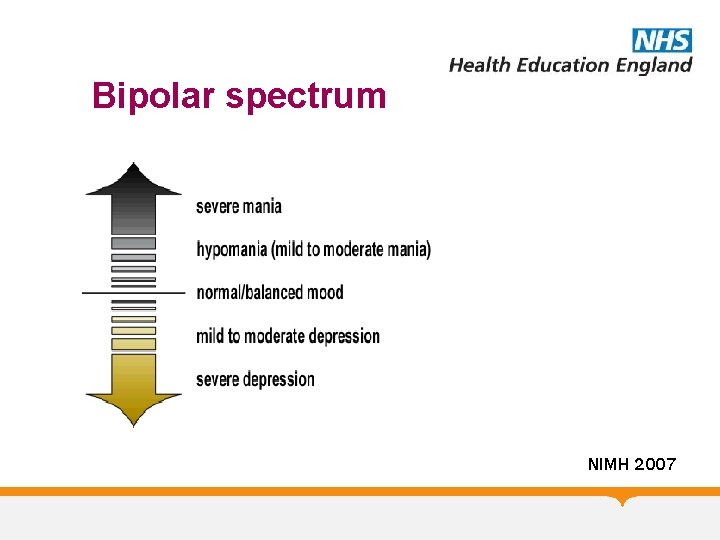
Bipolar spectrum NIMH 2007
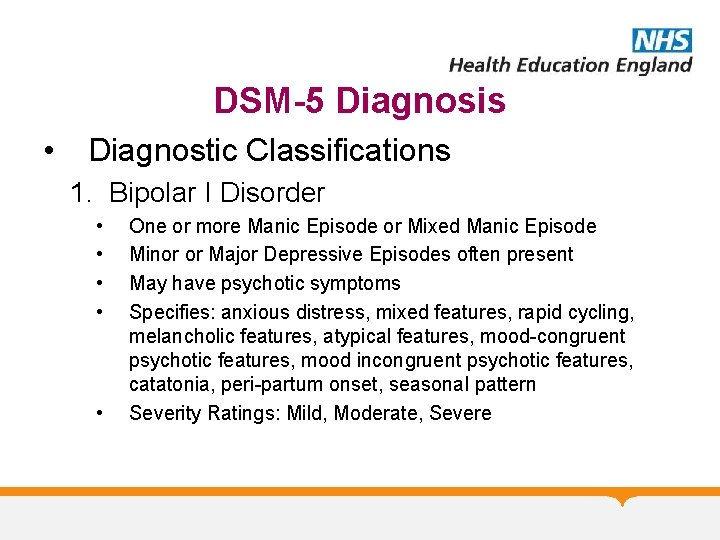
DSM-5 Diagnosis • Diagnostic Classifications 1. Bipolar I Disorder • • • One or more Manic Episode or Mixed Manic Episode Minor or Major Depressive Episodes often present May have psychotic symptoms Specifies: anxious distress, mixed features, rapid cycling, melancholic features, atypical features, mood-congruent psychotic features, mood incongruent psychotic features, catatonia, peri-partum onset, seasonal pattern Severity Ratings: Mild, Moderate, Severe
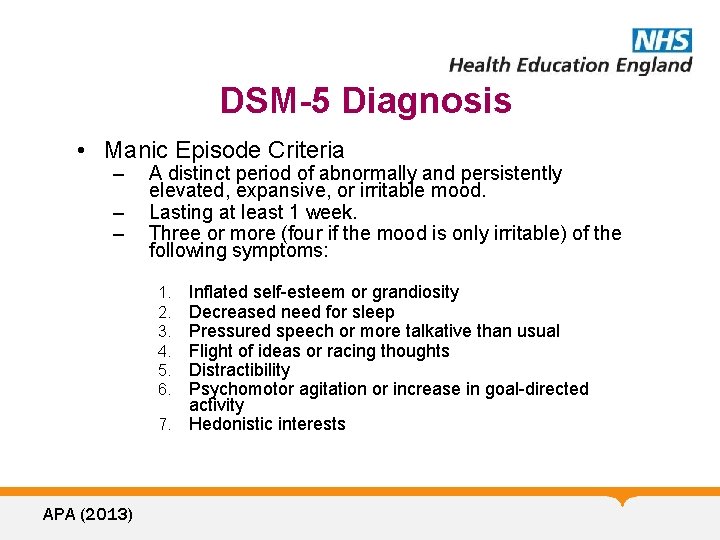
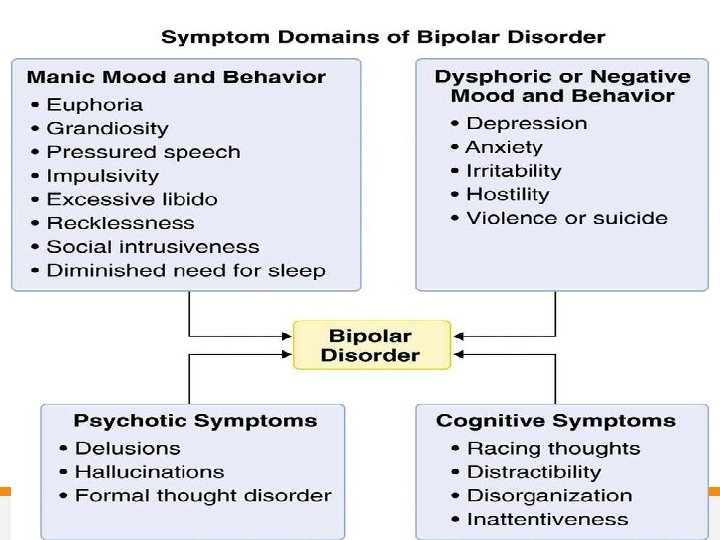
DSM-5 Diagnosis • Manic Episode Criteria – – – A distinct period of abnormally and persistently elevated, expansive, or irritable mood. Lasting at least 1 week. Three or more (four if the mood is only irritable) of the following symptoms: Inflated self-esteem or grandiosity Decreased need for sleep Pressured speech or more talkative than usual Flight of ideas or racing thoughts Distractibility Psychomotor agitation or increase in goal-directed activity 7. Hedonistic interests 1. 2. 3. 4. 5. 6. APA (2013)
DSM-5 Diagnosis • Manic Episode Criteria (cont. ) – – – APA (2013) Causes marked impairment in occupational functioning in usual social activities or relationships, or Necessitates hospitalization to prevent harm to self or others, or Has psychotic features Not due to substance use or abuse (e. g. , drug abuse, medication, other treatment), or a general medial condition (e. g. , hyperthyroidism). A full manic episode emerging during antidepressant treatment
DSM-5 Diagnosis • Diagnostic Classifications 2. Bipolar II Disorder • • • One or more Major Depressive Episode One or more Hypomanic Episode No full Manic or Mixed Manic Episodes No evidence of psychotic symptoms Severity Ratings: Mild, Moderate, Severe APA (2013)
DSM-5 Diagnosis • Hypomanic Criteria – Similarities with Manic Episode • Same symptoms – Differences from Manic Episode • • APA (2013) Length of time Impairment not as severe Psychotic symptoms not present May not be viewed by the individual as pathological – However, others may be troubled by erratic behavior
DSM-5 Diagnosis • Diagnostic Classifications 3. Cyclothymia • For at least 2 years (1 in children and adolescents), numerous periods with hypomanic symptoms that do not meet the criteria for hypomanic episode – Present at least ½ the time and not without for longer than 2 months – Short periods of depression alternating with short periods of hypomania. • Criteria for major depressive, manic, or hypomanic episode have never been met APA (2013)
DSM-5 Diagnosis • Diagnostic Classifications 4. Unspecified Bipolar and Related Disorder • Bipolar features that do not meet criteria for any specific bipolar disorder. APA (2013)
Diagnosis • Rapid-Cycling Specifier – – Can be applied to Bipolar I or II Four or more mood episodes (i. e. , Major Depressive, Manic, Mixed, or Hypomanic) per 12 months May occur in any order or combination Must be demarcated by … • a period of full remission, or • a switch to an episode of the opposite polarity – Manic, Hypomanic, and Mixed are on the same pole – NOTE: This definition is different from that used in some literature, where in cycling refers to mood changes within an episode (Geller et al. , 2004). APA (2013)
Bipolar –ICD-10 criteria F 31 BIPOLAR AFFECTIVE DISORDER • Note: Episodes are demarcated by a switch to an episode of opposite or mixed polarity or by a remission. F 31. 0 Bipolar affective disorder, current episode hypomanic • A. The current episode meets the criteria for hypomania (F 30. 0). • B. There has been at least one other affective episode in the past, meeting the criteria for hypomanic or manic episode (F 30. -), depressive episode (F 32. -) or mixed affective episode (F 38. 00). F 31. 1 Bipolar affective disorder, current episode manic without psychotic symptoms • A. The current episode meets the criteria for mania without psychotic symptoms (F 30. 1). • B. There has been at least one other affective episode in the past, meeting the criteria for hypomanic or manic episode (F 30. -), depressive episode (F 32. -) or mixed affective episode (F 38. 00).
Bipolar –ICD-10 criteria F 31. 2 Bipolar affective disorder, current episode manic with psychotic symptoms • A. The current episode meets the criteria for mania with psychotic symptoms (F 30. 2). • B. There has been at least one other affective episode in the past, meeting the criteria for hypomanic or manic episode (F 30. -), depressive episode (F 32. -) or mixed affective episode (F 38. 00). • A fifth character may be used to specify whether the psychotic symptoms are congruent or incongruent with the mood: • F 31. 20 with mood congruent psychotic symptoms • F 31. 21 with mood incongruent psychotic symptoms
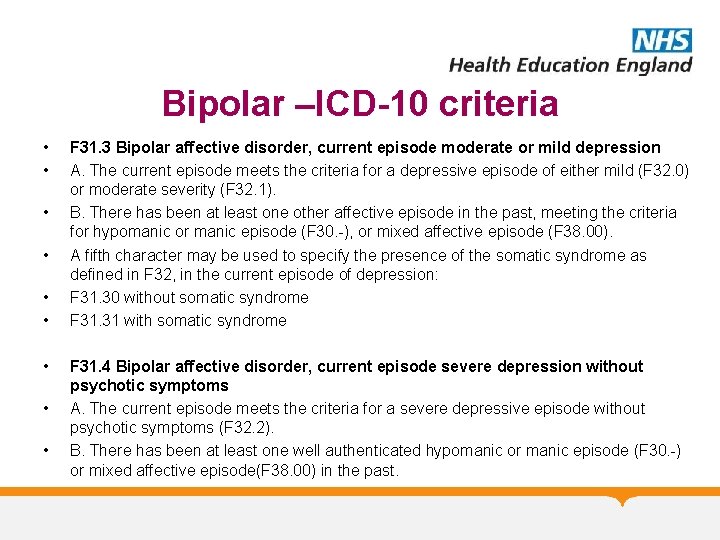
Bipolar –ICD-10 criteria • • • F 31. 3 Bipolar affective disorder, current episode moderate or mild depression A. The current episode meets the criteria for a depressive episode of either mild (F 32. 0) or moderate severity (F 32. 1). B. There has been at least one other affective episode in the past, meeting the criteria for hypomanic or manic episode (F 30. -), or mixed affective episode (F 38. 00). A fifth character may be used to specify the presence of the somatic syndrome as defined in F 32, in the current episode of depression: F 31. 30 without somatic syndrome F 31. 31 with somatic syndrome F 31. 4 Bipolar affective disorder, current episode severe depression without psychotic symptoms A. The current episode meets the criteria for a severe depressive episode without psychotic symptoms (F 32. 2). B. There has been at least one well authenticated hypomanic or manic episode (F 30. -) or mixed affective episode(F 38. 00) in the past.

Bipolar –ICD-10 criteria F 31. 5 Bipolar affective disorder, current episode severe depression with psychotic symptoms • A. The current episode meets the criteria for a severe depressive episode with psychotic symptoms (F 32. 3). • B. There has been at least one well authenticated hypomanic or manic episode (F 30. -) or mixed affective episode • (F 38. 00) in the past. • A fifth character may be used to specify whether the psychotic symptoms are congruent or incongruent with • the mood. • F 31. 50 with mood congruent psychotic symptoms • F 31. 51 with mood incongruent psychotic symptoms
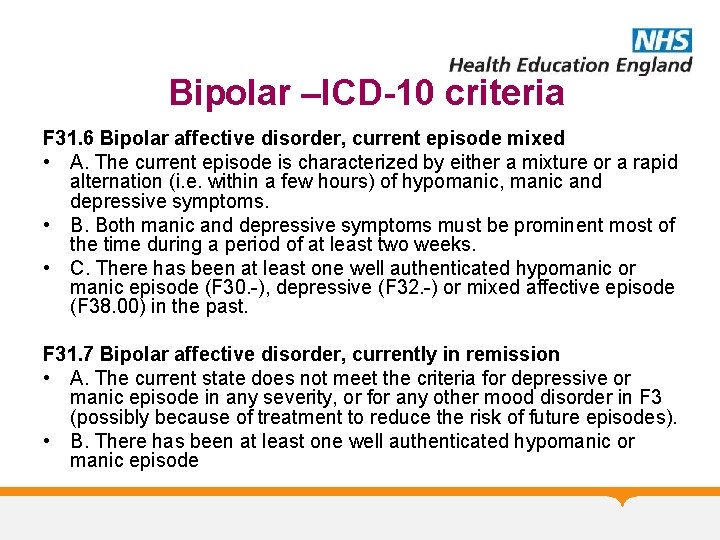
Bipolar –ICD-10 criteria F 31. 6 Bipolar affective disorder, current episode mixed • A. The current episode is characterized by either a mixture or a rapid alternation (i. e. within a few hours) of hypomanic, manic and depressive symptoms. • B. Both manic and depressive symptoms must be prominent most of the time during a period of at least two weeks. • C. There has been at least one well authenticated hypomanic or manic episode (F 30. -), depressive (F 32. -) or mixed affective episode (F 38. 00) in the past. F 31. 7 Bipolar affective disorder, currently in remission • A. The current state does not meet the criteria for depressive or manic episode in any severity, or for any other mood disorder in F 3 (possibly because of treatment to reduce the risk of future episodes). • B. There has been at least one well authenticated hypomanic or manic episode
Deferential Diagnosis

Bipolar I Alternative Diagnosis Differential Consideration Major Depressive Disorder Person with depressive Sx never had Manic/Hypomanic episodes Bipolar II Hypomanic episodes, w/o a full Manic episode Cyclothymic Disorder Lesser mood swings of alternating depression hypomania (never meeting depressive or manic criteria) cause clinically significant distress/impairment Normal Mood Swings Alternating periods of sadness and elevated mood, without clinically significant distress/impairment Schizoaffective Disorder Sx resemble Bipolar I, severe with psychotic features but psychotic Sx occur absent mood Sx Schizophrenia or Delusional Disorder Psychotic symptoms dominate. Occur without prominent mood episodes Substance Induced Bipolar Disorder Stimulant drugs can produce bipolar Sx Source: Francis (2013)
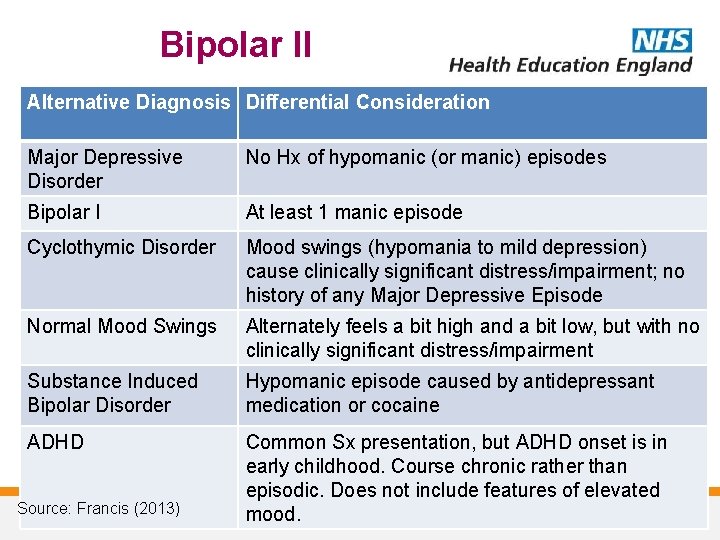
Bipolar II Alternative Diagnosis Differential Consideration Major Depressive Disorder No Hx of hypomanic (or manic) episodes Bipolar I At least 1 manic episode Cyclothymic Disorder Mood swings (hypomania to mild depression) cause clinically significant distress/impairment; no history of any Major Depressive Episode Normal Mood Swings Alternately feels a bit high and a bit low, but with no clinically significant distress/impairment Substance Induced Bipolar Disorder Hypomanic episode caused by antidepressant medication or cocaine ADHD Common Sx presentation, but ADHD onset is in early childhood. Course chronic rather than episodic. Does not include features of elevated mood. Source: Francis (2013)
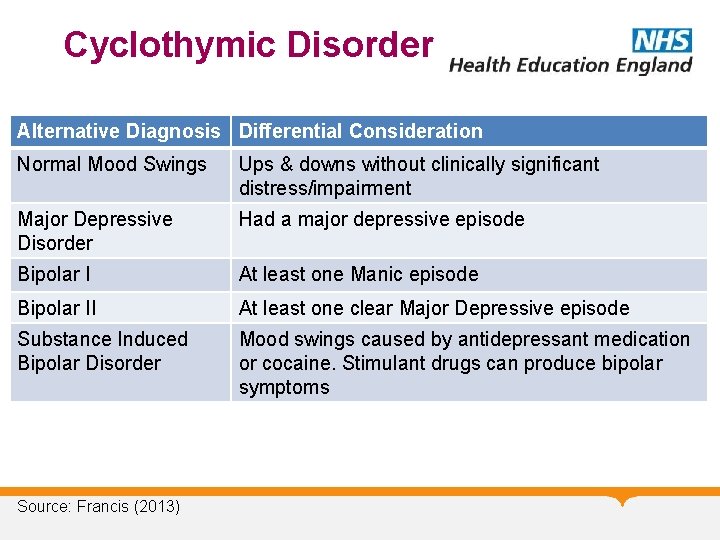
Cyclothymic Disorder Alternative Diagnosis Differential Consideration Normal Mood Swings Ups & downs without clinically significant distress/impairment Major Depressive Disorder Had a major depressive episode Bipolar I At least one Manic episode Bipolar II At least one clear Major Depressive episode Substance Induced Bipolar Disorder Mood swings caused by antidepressant medication or cocaine. Stimulant drugs can produce bipolar symptoms Source: Francis (2013)
Diagnostic difficulties of Bipolar • Lack of reliable assessment tools for Bipolar Disorder • Misdiagnosed as unipolar depression • Children, adolescents and young adults are often diagnosed with ADHD • People often do not have clear cut, discrete mood episodes • Mania if often unrecognized or considered irritability/ aggression • Psychotic features are often mistaken for Schizophrenia • Unwillingness of the client to seek treatment • Lack of insight from client in mood episodes • Clinicians missing manic/hypomanic episodes- and reliance on selfreports
PRECIPITATING FACTORS • 60% of first episodes precipitated by psychosocial, physical, or drug causes • 30% of second episodes-similar causes can be identified • 10% of third episodes have a notable cause • None of fourth episodes • Illness starts as exogenous and becomes more endogenous • Concept of kindling
Associated Impairments Suicidal Behaviors • Prevalence of suicide attempts – 40 -45% in Bipolar vs. 19% in Unipolar • Age of first attempt-tends to be younger than patients with unipolar depression • Multiple attempts-87% vs. 50% of unipolar patients • Severity of attempts • Suicidal ideation-significantly more (72% vs. 52% in unipolar)
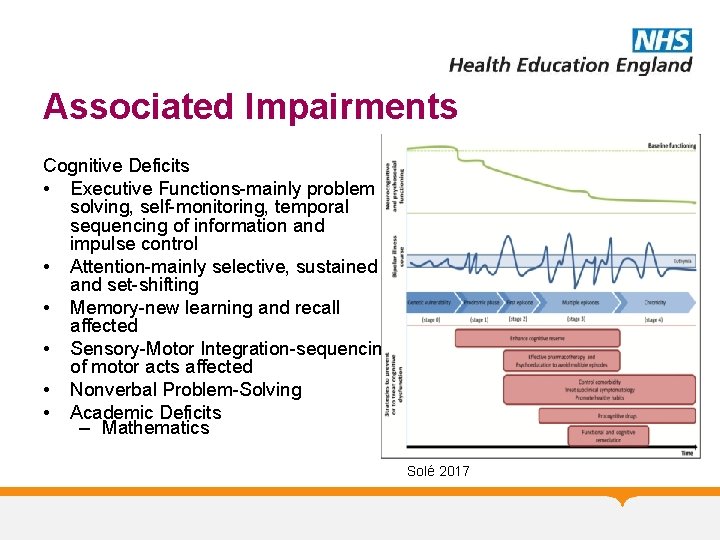
Associated Impairments Cognitive Deficits • Executive Functions-mainly problem solving, self-monitoring, temporal sequencing of information and impulse control • Attention-mainly selective, sustained and set-shifting • Memory-new learning and recall affected • Sensory-Motor Integration-sequencing of motor acts affected • Nonverbal Problem-Solving • Academic Deficits – Mathematics Solé 2017
Associated Impairments Psychosocial Deficits • Relationships – Peers – Family members • Recognition and Regulation of Emotion • Social Problem-Solving • Self-Esteem • Impulse Control & Risk taking behavior
COMORBID DISORDERS • Substance Abuse – At least 61% – Alcohol, Cocaine, THC(Cannabis) – Effect – More mixed and rapid cycling, poorer response to Lithium, slower time to recovery, and more lifetime hospitalizations • • Narcissistic PD Borderline PD 20 -30% OCD, Panic Disorder ADHD
Substance Abuse and Bipolar Disorder • BPAD has high rate of comorbid/concurrent substance misuse • 21 -61% of people with BPAD abuse or are addicted to substances as compared to 3 -13% in the general population • BPAD is second to antisocial personality disorder in terms of concurrent substance abuse • Substance use adversely effects medication, predisposes to earlier onset of symptoms and often leads to hospitalization
Bipolar Disorder and Personality Disorders • Approximately 50% of all Bipolar patients also meet criteria for a personality disorder • The most common comorbid conditions are in cluster B and C • The most common Cluster B disorders include Borderline, Histrionic, Narcissistic • The most common Cluster C disorders include Avoidant and Obsessive-Compulsive
References & further reading • American Psychiatric Association. (2013). Diagnostic and statistical manual of mental disorders (5 th ed. ). Washington, DC: Author. • NIMH. (2007). Bipolar disorder. Bethesda, MD: Author. Retrieved May 28, 2007, from http: //www. nimh. nih. gov/publicat/bipolar. cfm • Some of the slides were taken from a Power. Point presentation freely available online: Assessment and Intervention for Bipolar Disorder: Best Practices for School Psychologists by Stephen Brock, California State University Sacramento. • WORLD HEALTH ORGANIZATION. (1992). The ICD-10 classification of mental and behavioural disorders: clinical descriptions and diagnostic guidelines. Geneva, World Health Organization.
GA Module: Bipolar-2 Questions Discussion
GA Module: Bipolar- 2 MCQs 1. The experience of numerous periods of hypomanic symptoms (that do not meet the criteria for hypomanic episodes) over 2 years may be diagnosed as: A. Dysthymic disorder B. Cyclothymic disorder C. Rapid Cycling disorder D. Personality disorder E. Bipolar disorder NOS
GA Module: Bipolar- 2 MCQs Answer: B. Cyclothymic disorder • For at least 2 years (1 in children and adolescents), numerous periods with hypomanic symptoms that do not meet the criteria for hypomanic episode • Present at least ½ the time and not without for longer than 2 months • Short periods of depression alternating with short periods of hypomania. • Criteria for major depressive, manic, or hypomanic episode have never been met
GA Module: Bipolar- 2 MCQs 2. The Cognitive deficits associated with Bipolar Disorder may include: A. Executive functioning deficits B. Verbal learning and memory C. Difficulties in sequencing of motor acts D. Processing and psychomotor skills including fine motor skills E. All of the above
GA Module: Bipolar- 2 MCQs Answer: E. All of the above • Euthymic bipolar patients demonstrate relatively marked impairment in aspects of executive function and verbal memory. • However, In a meta analysis by Bourne et al, findings were inconsistent both across primary studies and previous meta‐analyses.
GA Module: Bipolar- 2 MCQs 3. Which of the following statements is false? A. The term 'melancholia' in DSM-IV is equivalent to somatic symptoms in ICD-10 B. Dysthymia is characterized by subthreshold depressive symptoms C. Bipolar I is characterized by hypomanic episodes only D. 'Endogenous' depression is characterized by somatic symptoms E. 'Reactive' depression is characterized by anxiety, irritability, and phobias
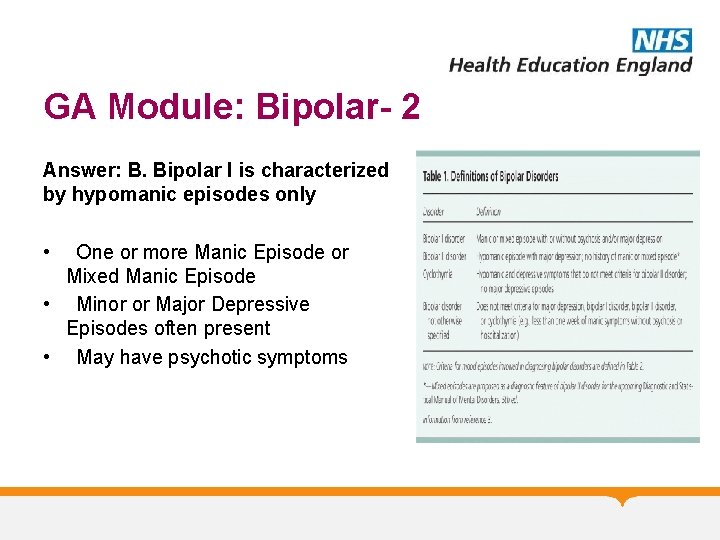
GA Module: Bipolar- 2 Answer: B. Bipolar I is characterized by hypomanic episodes only • One or more Manic Episode or Mixed Manic Episode • Minor or Major Depressive Episodes often present • May have psychotic symptoms
GA Module: Bipolar- 2 MCQs 4. Which of the following statements is FALSE about Rapid Cycling bipolar disorder: A. History of antidepressant induced hypomania is a risk factor B. Evidence of low thyroxin levels is found even when not under treatment C. Lasts less than 2 years in 50% of cases D. Patients cycle between hypomania and depression each week E. Is not genetically inherited in families with bipolar disorder
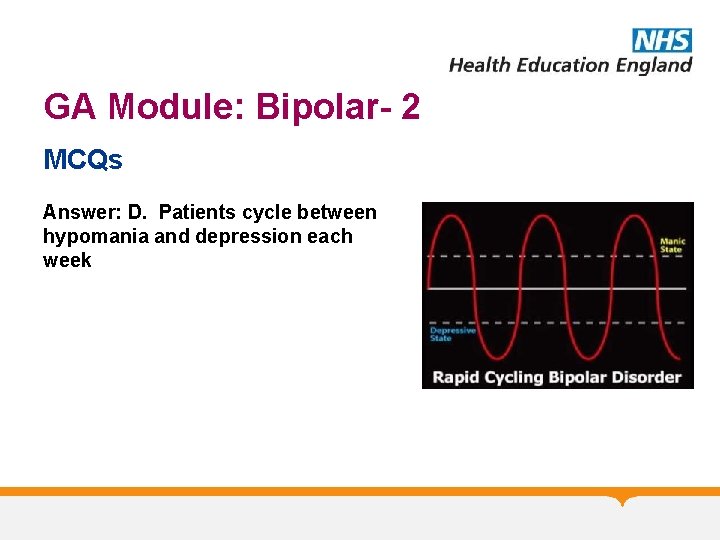
GA Module: Bipolar- 2 MCQs Answer: D. Patients cycle between hypomania and depression each week
GA Module: Bipolar- 2 MCQs 5. Which of the following statements is TRUE regarding Cyclothymia: A. Is more common in males B. Prevalence around 5% C. Usual age of onset is between 35 -40 years D. Results in a diagnosis of bipolar disorder in a third of patients E. Mood stabilisers are usually ineffective
GA Module: Bipolar- 2 MCQs Answer: D. Results in a diagnosis of bipolar disorder in a third of patients
GA Module: Bipolar Disorder Thank you
- Slides: 44