
Mr Shishir Chand Delhi Coordinator PBT India A
Mr. Shishir Chand, Delhi Coordinator , PBT India, A NGO helping victims of medical negligence
THE SIGNIFICANCE OF RECORD KEEPING VIS-À-VIS RTI ACT, 2005. In order to make sure that information is available to the citizens as and when it is requested for, every Government office must have proper record management systems in place. The importance of Records management with respect to Right to Information Act can be summarised as follows: “The effectiveness and efficiency of the public services across the range of government functions depends upon the availability of and access to information held in records. Badly managed records adversely affect the broad scope of public service reforms, and development projects are often difficult to implement and sustain effectively in the absence of good record management practices. ”
BENEFITS OF RECORD KEEPING An effective record management programme helps in the effective implementation of RTI Act. Some of its benefits are Protection of rights of agency, its employees and its customers. Allows quicker retrieval of information. Reduces subsequent appeals to public authorities. Reduces unwarranted litigation for missing records.
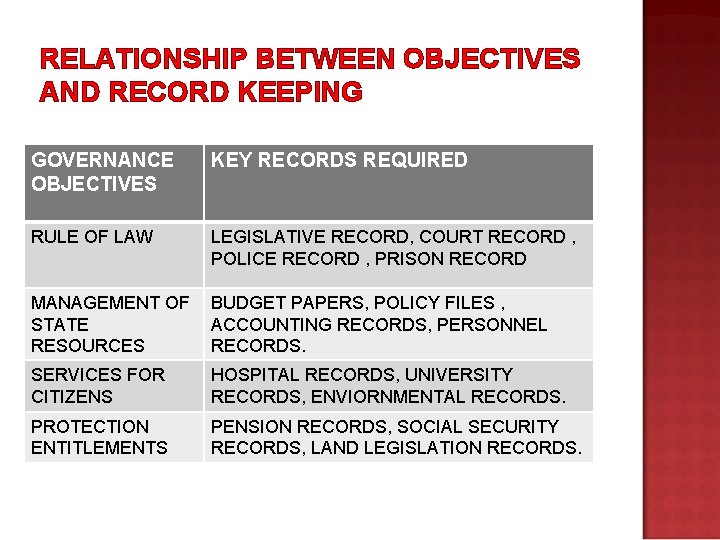
RELATIONSHIP BETWEEN OBJECTIVES AND RECORD KEEPING GOVERNANCE OBJECTIVES KEY RECORDS REQUIRED RULE OF LAW LEGISLATIVE RECORD, COURT RECORD , POLICE RECORD , PRISON RECORD MANAGEMENT OF STATE RESOURCES BUDGET PAPERS, POLICY FILES , ACCOUNTING RECORDS, PERSONNEL RECORDS. SERVICES FOR CITIZENS HOSPITAL RECORDS, UNIVERSITY RECORDS, ENVIORNMENTAL RECORDS. PROTECTION ENTITLEMENTS PENSION RECORDS, SOCIAL SECURITY RECORDS, LAND LEGISLATION RECORDS.
MY RTI TO RANCHI UNIVERSITY -A CASE STUDY Ø In 2011, I lost my younger brother, aged just 33 from gross, criminal and reckless negligence during treatment at a top corporate hospital in Jamshedpur. Ø The accused doctor could neither decipher half a dozen symptoms of an impending cardiac arrest nor correctly interpret a simple ECG thereby raising grave suspicion on the medical degree acquired by the doctor. Ø After my brother ‘s unfortunate death, I registered a FIR and filed an RTI application to Ranchi University seeking complete admission and graduation records of the accused. The accused claimed to have completed his MBBS in 1995 from a Jamshedpur based medical college in undivided Bihar. The college was then affiliated to Ranchi University. November 2012 5
STONEWALLING OF INFORMATION BY RESPONDENT UNIVERSITY Ø Ø Ø The University stonewalled my RTI Application as well as my RTI First Appeal to Appellate Authority cum Vice Chancellor citing Section 11 (1) of the RTI Act, 2005 on grounds that information belongs to Third Party. During the course of Second Appeal before State Information Commission, the respondent university not only changed its stand but also changed its PIO ( Public Information Officer). The newly recruited PIO came on record for the first time in 9 months and stated on record that copy of degree , mark sheets , admission details and convocation list for the 1995 batch of this medical college at Jamshedpur is not available in the record of the university.
MY WRIT PETITION IN DELHI HIGH COURT AGAINST RANCHI UNIVERSITY Ø Ø After Ranchi University failed to produce critical documents to confirm the authenticity of medical degree , I had to file a writ petition in Delhi High Court against MCI, the doctor and the university and sought verification of medical degree. The Hon’ble High Court vide its order dated 04. 08. 2017 directed the Respondent University to file records of accused doctor to confirm that accused had qualified from the said university. In compliance to court order , the university produced just a single document , a tabulation register sheet in support of the medical degree which too is tampered and has been further challenged before the Division Bench. My appeal is now coming up before Division Bench of Hon’ble Delhi High Court on 18. 12. 2017.
THE SAGA CONTINUES……………MY RTI TO CBSE IN THE SAME MATTER FOR ADMISSION RELATED RECORD. Ø Ø After respondent university confirmed that even the admission related documents of the accused are not available, I was left with no option but to file a RTI application to CBSE whereby I sought copy of accused doctor’s admission related record. To my utter surprise, even CBSE could neither produce the admission related documents nor the merit list of AIPMT candidates for the year 1989 under RTI Act. Appearing before CIC on 23. 11. 2017 , the CPIO of CBSE relied on a rule that period of retaining application form and other documents of a candidate are only 60 days after declaration of result. CBSE further directed me to contact DGHS, Health Ministry for a copy of merit list of candidates who qualified AIPMT 1989. Finally, I have written to DGHS on 24. 11. 2017.
RECENT CIC ORDER ON MISSING RECORDS Ø Ø Recently, in one of the cases involving missing documents CIC passed a landmark order. It ruled that neither lodging a FIR with the police nor denying information to a citizen under RTI under the pretext of a missing file is acceptable. The onus is on the PIO to reconstruct the missing file. The public authority has a duty to designate ‘ Public Records Officer’ as per Public Records Act, 1993. It is the duty of the respondent authority to reconstruct the file or develop a mechanism to address the issue. In a recent order, the CIC also observed that if Right to Information Act, 2005 is read along with Public Records Act, 1993 and Indian Penal Code, it will lead to serious consequences for those who lose the records, besides disciplinary action from top administration”.
SUMMARY OF PREDICAMENT OF AN RTI APPLICANT As an active RTI applicant, I would like to state on record that public authorities including medical college , university, examination conducting body like CBSE as well as investigating authority viz CID of state police have all failed me. Despite two years of sustained efforts, critical records of a doctor found guilty of professional misconduct by apex medical regulatory body, the Medical Council of India could not be produced and his medical degree remains unverified. Such poor maintenance of record defeats the purpose of the RTI Act, 2005. Unless the recent CIC order of disciplinary action against public authorities who fail to produce record are taken in letter and spirit, RTI Act will not deliver the result for which it was originally intended.
- Slides: 10