
MR MARSHALL GEORGE BUSH AND THE WORLD ECONOMY
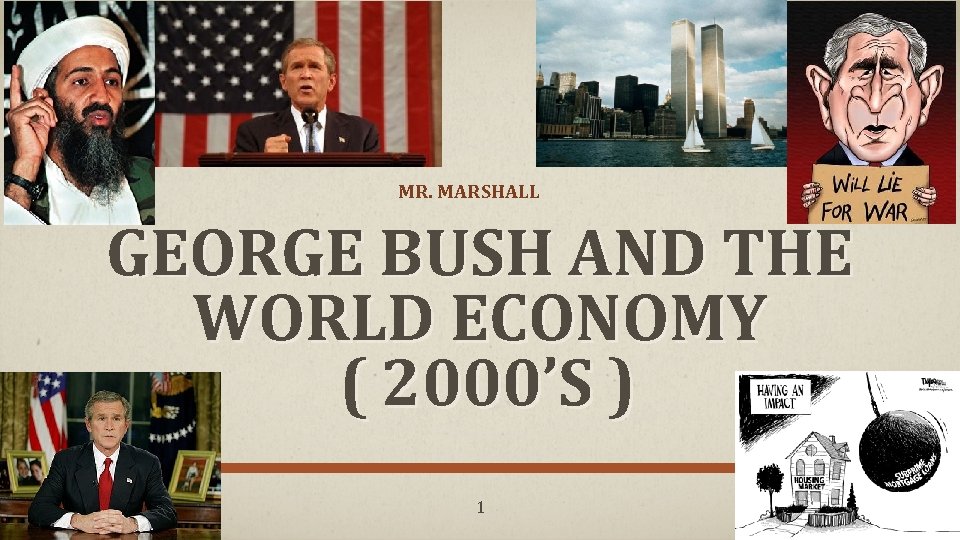
MR. MARSHALL GEORGE BUSH AND THE WORLD ECONOMY ( 2000’S ) 1
ESSENTIAL QUESTIONS 1. Discuss causes, course, and consequences of the Iraq War. 2. Discuss the significance of the Iraq War and 9/11 on the government and people of the United States 3. What was the Financial Crisis of 2008? 4. Who was Osama Bin Laden 5. Discuss the political, economic and social concerns that emerged at the end of the 20 th century and into the 21 st century. 6. Discuss the Foreign Policy of the United States when President Bush was in Office. 7. What were some of the achievements of President Bush’s Domestic Policies? 8. Explain the causes, course and consequences of the 9/11 Terror Attack. 2
• DOCUMENT A This excerpt is from a contemporary newspaper • editorial. Mr. Bush’s “Plan for Victory” speech was, of course, the usual unadulterated nonsense. Its overarching theme—“We will never accept anything less than complete victory”—was being contradicted even as he spoke by rampant reports of Pentagon plans for stepped-up troop withdrawals. . The specifics were phony, too. Once again inflating the readiness of Iraqi troops, Mr. Bush claimed that the recent assault on Tal Afar “was primarily led by Iraqi security forces”—a fairy tale immediately unmasked by Michael Ware, a Time reporter embedded in the battle’s front lines, as “completely wrong. ” —Frank Rich, The New York Times, December 11, 2005 • DOCUMENT C This excerpt is from an address by Donald Rumsfeld, Secretary of Defense under Bush. It’s a strange time: • . . . when a senior editor at Newsweek, disparagingly refers to the brave volunteers in our armed forces. . . as a “mercenary army; ” DOCUMENT D In this excerpt from a lecture, Amy Goodman, a journalist, examines media coverage of the war. Fairness and Accuracy in Reporting did a study. In the week leading up to General Colin Powell going to the Security Council to make his case for the invasions and the week afterwards—this was the period where more than half of the people in this country were opposed to an invasion—they did a study of. . . the four major newscasts. Two weeks. Three hundred and ninety-three interviews on war. Three were anti-war voices. Three of almost four hundred, and that included PBS. . [T]hey have to provide the diversity of opinion that fully expresses the debate and the anguish and the discussions that are going on all over this country. That is media serving a democratic society. —Amy Goodman, “Independent Media in a Time of War, ” April 21, 2003 • When the former head of CNN accuses the American military of deliberately targeting journalists. . 3
MULTIPLE CHOICE QUESTIONS • 1. In Document A, the writer claims that Bush’s statements about the Iraq War are A. too optimistic to be true. B. the result of misinformation. C. a reliable source of information about the war. D. not revealing the truth about the situation. • 2. In Document C, the media is characterized as A. biased in favor of the war. B. biased against the military. C. supportive of the enemy. D. influenced by foreign media. • 3. In Document D, the speaker believes the media A. was too supportive of the administration. B. should have been supporting the war effort. C. was gagged by the Bush administration. D. was too favorable to the enemy. 4
FLORIDA HISTORY • Why did Ralph Nader’s run as a candidate for the Green Party affect the 2000 presidential election in the United States? F. Nader wanted to deprive the Democrats of votes. G. The Green Party wanted him to win votes that would otherwise have gone to the Republican candidate. H. The Green Party wanted to make a point by attracting votes from both parties. I. Green Party concerns were not being addressed by either of the major parties. • Which of the following might represent a liberal point of view? A. Government should support a free, unregulated market. B. Government intervention is necessary to help the needy. C. Citizens should solve their own problems through individual effort. D. Private organizations should take responsibility for solving social problems. • How has recent immigration affected the demographics of the United States? A. Latino immigrants now hold more than ten percent of Congressional seats. B. Most Asian immigrants are now choosing to live in Midwestern cities and suburbs. C. Immigration to the United States has declined lately due to the troubled economy. D. Immigrants now account for more than ten percent of the population of the United States 5
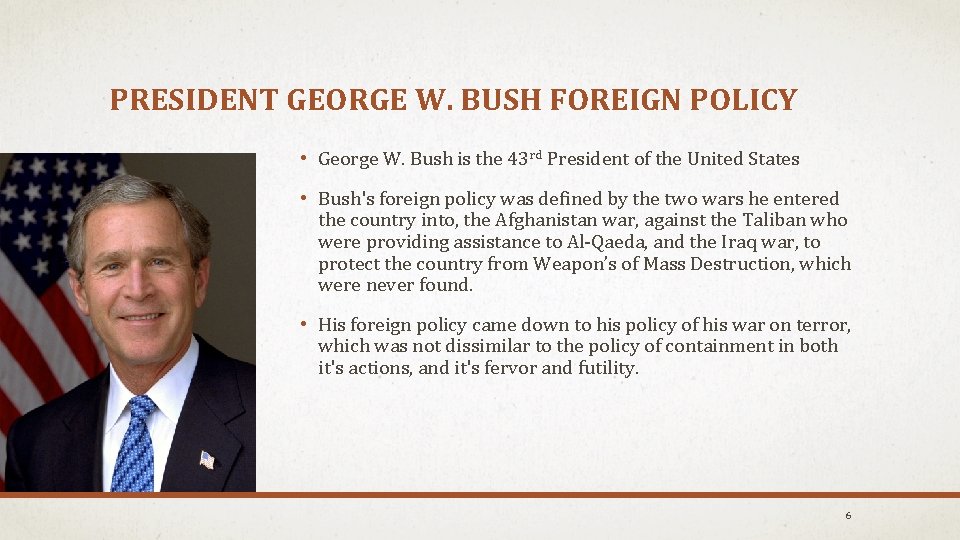
PRESIDENT GEORGE W. BUSH FOREIGN POLICY • George W. Bush is the 43 rd President of the United States • Bush's foreign policy was defined by the two wars he entered the country into, the Afghanistan war, against the Taliban who were providing assistance to Al-Qaeda, and the Iraq war, to protect the country from Weapon’s of Mass Destruction, which were never found. • His foreign policy came down to his policy of his war on terror, which was not dissimilar to the policy of containment in both it's actions, and it's fervor and futility. 6
PRESIDENT GEORGE W. BUSH DOMESTIC POLICY • Economically Bush was known for his large federal spending, as well as his controversial tax cuts for the rich, and the economic recession that occurred in the last years of his presidency. • Bush was also known for the controversial "No Child Left Behind", his rejection of the Kyoto Protocol on climate change, as well as his extension of Medicare to pay for prescriptions, which was Endorsed by the AARP. 7
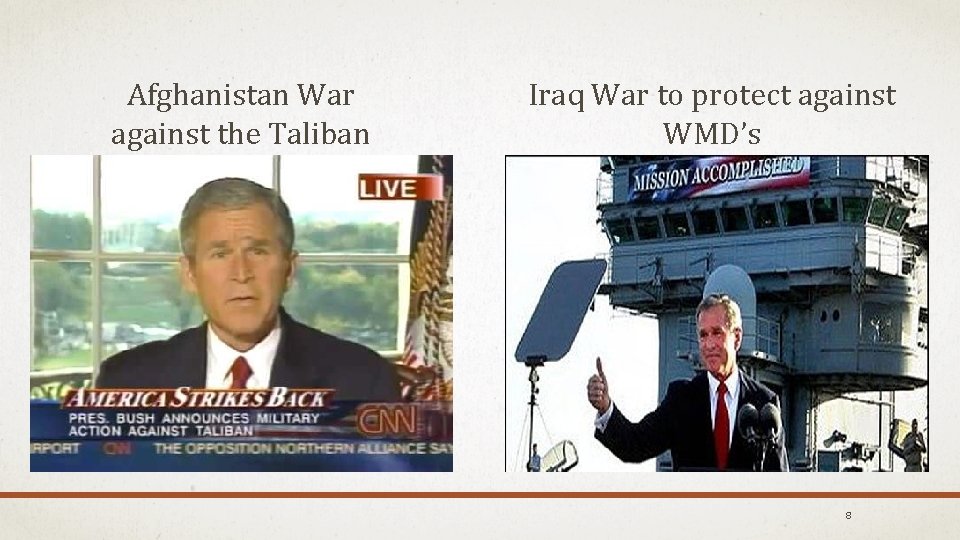
Afghanistan War against the Taliban Iraq War to protect against WMD’s 8
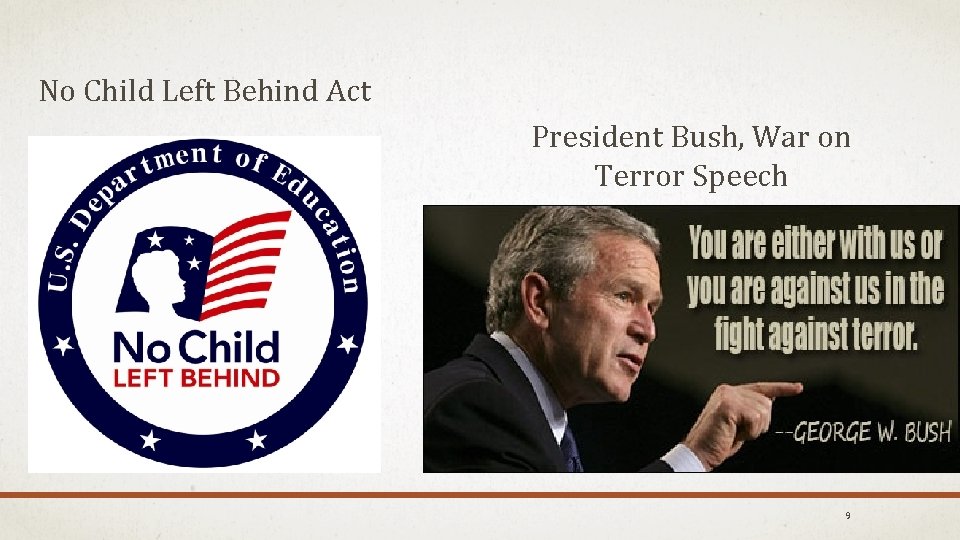
No Child Left Behind Act President Bush, War on Terror Speech 9
THE BUSH DOMESTIC AGENDA • Bush believed that tax cuts would stimulate the economy and create new jobs. • In 2001, Bush pushed a highly controversial $1. 3 trillion tax cut through Congress. • The tax cut put more money in consumers, But most of the benefits went to the wealthiest Americans creating a federal budget deficit increase 10
FOCUS ON EDUCATION • Bush’s other domestic priority was education • He supported legislation that tied the federal funding of schools of academic achievement. • The 2002 No Child Left Behind Act penalized schools that did not reach federal performance standards. • It also called for improving teacher quality and reforms. 11
FOCUS ON EDUCATION • The No Child Left Behind Act was signed by President Bush fulfilling his promise to pursue a domestic agenda that improved educational opportunities. • Bush also addressed the concerns of older Americans who faced rising costs for prescription drugs. • In 2003, Congress extended Medicare to cover prescription drugs for senior citizens. The measure was controversial. • It was expensive, and many seniors found its provisions confusing and its coverage inadequate. 12
REFORMING ENTITLEMENTS • In his inauguration address, Bush promised to reform Social Security and Medicare, the government-run health plan for senior citizens. • Together these programs account for about one third of the federal budget. • Bush was concerned that because of a rapidly aging U. S. population and the rising cost of Medicare 13
REFORMING ENTITLEMENTS • These government programs would eventually become insolvent unless changes were made. • Bush was able to make some progress on Medicare with the Medicare Act of 2003. • But Democratic opposition to Social Security reform thwarted Bush’s efforts. 14
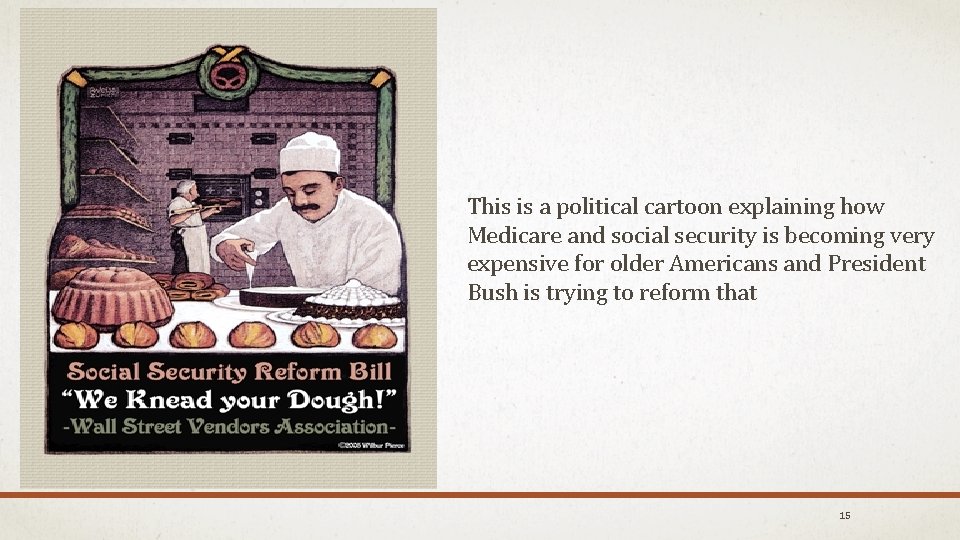
This is a political cartoon explaining how Medicare and social security is becoming very expensive for older Americans and President Bush is trying to reform that 15
THE SEPTEMBER 11, 2001 ATTACKS • As the first anniversary of Bush's election victory approached, the nation faced a number of important but typical problems. • No one was expecting a devastating attack that would stun the nation and usher in a new era in U. S. history. • Shortly before 9 A. M. Eastern time on September 11, 2001, American Airlines Flight 11 slammed into the north tower of the World Trade Center in New York City. 16
THE SEPTEMBER 11, 2001 ATTACKS • Soon another hijacked plane hit the World Trade Center. • Just over an hour after the first crash, the World Trade Center towers began to collapse, spewing dust and debris over the city, and trapping the hundreds of firefighters and police who had gone into the towers to rescue people. • As panicked people fled the area around the site, stunned Americans watched the horrific scenes unfold on their televisions. 17
THE SEPTEMBER 11, 2001 ATTACKS • These two crashes were not accidents, but part of a carefully planned assault on the United States • At 9: 40 A. M. a third airliner that had been hijacked after leaving Washington, D. C. , crashed into the Pentagon. • Meanwhile, passengers on a fourth hijacked plane learned of the earlier crashes on their cellphones. • They bravely stormed the cockpit, refusing to allow the hijackers to target another building. At 10: 03 A. M. , this fourth airliner crashed in a field near Pittsburgh. 18
THE SEPTEMBER 11, 2001 ATTACKS • That same day, it was confirmed that the al Qaeda Islamist terrorist group had spearheaded the attacks. • In time, Americans also learned that nearly 3, 000 people had died as a result of the attacks on 9/11. • In addition to the September 11 attacks in New York City, hijackers crashed a plane into the Pentagon in northern Virginia, taking the lives of more than one hundred government employees. 19
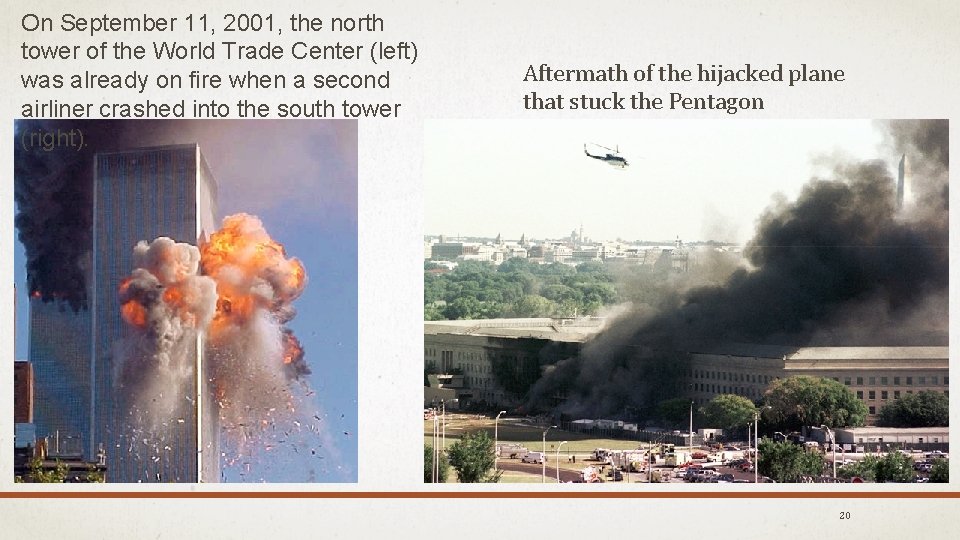
On September 11, 2001, the north tower of the World Trade Center (left) was already on fire when a second airliner crashed into the south tower (right). Aftermath of the hijacked plane that stuck the Pentagon 20
AL QAEDA'S CAMPAIGN OF TERRORISM • The suddenness, and cruelty of the 9/11 attacks against thousands of defenseless people was unprecedented in American history. • However, Americans soon began to realize that the 9/11 attacks were the most destructive in a series of attacks that al Qaeda had launched against the United States. • Al Qaeda, led by Osama bin Laden, was a terrorist group committed to an extreme form of Islam. • One of its goals was to end all American involvement in Muslim countries. 21
AL QAEDA'S CAMPAIGN OF TERRORISM • Throughout the 1990 s, al Qaeda had been targeting Americans at home and abroad, and in fact, it had attempted to blow up the World Trade Center once before. • In 1993 it exploded a bomb at the site, killing six people and injuring more than a thousand. • In 1998, the organization set off car bombs at American embassies in Nairobi, Kenya, and Dar es Salaam, Tanzania, killing 225 people and injuring more than 5, 500. • In 2000, al Qaeda bombed the USS Cole, an American ship anchored off the coast of Yemen, killing 17 American sailors. 22
AL QAEDA'S CAMPAIGN OF TERRORISM • Finally in 2001, al Qaeda chose to attack the World Trade Center and the Pentagon because these buildings represented American economic and military power. • Americans responded to the 9/11 attacks as a unified, and determined • On the day of the attacks, President Bush addressed the nation with the following speech: “Today, our fellow citizens, our way of life, and our very freedom came under attack in a series of deliberate and deadly terrorist acts. . Thousands of lives were suddenly ended by evil, despicable acts of terror. . These acts of mass murder were intended to frighten our nation into chaos and retreat. But they have failed. . Terrorist attacks can shake the foundations of our biggest buildings, but they cannot touch the foundation of America. These acts shatter steel, but they cannot dent the steel of American resolve. ” —President George W. Bush, September 11, 2001 23
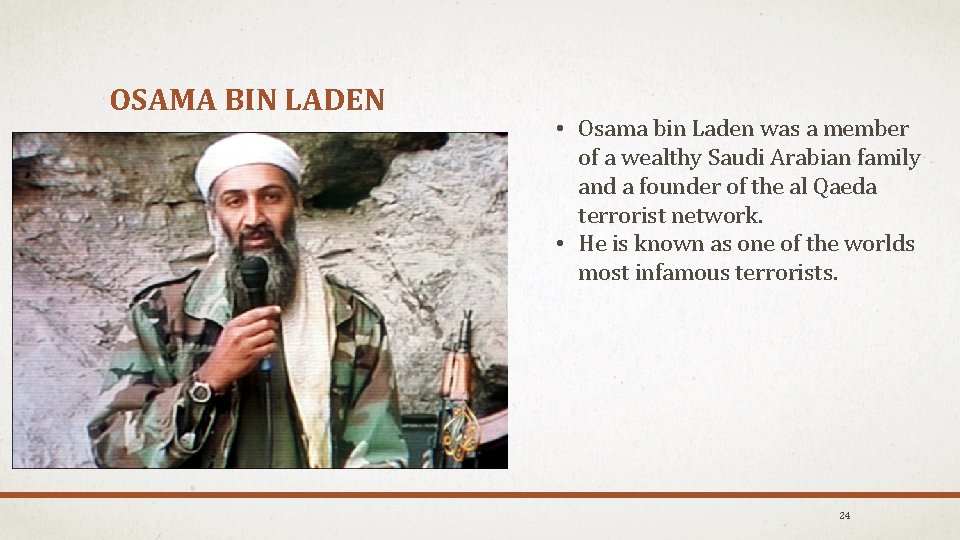
OSAMA BIN LADEN • Osama bin Laden was a member of a wealthy Saudi Arabian family and a founder of the al Qaeda terrorist network. • He is known as one of the worlds most infamous terrorists. 24
AMERICANS UNITE IN TROUBLING TIMES • Americans were shocked by the 9/11 attacks, but they rallied to defend their nation. • Millions of Americans rushed to donate money, supplies, services, and their own blood. • Throughout the country, Americans put up flags to show their patriotism and determination. 25
AMERICANS UNITE IN TROUBLING TIMES • Many held candlelight vigils and prayer services for the dead and bereaved. • Continued fears of more terrorist attacks, however, kept the nation on edge. • In October 2001, a newspaper editor in Florida died from an anthrax infection. • Anthrax is a type of bacteria that has been used by several countries to create biological weapons. 26
AMERICANS UNITE IN TROUBLING TIMES • Traces of anthrax then appeared in news offices in New York City and in the office of a U. S. senator in Washington. • Two postal workers who had handled materials containing anthrax died. • Although the FBI investigated, no terrorists were caught. 27
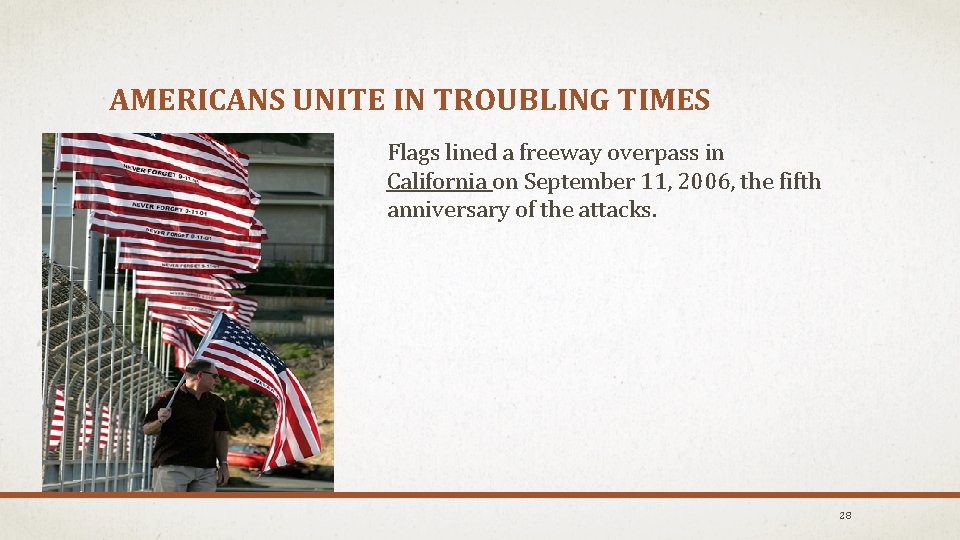
AMERICANS UNITE IN TROUBLING TIMES Flags lined a freeway overpass in California on September 11, 2006, the fifth anniversary of the attacks. 28
THE LEGACY OF 9/11 • September 11, 2001, became a watershed in modern American history, when Americans’ confidence in their nation’s security was deeply shaken. • Americans came together to grieve, rebuild, and decide how to deal with the threat of terrorism. • The name “ 9/11” quickly entered the national lexicon, with people viewing historical events and even ideas as “before 9/11” or “after 9/11. ” 29
THE LEGACY OF 9/11 • The 9/11 attacks also had great impact on the nation’s economy. • Despite increased airport security, some Americans remained wary of air travel, which hurt the airline and travel industries. • Businesses and households entered a period of uncertainty during which spending decreased. • Estimates indicate that the attacks cost the economy one million jobs and reduced the country’s output by three percent. 30
THE WAR ON TERROR AND THE INVASION OF AFGHANISTAN • President Bush had been in office less than a year when these attacks occurred. • The al Qaeda terrorist attack against the nation challenged the new President in unforeseen ways and led to a major shift in American foreign policy. • In the wake of September 11, Bush and his advisers agreed that the most important priority should be finding and prosecuting the people behind 9/11. • This would be just the first step in what Bush called the “war on terror. ” American government officials had determined that Osama bin Laden’s al Qaeda network had been behind the attacks. 31
THE WAR ON TERROR AND THE INVASION OF AFGHANISTAN • Bin Laden opposed the presence of American troops in Saudi Arabia, the U. S. economic boycott against Iraq, and U. S. support for Israel. • Bin Laden and other al Qaeda leaders were in Afghanistan, where the Islamist Taliban government allowed them to operate training camps for terrorists. • Bush believed that any government that sponsored terrorism should be held accountable. • He demanded that the Taliban turn bin Laden over to U. S. custody. When the Taliban refused, American forces, joined by Great Britain, invaded Afghanistan. • Allied forces quickly overthrew the Taliban. Although American troops captured several of al Qaeda’s leaders, Osama bin Laden escaped. 32
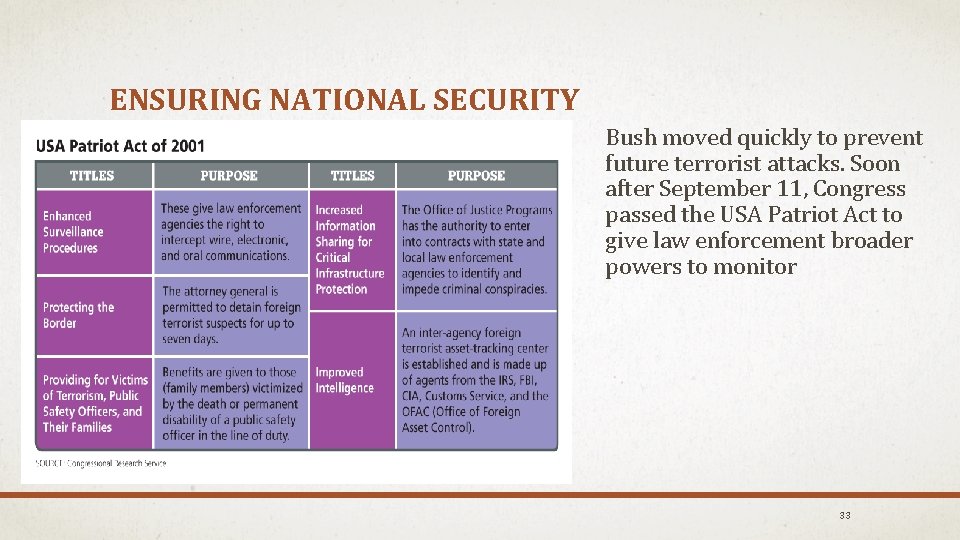
ENSURING NATIONAL SECURITY Bush moved quickly to prevent future terrorist attacks. Soon after September 11, Congress passed the USA Patriot Act to give law enforcement broader powers to monitor 33
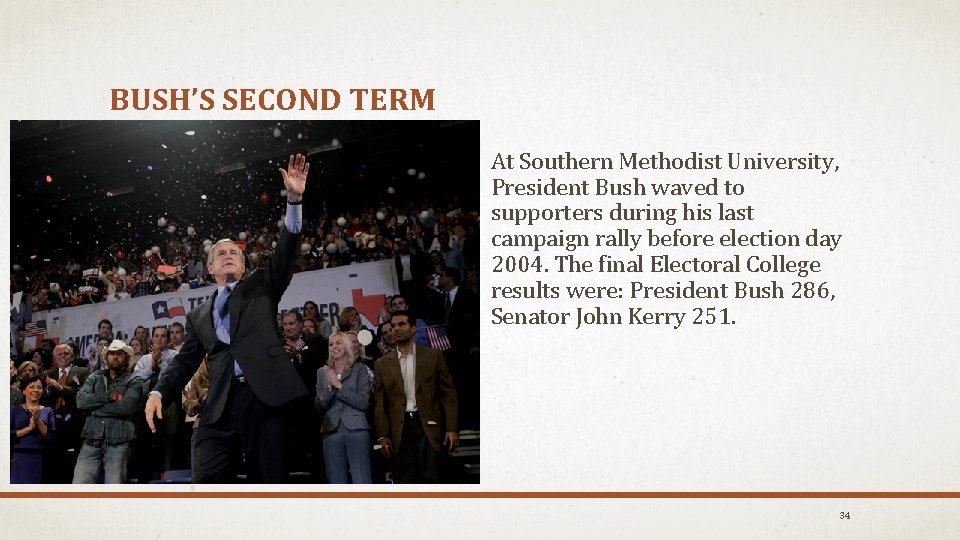
BUSH’S SECOND TERM • At Southern Methodist University, President Bush waved to supporters during his last campaign rally before election day 2004. The final Electoral College results were: President Bush 286, Senator John Kerry 251. 34
BUSH’S SECOND TERM • The Iraq war, terrorism, and the federal budget deficit weighed heavily on Americans’ minds as they voted in the 2004 presidential election. • Bush campaigned as a “war president, ” saying he had proved his competency as commander-in-chief. • Bush defeated the Democratic candidate for president, Massachusetts senator John Kerry, by a comfortable margin. 35
BUSH’S SECOND TERM • Among those casting ballots for Bush in 2004 were the nation’s Latino voters. • The Bush campaign turned to a Texas advertising agency run by Lionel Sosa. • With Sosa’s help, Bush captured an estimated 40 percent of Latino voters in 2004. • Just 8 years earlier, Republican candidate Bob Dole could attract only 21 percent of Latino voters. 36
PROBLEMS SURFACE IN IRAQ • Iraq remained a major focus of Bush’s second term as the war raged on. • However, by late 2005, Iraq had a new constitution and the beginnings of a democracy. • The following year, Saddam Hussein was tried and executed. • Saddam’s brutal rule had kept fighting in check among Iraq’s three major groups: Sunnis, Shi’a, and Kurds. • Now these groups fought bitterly for power. • An American troop surge in 2007 lessened the violence. 37
PROBLEMS SURFACE IN IRAQ • However, Iraq’s democracy remained fragile • In 2008, a Senate Intelligence Committee report determined that there was no credible evidence to support claims that Iraq was developing WMD or had ties to terrorist groups. • Some accused the Bush administration of deliberately misleading Congress and the American people to win support for the war. 38
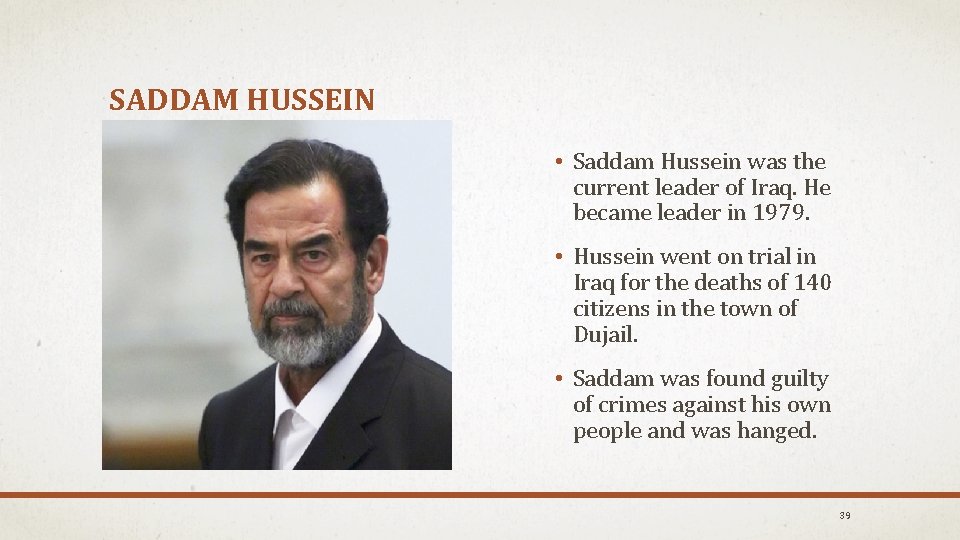
SADDAM HUSSEIN • Saddam Hussein was the current leader of Iraq. He became leader in 1979. • Hussein went on trial in Iraq for the deaths of 140 citizens in the town of Dujail. • Saddam was found guilty of crimes against his own people and was hanged. 39
TROUBLES AT HOME • Meanwhile, Bush faced domestic challenges. In August 2005, Hurricane Katrina hit the Gulf Coast. Katrina caused much destruction in New Orleans. • As fierce as the winds and rains of Katrina had been, New Orleans suffered even more after the storm passed. • Rising waters soon breached levees protecting the low-lying city. • Citizens were forced onto rooftops to await rescue and thousands of others sought shelter at the Superdome stadium. • The government’s slow response to the damage was widely criticized. National discontent was reflected in the 2006 elections. • For the first time in 12 years, Democrats won control of the House and the Senate. 40
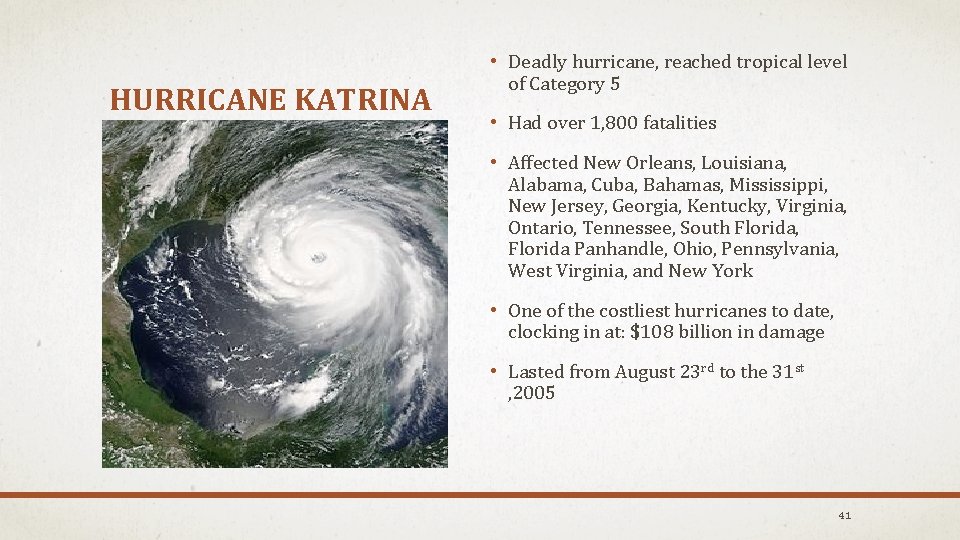
HURRICANE KATRINA • Deadly hurricane, reached tropical level of Category 5 • Had over 1, 800 fatalities • Affected New Orleans, Louisiana, Alabama, Cuba, Bahamas, Mississippi, New Jersey, Georgia, Kentucky, Virginia, Ontario, Tennessee, South Florida, Florida Panhandle, Ohio, Pennsylvania, West Virginia, and New York • One of the costliest hurricanes to date, clocking in at: $108 billion in damage • Lasted from August 23 rd to the 31 st , 2005 41
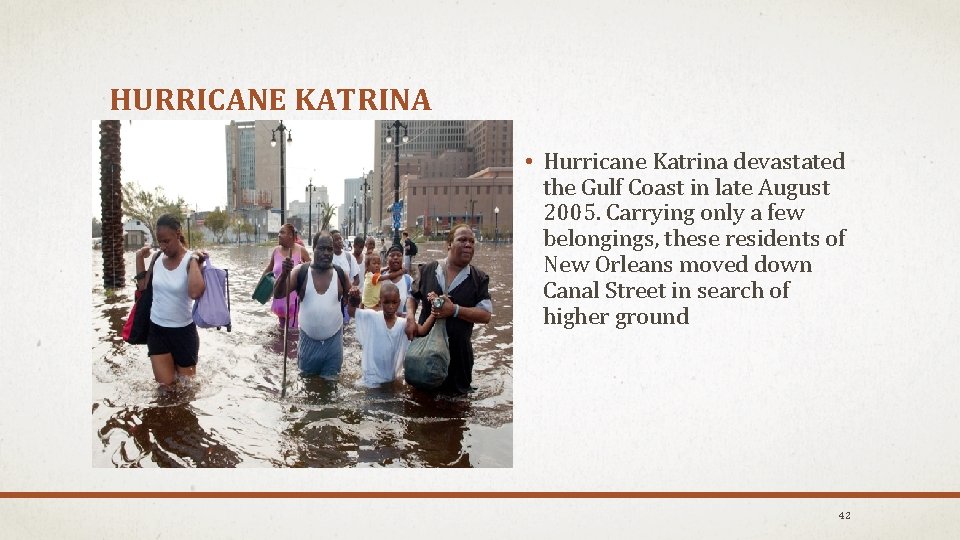
HURRICANE KATRINA • Hurricane Katrina devastated the Gulf Coast in late August 2005. Carrying only a few belongings, these residents of New Orleans moved down Canal Street in search of higher ground 42
BUSH REAFFIRMS SOVEREIGNTY • In February 2005, the Kyoto Protocol went into effect around the world. The treaty signed by 140 nations is aimed at controlling global warming linked to carbon dioxide and other greenhouse gases. • Negotiations took place in Kyoto, Japan, in 1997, with the help of the United States. • Just months after assuming the presidency in 2001, George W. Bush announced that the United States would not abide by the treaty. • The Bush administration argued that the treaty did not place emission limits on developing countries and that it could harm the U. S. economy. • Many considered the Kyoto Protocol as yet another example of an international treaty undermining U. S. sovereignty. 43
THE FINANCIAL CRISIS OF 2008 • During the autumn of 2008, Americans faced a potentially disastrous economic crisis centered on the financial industry. • The crisis stemmed in part from “subprime” home mortgage loans that banks had made to less-qualified, low-income borrowers. • The higher interest rates on these loans made them more profitable for banks. • The loans were then sold as mortgage-backed securities to investors. 44
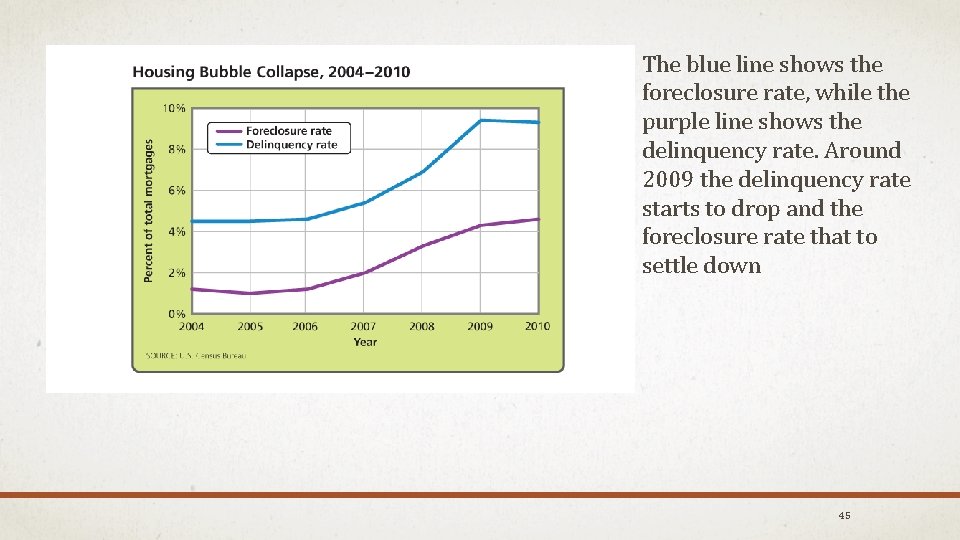
The blue line shows the foreclosure rate, while the purple line shows the delinquency rate. Around 2009 the delinquency rate starts to drop and the foreclosure rate that to settle down 45
THE U. S. SLIDES INTO RECESSION • After the U. S. economy slid into a recession in late 2007, unemployed Americans could no longer pay their mortgages. • Foreclosures, seizures of property from borrowers who are unable to repay their loans increased. • As a result, housing prices fell and mortgage-related investments lost their value. Several large banking and investment firms collapsed or were sold. 46
TOO BIG TO FAIL—THE FINANCIAL INDUSTRY BAILOUT • In September 2008, the stock market plunged. The country faced its worst economic crisis since the Great Depression. • Treasury Secretary Henry Paulson and Federal Reserve chairman Bernanke proposed a $700 billion bailout of the banks that had engaged in risky lending practices. • The (TARP) Troubled Asset Relief Program was supported by Bush and approved by Congress. 47
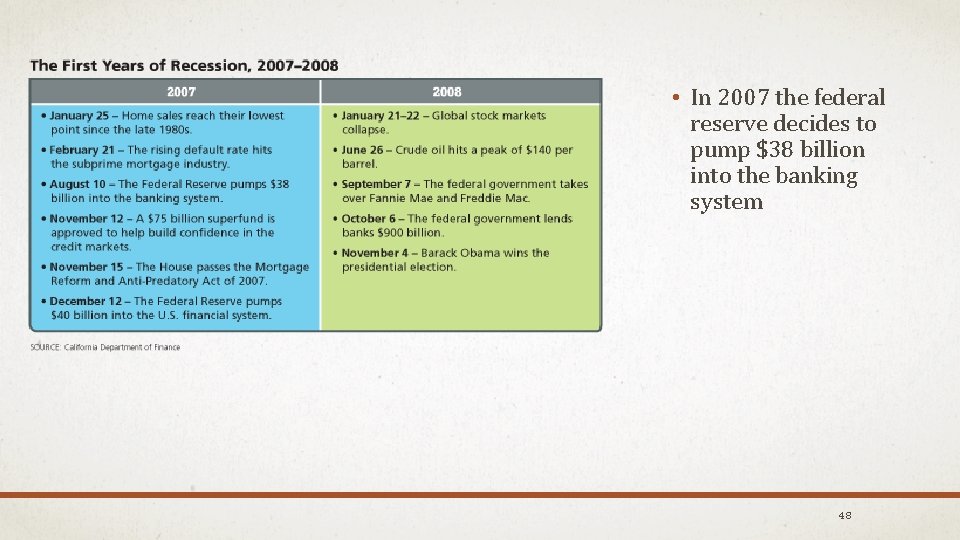
• In 2007 the federal reserve decides to pump $38 billion into the banking system 48
TOO BIG TO FAIL—THE FINANCIAL INDUSTRY BAILOUT • TARP funds were used to make multibillion-dollar loans to at-risk banks. • Public outrage over the taxpayer-funded bailout grew after executives at some of these companies received multimillion-dollar bonuses. • However, many credit the bailout with preventing a financial meltdown. 49
CITATIONS • URL: https: //etext 2. pearson. com/#/book/EK 2 ETV 1 V 9 HO/page/511 • Realize reader – The electronic book 50
- Slides: 50