
Mr KnowAll Somerset Maugham Historical and Social Background
Mr. Know-All /Somerset Maugham Historical and Social Background

Stereotypes- Definition A popular belief about specific social groups or types of individuals. Here a few examples of stereotypes. 1. Whites do not have rhythm 2. Jews have big noses. 3. All Asians are good at math. 4. All Irish people are drunks.

THE BRITISH GENTLEMAN STEREOTYPE What to do to imagine the perfect British gentleman: * British Accents * Appearance : a crazy mustache, a cane or umbrella, top hat * You have yourself the “ Britishest” British man who is/was: subtle in speech, dressed in quiet colors and they did not talk very much and did not use gestures ( ידיים )תנועות Extremely polite
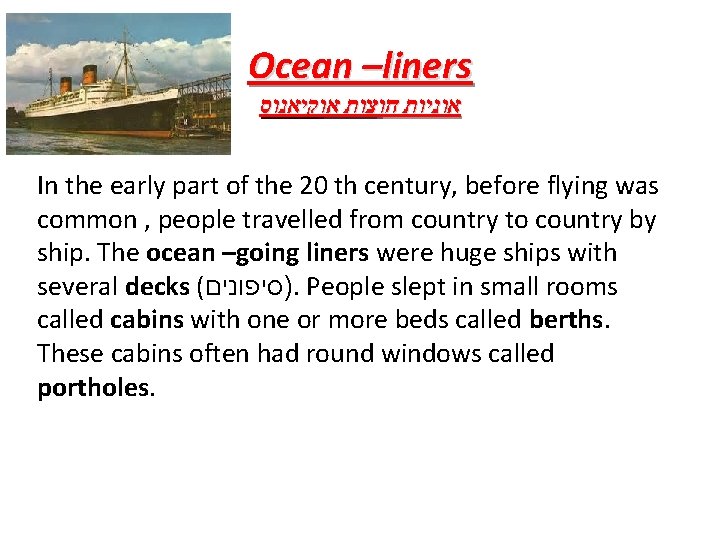
Ocean –liners אוניות חוצות אוקיאנוס In the early part of the 20 th century, before flying was common , people travelled from country to country by ship. The ocean –going liners were huge ships with several decks ( )סיפונים. People slept in small rooms called cabins with one or more beds called berths. These cabins often had round windows called portholes.
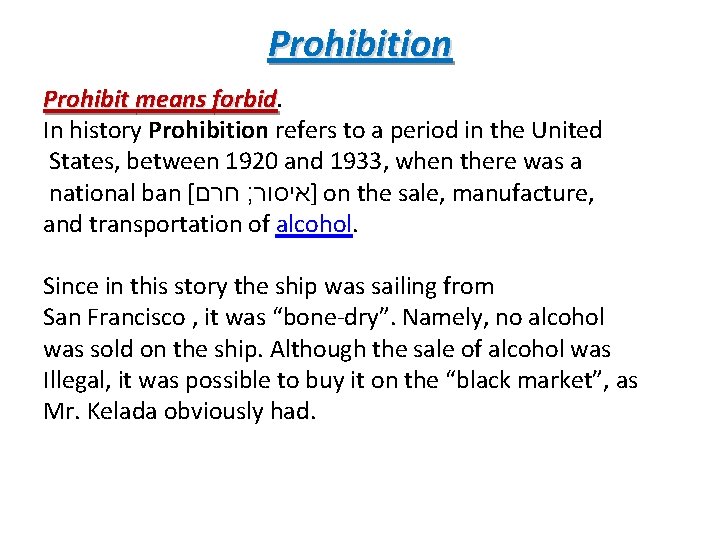
Prohibition Prohibit means forbid. In history Prohibition refers to a period in the United States, between 1920 and 1933, when there was a national ban [ חרם ; ]איסור on the sale, manufacture, and transportation of alcohol. Since in this story the ship was sailing from San Francisco , it was “bone-dry”. Namely, no alcohol was sold on the ship. Although the sale of alcohol was Illegal, it was possible to buy it on the “black market”, as Mr. Kelada obviously had.
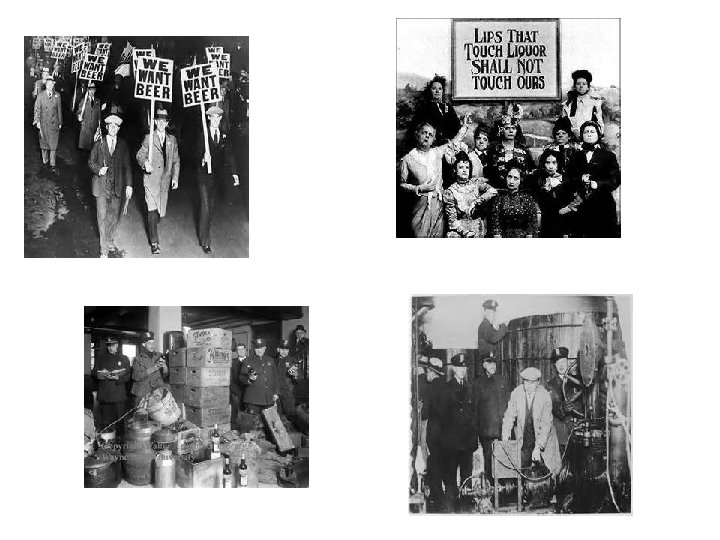
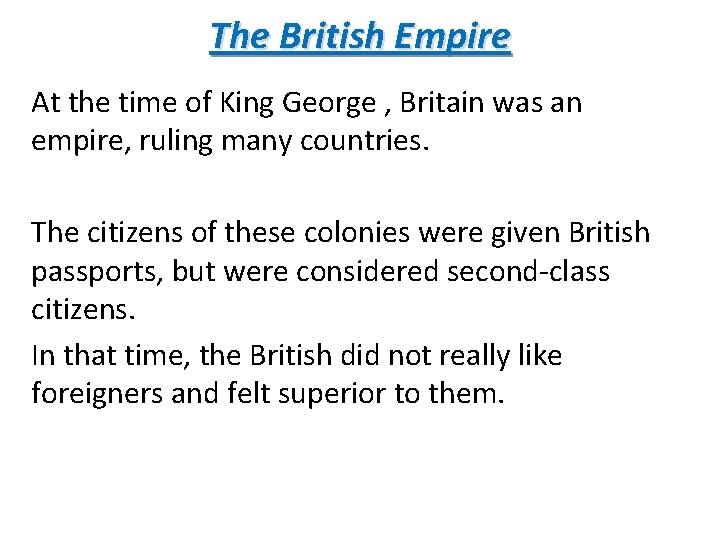
The British Empire At the time of King George , Britain was an empire, ruling many countries. The citizens of these colonies were given British passports, but were considered second-class citizens. In that time, the British did not really like foreigners and felt superior to them.
Levant - Levantine The Levant - Hebrew: כנען , also known as the Eastern Mediterranean, is a geographic and cultural region. The Levant consists today of Lebanon, Syria, Jordan, Israel, the Palestinian territories, Cyprus and parts of southern Turkey.
Pearls • Natural pearls : only the wealthiest and most powerful individuals were AND are able to possess and wear them. • Cultured pearls: were made by the Japanese around 1916. They were less valuable , but only real experts in the field could tell the difference just by looking at them.
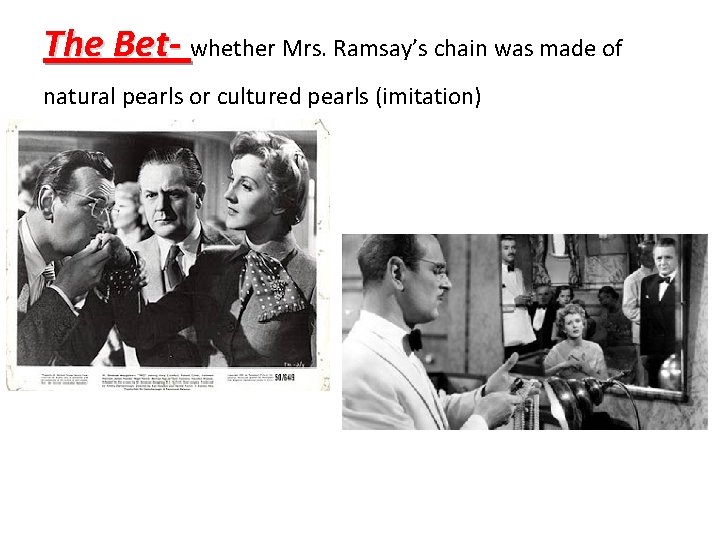
The Bet- whether Mrs. Ramsay’s chain was made of natural pearls or cultured pearls (imitation)
HOT: Inferring Read the following dialogue: Mona: Hi, Miriam, I hear that Susie won the History Prize again this year. You must be very proud of her! Miriam: Yes, I am. What can we understand about the connection between Miriam and Susie ?
HOT: Inferring My room was in a mess this morning , and when I came home this afternoon it was all neat and clean. My mother was the only one at home today. What can you infer from this?
HOT: Inferring Understanding things that are not actually mentioned is called “reading between the lines” or “inferring”. We can also use “inferring” when relating to someone’s actions, even if we don’t know for sure that they did them. Vocabulary: infer, conclude, assume read between the lines
HOT: Inferring- Practice 1) What can we understand about the narrator by the way he judges Mr. Kelada at the beginning of the story? 2) Mrs. Ramsay did not want Mr. Kelada to examine the pearls. She said, “I can’t undo it”. What can we infer about her from her behavior? 3) What can we infer about the narrator when he says “At that moment, I did not entirely dislike Mr. Kelada” at the end of the story?
HOT: Uncovering Motives- Review 1) Why did Mr. Ramsay have a bet with Mr. Kelada about his wife’s pearls? What did he hope to achieve? 2) Why did Mrs. Ramsay try to prevent Mr. Kelada from inspecting her pearls? What was she afraid he would discover? 3) Mr. Kelada was about to say that the pearls were real. What made him change his mind? Do you think it was easy for him to do this? Why or why not ? 4) What motivated Mrs. Ramsay to leave the envelope with a 100 $ bill under Mr. Kelada’s cabin door?
HOT: Explaining Patterns Identify and explain different patterns in the text and explain their significance. Examples: * Explain why certain lines/phrases/words are repeated. * What behavior does the character repeat? Vocabulary: repeat, repetition, significance, similar.
Practice 1) Why do you think the narrator’s opinion of Mr. Kelada changed at the end of the story ? What is the author’s message to his readers ? 2) Why the passengers on the ship call Mr. Kelada “Mr. Know All” ? What has he done to deserve this name? 3)What does Mr. Kelda do that annoys the narrator? Don’t forget ! Opening sentence
Practice 1) What do we understand from the end of the story about the narrator’s opinion of Mr. Kelada? Why is the end of the story such a surprise ? ( Choose the suitable HOT) 2) How does the pearls represent the main message of the story? / The labels on Mr. Kekada’s suitcases/ The narrator has no name/ The ship/ 3) In the story no one appears to be what they really are. Explain.
The importance of the setting The story takes place in “international waters. ” This is significant for two reasons: • By taking place in international waters, and not in a given country, the writer is saying that prejudice is an international problem, and not a problem of any given place. • The writer is saying that prejudice and racism are human traits and not the traits of any given culture.
- Slides: 22