
MR imaging of the common shoulder abnormalities MRI
MR imaging of the common shoulder abnormalities 肩关节常见疾病MRI诊断 (PartⅠ) Wang chaoyan 2013/05/27

Background 背景 Shoulder disorders mainly involve rotator cuff diseases and shoulder instability. For rotator cuff diseases, routine shoulder MR imaging as the first choice can solve most of the problems in practice. For shoulder instability and related glenoid labrum lesions, shoulder MR arthrography is the first selection for evaluation 肩关节常见病变主要为肩袖相关病变和肩关节不稳定。对于 肩袖相关病变,肩关节MRI 常规扫描可作为首选;对于肩关 节不稳定和盂唇病变,则一般首选肩关节MRI 造影进行评价。
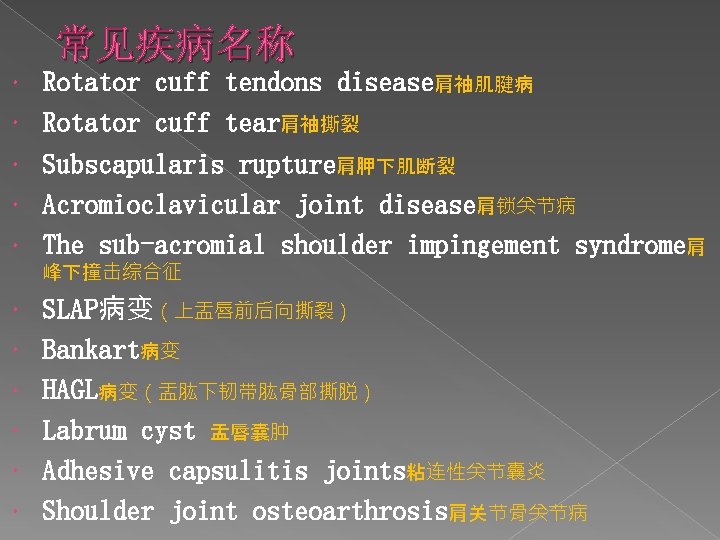
常见疾病名称 Rotator cuff tendons disease肩袖肌腱病 Rotator cuff tear肩袖撕裂 Subscapularis rupture肩胛下肌断裂 Acromioclavicular joint disease肩锁关节病 The sub-acromial shoulder impingement syndrome肩 峰下撞击综合征 SLAP病变(上盂唇前后向撕裂) Bankart病变 HAGL病变(盂肱下韧带肱骨部撕脱) Labrum cyst 盂唇囊肿 Adhesive capsulitis joints粘连性关节囊炎 Shoulder joint osteoarthrosis肩关节骨关节病

一、 Rotator cuff tendons disease 肩袖肌腱病 Etiology pathology 病因病理: Excessive use, lead to degeneration and tear of rotator cuff 过度使用导致肩袖的退行性变和撕裂 Most often in impingement最常继发于撞击综合征 Can occur in patients with collagen vascular disease可发 生于胶原血管病患者 Can be acute, but more often repeated attacks on the basis of the already suffer from tendon disease可急性发生, 但更常在已患有肌腱病的基础上反复发作 Tendon thickening, hardening; Partial or total disruption; Some tear on slippery bursa, articular surface or in the stroma肌腱增厚、硬化;部分或完全中断;部分撕裂可 在滑囊面、关节面或间质中 Collagen degeneration, but there is no inflammatory cells, chronic tendon can appear in fatty infiltration胶 原变性,但没有炎性细胞,慢性肌腱撕裂中可出现脂肪浸润
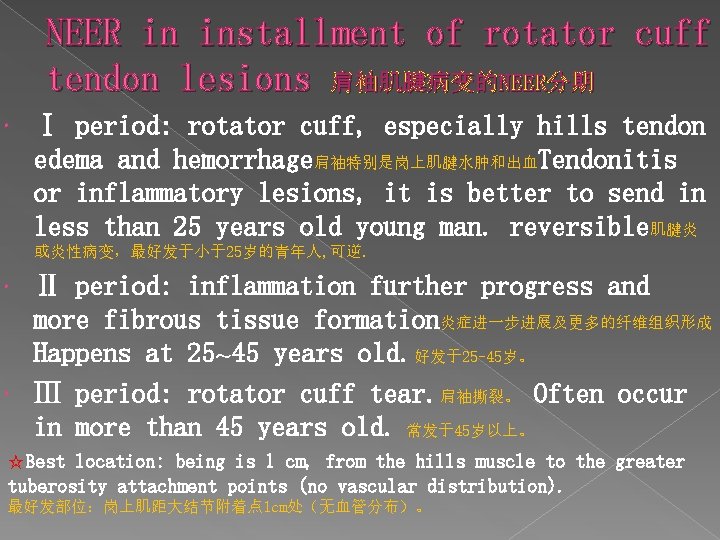
NEER in installment of rotator cuff tendon lesions 肩袖肌腱病变的NEER分期 Ⅰ period: rotator cuff, especially hills tendon edema and hemorrhage肩袖特别是岗上肌腱水肿和出血Tendonitis or inflammatory lesions, it is better to send in less than 25 years old young man. reversible肌腱炎 或炎性病变,最好发于小于25岁的青年人, 可逆. Ⅱ period: inflammation further progress and more fibrous tissue formation炎症进一步进展及更多的纤维组织形成 Happens at 25~ 45 years old. 好发于25 -45岁。 Ⅲ period: rotator cuff tear. 肩袖撕裂。 Often occur in more than 45 years old. 常发于45岁以上。 ☆Best location: being is 1 cm, from the hills muscle to the greater tuberosity attachment points (no vascular distribution). 最好发部位:岗上肌距大结节附着点 1 cm处(无血管分布)。
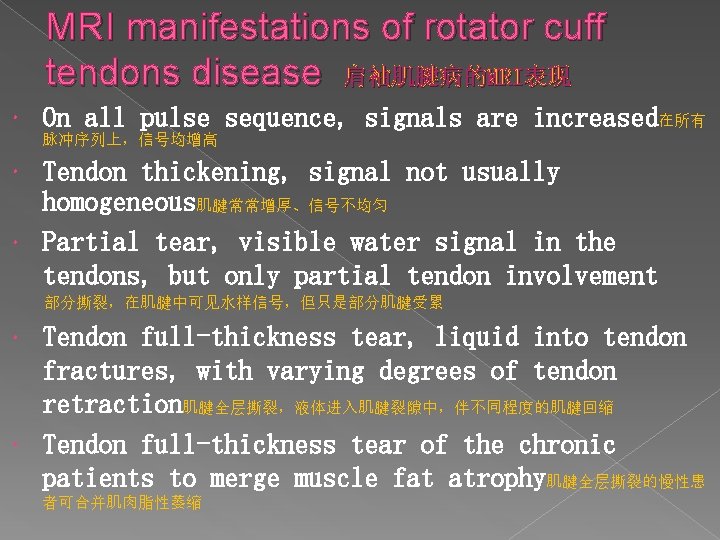
MRI manifestations of rotator cuff tendons disease 肩袖肌腱病的MRI表现 On all pulse sequence, signals are increased在所有 脉冲序列上,信号均增高 Tendon thickening, signal not usually homogeneous肌腱常常增厚、信号不均匀 Partial tear, visible water signal in the tendons, but only partial tendon involvement 部分撕裂,在肌腱中可见水样信号,但只是部分肌腱受累 Tendon full-thickness tear, liquid into tendon fractures, with varying degrees of tendon retraction肌腱全层撕裂,液体进入肌腱裂隙中,伴不同程度的肌腱回缩 Tendon full-thickness tear of the chronic patients to merge muscle fat atrophy肌腱全层撕裂的慢性患 者可合并肌肉脂性萎缩
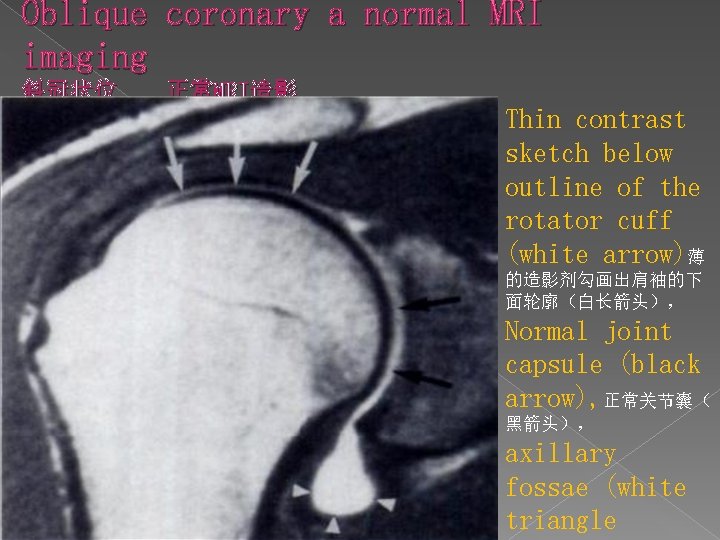
Oblique coronary a normal MRI imaging 斜冠状位 正常MRI造影 Thin contrast sketch below outline of the rotator cuff (white arrow)薄 的造影剂勾画出肩袖的下 面轮廓(白长箭头), Normal joint capsule (black arrow), 正常关节囊( 黑箭头), axillary fossae (white triangle
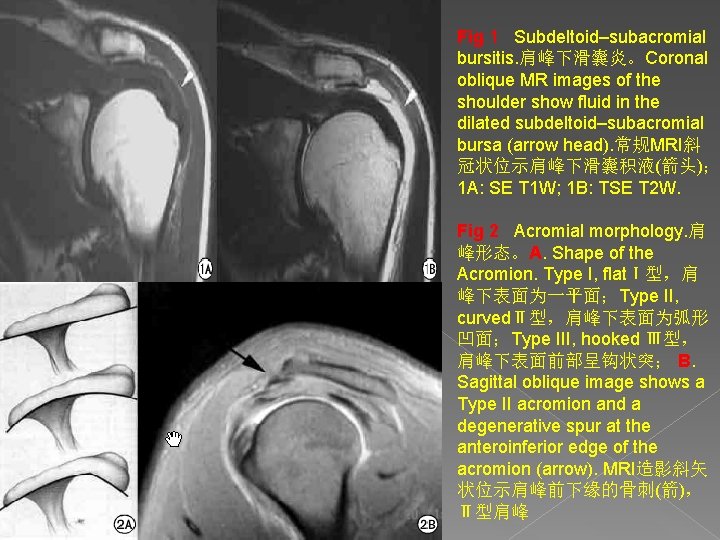
Fig 1 Subdeltoid–subacromial bursitis. 肩峰下滑囊炎。Coronal oblique MR images of the shoulder show fluid in the dilated subdeltoid–subacromial bursa (arrow head). 常规MRI斜 冠状位示肩峰下滑囊积液(箭头); 1 A: SE T 1 W; 1 B: TSE T 2 W. Fig 2 Acromial morphology. 肩 峰形态。A. Shape of the Acromion. Type I, flatⅠ型,肩 峰下表面为一平面;Type II, curvedⅡ型,肩峰下表面为弧形 凹面;Type III, hooked Ⅲ型, 肩峰下表面前部呈钩状突; B. Sagittal oblique image shows a Type II acromion and a degenerative spur at the anteroinferior edge of the acromion (arrow). MRI造影斜矢 状位示肩峰前下缘的骨刺(箭), Ⅱ型肩峰
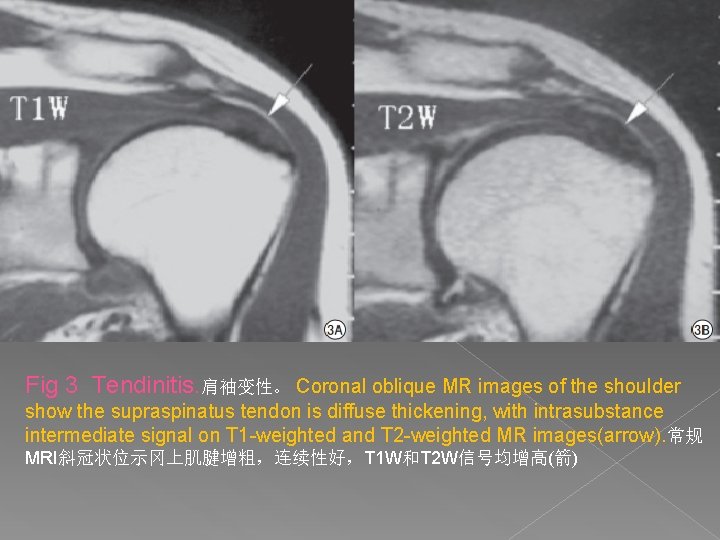
Fig 3 Tendinitis. 肩袖变性。 Coronal oblique MR images of the shoulder show the supraspinatus tendon is diffuse thickening, with intrasubstance intermediate signal on T 1 -weighted and T 2 -weighted MR images(arrow). 常规 MRI斜冠状位示冈上肌腱增粗,连续性好,T 1 W和T 2 W信号均增高(箭)
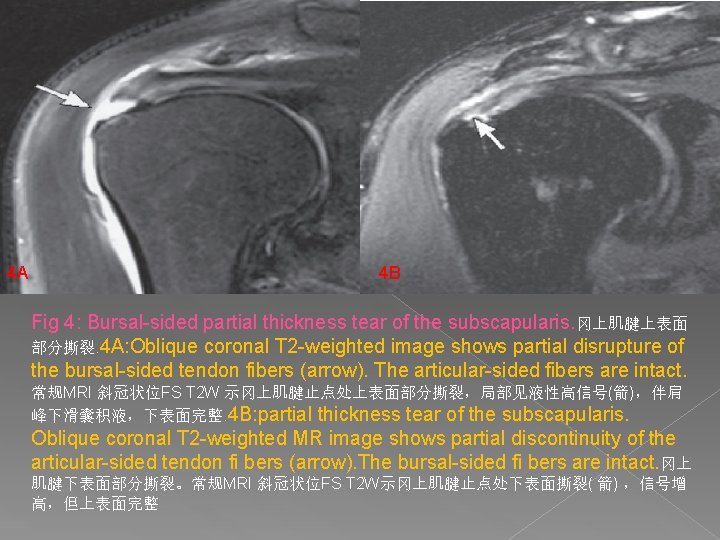
4 A 4 B Fig 4: Bursal-sided partial thickness tear of the subscapularis. 冈上肌腱上表面 部分撕裂. 4 A: Oblique coronal T 2 -weighted image shows partial disrupture of the bursal-sided tendon fibers (arrow). The articular-sided fibers are intact. 常规MRI 斜冠状位FS T 2 W 示冈上肌腱止点处上表面部分撕裂,局部见液性高信号(箭),伴肩 峰下滑囊积液,下表面完整. 4 B: partial thickness tear of the subscapularis. Oblique coronal T 2 -weighted MR image shows partial discontinuity of the articular-sided tendon fi bers (arrow). The bursal-sided fi bers are intact. 冈上 肌腱下表面部分撕裂。常规MRI 斜冠状位FS T 2 W示冈上肌腱止点处下表面撕裂( 箭) ,信号增 高,但上表面完整

4 C 4 D Fig 4 C: Intratendinous partial thickness tear of the subscapularis. 冈上肌腱腱内部分 撕裂。Oblique coronal T 2 -weighted MR image shows abnormal intratendinous fluid accumulation (arrows). The bursal-sided and articular-sided fi bers are intact常规MRI 斜冠状位FS T 2 W示冈上肌腱止点处腱内限局液性高信号影( 箭) ,肌腱上下表面均完 整. Fig 4 D: Articular-sided partial thickness tear of the subscapularis. 冈上肌腱下表面 部分撕裂。 Oblique coronal T 1 -weighted MR arthrographic image shows partial discontinuity of the articular-sided fi bers (arrows), with contrast material leaking into the substance of the tendon, and intact bursal-sided fi bers. MRI造影 斜冠状位示高信号对比剂进入冈上肌腱下表面(箭),但未进入肩峰下滑囊
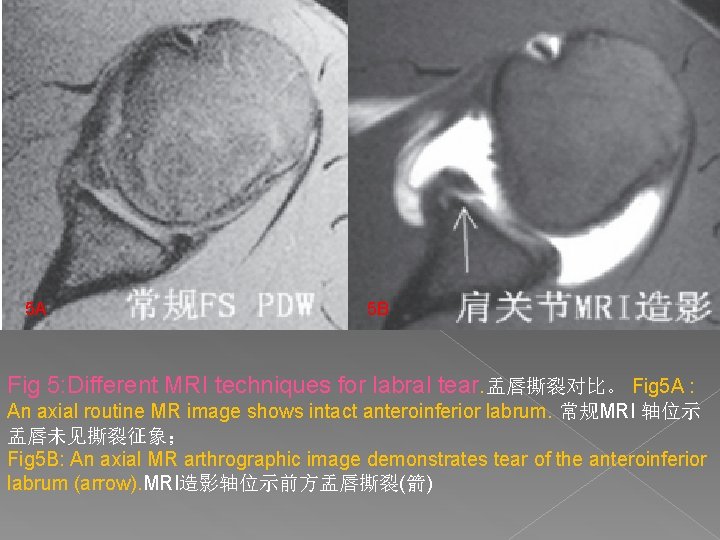
5 A 5 B Fig 5: Different MRI techniques for labral tear. 盂唇撕裂对比。 Fig 5 A : An axial routine MR image shows intact anteroinferior labrum. 常规MRI 轴位示 盂唇未见撕裂征象; Fig 5 B: An axial MR arthrographic image demonstrates tear of the anteroinferior labrum (arrow). MRI造影轴位示前方盂唇撕裂(箭)
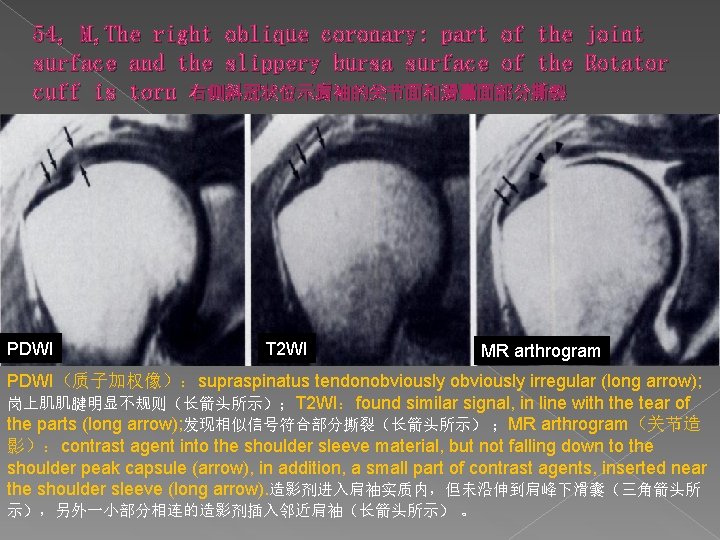
54, M, The right oblique coronary: part of the joint surface and the slippery bursa surface of the Rotator cuff is torn 右侧斜冠状位示肩袖的关节面和滑囊面部分撕裂 PDWI T 2 WI MR arthrogram PDWI(质子加权像):supraspinatus tendonobviously irregular (long arrow); 岗上肌肌腱明显不规则(长箭头所示);T 2 WI:found similar signal, in line with the tear of the parts (long arrow); 发现相似信号符合部分撕裂(长箭头所示) ;MR arthrogram(关节造 影):contrast agent into the shoulder sleeve material, but not falling down to the shoulder peak capsule (arrow), in addition, a small part of contrast agents, inserted near the shoulder sleeve (long arrow). 造影剂进入肩袖实质内,但未沿伸到肩峰下滑囊(三角箭头所 示),另外一小部分相连的造影剂插入邻近肩袖(长箭头所示) 。
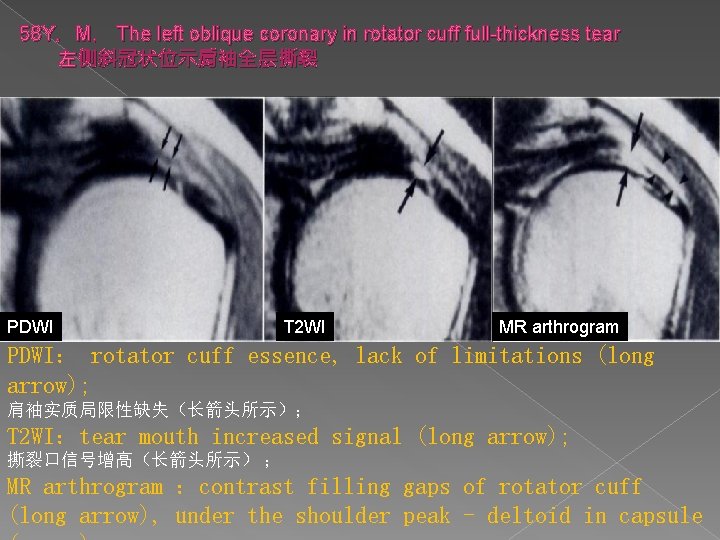
58 Y,M, The left oblique coronary in rotator cuff full-thickness tear 左侧斜冠状位示肩袖全层撕裂 PDWI T 2 WI MR arthrogram PDWI: rotator cuff essence, lack of limitations (long arrow); 肩袖实质局限性缺失(长箭头所示); T 2 WI:tear mouth increased signal (long arrow); 撕裂口信号增高(长箭头所示) ; MR arthrogram :contrast filling gaps of rotator cuff (long arrow), under the shoulder peak - deltoid in capsule
The differential diagnosis of tendon disease 肌腱病的鉴别诊断 Calcification features tendonitis钙化性肌腱炎: tendon thickening, and often accompanied by signal decreases肌腱可增厚,并常伴有信号减低 Within the tendon cyst肌腱内囊肿:tendon thickening, and on T 2 WI tumor cyst with partial rotator cuff tear肌 腱增厚,且在T 2 WI上见囊肿合并部分肩袖撕裂
二、 Rotator cuff tear肩袖撕裂 In tendon fissure, visible in joint fluid, slippery bursa liquid filling or granulation tissue, on the FSE T 2 WI or SPAIR sequences is most clear在肌腱裂隙中可见充以关节液、滑 囊液或肉芽组织,在FSE T 2 WI SPAIR序列中最清晰 Tendon edges appear different degree of contraction and degeneration肌腱边缘出现不同程度的收缩和退行性变 In patients with chronic tendon full-thickness tear can incorporate the fat of muscle atrophy慢性患者的肌腱全层撕裂 可合并肌肉的脂性萎缩 Merger of synovial sac effusion under the shoulder peak合并肩峰下滑囊积液 Occur between the front of the hills muscle tear or rotator cuff tear, easy to merge synovial sac effusion under beak有岗上肌前方撕裂和肩袖间撕裂时易合并喙下滑囊积液
Suspicious patients with rotator cuff tear, imaging examination, should be a comprehensive observation of rotator cuff and the surrounding structure可疑肩袖撕裂的病 人行影像学检查时需对肩袖及其周围结构作全面观察: Note that tear mouth size, affected the scope, edge cases, muscle atrophy and bone change and so on. 注意撕裂口大小、肌腱受累 范围、肌腱边缘情况、肌肉萎缩及骨骼改变等。 Partial tendon according to tear thickness or depth into three degrees. 部分性肌腱撕裂可按撕裂厚度或深度分三度。 Ⅰ度:﹤ 3 mm;Ⅱ度: 3 -6 mm;Ⅲ度:﹥ 6 mm。 Complete a tendon, according to the gap size is divided into four categories完全性肌腱撕裂据裂口大小分四类。 ﹤ 2 mm Mild tear轻度撕裂; 2 -4 Moderate tear中度撕裂; 4 -5 mm Severe tear重度撕裂;﹥ 5 mm Giant tear巨型撕裂。
The MRI classification of Rotator cuff tear (Neer) 肩袖撕裂的MRI分级(Neer) 0:Normally, a uniform low signal 正常,呈均匀一致的低信号 1:Rotator cuff normal form, on T 1 WI or PDWI sequences showed diffuse or linear high signal肩袖形 态正常,T 1 WI或PDWI上呈弥 漫性或线状高信号 2 :Shoulder sleeve, is thinning or irregular, and has high signal on T 1 WI or PDWI sequences肩袖变薄 或不规则, T 1 WI或PDWI上呈高信号 3 :Rotator cuff signal on T 2 WI sequence increased and affected tendon layer T 2 WI上肩袖信号增高且累 及肌腱全层
Carrino, think rotator cuff tear is divided into seven degrees 肩袖 撕裂分7级: Ø 0级: Tendon is normal肌腱正常; Ø 1级: Tendon (T 1 WI signal or PDWI) increased, the attachment points about 1 cm距附着点 1 cm肌腱信号(T 1 WI或PDWI)增高; Ø 2级:Tendonitis, increased signal on T 2 WI, but not involving the top of the shoulder joint (with Neer 2 degree)肌腱炎, T 2 WI上信号增高,但未 累及肩关节上面(同Neer 2级); Ø 3级: Degeneration, one or more high signal on T 2 WI, and there is no enough to the torn part of diagnostic criteria退行性变, T 2 WI上一个 或多个高信号区,未达部分撕裂诊断标准; Ø 4级:Part of tear, on T 2 WI sequence, tendon signal increased obviously, and affected tendon above or below部分撕裂, T 2 WI上肌腱信号 明星增高,且累及肌腱上下面; Ø 5级:Tendon near full-thickness rupture, but with a little muscle fiber complete肌腱近乎全层断裂,但有少许肌纤维完整; Ø 6级: Tendon full-thickness rupture, without tendon contracture 肌腱全层断裂,无肌腱挛缩; Ø 7级: Tendon full-thickness rupture with tendon contracture. 肌腱 全层断裂伴肌腱挛缩。
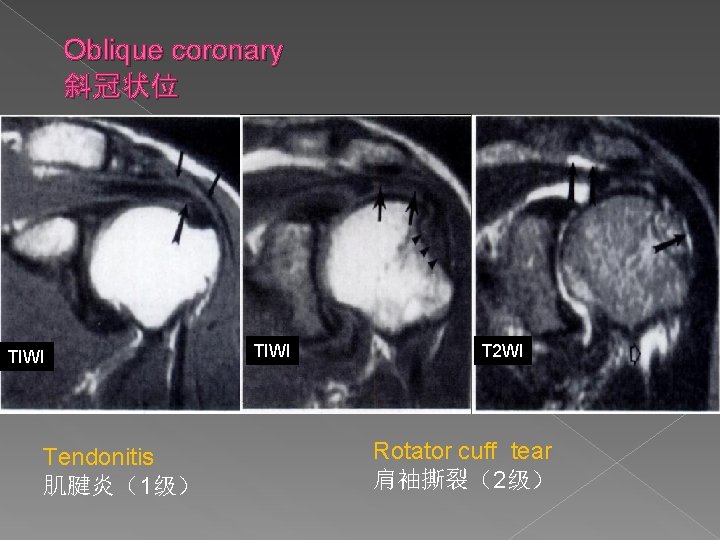
Oblique coronary 斜冠状位 TIWI Tendonitis 肌腱炎(1级) TIWI T 2 WI Rotator cuff tear 肩袖撕裂(2级)
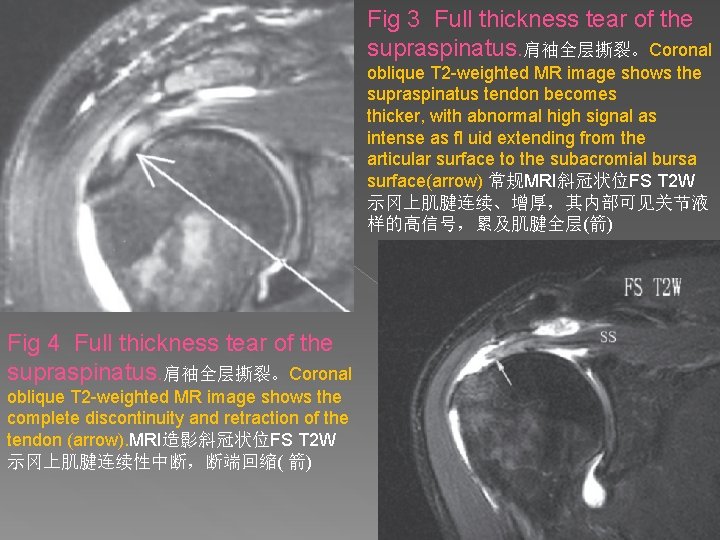
Fig 3 Full thickness tear of the supraspinatus. 肩袖全层撕裂。Coronal oblique T 2 -weighted MR image shows the supraspinatus tendon becomes thicker, with abnormal high signal as intense as fl uid extending from the articular surface to the subacromial bursa surface(arrow) 常规MRI斜冠状位FS T 2 W 示冈上肌腱连续、增厚,其内部可见关节液 样的高信号,累及肌腱全层(箭) Fig 4 Full thickness tear of the supraspinatus. 肩袖全层撕裂。Coronal oblique T 2 -weighted MR image shows the complete discontinuity and retraction of the tendon (arrow). MRI造影斜冠状位FS T 2 W 示冈上肌腱连续性中断,断端回缩( 箭)
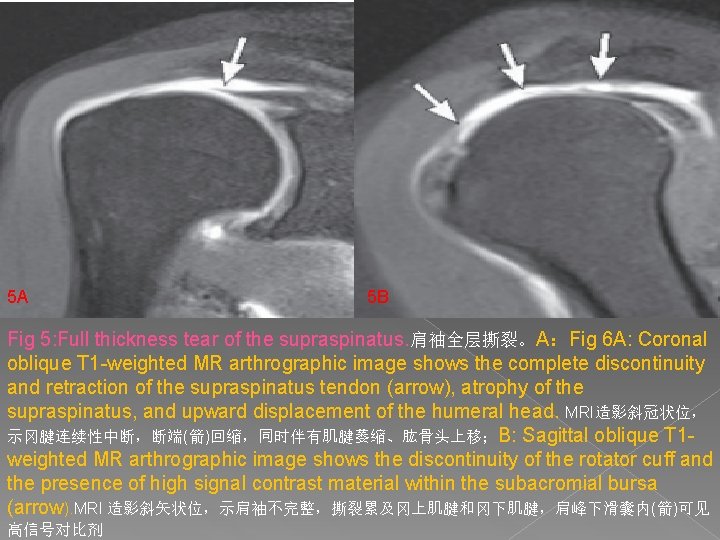
5 A 5 B Fig 5: Full thickness tear of the supraspinatus. 肩袖全层撕裂。A:Fig 6 A: Coronal oblique T 1 -weighted MR arthrographic image shows the complete discontinuity and retraction of the supraspinatus tendon (arrow), atrophy of the supraspinatus, and upward displacement of the humeral head. MRI造影斜冠状位, 示冈腱连续性中断,断端(箭)回缩,同时伴有肌腱萎缩、肱骨头上移;B: Sagittal oblique T 1 weighted MR arthrographic image shows the discontinuity of the rotator cuff and the presence of high signal contrast material within the subacromial bursa (arrow). MRI 造影斜矢状位,示肩袖不完整,撕裂累及冈上肌腱和冈下肌腱,肩峰下滑囊内(箭)可见 高信号对比剂
三、Subscapularis rupture 肩胛下肌断裂 Patients with secondary to anterior dislocation of shoulder joint, typically more than 40 years继发于肩关节 前脱位,患者一般大于40岁 Secondary to the rear of the shoulder joint dislocation, visible at any age继发于肩关节后脱位,可见于任何年龄 Tendon signal uneven; Tendon in see water signal; Different degree of tendon retraction. 肌腱信号不 均匀;肌腱中见水样信号;不同程度肌腱回缩。 Plain radiographs, shows the humerus small tubercle fracture平片可见肱骨小结节骨折
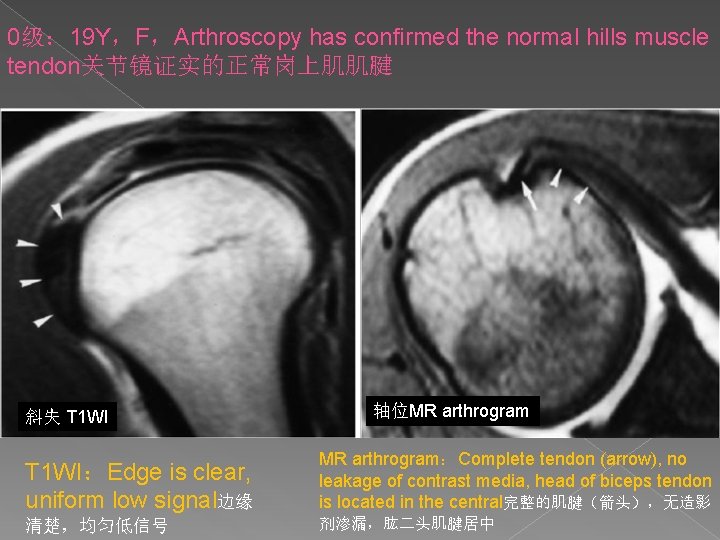
0级: 19 Y,F,Arthroscopy has confirmed the normal hills muscle tendon关节镜证实的正常岗上肌肌腱 斜失 T 1 WI 轴位MR arthrogram T 1 WI:Edge is clear, uniform low signal边缘 MR arthrogram:Complete tendon (arrow), no leakage of contrast media, head of biceps tendon is located in the central完整的肌腱(箭头),无造影 清楚,均匀低信号 剂渗漏,肱二头肌腱居中
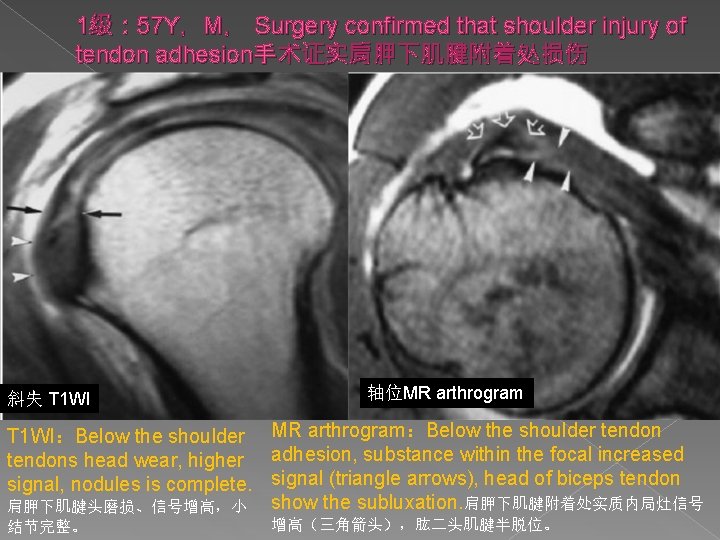
1级: 57 Y,M, Surgery confirmed that shoulder injury of tendon adhesion手术证实肩胛下肌腱附着处损伤 斜失 T 1 WI 轴位MR arthrogram T 1 WI:Below the shoulder MR arthrogram:Below the shoulder tendons head wear, higher adhesion, substance within the focal increased signal, nodules is complete. signal (triangle arrows), head of biceps tendon show the subluxation. 肩胛下肌腱附着处实质内局灶信号 肩胛下肌腱头磨损、信号增高,小 结节完整。 增高(三角箭头),肱二头肌腱半脱位。
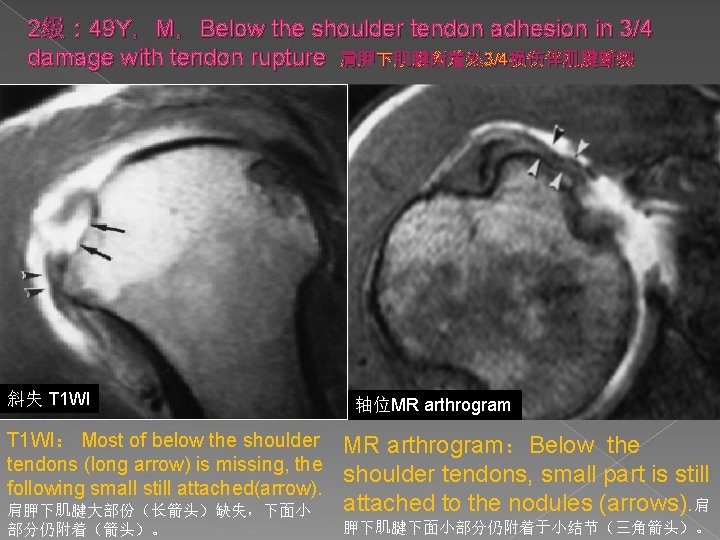
2级: 49 Y,M,Below the shoulder tendon adhesion in 3/4 damage with tendon rupture 肩胛下肌腱附着处3/4损伤伴肌腱断裂 斜失 T 1 WI: Most of below the shoulder tendons (long arrow) is missing, the following small still attached(arrow). 肩胛下肌腱大部份(长箭头)缺失,下面小 部分仍附着(箭头)。 轴位MR arthrogram:Below the shoulder tendons, small part is still attached to the nodules (arrows). 肩 胛下肌腱下面小部分仍附着于小结节(三角箭头)。
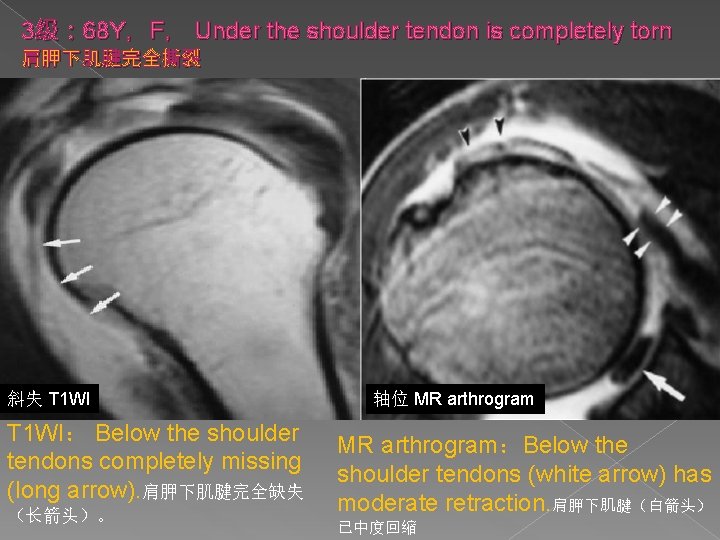
3级: 68 Y,F, Under the shoulder tendon is completely torn 肩胛下肌腱完全撕裂 斜失 T 1 WI: Below the shoulder tendons completely missing (long arrow). 肩胛下肌腱完全缺失 (长箭头)。 轴位 MR arthrogram:Below the shoulder tendons (white arrow) has moderate retraction. 肩胛下肌腱(白箭头) 已中度回缩
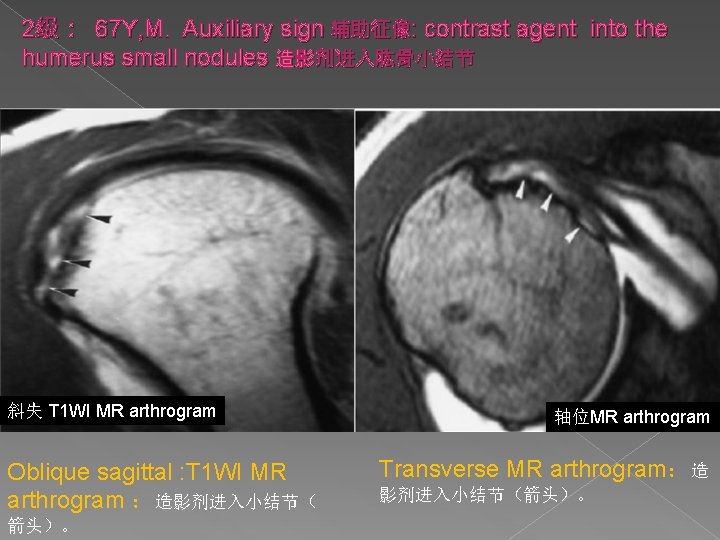
2级: 67 Y, M. Auxiliary sign 辅助征像: contrast agent into the humerus small nodules 造影剂进入肱骨小结节 斜失 T 1 WI MR arthrogram Oblique sagittal : T 1 WI MR arthrogram :造影剂进入小结节( 箭头)。 轴位MR arthrogram Transverse MR arthrogram:造 影剂进入小结节(箭头)。
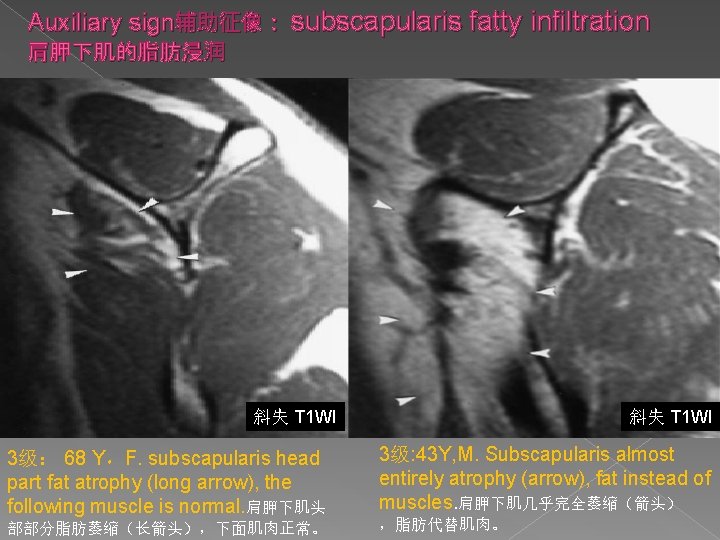
Auxiliary sign辅助征像: subscapularis fatty infiltration 肩胛下肌的脂肪浸润 斜失 T 1 WI 3级: 68 Y,F. subscapularis head part fat atrophy (long arrow), the following muscle is normal. 肩胛下肌头 部部分脂肪萎缩(长箭头),下面肌肉正常。 斜失 T 1 WI 3级: 43 Y, M. Subscapularis almost entirely atrophy (arrow), fat instead of muscles. 肩胛下肌几乎完全萎缩(箭头) ,脂肪代替肌肉。
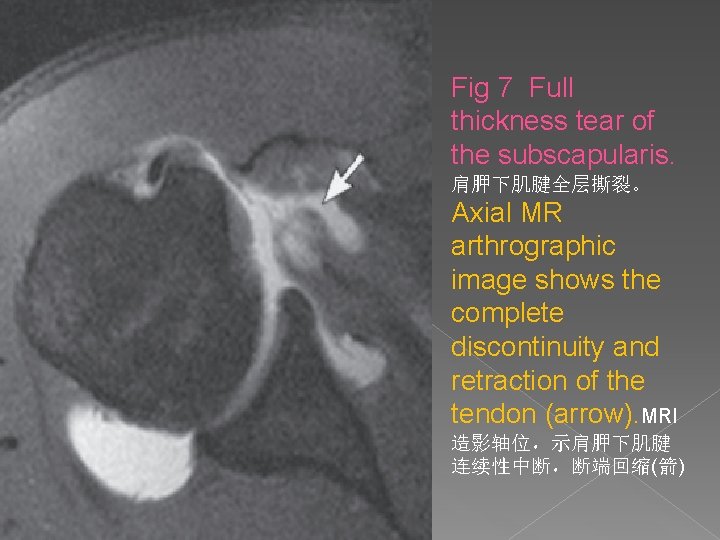
Fig 7 Full thickness tear of the subscapularis. 肩胛下肌腱全层撕裂。 Axial MR arthrographic image shows the complete discontinuity and retraction of the tendon (arrow). MRI 造影轴位,示肩胛下肌腱 连续性中断,断端回缩(箭)

To be continued ……
- Slides: 31