
Mr Bartons Maths Notes Algebra 3 Factorising www
Mr Barton’s Maths Notes Algebra 3. Factorising www. mrbartonmaths. com
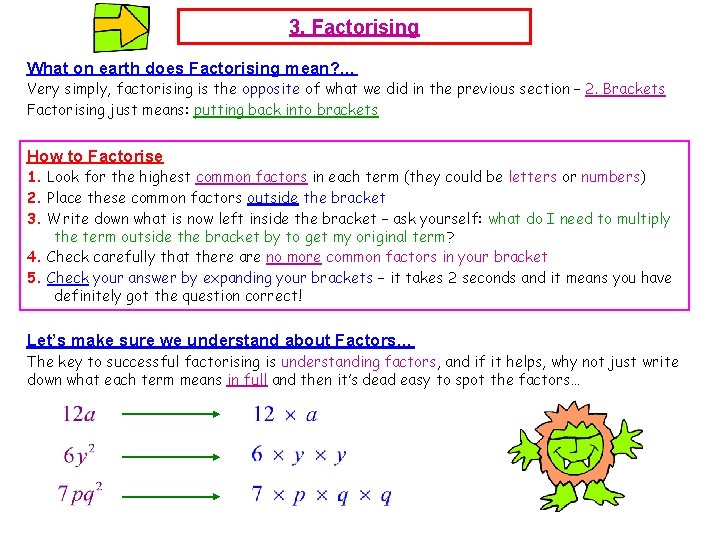
3. Factorising What on earth does Factorising mean? … Very simply, factorising is the opposite of what we did in the previous section – 2. Brackets Factorising just means: putting back into brackets How to Factorise 1. Look for the highest common factors in each term (they could be letters or numbers) 2. Place these common factors outside the bracket 3. Write down what is now left inside the bracket – ask yourself: what do I need to multiply the term outside the bracket by to get my original term? 4. Check carefully that there are no more common factors in your bracket 5. Check your answer by expanding your brackets – it takes 2 seconds and it means you have definitely got the question correct! Let’s make sure we understand about Factors… The key to successful factorising is understanding factors, and if it helps, why not just write down what each term means in full and then it’s dead easy to spot the factors…

Example 1 Example 2 Factorise: 1. Okay, so we’re on the hunt for common factors in both numbers and letters: Numbers: 7 and 21 Highest Factor = 7 Letters: there are no letters in the 2 nd term, so we can’t take any letters outside the bracket! 1. Okay, so we’re on the hunt for common factors in both numbers and letters: Numbers: 10 and Letters: p and 15 pq Highest Factor = 5 Highest Factor = p 2. So we have… 3. Now we have to figure out… Which gives us… 4. Check there are no more common factors left inside the bracket…erm… nothing is common to both a and 3, so we’re fine! 4. Check there are no more common factors left inside the bracket…erm… nothing is common to both 2 and 3 q, so we’re fine! 5. Expand the answer (on paper or in your head) to make sure you get the original question!
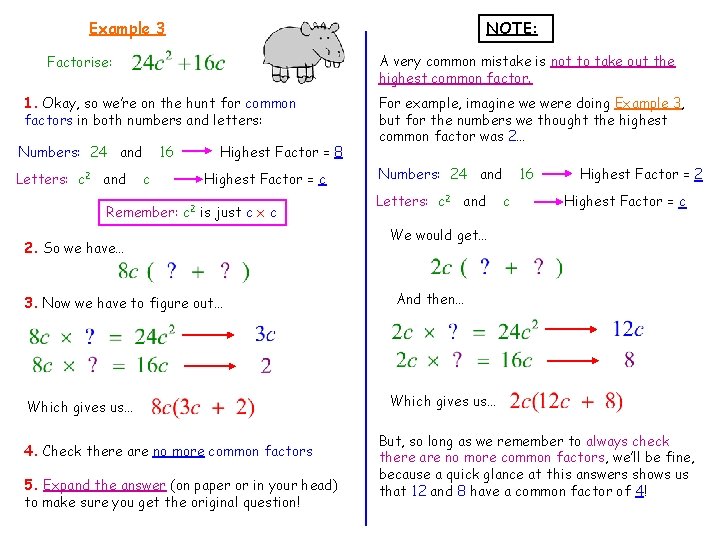
Example 3 NOTE: A very common mistake is not to take out the highest common factor. Factorise: 1. Okay, so we’re on the hunt for common factors in both numbers and letters: Numbers: 24 and Letters: c 2 and 16 Highest Factor = 8 c Remember: Highest Factor = c c 2 is just c x c 2. So we have… 3. Now we have to figure out… Which gives us… 4. Check there are no more common factors 5. Expand the answer (on paper or in your head) to make sure you get the original question! For example, imagine we were doing Example 3, but for the numbers we thought the highest common factor was 2… Numbers: 24 and Letters: c 2 and 16 c Highest Factor = 2 Highest Factor = c We would get… And then… Which gives us… But, so long as we remember to always check there are no more common factors, we’ll be fine, because a quick glance at this answers shows us that 12 and 8 have a common factor of 4!
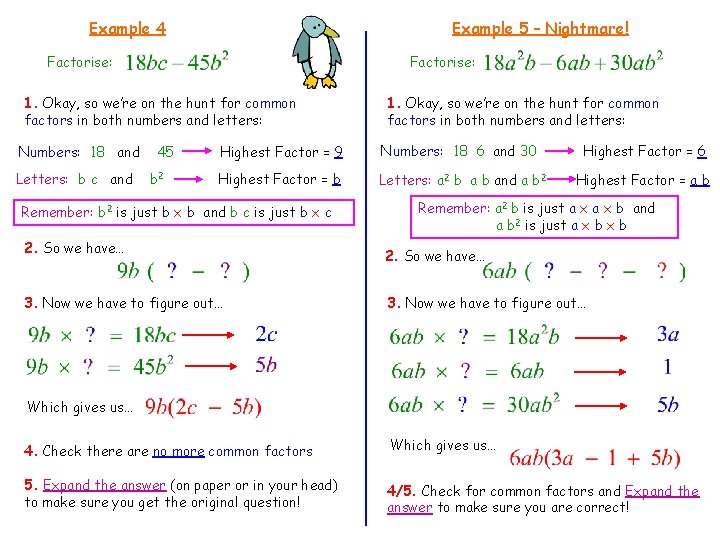
Example 5 – Nightmare! Example 4 Factorise: 1. Okay, so we’re on the hunt for common factors in both numbers and letters: Numbers: 18 and Letters: b c and 45 b 2 1. Okay, so we’re on the hunt for common factors in both numbers and letters: Highest Factor = 9 Numbers: 18 6 and 30 Highest Factor = 6 Highest Factor = b Letters: a 2 b and a b 2 Highest Factor = a b Remember: b 2 is just b x b and b c is just b x c 2. So we have… 3. Now we have to figure out… Remember: a 2 b is just a x b and a b 2 is just a x b 2. So we have… 3. Now we have to figure out… Which gives us… 4. Check there are no more common factors Which gives us… 5. Expand the answer (on paper or in your head) to make sure you get the original question! 4/5. Check for common factors and Expand the answer to make sure you are correct!

Good luck with your revision!
- Slides: 6