
MPRI Course on Concurrency Lecture 14 Application of
- Slides: 32
MPRI – Course on Concurrency Lecture 14 Application of probabilistic process calculi to security Catuscia Palamidessi LIX, Ecole Polytechnique kostas@lix. polytechnique. fr www. lix. polytechnique. fr/~catuscia Page of the course: http: //mpri. master. univ-paris 7. fr/C-2 -3. html Paris, 17 December 2007 MPRI Course on Concurrency
Plan of the lecture • Randomized protocols for security • Focus on protection of identity (anonymity) – The dining cryptographers • Correctness of the protocol • Anonymity analysis – Crowds (a protocol for anonymous web surfing) Paris, 17 December 2007 MPRI Course on Concurrency 2
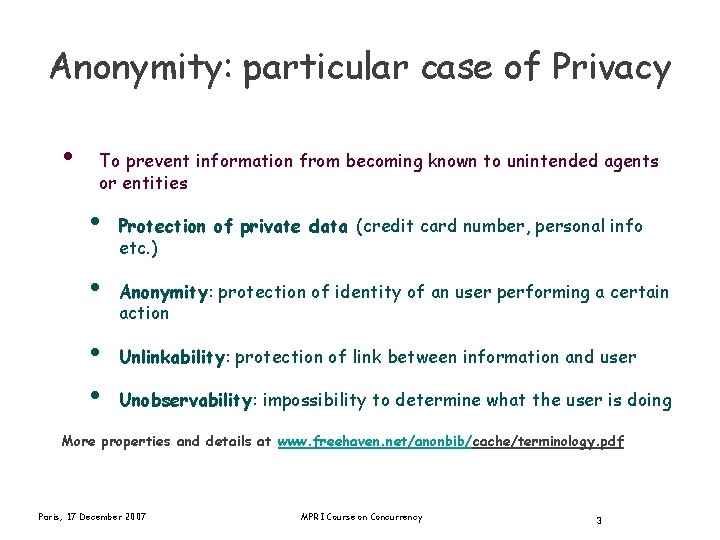
Anonymity: particular case of Privacy • To prevent information from becoming known to unintended agents or entities • Protection of private data (credit card number, personal info etc. ) • Anonymity: protection of identity of an user performing a certain action • • Unlinkability: protection of link between information and user Unobservability: impossibility to determine what the user is doing More properties and details at www. freehaven. net/anonbib/cache/terminology. pdf Paris, 17 December 2007 MPRI Course on Concurrency 3
Anonymity • • Hide the identity of a user performing a given action The action itself might be revealed Many applications • • Anonymous web-surfing Anonymous posting on forums Elections Anonymous donation Protocols for anonymity often use randomization Paris, 17 December 2007 MPRI Course on Concurrency 4
The dining cryptographers • • • A simple anonymity problem Introduced by Chaum in 1988 Chaum proposed a solution satisfying the socalled “strong anonymity” Paris, 17 December 2007 MPRI Course on Concurrency 5
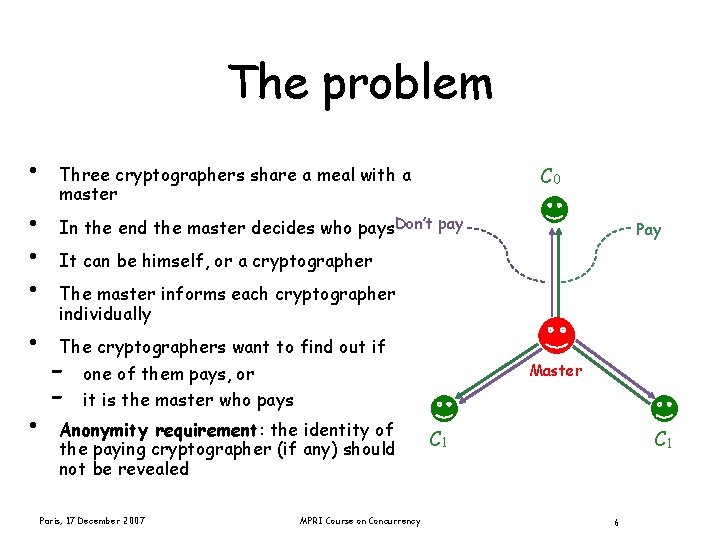
The problem • • • C 0 Three cryptographers share a meal with a master In the end the master decides who pays. Don’t pay Pay It can be himself, or a cryptographer The master informs each cryptographer individually The cryptographers want to find out if one of them pays, or it is the master who pays - Anonymity requirement: the identity of the paying cryptographer (if any) should not be revealed Paris, 17 December 2007 MPRI Course on Concurrency Master C 1 6
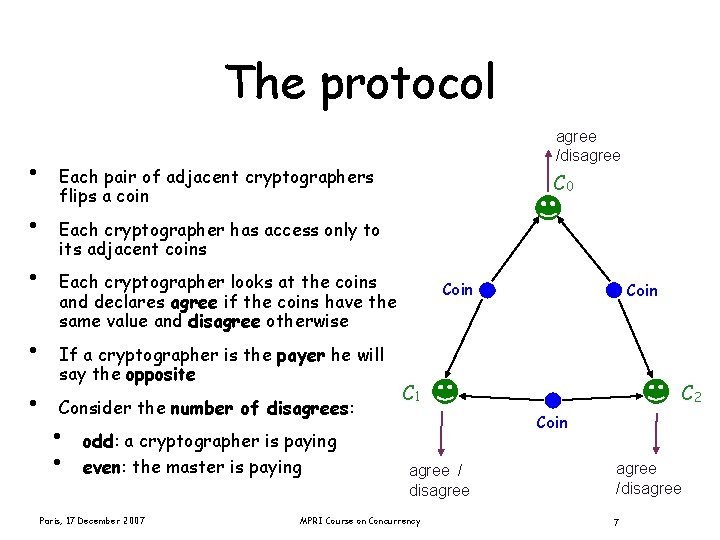
The protocol • • • agree /disagree Each pair of adjacent cryptographers flips a coin C 0 Each cryptographer has access only to its adjacent coins Each cryptographer looks at the coins and declares agree if the coins have the same value and disagree otherwise If a cryptographer is the payer he will say the opposite Consider the number of disagrees: • • odd: a cryptographer is paying even: the master is paying Paris, 17 December 2007 Coin C 1 C 2 Coin agree / disagree MPRI Course on Concurrency agree /disagree 7
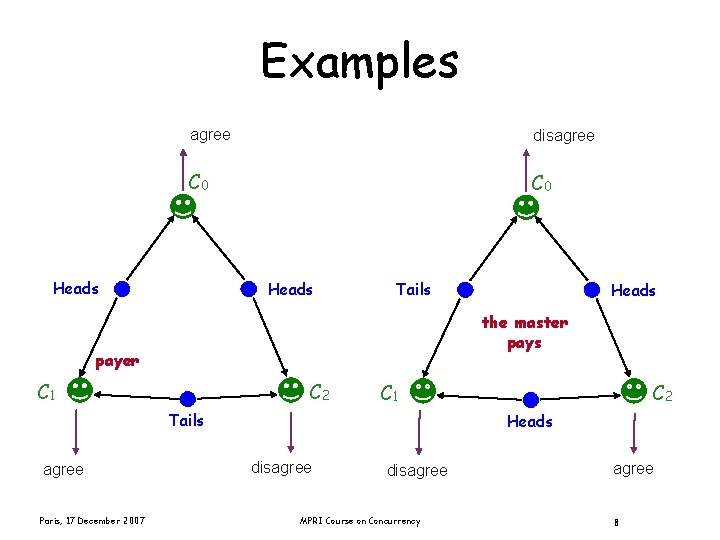
Examples agree disagree C 0 Heads Tails the master pays payer C 1 C 2 Paris, 17 December 2007 C 2 C 1 Tails agree Heads disagree MPRI Course on Concurrency agree 8
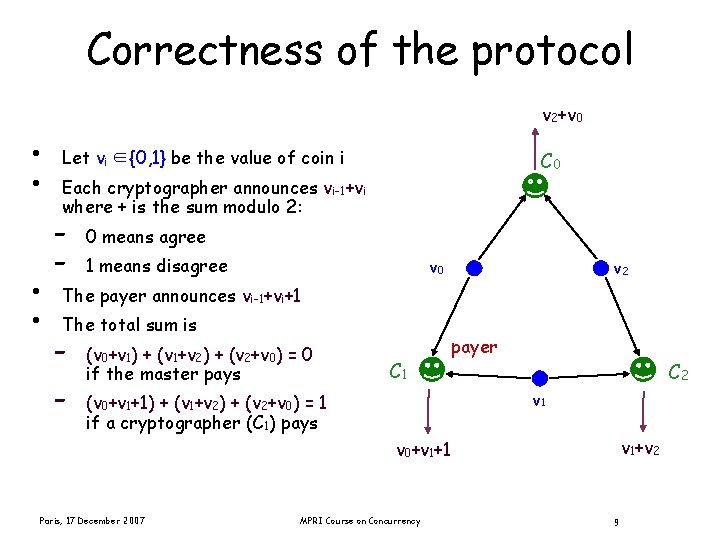
Correctness of the protocol v 2+v 0 • • Let vi ∈{0, 1} be the value of coin i C 0 Each cryptographer announces vi-1+vi where + is the sum modulo 2: - 0 means agree 1 means disagree v 0 v 2 The payer announces vi-1+vi+1 The total sum is - (v 0+v 1) + (v 1+v 2) + (v 2+v 0) = 0 if the master pays C 1 payer C 2 v 1 (v 0+v 1+1) + (v 1+v 2) + (v 2+v 0) = 1 if a cryptographer (C 1) pays v 1+v 2 v 0+v 1+1 Paris, 17 December 2007 MPRI Course on Concurrency 9
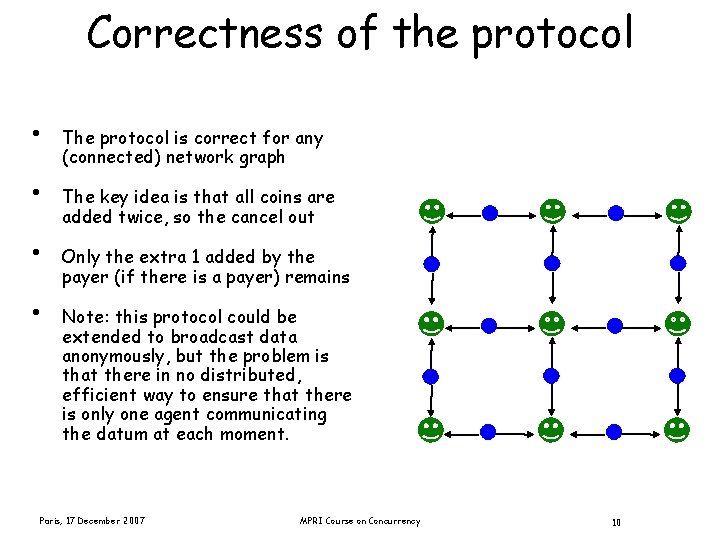
Correctness of the protocol • • The protocol is correct for any (connected) network graph The key idea is that all coins are added twice, so the cancel out Only the extra 1 added by the payer (if there is a payer) remains Note: this protocol could be extended to broadcast data anonymously, but the problem is that there in no distributed, efficient way to ensure that there is only one agent communicating the datum at each moment. Paris, 17 December 2007 MPRI Course on Concurrency 10
Anonymity of the protocol • • How can we define the notion of anonymity? First we have to fix the notion of observable: • The anonymity property change depending on who is the observer / what actions he can see - Paris, 17 December 2007 An external observer can only see the declarations One of the cryptographers can also see some of the coins MPRI Course on Concurrency 11
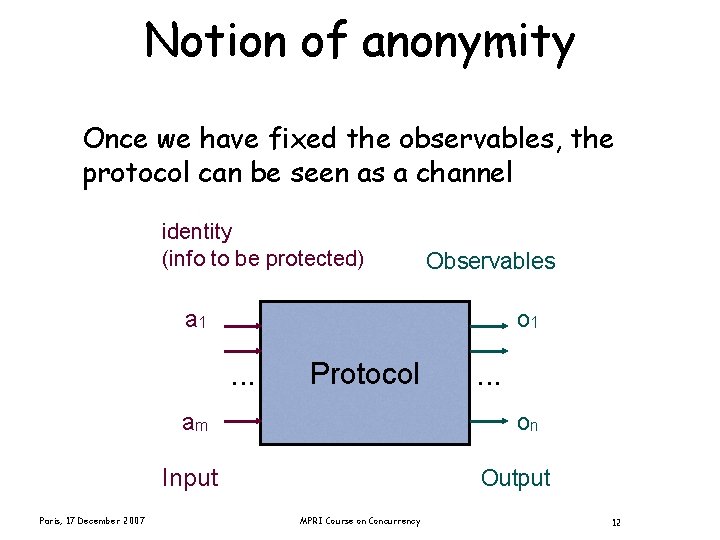
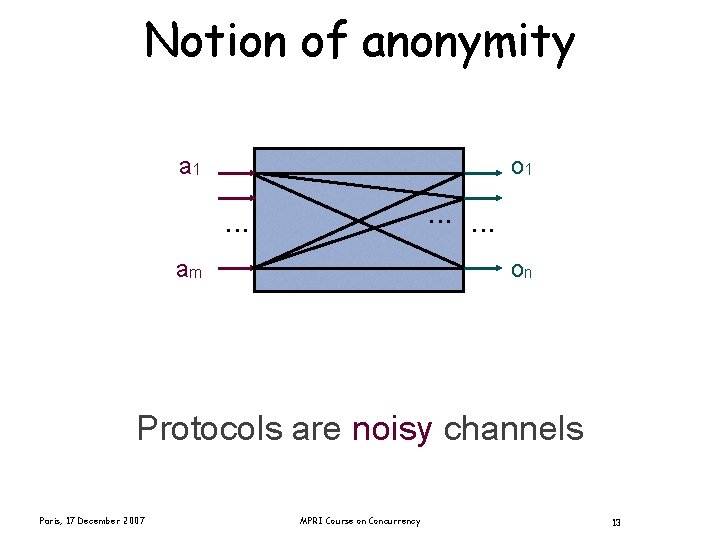
Notion of anonymity Once we have fixed the observables, the protocol can be seen as a channel identity (info to be protected) Observables a 1 o 1 . . . Protocol am on Input Paris, 17 December 2007 . . . Output MPRI Course on Concurrency 12
Notion of anonymity a 1 o 1 . . am on Protocols are noisy channels Paris, 17 December 2007 MPRI Course on Concurrency 13
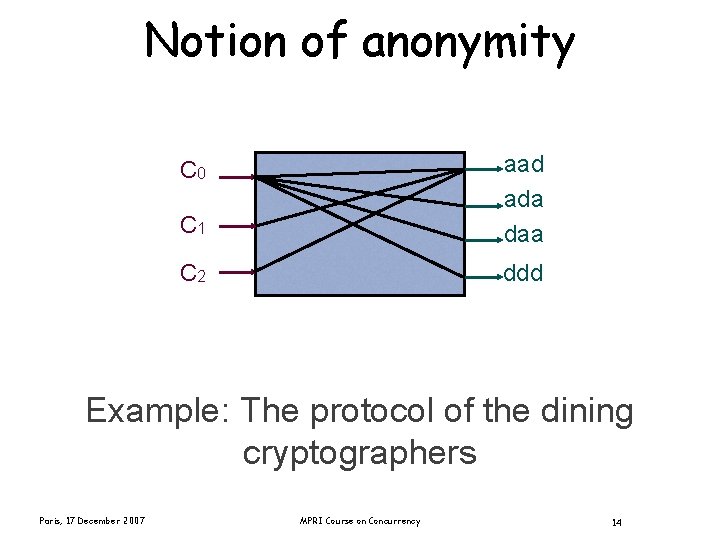
Notion of anonymity C 1 aad ada daa C 2 ddd C 0 Example: The protocol of the dining cryptographers Paris, 17 December 2007 MPRI Course on Concurrency 14
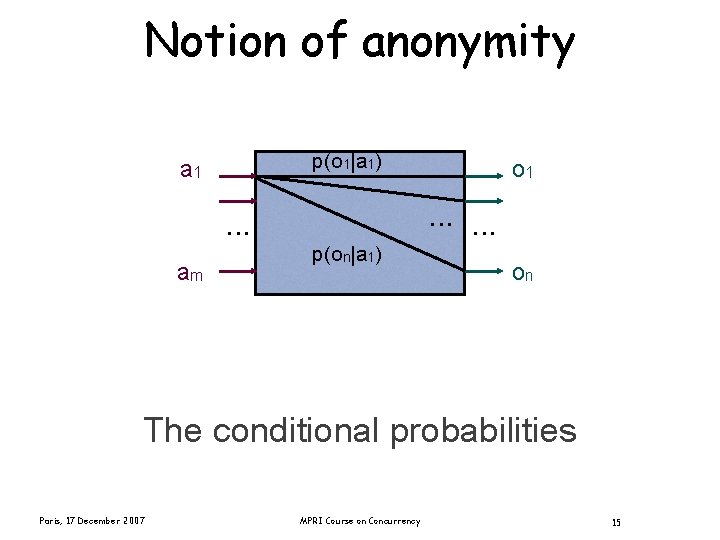
Notion of anonymity p(o 1|a 1) a 1 . . am o 1 p(on|a 1) on The conditional probabilities Paris, 17 December 2007 MPRI Course on Concurrency 15
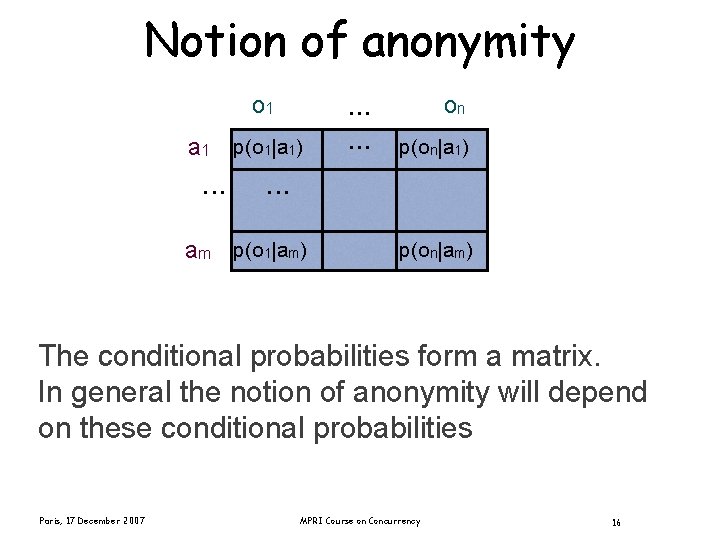
Notion of anonymity o 1 a 1 p(o 1|a 1) . . on p(on|a 1) . . . am p(o 1|am) p(on|am) The conditional probabilities form a matrix. In general the notion of anonymity will depend on these conditional probabilities Paris, 17 December 2007 MPRI Course on Concurrency 16
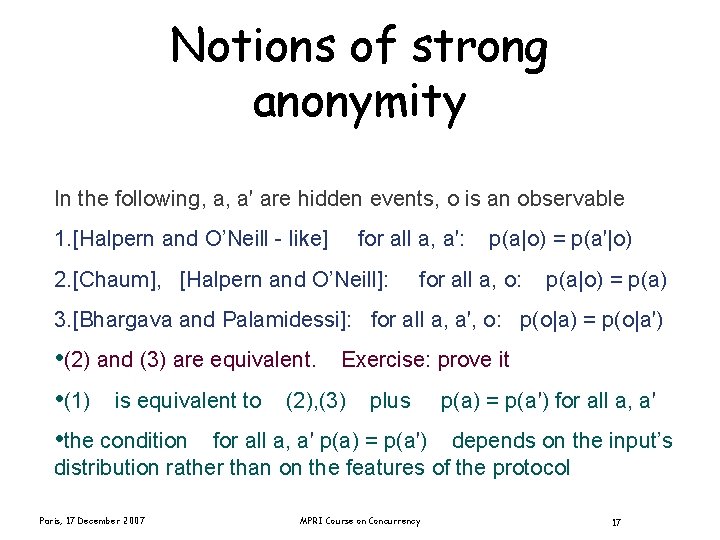
Notions of strong anonymity In the following, a, a′ are hidden events, o is an observable 1. [Halpern and O’Neill - like] for all a, a′: 2. [Chaum], [Halpern and O’Neill]: p(a|o) = p(a′|o) for all a, o: p(a|o) = p(a) 3. [Bhargava and Palamidessi]: for all a, a′, o: p(o|a) = p(o|a′) • (2) and (3) are equivalent. Exercise: prove it • (1) is equivalent to (2), (3) plus p(a) = p(a′) for all a, a′ • the condition for all a, a′ p(a) = p(a′) depends on the input’s distribution rather than on the features of the protocol Paris, 17 December 2007 MPRI Course on Concurrency 17
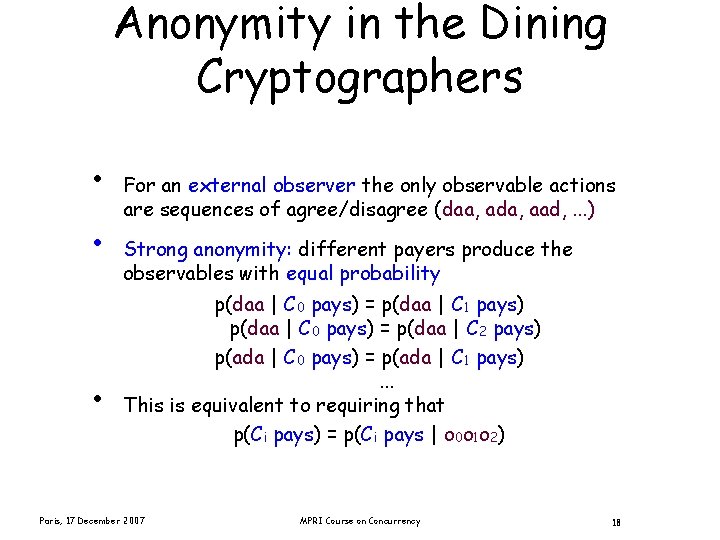
Anonymity in the Dining Cryptographers • • • For an external observer the only observable actions are sequences of agree/disagree (daa, ada, aad, . . . ) Strong anonymity: different payers produce the observables with equal probability p(daa | C 0 pays) = p(daa | C 1 pays) p(daa | C 0 pays) = p(daa | C 2 pays) p(ada | C 0 pays) = p(ada | C 1 pays). . . This is equivalent to requiring that p(Ci pays) = p(Ci pays | o 0 o 1 o 2) Paris, 17 December 2007 MPRI Course on Concurrency 18
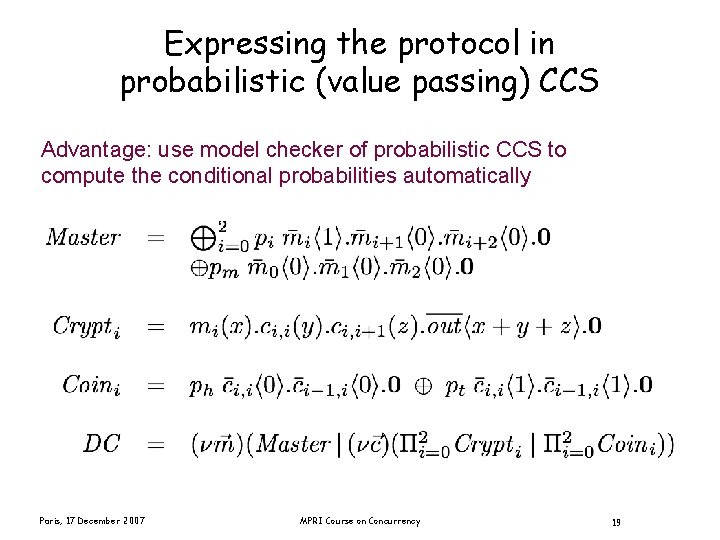
Expressing the protocol in probabilistic (value passing) CCS Advantage: use model checker of probabilistic CCS to compute the conditional probabilities automatically Paris, 17 December 2007 MPRI Course on Concurrency 19
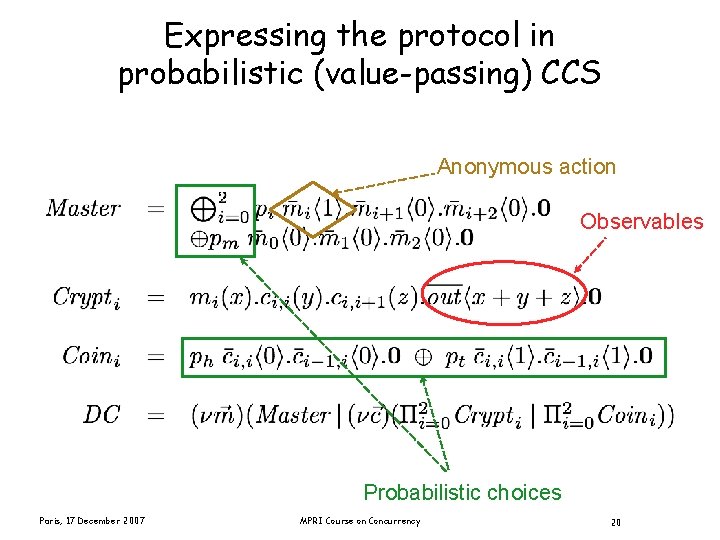
Expressing the protocol in probabilistic (value-passing) CCS Anonymous action Observables Probabilistic choices Paris, 17 December 2007 MPRI Course on Concurrency 20
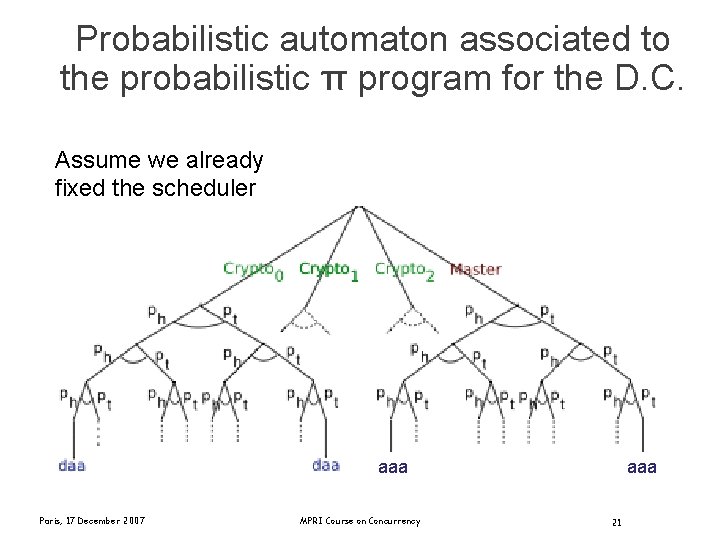
Probabilistic automaton associated to the probabilistic π program for the D. C. Assume we already fixed the scheduler aaa Paris, 17 December 2007 MPRI Course on Concurrency aaa 21
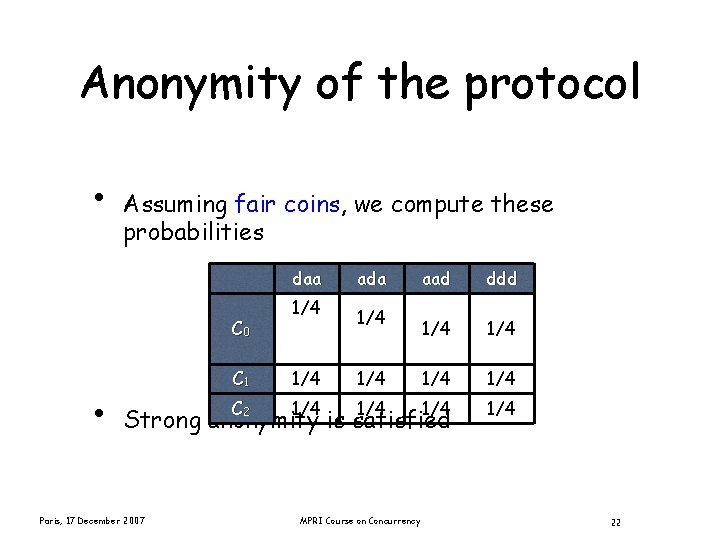
Anonymity of the protocol • Assuming fair coins, we compute these probabilities daa C 0 • 1/4 ada 1/4 aad ddd 1/4 C 1 1/4 1/4 C 2 1/4 1/4 Strong anonymity is satisfied Paris, 17 December 2007 MPRI Course on Concurrency 22
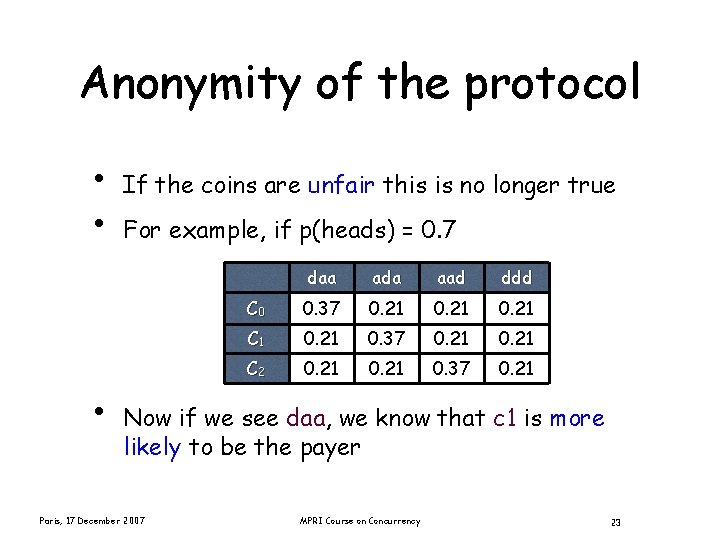
Anonymity of the protocol • • • If the coins are unfair this is no longer true For example, if p(heads) = 0. 7 daa ada aad ddd C 0 0. 37 0. 21 C 1 0. 21 0. 37 0. 21 C 2 0. 21 0. 37 0. 21 Now if we see daa, we know that c 1 is more likely to be the payer Paris, 17 December 2007 MPRI Course on Concurrency 23
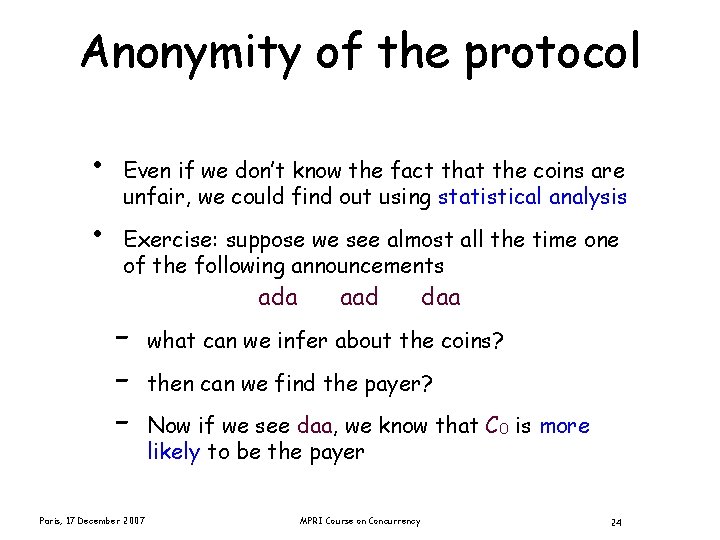
Anonymity of the protocol • • Even if we don’t know the fact that the coins are unfair, we could find out using statistical analysis Exercise: suppose we see almost all the time one of the following announcements Paris, 17 December 2007 ada aad daa what can we infer about the coins? then can we find the payer? Now if we see daa, we know that C 0 is more likely to be the payer MPRI Course on Concurrency 24
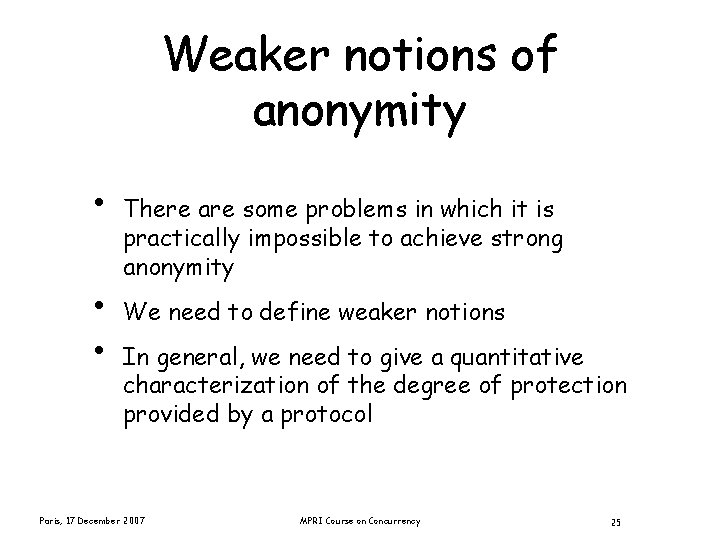
Weaker notions of anonymity • • • There are some problems in which it is practically impossible to achieve strong anonymity We need to define weaker notions In general, we need to give a quantitative characterization of the degree of protection provided by a protocol Paris, 17 December 2007 MPRI Course on Concurrency 25
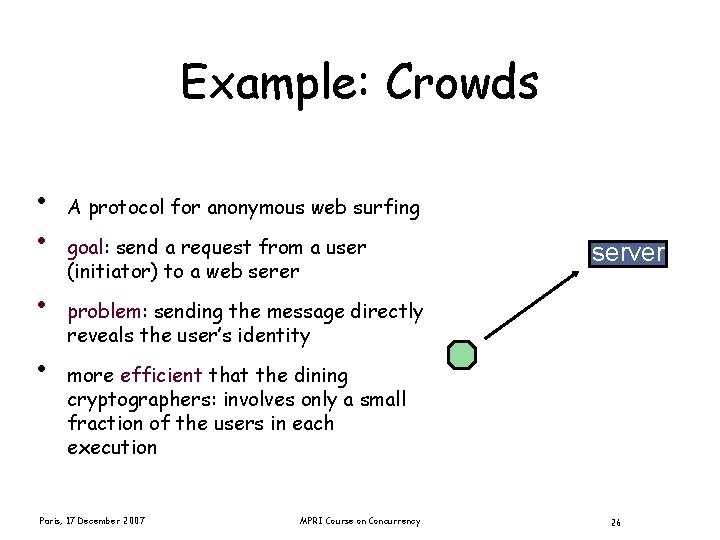
Example: Crowds • • A protocol for anonymous web surfing goal: send a request from a user (initiator) to a web serer server problem: sending the message directly reveals the user’s identity more efficient that the dining cryptographers: involves only a small fraction of the users in each execution Paris, 17 December 2007 MPRI Course on Concurrency 26
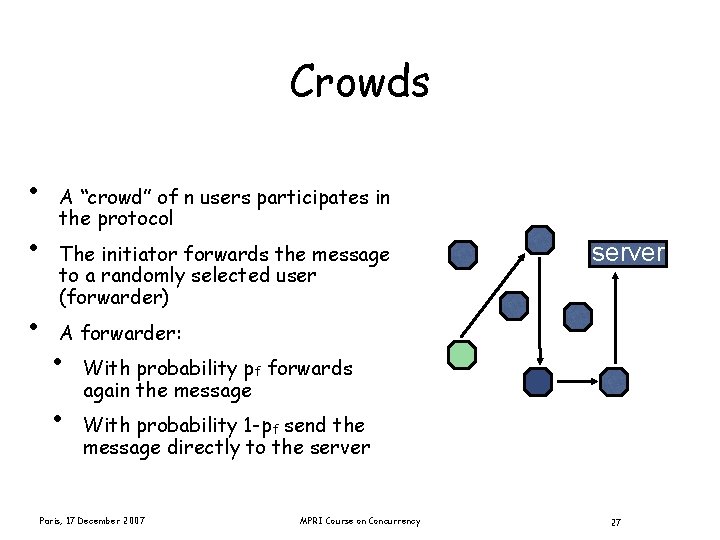
Crowds • • • A “crowd” of n users participates in the protocol The initiator forwards the message to a randomly selected user (forwarder) server A forwarder: • • With probability pf forwards again the message With probability 1 -pf send the message directly to the server Paris, 17 December 2007 MPRI Course on Concurrency 27
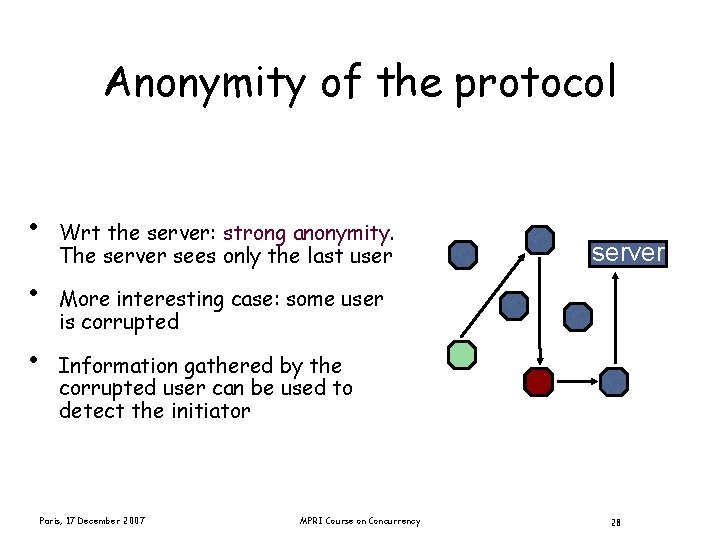
Anonymity of the protocol • • • Wrt the server: strong anonymity. The server sees only the last user server More interesting case: some user is corrupted Information gathered by the corrupted user can be used to detect the initiator Paris, 17 December 2007 MPRI Course on Concurrency 28
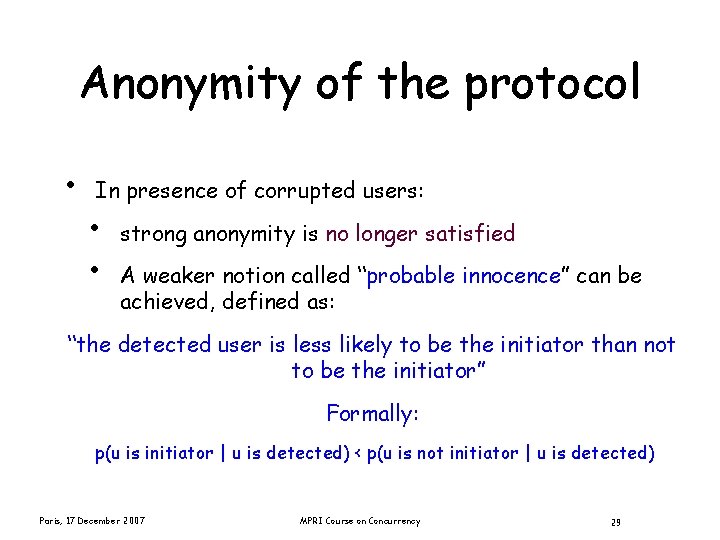
Anonymity of the protocol • In presence of corrupted users: • • strong anonymity is no longer satisfied A weaker notion called “probable innocence” can be achieved, defined as: “the detected user is less likely to be the initiator than not to be the initiator” Formally: p(u is initiator | u is detected) < p(u is not initiator | u is detected) Paris, 17 December 2007 MPRI Course on Concurrency 29
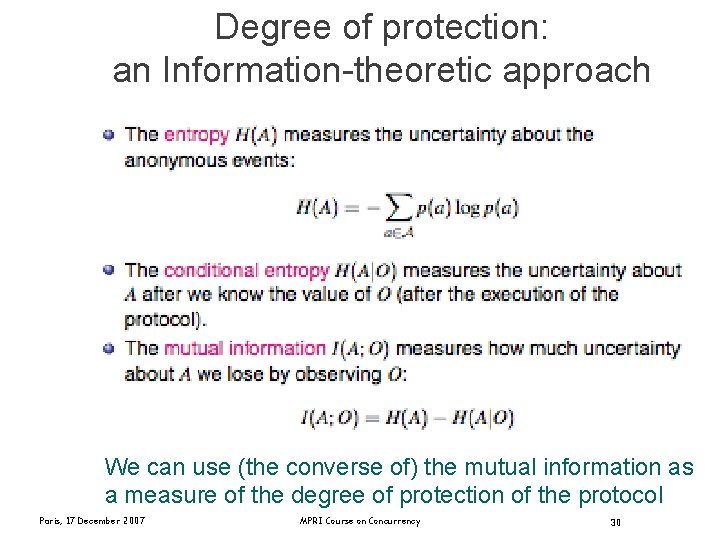
Degree of protection: an Information-theoretic approach We can use (the converse of) the mutual information as a measure of the degree of protection of the protocol Paris, 17 December 2007 MPRI Course on Concurrency 30
Open problems • Information protection is a very active field of research. There are many open problems. For instance: • • • Paris, 17 December 2007 Make model-checking more efficient for the computation of conditional probabilities Active attackers: how does the model of protocol-as-channel change? Inference of the input distribution from the observers MPRI Course on Concurrency 31
Bibliography D. Chaum. The Dining Cryptographers Problem. Journal of Cryptology, 1, 65 --75, 1988. J. Y. Halpern and K. R. O'Neill. Anonymity and information hiding in multiagent systems. Journal of Computer Security, 13(3), 483 -512, 2005 K. Chatzikokolakis, C. Palamidessi , P. Panangaden. Anonymity Protocols as Noisy Channels. Information and Computation. To appear. 2007. http: //www. lix. polytechnique. fr/~catuscia/papers/Anonymity/Channels/full. pdf Paris, 17 December 2007 MPRI Course on Concurrency 32