
MPLSTP Fault Management Draft draftboutrosmplstpfault01 txt Sami Boutros
MPLS-TP Fault Management Draft draft-boutros-mpls-tp-fault-01. txt Sami Boutros Sivabalan David Ward George Swallow Stewart Bryant
Introduction • This draft specifies a fault management mechanism for MPLS-TP LSP. • The proposed mechanism is based on a generic way of notifying a MEP or MIP of a fault on an MPLS-TP LSP using new type of MPLS OAM messages. • A new type of MPLS-OAM Fault Messages (FM) will be sent downstream and upstream from the node that detected the fault.
Introduction (cont’d) • Upon receiving an MPLS OAM FM message: – A MIP/MEP activates the backup MPLS-TP LSP (if available) rather than waiting for notification from other fault detection mechanism such as BFD. – A MEP sends MPLS-OAM Connection Verification Message (described in the MPLS-OAM Connection Verification Slides) to verify the new end-to-end path of the MPLS-TP LSP.
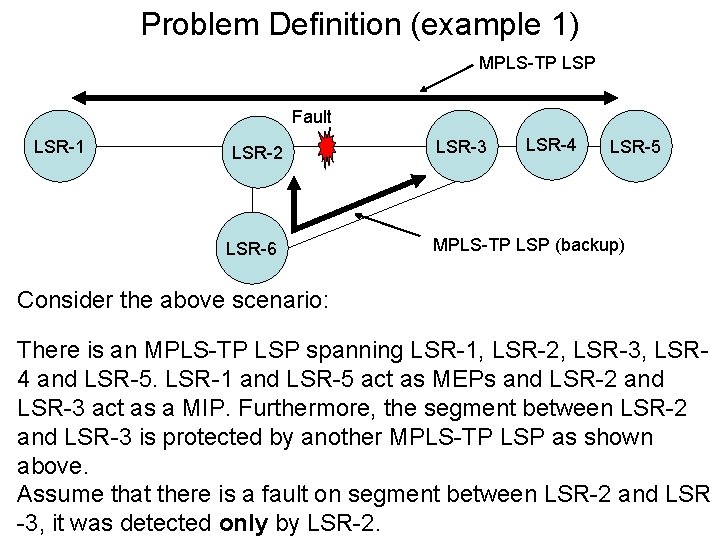
Problem Definition (example 1) MPLS-TP LSP Fault LSR-1 LSR-2 LSR-6 LSR-3 LSR-4 LSR-5 MPLS-TP LSP (backup) Consider the above scenario: There is an MPLS-TP LSP spanning LSR-1, LSR-2, LSR-3, LSR 4 and LSR-5. LSR-1 and LSR-5 act as MEPs and LSR-2 and LSR-3 act as a MIP. Furthermore, the segment between LSR-2 and LSR-3 is protected by another MPLS-TP LSP as shown above. Assume that there is a fault on segment between LSR-2 and LSR -3, it was detected only by LSR-2.
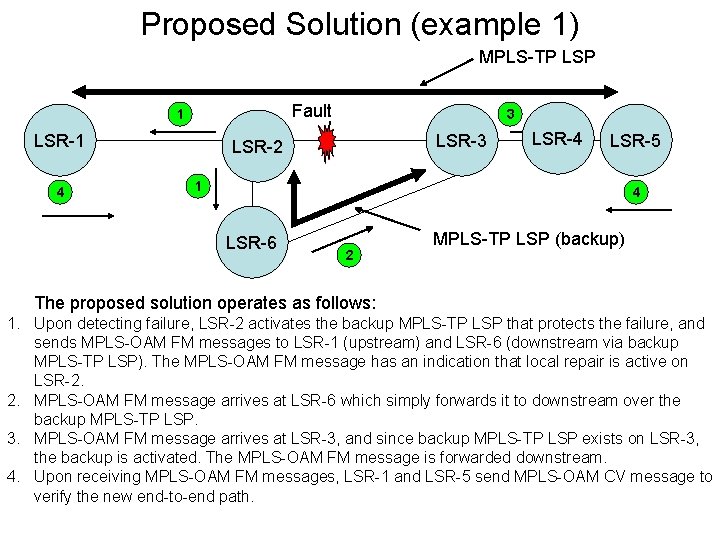
Proposed Solution (example 1) MPLS-TP LSP Fault 1 LSR-1 4 3 LSR-2 LSR-4 LSR-5 1 4 LSR-6 2 MPLS-TP LSP (backup) The proposed solution operates as follows: 1. Upon detecting failure, LSR-2 activates the backup MPLS-TP LSP that protects the failure, and sends MPLS-OAM FM messages to LSR-1 (upstream) and LSR-6 (downstream via backup MPLS-TP LSP). The MPLS-OAM FM message has an indication that local repair is active on LSR-2. 2. MPLS-OAM FM message arrives at LSR-6 which simply forwards it to downstream over the backup MPLS-TP LSP. 3. MPLS-OAM FM message arrives at LSR-3, and since backup MPLS-TP LSP exists on LSR-3, the backup is activated. The MPLS-OAM FM message is forwarded downstream. 4. Upon receiving MPLS-OAM FM messages, LSR-1 and LSR-5 send MPLS-OAM CV message to verify the new end-to-end path.
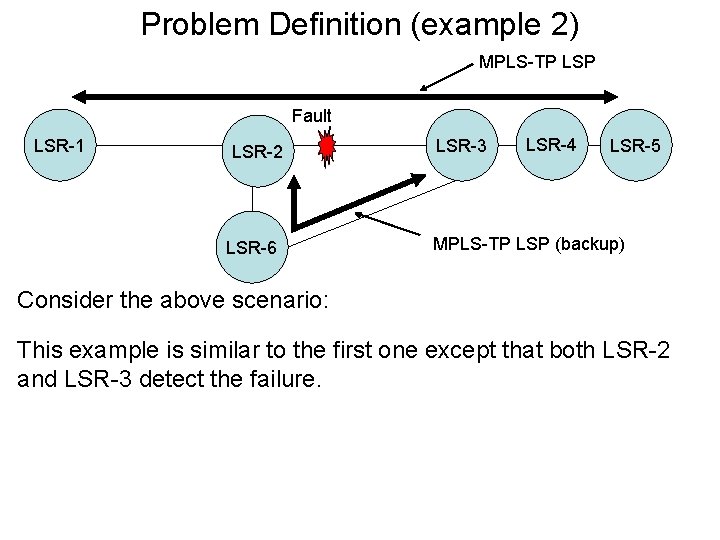
Problem Definition (example 2) MPLS-TP LSP Fault LSR-1 LSR-2 LSR-6 LSR-3 LSR-4 LSR-5 MPLS-TP LSP (backup) Consider the above scenario: This example is similar to the first one except that both LSR-2 and LSR-3 detect the failure.
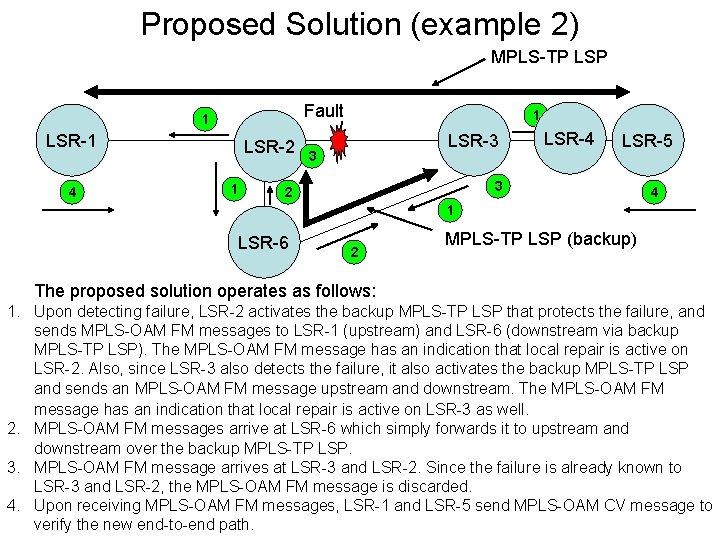
Proposed Solution (example 2) MPLS-TP LSP Fault 1 LSR-1 4 LSR-2 1 1 LSR-3 3 LSR-4 LSR-5 3 2 4 1 LSR-6 2 MPLS-TP LSP (backup) The proposed solution operates as follows: 1. Upon detecting failure, LSR-2 activates the backup MPLS-TP LSP that protects the failure, and sends MPLS-OAM FM messages to LSR-1 (upstream) and LSR-6 (downstream via backup MPLS-TP LSP). The MPLS-OAM FM message has an indication that local repair is active on LSR-2. Also, since LSR-3 also detects the failure, it also activates the backup MPLS-TP LSP and sends an MPLS-OAM FM message upstream and downstream. The MPLS-OAM FM message has an indication that local repair is active on LSR-3 as well. 2. MPLS-OAM FM messages arrive at LSR-6 which simply forwards it to upstream and downstream over the backup MPLS-TP LSP. 3. MPLS-OAM FM message arrives at LSR-3 and LSR-2. Since the failure is already known to LSR-3 and LSR-2, the MPLS-OAM FM message is discarded. 4. Upon receiving MPLS-OAM FM messages, LSR-1 and LSR-5 send MPLS-OAM CV message to verify the new end-to-end path.
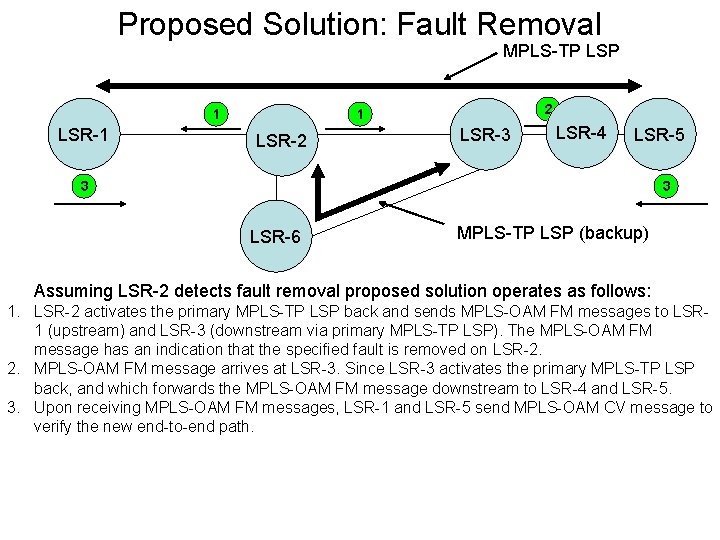
Proposed Solution: Fault Removal MPLS-TP LSP 1 LSR-1 2 1 LSR-2 LSR-3 LSR-4 LSR-5 3 3 LSR-6 MPLS-TP LSP (backup) Assuming LSR-2 detects fault removal proposed solution operates as follows: 1. LSR-2 activates the primary MPLS-TP LSP back and sends MPLS-OAM FM messages to LSR 1 (upstream) and LSR-3 (downstream via primary MPLS-TP LSP). The MPLS-OAM FM message has an indication that the specified fault is removed on LSR-2. 2. MPLS-OAM FM message arrives at LSR-3. Since LSR-3 activates the primary MPLS-TP LSP back, and which forwards the MPLS-OAM FM message downstream to LSR-4 and LSR-5. 3. Upon receiving MPLS-OAM FM messages, LSR-1 and LSR-5 send MPLS-OAM CV message to verify the new end-to-end path.
Proposed Solution: MPLS-OAM Fault Management Message This MPLS-OAM FM message shall contain: 1. Source and destination addresses of the two LSRs associated with the fault segment. 2. Connection ID of the MPLS-TP LSP. 3. Fault code (this would include link failure, node failure, low memory, high cpu, resource unavailable). A code is required for no fault to notify MIP/MEP when a given fault no longer exists. 4. An indication whether or not local repair is active.
Proposed Solution MPLS OAM Message extensions The proposed mechanism is based on a set of new TLVs which can be transported using one of the following methods: – – Using in-band MPLS OAM messages which are forwarded as MPLS packets (non-IP based). Using LSP-Ping messages where IP/UDP packets are used (IP-based) in compliance with RFC 4379.
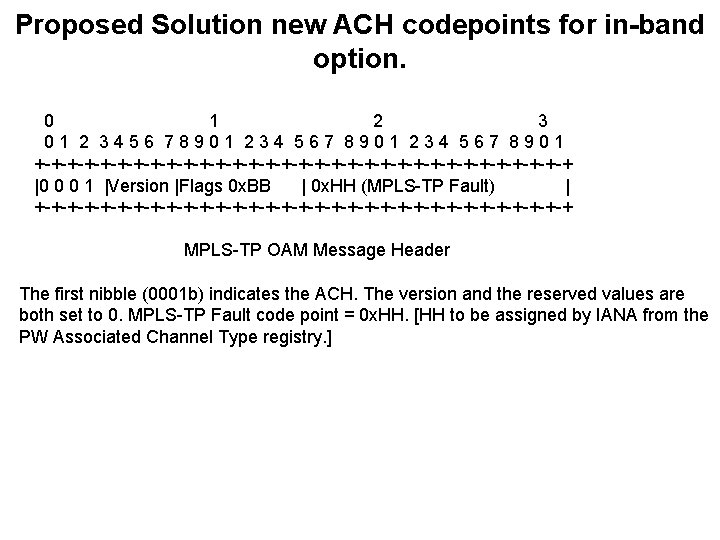
Proposed Solution new ACH codepoints for in-band option. 0 1 2 3 01 2 3456 78901 234 567 8901 +-+-+-+-+-+-+-+-+-+-+-+-+-+-+-+-+ |0 0 0 1 |Version |Flags 0 x. BB | 0 x. HH (MPLS-TP Fault) | +-+-+-+-+-+-+-+-+-+-+-+-+-+-+-+-+ MPLS-TP OAM Message Header The first nibble (0001 b) indicates the ACH. The version and the reserved values are both set to 0. MPLS-TP Fault code point = 0 x. HH. [HH to be assigned by IANA from the PW Associated Channel Type registry. ]
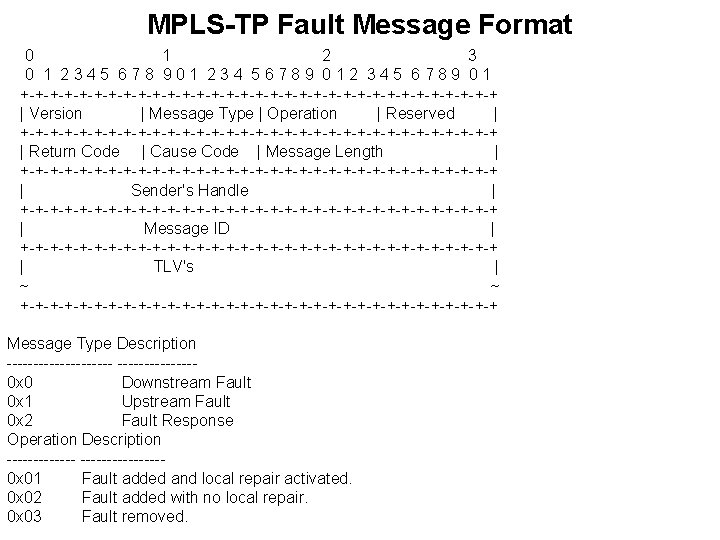
MPLS-TP Fault Message Format 0 1 2 3 0 1 2345 678 901 234 56789 012 345 6789 01 +-+-+-+-+-+-+-+-+-+-+-+-+-+-+-+-+ | Version | Message Type | Operation | Reserved | +-+-+-+-+-+-+-+-+-+-+-+-+-+-+-+-+ | Return Code | Cause Code | Message Length | +-+-+-+-+-+-+-+-+-+-+-+-+-+-+-+-+ | Sender's Handle | +-+-+-+-+-+-+-+-+-+-+-+-+-+-+-+-+ | Message ID | +-+-+-+-+-+-+-+-+-+-+-+-+-+-+-+-+ | TLV's | ~ ~ +-+-+-+-+-+-+-+-+-+-+-+-+-+-+-+-+ Message Type Description ----------0 x 0 Downstream Fault 0 x 1 Upstream Fault 0 x 2 Fault Response Operation Description ---------------0 x 01 Fault added and local repair activated. 0 x 02 Fault added with no local repair. 0 x 03 Fault removed.
- Slides: 12