
MPLS VPN Technology Introducing the MPLS VPN Routing
- Slides: 18
MPLS VPN Technology Introducing the MPLS VPN Routing Model © 2006 Cisco Systems, Inc. All rights reserved. MPLS v 2. 2— 4 -1
Outline • Overview • MPLS VPN Routing Requirements • What Is the MPLS VPN Routing Model? • Existing Internet Routing Support • Routing Tables on PE Routers • Identifying End-to-End Routing Update Flow • Route Distribution to CE Routers • Summary © 2006 Cisco Systems, Inc. All rights reserved. MPLS v 2. 2— 4 -2
MPLS VPN Routing Requirements • CE routers have to run standard IP routing software. • PE routers have to support MPLS VPN services and IP routing. • P routers have no VPN routes. © 2006 Cisco Systems, Inc. All rights reserved. MPLS v 2. 2— 4 -3
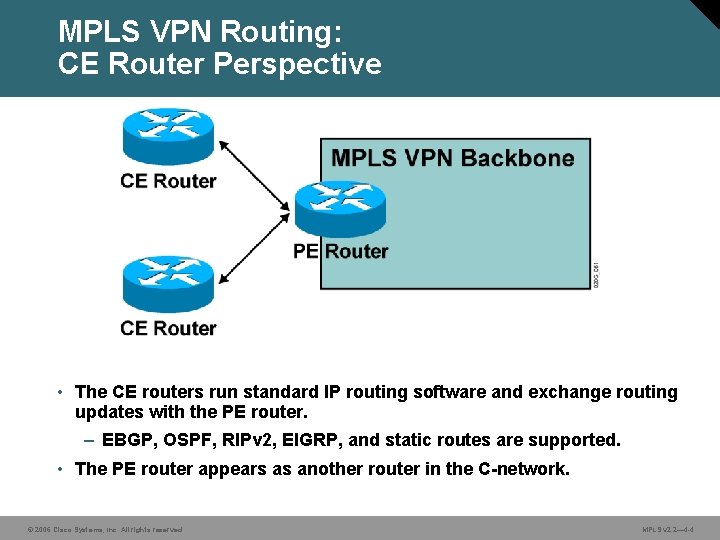
MPLS VPN Routing: CE Router Perspective • The CE routers run standard IP routing software and exchange routing updates with the PE router. – EBGP, OSPF, RIPv 2, EIGRP, and static routes are supported. • The PE router appears as another router in the C-network. © 2006 Cisco Systems, Inc. All rights reserved. MPLS v 2. 2— 4 -4
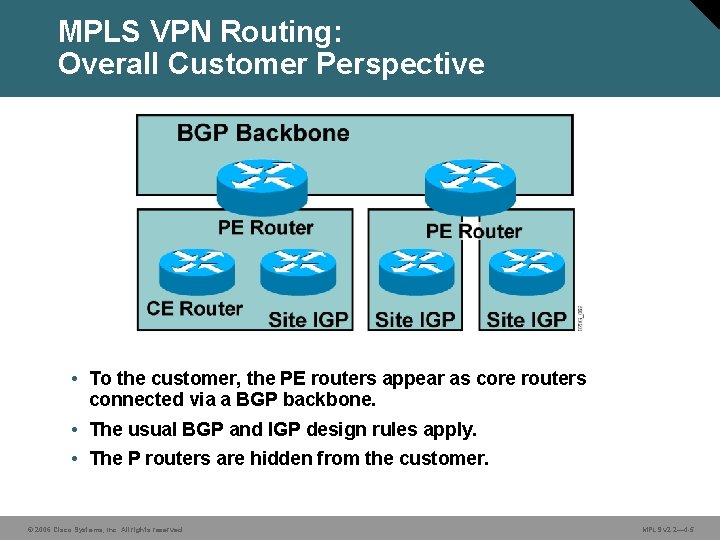
MPLS VPN Routing: Overall Customer Perspective • To the customer, the PE routers appear as core routers connected via a BGP backbone. • The usual BGP and IGP design rules apply. • The P routers are hidden from the customer. © 2006 Cisco Systems, Inc. All rights reserved. MPLS v 2. 2— 4 -5
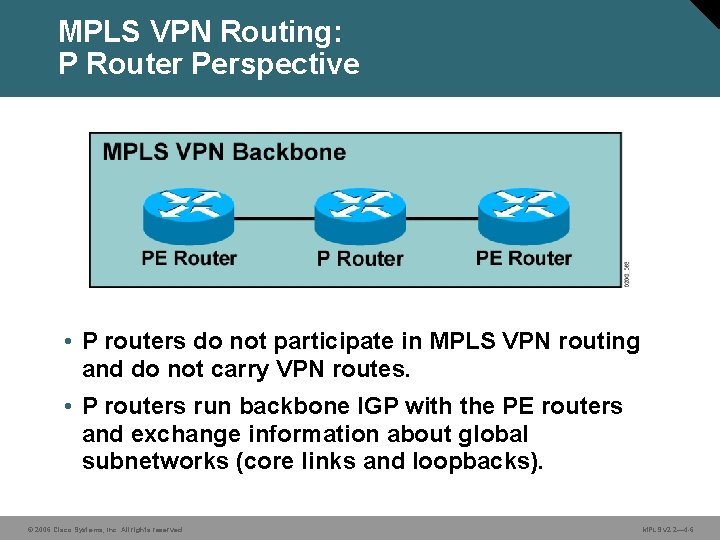
MPLS VPN Routing: P Router Perspective • P routers do not participate in MPLS VPN routing and do not carry VPN routes. • P routers run backbone IGP with the PE routers and exchange information about global subnetworks (core links and loopbacks). © 2006 Cisco Systems, Inc. All rights reserved. MPLS v 2. 2— 4 -6
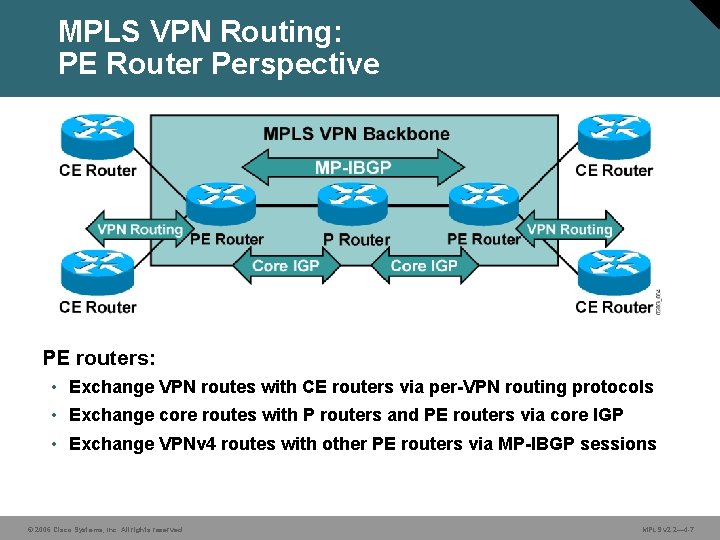
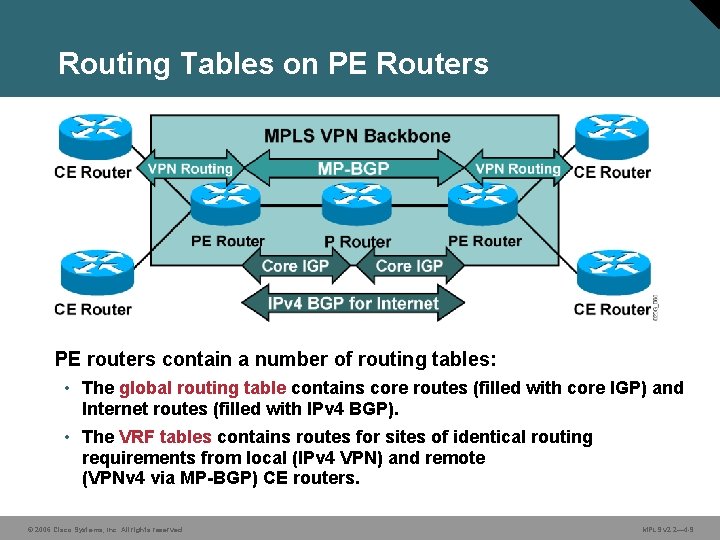
MPLS VPN Routing: PE Router Perspective PE routers: • Exchange VPN routes with CE routers via per-VPN routing protocols • Exchange core routes with P routers and PE routers via core IGP • Exchange VPNv 4 routes with other PE routers via MP-IBGP sessions © 2006 Cisco Systems, Inc. All rights reserved. MPLS v 2. 2— 4 -7
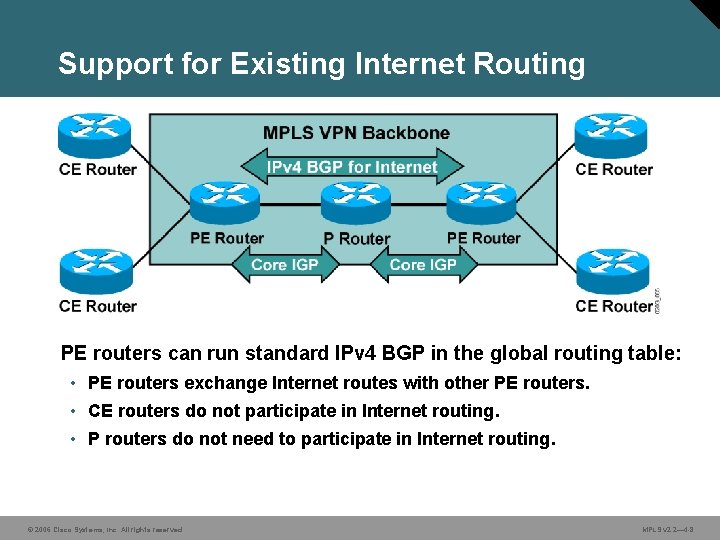
Support for Existing Internet Routing PE routers can run standard IPv 4 BGP in the global routing table: • PE routers exchange Internet routes with other PE routers. • CE routers do not participate in Internet routing. • P routers do not need to participate in Internet routing. © 2006 Cisco Systems, Inc. All rights reserved. MPLS v 2. 2— 4 -8
Routing Tables on PE Routers PE routers contain a number of routing tables: • The global routing table contains core routes (filled with core IGP) and Internet routes (filled with IPv 4 BGP). • The VRF tables contains routes for sites of identical routing requirements from local (IPv 4 VPN) and remote (VPNv 4 via MP-BGP) CE routers. © 2006 Cisco Systems, Inc. All rights reserved. MPLS v 2. 2— 4 -9
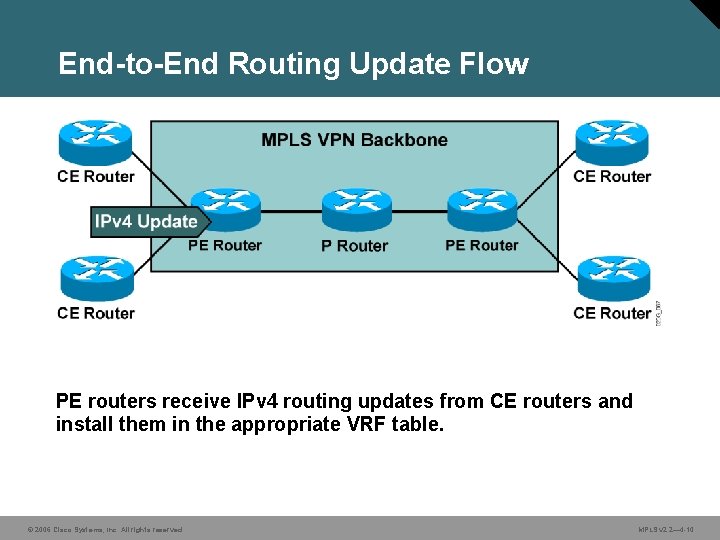
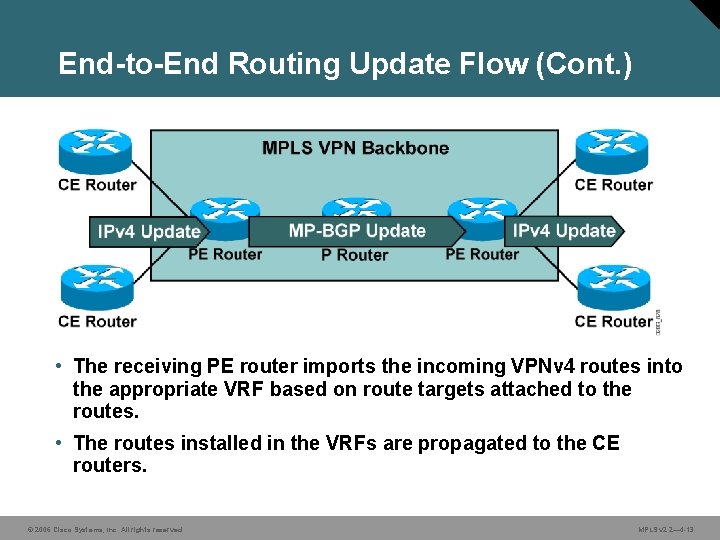
End-to-End Routing Update Flow PE routers receive IPv 4 routing updates from CE routers and install them in the appropriate VRF table. © 2006 Cisco Systems, Inc. All rights reserved. MPLS v 2. 2— 4 -10
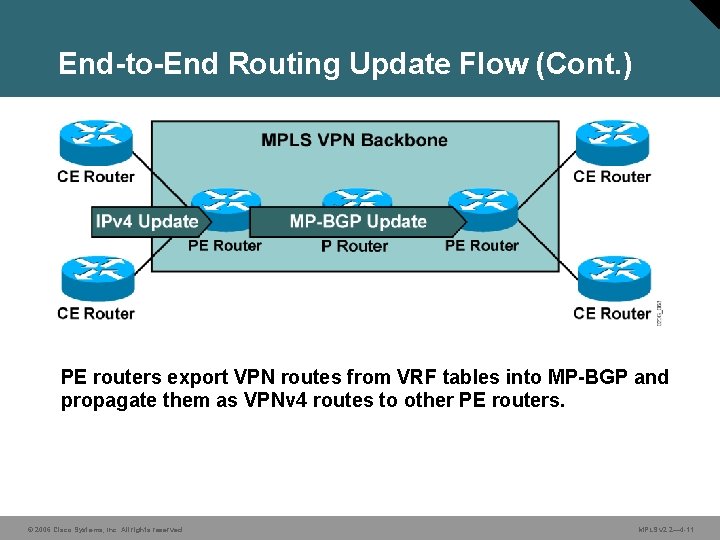
End-to-End Routing Update Flow (Cont. ) PE routers export VPN routes from VRF tables into MP-BGP and propagate them as VPNv 4 routes to other PE routers. © 2006 Cisco Systems, Inc. All rights reserved. MPLS v 2. 2— 4 -11
End-to-End Routing Update Flow: MP-BGP Update An MP-BGP update contains these elements: • VPNv 4 address • Extended communities (route targets, optionally SOO) • Label used for VPN packet forwarding • Any other BGP attribute (for example, AS path, local preference, MED, standard community) © 2006 Cisco Systems, Inc. All rights reserved. MPLS v 2. 2— 4 -12
End-to-End Routing Update Flow (Cont. ) • The receiving PE router imports the incoming VPNv 4 routes into the appropriate VRF based on route targets attached to the routes. • The routes installed in the VRFs are propagated to the CE routers. © 2006 Cisco Systems, Inc. All rights reserved. MPLS v 2. 2— 4 -13
Route Distribution to CE Routers • A route is installed in the site VRF if it matches the import route target attribute. • Route distribution to CE sites is driven by the following: – Route targets – SOO attribute if defined © 2006 Cisco Systems, Inc. All rights reserved. MPLS v 2. 2— 4 -14
What Is Multi-VRF CE (VRF-Lite)? • Multi-VRF CE (VRF-lite) is an application based on VRF implementation. – VRF-lite supports multiple overlapping and independent VRFs on the CE router. • The CE router separates traffic between client networks using VRFs. • There is no MPLS functionality on the CE router. – No label exchange between the CE and PE router. – No labeled packet flow between the CE and PE router. • Any routing protocol supported by normal VRF can be used in a Multi-VRF CE implementation. © 2006 Cisco Systems, Inc. All rights reserved. MPLS v 2. 2— 4 -15
Summary • In MPLS VPNs: – CE routers run standard protocols (static, RIPv 2, OSPF, EIGRP, EBGP) to the PE routers. – PE routers provide the VPN routing and services via MP-BGP. – P routers do not participate in VPN routing, and only provide core IGP backbone routing to the PE routers. • The PE router functions are extended to carry regular Internet routing via IPv 4 BGP in addition to the MP-BGP. © 2006 Cisco Systems, Inc. All rights reserved. MPLS v 2. 2— 4 -16
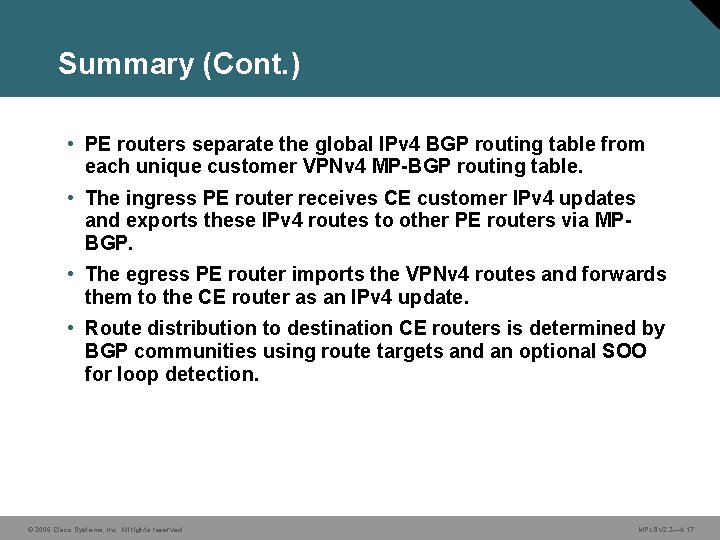
Summary (Cont. ) • PE routers separate the global IPv 4 BGP routing table from each unique customer VPNv 4 MP-BGP routing table. • The ingress PE router receives CE customer IPv 4 updates and exports these IPv 4 routes to other PE routers via MPBGP. • The egress PE router imports the VPNv 4 routes and forwards them to the CE router as an IPv 4 update. • Route distribution to destination CE routers is determined by BGP communities using route targets and an optional SOO for loop detection. © 2006 Cisco Systems, Inc. All rights reserved. MPLS v 2. 2— 4 -17
© 2006 Cisco Systems, Inc. All rights reserved. MPLS v 2. 2— 4 -18