
MPLS Architecture Overview Jay Kumarasamy jaykcisco com Adopted



- Slides: 42
MPLS Architecture Overview Jay Kumarasamy jayk@cisco. com Adopted from Stefano Previdi’s presentation © 2001, Cisco Systems. 1
Agenda • MPLS Concepts • LSRs and labels • Label assignment and distribution • Label Switch Paths • ATM LSRs • Loops and TTL • LDP overview • Day in the Life of a Packet 2001 Cisco Systems, Inc. www. cisco. com 2
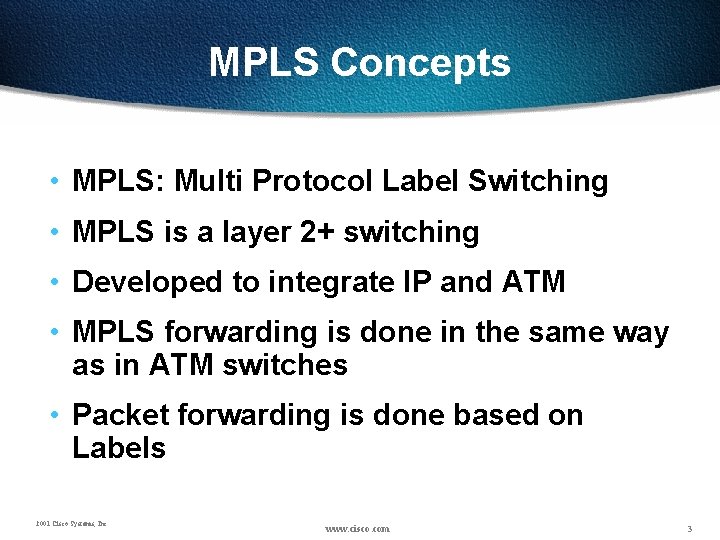
MPLS Concepts • MPLS: Multi Protocol Label Switching • MPLS is a layer 2+ switching • Developed to integrate IP and ATM • MPLS forwarding is done in the same way as in ATM switches • Packet forwarding is done based on Labels 2001 Cisco Systems, Inc. www. cisco. com 3
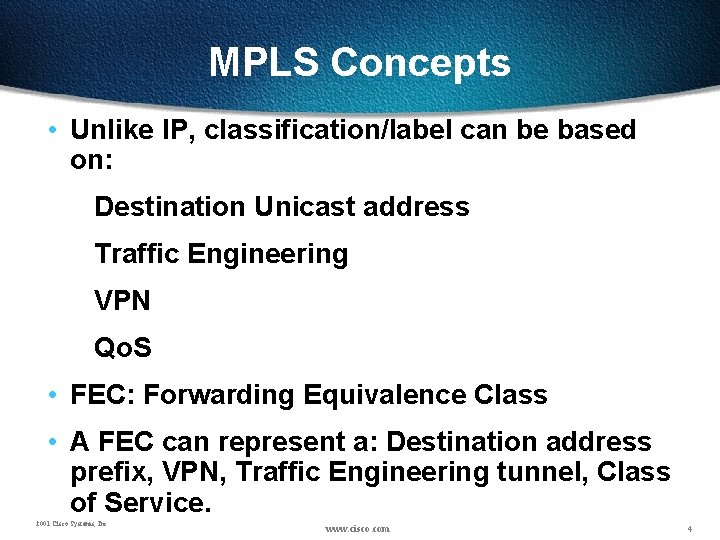
MPLS Concepts • Unlike IP, classification/label can be based on: Destination Unicast address Traffic Engineering VPN Qo. S • FEC: Forwarding Equivalence Class • A FEC can represent a: Destination address prefix, VPN, Traffic Engineering tunnel, Class of Service. 2001 Cisco Systems, Inc. www. cisco. com 4
Agenda • MPLS Concepts • LSRs and labels • Label assignment and distribution • Label Switch Paths • ATM LSRs • Loops and TTL • LDP overview • Summary 2001 Cisco Systems, Inc. www. cisco. com 5
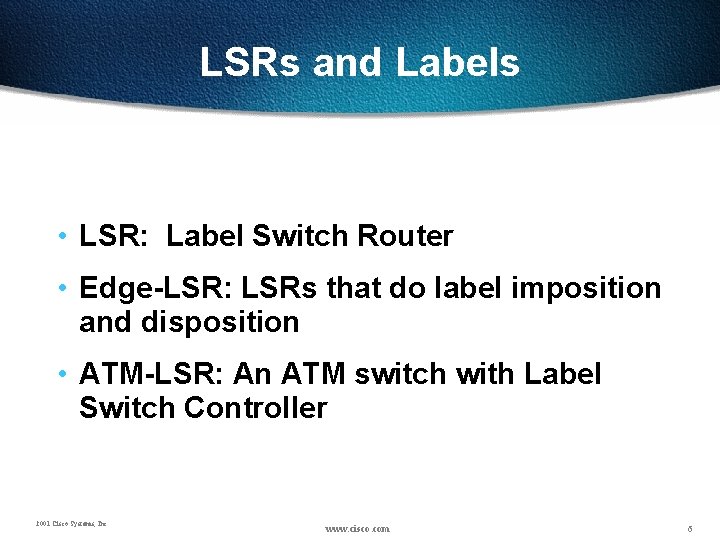
LSRs and Labels • LSR: Label Switch Router • Edge-LSR: LSRs that do label imposition and disposition • ATM-LSR: An ATM switch with Label Switch Controller 2001 Cisco Systems, Inc. www. cisco. com 6
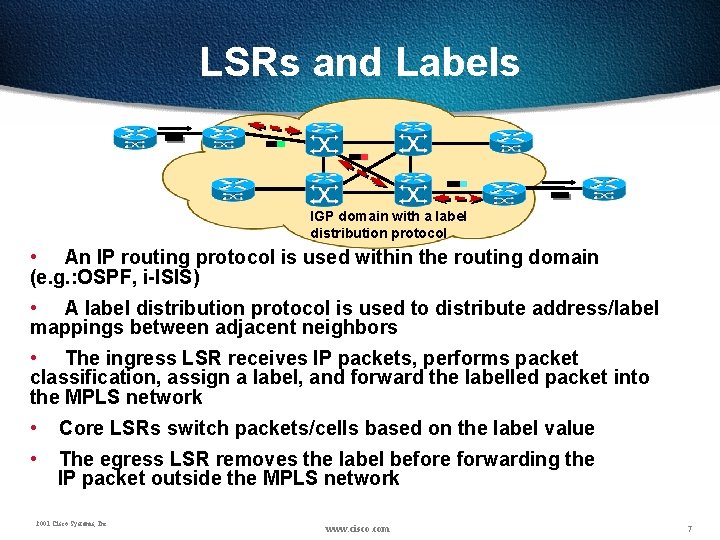
LSRs and Labels IGP domain with a label distribution protocol • An IP routing protocol is used within the routing domain (e. g. : OSPF, i-ISIS) • A label distribution protocol is used to distribute address/label mappings between adjacent neighbors • The ingress LSR receives IP packets, performs packet classification, assign a label, and forward the labelled packet into the MPLS network • Core LSRs switch packets/cells based on the label value • The egress LSR removes the label before forwarding the IP packet outside the MPLS network 2001 Cisco Systems, Inc. www. cisco. com 7
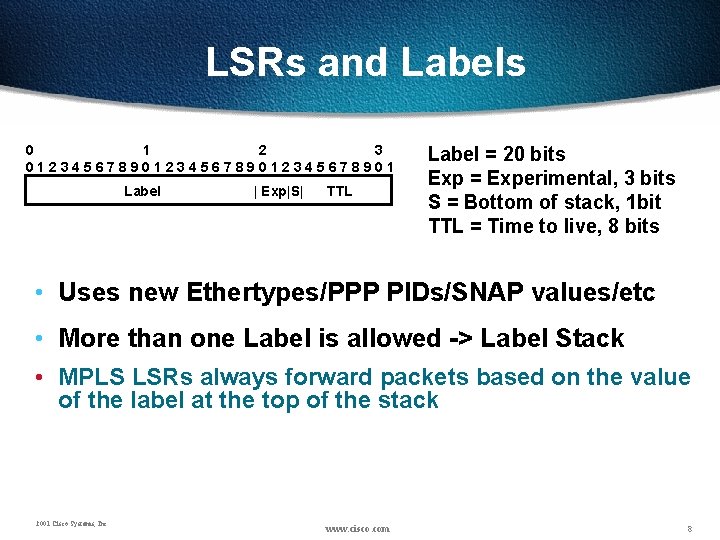
LSRs and Labels 0 1 2 3 0123456789012345678901 Label | Exp|S| TTL Label = 20 bits Exp = Experimental, 3 bits S = Bottom of stack, 1 bit TTL = Time to live, 8 bits • Uses new Ethertypes/PPP PIDs/SNAP values/etc • More than one Label is allowed -> Label Stack • MPLS LSRs always forward packets based on the value of the label at the top of the stack 2001 Cisco Systems, Inc. www. cisco. com 8
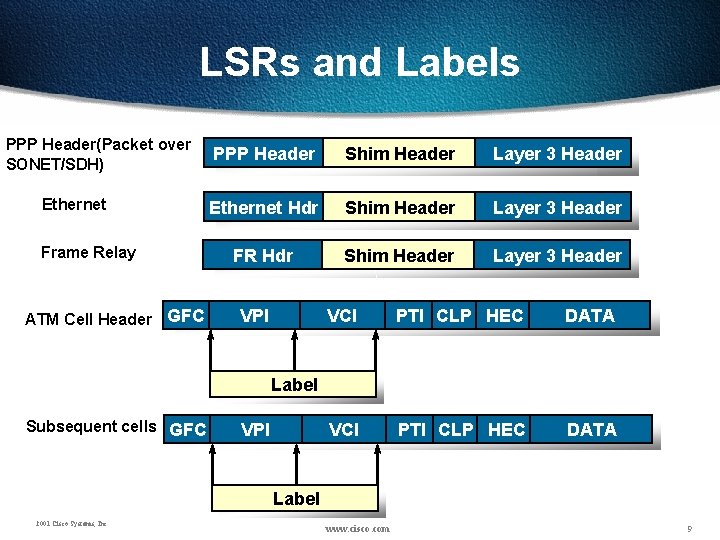
LSRs and Labels PPP Header(Packet over SONET/SDH) Ethernet Frame Relay ATM Cell Header GFC PPP Header Shim Header Layer 3 Header Ethernet Hdr Shim Header Layer 3 Header FR Hdr Shim Header Layer 3 Header VPI VCI PTI CLP HEC DATA Label Subsequent cells GFC VPI Label 2001 Cisco Systems, Inc. www. cisco. com 9
Agenda 2001 Cisco Systems, Inc. • MPLS Concepts • LSRs and labels • Label assignment and distribution • Label Switch Paths • ATM LSRs • Loops and TTL • LDP overview • Day in the Life of a Packet www. cisco. com 10
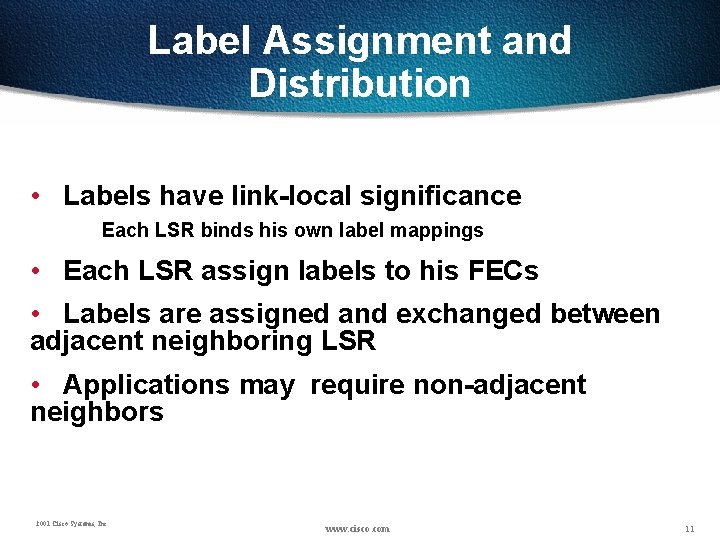
Label Assignment and Distribution • Labels have link-local significance Each LSR binds his own label mappings • Each LSR assign labels to his FECs • Labels are assigned and exchanged between adjacent neighboring LSR • Applications may require non-adjacent neighbors 2001 Cisco Systems, Inc. www. cisco. com 11
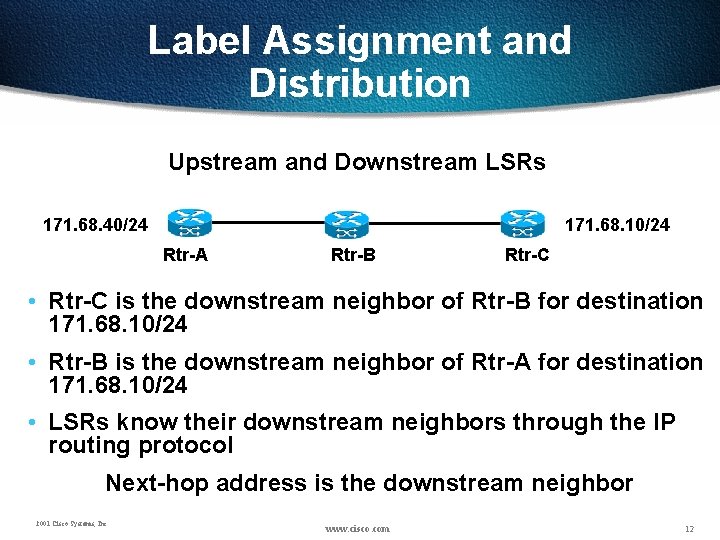
Label Assignment and Distribution Upstream and Downstream LSRs 171. 68. 40/24 171. 68. 10/24 Rtr-A Rtr-B Rtr-C • Rtr-C is the downstream neighbor of Rtr-B for destination 171. 68. 10/24 • Rtr-B is the downstream neighbor of Rtr-A for destination 171. 68. 10/24 • LSRs know their downstream neighbors through the IP routing protocol Next-hop address is the downstream neighbor 2001 Cisco Systems, Inc. www. cisco. com 12
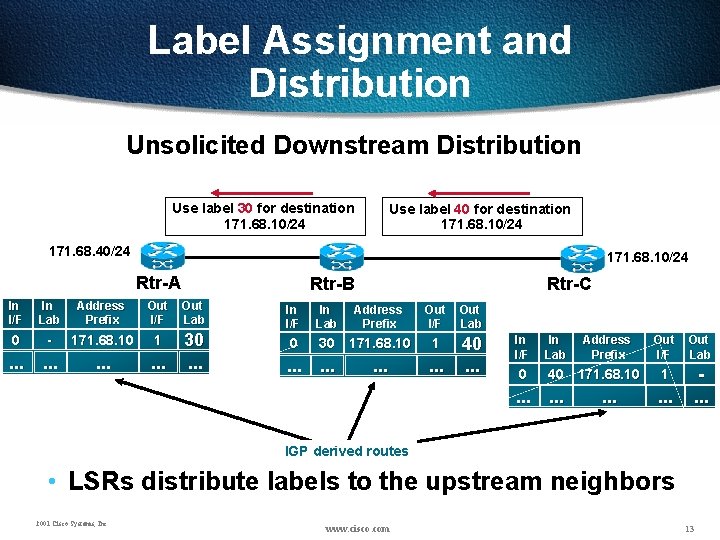
Label Assignment and Distribution Unsolicited Downstream Distribution Use label 30 for destination 171. 68. 10/24 Use label 40 for destination 171. 68. 10/24 171. 68. 40/24 171. 68. 10/24 Rtr-A In I/F In Lab Address Prefix 0 - 171. 68. 10 . . . Out I/F Rtr-B Out Lab 30 Next-Hop. . 1 Rtr-C In I/F In Lab 0 30 171. 68. 10 . . . Address Prefix Out I/F Out Lab 40 Next-Hop. . 1 In I/F In Lab 0 40 171. 68. 10 . . . Address Prefix Out I/F Out Lab 1 . . . Next-Hop. . . IGP derived routes • LSRs distribute labels to the upstream neighbors 2001 Cisco Systems, Inc. www. cisco. com 13
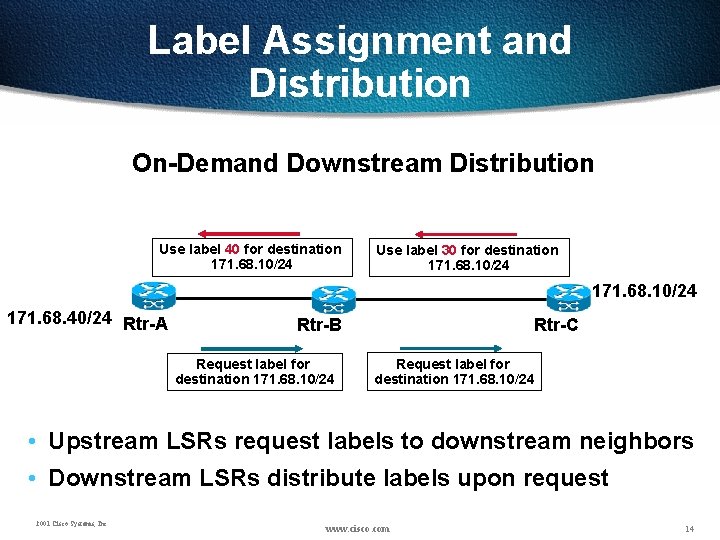
Label Assignment and Distribution On-Demand Downstream Distribution Use label 40 for destination 171. 68. 10/24 Use label 30 for destination 171. 68. 10/24 171. 68. 40/24 Rtr-A Rtr-B Request label for destination 171. 68. 10/24 Rtr-C Request label for destination 171. 68. 10/24 • Upstream LSRs request labels to downstream neighbors • Downstream LSRs distribute labels upon request 2001 Cisco Systems, Inc. www. cisco. com 14
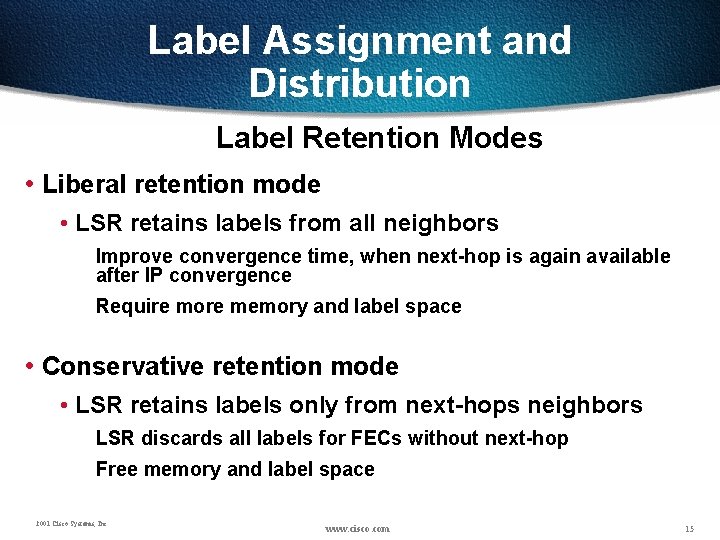
Label Assignment and Distribution Label Retention Modes • Liberal retention mode • LSR retains labels from all neighbors Improve convergence time, when next-hop is again available after IP convergence Require more memory and label space • Conservative retention mode • LSR retains labels only from next-hops neighbors LSR discards all labels for FECs without next-hop Free memory and label space 2001 Cisco Systems, Inc. www. cisco. com 15
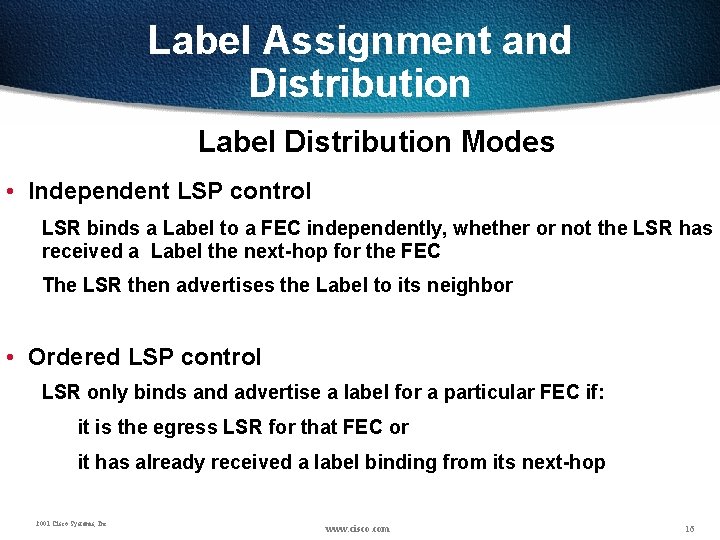
Label Assignment and Distribution Label Distribution Modes • Independent LSP control LSR binds a Label to a FEC independently, whether or not the LSR has received a Label the next-hop for the FEC The LSR then advertises the Label to its neighbor • Ordered LSP control LSR only binds and advertise a label for a particular FEC if: it is the egress LSR for that FEC or it has already received a label binding from its next-hop 2001 Cisco Systems, Inc. www. cisco. com 16
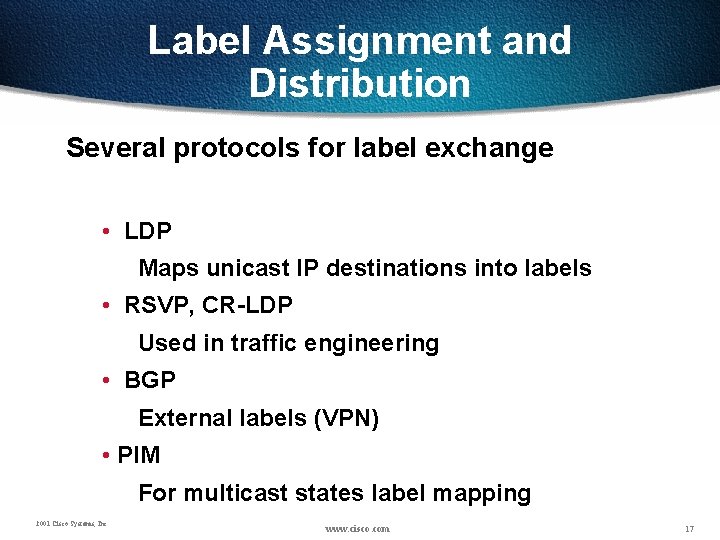
Label Assignment and Distribution Several protocols for label exchange • LDP Maps unicast IP destinations into labels • RSVP, CR-LDP Used in traffic engineering • BGP External labels (VPN) • PIM For multicast states label mapping 2001 Cisco Systems, Inc. www. cisco. com 17
Agenda 2001 Cisco Systems, Inc. • MPLS Concepts • LSRs and labels • Label assignment and distribution • Label Switch Paths • ATM LSRs • Loops and TTL • LDP overview • Day in the Life of a Packet www. cisco. com 18
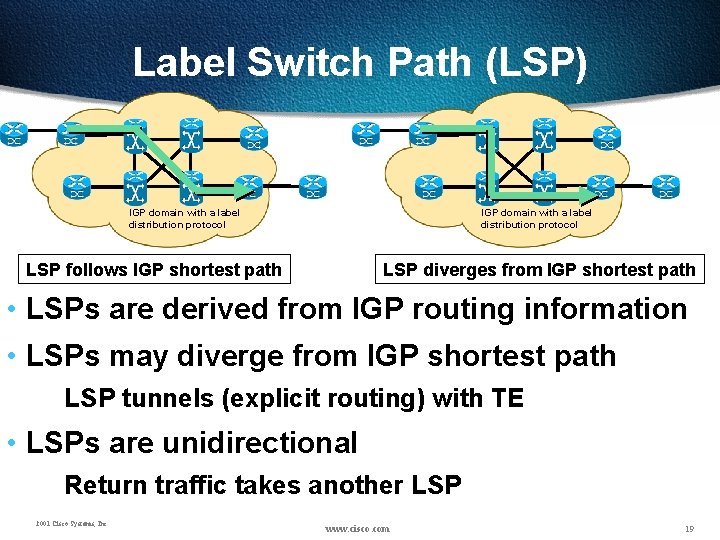
Label Switch Path (LSP) IGP domain with a label distribution protocol LSP follows IGP shortest path LSP diverges from IGP shortest path • LSPs are derived from IGP routing information • LSPs may diverge from IGP shortest path LSP tunnels (explicit routing) with TE • LSPs are unidirectional Return traffic takes another LSP 2001 Cisco Systems, Inc. www. cisco. com 19
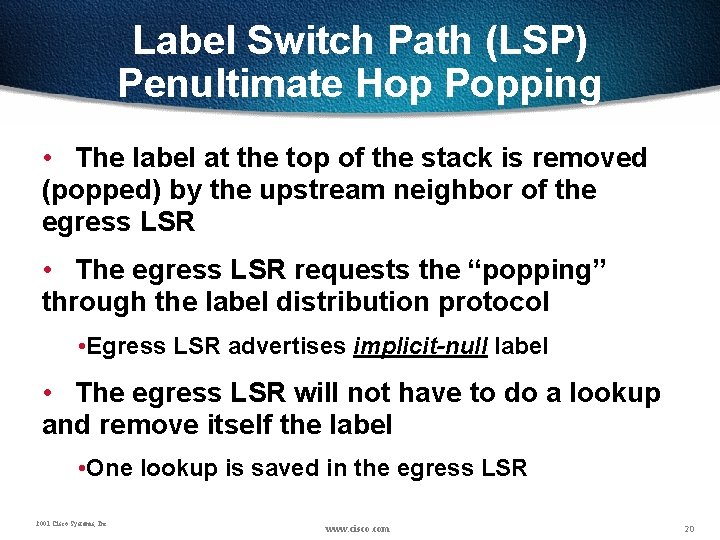
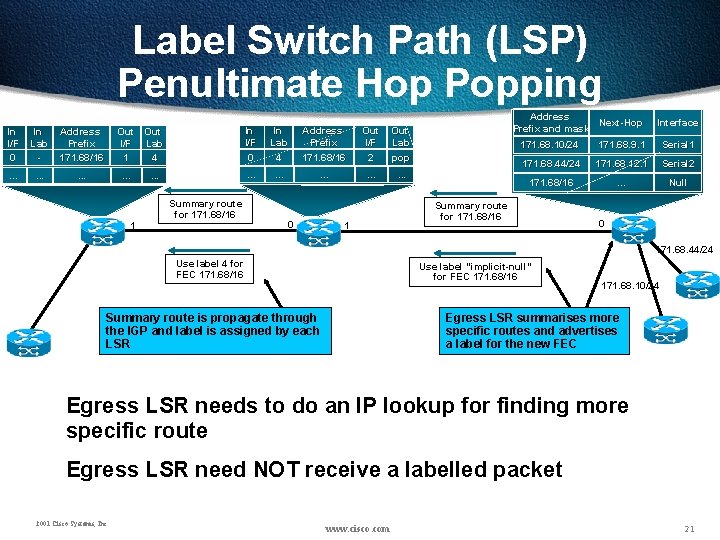
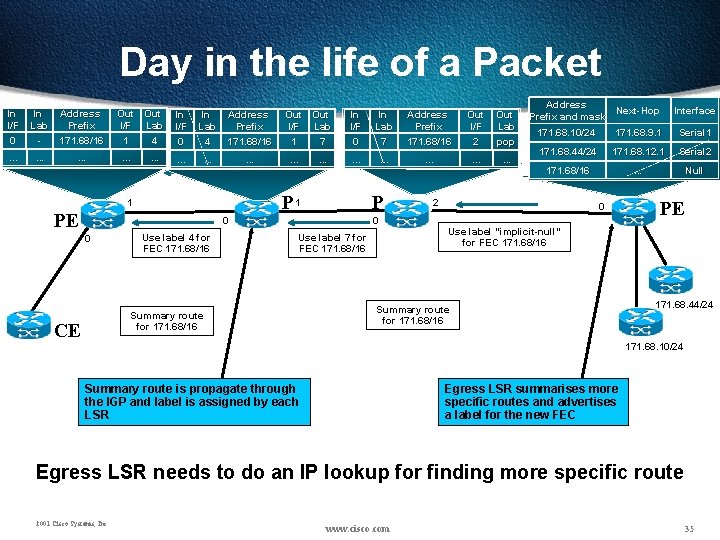
Label Switch Path (LSP) Penultimate Hop Popping • The label at the top of the stack is removed (popped) by the upstream neighbor of the egress LSR • The egress LSR requests the “popping” through the label distribution protocol • Egress LSR advertises implicit-null label • The egress LSR will not have to do a lookup and remove itself the label • One lookup is saved in the egress LSR 2001 Cisco Systems, Inc. www. cisco. com 20
Label Switch Path (LSP) Penultimate Hop Popping In I/F 0 In Lab - . . . Address Prefix 171. 68/16 Out I/F Lab 1 4 Next-Hop. . Summary route for 171. 68/16 1 In I/F 0 In Lab 4 . . . Address Prefix 171. 68/16 Out I/F 2 Next-Hop. . . 0 1 Address Next-Hop Prefix and mask Out Lab pop. . . Interface 171. 68. 10/24 171. 68. 9. 1 Serial 1 171. 68. 44/24 171. 68. 12. 1 Serial 2 171. 68/16 . . . Null Summary route for 171. 68/16 0 171. 68. 44/24 Use label 4 for FEC 171. 68/16 Use label “implicit-null” for FEC 171. 68/16 171. 68. 10/24 Egress LSR summarises more specific routes and advertises a label for the new FEC Summary route is propagate through the IGP and label is assigned by each LSR Egress LSR needs to do an IP lookup for finding more specific route Egress LSR need NOT receive a labelled packet 2001 Cisco Systems, Inc. www. cisco. com 21
Agenda 2001 Cisco Systems, Inc. • MPLS Concepts • LSRs and labels • Label assignment and distribution • Label Switch Paths • ATM LSRs • Loops and TTL • LDP overview • Summary www. cisco. com 22
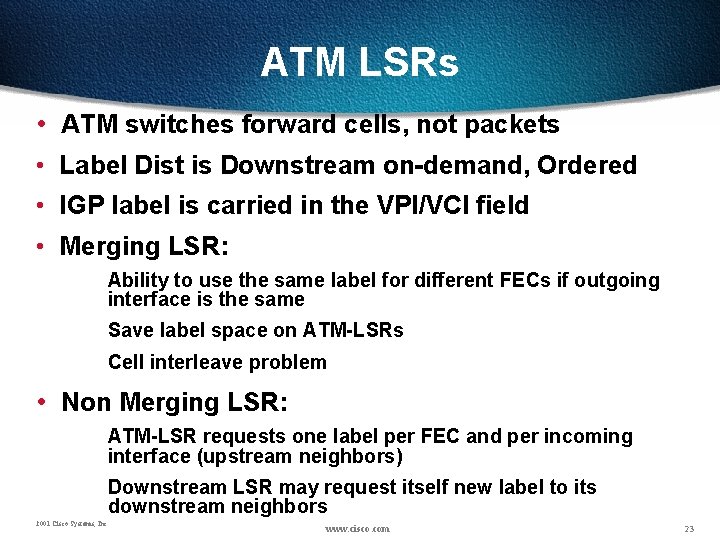
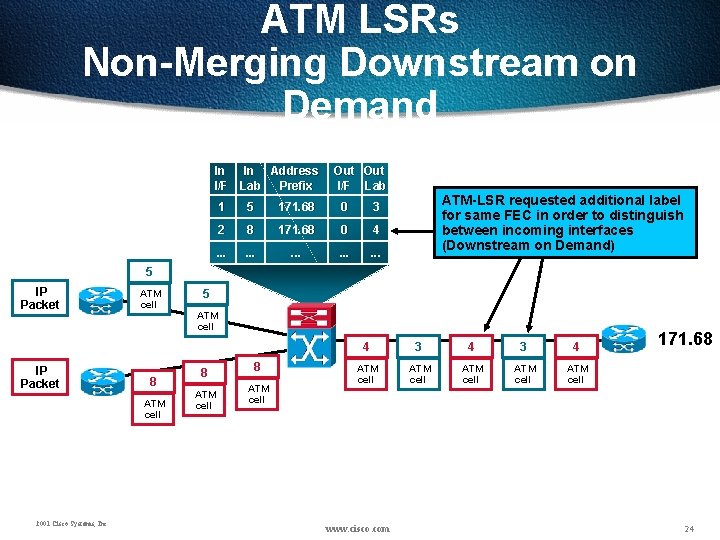
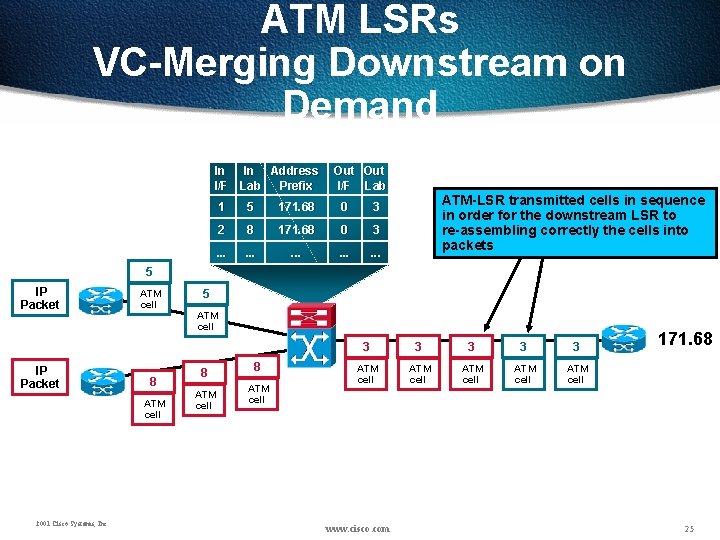
ATM LSRs • ATM switches forward cells, not packets • Label Dist is Downstream on-demand, Ordered • IGP label is carried in the VPI/VCI field • Merging LSR: Ability to use the same label for different FECs if outgoing interface is the same Save label space on ATM-LSRs Cell interleave problem • Non Merging LSR: ATM-LSR requests one label per FEC and per incoming interface (upstream neighbors) Downstream LSR may request itself new label to its downstream neighbors 2001 Cisco Systems, Inc. www. cisco. com 23
ATM LSRs Non-Merging Downstream on Demand In In Address I/F Lab Prefix Out I/F Lab 1 5 171. 68 0 3 2 8 171. 68 0 4 . . . . ATM-LSR requested additional label for same FEC in order to distinguish between incoming interfaces (Downstream on Demand) 5 IP Packet ATM cell 8 ATM cell 2001 Cisco Systems, Inc. 5 8 ATM cell 4 3 4 ATM cell ATM cell www. cisco. com 171. 68 24
ATM LSRs VC-Merging Downstream on Demand In In Address I/F Lab Prefix Out I/F Lab 1 5 171. 68 0 3 2 8 171. 68 0 3 . . . . ATM-LSR transmitted cells in sequence in order for the downstream LSR to re-assembling correctly the cells into packets 5 IP Packet ATM cell 8 ATM cell 2001 Cisco Systems, Inc. 5 8 ATM cell 3 3 3 ATM cell ATM cell www. cisco. com 171. 68 25
Agenda 2001 Cisco Systems, Inc. • MPLS Concepts • LSRs and labels • Label assignment and distribution • Label Switch Paths • ATM LSRs • Loops and TTL • LDP overview • Summary www. cisco. com 26
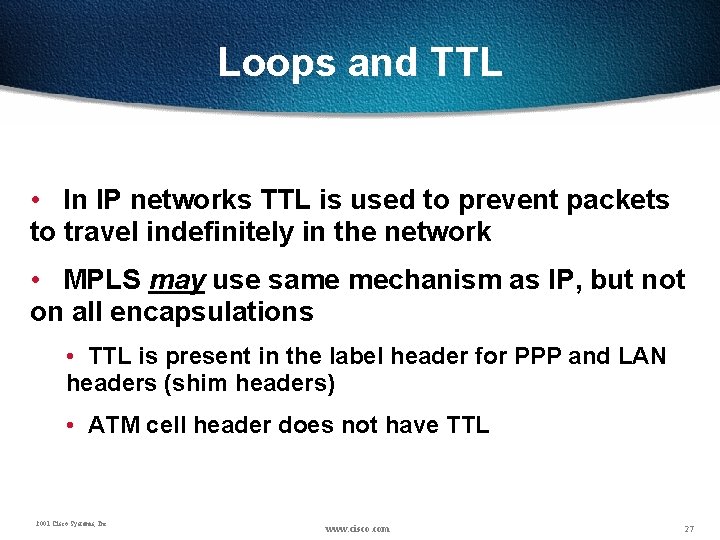
Loops and TTL • In IP networks TTL is used to prevent packets to travel indefinitely in the network • MPLS may use same mechanism as IP, but not on all encapsulations • TTL is present in the label header for PPP and LAN headers (shim headers) • ATM cell header does not have TTL 2001 Cisco Systems, Inc. www. cisco. com 27
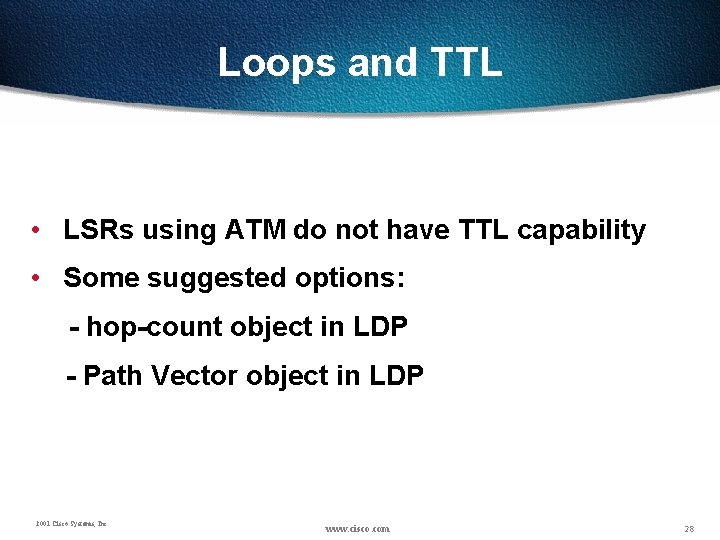
Loops and TTL • LSRs using ATM do not have TTL capability • Some suggested options: - hop-count object in LDP - Path Vector object in LDP 2001 Cisco Systems, Inc. www. cisco. com 28
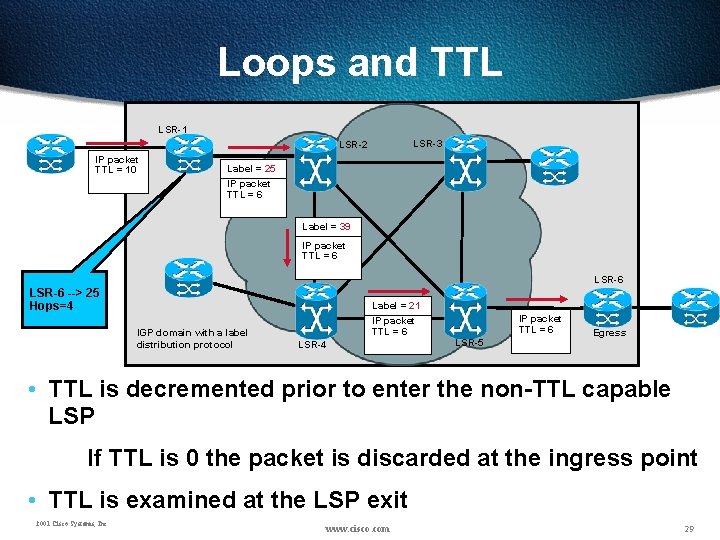
Loops and TTL LSR-1 LSR-3 LSR-2 IP packet TTL = 10 Label = 25 IP packet TTL = 6 Label = 39 IP packet TTL = 6 LSR-6 --> 25 Hops=4 IGP domain with a label distribution protocol Label = 21 IP packet TTL = 6 LSR-4 IP packet TTL = 6 LSR-5 Egress • TTL is decremented prior to enter the non-TTL capable LSP If TTL is 0 the packet is discarded at the ingress point • TTL is examined at the LSP exit 2001 Cisco Systems, Inc. www. cisco. com 29
Agenda 2001 Cisco Systems, Inc. • MPLS Concepts • LSRs and labels • Label assignment and distribution • Label Switch Paths • ATM LSRs • Loops and TTL • LDP overview • Day in the Life of a Packet www. cisco. com 30
LDP Concepts • Label Distribution Protocol • Labels map to FECs for Unicast Destination Prefix • LDP works between adjacent/non-adjacent peers • LDP sessions are established between peers 2001 Cisco Systems, Inc. www. cisco. com 31
LDP Messages • Discovery messages • Used to discover and maintain the presence of new peers • Hello packets (UDP) sent to all-routers multicast address • Once neighbor is discovered, the LDP session is established over TCP 2001 Cisco Systems, Inc. www. cisco. com 32
LDP Messages • Session messages • Establish, maintain and terminate LDP sessions • Advertisement messages • Create, modify, delete label mappings • Notification messages • Error signalling 2001 Cisco Systems, Inc. www. cisco. com 33
Agenda • MPLS Concepts • LSRs and labels • Label assignment and distribution • Label Switch Paths • ATM LSRs • Loops and TTL • LDP overview • Day in the Life of a Packet 2001 Cisco Systems, Inc. www. cisco. com 34
Day in the life of a Packet In I/F 0 In Lab - . . . Address Prefix 171. 68/16 Out I/F Lab 1 4 Next-Hop. . In I/F 0 In Lab 4 . . . Address Prefix 171. 68/16 Out I/F Lab 1 7 Next-Hop. . In I/F 0 In Lab 7 . . . P 1 1 PE P 0 0 Use label 4 for FEC 171. 68/16 Out I/F 2 Next-Hop. . . Out Lab pop. . . Address Next-Hop Prefix and mask Interface 171. 68. 10/24 171. 68. 9. 1 Serial 1 171. 68. 44/24 171. 68. 12. 1 Serial 2 171. 68/16 . . . Null 2 0 0 PE Use label “implicit-null” for FEC 171. 68/16 Use label 7 for FEC 171. 68/16 Summary route for 171. 68/16 CE Address Prefix 171. 68/16 Summary route for 171. 68/16 171. 68. 44/24 171. 68. 10/24 Summary route is propagate through the IGP and label is assigned by each LSR Egress LSR summarises more specific routes and advertises a label for the new FEC Egress LSR needs to do an IP lookup for finding more specific route 2001 Cisco Systems, Inc. www. cisco. com 35
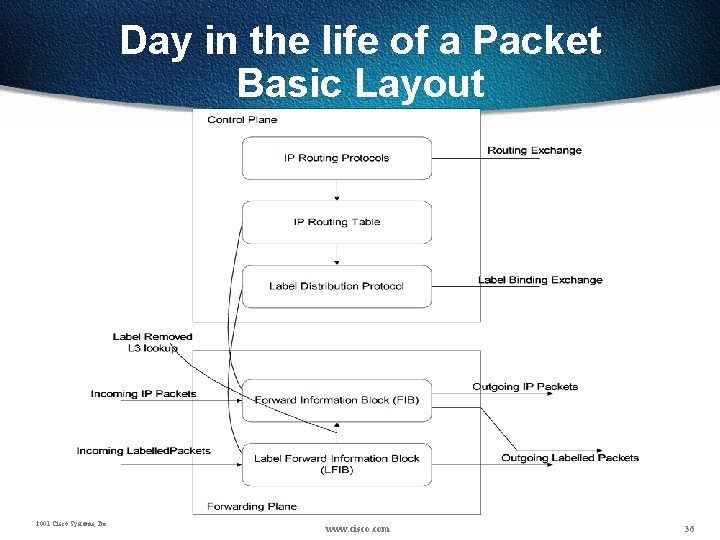
Day in the life of a Packet Basic Layout 2001 Cisco Systems, Inc. www. cisco. com 36
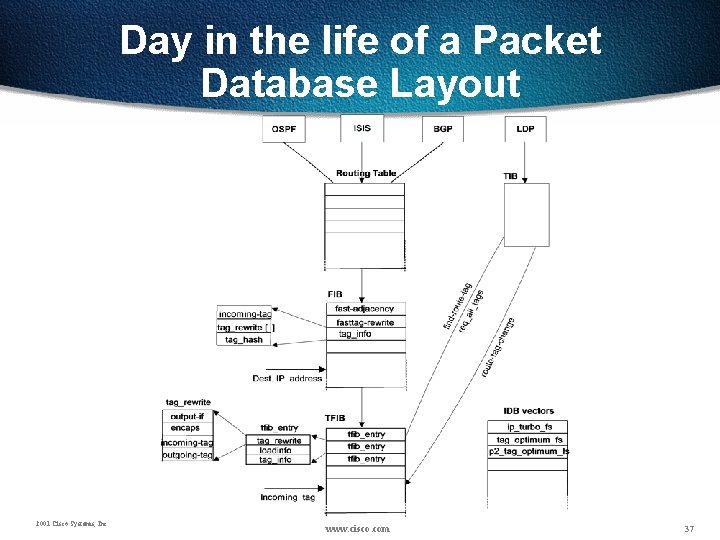
Day in the life of a Packet Database Layout 2001 Cisco Systems, Inc. www. cisco. com 37
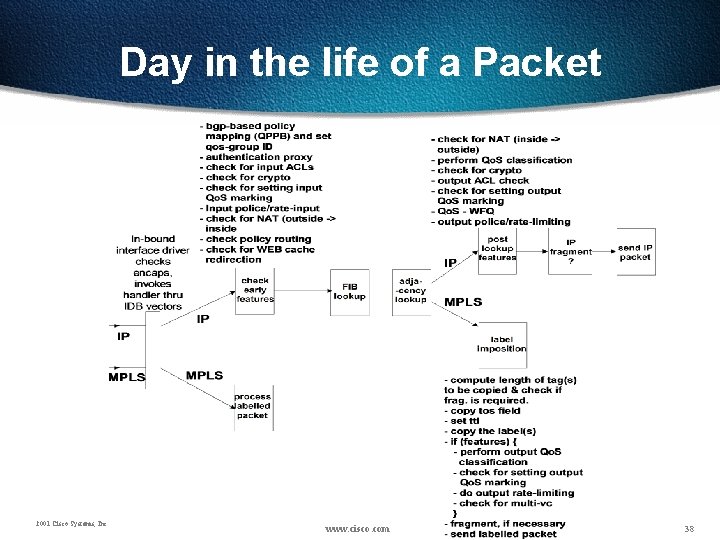
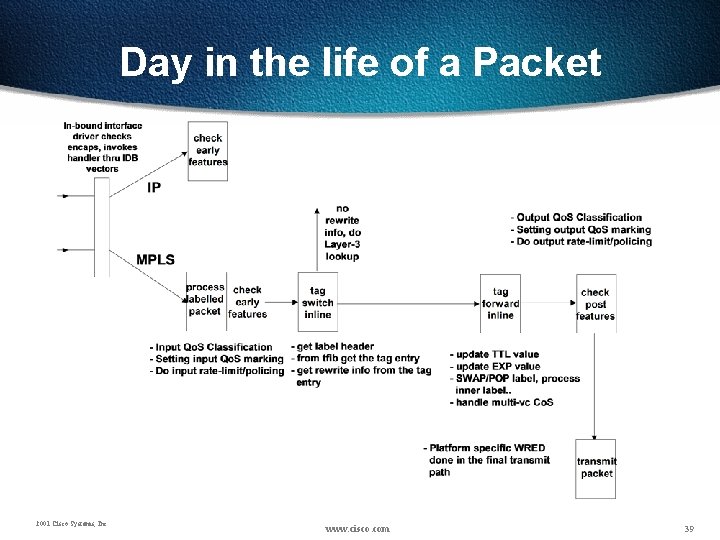
Day in the life of a Packet 2001 Cisco Systems, Inc. www. cisco. com 38
Day in the life of a Packet 2001 Cisco Systems, Inc. www. cisco. com 39
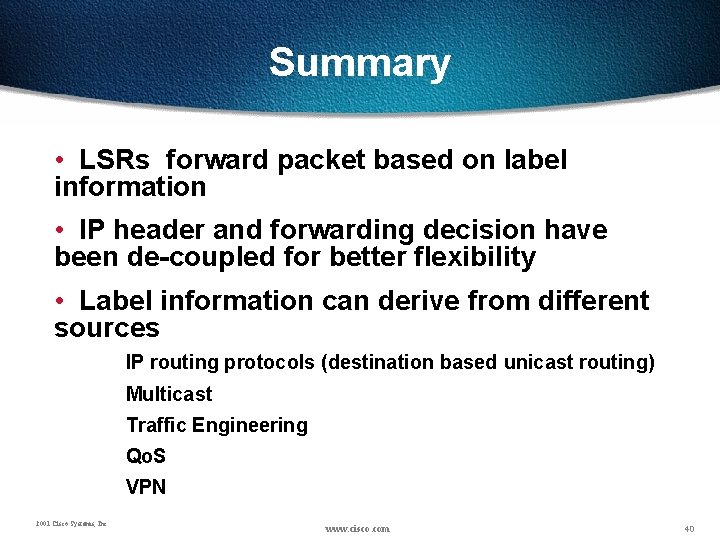
Summary • LSRs forward packet based on label information • IP header and forwarding decision have been de-coupled for better flexibility • Label information can derive from different sources IP routing protocols (destination based unicast routing) Multicast Traffic Engineering Qo. S VPN 2001 Cisco Systems, Inc. www. cisco. com 40
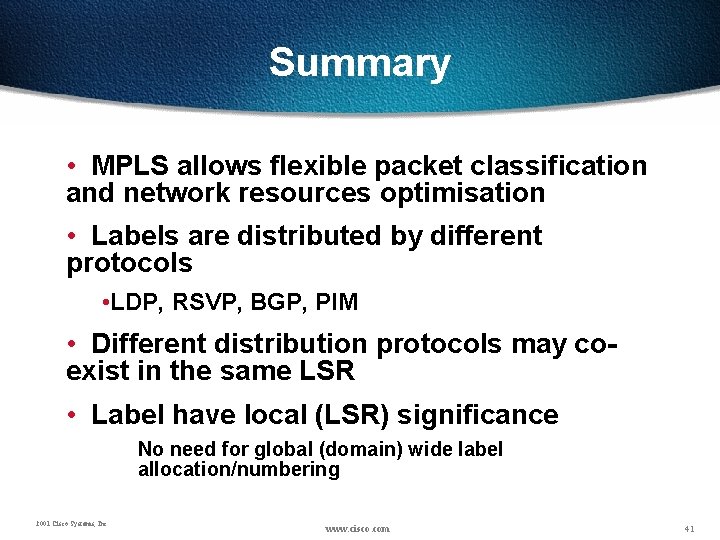
Summary • MPLS allows flexible packet classification and network resources optimisation • Labels are distributed by different protocols • LDP, RSVP, BGP, PIM • Different distribution protocols may coexist in the same LSR • Label have local (LSR) significance No need for global (domain) wide label allocation/numbering 2001 Cisco Systems, Inc. www. cisco. com 41
2001 Cisco Systems, Inc. www. cisco. com 42