
MPLS A single forwarding paradigm label swapping multiple
MPLS • A single forwarding paradigm (label swapping), multiple routing paradigms • Multiple link-specific realizations of the label swapping forwarding paradigm
Label Swapping • Every MPLS packet carries a label. • An MPLS forwarding device (Label Switch Router – LSR) has a forwarding table. For each label it has two entries – next hop and next label. • The old label is swapped out with the next label and sent to the next hop. • Labels may be stacked on top of each other.
Label Switched Path (LSP) • Concatenating label swapping between a series of LSRs creates a label switched path (LSP) • All MPLS packets that are switched along a common LSP are said to belong to the same forwarding equivalence class (FEC). • Label stacking enables aggregation of multiple LSPs into an LSP with a coarser FEC. • Labels are pushed and popped at the head and tail of an LSP.
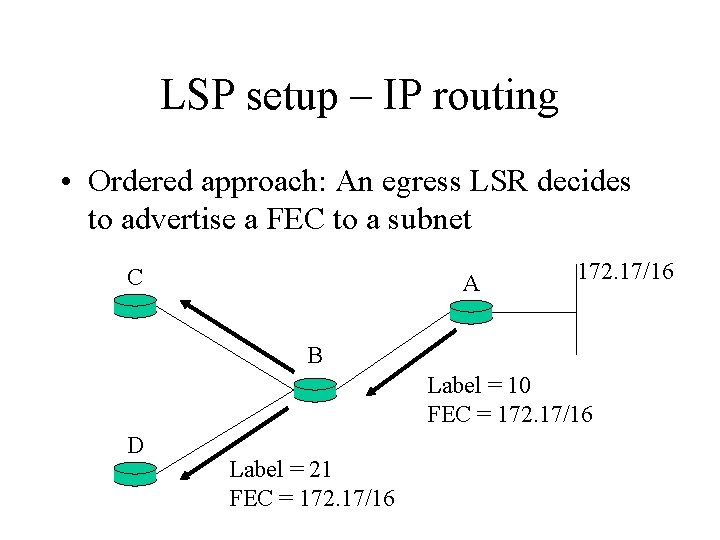
LSP setup – IP routing • Ordered approach: An egress LSR decides to advertise a FEC to a subnet C A 172. 17/16 B Label = 10 FEC = 172. 17/16 D Label = 21 FEC = 172. 17/16

LSP setup – IP routing • Independent Control: Each LSR decides on its own an FEC/Label binding to advertise. C A 172. 17/16 B Label = 10 FEC = 172. 17/16 D Label = 21 FEC = 172. 17/16
LSP setup – Constraint Based Routing • Goal: create an LSP that satisfies some constraint – e. g. minimum average throughput. • Link state protocol advertises unreserved capacity per link. • Pick shortest path on the remaining topology • Use RSVP to reserve resources and fill label switch table.
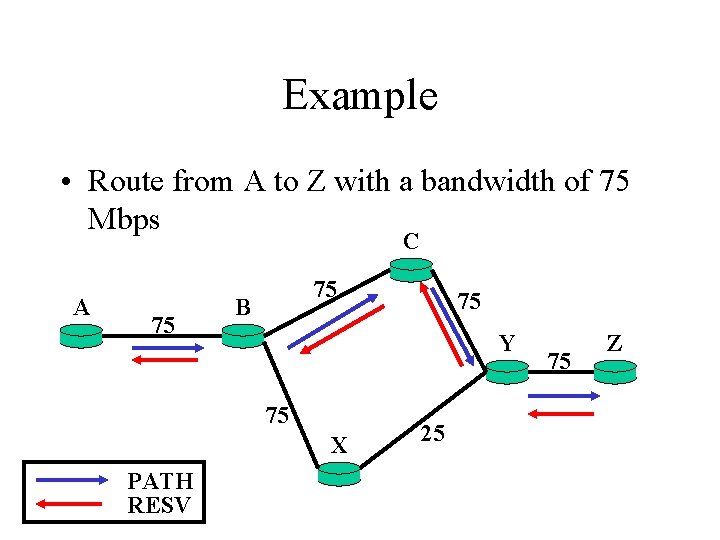
Example • Route from A to Z with a bandwidth of 75 Mbps C A 75 75 B Y 75 X PATH RESV 75 25 75 Z
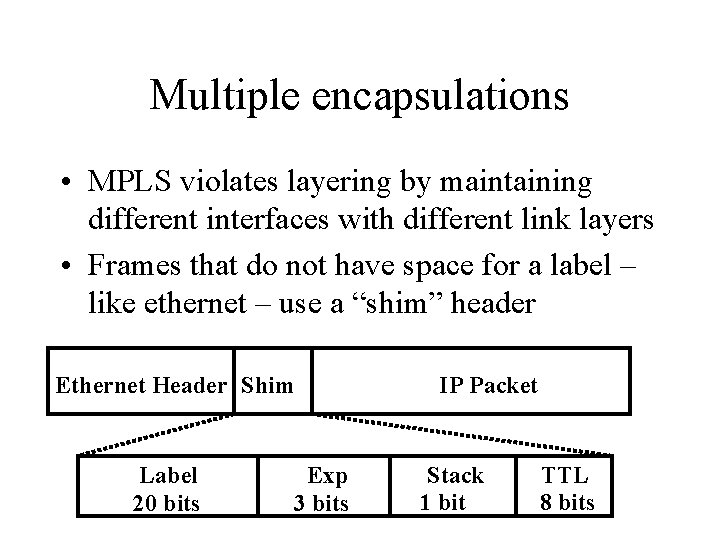
Multiple encapsulations • MPLS violates layering by maintaining different interfaces with different link layers • Frames that do not have space for a label – like ethernet – use a “shim” header Ethernet Header Shim Label 20 bits Exp 3 bits IP Packet Stack 1 bit TTL 8 bits
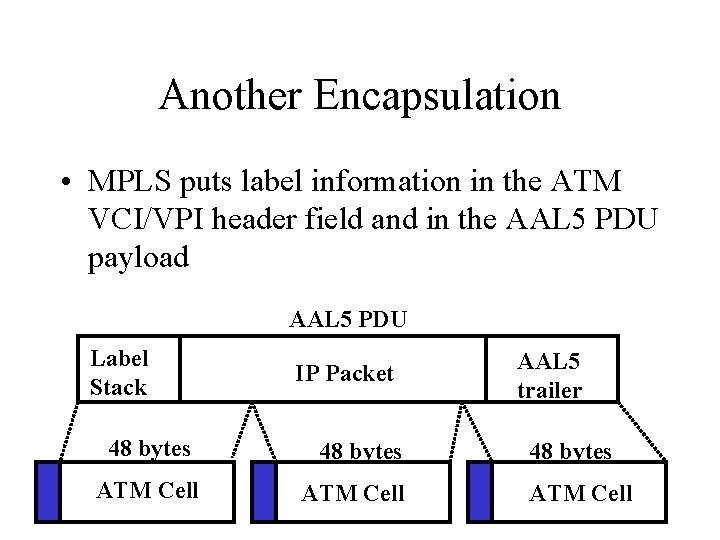
Another Encapsulation • MPLS puts label information in the ATM VCI/VPI header field and in the AAL 5 PDU payload AAL 5 PDU Label Stack 48 bytes ATM Cell IP Packet 48 bytes ATM Cell AAL 5 trailer 48 bytes ATM Cell
Two levels • In the OSI stack, each layer may have both a forwarding and control component. • Under MPLS there is one forwarding paradigm – label swapping. • A single forwarding paradigm implies all MPLS peers may share the same control plane. • MPLS “flattens” the OSI stack. Thus forwarding devices that belong to different layers in the OSI model may peer directly. – ATM switches, Ethernet Switches, OXC, IP routers all peer directly with each other.
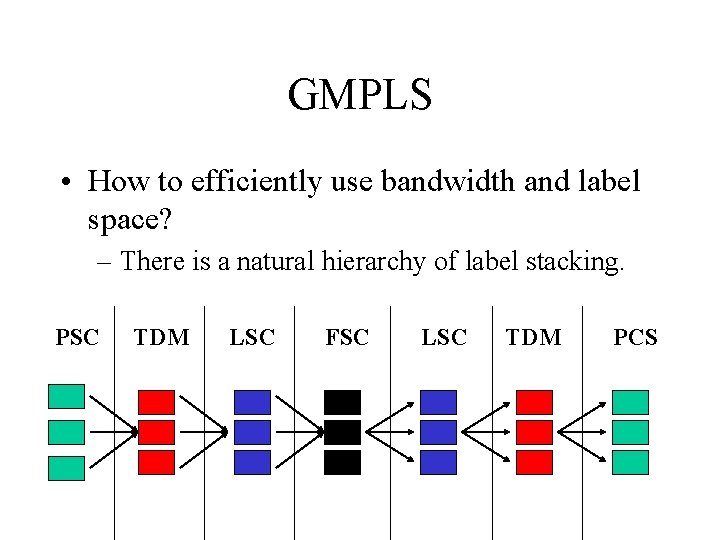
GMPLS • How to efficiently use bandwidth and label space? – There is a natural hierarchy of label stacking. PSC TDM LSC FSC LSC TDM PCS
Generalized MPLS (GMPLS) • Support for the following link layers – – Packet Switch Capable (PSC) – ATM/Ethernet/Frame Relay TDM Capable (TDM) – SONET/SDH Lambda Switching Capable (LSC) – Optical Switch Fiber Switch Capable (FSC) – OXC • The last three link layers are fundamentally different from the first – It is impossible to stack lambdas – There are typically few lambdas, ports, and time slots compared to the number of possible packet labels – Bandwidth comes in discrete values (OC-12, OC-48, OC -192)
- Slides: 12