
MOZART Development Evaluation and Applications at GFDL MOZART

- Slides: 29
MOZART Development, Evaluation, and Applications at GFDL MOZART Users’ Meeting August 17, 2005 Boulder, CO Arlene M. Fiore Larry W. Horowitz Arlene. Fiore@noaa. gov Larry. Horowitz@noaa. gov
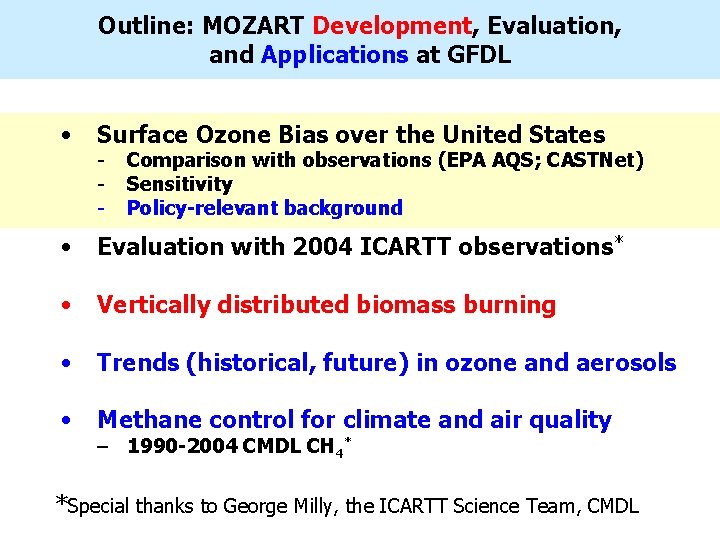
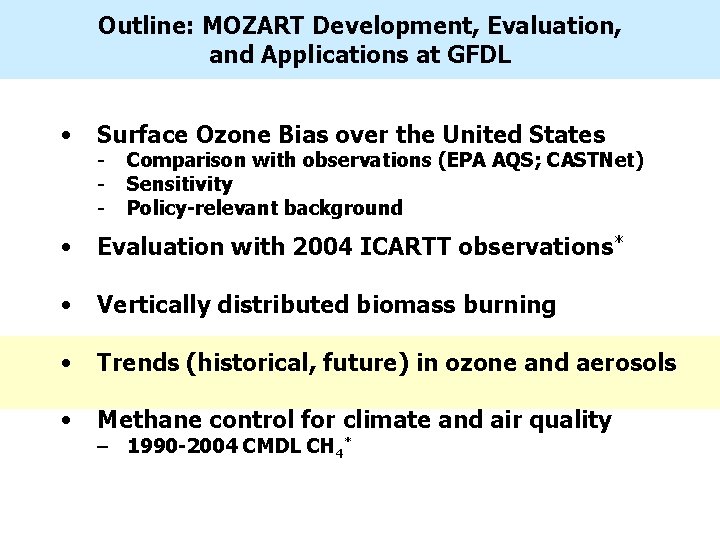
Outline: MOZART Development, Evaluation, and Applications at GFDL • Surface Ozone Bias over the United States • Evaluation with 2004 ICARTT observations* • Vertically distributed biomass burning • Trends (historical, future) in ozone and aerosols • Methane control for climate and air quality - Comparison with observations (EPA AQS; CASTNet) Sensitivity Policy-relevant background – 1990 -2004 CMDL CH 4* *Special thanks to George Milly, the ICARTT Science Team, CMDL
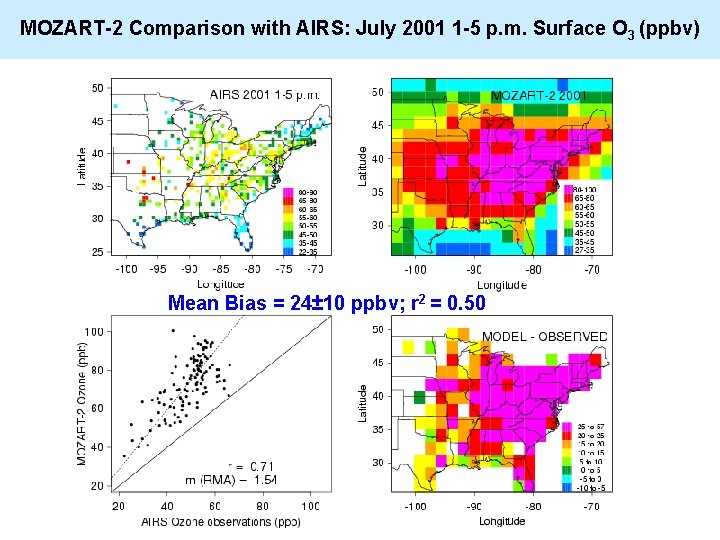
MOZART-2 Comparison with AIRS: July 2001 1 -5 p. m. Surface O 3 (ppbv) Mean Bias = 24± 10 ppbv; r 2 = 0. 50
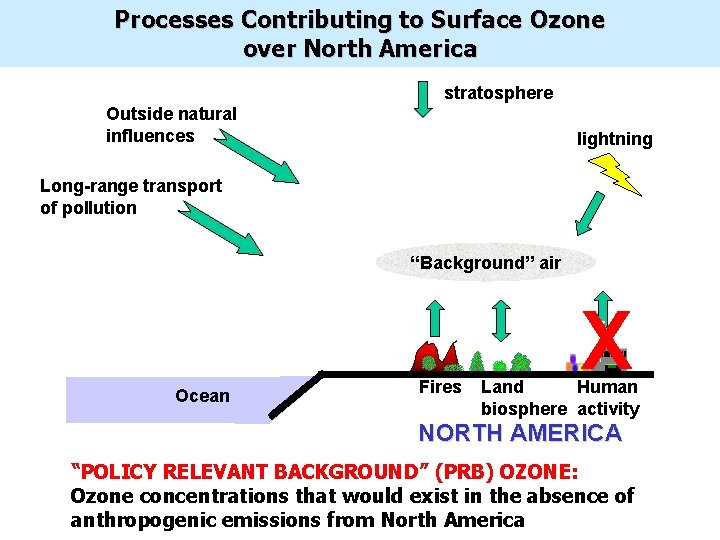
Processes Contributing to Surface Ozone over North America stratosphere Outside natural influences Lightning lightning Long-range transport of pollution “Background” air Ocean Fires X Human Land biosphere activity NORTH AMERICA “POLICY RELEVANT BACKGROUND” (PRB) OZONE: Ozone concentrations that would exist in the absence of anthropogenic emissions from North America
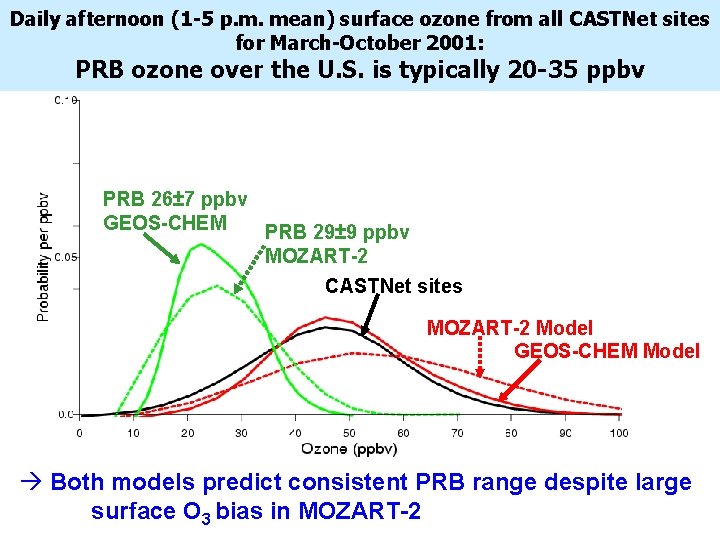
Daily afternoon (1 -5 p. m. mean) surface ozone from all CASTNet sites for March-October 2001: PRB ozone over the U. S. is typically 20 -35 ppbv PRB 26± 7 ppbv GEOS-CHEM PRB 29± 9 ppbv MOZART-2 CASTNet sites MOZART-2 Model GEOS-CHEM Model à Both models predict consistent PRB range despite large surface O 3 bias in MOZART-2
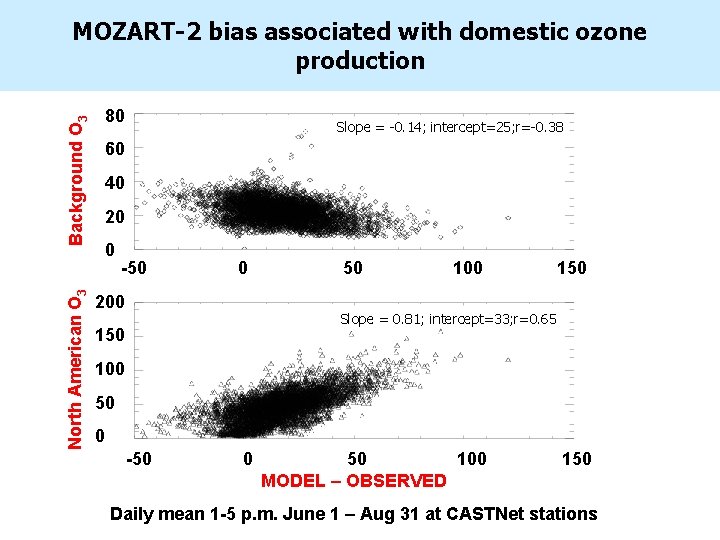
North American O 3 Background O 3 MOZART-2 bias associated with domestic ozone production 80 Slope = -0. 14; intercept=25; r=-0. 38 60 40 20 0 -50 0 200 50 100 150 Slope = 0. 81; intercept=33; r=0. 65 150 100 50 0 -50 0 50 100 MODEL – OBSERVED 150 Daily mean 1 -5 p. m. June 1 – Aug 31 at CASTNet stations
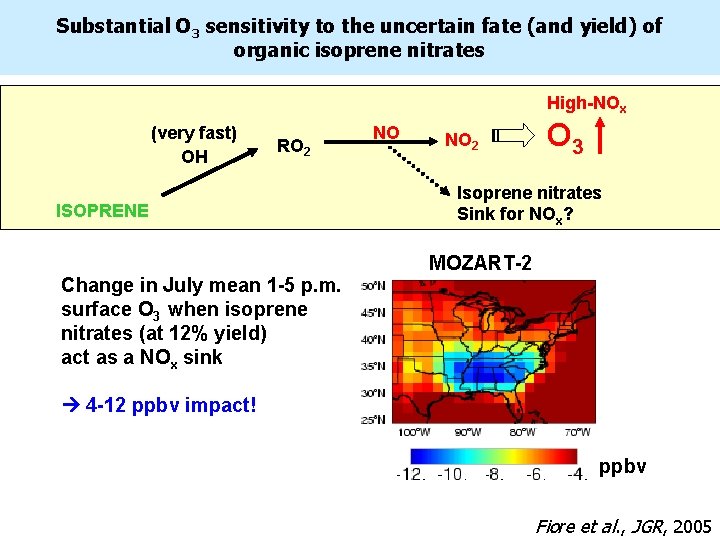
Substantial O 3 sensitivity to the uncertain fate (and yield) of organic isoprene nitrates High-NOx (very fast) OH RO 2 ISOPRENE Change in July mean 1 -5 p. m. surface O 3 when isoprene nitrates (at 12% yield) act as a NOx sink NO NO 2 O 3 Isoprene nitrates Sink for NOx? MOZART-2 4 -12 ppbv impact! ppbv Fiore et al. , JGR, 2005
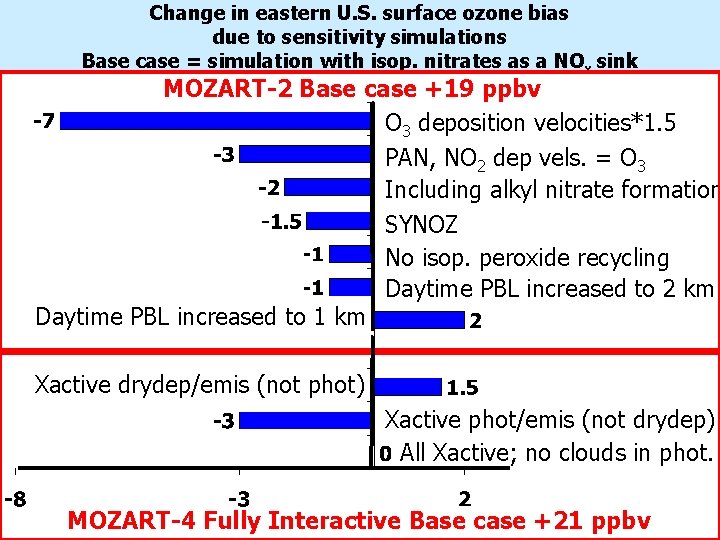
Change in eastern U. S. surface ozone bias due to sensitivity simulations Base case = simulation with isop. nitrates as a NOx sink MOZART-2 Base case +19 ppbv O 3 deposition velocities*1. 5 PAN, NO 2 dep vels. = O 3 Including alkyl nitrate formation SYNOZ No isop. peroxide recycling Daytime PBL increased to 2 km Daytime PBL increased to 1 km Xactive drydep/emis (not phot) Xactive phot/emis (not drydep) All Xactive; no clouds in phot. MOZART-4 Fully Interactive Base case +21 ppbv
Outline: MOZART Development, Evaluation, and Applications at GFDL • Surface Ozone Bias over the United States • Evaluation with 2004 ICARTT observations • Vertically distributed biomass burning • Trends (historical, future) in ozone and aerosols • Methane control for climate and air quality - Comparison with observations (EPA AQS; CASTNet) Sensitivity Policy-relevant background – 1990 -2004 CMDL CH 4*
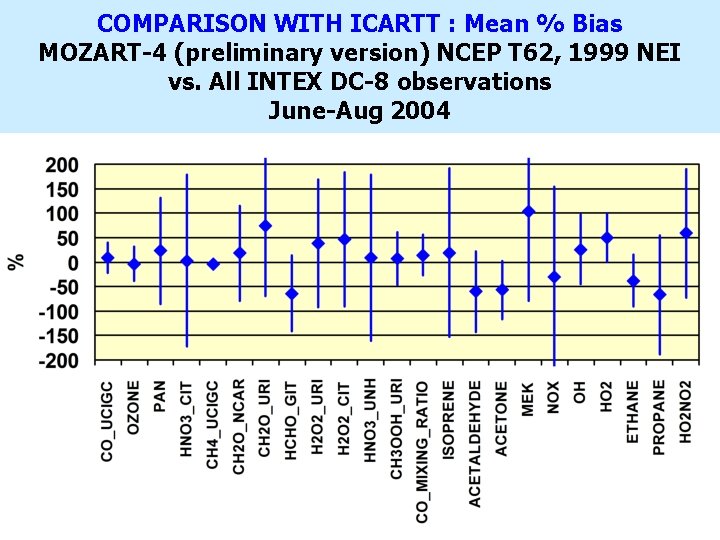
COMPARISON WITH ICARTT : Mean % Bias MOZART-4 (preliminary version) NCEP T 62, 1999 NEI vs. All INTEX DC-8 observations June-Aug 2004
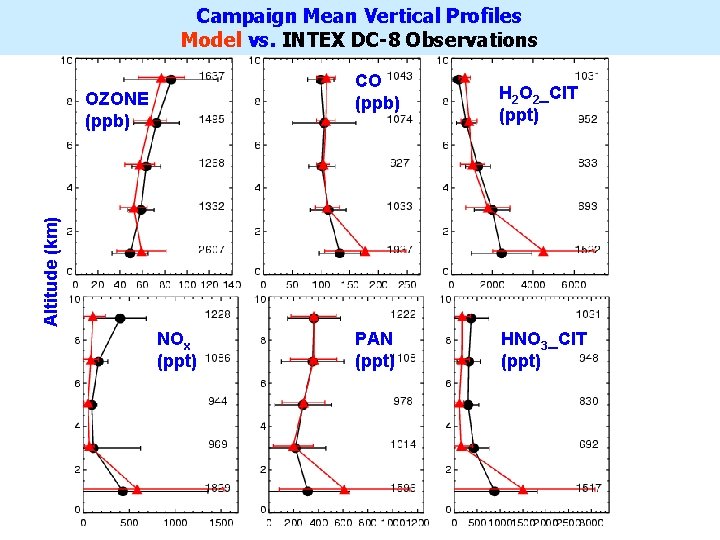
Campaign Mean Vertical Profiles Model vs. INTEX DC-8 Observations CO (ppb) H 2 O 2_CIT (ppt) Altitude (km) OZONE (ppb) NOx (ppt) PAN (ppt) HNO 3_CIT (ppt)
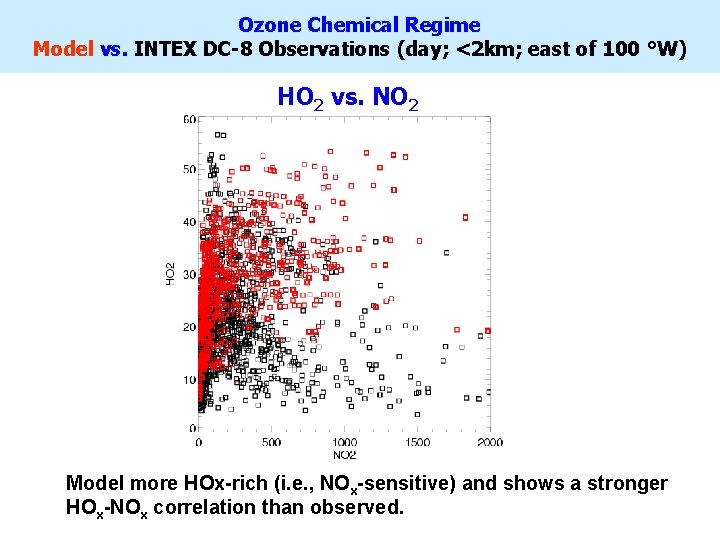
Ozone Chemical Regime Model vs. INTEX DC-8 Observations (day; <2 km; east of 100 °W) HO 2 vs. NO 2 Model more HOx-rich (i. e. , NOx-sensitive) and shows a stronger HOx-NOx correlation than observed.
Outline: MOZART Development, Evaluation, and Applications at GFDL • Surface Ozone Bias over the United States • Evaluation with 2004 ICARTT observations • Vertically distributed biomass burning • Trends (historical, future) in ozone and aerosols • Methane control for climate and air quality - Comparison with observations (EPA AQS; CASTNet) Sensitivity Policy-relevant background – 1990 -2004 CMDL CH 4*
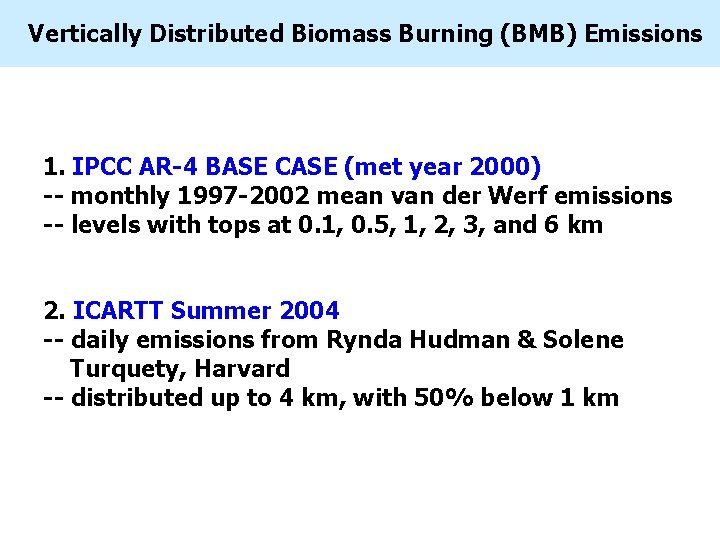
Vertically Distributed Biomass Burning (BMB) Emissions 1. IPCC AR-4 BASE CASE (met year 2000) -- monthly 1997 -2002 mean van der Werf emissions -- levels with tops at 0. 1, 0. 5, 1, 2, 3, and 6 km 2. ICARTT Summer 2004 -- daily emissions from Rynda Hudman & Solene Turquety, Harvard -- distributed up to 4 km, with 50% below 1 km
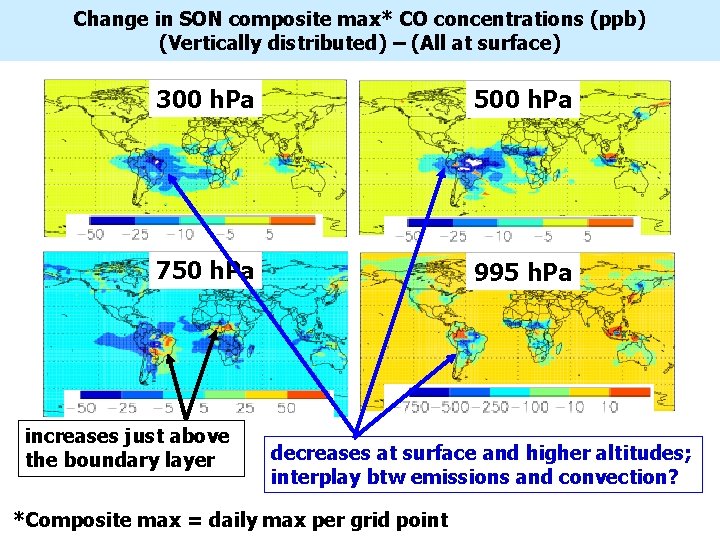
Change in SON composite max* CO concentrations (ppb) (Vertically distributed) – (All at surface) 300 h. Pa 500 h. Pa 750 h. Pa 995 h. Pa increases just above the boundary layer decreases at surface and higher altitudes; interplay btw emissions and convection? *Composite max = daily max per grid point
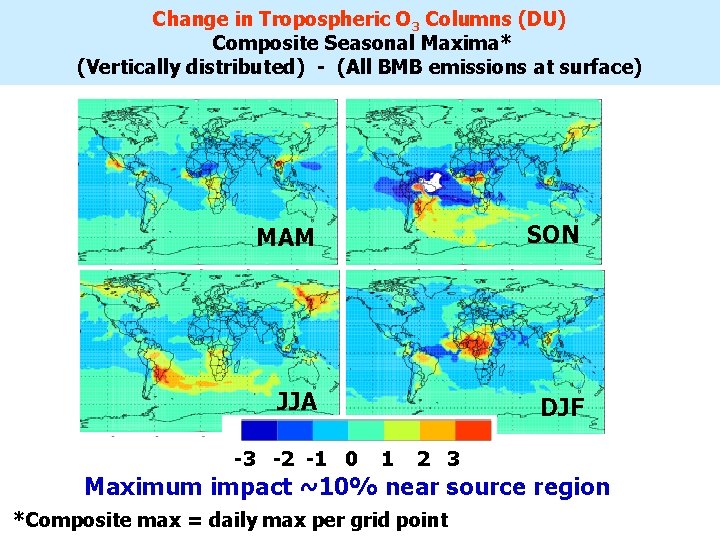
Change in Tropospheric O 3 Columns (DU) Composite Seasonal Maxima* (Vertically distributed) - (All BMB emissions at surface) MAM SON JJA DJF -3 -2 -1 0 1 2 3 Maximum impact ~10% near source region *Composite max = daily max per grid point
Outline: MOZART Development, Evaluation, and Applications at GFDL • Surface Ozone Bias over the United States • Evaluation with 2004 ICARTT observations* • Vertically distributed biomass burning • Trends (historical, future) in ozone and aerosols • Methane control for climate and air quality - Comparison with observations (EPA AQS; CASTNet) Sensitivity Policy-relevant background – 1990 -2004 CMDL CH 4*
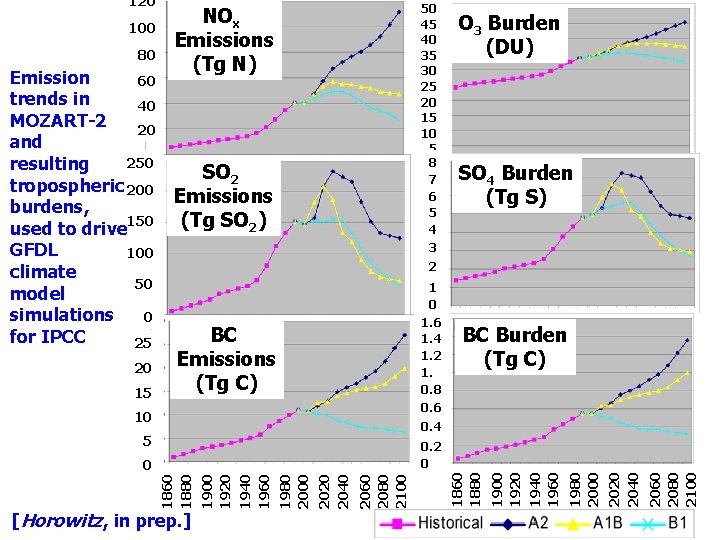
20 15 SO 2 Emissions (Tg SO 2) 1 0 1. 6 1. 4 1. 2 1. 0. 8 0. 6 0. 4 BC Emissions (Tg C) 10 5 SO 4 Burden (Tg S) BC Burden (Tg C) 0. 2 0 2060 2080 2100 1980 2000 2020 2040 [Horowitz, in prep. ] 1900 1920 1940 1960 1880 0 2060 2080 2100 Emission 60 trends in 40 MOZART-2 20 and 250 resulting tropospheric 200 burdens, used to drive 150 GFDL 100 climate 50 model simulations 0 for IPCC 25 1980 2000 2020 2040 80 O 3 Burden (DU) 1900 1920 1940 1960 100 50 45 40 35 30 25 20 15 10 5 8 7 6 5 4 3 2 NOx Emissions (Tg N) 1860 1880 120
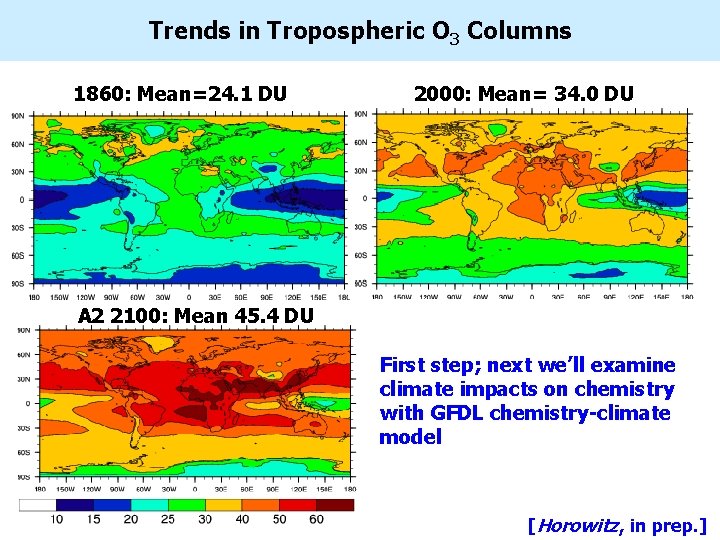
Trends in Tropospheric O 3 Columns 1860: Mean=24. 1 DU 2000: Mean= 34. 0 DU A 2 2100: Mean 45. 4 DU First step; next we’ll examine climate impacts on chemistry with GFDL chemistry-climate model [Horowitz, in prep. ]
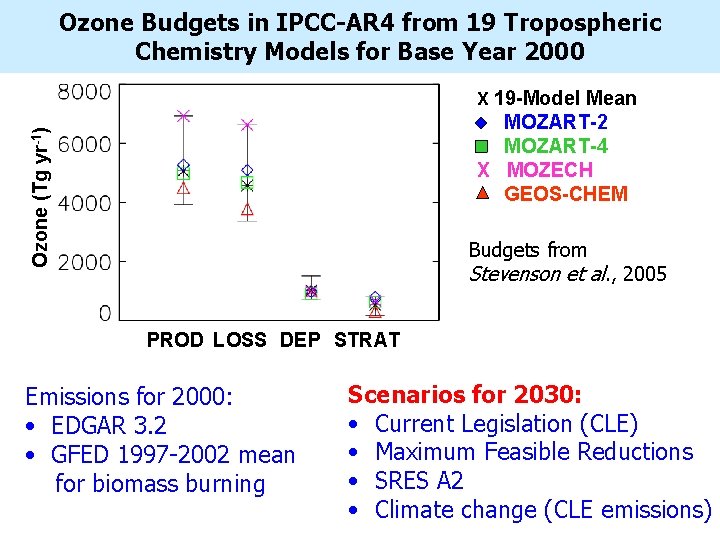
Ozone Budgets in IPCC-AR 4 from 19 Tropospheric Chemistry Models for Base Year 2000 X 19 -Model Mean Ozone (Tg yr-1) MOZART-2 MOZART-4 X MOZECH GEOS-CHEM Budgets from Stevenson et al. , 2005 PROD LOSS DEP STRAT Emissions for 2000: • EDGAR 3. 2 • GFED 1997 -2002 mean for biomass burning Scenarios for 2030: • Current Legislation (CLE) • Maximum Feasible Reductions • SRES A 2 • Climate change (CLE emissions)
Outline: MOZART Development, Evaluation, and Applications at GFDL • Surface Ozone Bias over the United States • Evaluation with 2004 ICARTT observations • Vertically distributed biomass burning • Trends (historical, future) in ozone and aerosols • Methane control for climate and air quality - Comparison with observations (EPA AQS; CASTNet) Sensitivity Policy-relevant background – 1990 -2004 CMDL CH 4*
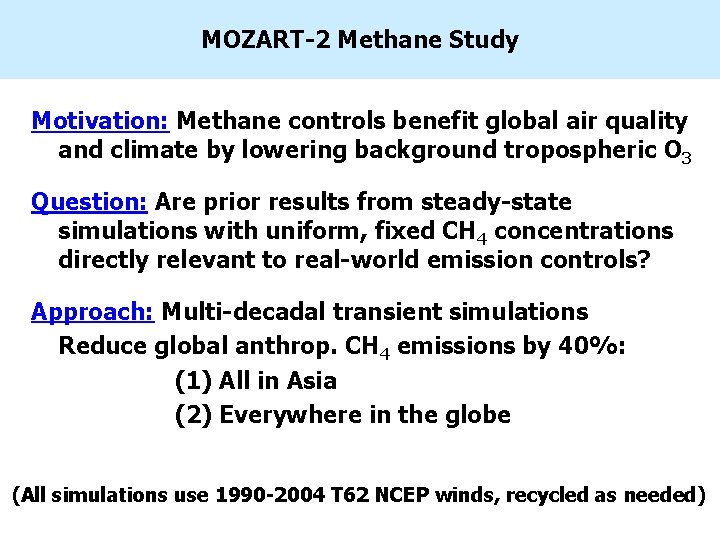
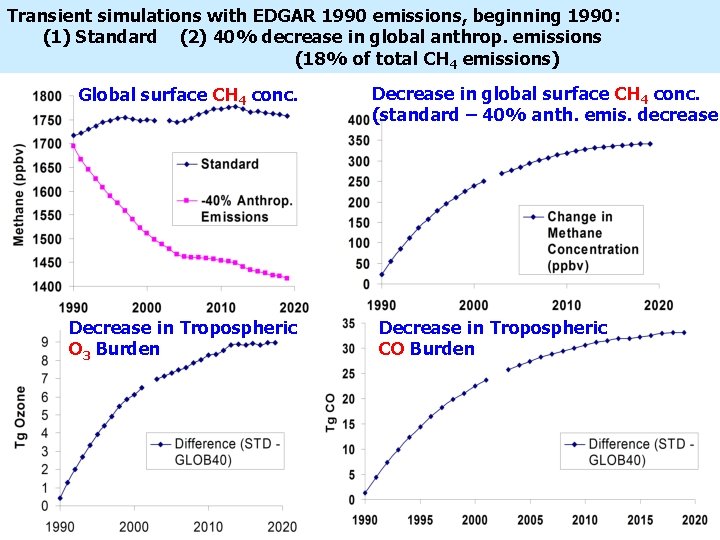
MOZART-2 Methane Study Motivation: Methane controls benefit global air quality and climate by lowering background tropospheric O 3 Question: Are prior results from steady-state simulations with uniform, fixed CH 4 concentrations directly relevant to real-world emission controls? Approach: Multi-decadal transient simulations Reduce global anthrop. CH 4 emissions by 40%: (1) All in Asia (2) Everywhere in the globe (All simulations use 1990 -2004 T 62 NCEP winds, recycled as needed)
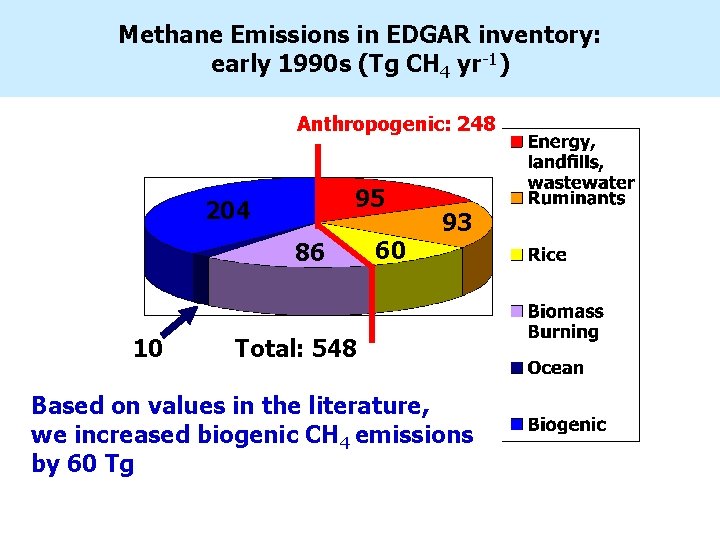
Methane Emissions in EDGAR inventory: early 1990 s (Tg CH 4 yr-1) Anthropogenic: 248 95 204 86 10 60 93 Total: 548 Based on values in the literature, we increased biogenic CH 4 emissions by 60 Tg
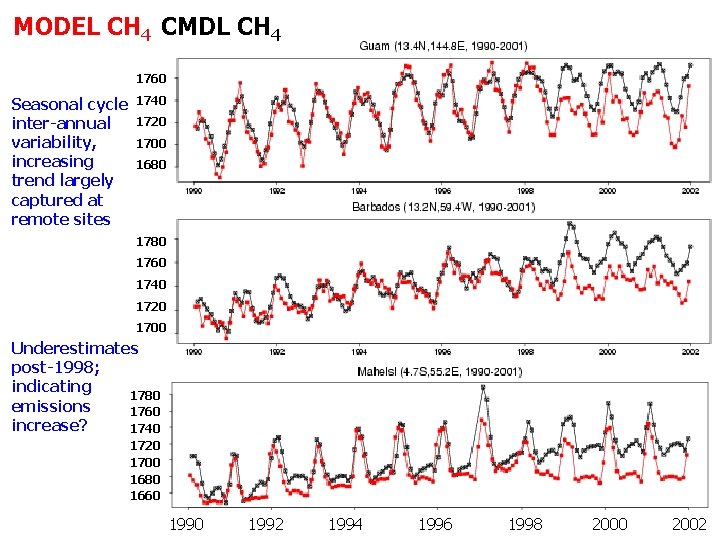
MODEL CH 4 CMDL CH 4 1760 Seasonal cycle, 1740 1720 inter-annual 1700 variability, increasing 1680 trend largely captured at remote sites 1780 1760 1740 1720 1700 Underestimates post-1998; indicating 1780 emissions 1760 increase? 1740 1720 1700 1680 1660 1992 1994 1996 1998 2000 2002
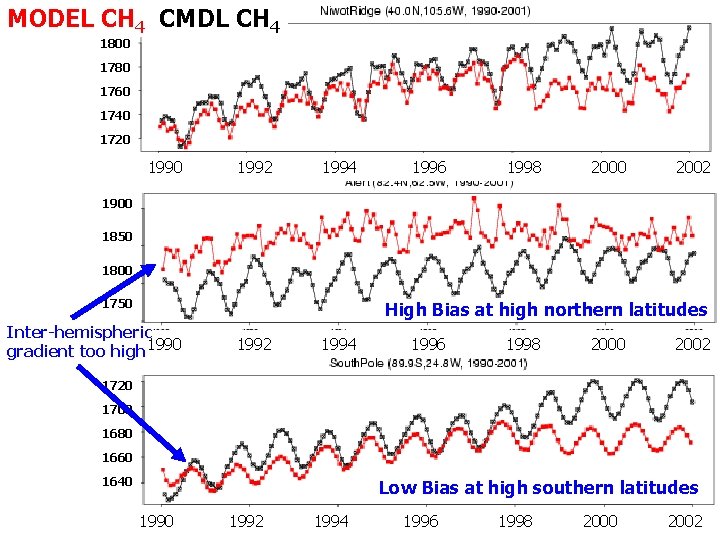
MODEL CH 4 CMDL CH 4 1800 1780 1760 1740 1720 1992 1994 1996 1998 2000 2002 1900 1850 1800 1750 High Bias at high northern latitudes Inter-hemispheric gradient too high 1990 1992 1994 1996 1998 2000 2002 1720 1700 1680 1660 1640 Low Bias highsouthern latitudes Low bias at at high 1990 1992 1994 1996 1998 2000 2002
Transient simulations with EDGAR 1990 emissions, beginning 1990: (1) Standard (2) 40% decrease in global anthrop. emissions (18% of total CH 4 emissions) Global surface CH 4 conc. Decrease in Tropospheric O 3 Burden Decrease in global surface CH 4 conc. (standard – 40% anth. emis. decrease Decrease in Tropospheric CO Burden
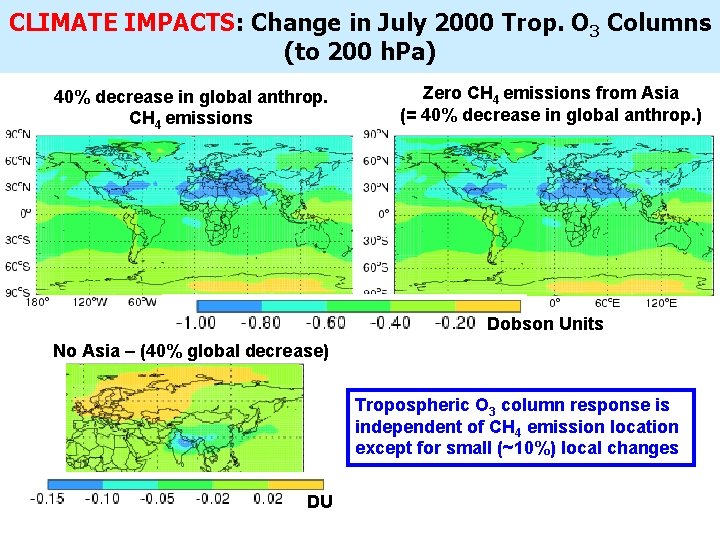
CLIMATE IMPACTS: Change in July 2000 Trop. O 3 Columns (to 200 h. Pa) 40% decrease in global anthrop. CH 4 emissions Zero CH 4 emissions from Asia (= 40% decrease in global anthrop. ) Dobson Units No Asia – (40% global decrease) Tropospheric O 3 column response is independent of CH 4 emission location except for small (~10%) local changes DU
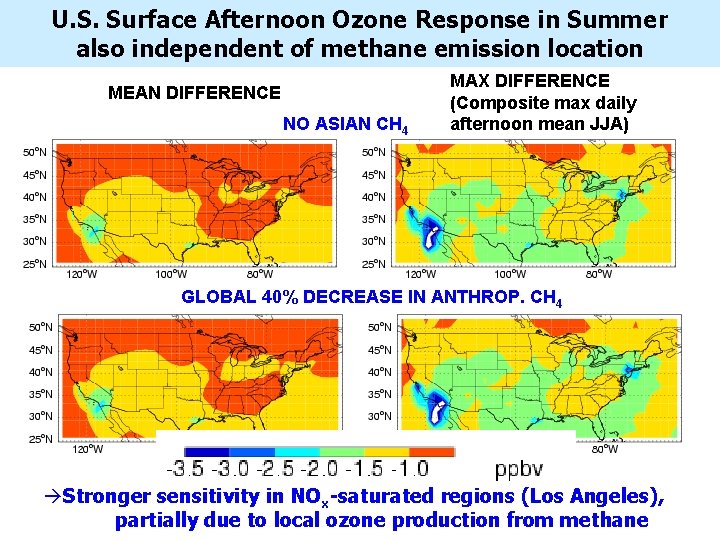
U. S. Surface Afternoon Ozone Response in Summer also independent of methane emission location MEAN DIFFERENCE NO ASIAN CH 4 MAX DIFFERENCE (Composite max daily afternoon mean JJA) GLOBAL 40% DECREASE IN ANTHROP. CH 4 àStronger sensitivity in NOx-saturated regions (Los Angeles), partially due to local ozone production from methane
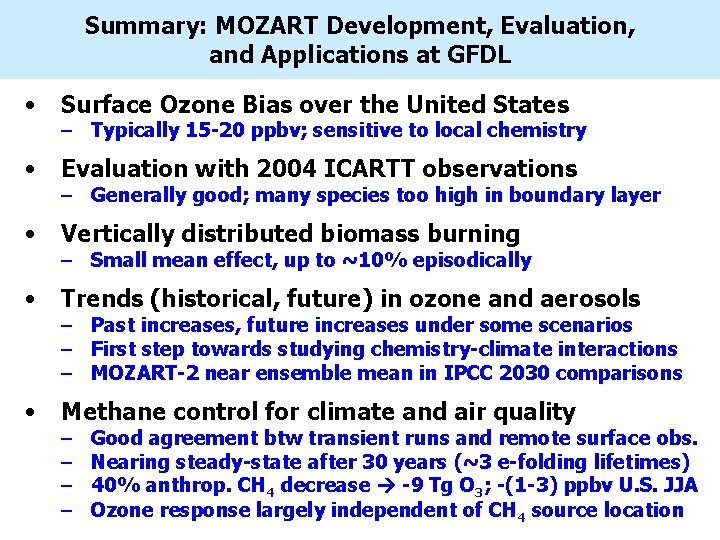
Summary: MOZART Development, Evaluation, and Applications at GFDL • Surface Ozone Bias over the United States • Evaluation with 2004 ICARTT observations • Vertically distributed biomass burning • Trends (historical, future) in ozone and aerosols • Methane control for climate and air quality – Typically 15 -20 ppbv; sensitive to local chemistry – Generally good; many species too high in boundary layer – Small mean effect, up to ~10% episodically – Past increases, future increases under some scenarios – First step towards studying chemistry-climate interactions – MOZART-2 near ensemble mean in IPCC 2030 comparisons – – Good agreement btw transient runs and remote surface obs. Nearing steady-state after 30 years (~3 e-folding lifetimes) 40% anthrop. CH 4 decrease -9 Tg O 3; -(1 -3) ppbv U. S. JJA Ozone response largely independent of CH 4 source location