
Moving out of Aid Dependency Lessons from the
- Slides: 6
Moving out of Aid Dependency: Lessons from the South Korean experience Irma Adelman University of California, Berkeley
Moving out of Aid Dependency: Lessons from the South Korean experience ØAccelerated development is possible ØThe essence of development policy consists of the creation of dynamic comparative advantage. q Requires anticipatory and coordinated restructuring of : -production and investment patterns - technology - social development - economic, social and political institutions - investment and trade policies
q. The critical factors needed to generate economic development are both tangible and intangible -leadership commitment to development - social capital, including not only the level of human resources but also the degrees of social cohesion, social trust, cooperative norms and willingness to act in the social good - institutional and social resilience and malleability - appropriate policy design in investment, capital accumulation, technology and trade
Ø Government has a central role in the promotion of economic development. But its functions must adapt dynamically evolving from prime-mover and direction-setter into a quasi-Smithian State. A sound economy therefore requires a sound State Ø The economy, society, institutions and policies must be malleable and capable of even abrupt change Ø The prospects for economic development are intimately linked not only to the country’s own institutions and policies but also to existing global operational rules of global institutions
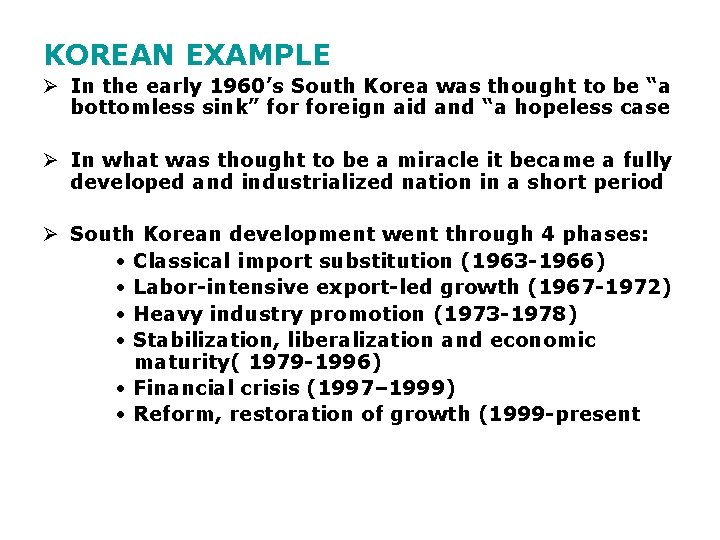
KOREAN EXAMPLE Ø In the early 1960’s South Korea was thought to be “a bottomless sink” foreign aid and “a hopeless case Ø In what was thought to be a miracle it became a fully developed and industrialized nation in a short period Ø South Korean development went through 4 phases: • Classical import substitution (1963 -1966) • Labor-intensive export-led growth (1967 -1972) • Heavy industry promotion (1973 -1978) • Stabilization, liberalization and economic maturity( 1979 -1996) • Financial crisis (1997– 1999) • Reform, restoration of growth (1999 -present
Ø WTO rules either prohibit or severely restrict most measures used by South Korea for its accelerated development Ø Aid to South Korea was mostly untied; current flows are tied