
Moving From Power and Control to Collaboration and
Moving From Power and Control to Collaboration and Problem Solving…and Creating the Structures to Do It Ross W. Greene, Ph. D. © 2018 Dr. Ross Greene livesinthebalance. org © Ross W. Greene, Ph. D.
WHAT WE CAN CHANGE - Lenses Practices Structures © 2018 Dr. Ross Greene 2
KEY THEMES 1. Emphasis is on problems (and solving them) rather than on behaviors (and modifying them)…upstream (not downstream) § Challenging behavior is simply the signal…the fever…the means by which a child communicates that he/she is having difficulty meeting certain expectations § Behaviors are not the only observable, objective, quantifiable data…unsolved problems are too § Think about standard assessment and instrumentation CHANGE IT! © 2018 Dr. Ross Greene 3
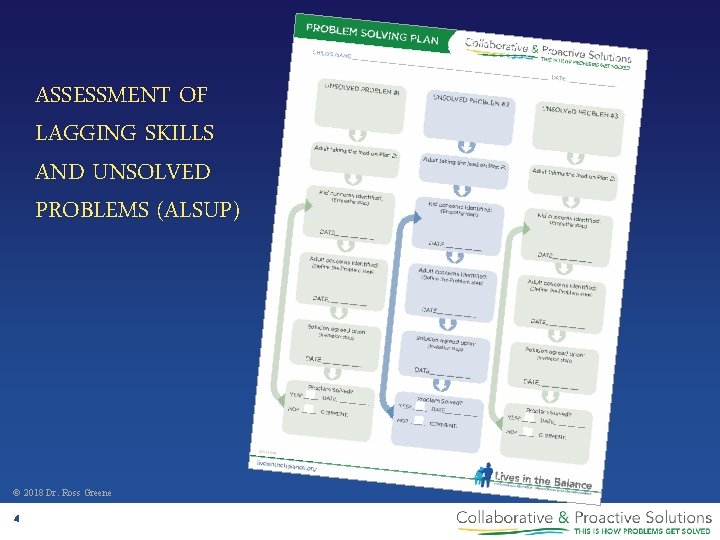
ASSESSMENT OF LAGGING SKILLS AND UNSOLVED PROBLEMS (ALSUP) © 2018 Dr. Ross Greene 4
KEY THEMES The problem solving is collaborative rather than unilateral 2. § © 2018 Dr. Ross Greene 5 Something you’re doing with the kid rather than to him § Implications for disciplinary practices CHANGE IT! § Implications for assessment processes and planning: someone’s missing CHANGE IT!
KEY THEMES 3. The problem solving is proactive rather than emergent § This is possible only if we answer two important questions: why and when is this kid challenging? § Implications for training and practices CHANGE IT! © 2018 Dr. Ross Greene 6
TIMING IS EVERYTHING CHALLENGING EPISODES ARE HIGHLY PREDICTABLE CRISIS MANAGEMENT: Intervention is reactive and occurs emergently, in the heat of the moment (“What should I do when? ”) CRISIS PREVENTION: Intervention is planned and occurs proactively, well before highly predictable incompatibility episodes occur again (“What am I going to do before? ”) © 2018 Dr. Ross Greene 7
SIX KEY THEMES 4. Kids do well if they can § If the kid could do well, he would do well § Not True: § § § © 2018 Dr. Ross Greene 8 Attention-seeking Manipulative Coercive Unmotivated Limit-testing Implications for lenses (lagging skills) and school disciplinary practices CHANGE IT!
WHAT SKILLS ARE BEHAVIORALLY CHALLENGING KIDS LACKING? ü Executive skills ü Language processing/communication skills ü Emotion regulation skills ü Cognitive flexibility skills ü Social skills © 2018 Dr. Ross Greene 9
THE TOP 5 Skills That Foster the Better Side of Human Nature § Empathy § Appreciating how one’s behavior is affecting others § Resolving disagreements without conflict § Taking another’s perspective § Honesty © 2018 Dr. Ross Greene 10
ADULT ROLES IN THE LIVES OF BEHAVIORALLY CHALLENGING KIDS § Identify lagging skills and unsolved problems § Solve problems collaboratively and proactively (AND KEEP TRACK!) § § © 2018 Dr. Ross Greene 11 Promotes a problem solving partnership Engages kids in solving the problems that affect their lives Produces more effective, durable solutions Simultaneously teaches skills
KEEPING TRACK: THE PROBLEM SOLVING PLAN © 2018 Dr. Ross Greene 12
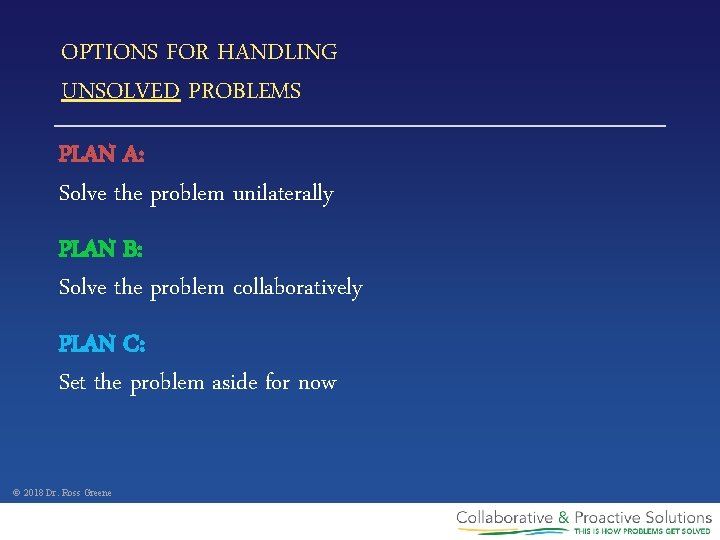
OPTIONS FOR HANDLING UNSOLVED PROBLEMS PLAN A: Solve the problem unilaterally PLAN B: Solve the problem collaboratively PLAN C: Set the problem aside for now © 2018 Dr. Ross Greene
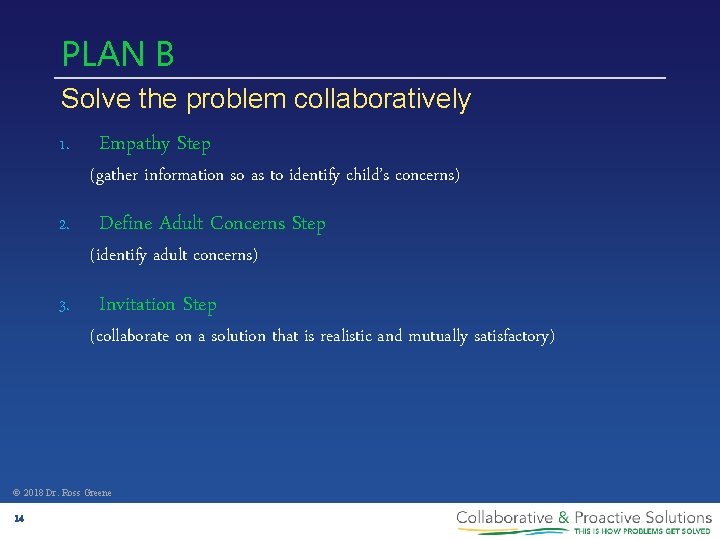
PLAN B Solve the problem collaboratively 1. Empathy Step (gather information so as to identify child’s concerns) 2. Define Adult Concerns Step (identify adult concerns) 3. Invitation Step (collaborate on a solution that is realistic and mutually satisfactory) © 2018 Dr. Ross Greene 14
TIME § The big unsolved problem for every school and school system § The school day was designed for academics § § Logical times for Plan B § Every school has to deal with the fact that classroom teachers don’t feel like they have time to solve problems with kids CHANGE IT! © 2018 Dr. Ross Greene 15 That would be great, but…
WHAT WE CAN CHANGE - Lenses Practices Structures © 2018 Dr. Ross Greene 16
HELPING YOU CHANGE IT livesinthebalance. org © 2018 Dr. Ross Greene 17
- Slides: 17