
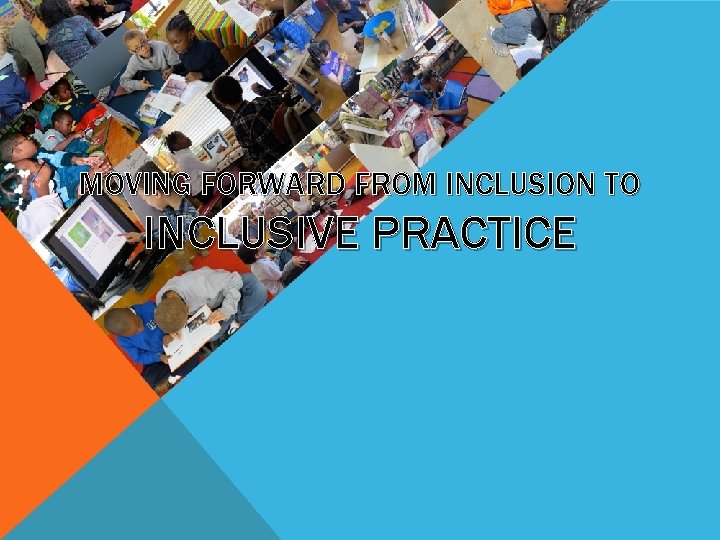
MOVING FORWARD FROM INCLUSION TO INCLUSIVE PRACTICE O


- Slides: 17
MOVING FORWARD FROM INCLUSION TO INCLUSIVE PRACTICE
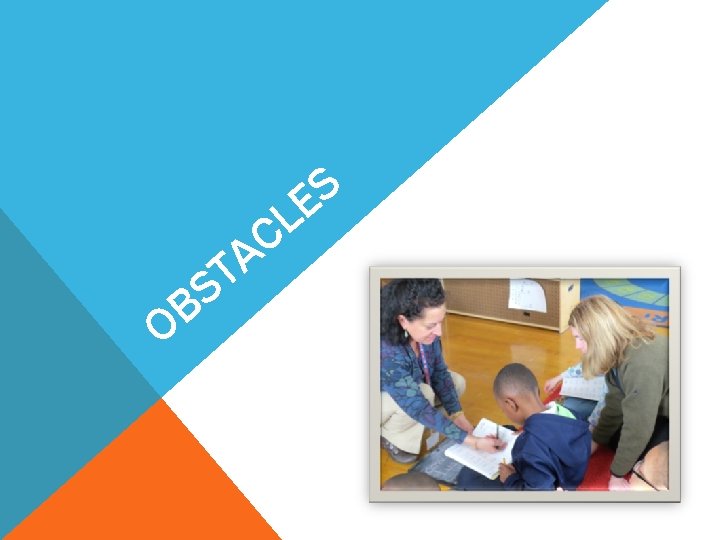
O S B A T L C S E
• The greatest barriers to inclusive practice are caused by society. • Negative attitudes towards differences result in discrimination and can lead to a serious barrier to learning. • Negative attitudes can take the form of social discrimination, lack of awareness and traditional prejudices. • Regarding disabled, children some people still maintain beliefs that educating the disabled is pointless. Often the problem is identified as being caused by the child's differences rather than the education systems lack of resources Some Barriers to Inclusive Practice
• Teachers' abilities and attitudes can be major limitations for inclusive education. The training of staff at all levels is often not adequate. Where there is training it often tends to be fragmented, uncoordinated and inadequate. If teachers do not have positive attitudes towards learners with special needs, it is unlikely that these children will receive satisfactory education. • Curriculum is often unable to meet the needs of a wide range of different learners. In many contexts, the curriculum is centrally designed and rigid, leaving little flexibility for adaptations or for teachers to experiment and try out new approaches Some Barriers to Inclusive Practice
Serious challenges to implementation of inclusive practices exist, but careful planning and attention to the unique needs and nature of a school’s inclusive practices can result in significant changes that benefit students and their families as well as professionals. Some Barriers to Inclusive Practice
S E R A E H C R
• The purpose of the survey is to gather information intended to provide a snapshot of the current status of our “Inclusion” School. • The data collected will be used as the basis for recommendations to: § refine and develop inclusive practices and steps for implementing them, as we move forward to the “Inclusive Practice” School. § expand the understanding of “inclusive practice” for all staff (principal, teachers, paraprofessionals, and itinerant staff), as we move forward to the “Inclusive Practice” School. § increase implementation of inclusive practice with all staff (principal, teachers, paraprofessionals, and itinerant staff), and to improve achievement and other outcomes for all students; children with disabilities, English language learners, and children who have extraordinary gifts, or talents. Survey of All Staff Perceptions Regarding Inclusive Practice School
Y T I C A V I T
• Gallery Walk is an activity that promotes awareness of the benefits of inclusive practice. • Awareness is the first step in promoting positive change. Once people are able to recognize the promise of inclusive practice, they can begin to seek the knowledge and skills necessary to make their schools more inclusive, and thereby, significantly contributing to the development of a more inclusive society. • Gallery Walk is an activity that allows small groups of staff to move around a learning area and respond, as a group to a question posted on a chart. • The group response is generated through “brainstorming” after a short period of time and is recorded on the chart using a colored marker. All of the information posted on the charts is summarized and the key concepts are reported back to the whole group. Gallery Walk: Celebrate Success And Learn from Challenges
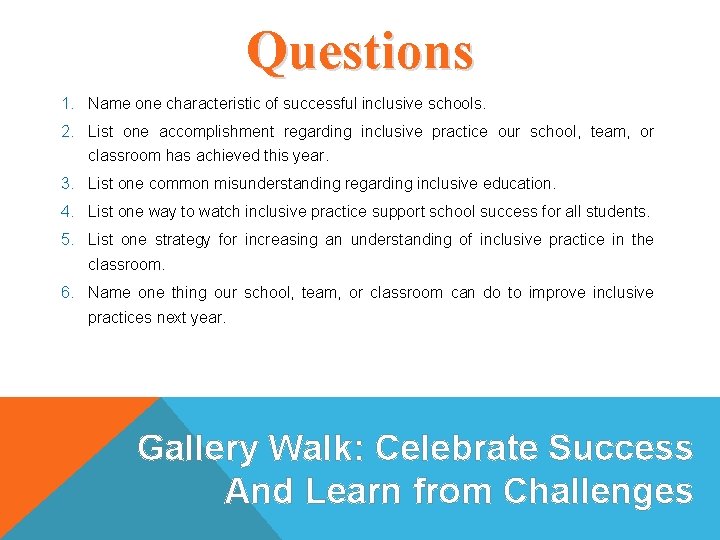
Questions 1. Name one characteristic of successful inclusive schools. 2. List one accomplishment regarding inclusive practice our school, team, or classroom has achieved this year. 3. List one common misunderstanding regarding inclusive education. 4. List one way to watch inclusive practice support school success for all students. 5. List one strategy for increasing an understanding of inclusive practice in the classroom. 6. Name one thing our school, team, or classroom can do to improve inclusive practices next year. Gallery Walk: Celebrate Success And Learn from Challenges
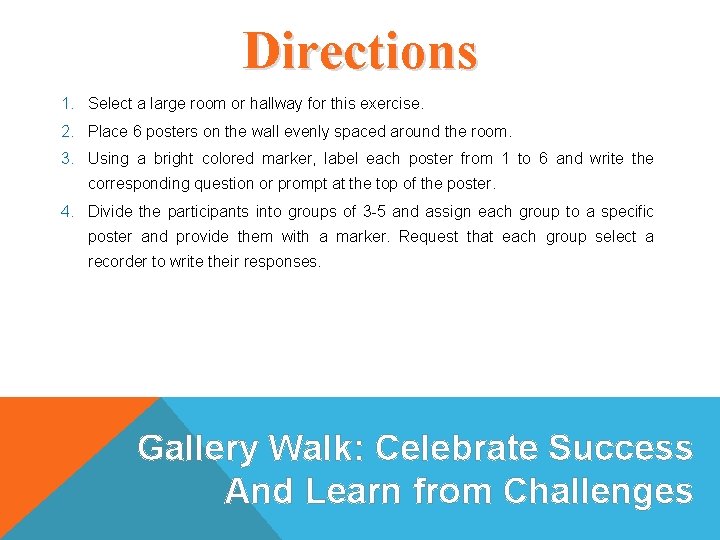
Directions 1. Select a large room or hallway for this exercise. 2. Place 6 posters on the wall evenly spaced around the room. 3. Using a bright colored marker, label each poster from 1 to 6 and write the corresponding question or prompt at the top of the poster. 4. Divide the participants into groups of 3 -5 and assign each group to a specific poster and provide them with a marker. Request that each group select a recorder to write their responses. Gallery Walk: Celebrate Success And Learn from Challenges
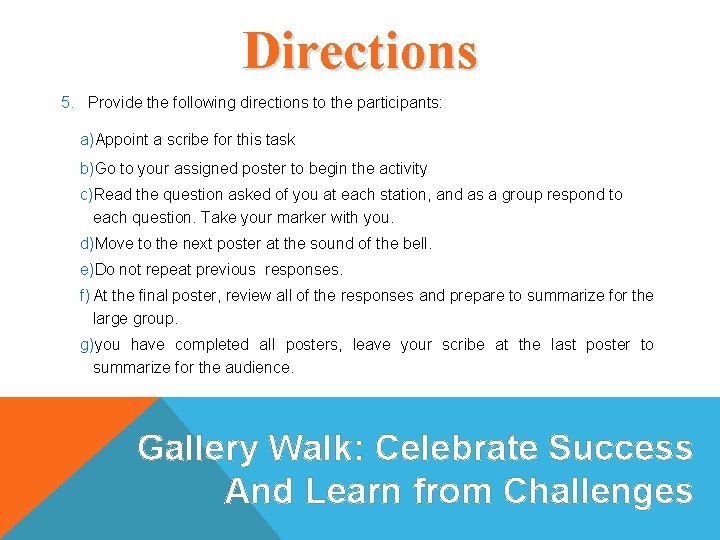
Directions 5. Provide the following directions to the participants: a)Appoint a scribe for this task b)Go to your assigned poster to begin the activity c)Read the question asked of you at each station, and as a group respond to each question. Take your marker with you. d)Move to the next poster at the sound of the bell. e)Do not repeat previous responses. f) At the final poster, review all of the responses and prepare to summarize for the large group. g)you have completed all posters, leave your scribe at the last poster to summarize for the audience. Gallery Walk: Celebrate Success And Learn from Challenges
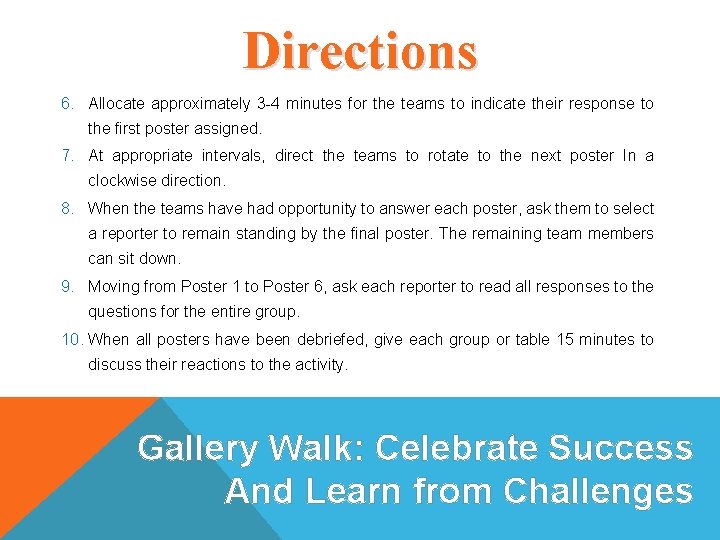
Directions 6. Allocate approximately 3 -4 minutes for the teams to indicate their response to the first poster assigned. 7. At appropriate intervals, direct the teams to rotate to the next poster In a clockwise direction. 8. When the teams have had opportunity to answer each poster, ask them to select a reporter to remain standing by the final poster. The remaining team members can sit down. 9. Moving from Poster 1 to Poster 6, ask each reporter to read all responses to the questions for the entire group. 10. When all posters have been debriefed, give each group or table 15 minutes to discuss their reactions to the activity. Gallery Walk: Celebrate Success And Learn from Challenges
I S N O S U D C IS
1. What are your impressions of the status of inclusive practice at our school? 2. Were there any surprises? If so, what were they? 3. What aspects of our inclusive practices can we celebrate and why? 4. Name three priorities for improving our inclusive practices. 5. What are our next steps? Discussion Questions
N O I S U L O C C N
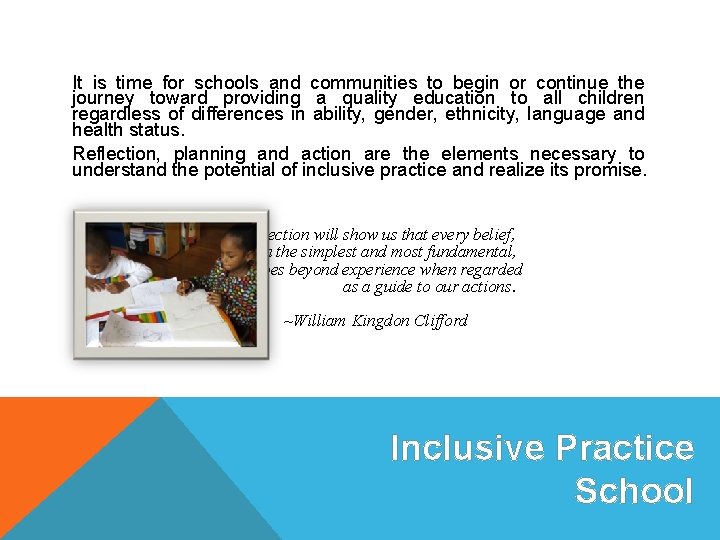
It is time for schools and communities to begin or continue the journey toward providing a quality education to all children regardless of differences in ability, gender, ethnicity, language and health status. Reflection, planning and action are the elements necessary to understand the potential of inclusive practice and realize its promise. A little reflection will show us that every belief, even the simplest and most fundamental, goes beyond experience when regarded as a guide to our actions. ~William Kingdon Clifford Inclusive Practice School