
Movements of Earth Vocabulary Rotation Revolution Perihelion Aphelion
Movements of Earth
Vocabulary Rotation Revolution Perihelion Aphelion Precession Perigee Apogee Solar eclipse Nutation Barycenter Elliopsoid
Revolution Period of REVOLUTION= one complete elliptical orbit around the sun or planet (moon). Earth=364. 26 Why do we need a leap year? Mercury=88 days Pluto=248 Earth years Planets revolve in a counterclockwise direction around the Sun.

Rotation The period of ROTATION= movement of planet around its axis. =1 day/night cycle. Earth=24 hours Mercury=59 Earth days Pluto=6 Earth days

Aphelion = the point at which the Earth is farthest from the Sun in its orbit Perihelion = the point at which the Earth is closest to the Sun in its orbit Contrary to belief, the Earth is at its aphelion(farthest) during summer So why is summer hotter?
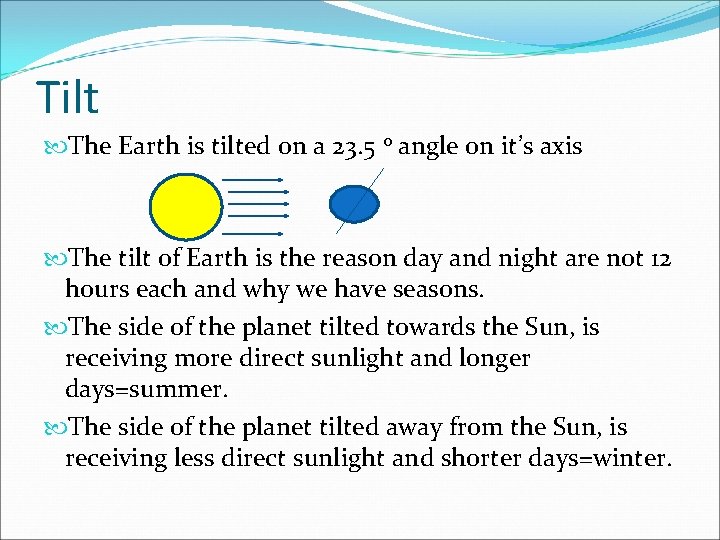
Tilt The Earth is tilted on a 23. 5 o angle on it’s axis The tilt of Earth is the reason day and night are not 12 hours each and why we have seasons. The side of the planet tilted towards the Sun, is receiving more direct sunlight and longer days=summer. The side of the planet tilted away from the Sun, is receiving less direct sunlight and shorter days=winter.
Tilt Any planet that is tilted on its axis will have seasons. Seasons are marked by specific dates: Summer solstice June 20/21 –sun is at highest point in the sky and longest day of the year. Winter solstice Dec. 21/22 -the Northern hemisphere is at full tilt away from the sun and shortest day of the year. Autumnal equinox Sept. 22/23 -day and night are equal Vernal equinox March 20/21 day-day and night are equal.

Precession Change in the direction of the axis but there is not change in the 23. 5 o tilt. Changes the stars that appear near the pole-Polaris (current) or Vega. Does not affect seasons.
Barycenter http: //spaceplace. nasa. gov/barycenter/ The balance between the masses of the planets as they orbit. In the case of the Moon and the Earth-the Moon doesn’t orbit the Earth’s exact center, but a point 1, 710 km below the surface. This is where the masses balance each other. Causes the Sun to wobble-it is not stationary in the solar system. As planets tug on it with their gravity it wobbles, but never goes far from its barycenter.

Nutation A wobble around the Earth’s axis 1/2 o change/18 year period. Due to the Moon and tides.
Ellipsoid Earth The Earth’s diameter is wider at the equator than at the poles-not a perfect sphere. Caused by the rotation of the Earth and the centrifugal force perpindicular to it. The Earth has a molten core, tectonic plates, and a thin crust that can move; therefore there is a slight flattening.
Eclipses Solar eclipse-when the moon moved between the Earth and the sun. During the New Moon phases Lunar eclipse-the moon is eclipsed when it moves within the Earth’s shadow. During the Full Moon phases
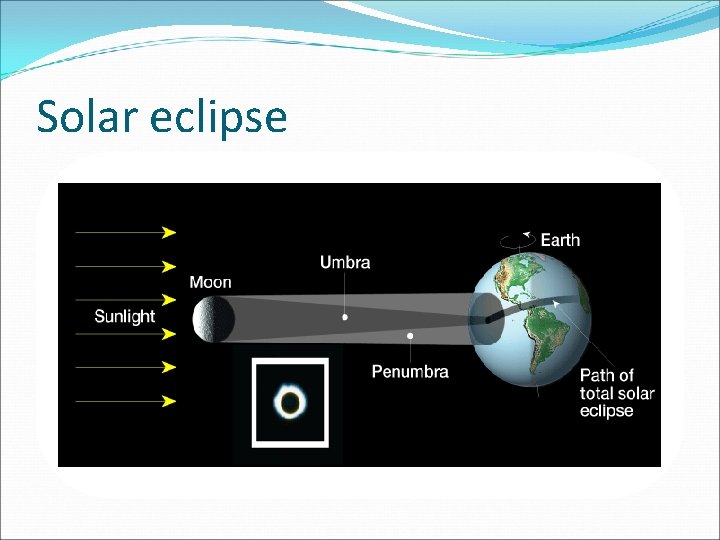
Solar eclipse
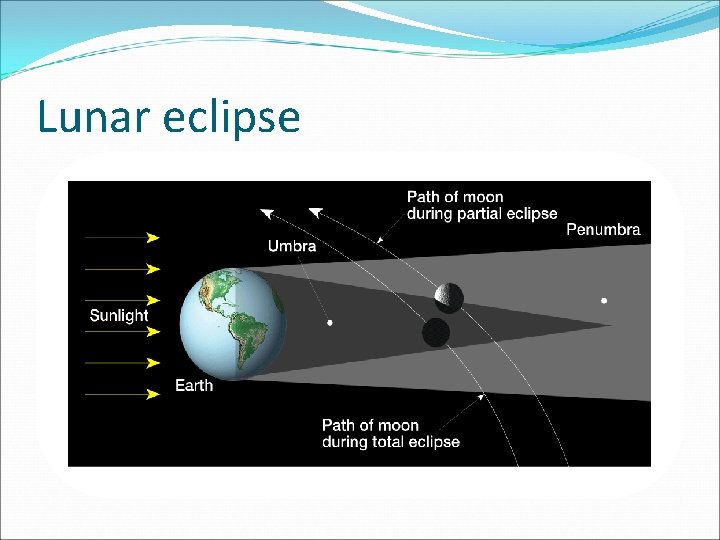
Lunar eclipse
- Slides: 14