
MOVEMENT The roles of the musculoskeletal system are
- Slides: 44
MOVEMENT The roles of the musculoskeletal system are movement, support and protection. AHL Topic 11. 2 IB Biology Miss Werba
TOPIC 11 – ANIMAL PHYSIOLOGY 11. 1 ANTIBODY PRODUCTION & VACCINATION 11. 4 SEXUAL REPRODUCTION 11. 2 MOVEMENT 11. 3 THE KIDNEY & OSMOREGULATION J WERBA – IB BIOLOGY 2
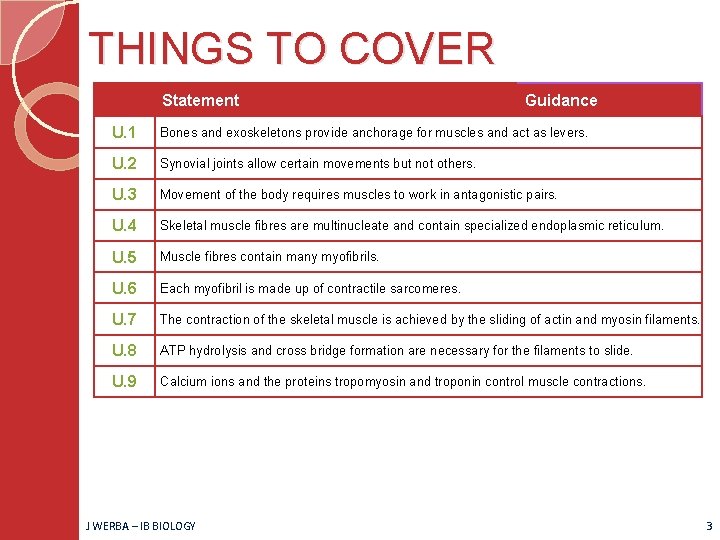
THINGS TO COVER Statement Guidance U. 1 Bones and exoskeletons provide anchorage for muscles and act as levers. U. 2 Synovial joints allow certain movements but not others. U. 3 Movement of the body requires muscles to work in antagonistic pairs. U. 4 Skeletal muscle fibres are multinucleate and contain specialized endoplasmic reticulum. U. 5 Muscle fibres contain many myofibrils. U. 6 Each myofibril is made up of contractile sarcomeres. U. 7 The contraction of the skeletal muscle is achieved by the sliding of actin and myosin filaments. U. 8 ATP hydrolysis and cross bridge formation are necessary for the filaments to slide. U. 9 Calcium ions and the proteins tropomyosin and troponin control muscle contractions. J WERBA – IB BIOLOGY 3
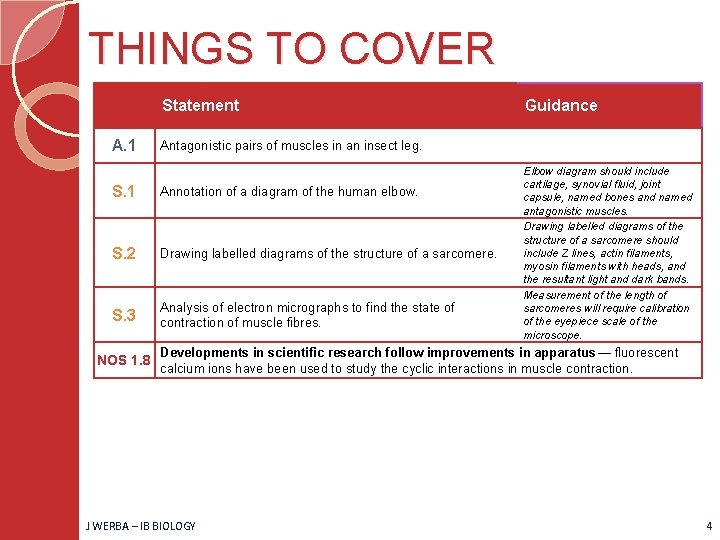
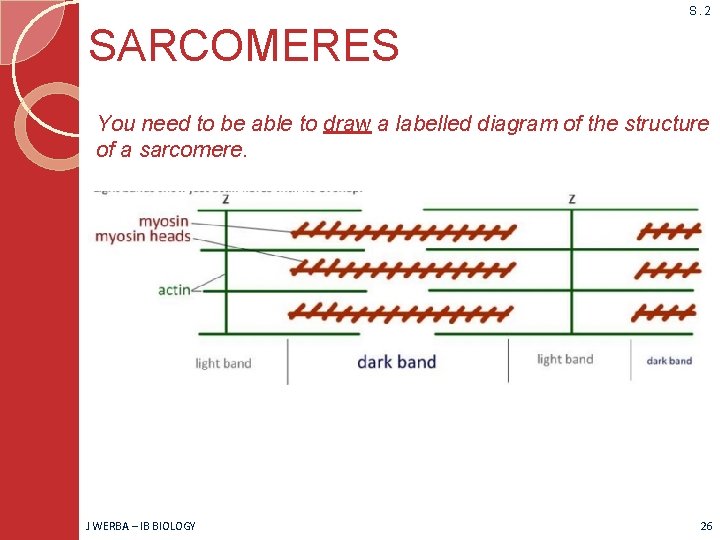
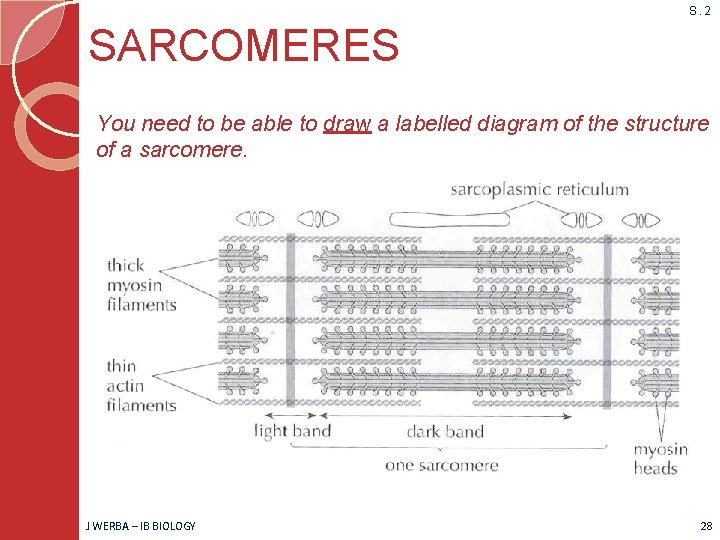
THINGS TO COVER Statement A. 1 Antagonistic pairs of muscles in an insect leg. S. 1 Annotation of a diagram of the human elbow. S. 2 Drawing labelled diagrams of the structure of a sarcomere. S. 3 Analysis of electron micrographs to find the state of contraction of muscle fibres. NOS 1. 8 Guidance Elbow diagram should include cartilage, synovial fluid, joint capsule, named bones and named antagonistic muscles. Drawing labelled diagrams of the structure of a sarcomere should include Z lines, actin filaments, myosin filaments with heads, and the resultant light and dark bands. Measurement of the length of sarcomeres will require calibration of the eyepiece scale of the microscope. Developments in scientific research follow improvements in apparatus — fluorescent calcium ions have been used to study the cyclic interactions in muscle contraction. J WERBA – IB BIOLOGY 4
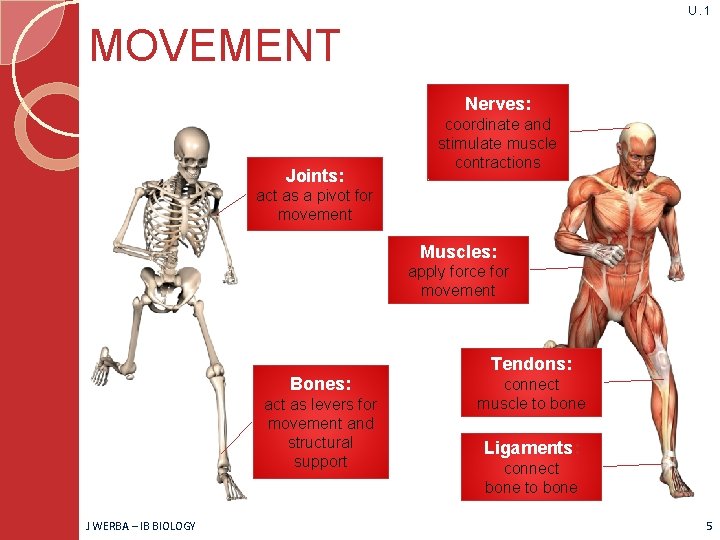
U. 1 MOVEMENT Nerves: Joints: coordinate and stimulate muscle contractions act as a pivot for movement Muscles: apply force for movement Tendons: Bones: act as levers for movement and structural support J WERBA – IB BIOLOGY connect muscle to bone Ligaments: connect bone to bone 5
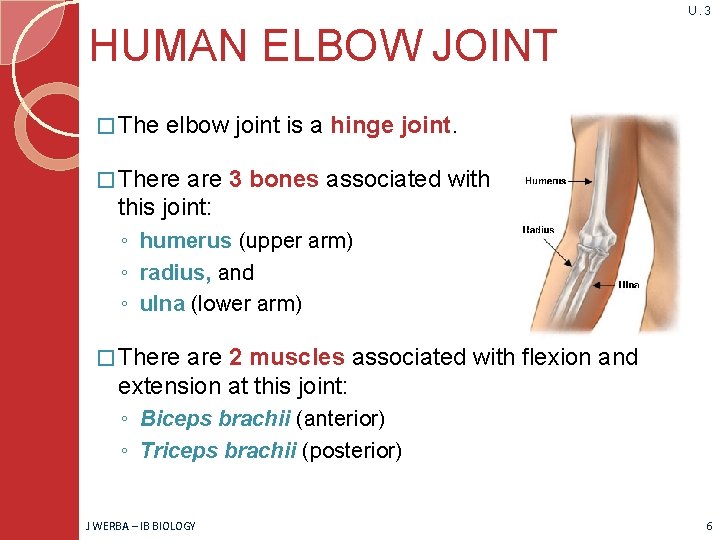
U. 3 HUMAN ELBOW JOINT � The elbow joint is a hinge joint. � There are 3 bones associated with this joint: ◦ humerus (upper arm) ◦ radius, and ◦ ulna (lower arm) � There are 2 muscles associated with flexion and extension at this joint: ◦ Biceps brachii (anterior) ◦ Triceps brachii (posterior) J WERBA – IB BIOLOGY 6
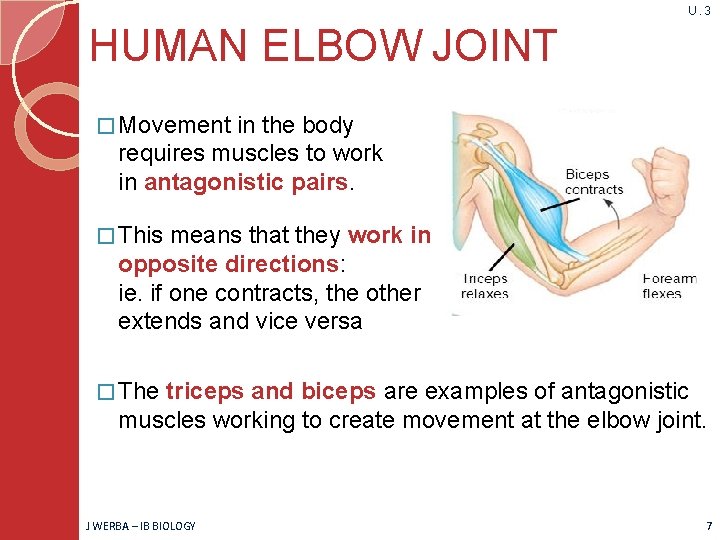
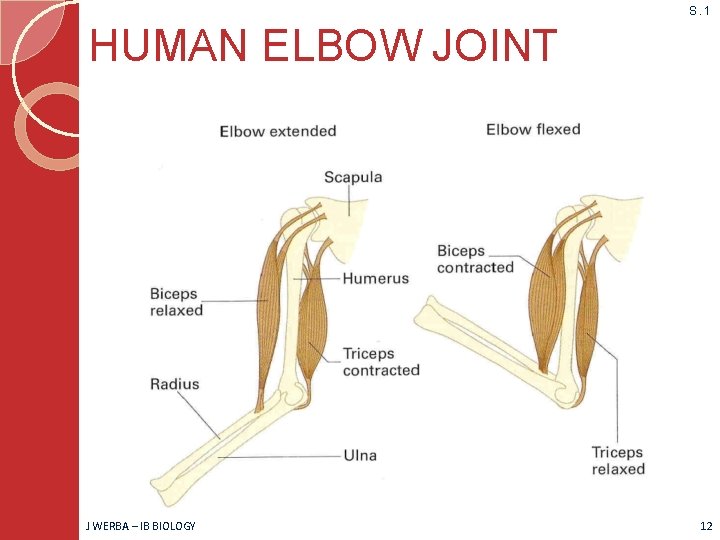
U. 3 HUMAN ELBOW JOINT � Movement in the body requires muscles to work in antagonistic pairs. � This means that they work in opposite directions: ie. if one contracts, the other extends and vice versa � The triceps and biceps are examples of antagonistic muscles working to create movement at the elbow joint. J WERBA – IB BIOLOGY 7
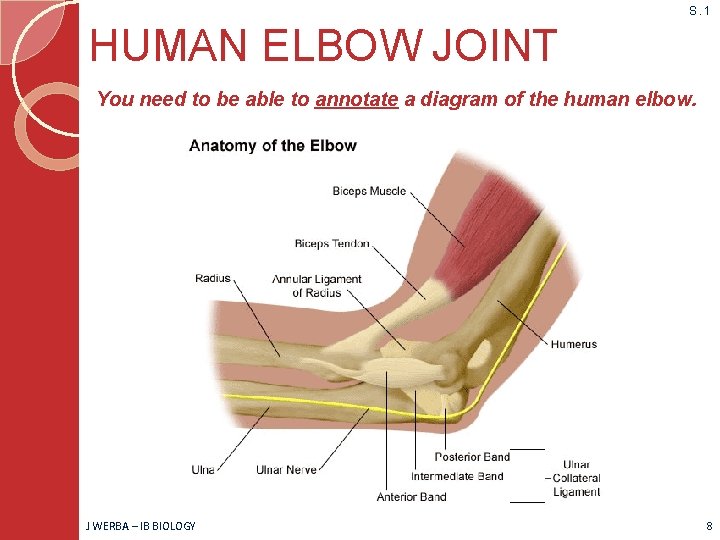
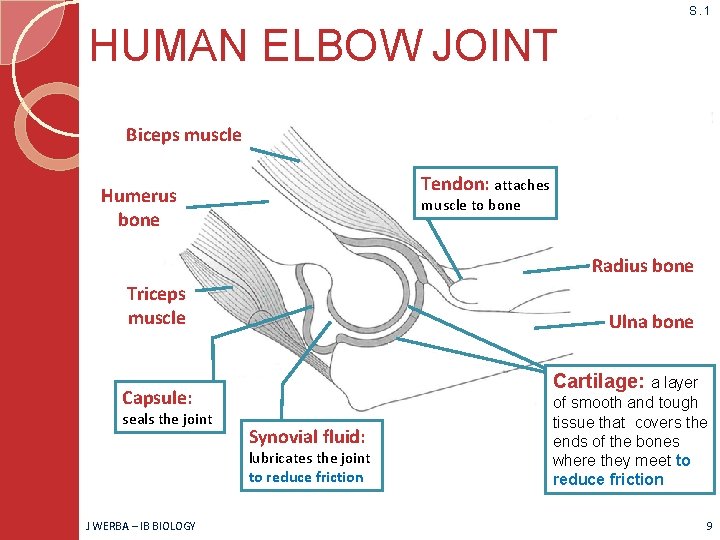
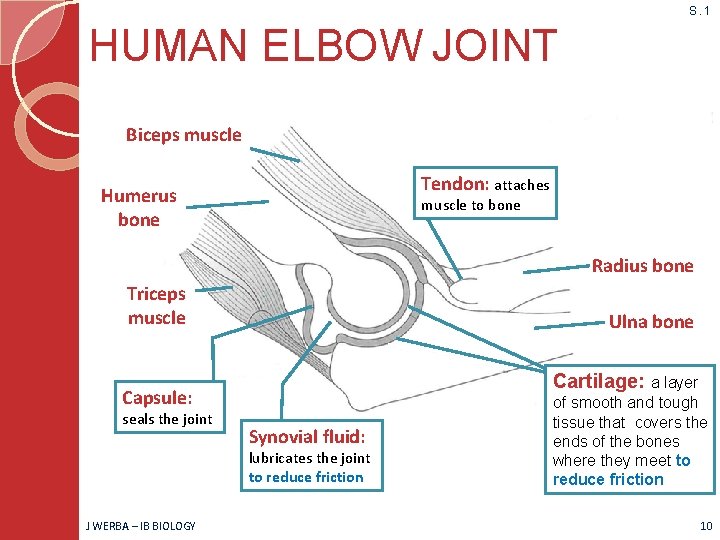
S. 1 HUMAN ELBOW JOINT You need to be able to annotate a diagram of the human elbow. J WERBA – IB BIOLOGY 8
S. 1 HUMAN ELBOW JOINT Biceps muscle Tendon: attaches Humerus bone muscle to bone Radius bone Triceps muscle Ulna bone Cartilage: a layer Capsule: seals the joint Synovial fluid: lubricates the joint to reduce friction J WERBA – IB BIOLOGY of smooth and tough tissue that covers the ends of the bones where they meet to reduce friction 9
S. 1 HUMAN ELBOW JOINT Biceps muscle Tendon: attaches Humerus bone muscle to bone Radius bone Triceps muscle Ulna bone Cartilage: a layer Capsule: seals the joint Synovial fluid: lubricates the joint to reduce friction J WERBA – IB BIOLOGY of smooth and tough tissue that covers the ends of the bones where they meet to reduce friction 10
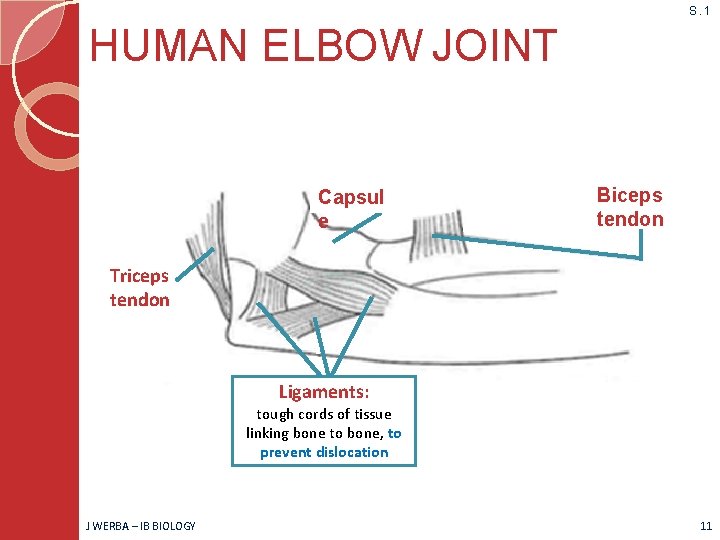
S. 1 HUMAN ELBOW JOINT Capsul e Biceps tendon Triceps tendon Ligaments: tough cords of tissue linking bone to bone, to prevent dislocation J WERBA – IB BIOLOGY 11
S. 1 HUMAN ELBOW JOINT J WERBA – IB BIOLOGY 12
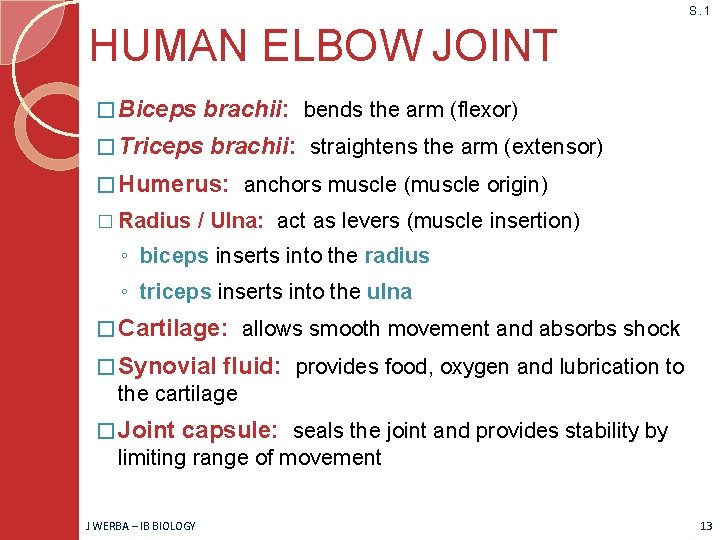
S. 1 HUMAN ELBOW JOINT � Biceps brachii: bends the arm (flexor) � Triceps brachii: straightens the arm (extensor) � Humerus: anchors muscle (muscle origin) � Radius / Ulna: act as levers (muscle insertion) ◦ biceps inserts into the radius ◦ triceps inserts into the ulna � Cartilage: allows smooth movement and absorbs shock � Synovial fluid: provides food, oxygen and lubrication to the cartilage � Joint capsule: seals the joint and provides stability by limiting range of movement J WERBA – IB BIOLOGY 13
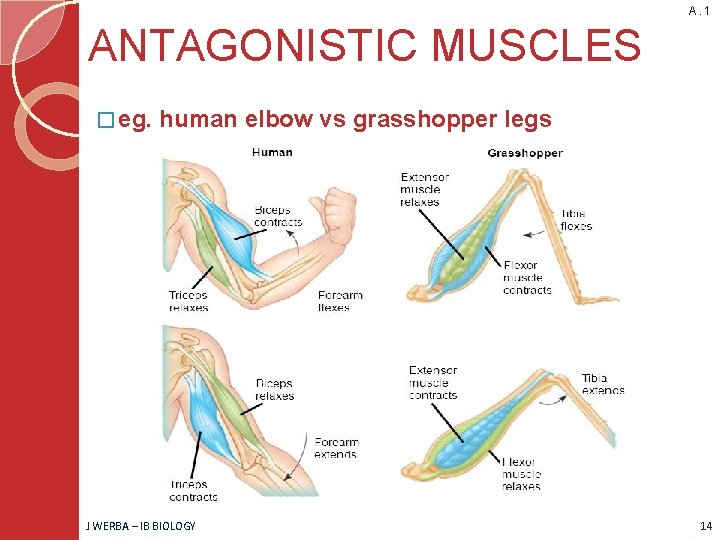
A. 1 ANTAGONISTIC MUSCLES � eg. human elbow vs grasshopper legs J WERBA – IB BIOLOGY 14
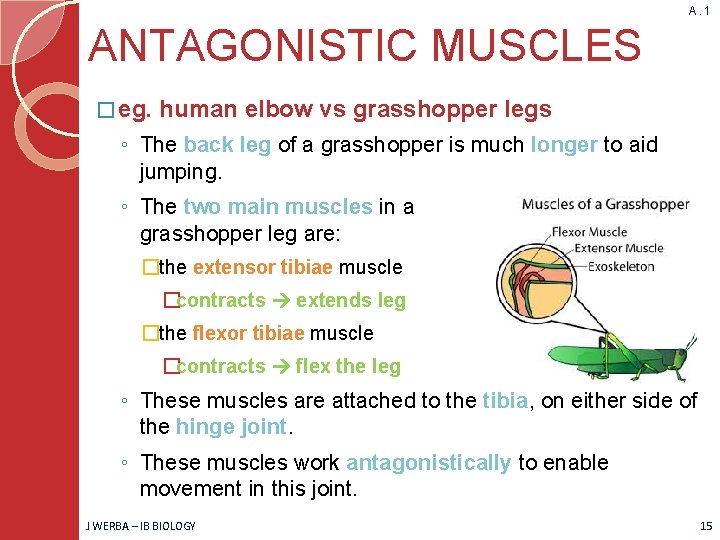
A. 1 ANTAGONISTIC MUSCLES � eg. human elbow vs grasshopper legs ◦ The back leg of a grasshopper is much longer to aid jumping. ◦ The two main muscles in a grasshopper leg are: �the extensor tibiae muscle �contracts extends leg �the flexor tibiae muscle �contracts flex the leg ◦ These muscles are attached to the tibia, on either side of the hinge joint. ◦ These muscles work antagonistically to enable movement in this joint. J WERBA – IB BIOLOGY 15
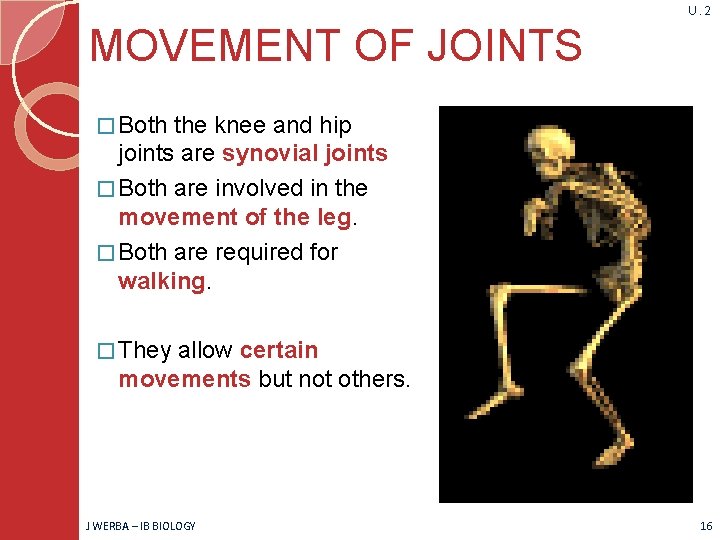
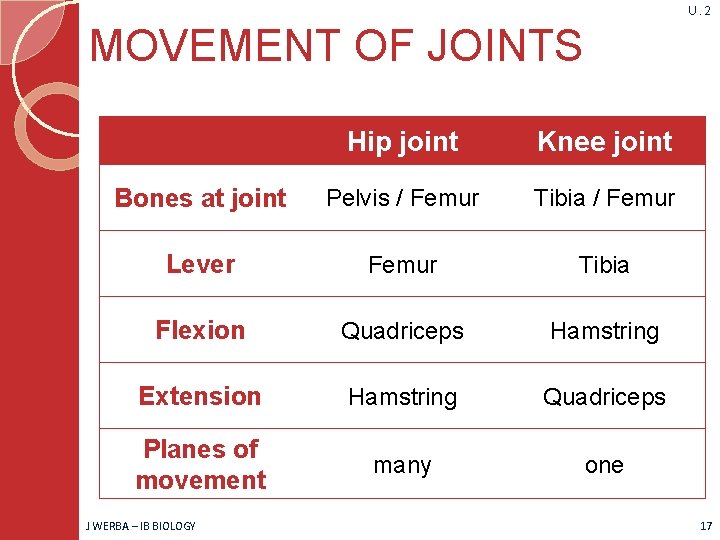
U. 2 MOVEMENT OF JOINTS � Both the knee and hip joints are synovial joints � Both are involved in the movement of the leg. � Both are required for walking. � They allow certain movements but not others. J WERBA – IB BIOLOGY 16
U. 2 MOVEMENT OF JOINTS Hip joint Knee joint Bones at joint Pelvis / Femur Tibia / Femur Lever Femur Tibia Flexion Quadriceps Hamstring Extension Hamstring Quadriceps Planes of movement many one J WERBA – IB BIOLOGY 17
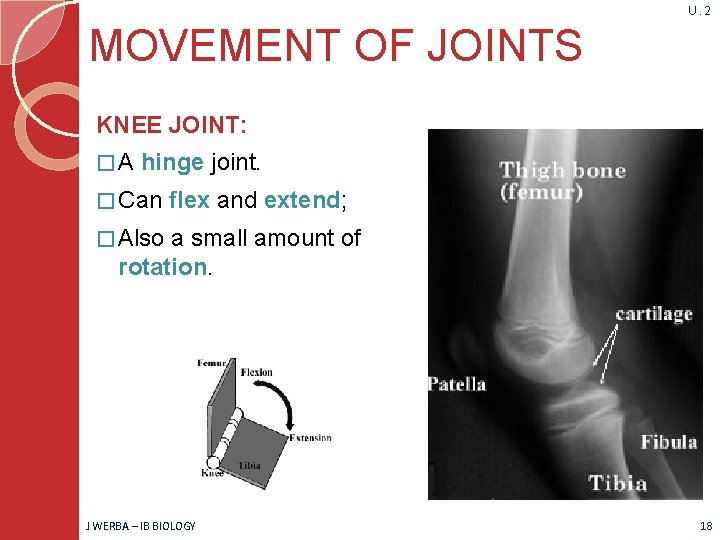
U. 2 MOVEMENT OF JOINTS KNEE JOINT: �A hinge joint. � Can flex and extend; � Also a small amount of rotation. J WERBA – IB BIOLOGY 18
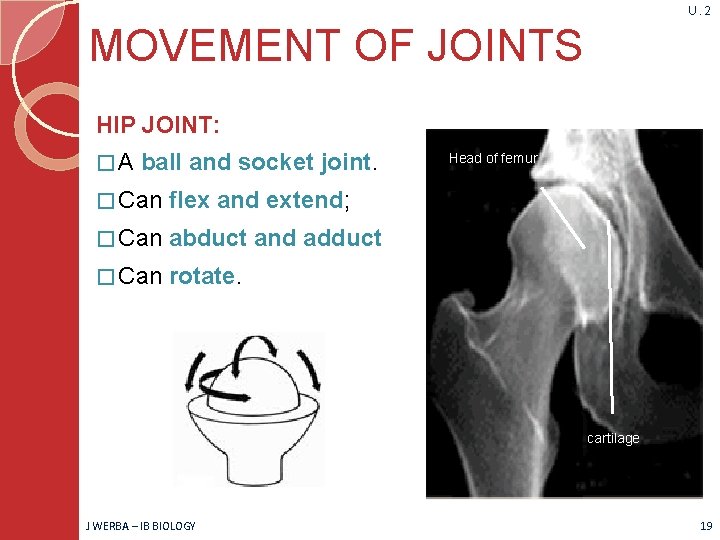
U. 2 MOVEMENT OF JOINTS HIP JOINT: �A ball and socket joint. � Can flex and extend; � Can abduct and adduct � Can rotate. Head of femur cartilage J WERBA – IB BIOLOGY 19
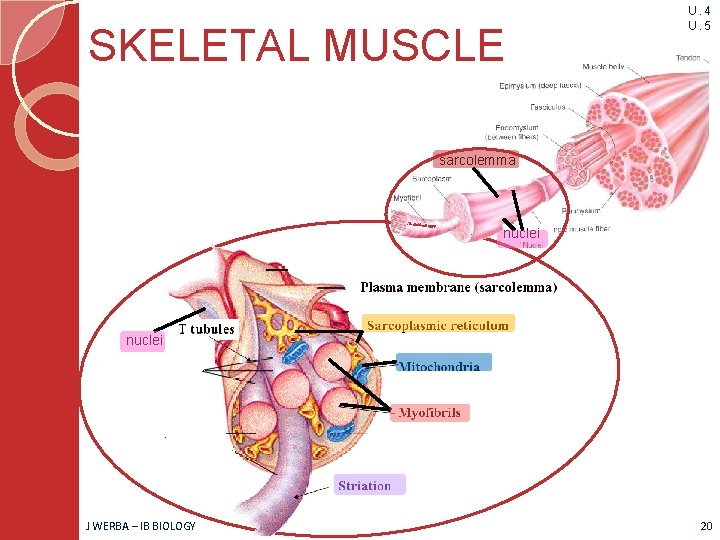
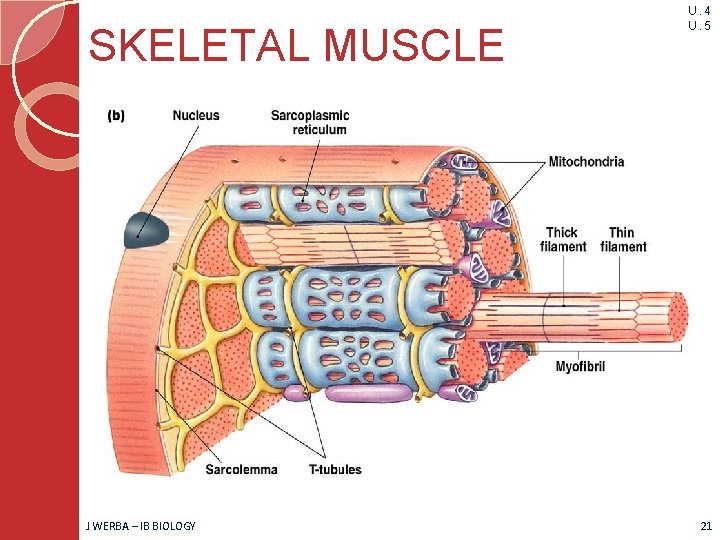
SKELETAL MUSCLE U. 4 U. 5 sarcolemma nuclei J WERBA – IB BIOLOGY 20
SKELETAL MUSCLE J WERBA – IB BIOLOGY U. 4 U. 5 21
SKELETAL MUSCLE U. 4 U. 5 � Skeletal muscle cells (fibres) are bundled together by the sarcolemma (a membrane). � Muscle cells are multinucleated – with the nuclei along the edges of the cell. � The muscle cells have many mitochondria to supply the large amount of ATP required. � The muscle cell is composed of myofibrils. � The myofibrils have striations - dark and light bands and contracts longitudinally (ie. along its length). � The sarcoplasmic reticulum lies under the sarcolemma. This is a special type of smooth ER whose function is to store and release calcium ions. J WERBA – IB BIOLOGY 22
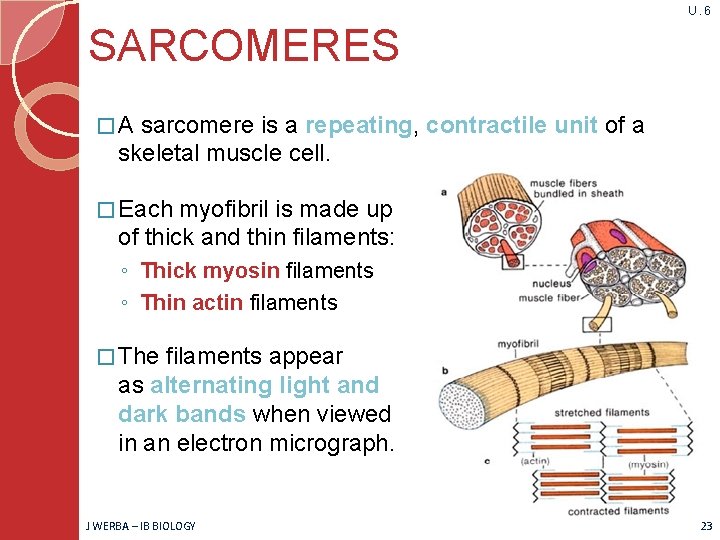
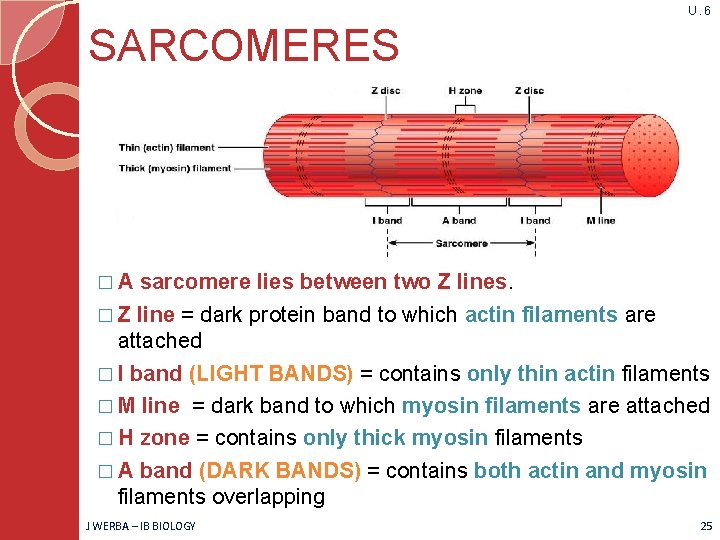
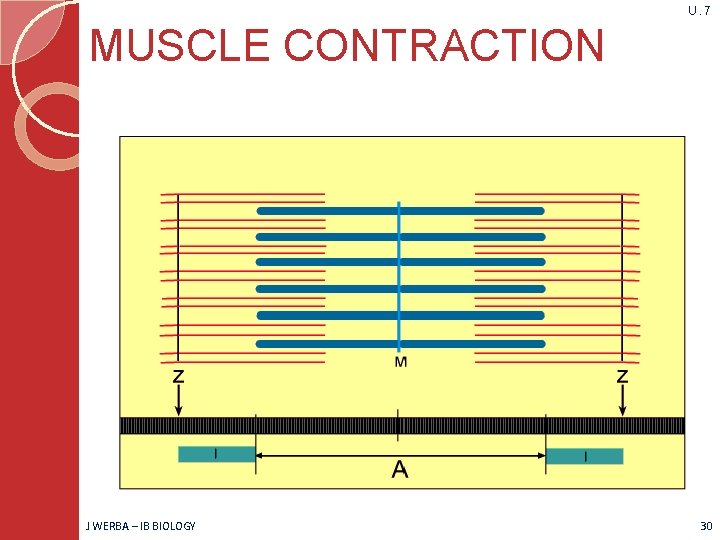
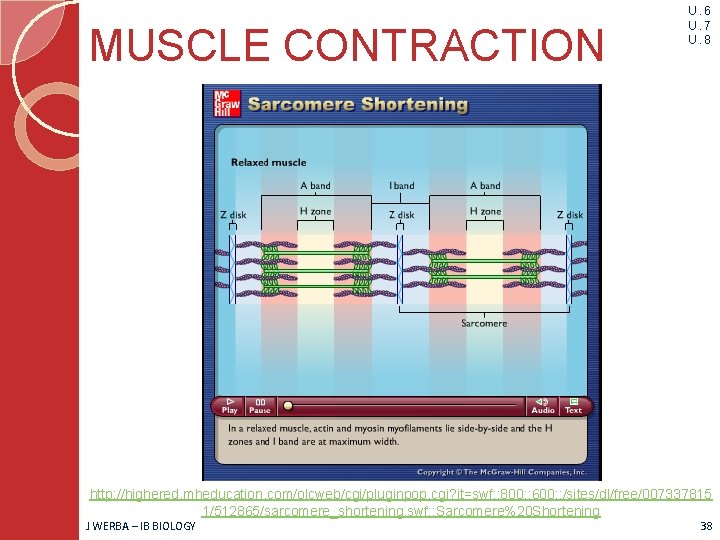
U. 6 SARCOMERES �A sarcomere is a repeating, contractile unit of a skeletal muscle cell. � Each myofibril is made up of thick and thin filaments: ◦ Thick myosin filaments ◦ Thin actin filaments � The filaments appear as alternating light and dark bands when viewed in an electron micrograph. J WERBA – IB BIOLOGY 23
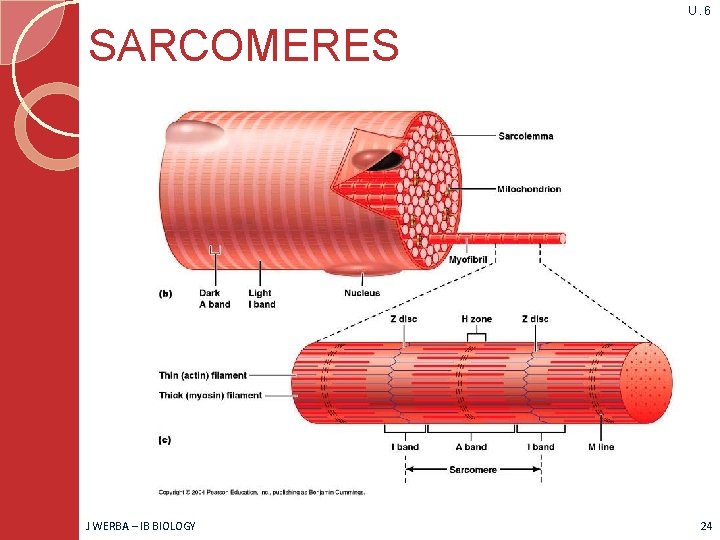
U. 6 SARCOMERES J WERBA – IB BIOLOGY 24
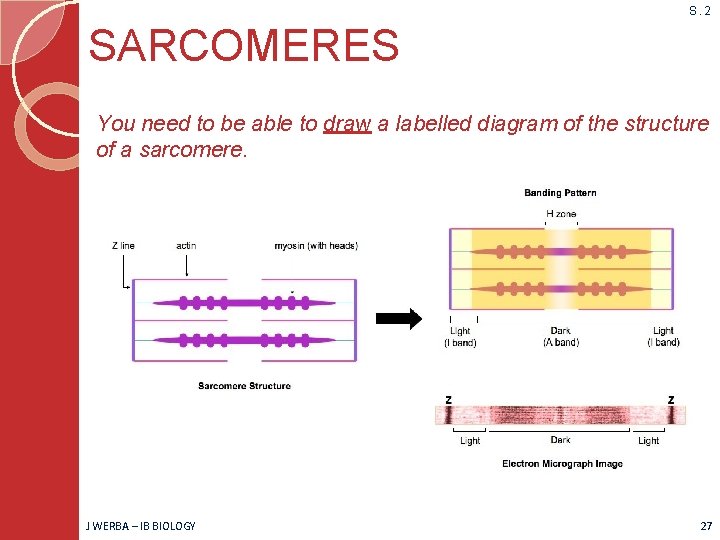
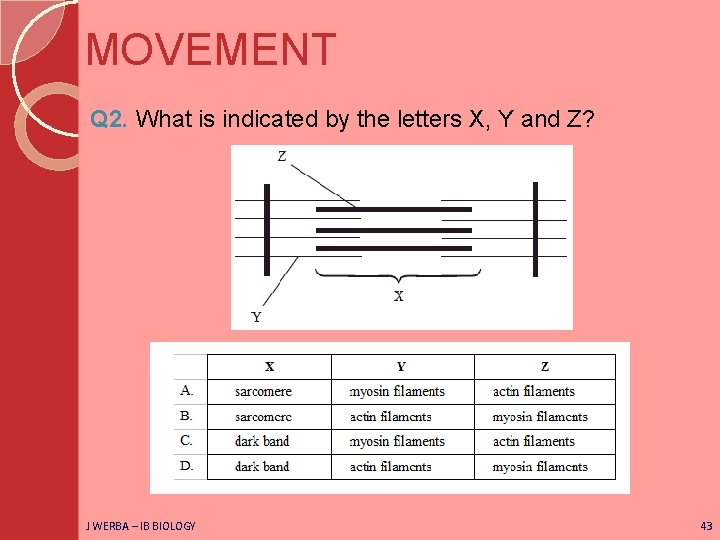
U. 6 SARCOMERES �A sarcomere lies between two Z lines. � Z line = dark protein band to which actin filaments are attached � I band (LIGHT BANDS) = contains only thin actin filaments � M line = dark band to which myosin filaments are attached � H zone = contains only thick myosin filaments � A band (DARK BANDS) = contains both actin and myosin filaments overlapping J WERBA – IB BIOLOGY 25
S. 2 SARCOMERES You need to be able to draw a labelled diagram of the structure of a sarcomere. J WERBA – IB BIOLOGY 26
S. 2 SARCOMERES You need to be able to draw a labelled diagram of the structure of a sarcomere. J WERBA – IB BIOLOGY 27
S. 2 SARCOMERES You need to be able to draw a labelled diagram of the structure of a sarcomere. J WERBA – IB BIOLOGY 28
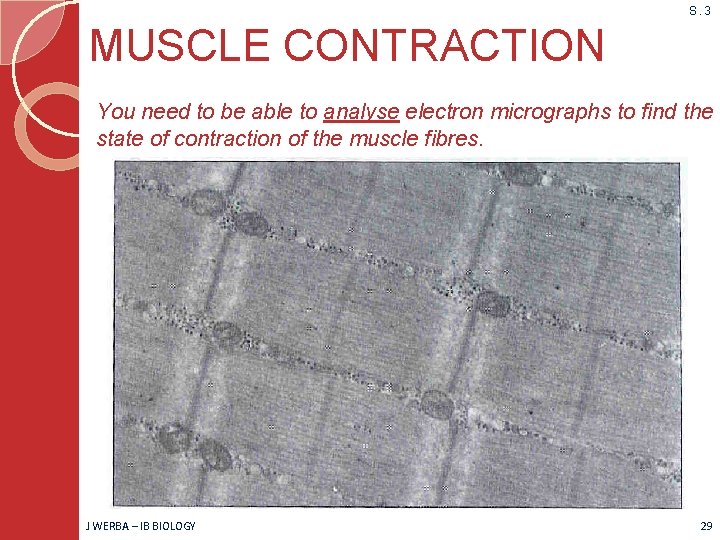
S. 3 MUSCLE CONTRACTION You need to be able to analyse electron micrographs to find the state of contraction of the muscle fibres. J WERBA – IB BIOLOGY 29
U. 7 MUSCLE CONTRACTION J WERBA – IB BIOLOGY 30
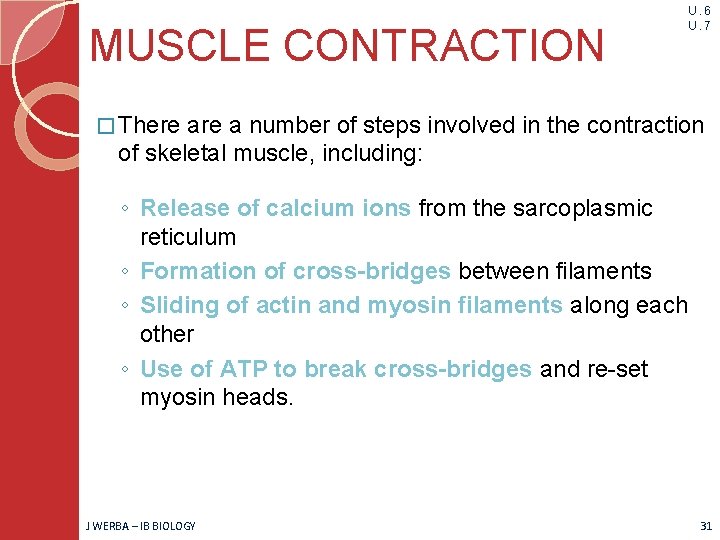
MUSCLE CONTRACTION U. 6 U. 7 � There a number of steps involved in the contraction of skeletal muscle, including: ◦ Release of calcium ions from the sarcoplasmic reticulum ◦ Formation of cross-bridges between filaments ◦ Sliding of actin and myosin filaments along each other ◦ Use of ATP to break cross-bridges and re-set myosin heads. J WERBA – IB BIOLOGY 31
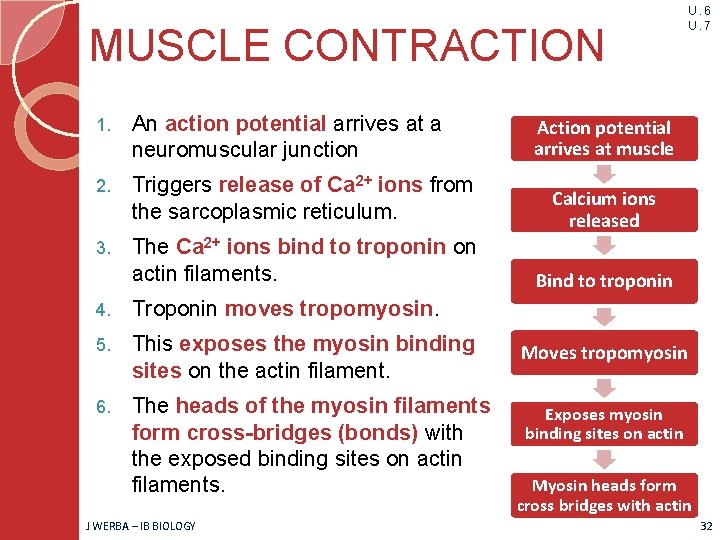
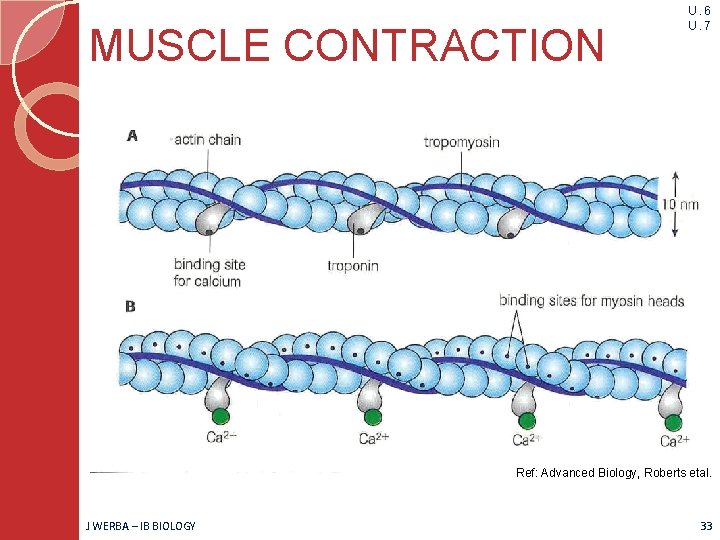
MUSCLE CONTRACTION 1. An action potential arrives at a neuromuscular junction 2. Triggers release of Ca 2+ ions from the sarcoplasmic reticulum. Calcium ions released 3. The Ca 2+ ions bind to troponin on actin filaments. Bind to troponin 4. Troponin moves tropomyosin. 5. This exposes the myosin binding sites on the actin filament. 6. The heads of the myosin filaments form cross-bridges (bonds) with the exposed binding sites on actin filaments. J WERBA – IB BIOLOGY U. 6 U. 7 Action potential arrives at muscle Moves tropomyosin Exposes myosin binding sites on actin Myosin heads form cross bridges with actin 32
MUSCLE CONTRACTION U. 6 U. 7 Ref: Advanced Biology, Roberts etal. J WERBA – IB BIOLOGY 33
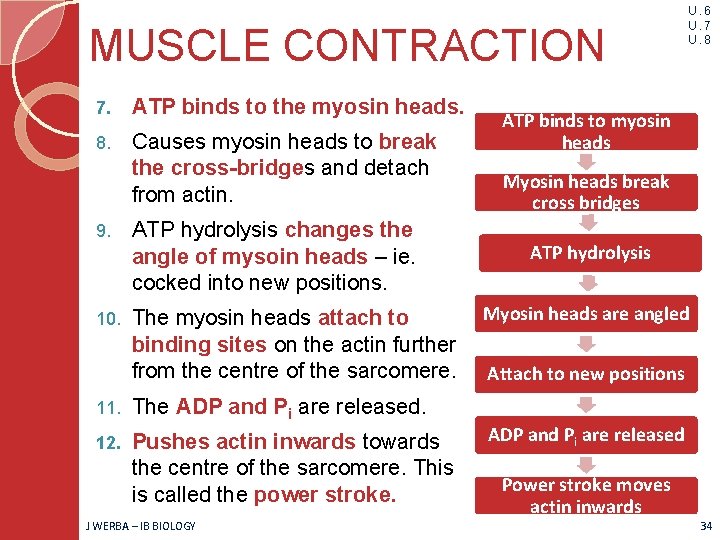
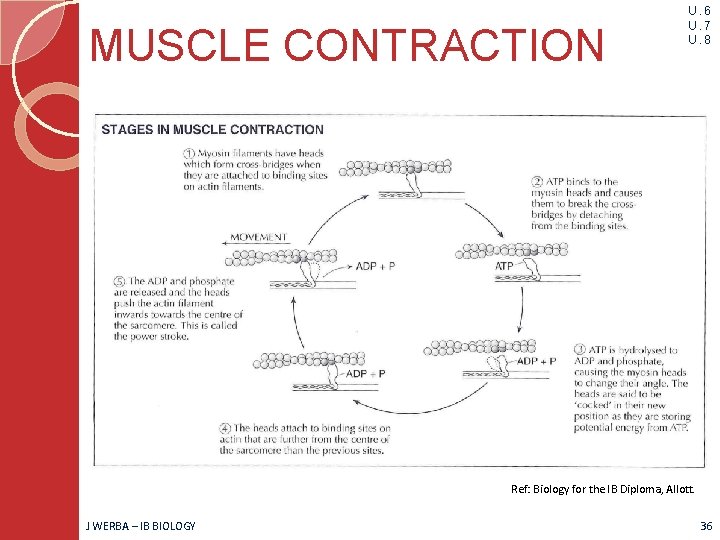
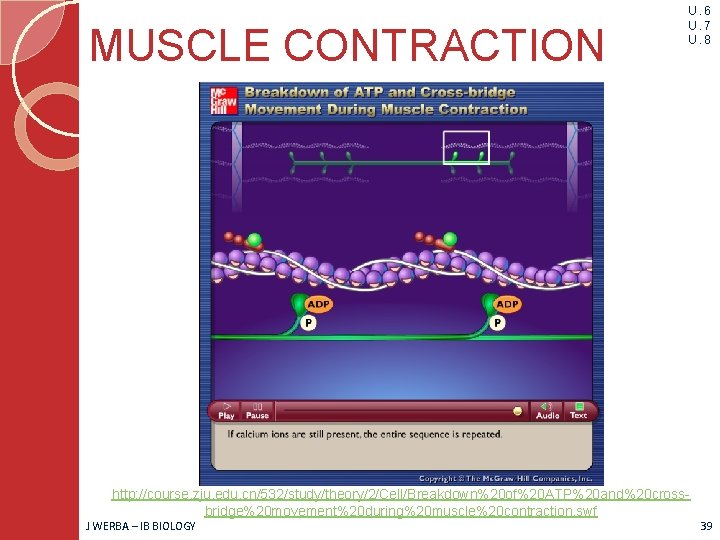
MUSCLE CONTRACTION 7. ATP binds to the myosin heads. 8. Causes myosin heads to break the cross-bridges and detach from actin. 9. ATP hydrolysis changes the angle of mysoin heads – ie. cocked into new positions. 10. The myosin heads attach to binding sites on the actin further from the centre of the sarcomere. 11. The ADP and Pi are released. 12. Pushes actin inwards towards the centre of the sarcomere. This is called the power stroke. J WERBA – IB BIOLOGY U. 6 U. 7 U. 8 ATP binds to myosin heads Myosin heads break cross bridges ATP hydrolysis Myosin heads are angled Attach to new positions ADP and Pi are released Power stroke moves actin inwards 34
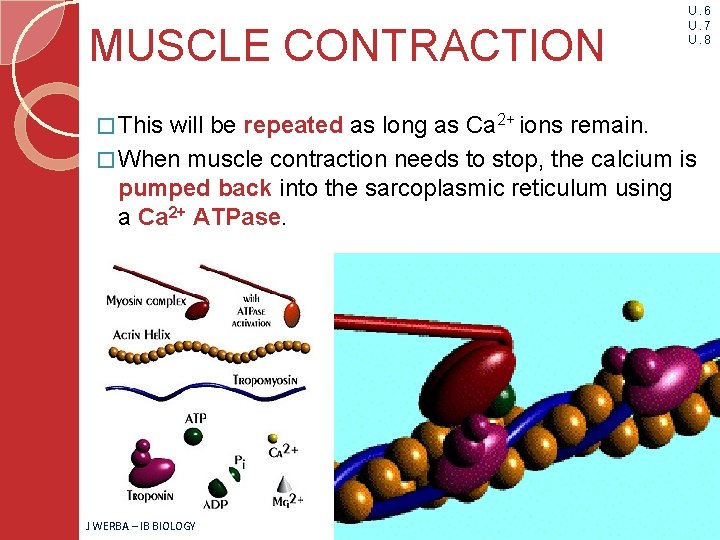
MUSCLE CONTRACTION U. 6 U. 7 U. 8 � This will be repeated as long as Ca 2+ ions remain. � When muscle contraction needs to stop, the calcium is pumped back into the sarcoplasmic reticulum using a Ca 2+ ATPase. J WERBA – IB BIOLOGY 35
MUSCLE CONTRACTION U. 6 U. 7 U. 8 Ref: Biology for the IB Diploma, Allott. J WERBA – IB BIOLOGY 36
MUSCLE CONTRACTION J WERBA – IB BIOLOGY U. 6 U. 7 U. 8 37
MUSCLE CONTRACTION U. 6 U. 7 U. 8 http: //highered. mheducation. com/olcweb/cgi/pluginpop. cgi? it=swf: : 800: : 600: : /sites/dl/free/007337815 1/512865/sarcomere_shortening. swf: : Sarcomere%20 Shortening J WERBA – IB BIOLOGY 38
MUSCLE CONTRACTION U. 6 U. 7 U. 8 http: //course. zju. edu. cn/532/study/theory/2/Cell/Breakdown%20 of%20 ATP%20 and%20 crossbridge%20 movement%20 during%20 muscle%20 contraction. swf J WERBA – IB BIOLOGY 39
ASHLEY & RIDGEWAY NOS 1. 8 Developments in scientific research follow improvements in apparatus Fluorescent calcium ions have been used to study the cyclic interactions in muscle contraction. J WERBA – IB BIOLOGY 40
NOS 1. 8 ASHLEY & RIDGEWAY � Experiments performed in 1968. � First to study the role of calcium ions at the neuromuscular junction. � Used aequorin – a bioluminescent protein that binds to calcium ions � Light is produced when calcium is released. � Linked the arrival of the action potential at the muscle fibre with the contraction of the muscle. � Consistent with theory of the release of calcium ions from the sarcoplasmic reticulum. J WERBA – IB BIOLOGY 41
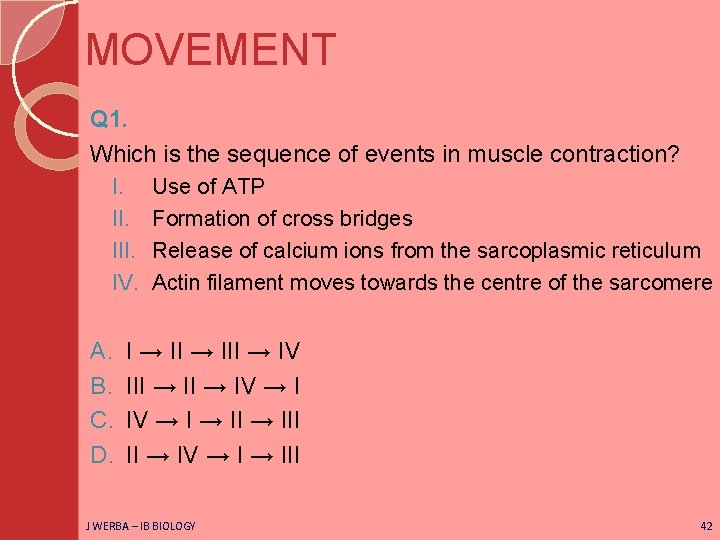
MOVEMENT Q 1. Which is the sequence of events in muscle contraction? I. III. IV. A. B. C. D. Use of ATP Formation of cross bridges Release of calcium ions from the sarcoplasmic reticulum Actin filament moves towards the centre of the sarcomere I → III → IV → I → III II → IV → III J WERBA – IB BIOLOGY 42
MOVEMENT Q 2. What is indicated by the letters X, Y and Z? J WERBA – IB BIOLOGY 43
MOVEMENT Q 3. Coughing to clear the airways is accomplished by muscle contractions. Explain muscle contraction. [8] J WERBA – IB BIOLOGY 44