
MOVE MOVE FREEZE TOTAL PHYSICAL RESPONSE TPR WHAT
- Slides: 9
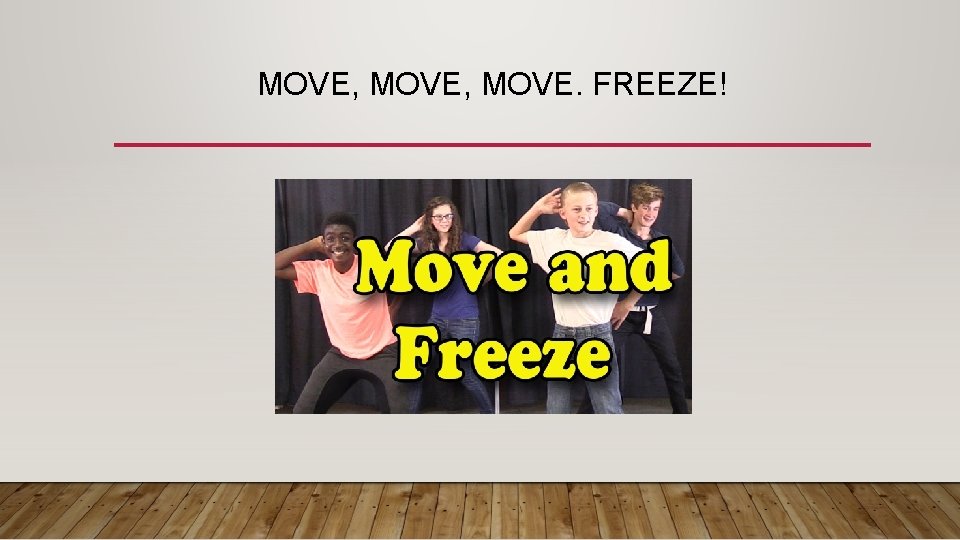
MOVE, MOVE. FREEZE!
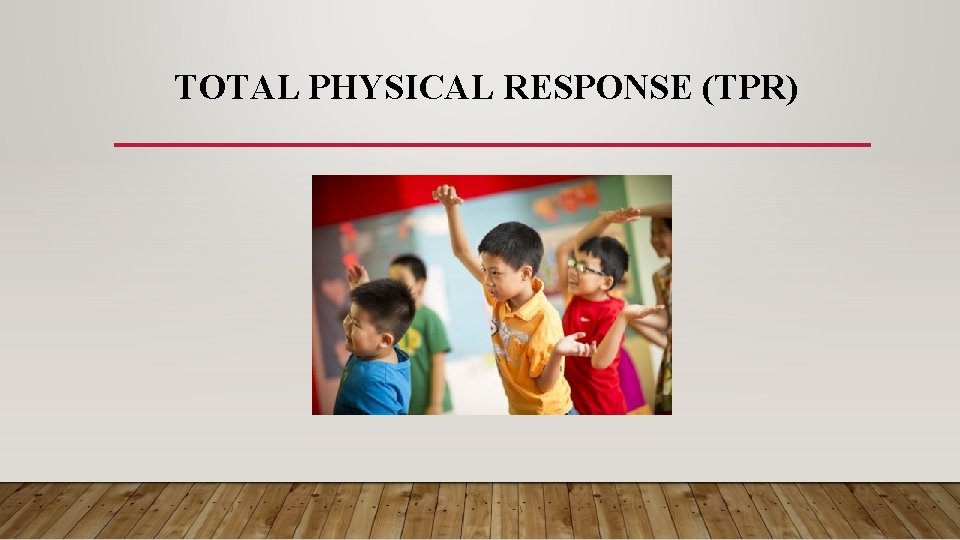
TOTAL PHYSICAL RESPONSE (TPR)
WHAT IS TPR? • Retention of vocabulary in the second language is enhanced by performing physical actions while learning that vocabulary. • Closely associated with theories of very young children learning their first language by responding with physical actions to the verbal requests of their parents (i. e. “Get the ball. ” “Pick up the truck. ”). • There is a biological element in the human brain for learning language. Listening and comprehension are emphasized before speaking and reading. Students only move to speaking and reading when they feel ready.
TPR VS. TRANSLATION METHOD • An experiential method that differs from a translation method in three significant ways: • The experiences involve physical reaction while the students connect with the target language: • Students are told to stand when they hear “levántate” and sit when they hear “siéntate” • Students will retain the word and its meaning much longer, even with only one exposure. • Brain cells are activated during the learning/acquisition process. In traditional classrooms, secondary perceptions may be more susceptible to distortions as an “instructor” constructs the language for the student. Students may gain a distorted view of the language. • Experience with the language creates an “aptitude-free” environment, meaning that anyone with typical intelligence can acquire the targeted language.
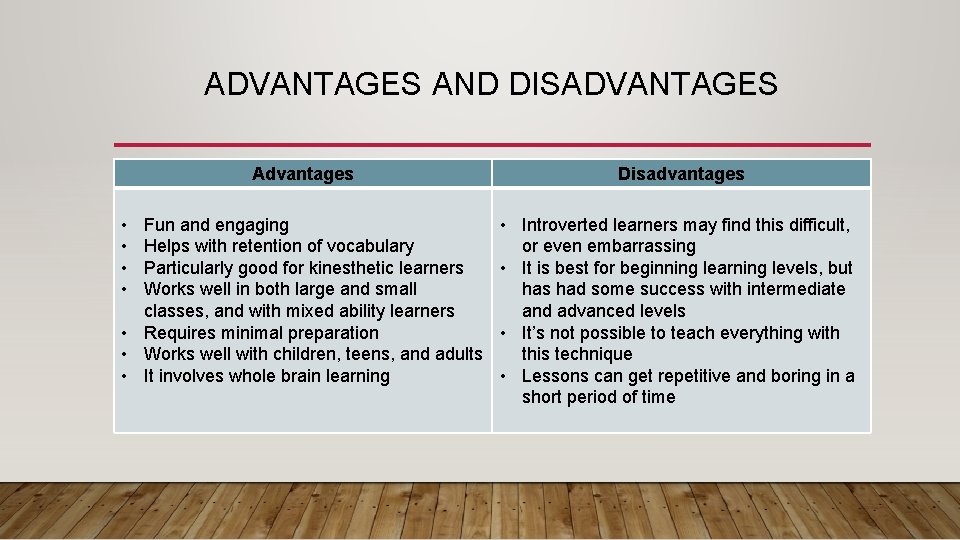
ADVANTAGES AND DISADVANTAGES Advantages Disadvantages Fun and engaging Helps with retention of vocabulary Particularly good for kinesthetic learners Works well in both large and small classes, and with mixed ability learners • Requires minimal preparation • Works well with children, teens, and adults • It involves whole brain learning • Introverted learners may find this difficult, or even embarrassing • It is best for beginning learning levels, but has had some success with intermediate and advanced levels • It’s not possible to teach everything with this technique • Lessons can get repetitive and boring in a short period of time • •
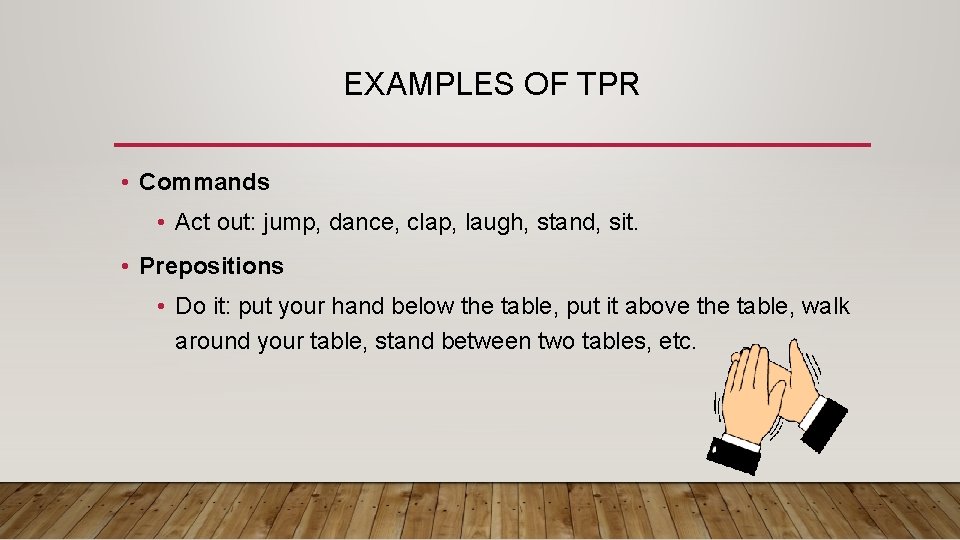
EXAMPLES OF TPR • Commands • Act out: jump, dance, clap, laugh, stand, sit. • Prepositions • Do it: put your hand below the table, put it above the table, walk around your table, stand between two tables, etc.
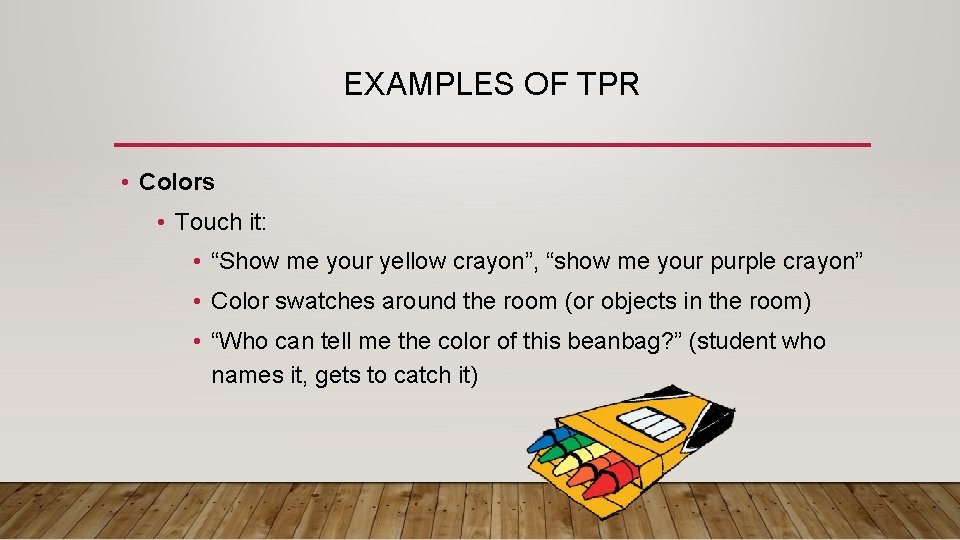
EXAMPLES OF TPR • Colors • Touch it: • “Show me your yellow crayon”, “show me your purple crayon” • Color swatches around the room (or objects in the room) • “Who can tell me the color of this beanbag? ” (student who names it, gets to catch it)
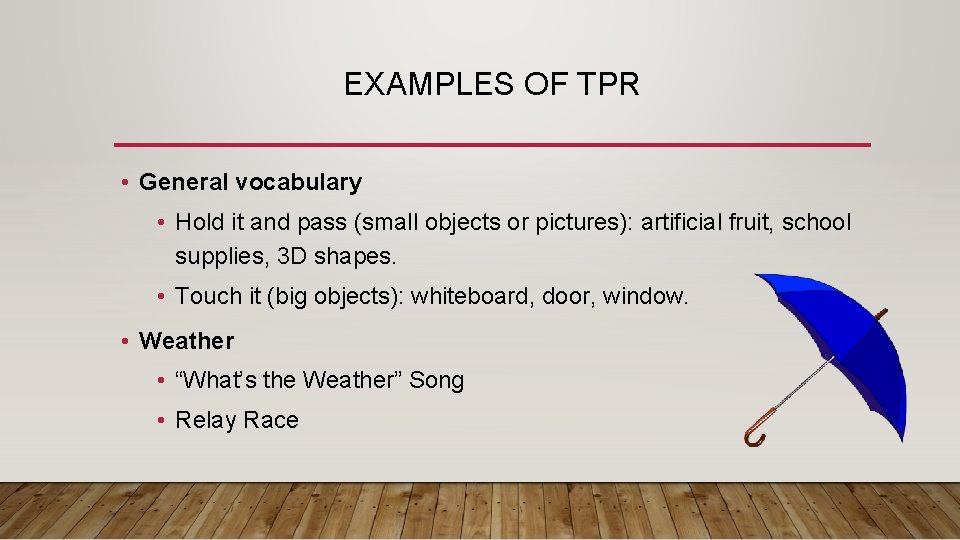
EXAMPLES OF TPR • General vocabulary • Hold it and pass (small objects or pictures): artificial fruit, school supplies, 3 D shapes. • Touch it (big objects): whiteboard, door, window. • Weather • “What’s the Weather” Song • Relay Race
WEBSITE AND REFERENCES • http: //www. tpr-world. com/ - website of TPR creator, James Asher; provides research and resources to learn about and use TPR • Asher, J. J. (2009). The total physical response (TPR): A review of the evidence. • Asher, J. J. (1969). The total physical response approach to second language learning. The Modern Language Journal. 53(3 -17). DOI: 10. 1111/j. 1540 -4781. 1969. tb 04552. x • Asher, J. J. & Price, B. S. (1967). The learning strategy of the total physical response: Some age differences. Child Development. 38(1219 -1227). • https: //www. slideshare. net/mobile/ignorantdavinci/total-physical-response - great slideshow on TPR, based on a lecture of Dr. Asher’s.