
Mouth Oral Cavity Anatomy Lips labia protect the
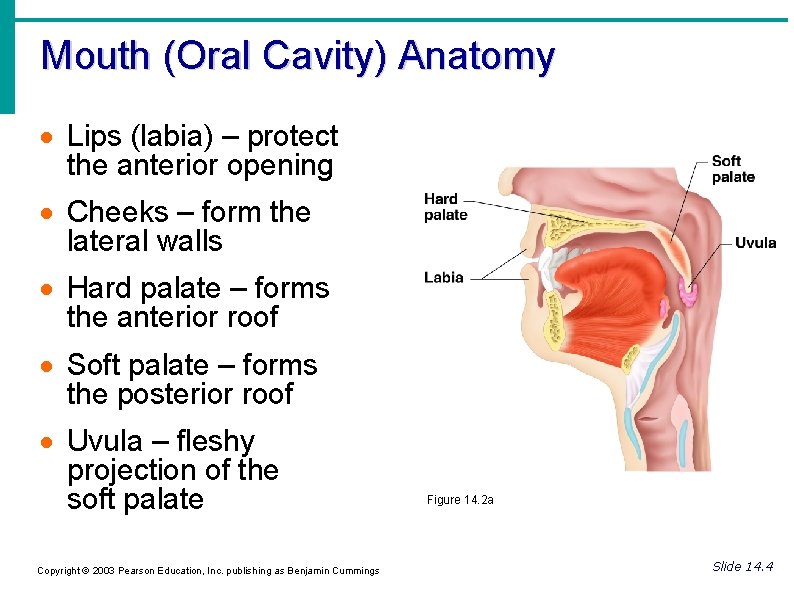
Mouth (Oral Cavity) Anatomy Lips (labia) – protect the anterior opening Cheeks – form the lateral walls Hard palate – forms the anterior roof Soft palate – forms the posterior roof Uvula – fleshy projection of the soft palate Copyright © 2003 Pearson Education, Inc. publishing as Benjamin Cummings Figure 14. 2 a Slide 14. 4
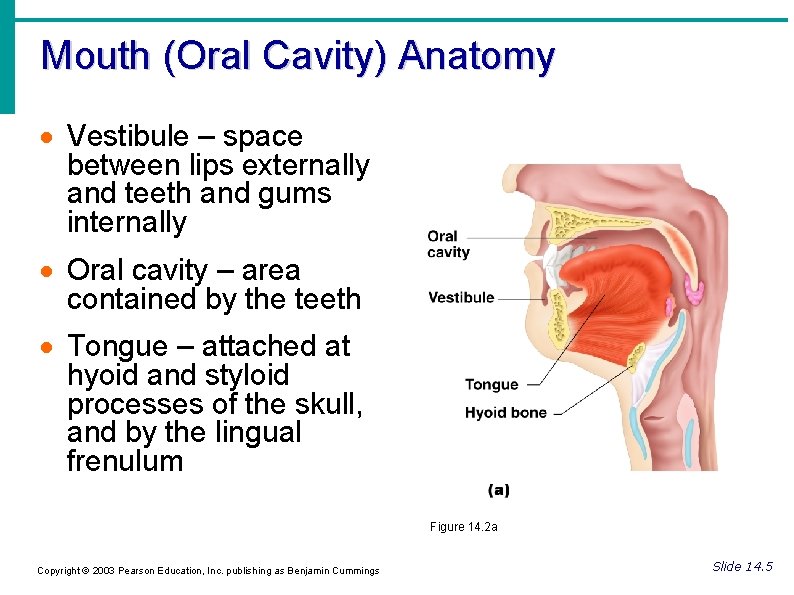
Mouth (Oral Cavity) Anatomy Vestibule – space between lips externally and teeth and gums internally Oral cavity – area contained by the teeth Tongue – attached at hyoid and styloid processes of the skull, and by the lingual frenulum Figure 14. 2 a Copyright © 2003 Pearson Education, Inc. publishing as Benjamin Cummings Slide 14. 5

Mouth (Oral Cavity) Anatomy Tonsils Palatine tonsils Lingual tonsil Figure 14. 2 a Copyright © 2003 Pearson Education, Inc. publishing as Benjamin Cummings Slide 14. 6
Processes of the Mouth Mastication (chewing) of food Mixing masticated food with saliva Initiation of swallowing by the tongue Allowing for the sense of taste Copyright © 2003 Pearson Education, Inc. publishing as Benjamin Cummings Slide 14. 7
Salivary Glands Funtions of saliva: • Softens food (easier to swallow) • Lubricates food (easier to swallow) • Dissolves food for taste • Digests starch (Amylase-enzyme) • Washes the teeth • Keeps the mouth moist for speech Copyright © 2003 Pearson Education, Inc. publishing as Benjamin Cummings Slide 14. 7
Salivary Glands 1) Parotid- (Stenson's duct) 2) Submandibular- Submaxillary (Wharton's duct) 3) Sublingual Copyright © 2003 Pearson Education, Inc. publishing as Benjamin Cummings Slide 14. 7
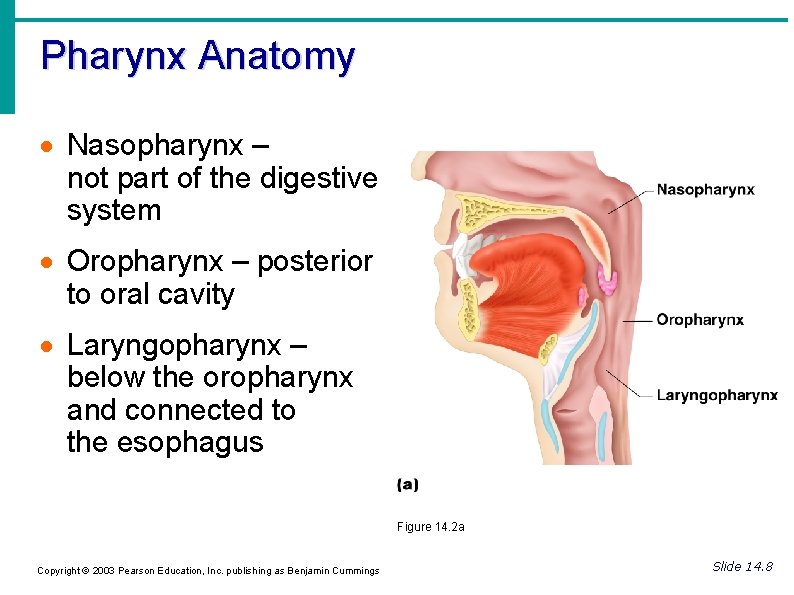
Pharynx Anatomy Nasopharynx – not part of the digestive system Oropharynx – posterior to oral cavity Laryngopharynx – below the oropharynx and connected to the esophagus Figure 14. 2 a Copyright © 2003 Pearson Education, Inc. publishing as Benjamin Cummings Slide 14. 8
Pharynx Function Serves as a passageway for air and food Food is propelled to the esophagus by two muscle layers Longitudinal inner layer Circular outer layer Food movement is by alternating contractions of the muscle layers (peristalsis) Copyright © 2003 Pearson Education, Inc. publishing as Benjamin Cummings Slide 14. 9
Esophagus Runs from pharynx to stomach through the diaphragm Conducts food by peristalsis (slow rhythmic squeezing) Passageway for food only (respiratory system branches off after the pharynx) Copyright © 2003 Pearson Education, Inc. publishing as Benjamin Cummings Slide 14. 10
- Slides: 9