
Mount St Helens erupted on May 18 1980


- Slides: 14
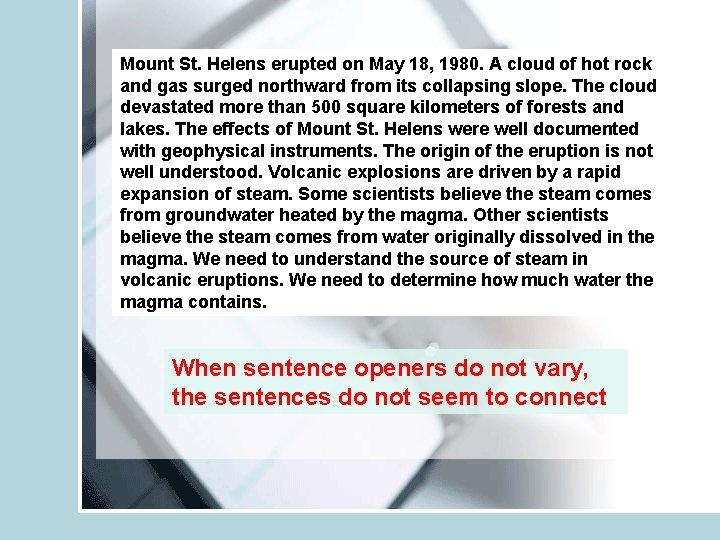
Mount St. Helens erupted on May 18, 1980. A cloud of hot rock and gas surged northward from its collapsing slope. The cloud devastated more than 500 square kilometers of forests and lakes. The effects of Mount St. Helens were well documented with geophysical instruments. The origin of the eruption is not well understood. Volcanic explosions are driven by a rapid expansion of steam. Some scientists believe the steam comes from groundwater heated by the magma. Other scientists believe the steam comes from water originally dissolved in the magma. We need to understand the source of steam in volcanic eruptions. We need to determine how much water the magma contains. When sentence openers do not vary, the sentences do not seem to connect
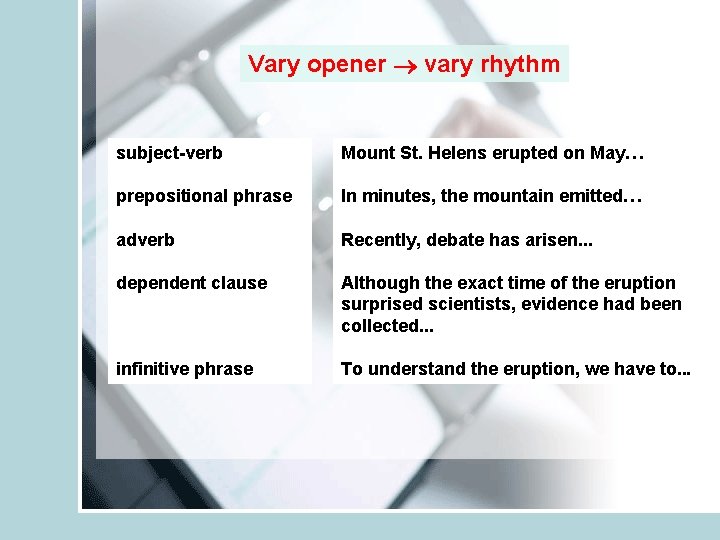
Vary opener vary rhythm subject-verb Mount St. Helens erupted on May… prepositional phrase In minutes, the mountain emitted… adverb Recently, debate has arisen. . . dependent clause Although the exact time of the eruption surprised scientists, evidence had been collected. . . infinitive phrase To understand the eruption, we have to. . .
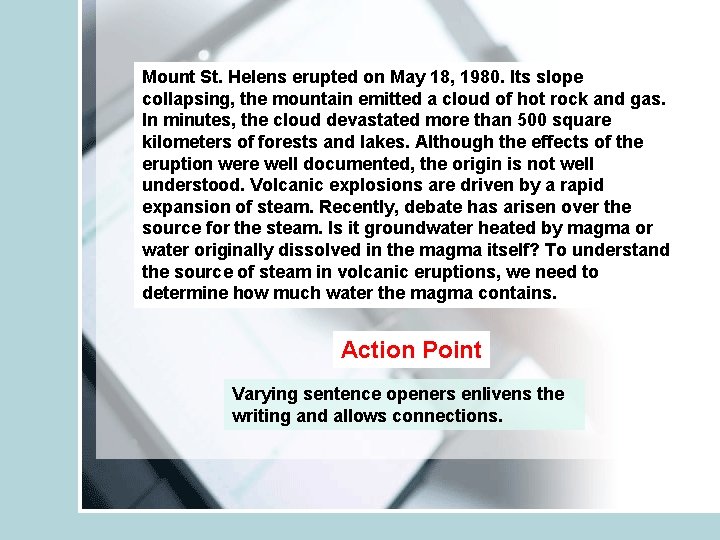
Mount St. Helens erupted on May 18, 1980. Its slope collapsing, the mountain emitted a cloud of hot rock and gas. In minutes, the cloud devastated more than 500 square kilometers of forests and lakes. Although the effects of the eruption were well documented, the origin is not well understood. Volcanic explosions are driven by a rapid expansion of steam. Recently, debate has arisen over the source for the steam. Is it groundwater heated by magma or water originally dissolved in the magma itself? To understand the source of steam in volcanic eruptions, we need to determine how much water the magma contains. Action Point Varying sentence openers enlivens the writing and allows connections.
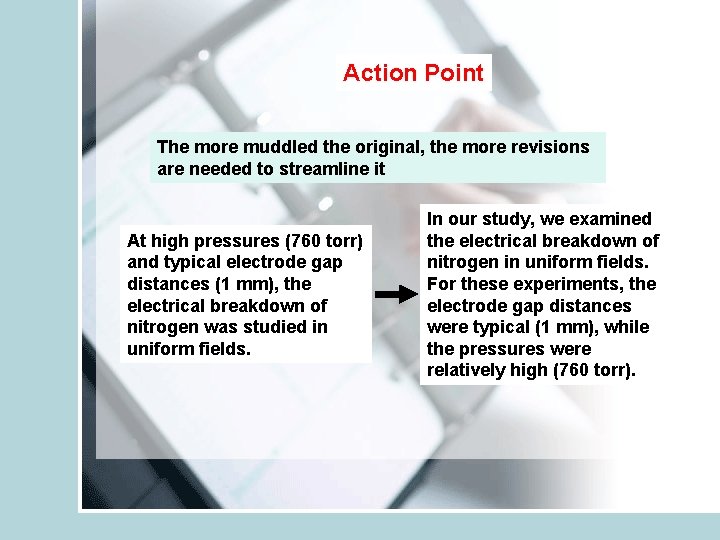
Action Point The more muddled the original, the more revisions are needed to streamline it At high pressures (760 torr) and typical electrode gap distances (1 mm), the electrical breakdown of nitrogen was studied in uniform fields. In our study, we examined the electrical breakdown of nitrogen in uniform fields. For these experiments, the electrode gap distances were typical (1 mm), while the pressures were relatively high (760 torr).
Download from Web. CT the excerpt from Pilsik Choi’s dissertation.
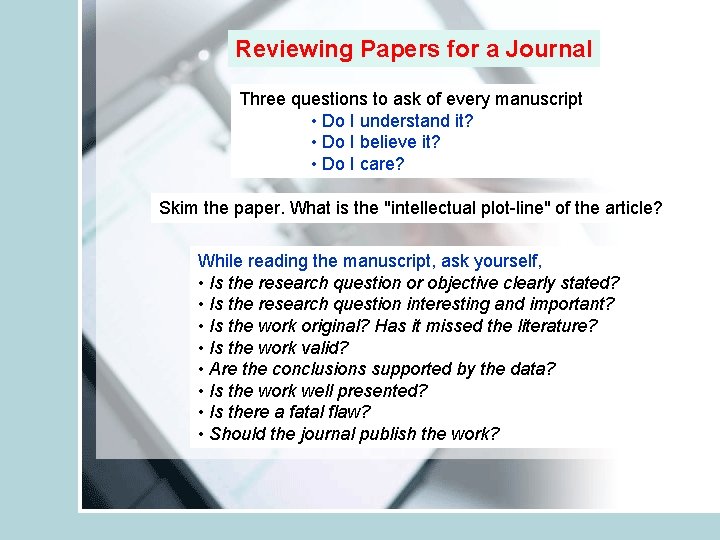
Reviewing Papers for a Journal Three questions to ask of every manuscript • Do I understand it? • Do I believe it? • Do I care? Skim the paper. What is the "intellectual plot-line" of the article? While reading the manuscript, ask yourself, • Is the research question or objective clearly stated? • Is the research question interesting and important? • Is the work original? Has it missed the literature? • Is the work valid? • Are the conclusions supported by the data? • Is the work well presented? • Is there a fatal flaw? • Should the journal publish the work?
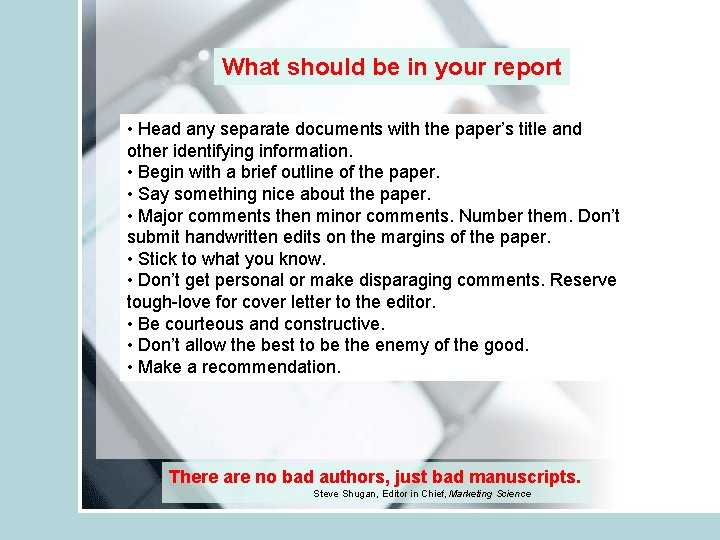
What should be in your report • Head any separate documents with the paper’s title and other identifying information. • Begin with a brief outline of the paper. • Say something nice about the paper. • Major comments then minor comments. Number them. Don’t submit handwritten edits on the margins of the paper. • Stick to what you know. • Don’t get personal or make disparaging comments. Reserve tough-love for cover letter to the editor. • Be courteous and constructive. • Don’t allow the best to be the enemy of the good. • Make a recommendation. There are no bad authors, just bad manuscripts. Steve Shugan, Editor in Chief, Marketing Science
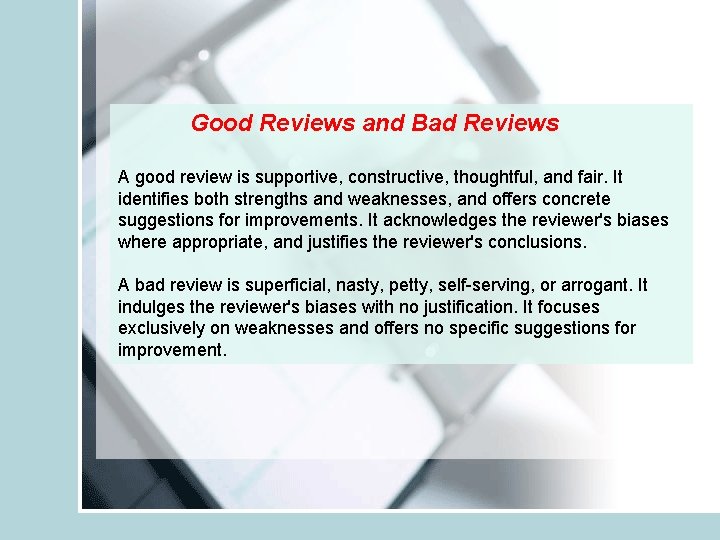
Good Reviews and Bad Reviews A good review is supportive, constructive, thoughtful, and fair. It identifies both strengths and weaknesses, and offers concrete suggestions for improvements. It acknowledges the reviewer's biases where appropriate, and justifies the reviewer's conclusions. A bad review is superficial, nasty, petty, self-serving, or arrogant. It indulges the reviewer's biases with no justification. It focuses exclusively on weaknesses and offers no specific suggestions for improvement.
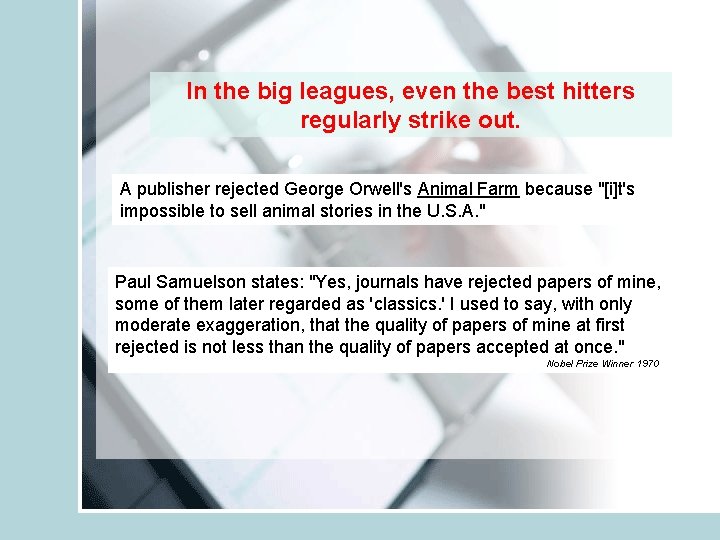
In the big leagues, even the best hitters regularly strike out. A publisher rejected George Orwell's Animal Farm because "[i]t's impossible to sell animal stories in the U. S. A. " Paul Samuelson states: "Yes, journals have rejected papers of mine, some of them later regarded as 'classics. ' I used to say, with only moderate exaggeration, that the quality of papers of mine at first rejected is not less than the quality of papers accepted at once. " Nobel Prize Winner 1970
The Grim Reaper Knocks On All Doors “I presented my paper (on the Duesenberry-Modigliani consumption function) at a 1949 Conference on Income and Wealth, and then submitted it for publication to Econometrica. The paper was returned with a letter rejecting my paper with no offer to revise and resubmit. As I recall, the only reason for rejecting the paper was that in his view these were no times formulating ingenious new hypotheses, the important issue of the time being to pursue better estimation methods recognizing problems of simultaneity. By contrast, my paper used single equation methods. " Franco Modigliani, Nobel Prize Winner 1985
“The Market for Lemons” "I submitted it in June, 1967 to the American Economic Review. I got a reply from the editor which said that the article was interesting but the American Economic Review did not publish such trivial stuff. " The article next went to the Journal of Political Economy. Again it was rejected. Akerlof kept trying. "I next sent the article to the Review of Economic Studies. I had been urged by one of its co-editors to do that. Instead it went to another editor whose view of 'The Market for 'Lemons" was decidedly less favorable. It was rejected on the grounds again that it was 'trivial. ' Finally I sent it to the Quarterly Journal of Economics which accepted it with some degree of enthusiasm. " Akerlof believes that journal editors refused the article both because they feared the introduction into economics of informational considerations and “. . . they also almost surely objected to the style of the article which did not reflect the usual solemnity of economic journals. " George Akerlof, Nobel Prize Winner 2001
The Kindest Cut of All "We have read your manuscript with boundless delight. If we were to publish your paper, it would be impossible for us to publish any work of lower standard. And as it is unthinkable that in the next thousand years we shall see its equal, we are, to our regret, compelled to return your divine composition, and to beg you a thousand times to overlook our short sight and timidity. "
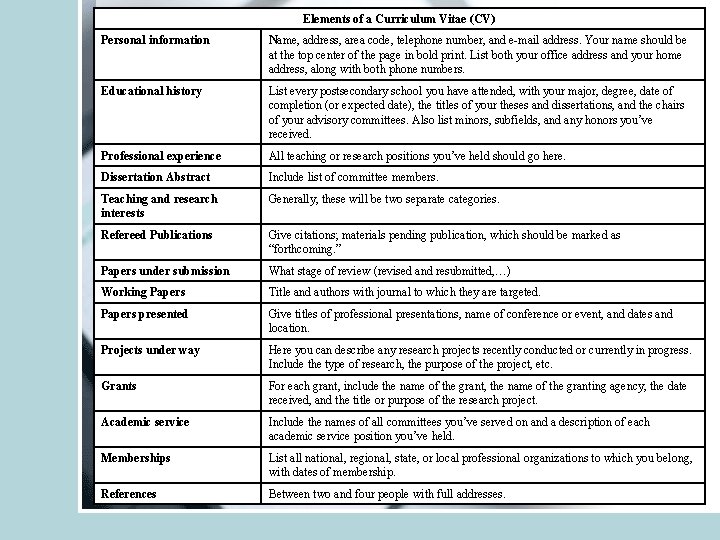
Elements of a Curriculum Vitae (CV) Personal information Name, address, area code, telephone number, and e-mail address. Your name should be at the top center of the page in bold print. List both your office address and your home address, along with both phone numbers. Educational history List every postsecondary school you have attended, with your major, degree, date of completion (or expected date), the titles of your theses and dissertations, and the chairs of your advisory committees. Also list minors, subfields, and any honors you’ve received. Professional experience All teaching or research positions you’ve held should go here. Dissertation Abstract Include list of committee members. Teaching and research interests Generally, these will be two separate categories. Refereed Publications Give citations; materials pending publication, which should be marked as “forthcoming. ” Papers under submission What stage of review (revised and resubmitted, …) Working Papers Title and authors with journal to which they are targeted. Papers presented Give titles of professional presentations, name of conference or event, and dates and location. Projects under way Here you can describe any research projects recently conducted or currently in progress. Include the type of research, the purpose of the project, etc. Grants For each grant, include the name of the grant, the name of the granting agency, the date received, and the title or purpose of the research project. Academic service Include the names of all committees you’ve served on and a description of each academic service position you’ve held. Memberships List all national, regional, state, or local professional organizations to which you belong, with dates of membership. References Between two and four people with full addresses.
Top Ten List of What Search Committees are Searching For? 10. Will you finish your dissertation before arriving on campus? 9. Can you publish in the major journals? 8. Can you tell a research story that they can remember when asked at a faculty meeting a week after the interview? 7. Do you recognize a good research project when you see it? A not so good one? 6. Do you generate good projects on your own? 5. Do you fit a recognized need? 4. Would you add intellectual vitality? 3. Could you (eventually) handle a classroom filled with MBAs? 2. Will the profession say, “Wow!” when they hear of your hiring? 1. Would they have fun lunching with you for the rest of their careers?