
Mount Harmon Plantation Highlights in History Virtual Tour
- Slides: 13
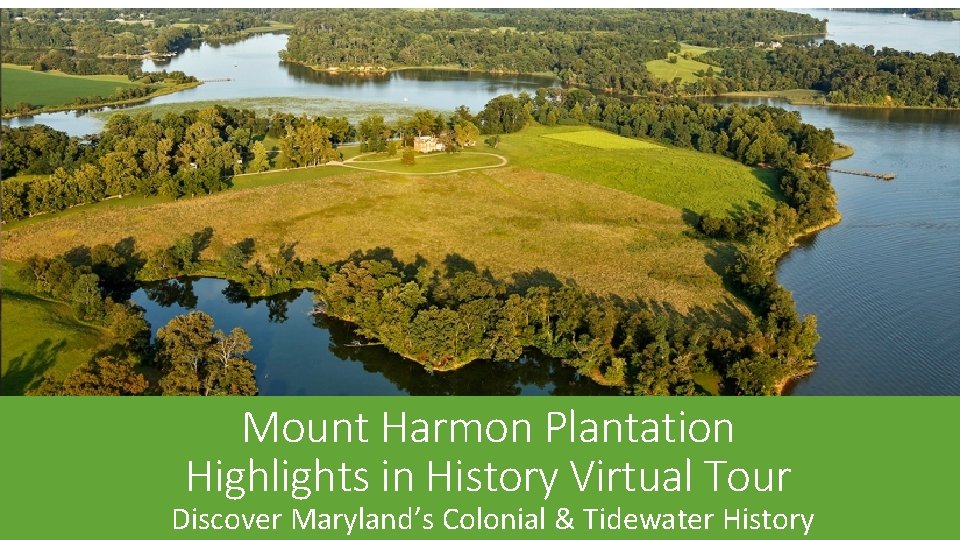
Mount Harmon Plantation Highlights in History Virtual Tour Discover Maryland’s Colonial & Tidewater History
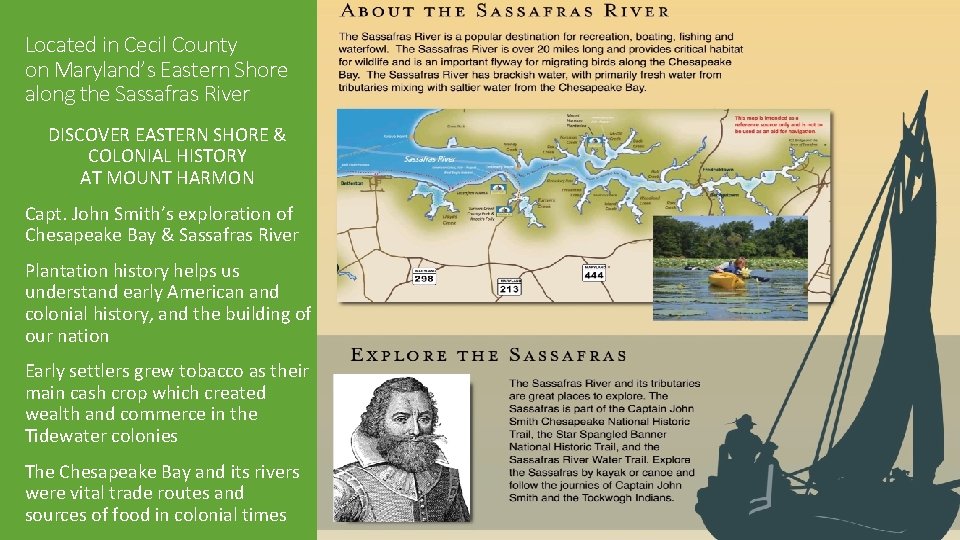
Located in Cecil County on Maryland’s Eastern Shore along the Sassafras River DISCOVER EASTERN SHORE & COLONIAL HISTORY AT MOUNT HARMON Capt. John Smith’s exploration of Chesapeake Bay & Sassafras River Plantation history helps us understand early American and colonial history, and the building of our nation Early settlers grew tobacco as their main cash crop which created wealth and commerce in the Tidewater colonies The Chesapeake Bay and its rivers were vital trade routes and sources of food in colonial times
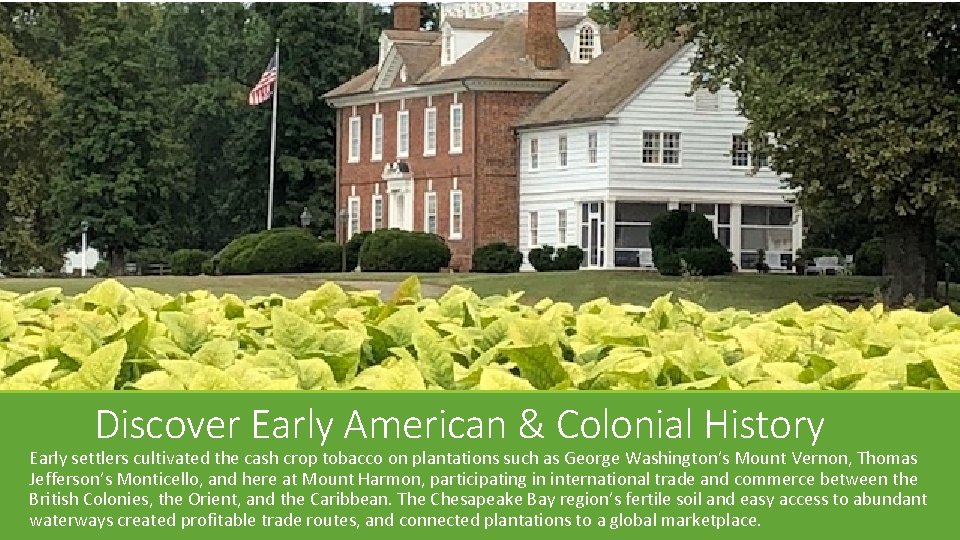
Discover Early American & Colonial History Early settlers cultivated the cash crop tobacco on plantations such as George Washington’s Mount Vernon, Thomas Jefferson’s Monticello, and here at Mount Harmon, participating in international trade and commerce between the British Colonies, the Orient, and the Caribbean. The Chesapeake Bay region’s fertile soil and easy access to abundant waterways created profitable trade routes, and connected plantations to a global marketplace.
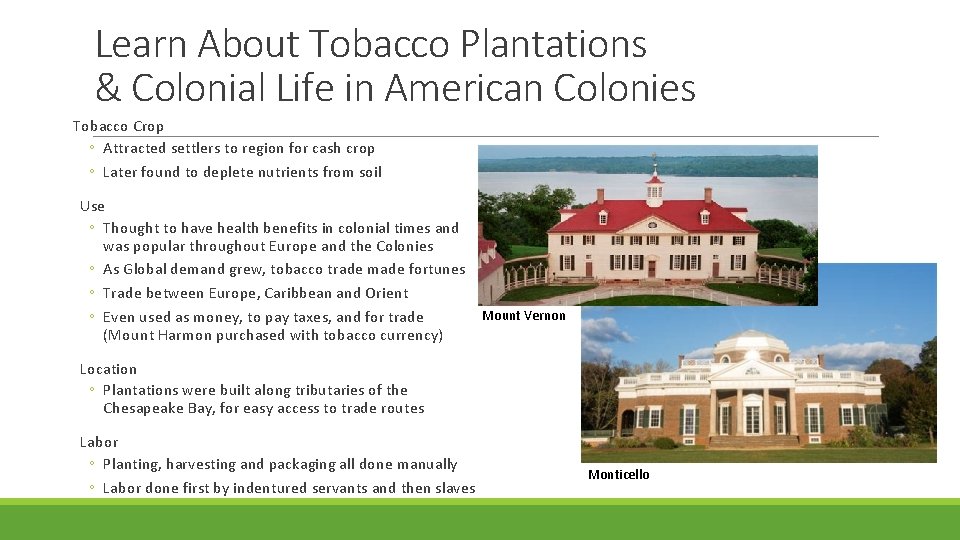
Learn About Tobacco Plantations & Colonial Life in American Colonies Tobacco Crop ◦ Attracted settlers to region for cash crop ◦ Later found to deplete nutrients from soil Use ◦ Thought to have health benefits in colonial times and was popular throughout Europe and the Colonies ◦ As Global demand grew, tobacco trade made fortunes ◦ Trade between Europe, Caribbean and Orient ◦ Even used as money, to pay taxes, and for trade (Mount Harmon purchased with tobacco currency) Mount Vernon Location ◦ Plantations were built along tributaries of the Chesapeake Bay, for easy access to trade routes Labor ◦ Planting, harvesting and packaging all done manually ◦ Labor done first by indentured servants and then slaves Monticello
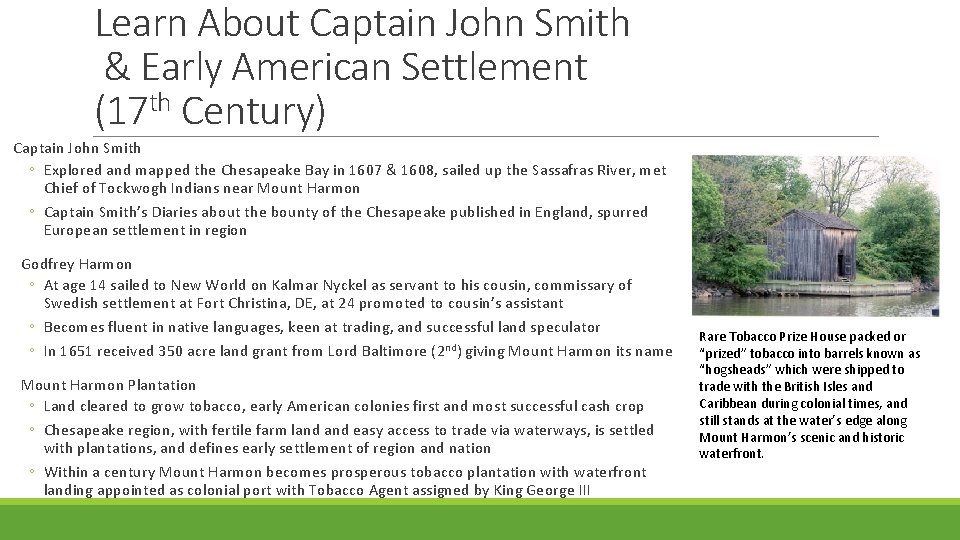
Learn About Captain John Smith & Early American Settlement (17 th Century) Captain John Smith ◦ Explored and mapped the Chesapeake Bay in 1607 & 1608, sailed up the Sassafras River, met Chief of Tockwogh Indians near Mount Harmon ◦ Captain Smith’s Diaries about the bounty of the Chesapeake published in England, spurred European settlement in region Godfrey Harmon ◦ At age 14 sailed to New World on Kalmar Nyckel as servant to his cousin, commissary of Swedish settlement at Fort Christina, DE, at 24 promoted to cousin’s assistant ◦ Becomes fluent in native languages, keen at trading, and successful land speculator ◦ In 1651 received 350 acre land grant from Lord Baltimore (2 nd) giving Mount Harmon its name Mount Harmon Plantation ◦ Land cleared to grow tobacco, early American colonies first and most successful cash crop ◦ Chesapeake region, with fertile farm land easy access to trade via waterways, is settled with plantations, and defines early settlement of region and nation ◦ Within a century Mount Harmon becomes prosperous tobacco plantation with waterfront landing appointed as colonial port with Tobacco Agent assigned by King George III Rare Tobacco Prize House packed or “prized” tobacco into barrels known as “hogsheads” which were shipped to trade with the British Isles and Caribbean during colonial times, and still stands at the water’s edge along Mount Harmon’s scenic and historic waterfront.
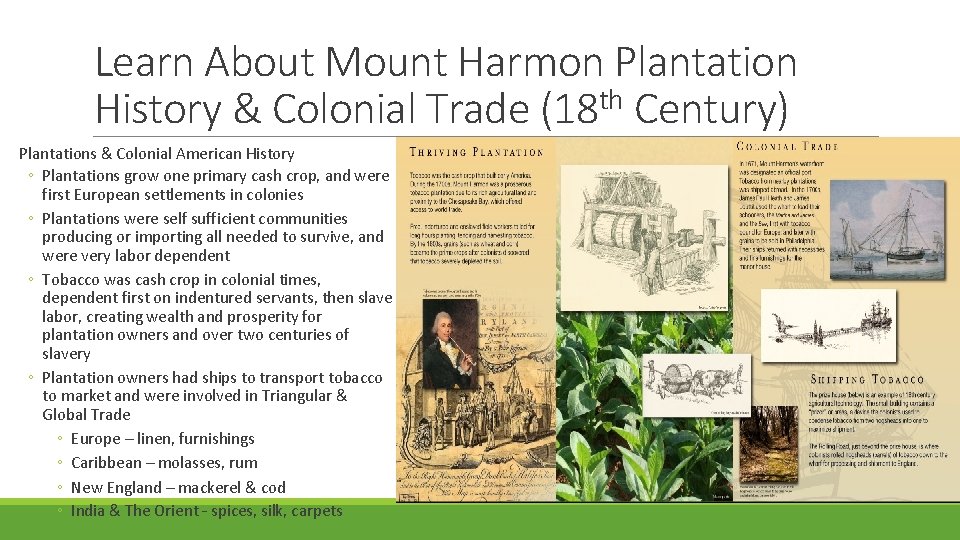
Learn About Mount Harmon Plantation History & Colonial Trade (18 th Century) Plantations & Colonial American History ◦ Plantations grow one primary cash crop, and were first European settlements in colonies ◦ Plantations were self sufficient communities producing or importing all needed to survive, and were very labor dependent ◦ Tobacco was cash crop in colonial times, dependent first on indentured servants, then slave labor, creating wealth and prosperity for plantation owners and over two centuries of slavery ◦ Plantation owners had ships to transport tobacco to market and were involved in Triangular & Global Trade ◦ Europe – linen, furnishings ◦ Caribbean – molasses, rum ◦ New England – mackerel & cod ◦ India & The Orient – spices, silk, carpets
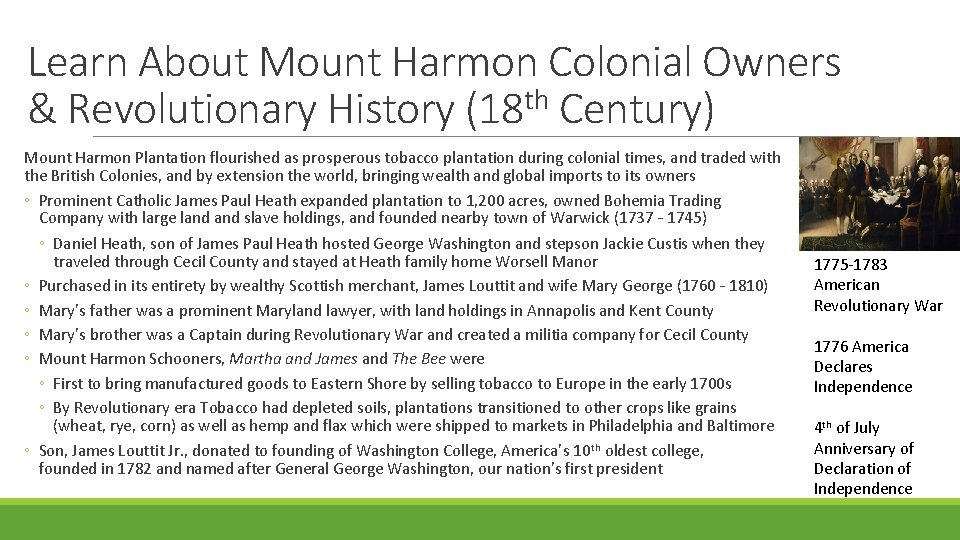
Learn About Mount Harmon Colonial Owners & Revolutionary History (18 th Century) Mount Harmon Plantation flourished as prosperous tobacco plantation during colonial times, and traded with the British Colonies, and by extension the world, bringing wealth and global imports to its owners ◦ Prominent Catholic James Paul Heath expanded plantation to 1, 200 acres, owned Bohemia Trading Company with large land slave holdings, and founded nearby town of Warwick (1737 – 1745) ◦ Daniel Heath, son of James Paul Heath hosted George Washington and stepson Jackie Custis when they traveled through Cecil County and stayed at Heath family home Worsell Manor ◦ Purchased in its entirety by wealthy Scottish merchant, James Louttit and wife Mary George (1760 – 1810) ◦ Mary’s father was a prominent Maryland lawyer, with land holdings in Annapolis and Kent County ◦ Mary’s brother was a Captain during Revolutionary War and created a militia company for Cecil County ◦ Mount Harmon Schooners, Martha and James and The Bee were ◦ First to bring manufactured goods to Eastern Shore by selling tobacco to Europe in the early 1700 s ◦ By Revolutionary era Tobacco had depleted soils, plantations transitioned to other crops like grains (wheat, rye, corn) as well as hemp and flax which were shipped to markets in Philadelphia and Baltimore ◦ Son, James Louttit Jr. , donated to founding of Washington College, America’s 10 th oldest college, founded in 1782 and named after General George Washington, our nation’s first president 1775 -1783 American Revolutionary War 1776 America Declares Independence 4 th of July Anniversary of Declaration of Independence
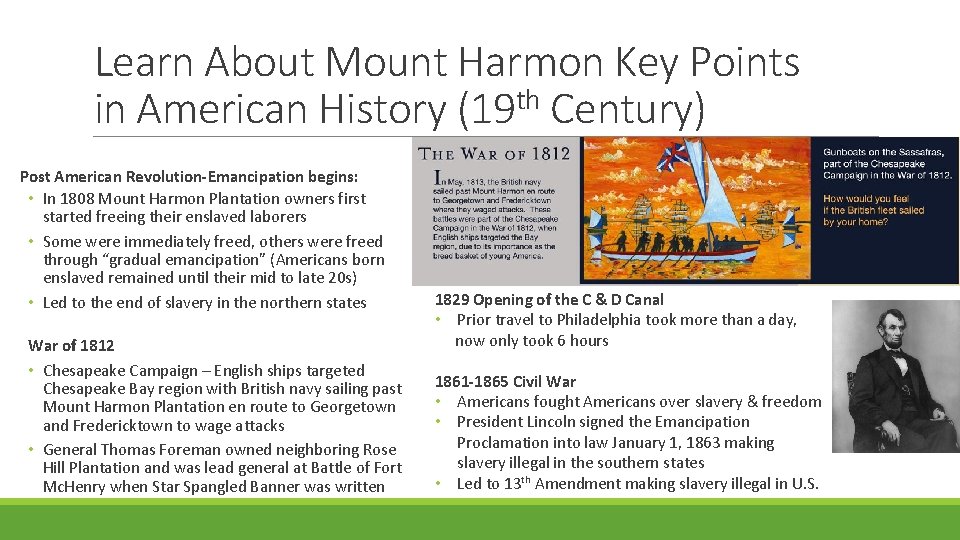
Learn About Mount Harmon Key Points in American History (19 th Century) Post American Revolution-Emancipation begins: • In 1808 Mount Harmon Plantation owners first started freeing their enslaved laborers • Some were immediately freed, others were freed through “gradual emancipation” (Americans born enslaved remained until their mid to late 20 s) • Led to the end of slavery in the northern states War of 1812 • Chesapeake Campaign – English ships targeted Chesapeake Bay region with British navy sailing past Mount Harmon Plantation en route to Georgetown and Fredericktown to wage attacks • General Thomas Foreman owned neighboring Rose Hill Plantation and was lead general at Battle of Fort Mc. Henry when Star Spangled Banner was written 1829 Opening of the C & D Canal • Prior travel to Philadelphia took more than a day, now only took 6 hours 1861 -1865 Civil War • Americans fought Americans over slavery & freedom • President Lincoln signed the Emancipation Proclamation into law January 1, 1863 making slavery illegal in the southern states • Led to 13 th Amendment making slavery illegal in U. S.
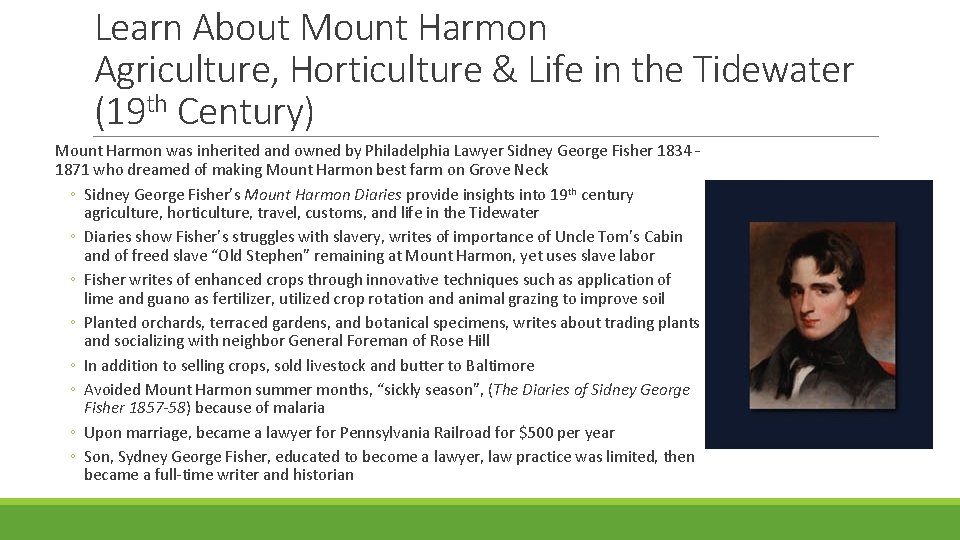
Learn About Mount Harmon Agriculture, Horticulture & Life in the Tidewater (19 th Century) Mount Harmon was inherited and owned by Philadelphia Lawyer Sidney George Fisher 1834 – 1871 who dreamed of making Mount Harmon best farm on Grove Neck ◦ Sidney George Fisher’s Mount Harmon Diaries provide insights into 19 th century agriculture, horticulture, travel, customs, and life in the Tidewater ◦ Diaries show Fisher’s struggles with slavery, writes of importance of Uncle Tom’s Cabin and of freed slave “Old Stephen” remaining at Mount Harmon, yet uses slave labor ◦ Fisher writes of enhanced crops through innovative techniques such as application of lime and guano as fertilizer, utilized crop rotation and animal grazing to improve soil ◦ Planted orchards, terraced gardens, and botanical specimens, writes about trading plants and socializing with neighbor General Foreman of Rose Hill ◦ In addition to selling crops, sold livestock and butter to Baltimore ◦ Avoided Mount Harmon summer months, “sickly season”, (The Diaries of Sidney George Fisher 1857 -58) because of malaria ◦ Upon marriage, became a lawyer for Pennsylvania Railroad for $500 per year ◦ Son, Sydney George Fisher, educated to become a lawyer, law practice was limited, then became a full-time writer and historian
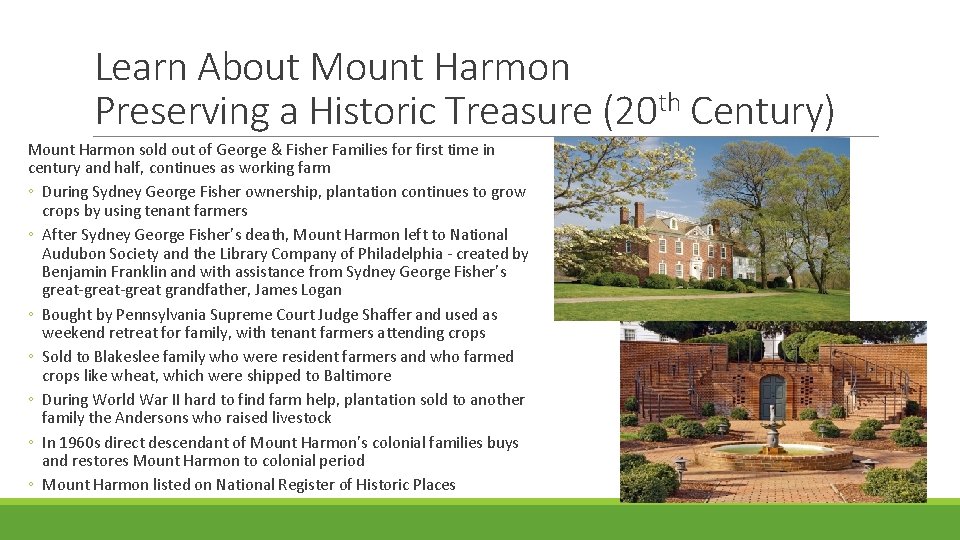
Learn About Mount Harmon Preserving a Historic Treasure (20 th Century) Mount Harmon sold out of George & Fisher Families for first time in century and half, continues as working farm ◦ During Sydney George Fisher ownership, plantation continues to grow crops by using tenant farmers ◦ After Sydney George Fisher’s death, Mount Harmon left to National Audubon Society and the Library Company of Philadelphia - created by Benjamin Franklin and with assistance from Sydney George Fisher’s great-great grandfather, James Logan ◦ Bought by Pennsylvania Supreme Court Judge Shaffer and used as weekend retreat for family, with tenant farmers attending crops ◦ Sold to Blakeslee family who were resident farmers and who farmed crops like wheat, which were shipped to Baltimore ◦ During World War II hard to find farm help, plantation sold to another family the Andersons who raised livestock ◦ In 1960 s direct descendant of Mount Harmon’s colonial families buys and restores Mount Harmon to colonial period ◦ Mount Harmon listed on National Register of Historic Places
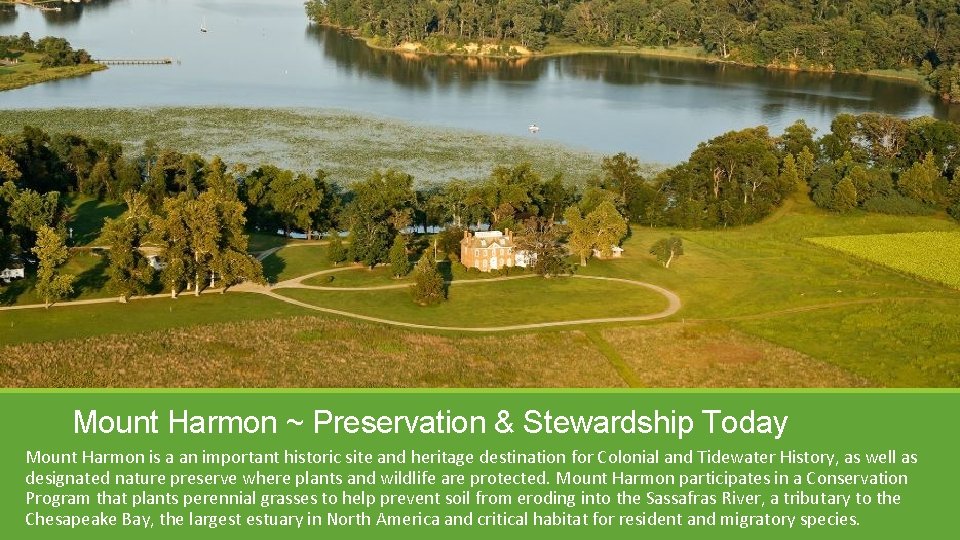
Mount Harmon ~ Preservation & Stewardship Today Mount Harmon is a an important historic site and heritage destination for Colonial and Tidewater History, as well as designated nature preserve where plants and wildlife are protected. Mount Harmon participates in a Conservation Program that plants perennial grasses to help prevent soil from eroding into the Sassafras River, a tributary to the Chesapeake Bay, the largest estuary in North America and critical habitat for resident and migratory species.
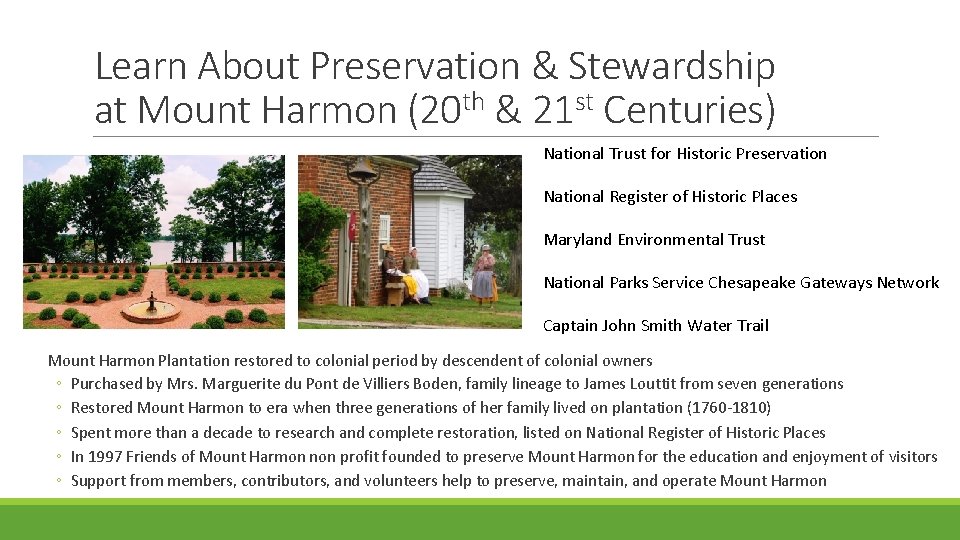
Learn About Preservation & Stewardship at Mount Harmon (20 th & 21 st Centuries) National Trust for Historic Preservation National Register of Historic Places Maryland Environmental Trust National Parks Service Chesapeake Gateways Network Captain John Smith Water Trail Mount Harmon Plantation restored to colonial period by descendent of colonial owners ◦ Purchased by Mrs. Marguerite du Pont de Villiers Boden, family lineage to James Louttit from seven generations ◦ Restored Mount Harmon to era when three generations of her family lived on plantation (1760 -1810) ◦ Spent more than a decade to research and complete restoration, listed on National Register of Historic Places ◦ In 1997 Friends of Mount Harmon non profit founded to preserve Mount Harmon for the education and enjoyment of visitors ◦ Support from members, contributors, and volunteers help to preserve, maintain, and operate Mount Harmon
Visit Often & Keep Learning About Mount Harmon History & Nature For more information about Mount Harmon History, Guided Tours, School Field Trips & Educational Resources Please visit us online at www. mountharmon. org Like and follow us on Facebook & Instagram!