
MottBerezinsky formula instantons and integrability Ilya A Gruzberg
Mott-Berezinsky formula, instantons, and integrability Ilya A. Gruzberg In collaboration with Adam Nahum (Oxford University) Euler Symposium, Saint Petersburg, Russia, July 8 th, 2011
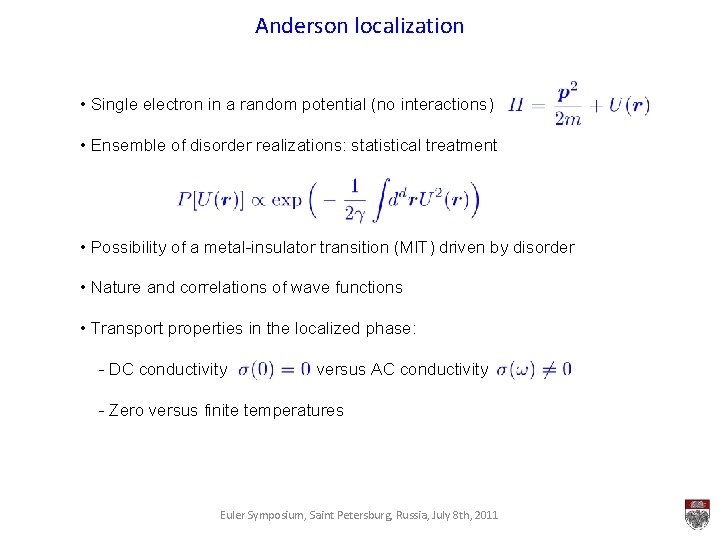
Anderson localization • Single electron in a random potential (no interactions) • Ensemble of disorder realizations: statistical treatment • Possibility of a metal-insulator transition (MIT) driven by disorder • Nature and correlations of wave functions • Transport properties in the localized phase: - DC conductivity versus AC conductivity - Zero versus finite temperatures Euler Symposium, Saint Petersburg, Russia, July 8 th, 2011
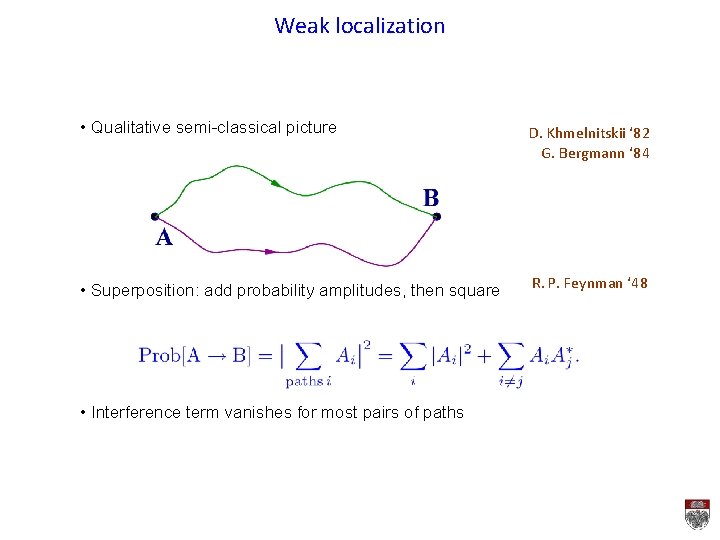
Weak localization • Qualitative semi-classical picture D. Khmelnitskii ‘ 82 G. Bergmann ‘ 84 • Superposition: add probability amplitudes, then square R. P. Feynman ‘ 48 • Interference term vanishes for most pairs of paths
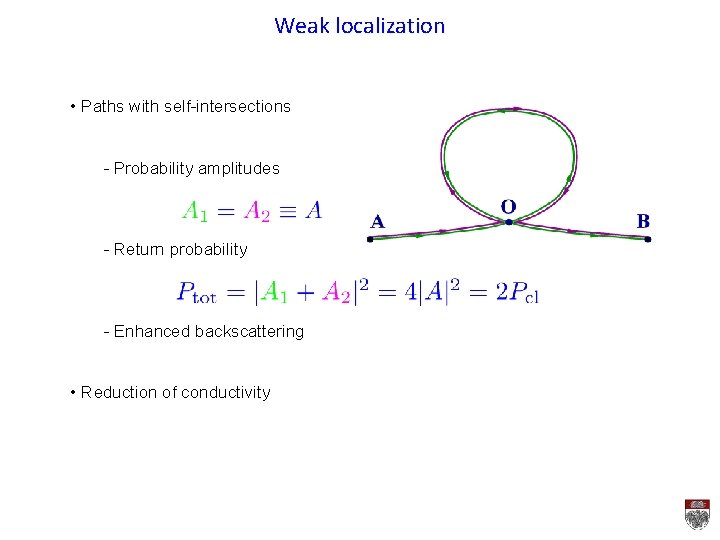
Weak localization • Paths with self-intersections - Probability amplitudes - Return probability - Enhanced backscattering • Reduction of conductivity
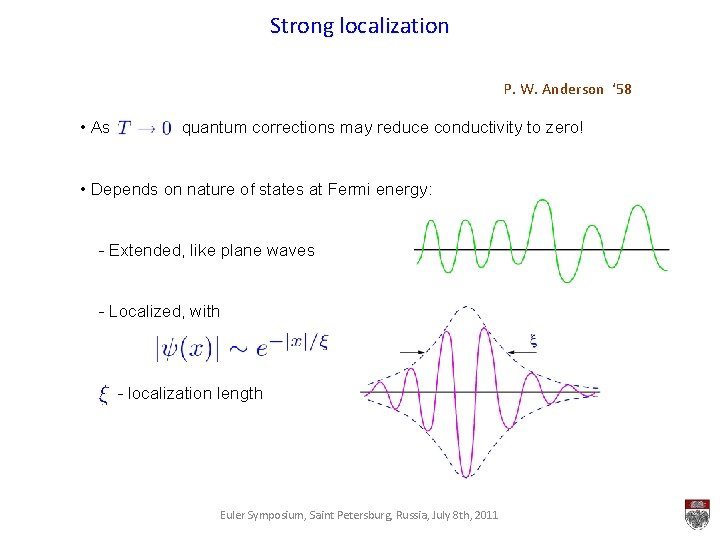
Strong localization P. W. Anderson ‘ 58 • As quantum corrections may reduce conductivity to zero! • Depends on nature of states at Fermi energy: - Extended, like plane waves - Localized, with - localization length Euler Symposium, Saint Petersburg, Russia, July 8 th, 2011
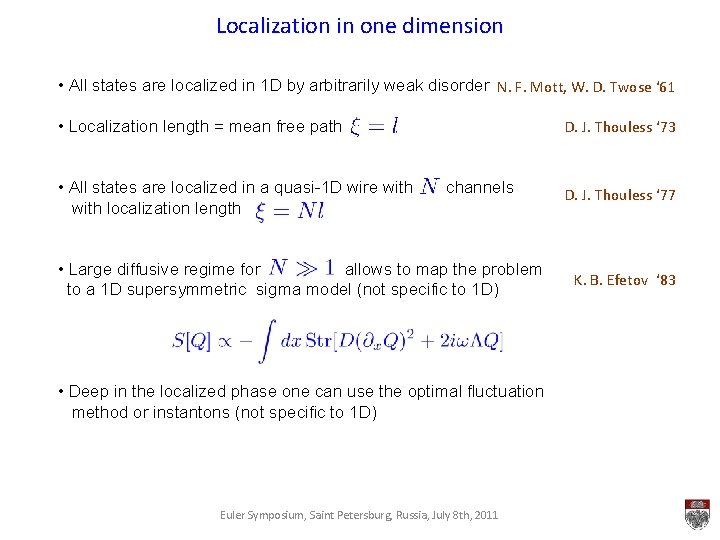
Localization in one dimension • All states are localized in 1 D by arbitrarily weak disorder N. F. Mott, W. D. Twose ‘ 61 • Localization length = mean free path • All states are localized in a quasi-1 D wire with localization length D. J. Thouless ‘ 73 channels • Large diffusive regime for allows to map the problem to a 1 D supersymmetric sigma model (not specific to 1 D) • Deep in the localized phase one can use the optimal fluctuation method or instantons (not specific to 1 D) Euler Symposium, Saint Petersburg, Russia, July 8 th, 2011 D. J. Thouless ‘ 77 K. B. Efetov ‘ 83
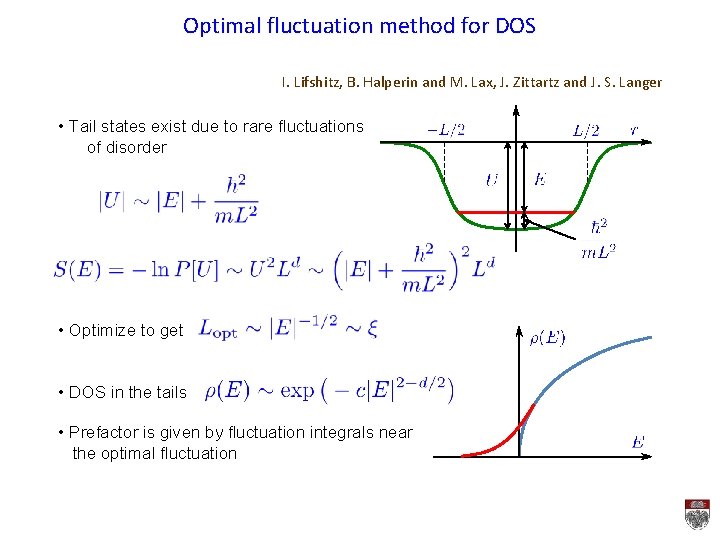
Optimal fluctuation method for DOS I. Lifshitz, B. Halperin and M. Lax, J. Zittartz and J. S. Langer • Tail states exist due to rare fluctuations of disorder • Optimize to get • DOS in the tails • Prefactor is given by fluctuation integrals near the optimal fluctuation

Mott argument for AC conductivity • Apply an AC electric field to an Anderson insulator N. F. Mott ‘ 68 • Rate of energy absorption due to transitions between states (in 1 D) • Need to estimate the matrix element Euler Symposium, Saint Petersburg, Russia, July 8 th, 2011
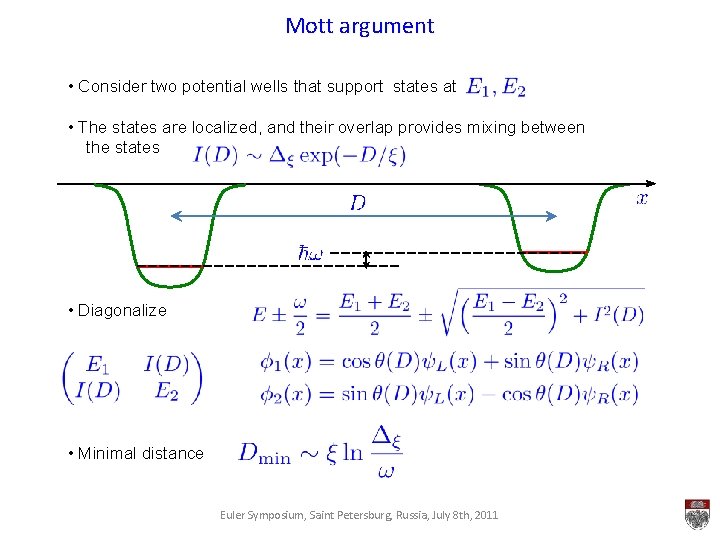
Mott argument • Consider two potential wells that support states at • The states are localized, and their overlap provides mixing between the states • Diagonalize • Minimal distance Euler Symposium, Saint Petersburg, Russia, July 8 th, 2011
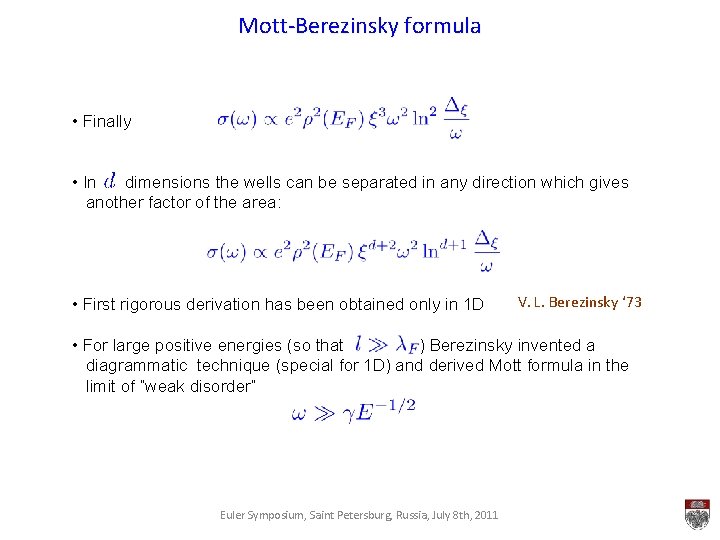
Mott-Berezinsky formula • Finally • In dimensions the wells can be separated in any direction which gives another factor of the area: • First rigorous derivation has been obtained only in 1 D V. L. Berezinsky ‘ 73 • For large positive energies (so that ) Berezinsky invented a diagrammatic technique (special for 1 D) and derived Mott formula in the limit of “weak disorder” Euler Symposium, Saint Petersburg, Russia, July 8 th, 2011
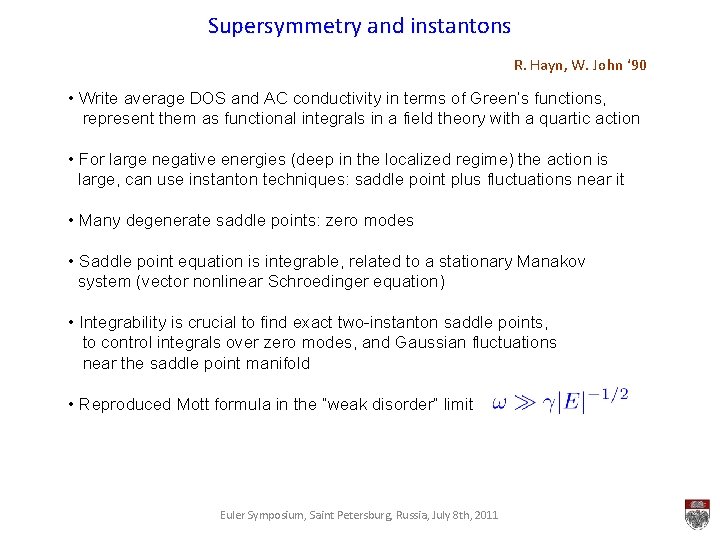
Supersymmetry and instantons R. Hayn, W. John ‘ 90 • Write average DOS and AC conductivity in terms of Green’s functions, represent them as functional integrals in a field theory with a quartic action • For large negative energies (deep in the localized regime) the action is large, can use instanton techniques: saddle point plus fluctuations near it • Many degenerate saddle points: zero modes • Saddle point equation is integrable, related to a stationary Manakov system (vector nonlinear Schroedinger equation) • Integrability is crucial to find exact two-instanton saddle points, to control integrals over zero modes, and Gaussian fluctuations near the saddle point manifold • Reproduced Mott formula in the “weak disorder” limit Euler Symposium, Saint Petersburg, Russia, July 8 th, 2011
Other results in 1 D and quasi 1 D • Other correlators involving different wave functions • Correlation function of local DOS in 1 D L. P. Gor’kov, O. N. Dorokhov, F. V. Prigara ‘ 83 • Correlation function of local DOS in quasi 1 D from sigma model D. A. Ivanov, P. M. Ostrovsky, M. A. Skvortsov ‘ 09 • Something else? Euler Symposium, Saint Petersburg, Russia, July 8 th, 2011
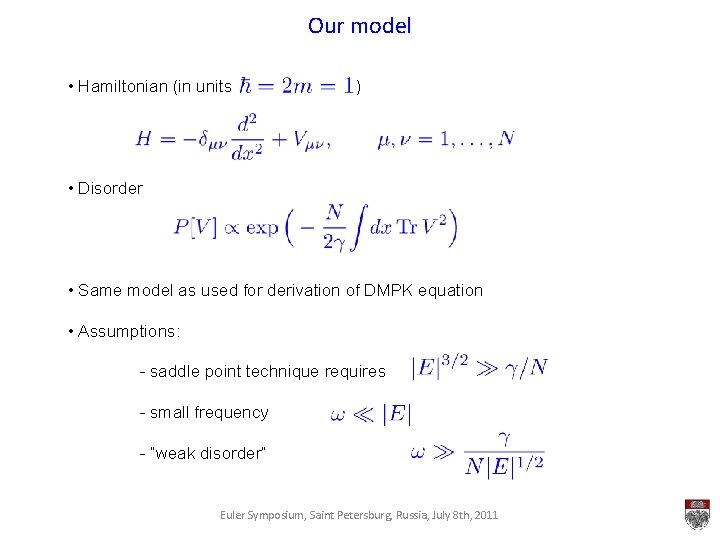
Our model • Hamiltonian (in units ) • Disorder • Same model as used for derivation of DMPK equation • Assumptions: - saddle point technique requires - small frequency - “weak disorder” Euler Symposium, Saint Petersburg, Russia, July 8 th, 2011
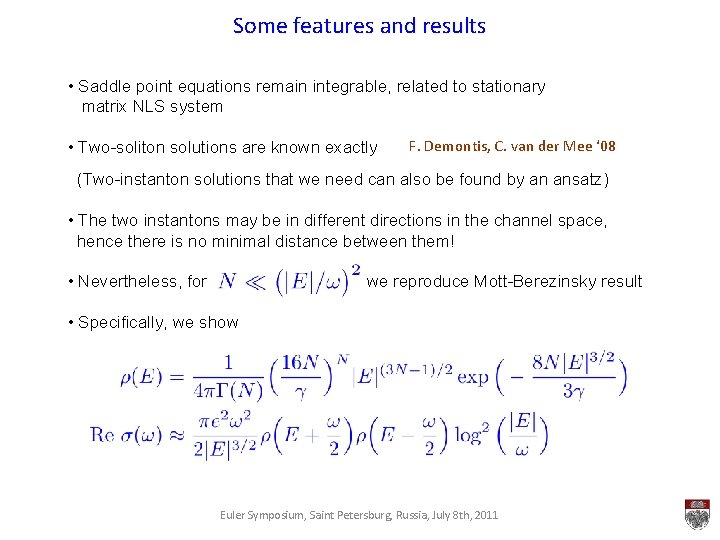
Some features and results • Saddle point equations remain integrable, related to stationary matrix NLS system • Two-soliton solutions are known exactly F. Demontis, C. van der Mee ‘ 08 (Two-instanton solutions that we need can also be found by an ansatz) • The two instantons may be in different directions in the channel space, hence there is no minimal distance between them! • Nevertheless, for we reproduce Mott-Berezinsky result • Specifically, we show Euler Symposium, Saint Petersburg, Russia, July 8 th, 2011
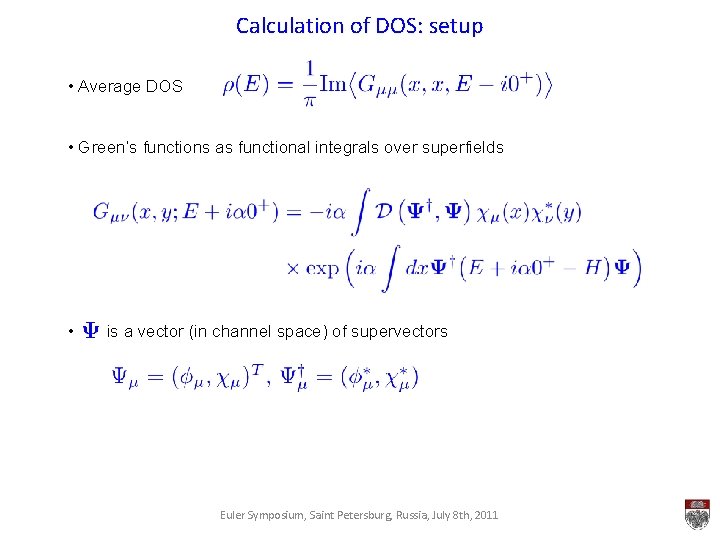
Calculation of DOS: setup • Average DOS • Green’s functions as functional integrals over superfields • is a vector (in channel space) of supervectors Euler Symposium, Saint Petersburg, Russia, July 8 th, 2011
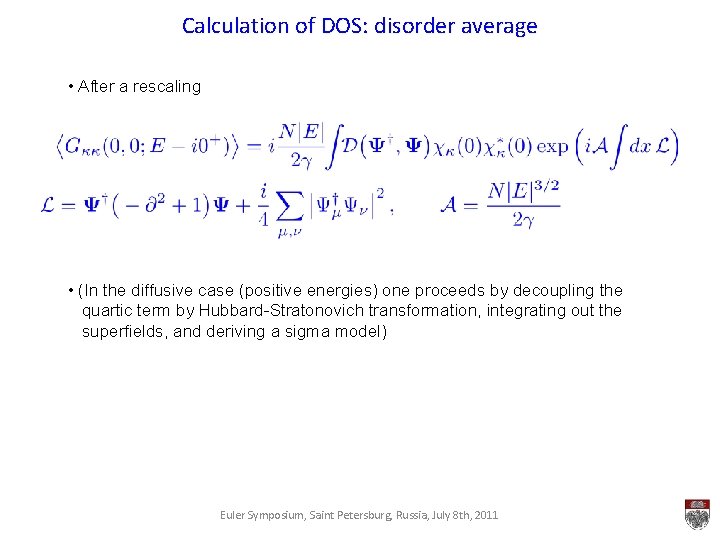
Calculation of DOS: disorder average • After a rescaling • (In the diffusive case (positive energies) one proceeds by decoupling the quartic term by Hubbard-Stratonovich transformation, integrating out the superfields, and deriving a sigma model) Euler Symposium, Saint Petersburg, Russia, July 8 th, 2011
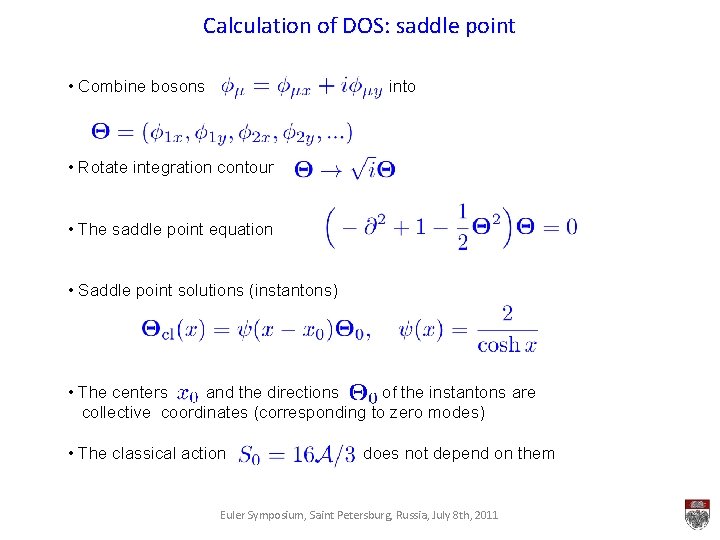
Calculation of DOS: saddle point • Combine bosons into • Rotate integration contour • The saddle point equation • Saddle point solutions (instantons) • The centers and the directions of the instantons are collective coordinates (corresponding to zero modes) • The classical action does not depend on them Euler Symposium, Saint Petersburg, Russia, July 8 th, 2011
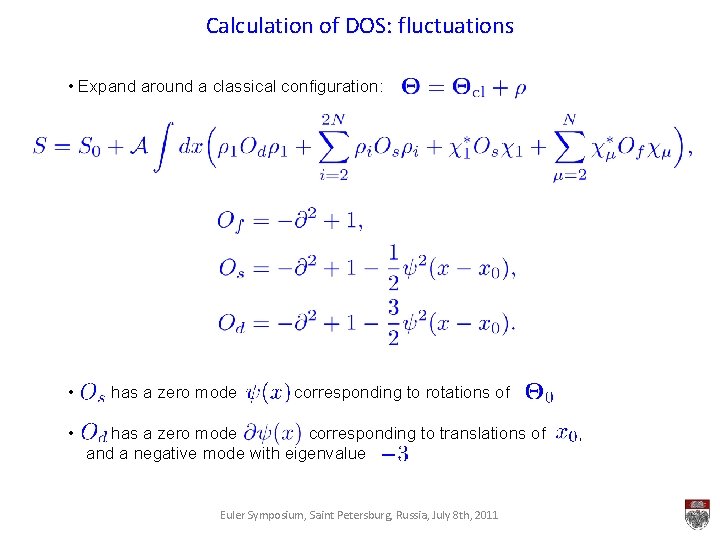
Calculation of DOS: fluctuations • Expand around a classical configuration: • • has a zero mode corresponding to rotations of has a zero mode corresponding to translations of and a negative mode with eigenvalue Euler Symposium, Saint Petersburg, Russia, July 8 th, 2011 ,
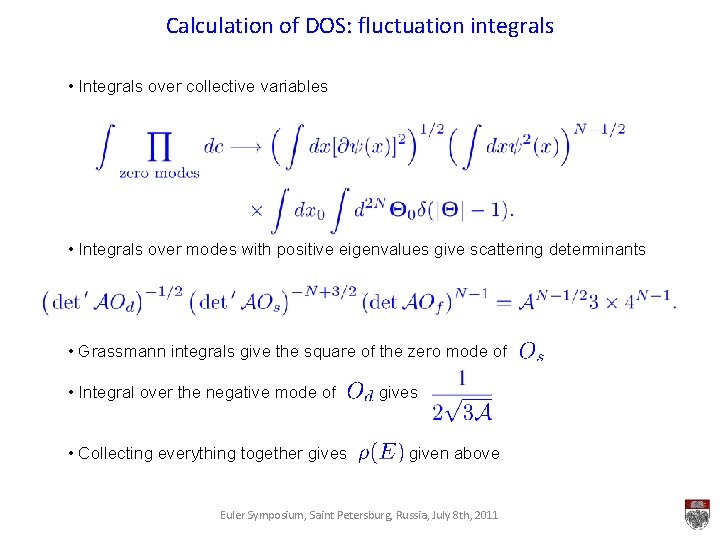
Calculation of DOS: fluctuation integrals • Integrals over collective variables • Integrals over modes with positive eigenvalues give scattering determinants • Grassmann integrals give the square of the zero mode of • Integral over the negative mode of • Collecting everything together gives given above Euler Symposium, Saint Petersburg, Russia, July 8 th, 2011

Calculation of the AC conductivity • is much more involved due to appearance of nearly zero modes • Need to use the integrability to determine exact two-instanton solutions and zero modes • Surprising cancelation between fluctuation integrals over nearly zero modes and the integral over the saddle point manifold • In the end get the Mott-Berezinsky formula plus ( with lower powers of -dependent) corrections Euler Symposium, Saint Petersburg, Russia, July 8 th, 2011
Conclusions • We present a rigorous and conreolled derivation of Mott-Berezinsky formula for the AC conductivity of a disordered quasi-1 D wire in the localized tails • Generalizations to higher dimensions • Generalizations to other types of disorder (non-Gaussian) • Relation to sigma model Euler Symposium, Saint Petersburg, Russia, July 8 th, 2011
- Slides: 21