
MOTOR SYSTEM EXAMINATION DR SARA SALAMA LECTURER OF


- Slides: 17
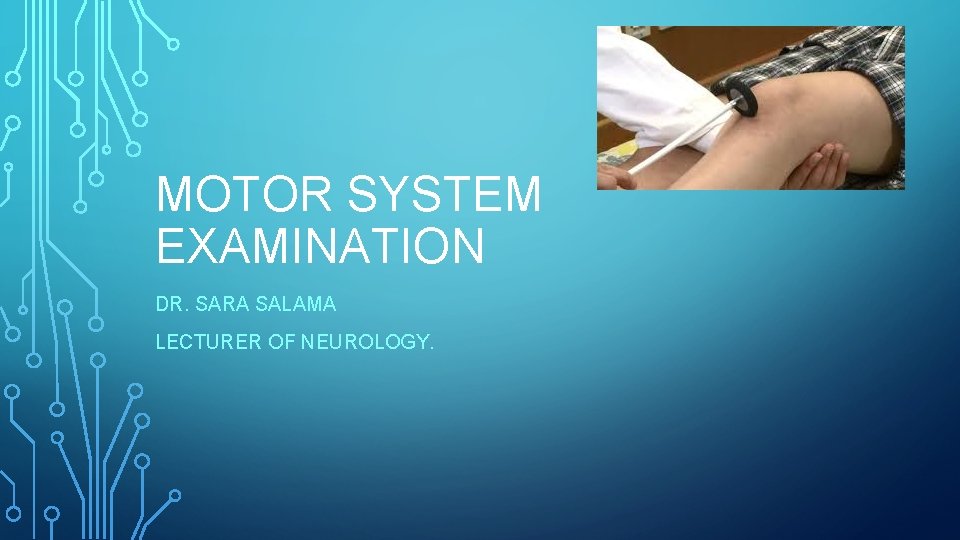
MOTOR SYSTEM EXAMINATION DR. SARA SALAMA LECTURER OF NEUROLOGY.
IMPORTANT POINT: • In all aspects of the motor system examination, compare left to right, distal to proximal, upper to lower extremities.
ITEMS • Involuntary movements • Muscle state (bulk, mass). • Muscle tone. • Muscle power. • Reflexes.
INVOLUNTARY MOVEMENTS • Observe for any abnormal involuntary movements. Ø Resting tremors Ø Fasciculations Ø Chorea Ø Dystonia
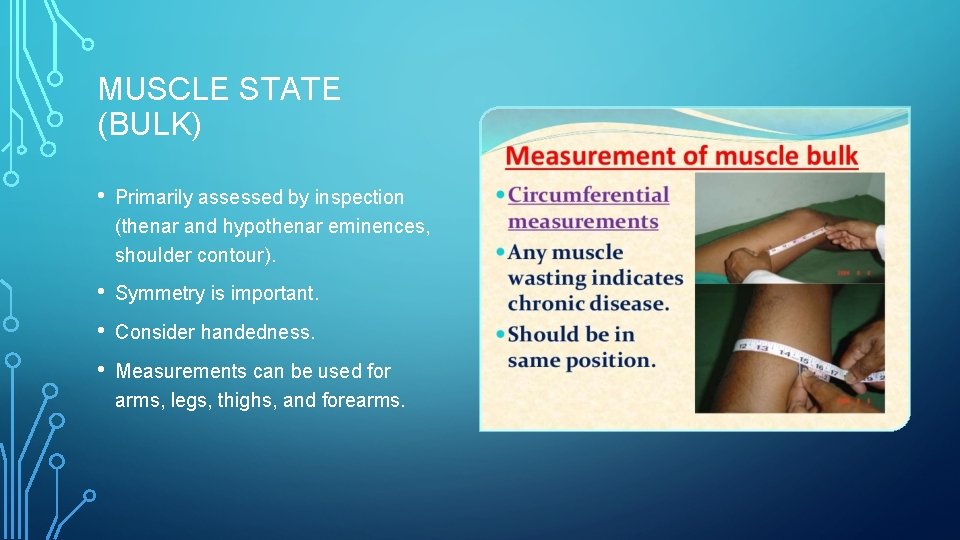
MUSCLE STATE (BULK) • Primarily assessed by inspection (thenar and hypothenar eminences, shoulder contour). • Symmetry is important. • Consider handedness. • Measurements can be used for arms, legs, thighs, and forearms.
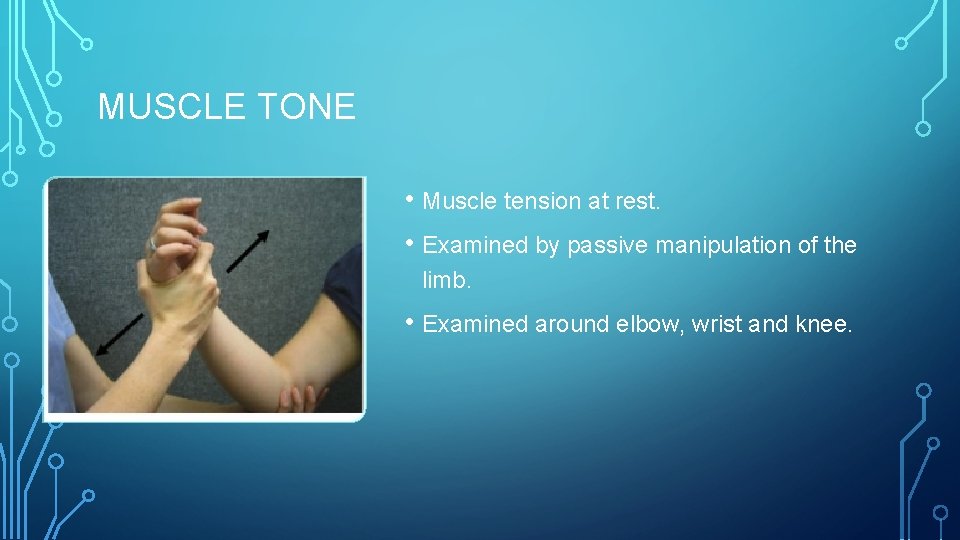
MUSCLE TONE • Muscle tension at rest. • Examined by passive manipulation of the limb. • Examined around elbow, wrist and knee.
FINDINGS: • Normal: shouldn’t be floppy neither stiff. • Increased (UMN lesion): ØSpasticity: pyramidal lesion. ØRigidity: extrapyramidal lesion. • Reduced (LMN lesion or cerebellar lesion). Abnormal tone is accompanied by other signs on examination that help with the lesion localization. https: //www. youtube. com/watch? v=g. LZo. YLxd. XCQ
MUSCLE POWER: • • Isolate muscle. • • https: //www. youtube. com/watch? v=Cjt 0 i. Ft 2 h. L 8 Fix proximal muscles when testing distally. Add to lower extremity testing; heel and toe walking. Consider normal variability such as age, sex, and handedness https: //www. youtube. com/watch? v=KZo. Q 2 Uk. MFTA
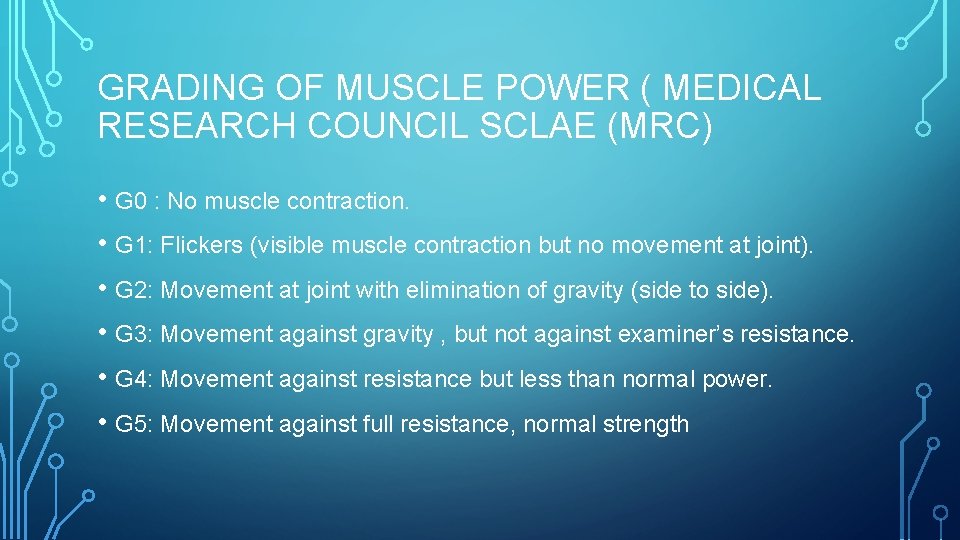
GRADING OF MUSCLE POWER ( MEDICAL RESEARCH COUNCIL SCLAE (MRC) • G 0 : No muscle contraction. • G 1: Flickers (visible muscle contraction but no movement at joint). • G 2: Movement at joint with elimination of gravity (side to side). • G 3: Movement against gravity , but not against examiner’s resistance. • G 4: Movement against resistance but less than normal power. • G 5: Movement against full resistance, normal strength
REFLEXES DEEP TENDON REFLEXES: UPPER LIMBS: • Biceps (C 5, 6). • Brachioradialis (C 5, C 6). • Triceps (C 6, C 7). • Pathological reflexes: Ø Finger jerk. Ø Hoffmann’s. Ø Wartenberg’s. https: //www. youtube. com/watch? v=3 a-PYp. MCB 4 U http: //neurosigns. org/wiki/Wartenberg%27 s_thumb_adduction_sign https: //www. youtube. com/watch? v=MUff. Mh-pa. Jc
DEEP TENDON REFLEXES LOWER LIMBS • Knee (L 3, L 4) • Ankle (S 1) • Pathological reflex: ØClonus https: //www. youtube. com/watch? v=K 7 FEm 8 Jn. V-s https: //www. youtube. com/watch? v=A 67 Od 2 Z_Tp. Q
GRADING OF REFLEXES: • 0 absent with reinforcement. • 1(+) just elicited • 2 (++) elicited (normal) • 3 (+++) brisky (hyperactive) • 4 (+++) with clonus
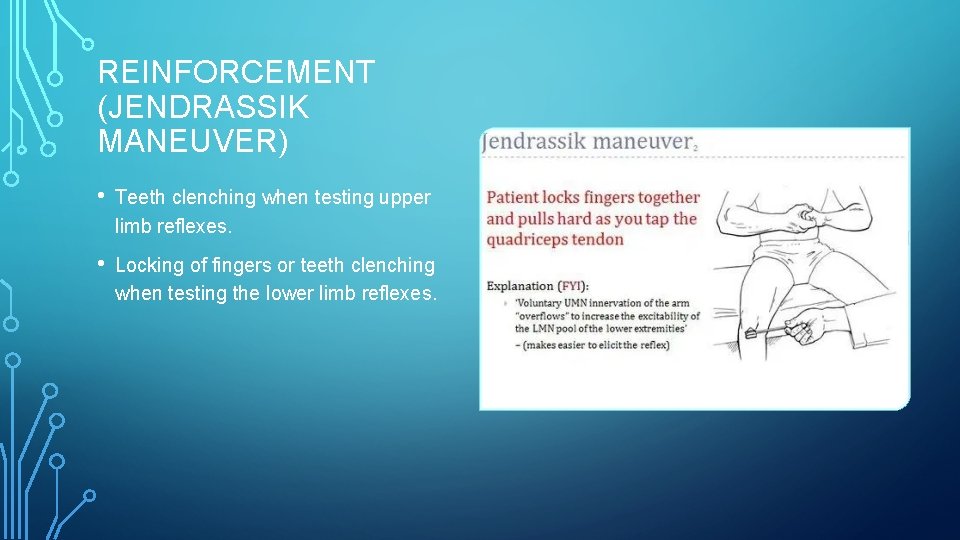
REINFORCEMENT (JENDRASSIK MANEUVER) • Teeth clenching when testing upper limb reflexes. • Locking of fingers or teeth clenching when testing the lower limb reflexes.
SUPERFICIAL REFLEXES • Plantar reflex. • Abdominal reflexe.
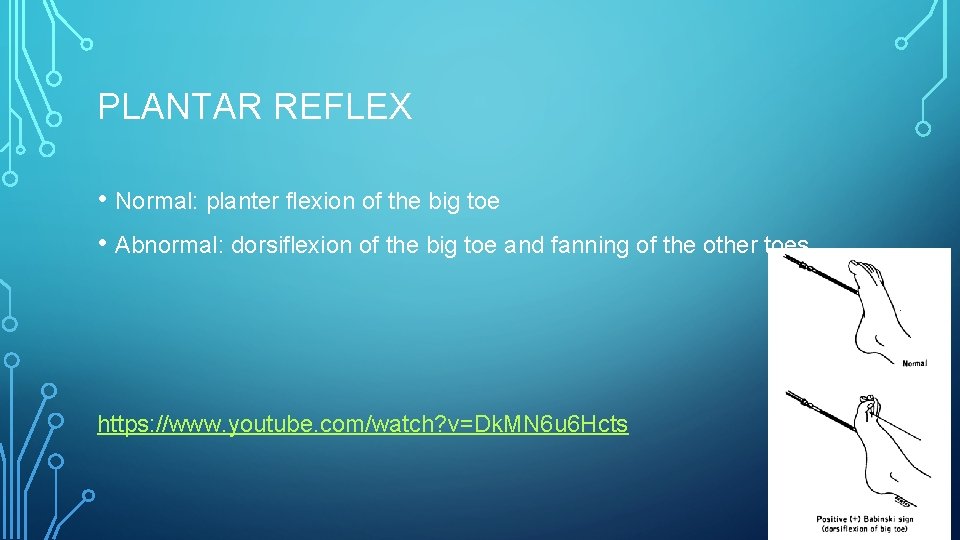
PLANTAR REFLEX • Normal: planter flexion of the big toe • Abnormal: dorsiflexion of the big toe and fanning of the other toes. https: //www. youtube. com/watch? v=Dk. MN 6 u 6 Hcts
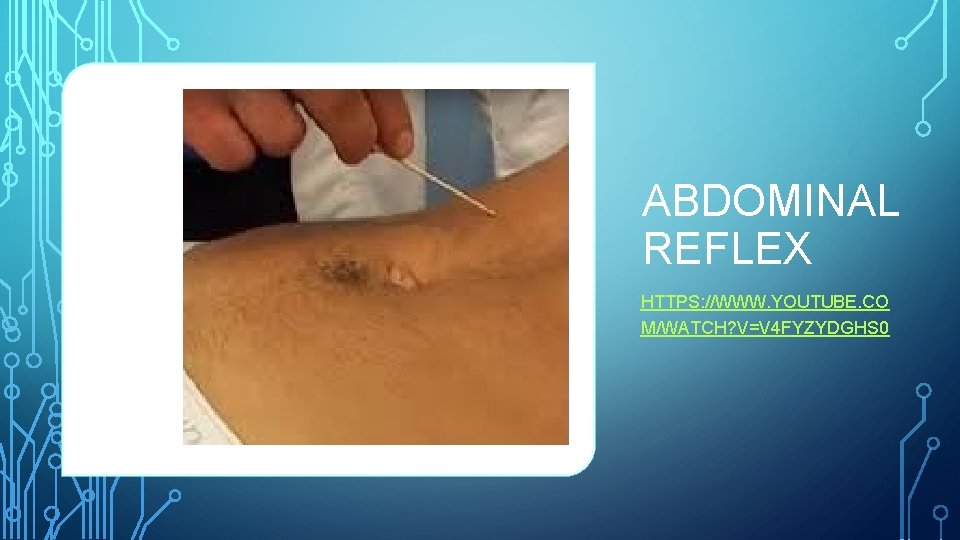
ABDOMINAL REFLEX HTTPS: //WWW. YOUTUBE. CO M/WATCH? V=V 4 FYZYDGHS 0
THANK YOU