
Motor Skills Ashira Hiruntrakul Ph D Important vocabulary
Motor Skills Ashira Hiruntrakul Ph. D.
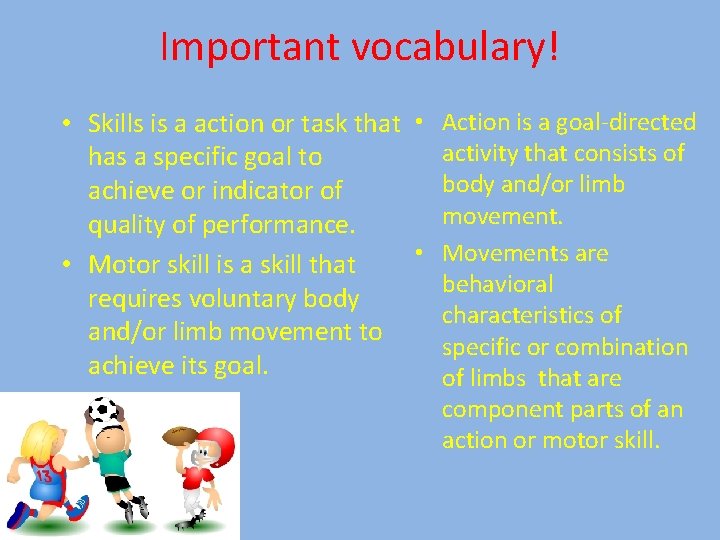
Important vocabulary! • Skills is a action or task that • Action is a goal-directed activity that consists of has a specific goal to body and/or limb achieve or indicator of movement. quality of performance. • Movements are • Motor skill is a skill that behavioral requires voluntary body characteristics of and/or limb movement to specific or combination achieve its goal. of limbs that are component parts of an action or motor skill.
What could cause a problem in learning a skill? • Incorrect understanding of movement • Poor physical abilities • Poor coordination • Incorrect application of power • Lack of concentration: fatigue, motivation • Inappropriate equipment, clothing, footwear • External factors: weather, audience, etc

• As we grow and develop our ability to complete complex motor tasks increases profoundly • All individuals go through 4 distinct stages from birth to adulthood • Reflexive Movement • Rudimentary Movement • Fundamental Movement • Sport-related Movement

• Reflexive Movement Phase (0 -4 months) -controlled motor development is displayed -moving arms and legs • Rudimentary Movement Phase (birth-2 years) -locomotor crawling -basic manipulation picking up/releasing -stability controlling head/neck, sitting up and down - overlaps reflexive movement phase
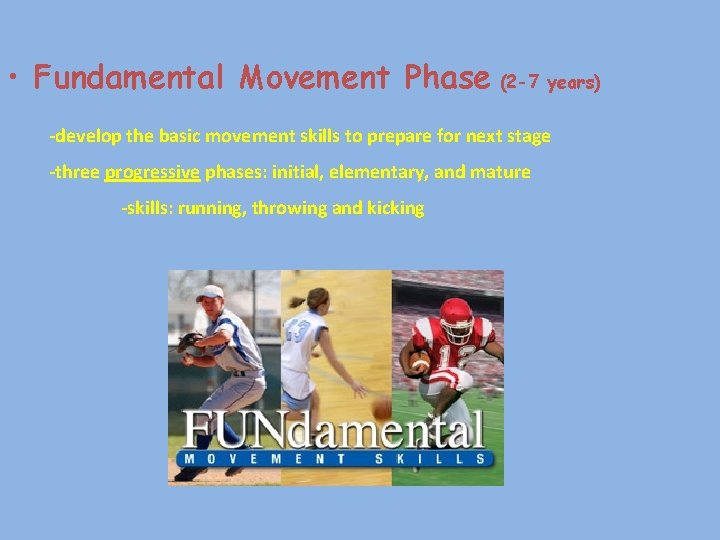
• Fundamental Movement Phase (2 -7 years) -develop the basic movement skills to prepare for next stage -three progressive phases: initial, elementary, and mature -skills: running, throwing and kicking
• Sport-related Movement Phase (7 ) - 3 distinct sub-phases: 1. General Phase (7 -10 yrs) -Skills learned in fundamental phase become refined into sport skills - ex. Throwing a ball: overhand pitch 2. Specific Phase (11 -13 yrs) -athlete develops more accuracy and complexity - ex. Pitching to the strike zone with different windups 3. Specialized Phase (14 – adult) -skills refined further -muscle memory

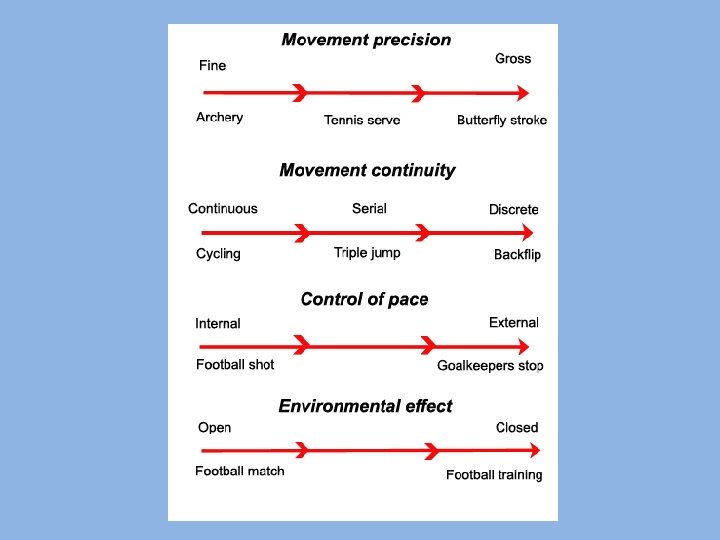
Classification of Skills - Size of primary musculature required - Gross and fine motor skill - Specificity of action time - Discrete, serial, and continuous motor skill - Stability of the environment - Closed and open motor skill - Environmental context - Regulatory condition and intertrail variability
Size of primary musculature required - Gross motor skill that requires the use of large muscle to achieve the goal. - Fine motor skill that requires control of small muscles to achieve the goal ; involved - eye-hand coordination - high degree of precision of hand finger movement.
Specificity of action time - Discrete motor skill is a motor skill with clearly defined beginning and end point; simple movement. - Serial motor skill is involving a series of discrete skills. - Continuous motor skill is a motor skill with arbitrary beginning and end point; repetitive movements.
Stability of the environment - Closed motor skill performed in a stable or predictable environment where the performer determines when to begin the action. - Open motor skill involves a nonstable unpredictable environment where an object or environment context is in motion and determines when to begin the action.
Environmental context - Regulatory condition : characteristics of the environmental context that determine the required movement characteristics needed to perform an action - Intertrail variability : whether the regulatory conditions that exist for the performance of a skill in one situation or for one trail are present or absent in the next situation or trail.
Performance in games and/or sports is related to skill development. Sports skills can be improved by: • Learning about the game/sport • Self-evaluation • Practice
The Terms Ability and Motor Ability • Ability – A general trait or capacity of a person – Relatively enduring characteristic – Serves as a determinant of a person’s achievement potential for the performance of specific skills • Motor Ability – An ability that is specifically related to the performance of a motor skill – Each person has a variety of motor abilities
Characteristics of Ability Innate/genetically determined Stable and enduring Support skills Abilities are seen as being building blocks helping us to learn and develop skills. • For example: to perform a handstand you must have the strength in your arms to support your body weight as well as the balance to keep your legs above your head. • •
Two types of ability • Gross motor abilities e. g. dynamic strength, static strength, explosive strength, stamina, extent flexibility, dynamic flexibility, gross body co-ordination, gross body equilibrium, trunk strength. • Psychomotor abilities e. g. multi limb coordination, response orientation, reaction time, speed of movement, finger dexterity, manual dexterity, rate control, aiming

Abilities as Individual Difference Variables • Motor abilities establish achievement potentials for specific motor skills • Each motor skill requires specific motor abilities to successfully perform it If 2 people have the same – Amount of practice – Level and amount of instruction – Motivation to perform the skill Then - Motor abilities will influence the level of performance success each person can/will achieve

Abilities as Individual Difference Variables, cont’d • Two hypotheses: – General Motor Ability Hypothesis: many different motor abilities that exist are highly related within a person and can be grouped as a singular, global motor ability (Brace, 1927; Mc. Cloy, 1934) – Specificity of Motor Ability Hypothesis: many motor abilities are relatively independent in an individual (Henry, 1961)
Controversy About Relationship Among Motor Abilities General Motor Ability Hypothesis • All motor abilities are highly related to each other • A person can be described as having an overall amount of general motor ability Specificity of Motor Abilities Hypothesis • All motor abilities are relatively independent • Each person varies in the amount of each ability • A person’s motor ability can be described only by a profile of amounts of each of several specific motor abilities

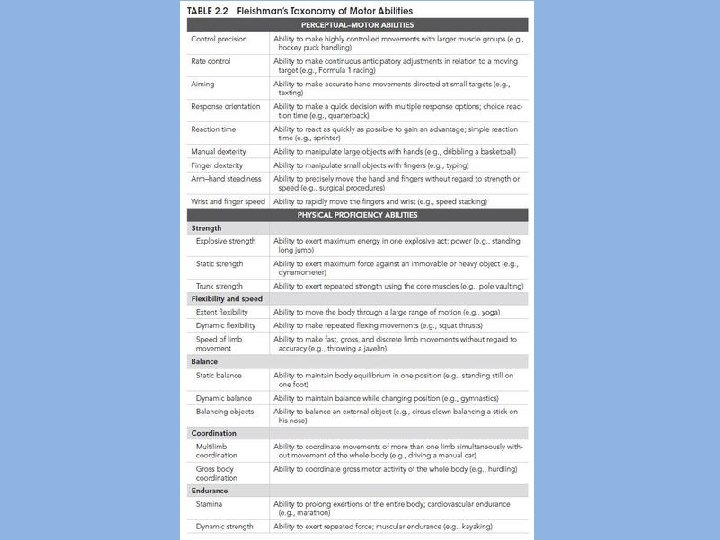
Identifying Motor Abilities One example of an attempt to identify motor abilities Fleishman’s Taxonomy of Motor Abilities – Described 11 perceptual-motor abilities – Identified 9 physical proficiency abilities
Fleishman (1972) • Who developed a taxonomy of human perceptual motor abilities; he identified eleven identifiable & measurable perceptual motor abilities; he also identified nine physical proficiency abilities (gross motor abilities)
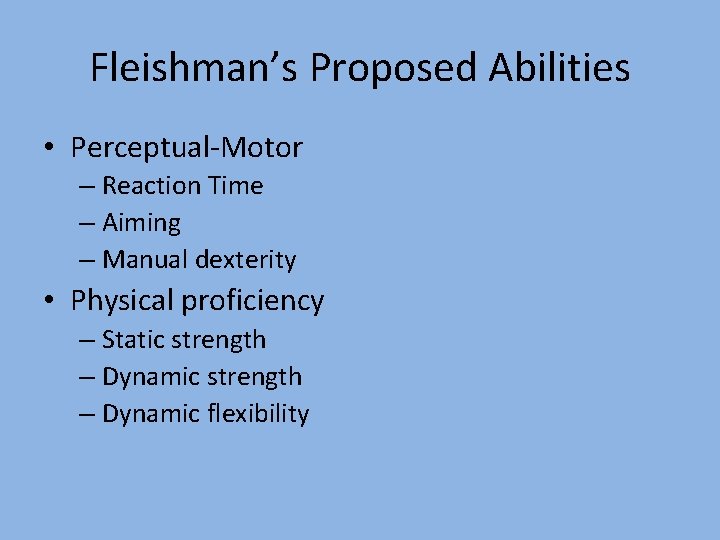
Fleishman’s Proposed Abilities • Perceptual-Motor – Reaction Time – Aiming – Manual dexterity • Physical proficiency – Static strength – Dynamic flexibility

Perceptual Motor Abilities • Multi-limb coordination – ability to coordinate movements of a number of limbs simultaneously • Control precision – ability to make rapid and precise movement adjustments of control devices involving single are-hand or leg movements; adjustments are made to visual stimuli
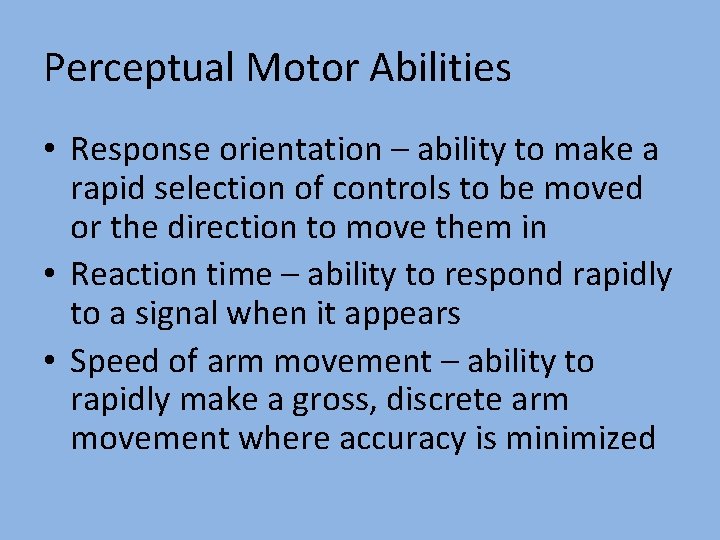
Perceptual Motor Abilities • Response orientation – ability to make a rapid selection of controls to be moved or the direction to move them in • Reaction time – ability to respond rapidly to a signal when it appears • Speed of arm movement – ability to rapidly make a gross, discrete arm movement where accuracy is minimized
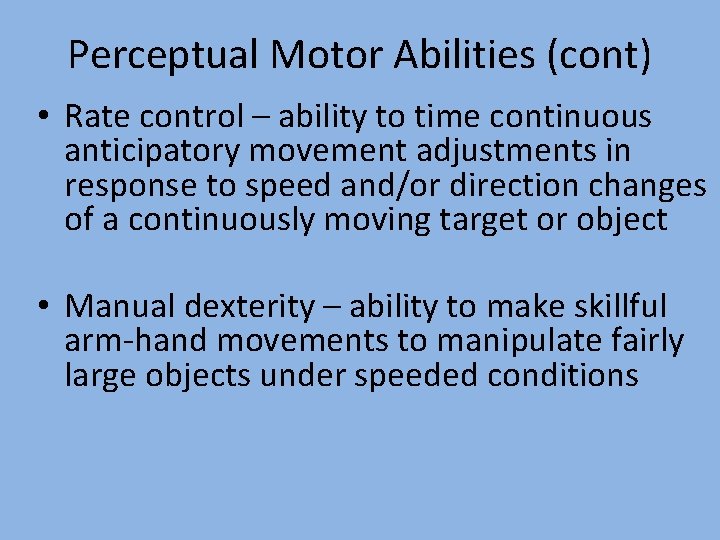
Perceptual Motor Abilities (cont) • Rate control – ability to time continuous anticipatory movement adjustments in response to speed and/or direction changes of a continuously moving target or object • Manual dexterity – ability to make skillful arm-hand movements to manipulate fairly large objects under speeded conditions
Perceptual Motor Abilities (cont) • Finger dexterity – ability to make skillful, controlled manipulations of tiny objects involving primarily the fingers • Arm-hand steadiness – ability to make precise arm-hand positioning movements where strength and speed are minimized; includes maintaining arm-hand steadiness during arm movement or in a static arm position
Perceptual Motor Abilities (cont) • Wrist, finger speed – ability to make rapid and repetitive movements with the hand fingers, and/or rotary wrist movements when accuracy is not critical • Aiming – ability to rapidly and accurately move the hand to a small target
Physical Proficiency Abilities • Static strength – maximum force that a person can exert against external objects • Dynamic strength – muscular endurance used in exerting force repeatedly • Explosive strength – ability to mobilize energy effectively for burst of muscular effort • Trunk strength – strength of the trunk muscles • Extent flexibility – ability to flex or stretch the trunk and back muscles
Physical Proficiency Abilities (cont) • Dynamic flexibility – ability to make repeated, rapid trunk-flexing movements • Gross body coordination – ability to coordinate the action of several parts of the body while body is in motion • Gross body equilibrium – ability to maintain balance without visual cues • Stamina – capacity to sustain maximum effort requiring cardiovascular effort
Additional Motor Abilities • Static balance – ability to maintain postural stability on a stable surface or when not engaging in locomotor acitviites • Dynamic balance – ability to maintain postural stability on a moving surface or when engaging in locomotor activities • Visual acuity – ability to see clearly and precisely • Visual tracking ability to visually follow a moving object • Eye-hand or eye-foot coordination – ability to perform skills requiring vision and the precise use of the hands or feet
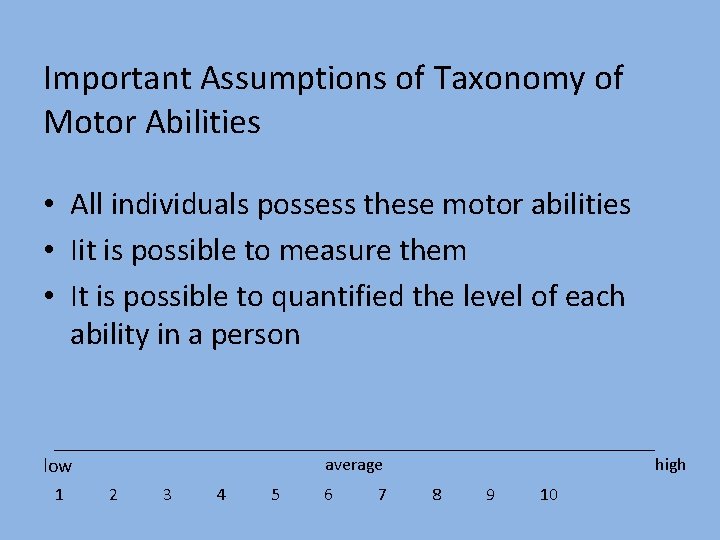
Important Assumptions of Taxonomy of Motor Abilities • All individuals possess these motor abilities • Iit is possible to measure them • It is possible to quantified the level of each ability in a person low 1 average 2 3 4 5 6 7 high 8 9 10

Relating Motor Abilities to Motor Skill Performance Task Analysis The motor skill The components of the skill The motor abilities underlying the performance of the skill’s components
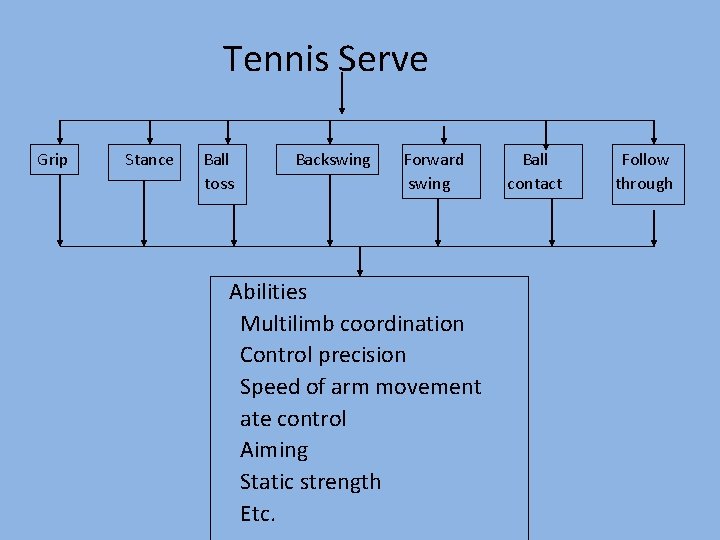
Tennis Serve Grip Stance Ball toss Backswing Forward swing Abilities Multilimb coordination Control precision Speed of arm movement ate control Aiming Static strength Etc. Ball contact Follow through
- Slides: 35