
Motor Pathways Lectures Objectives Define the terms upper
Motor Pathways
Lectures Objectives • Define the terms upper and lower motor neurons with examples. • Describe the corticospinal (pyramidal) tract and the direct motor pathways from the cortex to the trunk and limbs. • Briefly describe the indirect motor pathways from the cortex to the trunk and limbs through extrapyramidal tracts such as rubrospinal and reticulospinal tracts. • Describe motor pathways to the face muscles. • Compare the signs and symptoms of the upper and lower motor neuron lesions. • Identify the centers that make the basal ganglia. • Identify the different parts, regions and nuclei of the cerebellum. • Summarize the motor system circuitry.

Motor System Hierarchy Control Systems Initiator Executers Lower motor neuron Muscle Basal Ganglia Cerebellum Cortex Upper motor neurons Lower motor neuron Muscle
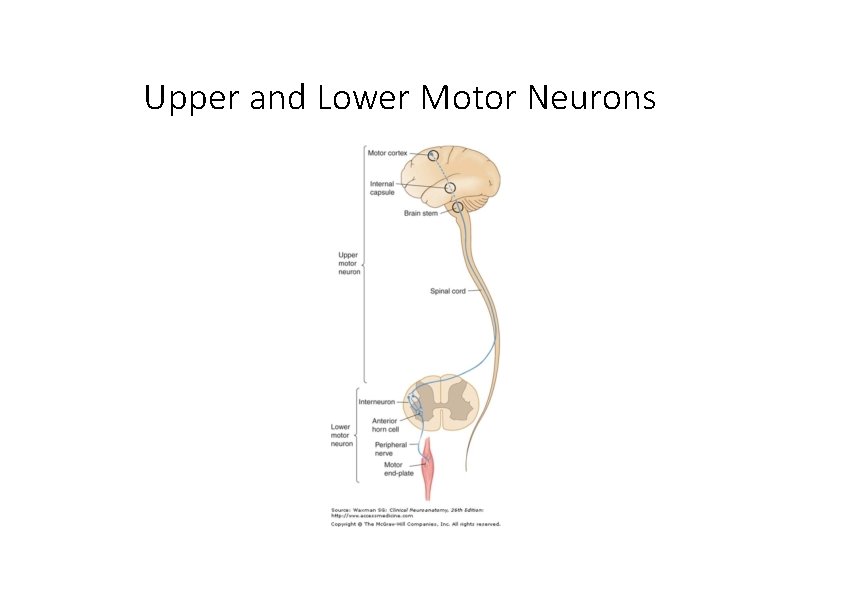
Upper and Lower Motor Neurons
Lower Motor Neurons • Neurons innervates muscles • Alpha motoneurons • Innervates normal fibers • Gamma motor neurons • Innervates fibers in muscle spindle • Present in: • Spinal cord • Brainstem (in the cranial nerves nuclei) • Muscle tone
Muscle Tone • Determined by the level of activity in the lower motor neurons • Tone refers to the resistance of a muscle to passive stretch • Primary determinant of muscle tone is the level of activity in the stretch reflex
Upper Motor Neurons • Project to LMN • Innervate α and γ motor neurons and inhibitory interneurons • Location of UMN • • • Reticular formation: reticulospinal tract Vestibular nuclei: vestibulospinal tract Superior colliculus: tectospinal tract Red nucleus: rubrospinal tract Motor cortex: corticospinal & corticobulbar tracts (+ corticorubral & corticoreticular)
Descending Tracts Classification • Classical classification: • Pyramidal system • Axons traverse the pyramids in medulla • Corticospinal axons • Extrapyramidal system • Other descending tracts • Basal ganglia and their connections with motor region • Functional classification: • Medial system • Innervate medial motor nucleus • Lateral system • Innervate lateral motor nucleus
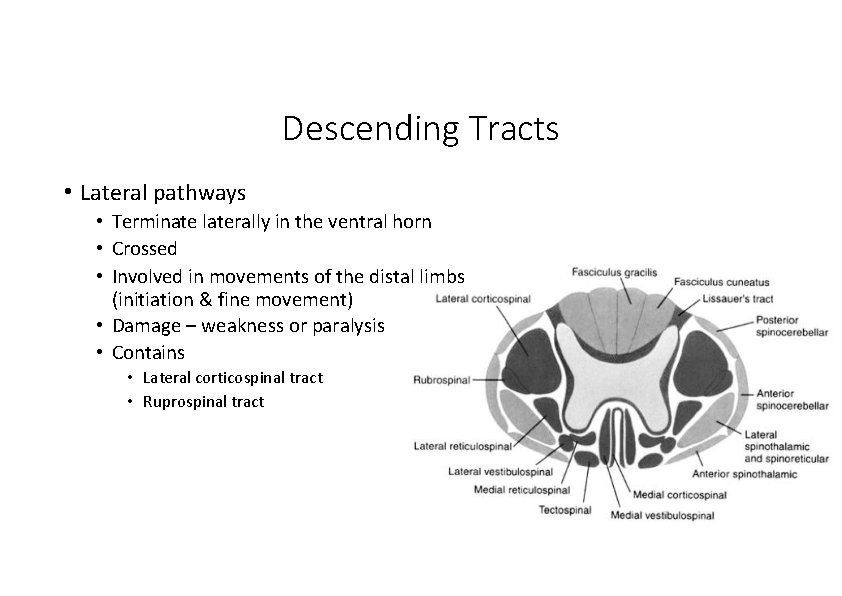
Descending Tracts • Lateral pathways • Terminate laterally in the ventral horn • Crossed • Involved in movements of the distal limbs (initiation & fine movement) • Damage – weakness or paralysis • Contains • Lateral corticospinal tract • Ruprospinal tract
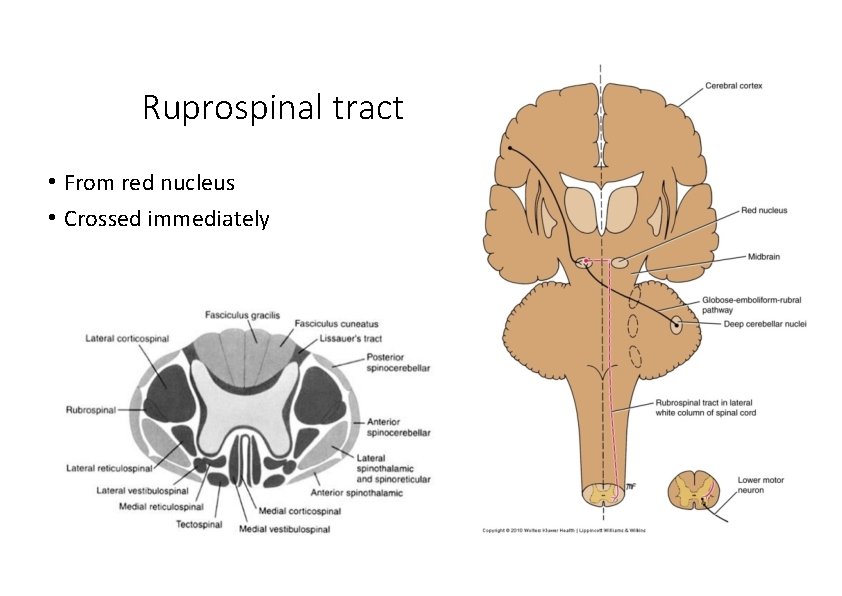
Ruprospinal tract • From red nucleus • Crossed immediately
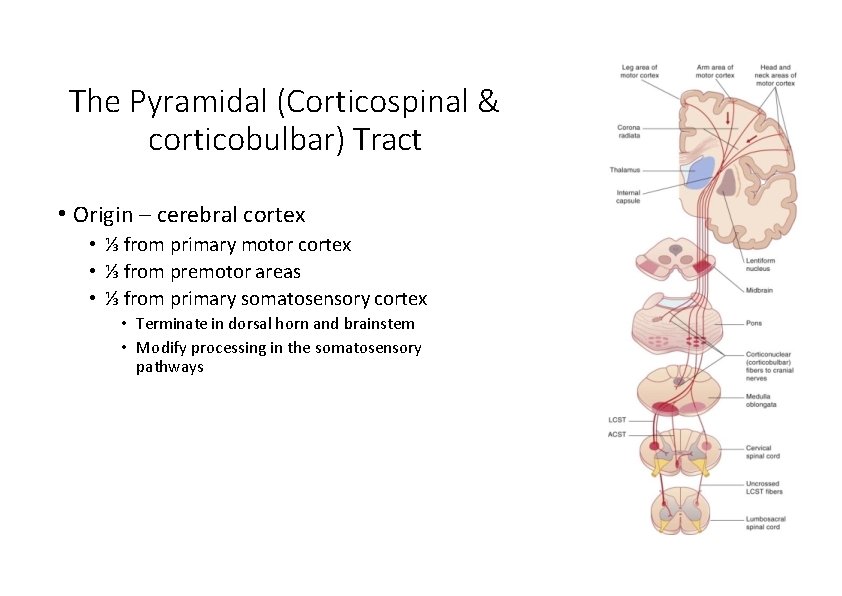
The Pyramidal (Corticospinal & corticobulbar) Tract • Origin – cerebral cortex • ⅓ from primary motor cortex • ⅓ from premotor areas • ⅓ from primary somatosensory cortex • Terminate in dorsal horn and brainstem • Modify processing in the somatosensory pathways
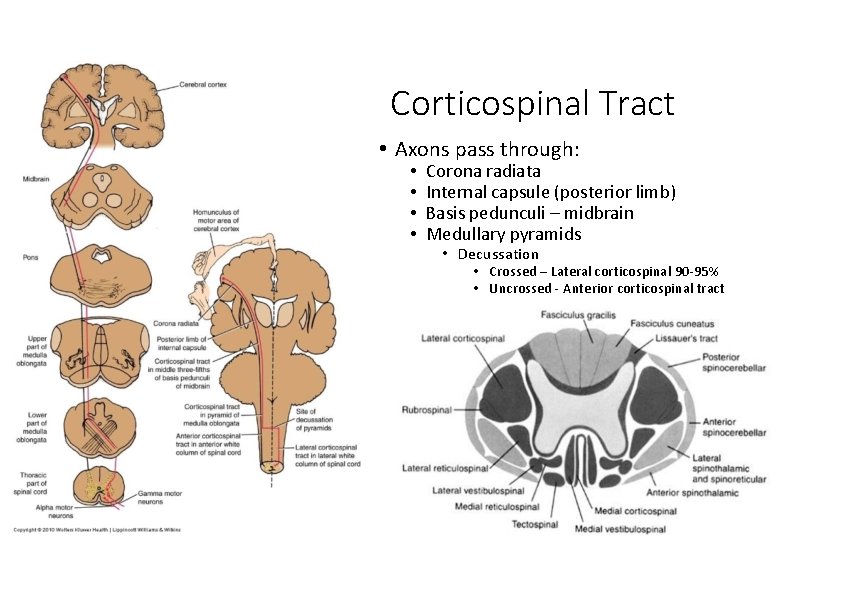
Corticospinal Tract • Axons pass through: • • Corona radiata Internal capsule (posterior limb) Basis pedunculi – midbrain Medullary pyramids • Decussation • Crossed – Lateral corticospinal 90‐ 95% • Uncrossed ‐ Anterior corticospinal tract
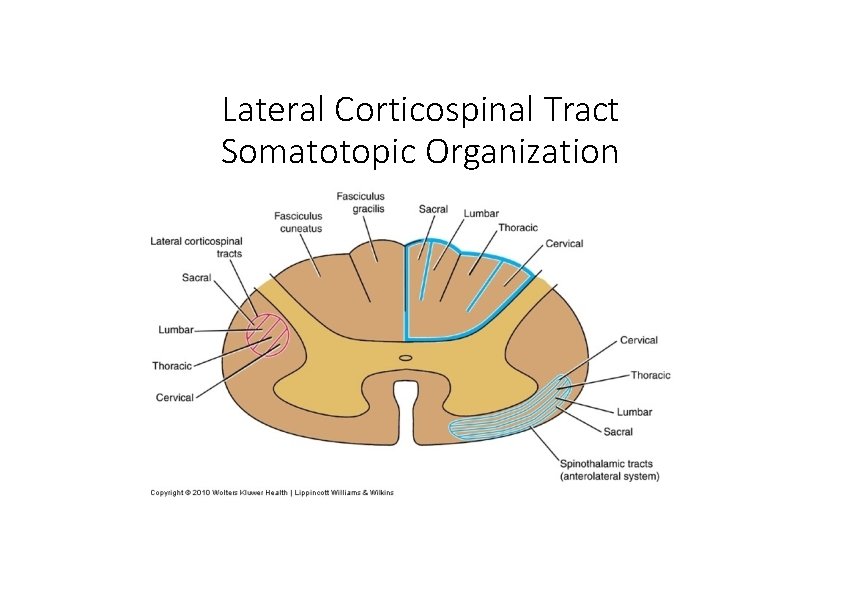
Lateral Corticospinal Tract Somatotopic Organization
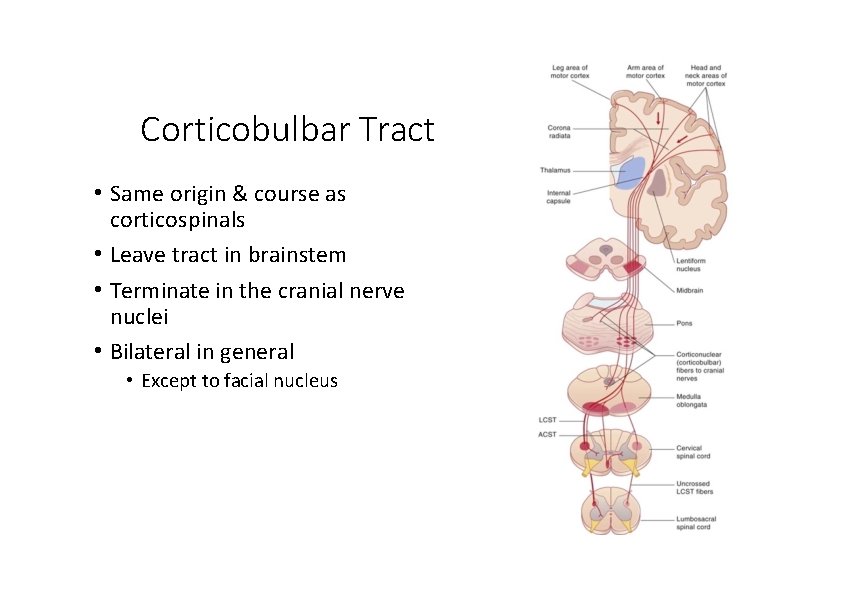
Corticobulbar Tract • Same origin & course as corticospinals • Leave tract in brainstem • Terminate in the cranial nerve nuclei • Bilateral in general • Except to facial nucleus
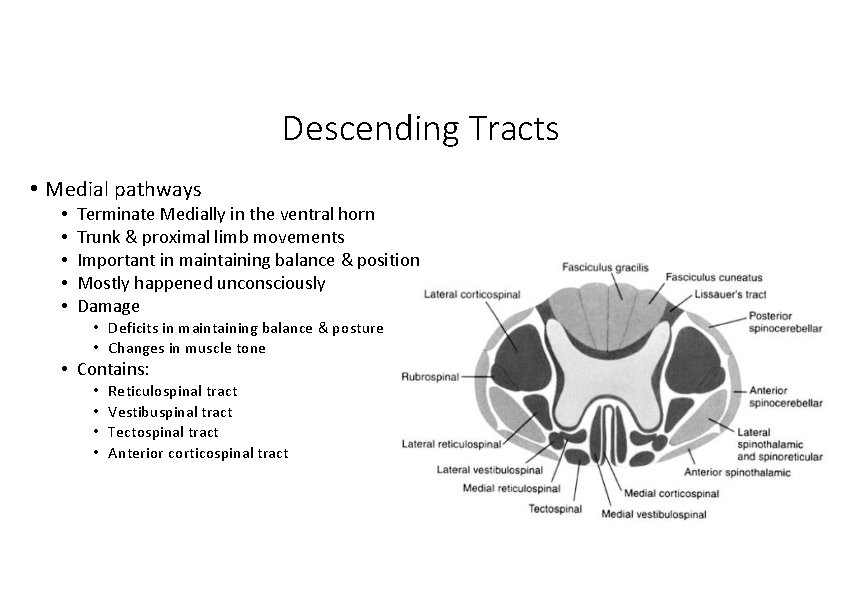
Descending Tracts • Medial pathways • • • Terminate Medially in the ventral horn Trunk & proximal limb movements Important in maintaining balance & position Mostly happened unconsciously Damage • Deficits in maintaining balance & posture • Changes in muscle tone • Contains: • • Reticulospinal tract Vestibuspinal tract Tectospinal tract Anterior corticospinal tract
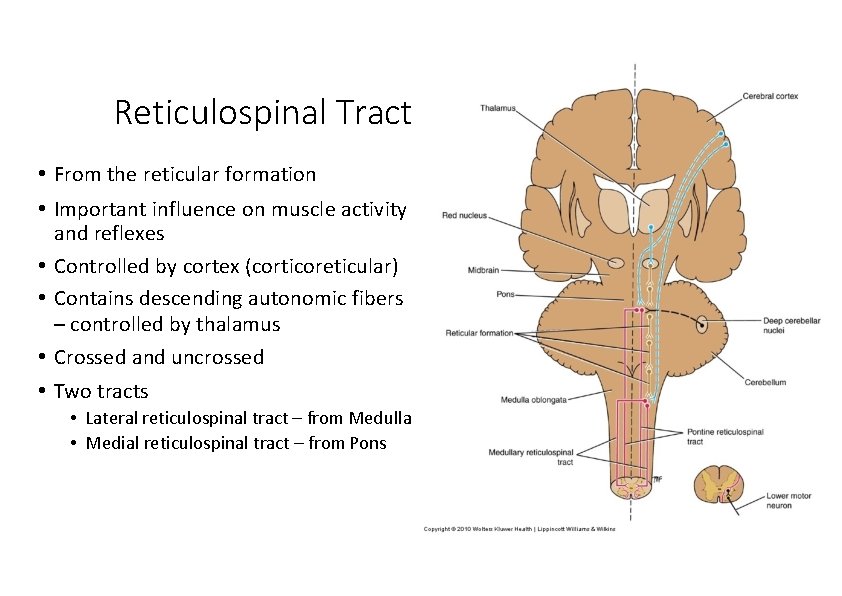
Reticulospinal Tract • From the reticular formation • Important influence on muscle activity and reflexes • Controlled by cortex (corticoreticular) • Contains descending autonomic fibers – controlled by thalamus • Crossed and uncrossed • Two tracts • Lateral reticulospinal tract – from Medulla • Medial reticulospinal tract – from Pons
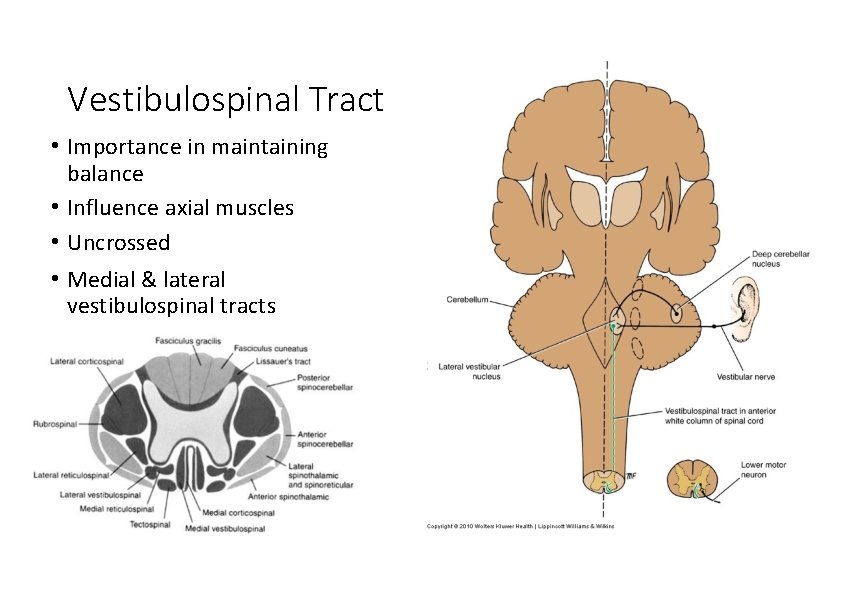
Vestibulospinal Tract • Importance in maintaining balance • Influence axial muscles • Uncrossed • Medial & lateral vestibulospinal tracts
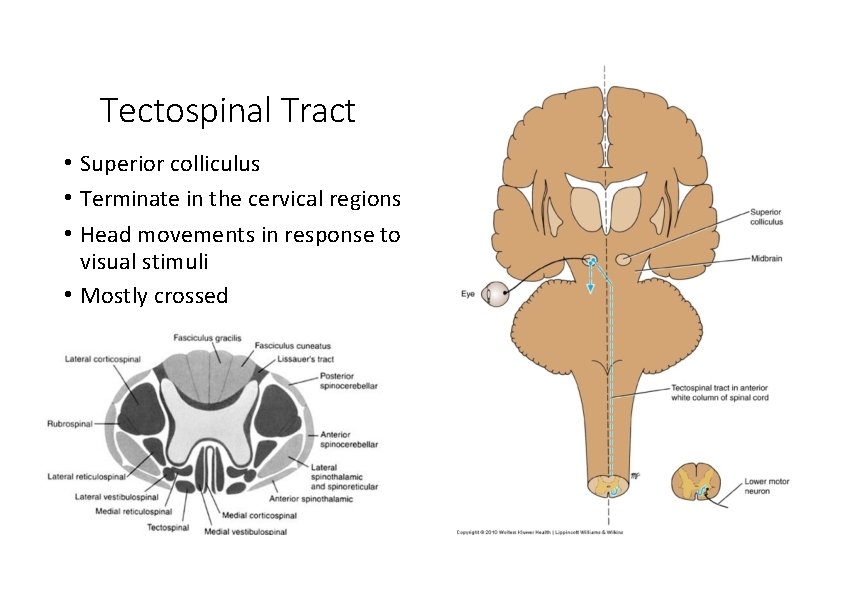
Tectospinal Tract • Superior colliculus • Terminate in the cervical regions • Head movements in response to visual stimuli • Mostly crossed
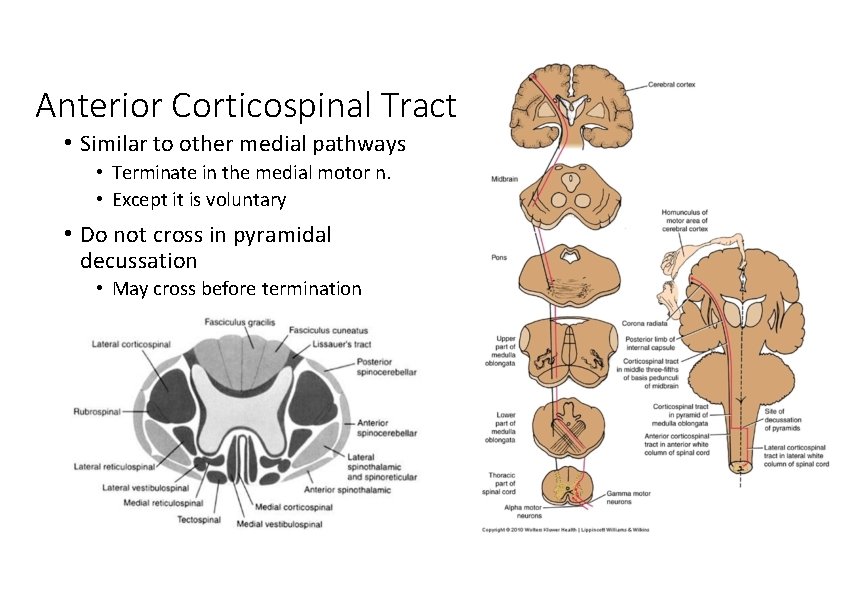
Anterior Corticospinal Tract • Similar to other medial pathways • Terminate in the medial motor n. • Except it is voluntary • Do not cross in pyramidal decussation • May cross before termination
Lower Motor Neuron Lesion • Flaccid paralysis or paresis (weakness) • Hypo‐ or areflexia • Decreased muscle tone • Atrophy‐ muscle wasting • Develops over time (weeks) • Fasciculations – small twitches that are visible to the eye
Upper Motor Neuron Lesion • Paralysis or paresis • Spasticity • Hypertonia • Hyperreflexia And maybe: • Babinski sign • Clonus • Decreased superficial reflexes • Abdominal reflex & Cremasteric reflex
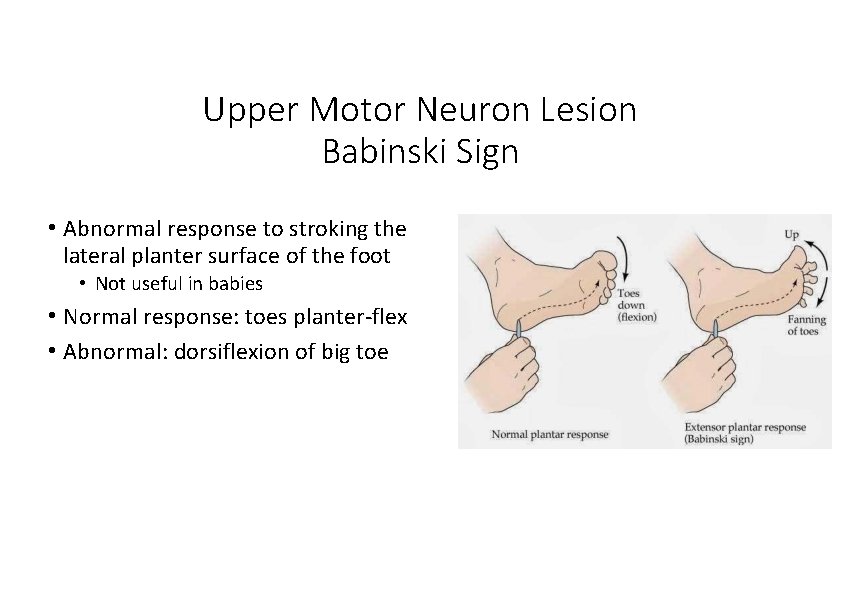
Upper Motor Neuron Lesion Babinski Sign • Abnormal response to stroking the lateral planter surface of the foot • Not useful in babies • Normal response: toes planter‐flex • Abnormal: dorsiflexion of big toe
Upper Motor Neuron Lesion Clonus • Repetitive flexion‐extension of a joint in response to single flexion or extension • https: //youtu. be/UX 75 k 8 s 5 QUE
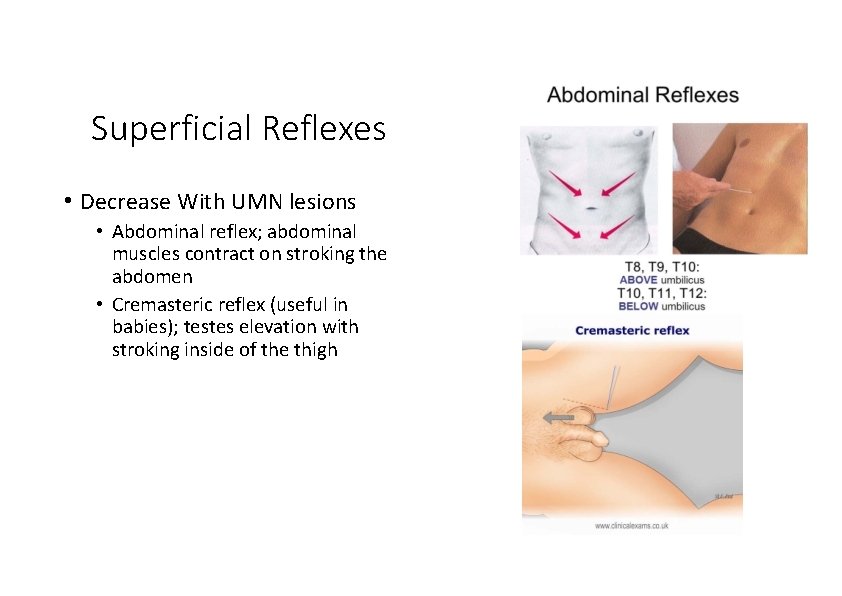
Superficial Reflexes • Decrease With UMN lesions • Abdominal reflex; abdominal muscles contract on stroking the abdomen • Cremasteric reflex (useful in babies); testes elevation with stroking inside of the thigh
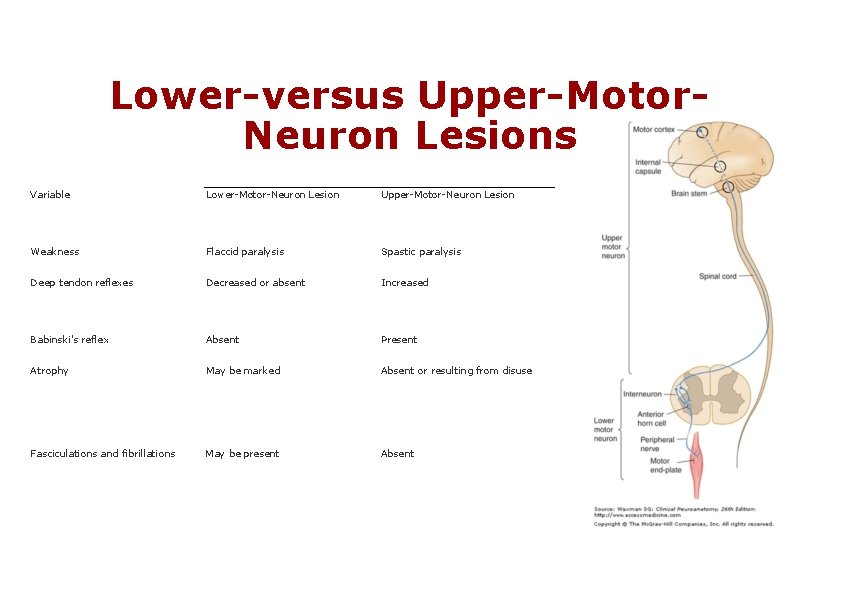
Lower-versus Upper-Motor. Neuron Lesions Variable Lower-Motor-Neuron Lesion Upper-Motor-Neuron Lesion Weakness Flaccid paralysis Spastic paralysis Deep tendon reflexes Decreased or absent Increased Babinski's reflex Absent Present Atrophy May be marked Absent or resulting from disuse Fasciculations and fibrillations May be present Absent
Spinal Shock • Follows severe acute injury to the spinal cord • For short period (days or weeks) • Loss of all functions (motor & sensory) bellow level of injury • Loss of reflexes • Due to sudden loss of supraspinal inputs
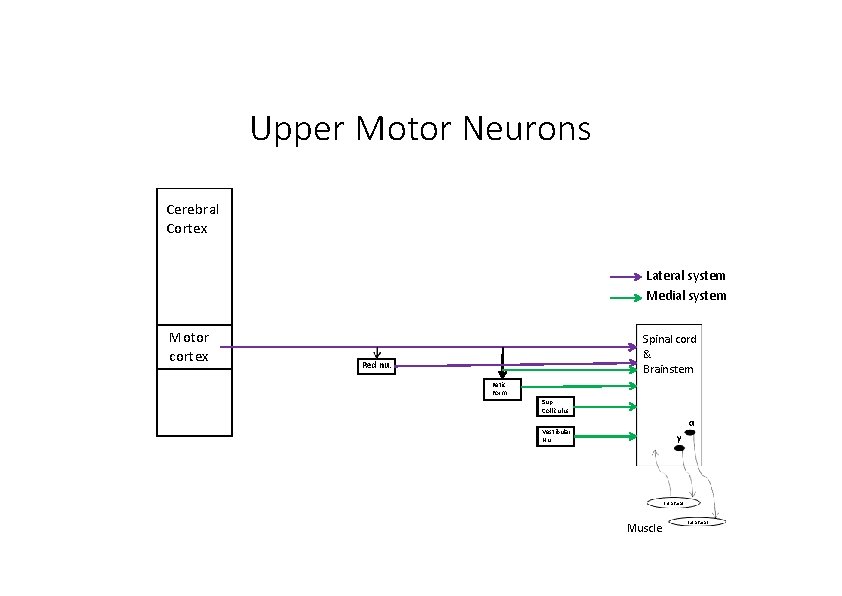
Upper Motor Neurons Cerebral Cortex Lateral system Medial system Motor cortex Spinal cord & Brainstem Red nu. Retic. Form. Sup. Colliculus α Vestibular Nu. γ Intrafusal Muscle Extrafusal
Basal Nuclei (Ganglia)
Basal Ganglia • The basal ganglia include the caudate, putamen, and globus pallidus and number of closely related nuclei • They influence motor system primarily through projections to upper motor neurons • Motor deficits depend on the specific nucleus damaged • Understanding the neurochemistry of basal ganglia drives the development of clinical treatment
Basal Ganglia • The basal ganglia act as • Brake against involuntary movement • Switch to turn on a fixed action pattern • Their major output is to the VA of the thalamus • Projects primarily to area 6 (premotor & supplementary motor areas)
Basal Ganglia Terminology • Striatum (neostriatum) = caudate + putamen • Lentiform nucleus = putamen + globus pallidus • Corpus striatum = caudate + lentiform • Basal ganglia = corpus striatum + amygdala • Globus pallidus = pallidum = paleostriatum • Claustrum is some times included with the basal ganglia • Basal ganglia is included by the extrapyramidal system
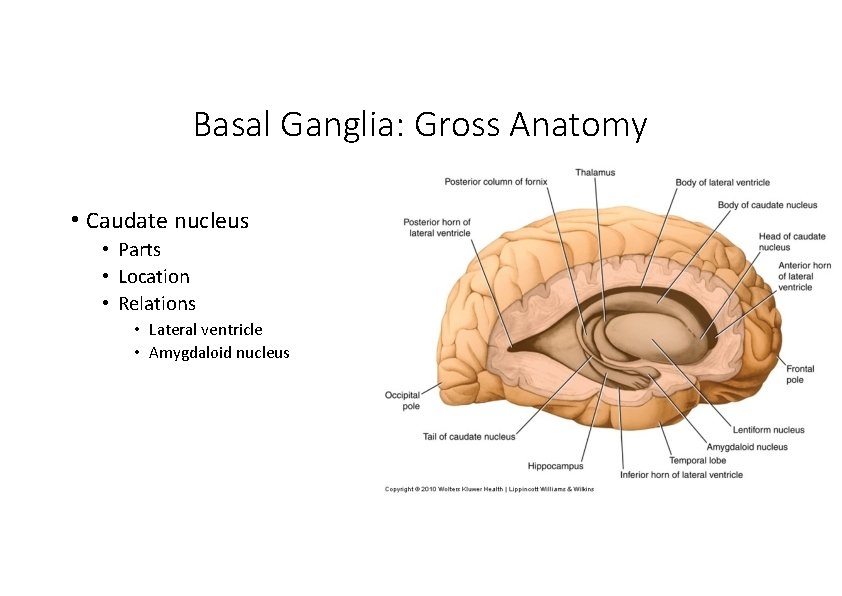
Basal Ganglia: Gross Anatomy • Caudate nucleus • Parts • Location • Relations • Lateral ventricle • Amygdaloid nucleus
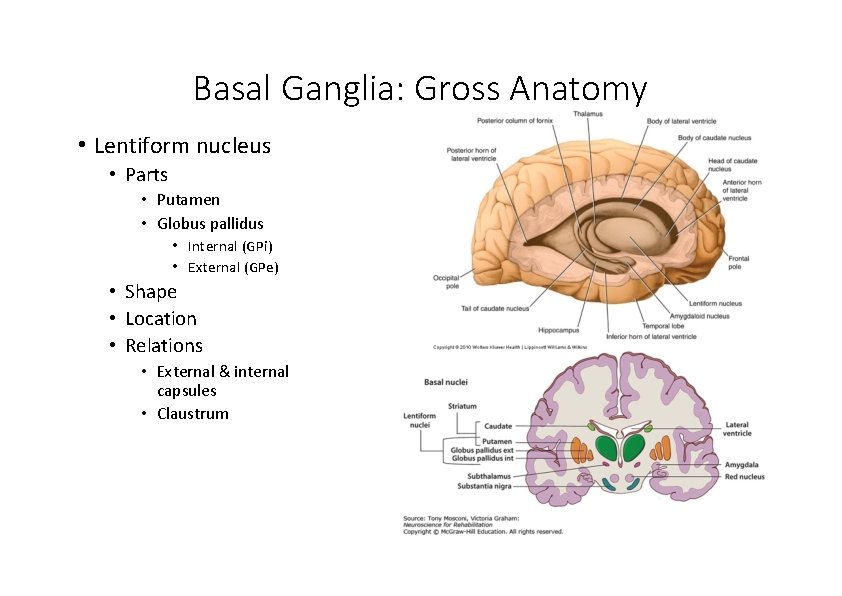
Basal Ganglia: Gross Anatomy • Lentiform nucleus • Parts • Putamen • Globus pallidus • Internal (GPi) • External (GPe) • Shape • Location • Relations • External & internal capsules • Claustrum
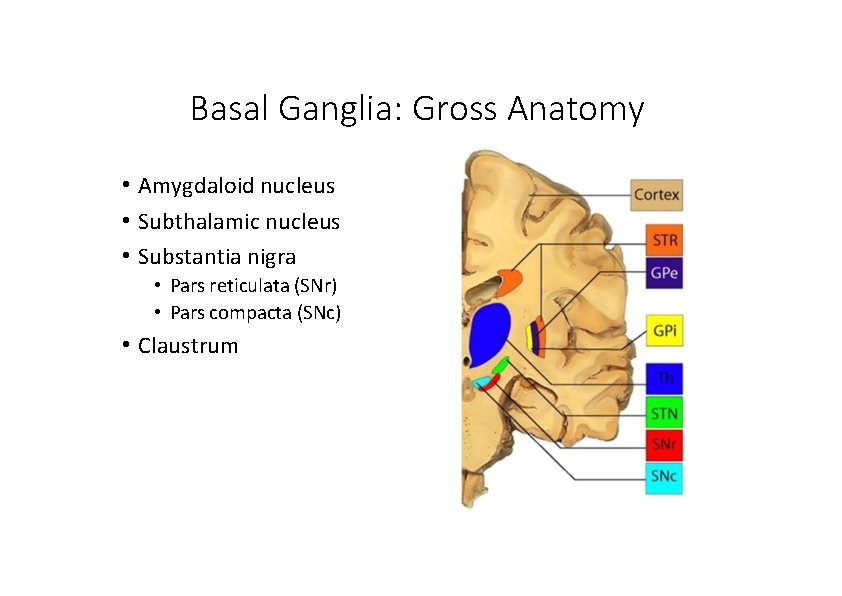
Basal Ganglia: Gross Anatomy • Amygdaloid nucleus • Subthalamic nucleus • Substantia nigra • Pars reticulata (SNr) • Pars compacta (SNc) • Claustrum
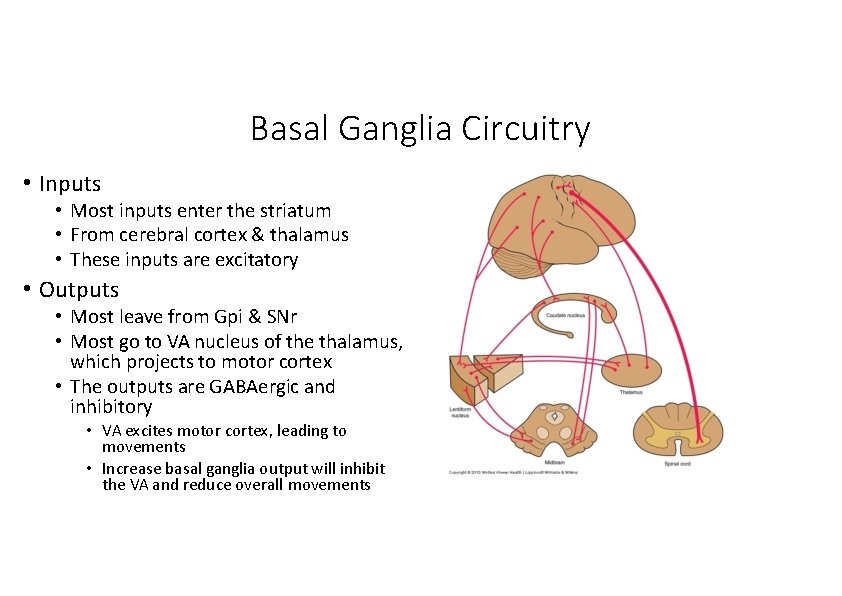
Basal Ganglia Circuitry • Inputs • Most inputs enter the striatum • From cerebral cortex & thalamus • These inputs are excitatory • Outputs • Most leave from Gpi & SNr • Most go to VA nucleus of the thalamus, which projects to motor cortex • The outputs are GABAergic and inhibitory • VA excites motor cortex, leading to movements • Increase basal ganglia output will inhibit the VA and reduce overall movements
Basal Ganglia Circuitry Intrinsic Circuits • Large number of connections between components of the basal ganglia • Can be grouped into • Direct pathway • Indirect pathway • These pathways affect the VA activity and thus the motor cortex activity
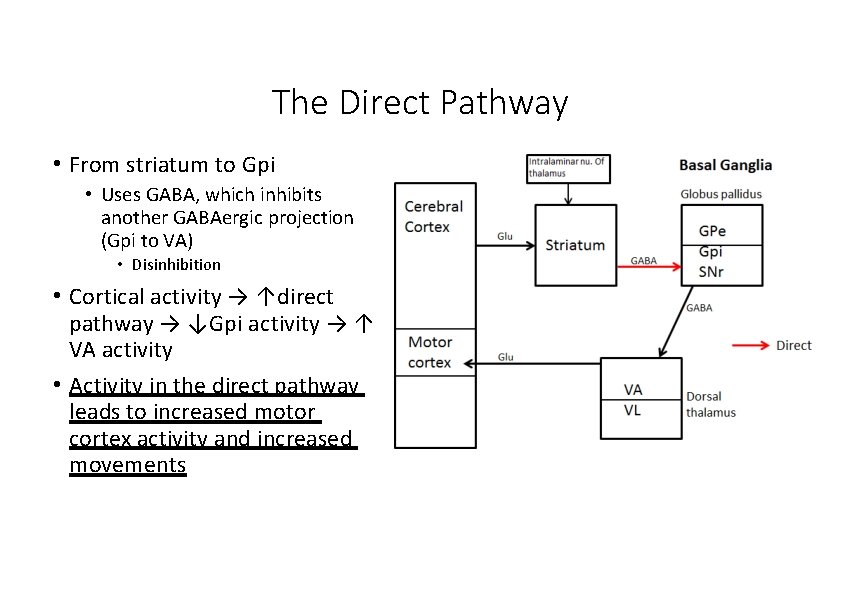
The Direct Pathway • From striatum to Gpi • Uses GABA, which inhibits another GABAergic projection (Gpi to VA) • Disinhibition • Cortical activity → ↑direct pathway → ↓Gpi activity → ↑ VA activity • Activity in the direct pathway leads to increased motor cortex activity and increased movements
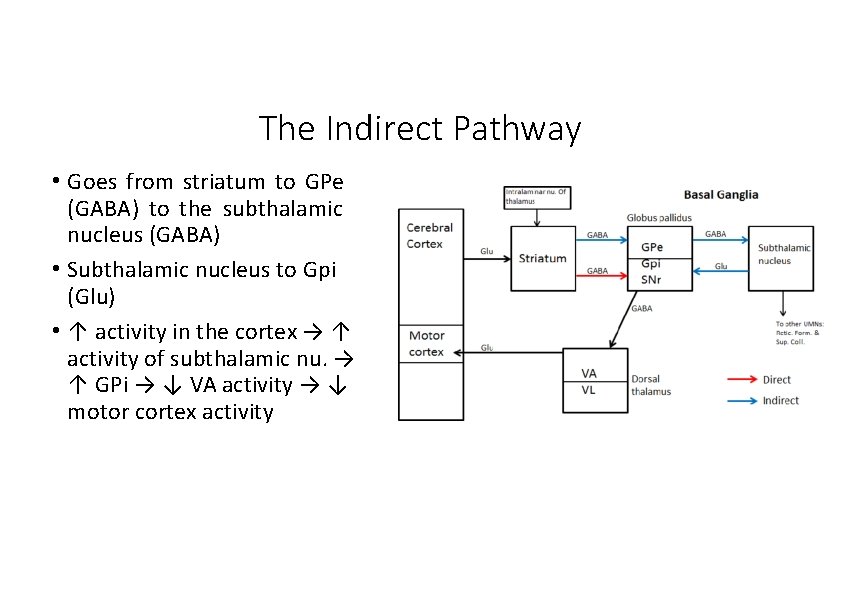
The Indirect Pathway • Goes from striatum to GPe (GABA) to the subthalamic nucleus (GABA) • Subthalamic nucleus to Gpi (Glu) • ↑ activity in the cortex → ↑ activity of subthalamic nu. → ↑ GPi → ↓ VA activity → ↓ motor cortex activity
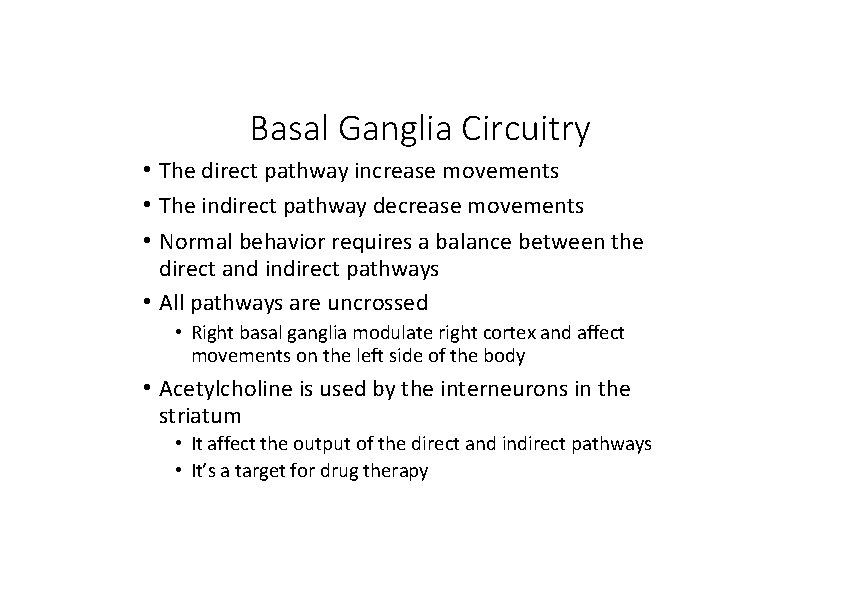
Basal Ganglia Circuitry • The direct pathway increase movements • The indirect pathway decrease movements • Normal behavior requires a balance between the direct and indirect pathways • All pathways are uncrossed • Right basal ganglia modulate right cortex and affect movements on the left side of the body • Acetylcholine is used by the interneurons in the striatum • It affect the output of the direct and indirect pathways • It’s a target for drug therapy
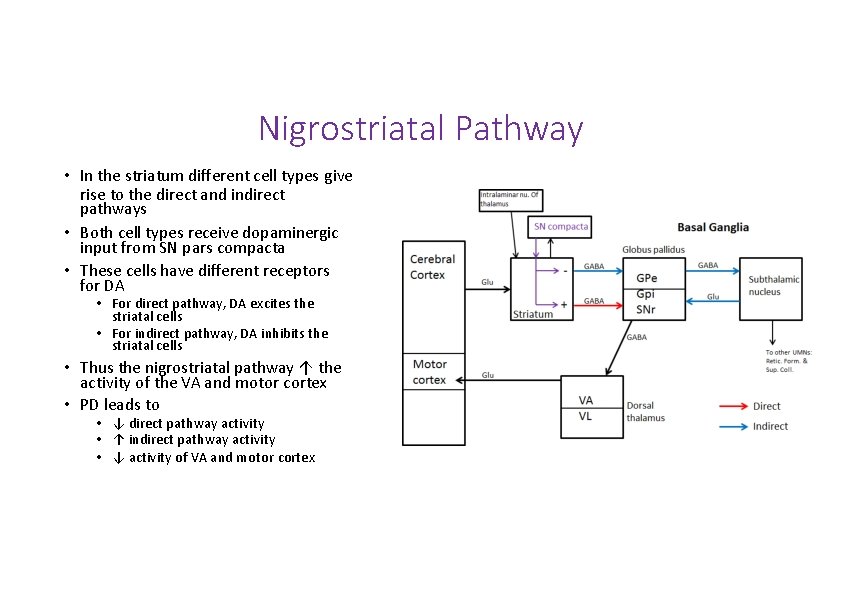
Nigrostriatal Pathway • In the striatum different cell types give rise to the direct and indirect pathways • Both cell types receive dopaminergic input from SN pars compacta • These cells have different receptors for DA • For direct pathway, DA excites the striatal cells • For indirect pathway, DA inhibits the striatal cells • Thus the nigrostriatal pathway ↑ the activity of the VA and motor cortex • PD leads to • ↓ direct pathway activity • ↑ indirect pathway activity • ↓ activity of VA and motor cortex
Cerebellum
Cerebellum • The cerebellum is essential for normal movements • It affects motor behavior by affecting UMNs • The cerebellum acts as a comparator • Compares intended movements (data from cerebral cortex) to the actual movements (sensory data) • Sends corrective signals into the descending motor pathways
Cerebellar Function • It affects all movements, it is important in: • • Balance Locomotion Simple & complex movements Eye movements, etc. • Site of motor learning • Important for learning new motor skills and adjusting movements to changing sensory inputs
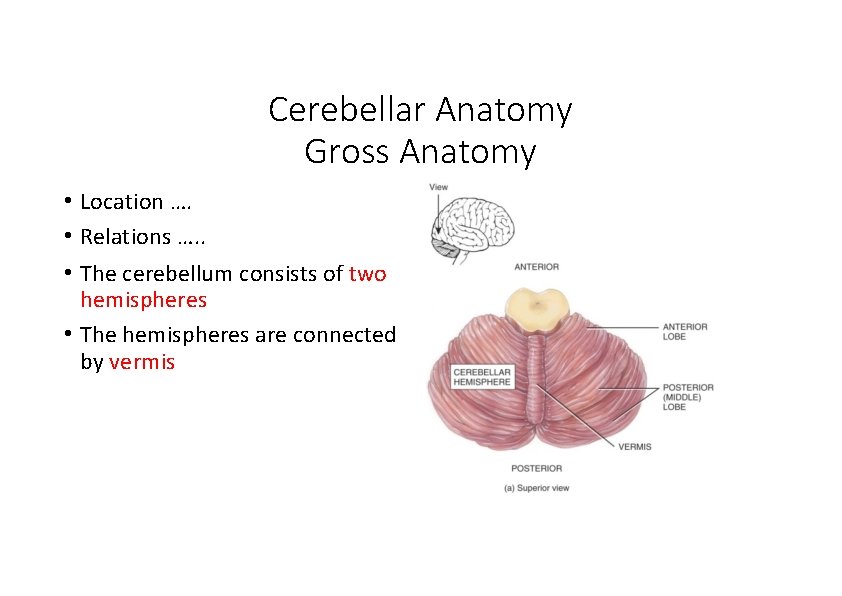
Cerebellar Anatomy Gross Anatomy • Location …. • Relations …. . • The cerebellum consists of two hemispheres • The hemispheres are connected by vermis
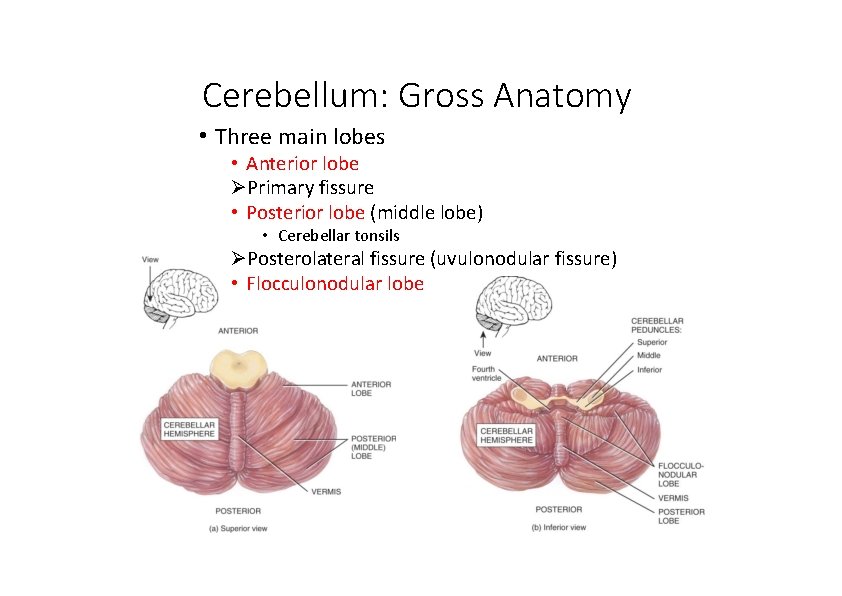
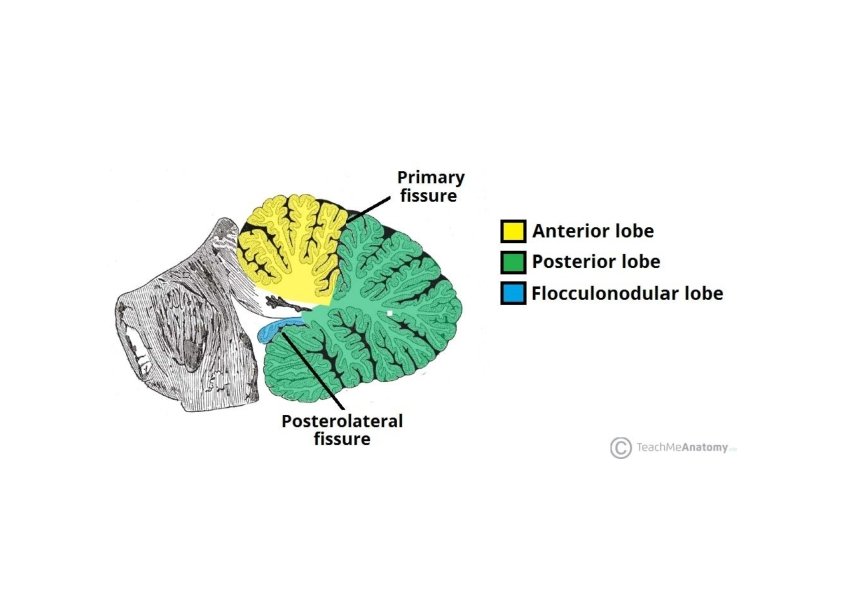
Cerebellum: Gross Anatomy • Three main lobes • Anterior lobe Primary fissure • Posterior lobe (middle lobe) • Cerebellar tonsils Posterolateral fissure (uvulonodular fissure) • Flocculonodular lobe
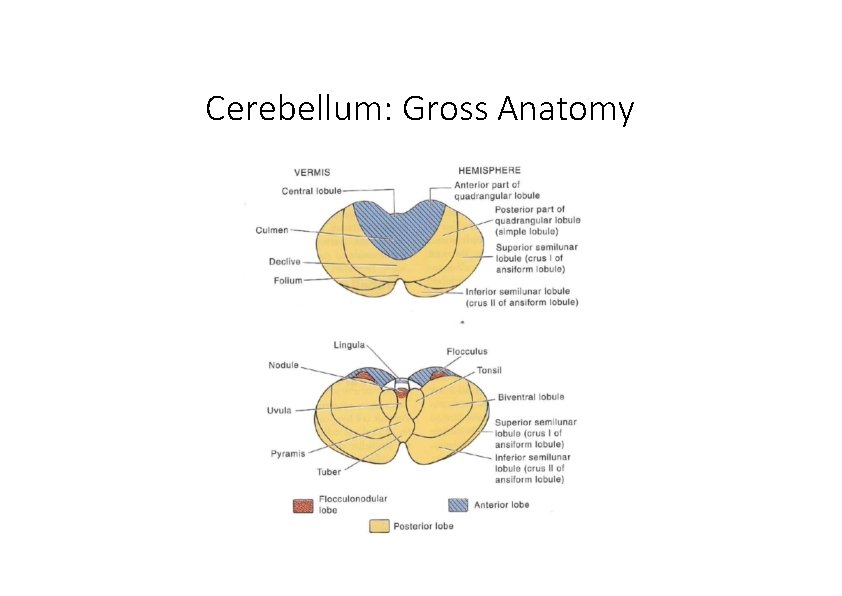
Cerebellum: Gross Anatomy
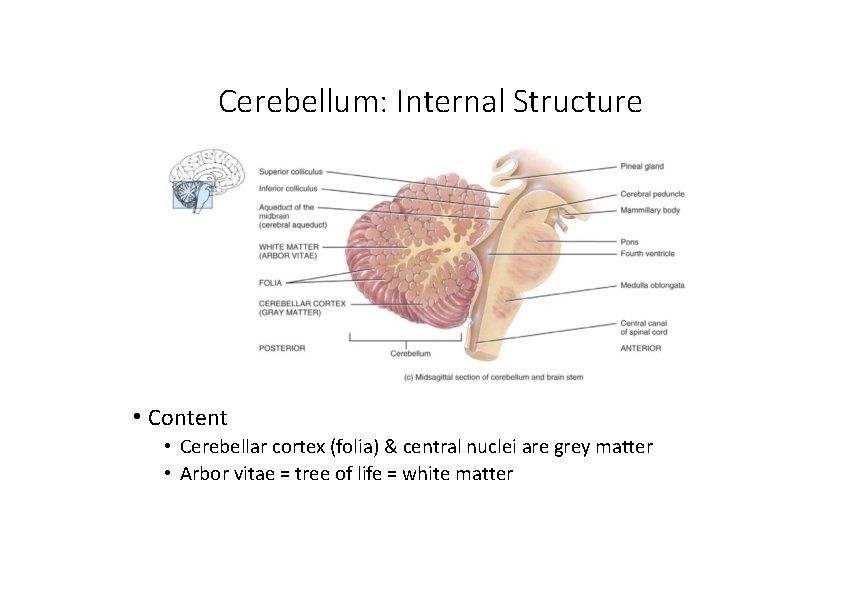
Cerebellum: Internal Structure • Content • Cerebellar cortex (folia) & central nuclei are grey matter • Arbor vitae = tree of life = white matter
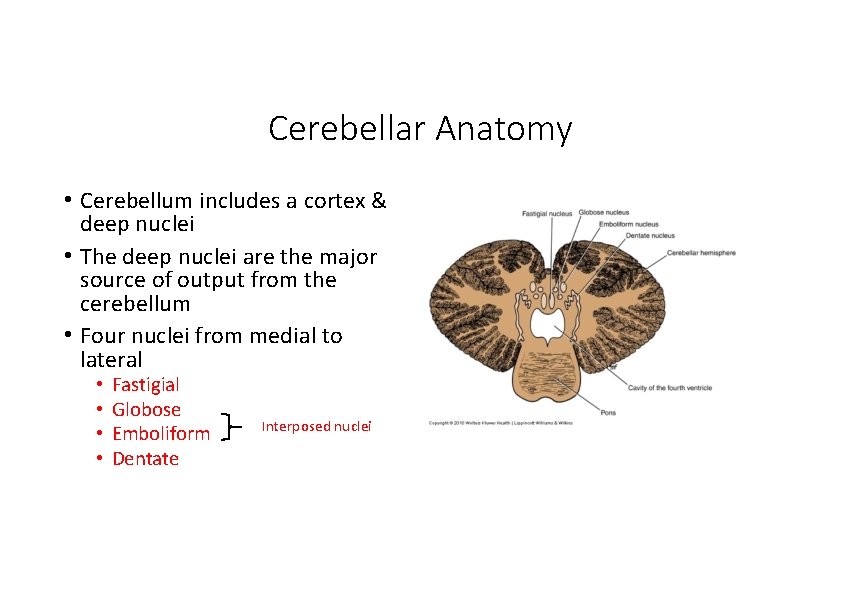
Cerebellar Anatomy • Cerebellum includes a cortex & deep nuclei • The deep nuclei are the major source of output from the cerebellum • Four nuclei from medial to lateral • • Fastigial Globose Emboliform Dentate Interposed nuclei
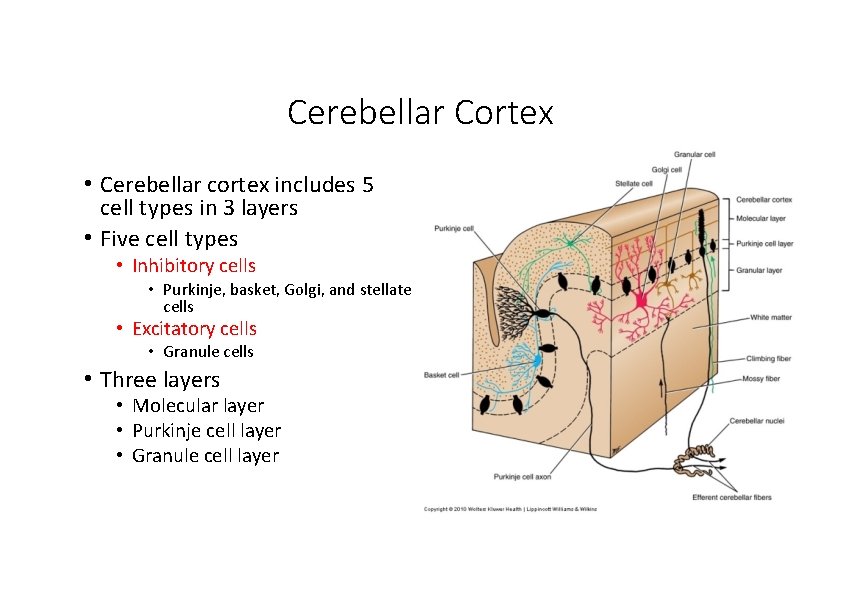
Cerebellar Cortex • Cerebellar cortex includes 5 cell types in 3 layers • Five cell types • Inhibitory cells • Purkinje, basket, Golgi, and stellate cells • Excitatory cells • Granule cells • Three layers • Molecular layer • Purkinje cell layer • Granule cell layer
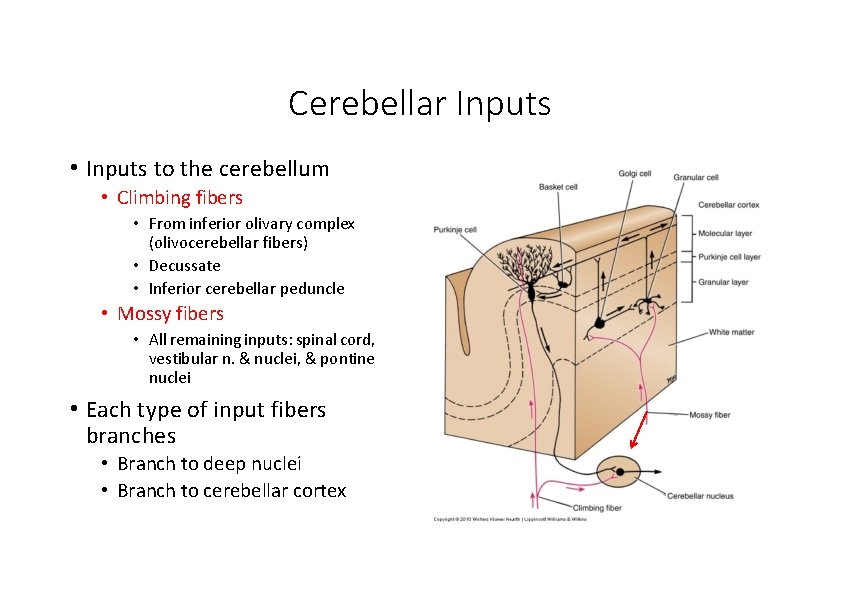
Cerebellar Inputs • Inputs to the cerebellum • Climbing fibers • From inferior olivary complex (olivocerebellar fibers) • Decussate • Inferior cerebellar peduncle • Mossy fibers • All remaining inputs: spinal cord, vestibular n. & nuclei, & pontine nuclei • Each type of input fibers branches • Branch to deep nuclei • Branch to cerebellar cortex
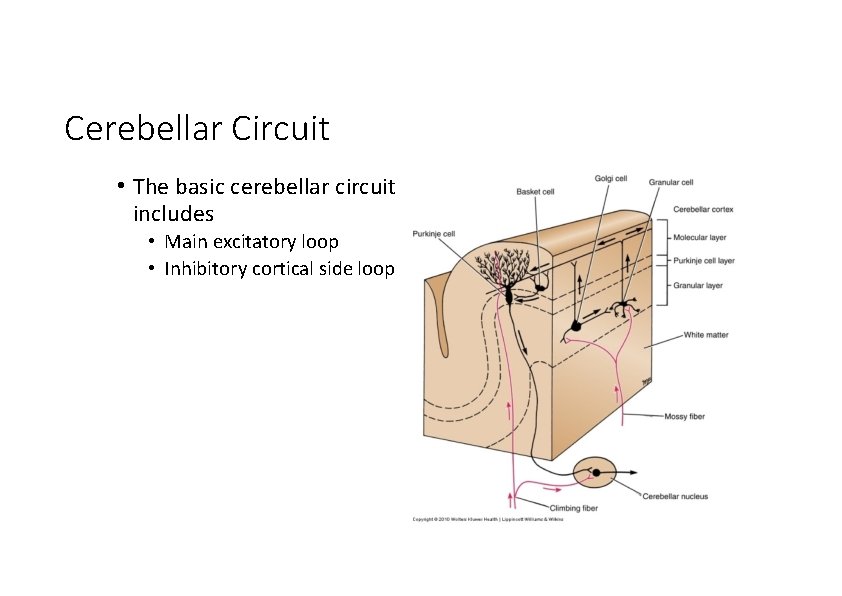
Cerebellar Circuit • The basic cerebellar circuit includes • Main excitatory loop • Inhibitory cortical side loop
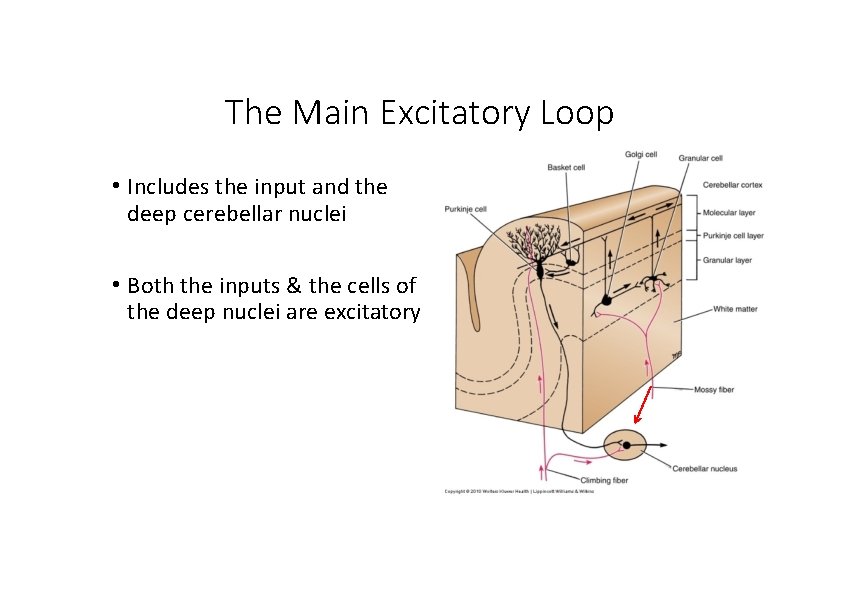
The Main Excitatory Loop • Includes the input and the deep cerebellar nuclei • Both the inputs & the cells of the deep nuclei are excitatory
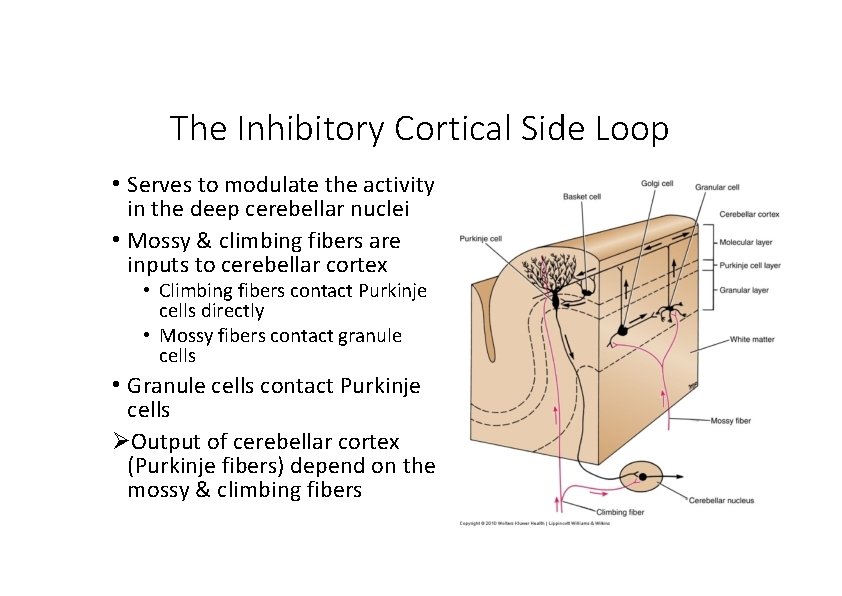
The Inhibitory Cortical Side Loop • Serves to modulate the activity in the deep cerebellar nuclei • Mossy & climbing fibers are inputs to cerebellar cortex • Climbing fibers contact Purkinje cells directly • Mossy fibers contact granule cells • Granule cells contact Purkinje cells Output of cerebellar cortex (Purkinje fibers) depend on the mossy & climbing fibers
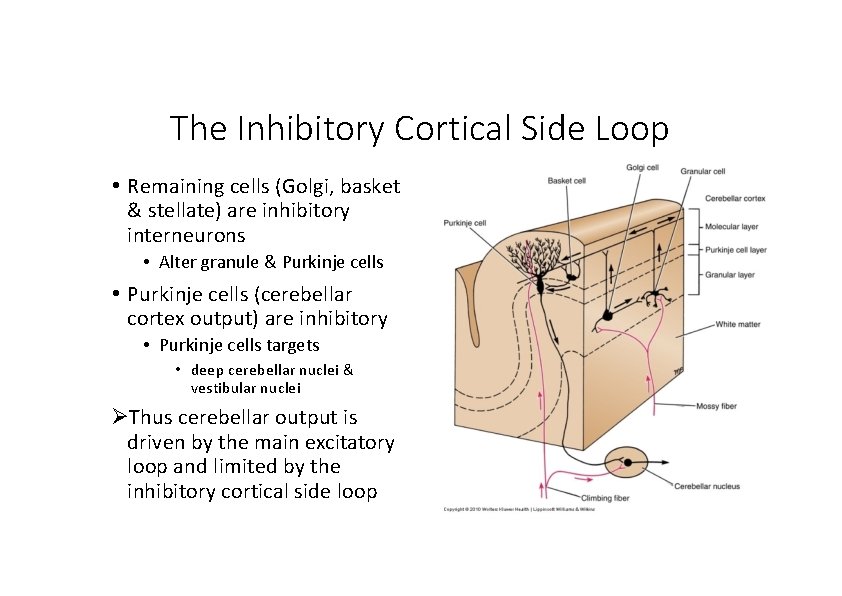
The Inhibitory Cortical Side Loop • Remaining cells (Golgi, basket & stellate) are inhibitory interneurons • Alter granule & Purkinje cells • Purkinje cells (cerebellar cortex output) are inhibitory • Purkinje cells targets • deep cerebellar nuclei & vestibular nuclei Thus cerebellar output is driven by the main excitatory loop and limited by the inhibitory cortical side loop
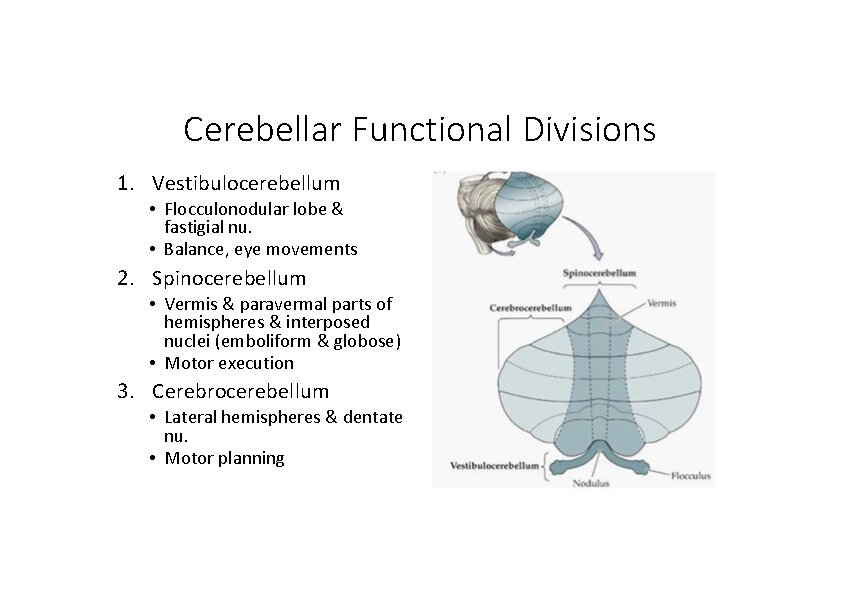
Cerebellar Functional Divisions 1. Vestibulocerebellum • Flocculonodular lobe & fastigial nu. • Balance, eye movements 2. Spinocerebellum • Vermis & paravermal parts of hemispheres & interposed nuclei (emboliform & globose) • Motor execution 3. Cerebrocerebellum • Lateral hemispheres & dentate nu. • Motor planning
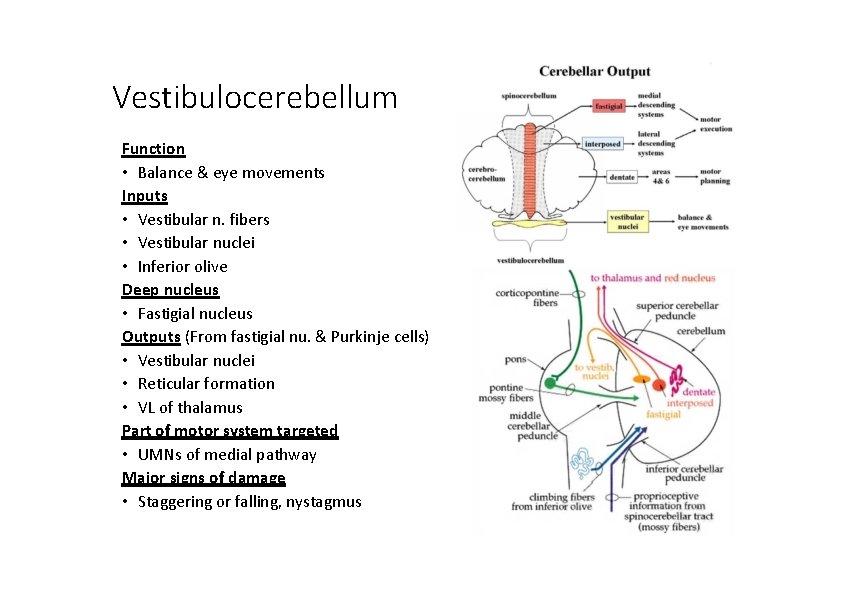
Vestibulocerebellum Function • Balance & eye movements Inputs • Vestibular n. fibers • Vestibular nuclei • Inferior olive Deep nucleus • Fastigial nucleus Outputs (From fastigial nu. & Purkinje cells) • Vestibular nuclei • Reticular formation • VL of thalamus Part of motor system targeted • UMNs of medial pathway Major signs of damage • Staggering or falling, nystagmus
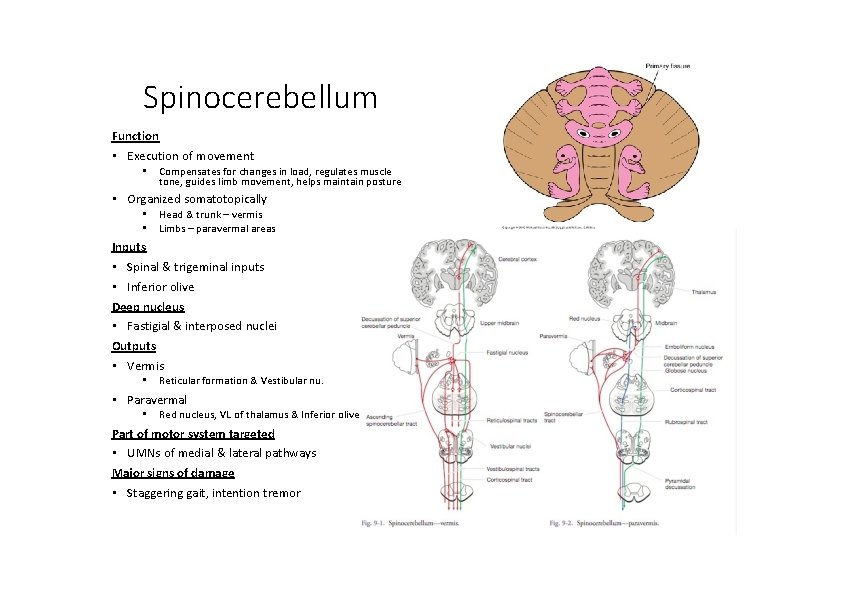
Spinocerebellum Function • Execution of movement • Compensates for changes in load, regulates muscle tone, guides limb movement, helps maintain posture • Organized somatotopically • • Head & trunk – vermis Limbs – paravermal areas Inputs • Spinal & trigeminal inputs • Inferior olive Deep nucleus • Fastigial & interposed nuclei Outputs • Vermis • Reticular formation & Vestibular nu. • Paravermal • Red nucleus, VL of thalamus & Inferior olive Part of motor system targeted • UMNs of medial & lateral pathways Major signs of damage • Staggering gait, intention tremor
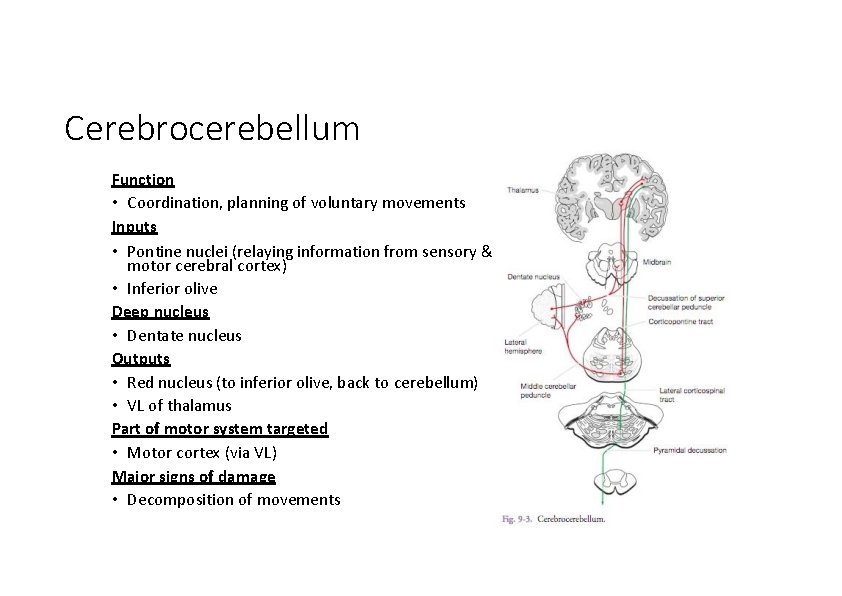
Cerebrocerebellum Function • Coordination, planning of voluntary movements Inputs • Pontine nuclei (relaying information from sensory & motor cerebral cortex) • Inferior olive Deep nucleus • Dentate nucleus Outputs • Red nucleus (to inferior olive, back to cerebellum) • VL of thalamus Part of motor system targeted • Motor cortex (via VL) Major signs of damage • Decomposition of movements
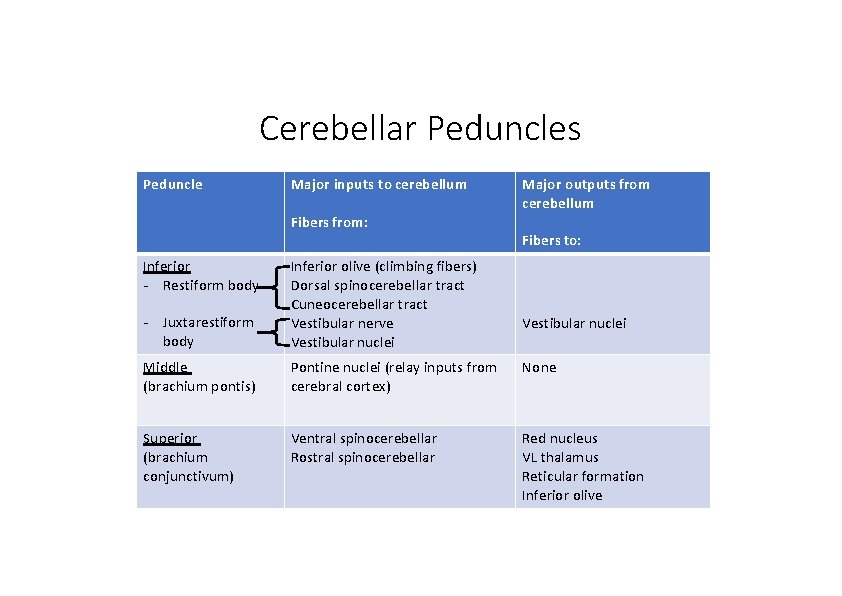
Cerebellar Peduncles Peduncle Major inputs to cerebellum Major outputs from cerebellum Fibers from: Fibers to: ‐ Juxtarestiform body Inferior olive (climbing fibers) Dorsal spinocerebellar tract Cuneocerebellar tract Vestibular nerve Vestibular nuclei Middle (brachium pontis) Pontine nuclei (relay inputs from cerebral cortex) None Superior (brachium conjunctivum) Ventral spinocerebellar Rostral spinocerebellar Red nucleus VL thalamus Reticular formation Inferior olive Inferior ‐ Restiform body Vestibular nuclei
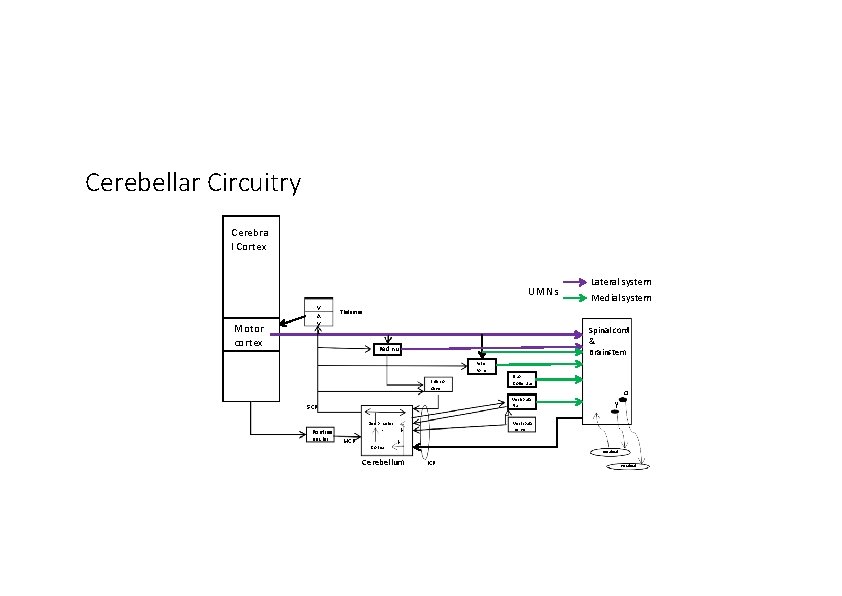
Cerebellar Circuitry Cerebra l Cortex UMNs Motor cortex V A V L Lateral system Medial system Thalamus Spinal cord & Brainstem Red nu. Retic. Form. Inferior olive Vestibular Nu. SCP Deep nuclei Pontine nuclei Sup. Colliculus ‐ MCP Cortex Vestibular nerve + + Cerebellum α γ Intrafusal ICP Extrafusal
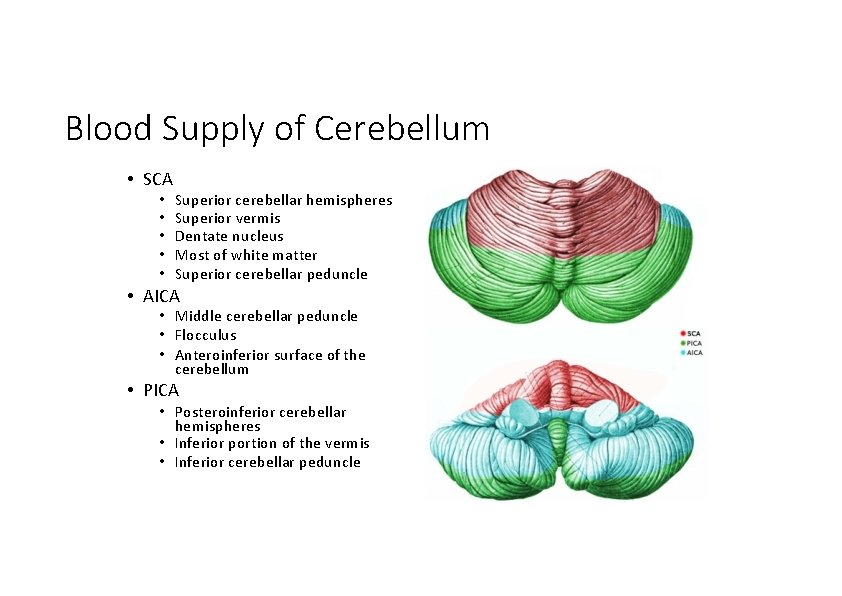
Blood Supply of Cerebellum • SCA • • • Superior cerebellar hemispheres Superior vermis Dentate nucleus Most of white matter Superior cerebellar peduncle • AICA • Middle cerebellar peduncle • Flocculus • Anteroinferior surface of the cerebellum • PICA • Posteroinferior cerebellar hemispheres • Inferior portion of the vermis • Inferior cerebellar peduncle
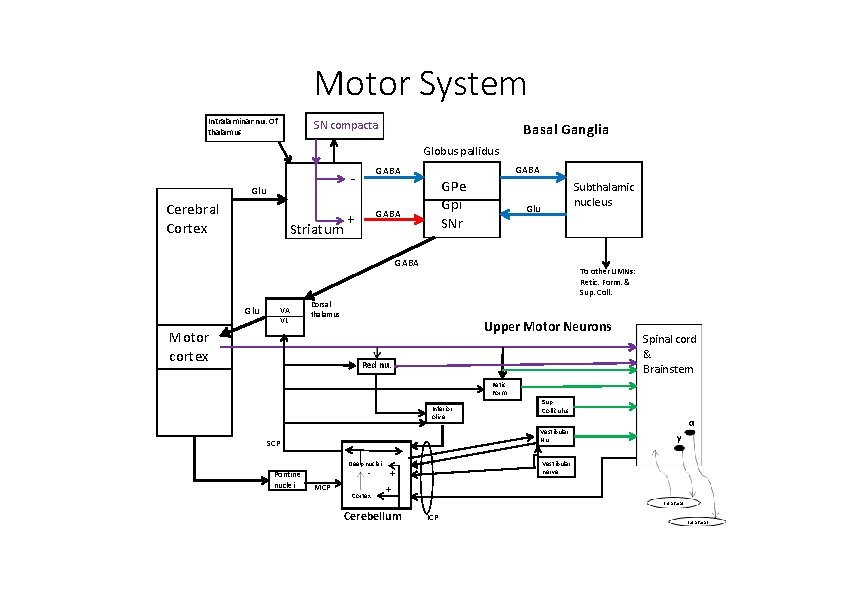
Motor System Intralaminar nu. Of thalamus SN compacta Basal Ganglia Globus pallidus Glu Cerebral Cortex Striatum ‐ GABA + GABA GPe Gpi SNr Subthalamic nucleus Glu GABA Glu VA VL To other UMNs: Retic. Form. & Sup. Coll. Dorsal thalamus Motor cortex Upper Motor Neurons Red nu. Spinal cord & Brainstem Retic. Form. Inferior olive Vestibular Nu. SCP Deep nuclei Pontine nuclei Sup. Colliculus ‐ MCP Cortex α γ Vestibular nerve + + Intrafusal Cerebellum ICP Extrafusal
- Slides: 63