
Motor Nervous System Cortical and Brain Stem Control
Motor Nervous System Cortical and Brain Stem Control of Motor Function
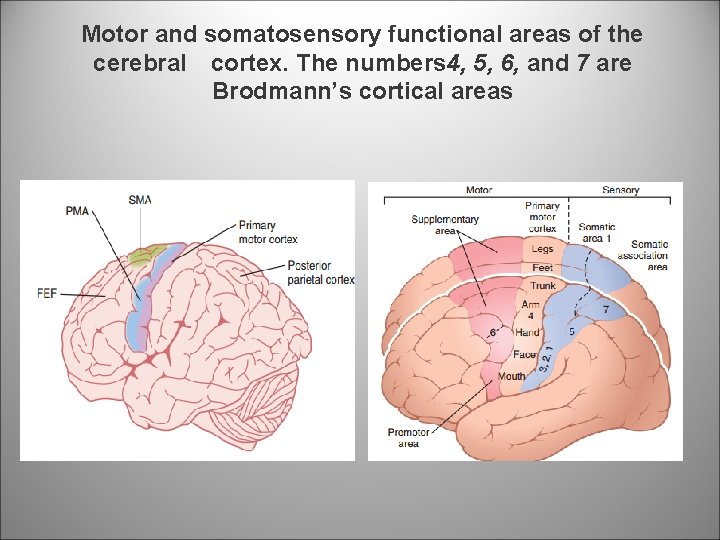
Motor and somatosensory functional areas of the cerebral cortex. The numbers 4, 5, 6, and 7 are Brodmann’s cortical areas
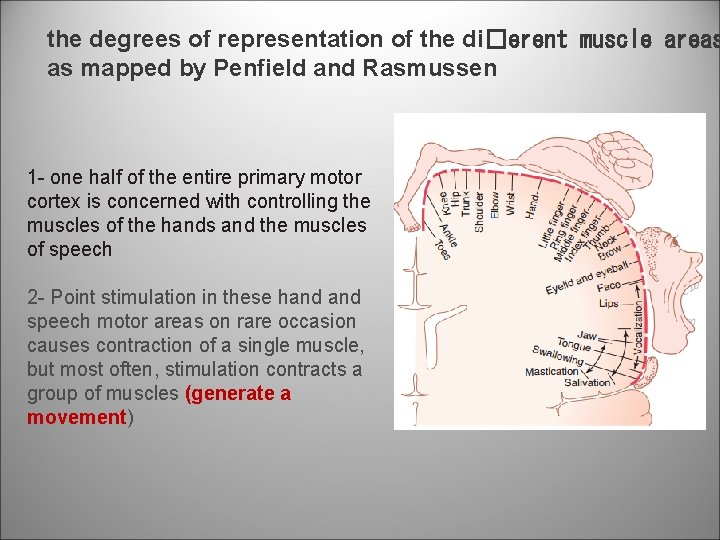
the degrees of representation of the di�erent muscle areas as mapped by Penfield and Rasmussen 1 one half of the entire primary motor cortex is concerned with controlling the muscles of the hands and the muscles of speech 2 Point stimulation in these hand speech motor areas on rare occasion causes contraction of a single muscle, but most often, stimulation contracts a group of muscles (generate a movement)
Premotor area 1 Nerve signals generated in the premotor area cause much more complex “patterns” of movement 2 anterior premotor area: develops a “motor image” for make a position to perform a specific tasks 3 posterior premotor area: this image excites each successive pattern of muscle activity required to achieve the image 4 mirror neurons becomes active when a person performs a specific motor task or when he or she observes the same task performed by others

Supplementary motor area 1 It has topographical organization for the control of motor function. 2 Contractions elicited by stimulating this area are often bilateral rather than unilateral. Such as : bilateral grasping , climbing. 3 in concert with the premotor area to provide * body wideattitudinal movements ** fixation movements of the di�erent segments *** positional movements of the head and eyes, of the body 4 form a background for the finer motor control of the arms and hands by the premotor area and primary motor cortex.
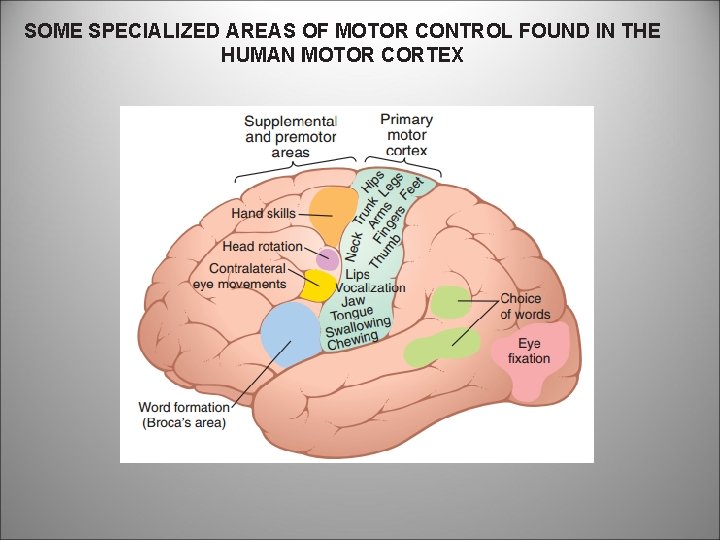
SOME SPECIALIZED AREAS OF MOTOR CONTROL FOUND IN THE HUMAN MOTOR CORTEX

Transmission of signals from the motor cortex to the muscles Direct pathway: Corticospinal (Pyramidal) Tract lateral corticospinal Ventral corticospinal Termination: 1 -principally on the interneurons 2 -a few on sensory relay neurons 3 -a very few directly on the anterior motor neurons Functions: Lateral: control of discrete and detailed movements Ventral: control of bilateral postural movements by the supplementary motor cortex
Composition of fibers in pyramidal tract Large very rapid fibers (3%) : The most impressive fibers originate from giant pyramidal cells (Betz cells) that are found only in the primary motor cortex. Betz cells: “sharpening” the boundaries of the excitatory signal by send back collateral to the M 1 Medium size, rapid fibers (97%): conduct background tonic signals to the motor areas of the cord
The corticobulbar tract projects to the cranial nerve motor nuclei, has subdivisions that are comparable with the lateral and ventral corticospinal tracts. Lateral division: ends contralaterally in the portion of the facial nucleus that supplies muscles of the lower part of the face and in the hypoglossal nucleus. Medial division: The remainder of the corticobulbar tract ends bilaterally like as medial system.
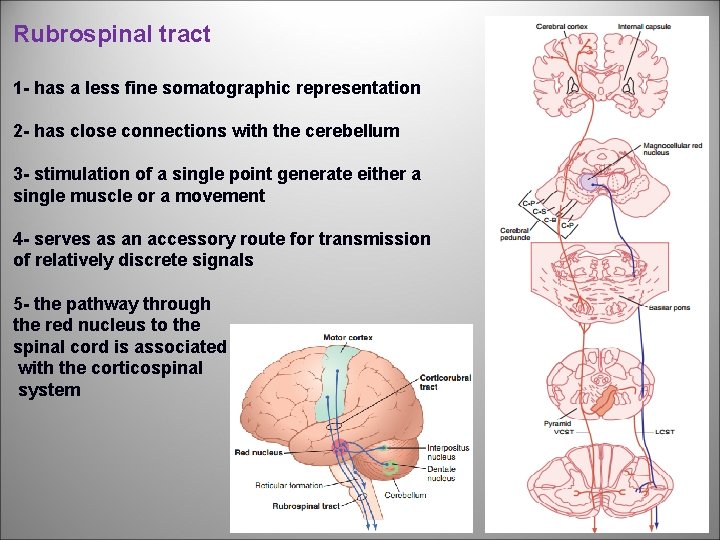
Rubrospinal tract 1 has a less fine somatographic representation 2 has close connections with the cerebellum 3 stimulation of a single point generate either a single muscle or a movement 4 serves as an accessory route for transmission of relatively discrete signals 5 the pathway through the red nucleus to the spinal cord is associated with the corticospinal system

Lateral motor system : The corticospinal and rubrospinal tracts together are called the lateral motor system of the cord in contradistinction, medial motor system refer to a vestibule reticulo spinal system, which lies mainly medially in the cord The term extrapyramidal motor system has been used in clinical circles to denote all the portions of the brain and brain stem that contribute to motor control but are not part of the direct corticospinal pyramidal system. Include: the basal ganglia, the reticular formation of the brain stem, the vestibular nuclei, and often the red nuclei.
The Medial System Originate From higher centers 1 The ventral corticospinal tract and much of the corticobulbar tract can be regarded as medial system pathways. Function: The axial muscles are controlled by these pathways to provide postural support or some other bilateral function Originate From lower centers 2 Pontine Reticulospinal Tracts Its function is to excite motor neurons to the proximal extensor muscles to support posture 3 Medullary Reticulospinal tract The function of the pathway is mainly inhibitory Continue……
4 The lateral vestibulospinal tract Function: excite extensor and inhibit flexor muscles of the proximal part of the limb that are important for postural control. 5 medial vestibulospinal tract Function: send signal to excite extensor muscle at the cervical and midthoracic levels Thus, the pathways 4 & 5 mediates adjustments in head position in response to angular acceleration of the head. 6 The Tectospinal Tract 1 originates in the deep layers of the superior colliculus and terminate on the medial group of interneurons in the upper cervical spinal cord. Function: The tectospinal tract regulates head movement in response to visual, auditory, and somatic stimuli
7 A large number of fibers pass from the motor cortex into the caudate nucleus and putamen. From there, additional pathways extend into the brain stem and spinal cord, as discussed in the next chapter, mainly to control body postural muscle contractions 8 A tremendous number of motor fibers synapse in the pontile nuclei, which give rise to the pontocerebellar fibers, carrying signals into the cerebellar hemispheres. 9. Collaterals also terminate in the inferior olivary nuclei, and from there, secondary olivocerebellar fibers transmit signals to multiple areas of the cerebellum Tus, the basal ganglia, brain stem, and cerebellum all receive strong motor signals from the corticospinal system every time a signal is transmitted down the spinal cord to cause a motor activity.

Cortical layers and organization 1 - each column has six distinct layers of cells, as is true throughout nearly all the cerebral cortex 2 - The pyramidal cells that give rise to the corticospinal fibers all lie in the fifth layer of cells from the cortical surface 3 - The input signals all enter by way of layers 2 through 4 4 - the sixth layer gives rise mainly to fibers that communicate with other regions of the cerebral cortex.
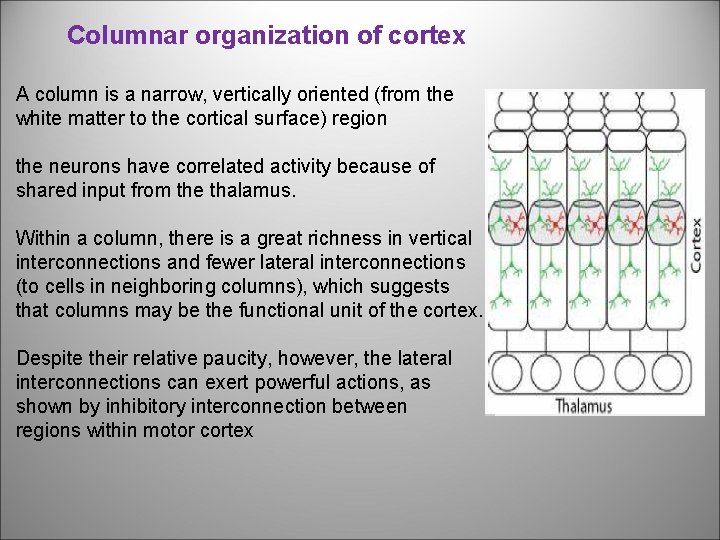
Columnar organization of cortex A column is a narrow, vertically oriented (from the white matter to the cortical surface) region the neurons have correlated activity because of shared input from the thalamus. Within a column, there is a great richness in vertical interconnections and fewer lateral interconnections (to cells in neighboring columns), which suggests that columns may be the functional unit of the cortex. Despite their relative paucity, however, the lateral interconnections can exert powerful actions, as shown by inhibitory interconnection between regions within motor cortex
Vertical Columnar Arrangement of the Neurons in the Motor Cortex 1 - the cells of the motor cortex are organized in vertical columns a fraction of a millimeter in diameter, with thousands of neurons in each column 2 - Each column of cells functions as a processing, integrating and amplifying unit, usually stimulating large number of pyramidal fibers to excite a group of synergistic muscles, but sometimes stimulating just a single muscle 3 - each column has six distinct layers of cells, as is true throughout nearly all the cerebral cortex 4 - The pyramidal cells that give rise to the corticospinal fibers all lie in the fifth layer of cells from the cortical surface 5 - The input signals all enter by way of layers 2 through 4 6 - the sixth layer gives rise mainly to fibers that communicate with other regions of the cerebral cortex.
Dynamic and Static Signals Are Transmitted by the Pyramidal Neurons Usual manner for muscle contractions In each vertical column in M 1: Fist the dynamic neurons excite phasic to produce the initial rapid development of force Then, the static neurons fire slowly and statistically to maintain the force of contraction as long as the contraction is required the red nucleus have similar dynamic and static characteristics, except that a greater percentage of dynamic neurons is in the red nucleus and a greater percentage of static neurons is in the M 1. NOTE: the red nucleus is closely allied with the cerebellum, and the cerebellum plays an important role in rapid initiation of muscle contraction, THUS RED NUCLEUS NEEDS TO THE MORE DYNAMIC NEURONS
Somatosensory Feedback to the Motor Cortex Helps Control the Precision of Muscle Contraction Types of somatosensory positive feedback through the thalamus (1) the muscle spindles (2) the tendon organs of the muscle tendons (3) the tactile receptors of the skin overlying the muscles Function: cause positive feedback enhancement of the muscle contraction
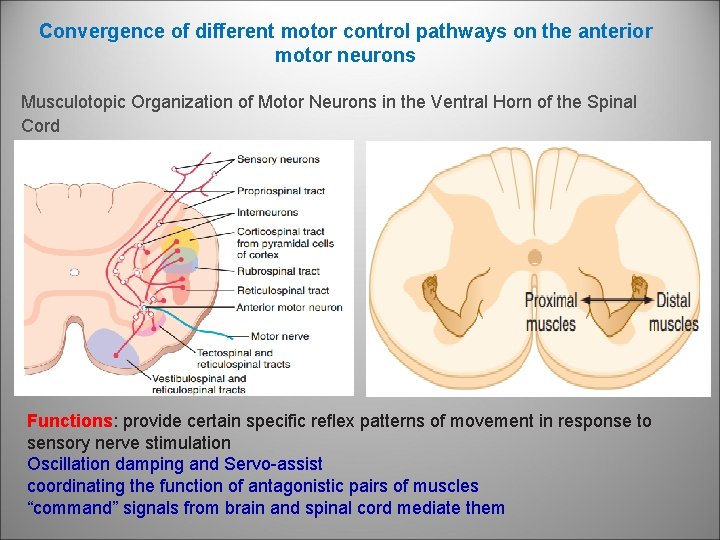
Convergence of different motor control pathways on the anterior motor neurons Musculotopic Organization of Motor Neurons in the Ventral Horn of the Spinal Cord Functions: provide certain specific reflex patterns of movement in response to sensory nerve stimulation Oscillation damping and Servo assist coordinating the function of antagonistic pairs of muscles “command” signals from brain and spinal cord mediate them
Effect of Lesions in the Motor Cortex or in the Corticospinal Pathway—The “Stroke” The primary motor cortex normally exerts a continual tonic stimulatory e�ect on the motor neurons of the spinal cord but normally inhibit the vestibular and reticular brain stem motor nuclei 1 Removal of the M 1 (Area Pyramidalis) causes varying degrees of paralysis of the represented muscles. If the sublying caudate nucleus and adjacent premotor and supplementary motor areas are not damaged, gross postural and limb “fixation” movements can still occur, but there is loss of voluntary control of discrete movements of the distal segments of the limbs, especially of the hands and fingers. 2 Removal of the M 1 and sublying layers and adjacent cortical areas Most lesions of the motor cortex, especially those caused by a stroke, involve not only the primary motor cortex but also adjacent parts of the brain such as the basal ganglia. In these instances, muscle spasm almost invariably occurs in the affected muscle areas on the opposite side
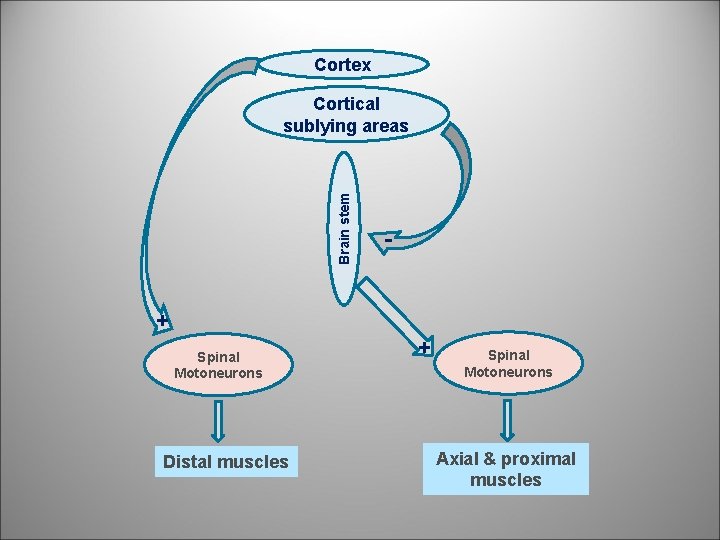
Cortex Brain stem Cortical sublying areas + Spinal Motoneurons Distal muscles + Spinal Motoneurons Axial & proximal muscles
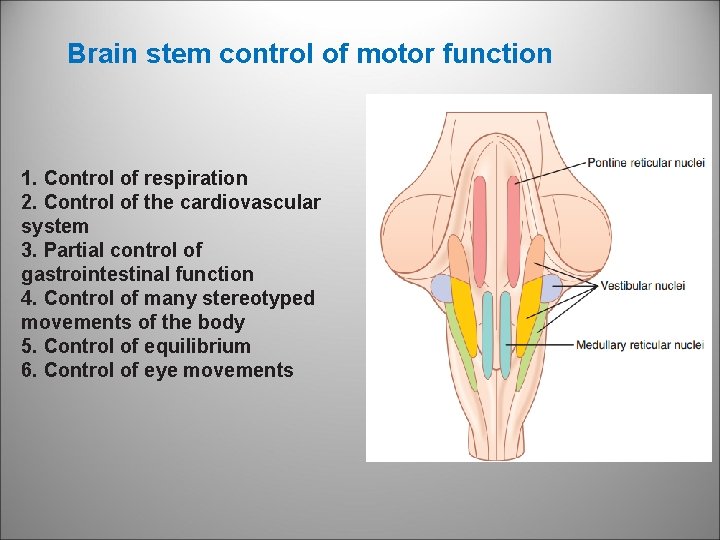
Brain stem control of motor function 1. Control of respiration 2. Control of the cardiovascular system 3. Partial control of gastrointestinal function 4. Control of many stereotyped movements of the body 5. Control of equilibrium 6. Control of eye movements
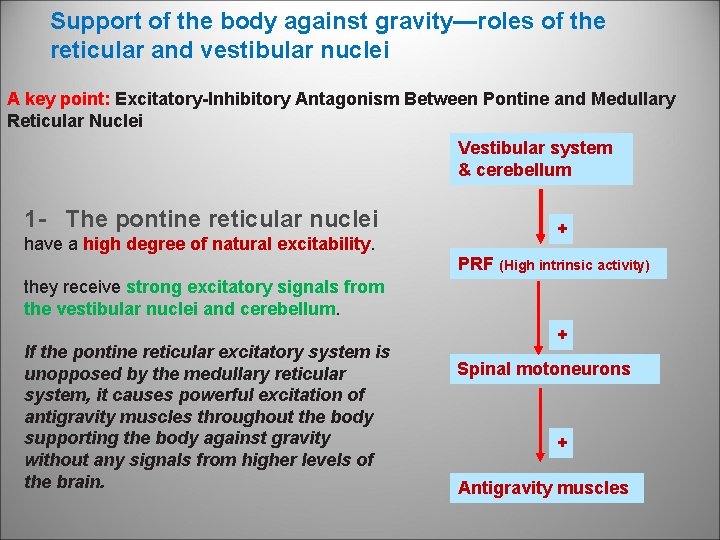
Support of the body against gravity—roles of the reticular and vestibular nuclei A key point: Excitatory Inhibitory Antagonism Between Pontine and Medullary Reticular Nuclei Vestibular system & cerebellum 1 The pontine reticular nuclei have a high degree of natural excitability. + PRF (High intrinsic activity) they receive strong excitatory signals from the vestibular nuclei and cerebellum. If the pontine reticular excitatory system is unopposed by the medullary reticular system, it causes powerful excitation of antigravity muscles throughout the body supporting the body against gravity without any signals from higher levels of the brain. + Spinal motoneurons + Antigravity muscles
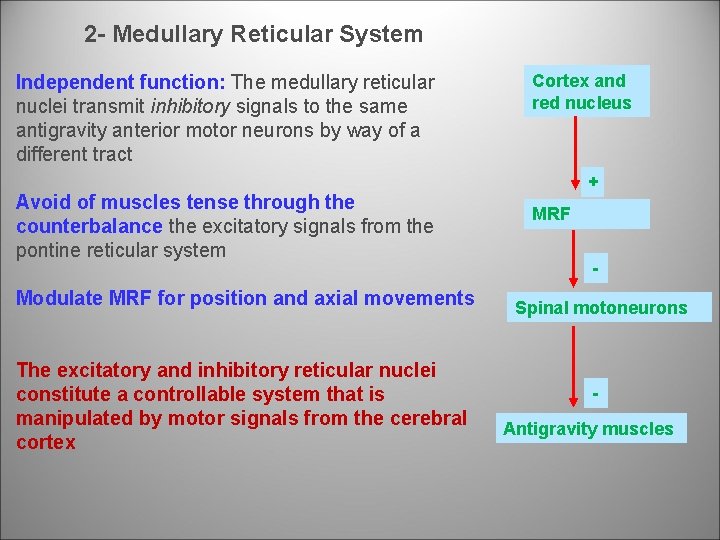
2 Medullary Reticular System Independent function: The medullary reticular nuclei transmit inhibitory signals to the same antigravity anterior motor neurons by way of a different tract Avoid of muscles tense through the counterbalance the excitatory signals from the pontine reticular system Modulate MRF for position and axial movements The excitatory and inhibitory reticular nuclei constitute a controllable system that is manipulated by motor signals from the cerebral cortex Cortex and red nucleus + MRF Spinal motoneurons Antigravity muscles
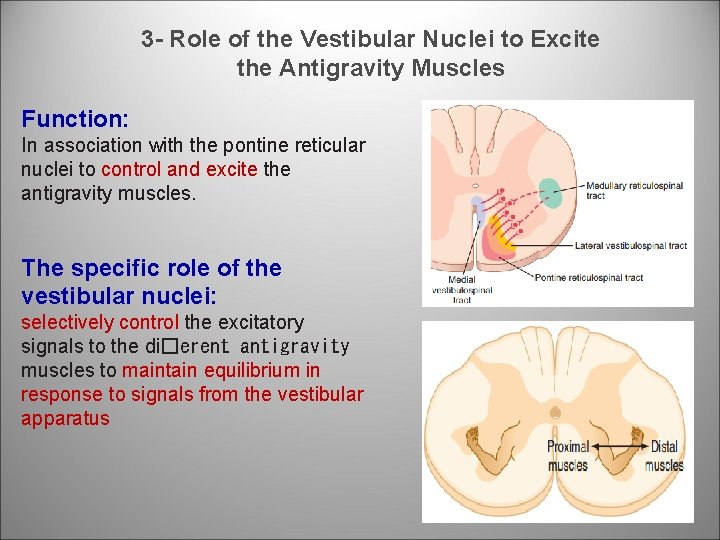
3 Role of the Vestibular Nuclei to Excite the Antigravity Muscles Function: In association with the pontine reticular nuclei to control and excite the antigravity muscles. The specific role of the vestibular nuclei: selectively control the excitatory signals to the di�erent antigravity muscles to maintain equilibrium in response to signals from the vestibular apparatus
decerebration rigidity is blockage of normally strong input to the medullary reticular nuclei fromthe cerebral cortex, the red nuclei, and the basal ganglia. Lacking this input, the medullary reticular inhibitor system becomes nonfunctional, full overactivity of thepontine excitatory system occurs, and rigidity develops
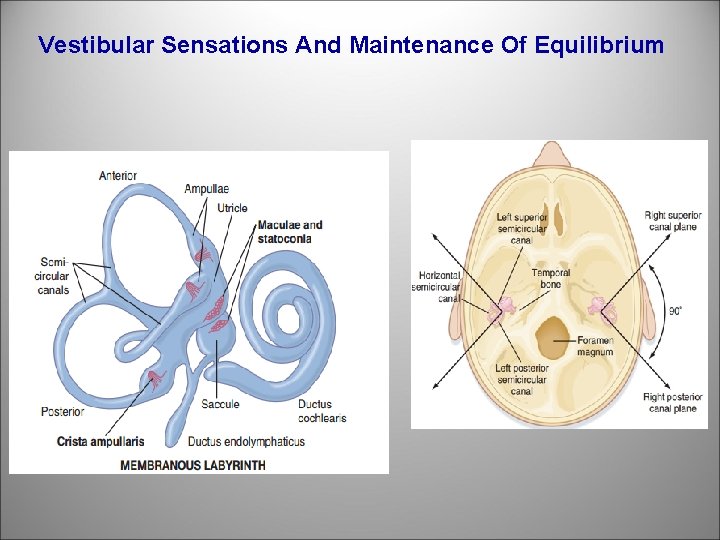
Vestibular Sensations And Maintenance Of Equilibrium
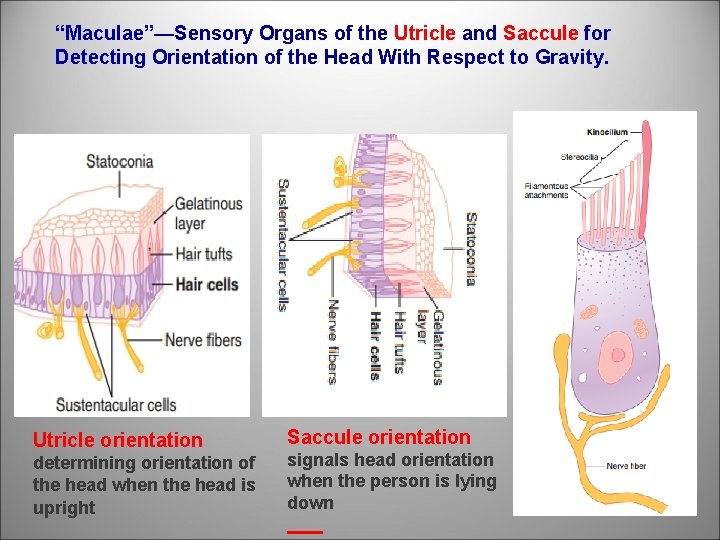
“Maculae”—Sensory Organs of the Utricle and Saccule for Detecting Orientation of the Head With Respect to Gravity. Utricle orientation determining orientation of the head when the head is upright Saccule orientation signals head orientation when the person is lying down
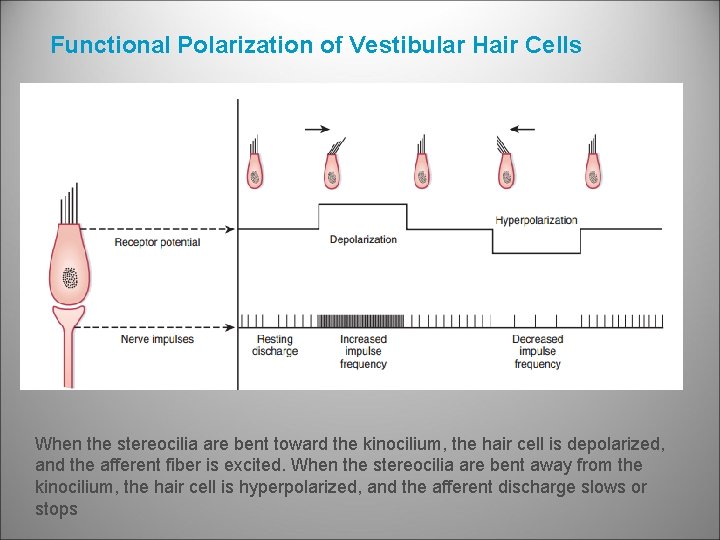
Functional Polarization of Vestibular Hair Cells When the stereocilia are bent toward the kinocilium, the hair cell is depolarized, and the afferent fiber is excited. When the stereocilia are bent away from the kinocilium, the hair cell is hyperpolarized, and the afferent discharge slows or stops
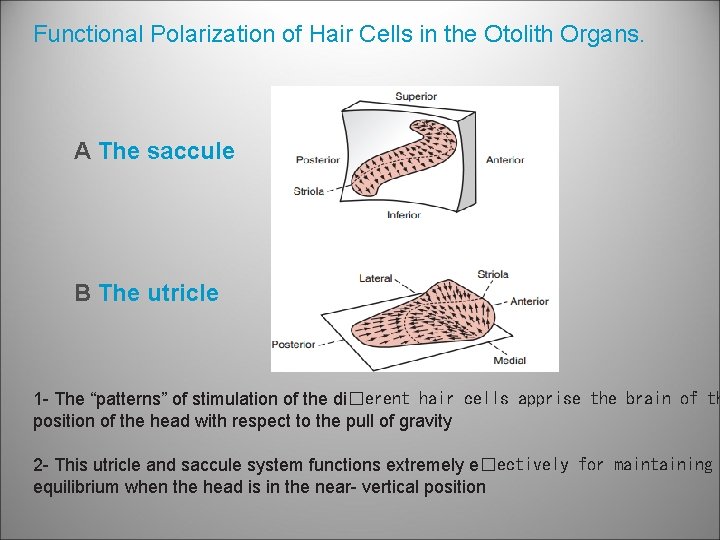
Functional Polarization of Hair Cells in the Otolith Organs. A The saccule B The utricle 1 The “patterns” of stimulation of the di�erent hair cells apprise the brain of th position of the head with respect to the pull of gravity 2 This utricle and saccule system functions extremely e�ectively for maintaining equilibrium when the head is in the near vertical position
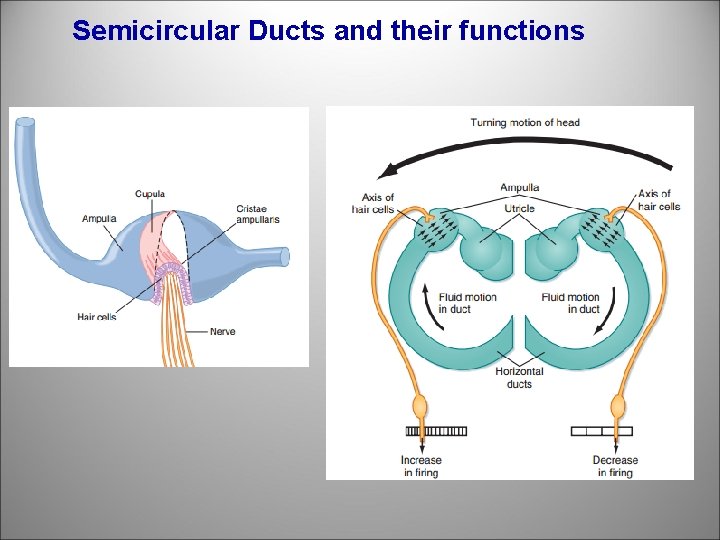
Semicircular Ducts and their functions
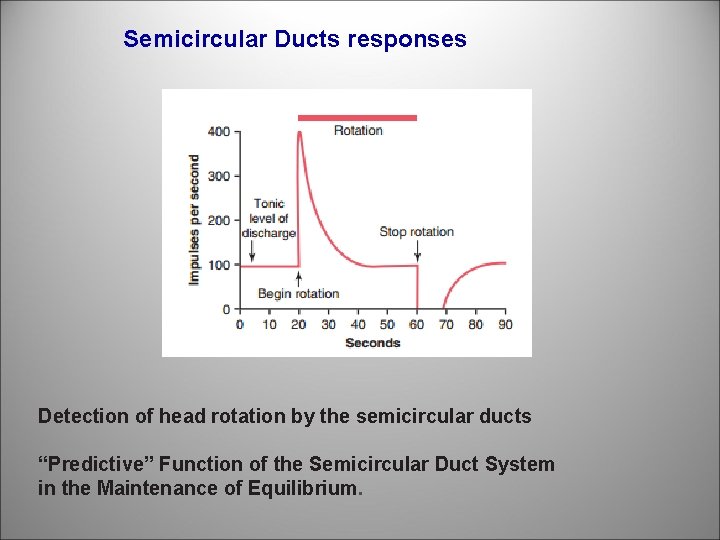
Semicircular Ducts responses Detection of head rotation by the semicircular ducts “Predictive” Function of the Semicircular Duct System in the Maintenance of Equilibrium.
- Slides: 33