
Motor Learning Skill Acquisition Processes Chapter 10 Outline
- Slides: 49
Motor Learning: Skill Acquisition Processes Chapter 10
Outline: n Developing n Stages Movement Intelligence of Learning a Skill n Feedback n Transfer for Skill Learning of Motor Learning Kinesiology Books Publisher 2
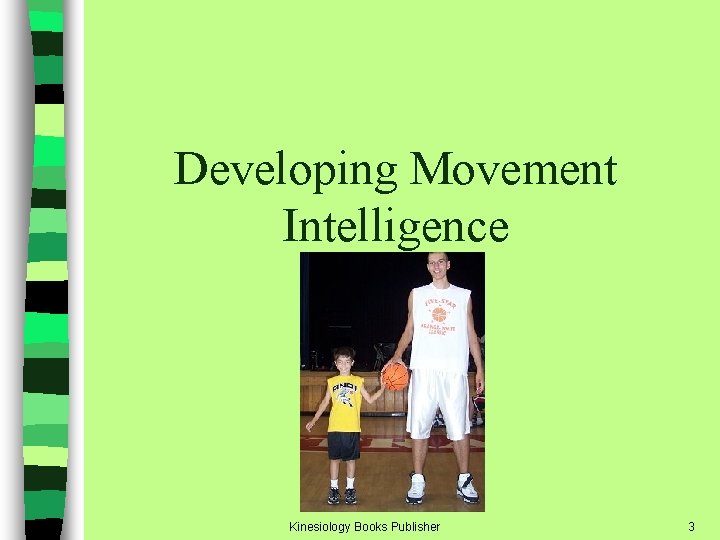
Developing Movement Intelligence Kinesiology Books Publisher 3
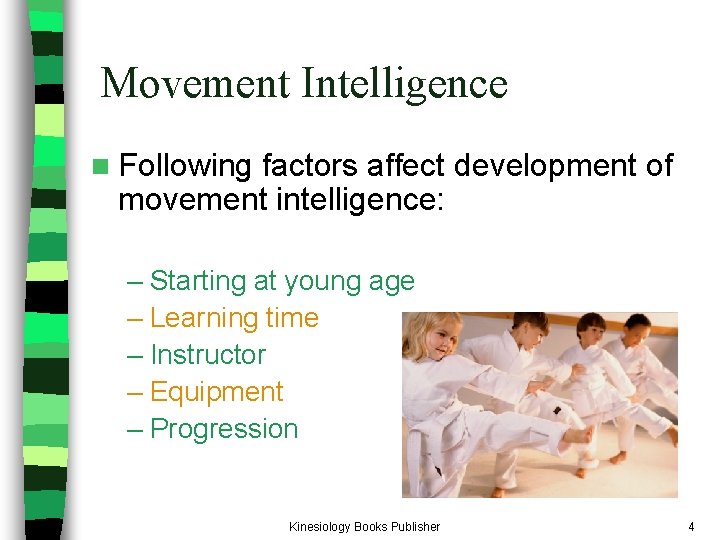
Movement Intelligence n Following factors affect development of movement intelligence: – Starting at young age – Learning time – Instructor – Equipment – Progression Kinesiology Books Publisher 4
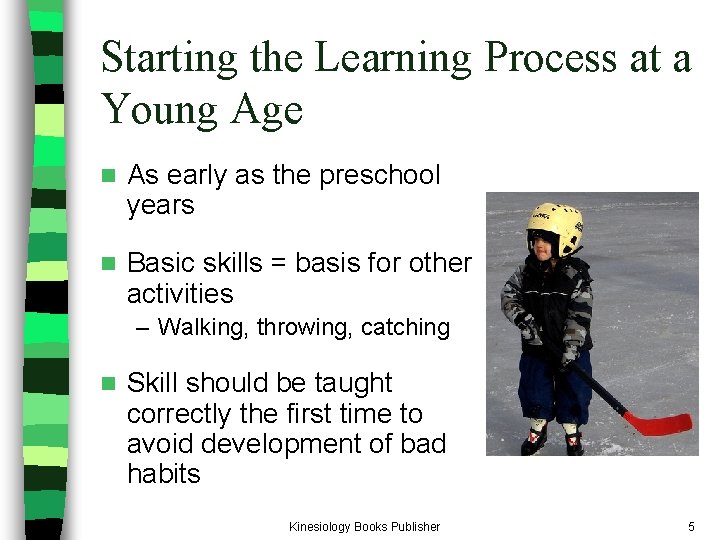
Starting the Learning Process at a Young Age n As early as the preschool years n Basic skills = basis for other activities – Walking, throwing, catching n Skill should be taught correctly the first time to avoid development of bad habits Kinesiology Books Publisher 5
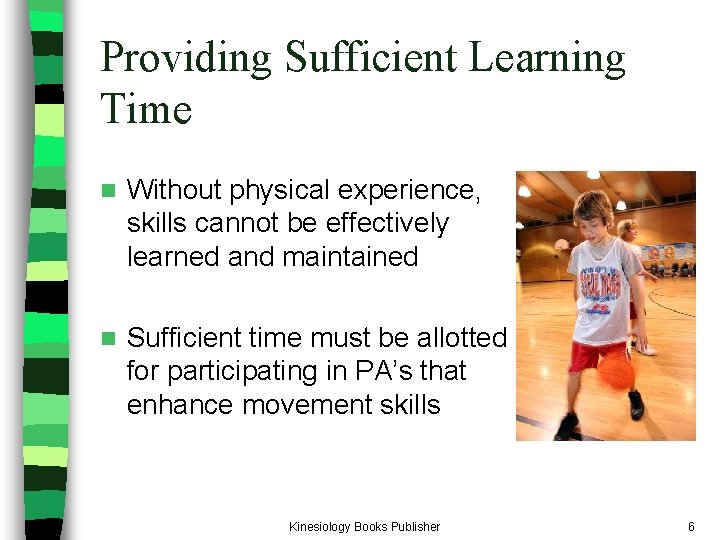
Providing Sufficient Learning Time n Without physical experience, skills cannot be effectively learned and maintained n Sufficient time must be allotted for participating in PA’s that enhance movement skills Kinesiology Books Publisher 6
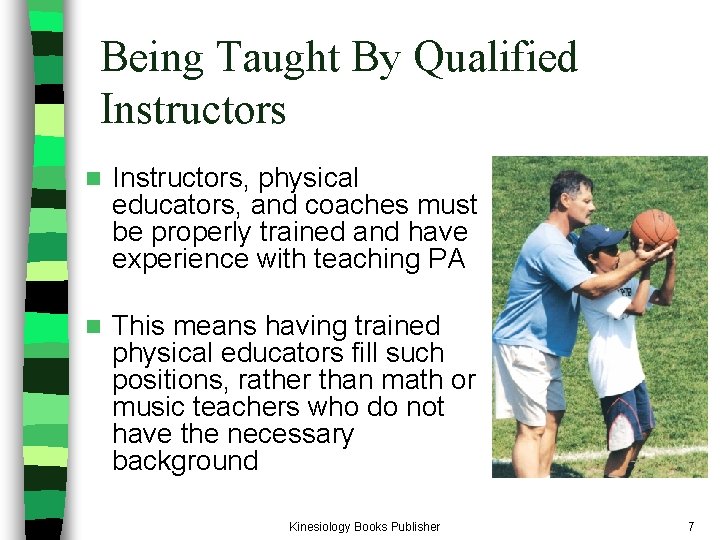
Being Taught By Qualified Instructors n Instructors, physical educators, and coaches must be properly trained and have experience with teaching PA n This means having trained physical educators fill such positions, rather than math or music teachers who do not have the necessary background Kinesiology Books Publisher 7
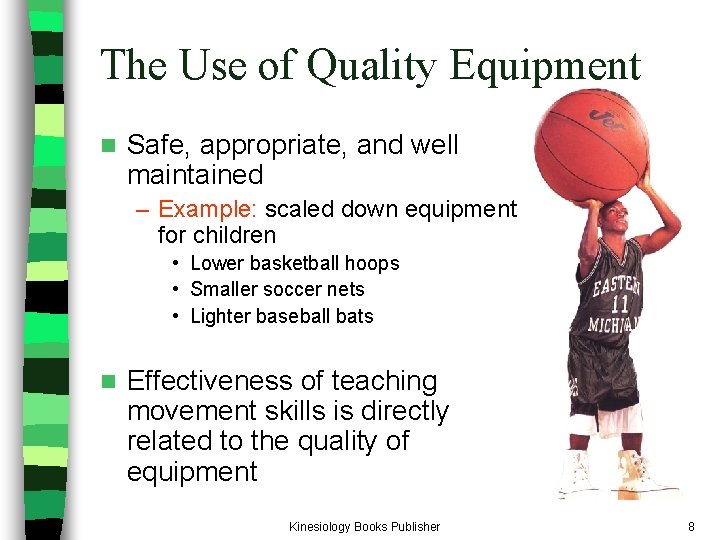
The Use of Quality Equipment n Safe, appropriate, and well maintained – Example: scaled down equipment for children • Lower basketball hoops • Smaller soccer nets • Lighter baseball bats n Effectiveness of teaching movement skills is directly related to the quality of equipment Kinesiology Books Publisher 8
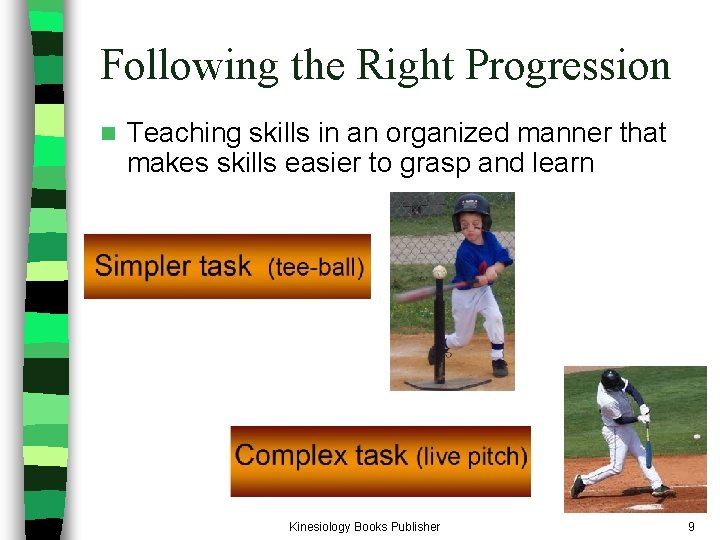
Following the Right Progression n Teaching skills in an organized manner that makes skills easier to grasp and learn Kinesiology Books Publisher 9
Stages of Learning a Skill Kinesiology Books Publisher 10
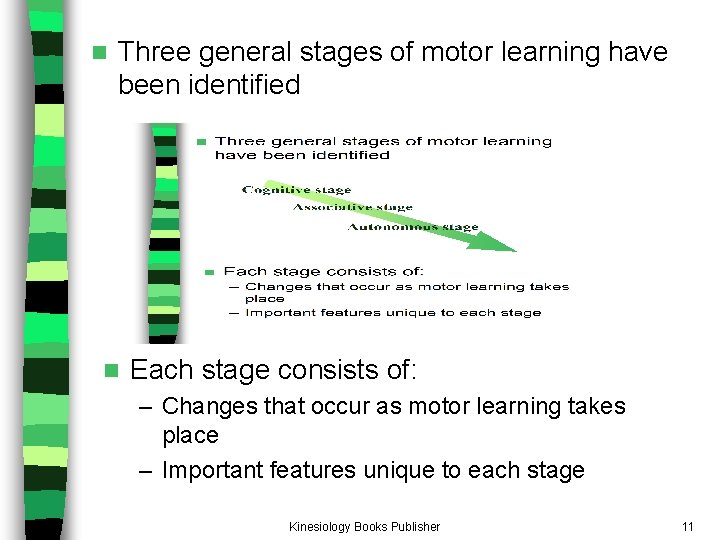
n Three general stages of motor learning have been identified n Each stage consists of: – Changes that occur as motor learning takes place – Important features unique to each stage Kinesiology Books Publisher 11
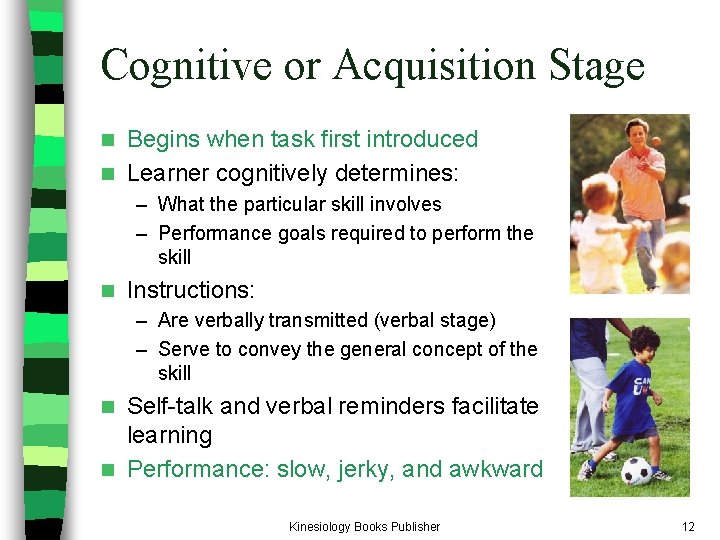
Cognitive or Acquisition Stage Begins when task first introduced n Learner cognitively determines: n – What the particular skill involves – Performance goals required to perform the skill n Instructions: – Are verbally transmitted (verbal stage) – Serve to convey the general concept of the skill Self-talk and verbal reminders facilitate learning n Performance: slow, jerky, and awkward n Kinesiology Books Publisher 12
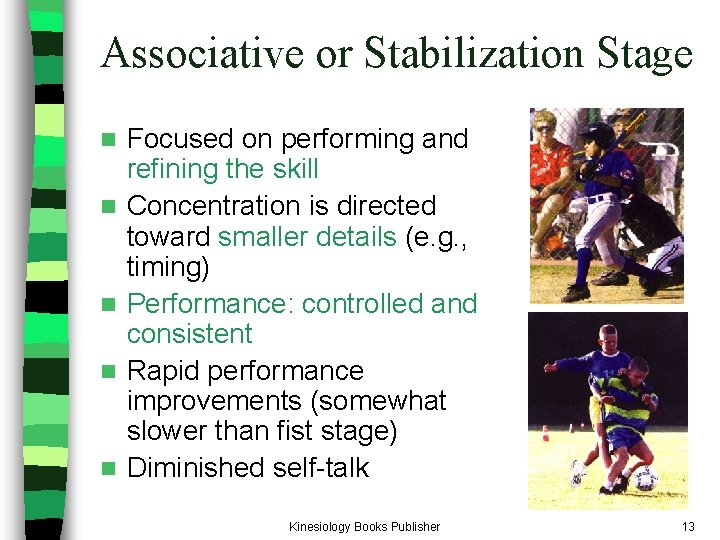
Associative or Stabilization Stage n n n Focused on performing and refining the skill Concentration is directed toward smaller details (e. g. , timing) Performance: controlled and consistent Rapid performance improvements (somewhat slower than fist stage) Diminished self-talk Kinesiology Books Publisher 13
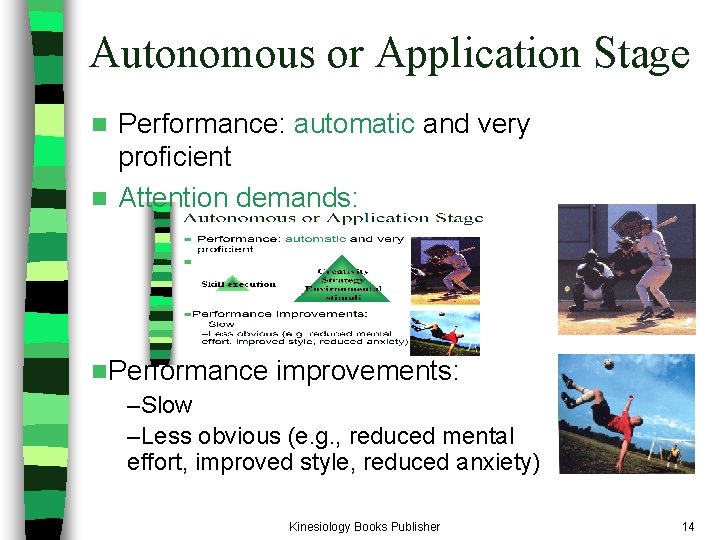
Autonomous or Application Stage Performance: automatic and very proficient n Attention demands: n n. Performance improvements: –Slow –Less obvious (e. g. , reduced mental effort, improved style, reduced anxiety) Kinesiology Books Publisher 14
Feedback for Skill Learning Kinesiology Books Publisher 15
n Information feedback: “the information that occurs as a result of a movement” n Some information is received during the movement and some is provided as a result of the movement n Feedback is one of the strongest factors that controls the effectiveness of learning Kinesiology Books Publisher 16
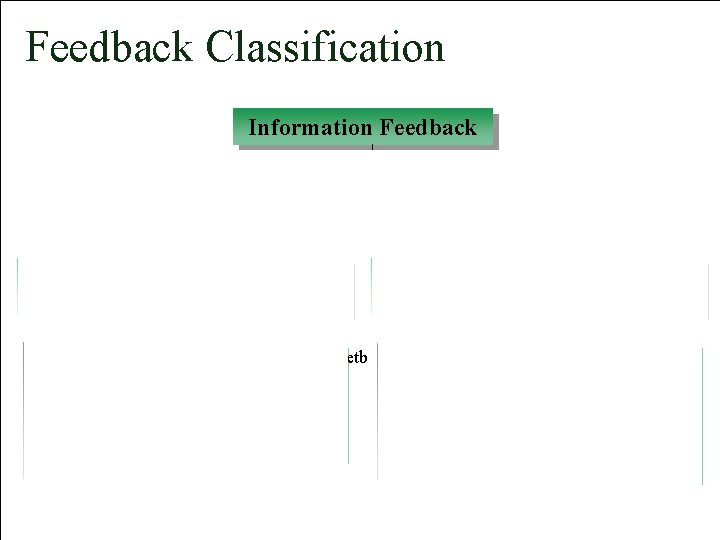
Feedback Classification Information Feedback Intrinsic Feedback Knowledge of Performance Vision Audition Touch Muscle Feeling Knowledge of Results Basketb all Golf Tennis service ace Darts. Extrinsic Feedback Knowledge of Performance Instructor/Coach Parent/Friend Video replay Photographs Radar gun Stopwatch Kinesiology Books Publisher Knowledge of Results Lap times Distance jumped Height jumped Judge’s score. 17
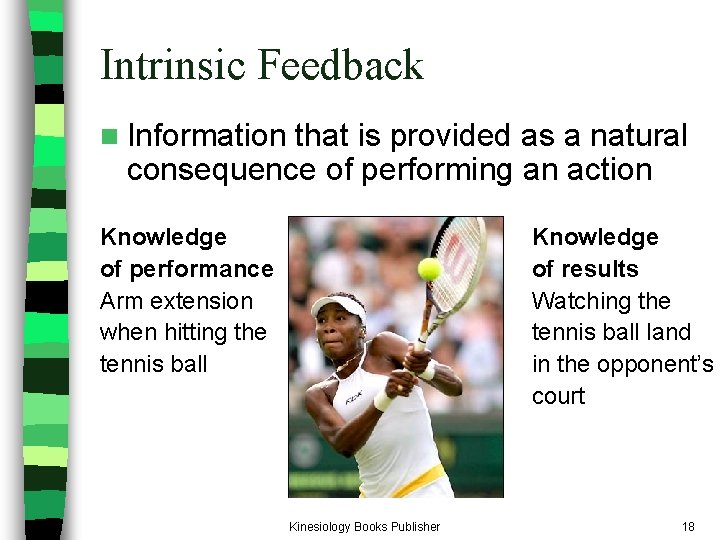
Intrinsic Feedback n Information that is provided as a natural consequence of performing an action Knowledge of performance Arm extension when hitting the tennis ball Knowledge of results Watching the tennis ball land in the opponent’s court Kinesiology Books Publisher 18
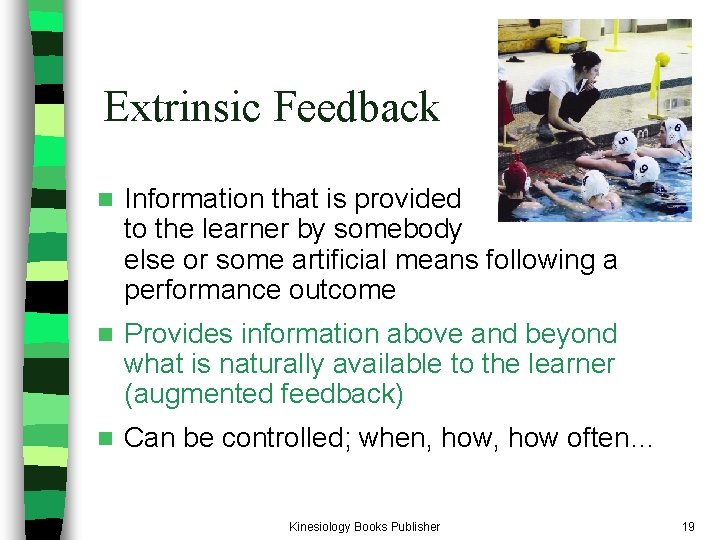
Extrinsic Feedback n Information that is provided to the learner by somebody else or some artificial means following a performance outcome n Provides information above and beyond what is naturally available to the learner (augmented feedback) n Can be controlled; when, how often… Kinesiology Books Publisher 19
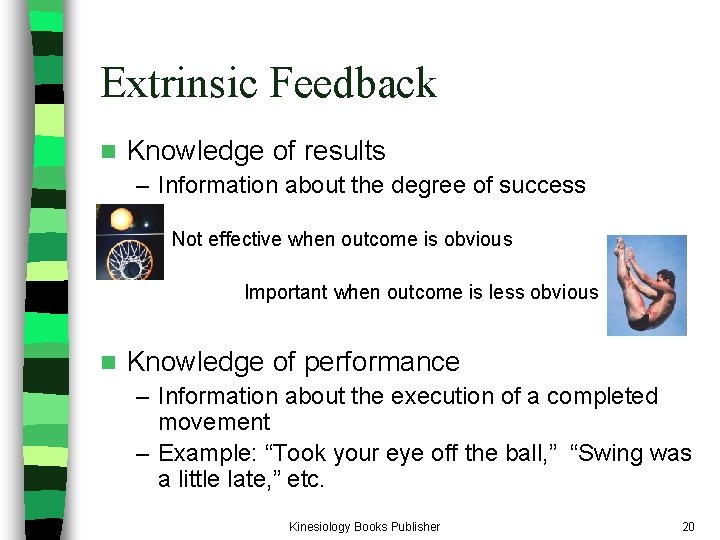
Extrinsic Feedback n Knowledge of results – Information about the degree of success Not effective when outcome is obvious Important when outcome is less obvious n Knowledge of performance – Information about the execution of a completed movement – Example: “Took your eye off the ball, ” “Swing was a little late, ” etc. Kinesiology Books Publisher 20
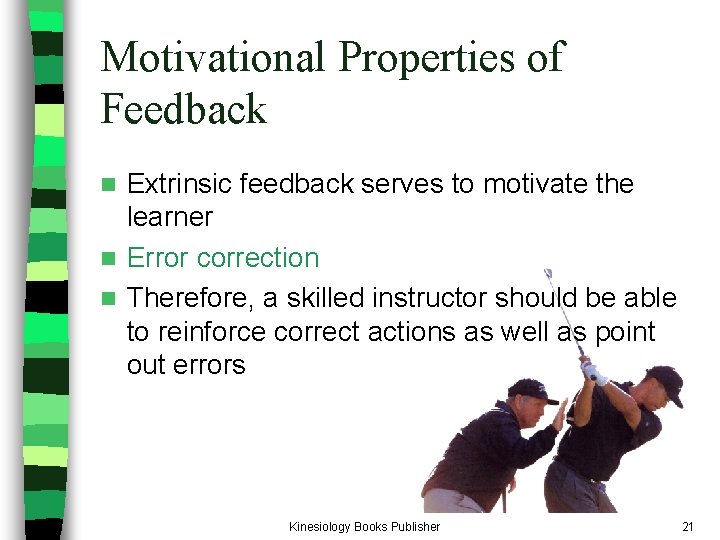
Motivational Properties of Feedback Extrinsic feedback serves to motivate the learner n Error correction n Therefore, a skilled instructor should be able to reinforce correct actions as well as point out errors n Kinesiology Books Publisher 21
Feedback Can be a Crutch n Providing feedback continuously for a long period of time can lead to dependency n Occasional feedback tends to enhance learning n Various types of feedback that minimize dependency have been identified Kinesiology Books Publisher 22
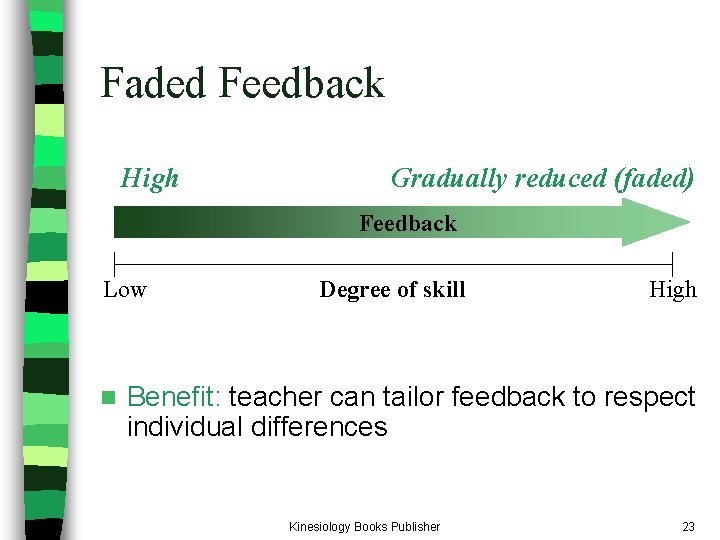
Faded Feedback High Gradually reduced (faded) Feedback Low n Degree of skill High Benefit: teacher can tailor feedback to respect individual differences Kinesiology Books Publisher 23
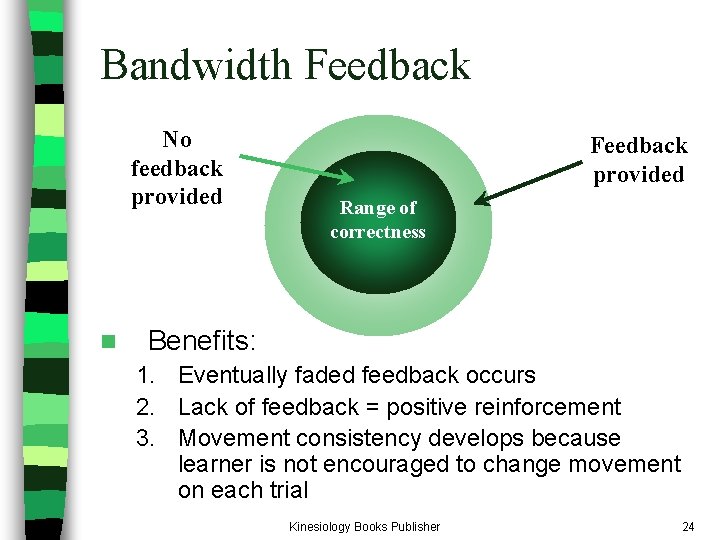
Bandwidth Feedback No feedback provided n Feedback provided Range of correctness Benefits: 1. Eventually faded feedback occurs 2. Lack of feedback = positive reinforcement 3. Movement consistency develops because learner is not encouraged to change movement on each trial Kinesiology Books Publisher 24
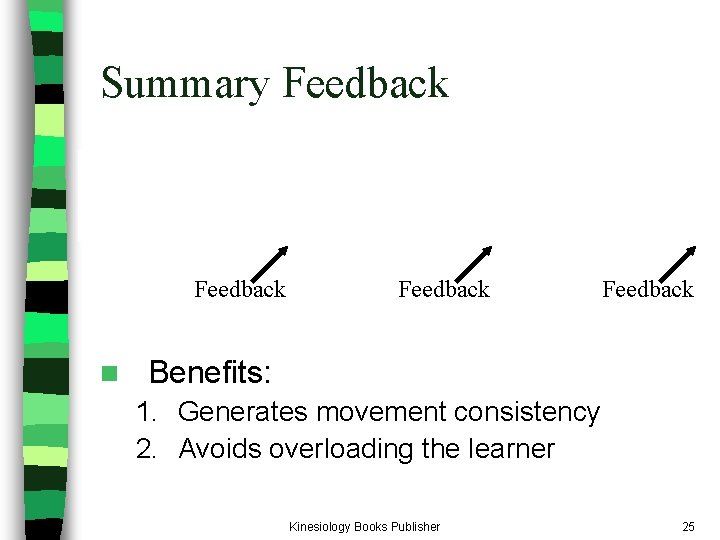
Summary Feedback Trial 1 Trial 2 Trial 3 Trial 4 Trial 5 Trial 6 Trial 7 Trial 8 Trial 9 Feedback n Feedback Benefits: 1. Generates movement consistency 2. Avoids overloading the learner Kinesiology Books Publisher 25
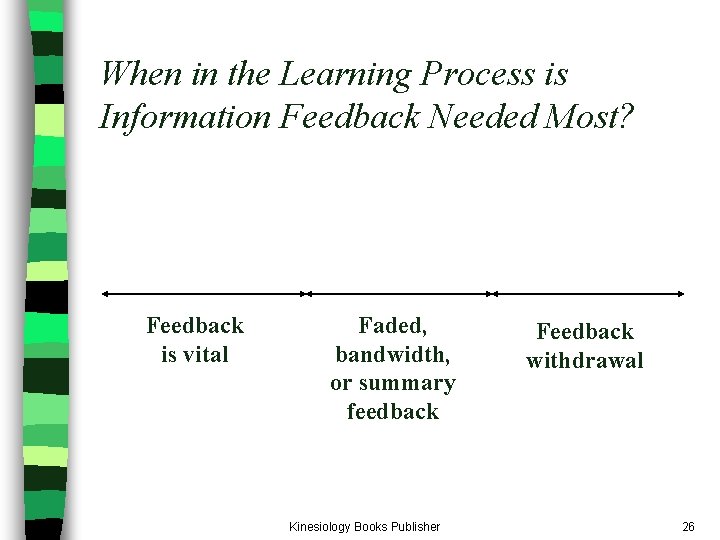
When in the Learning Process is Information Feedback Needed Most? Cognitive stage Feedback is vital Associative stage Faded, bandwidth, or summary feedback Kinesiology Books Publisher Autonomous stage Feedback withdrawal 26
How Much Feedback is Necessary? n Novel tasks – Processing capacity can be easily overloaded – Intense but selective instruction – One important piece of information feedback at a time Kinesiology Books Publisher 27
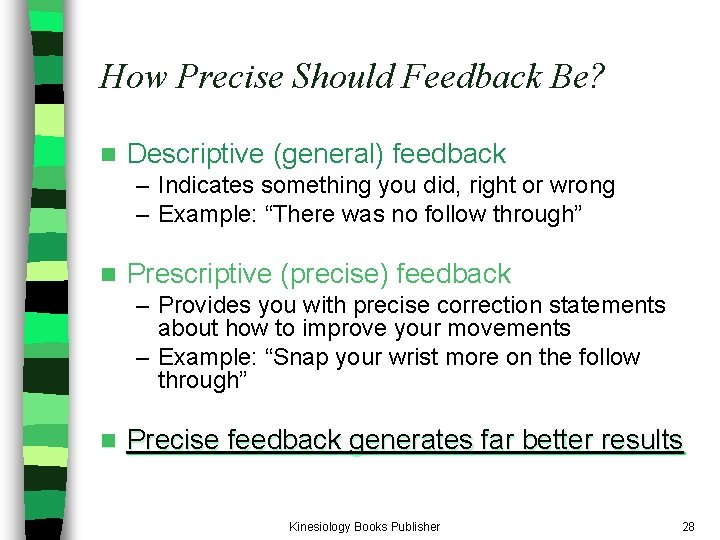
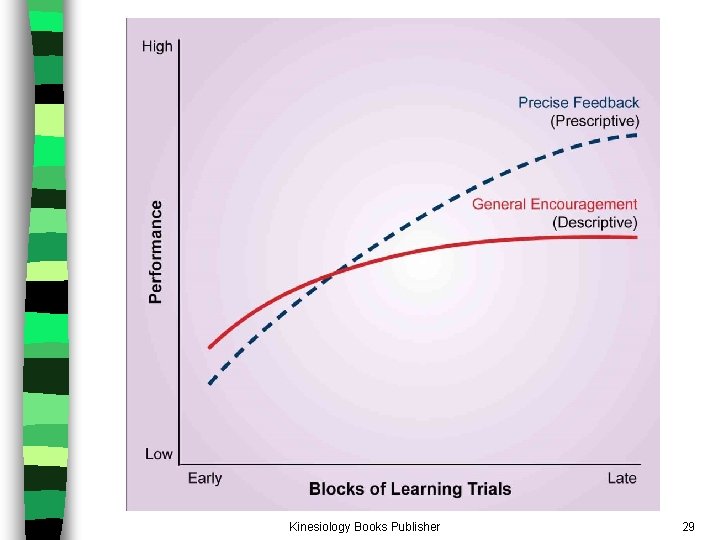
How Precise Should Feedback Be? n Descriptive (general) feedback – Indicates something you did, right or wrong – Example: “There was no follow through” n Prescriptive (precise) feedback – Provides you with precise correction statements about how to improve your movements – Example: “Snap your wrist more on the follow through” n Precise feedback generates far better results Kinesiology Books Publisher 28
Kinesiology Books Publisher 29
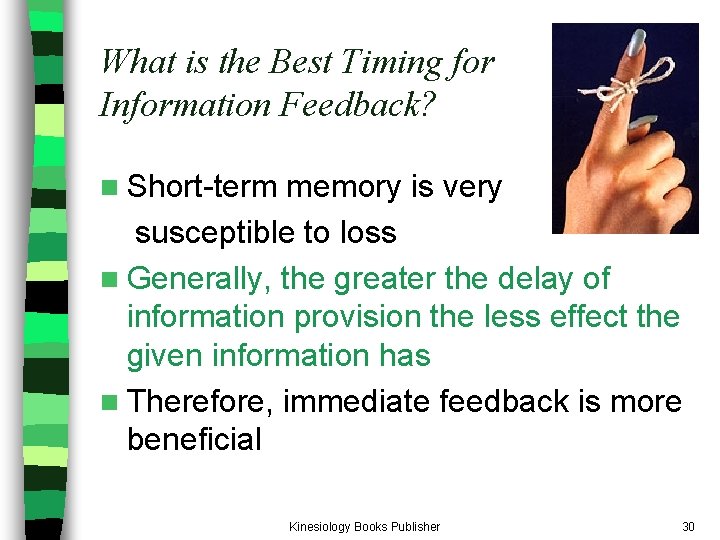
What is the Best Timing for Information Feedback? n Short-term memory is very susceptible to loss n Generally, the greater the delay of information provision the less effect the given information has n Therefore, immediate feedback is more beneficial Kinesiology Books Publisher 30
Transfer of Motor Learning Kinesiology Books Publisher 31
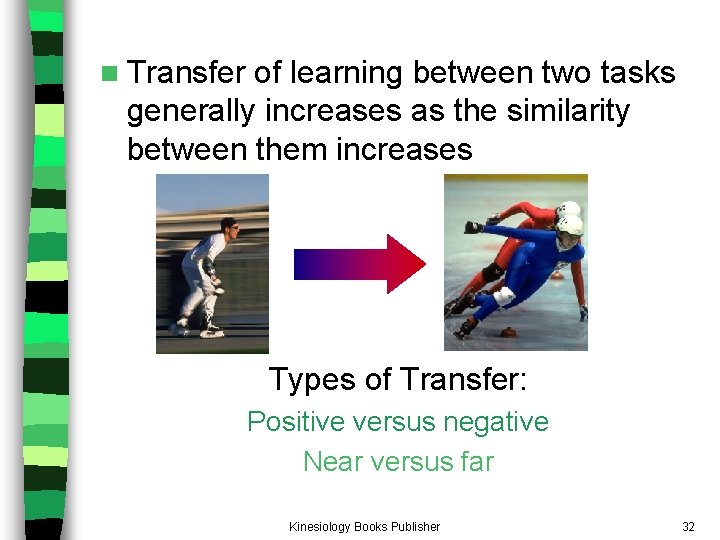
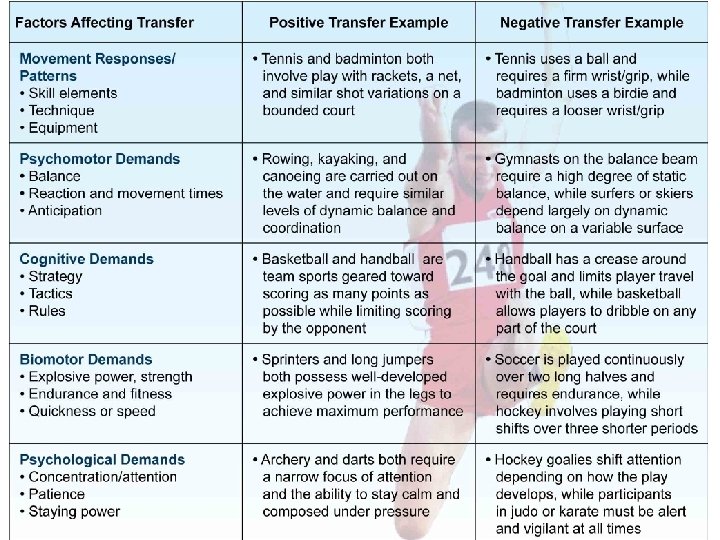
n Transfer of learning between two tasks generally increases as the similarity between them increases Types of Transfer: Positive versus negative Near versus far Kinesiology Books Publisher 32
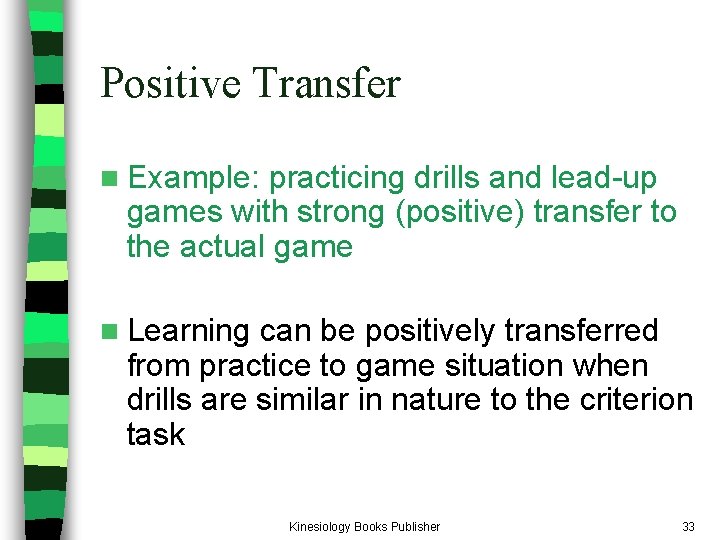
Positive Transfer n Example: practicing drills and lead-up games with strong (positive) transfer to the actual game n Learning can be positively transferred from practice to game situation when drills are similar in nature to the criterion task Kinesiology Books Publisher 33
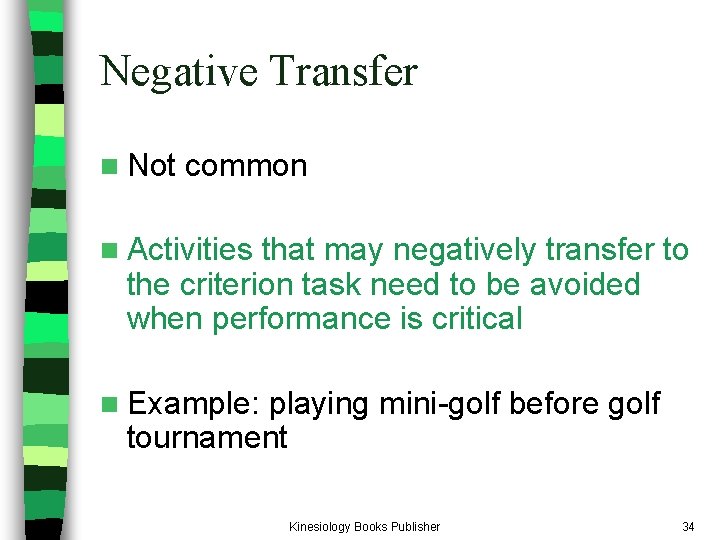
Negative Transfer n Not common n Activities that may negatively transfer to the criterion task need to be avoided when performance is critical n Example: playing mini-golf before golf tournament Kinesiology Books Publisher 34
Kinesiology Books Publisher 35
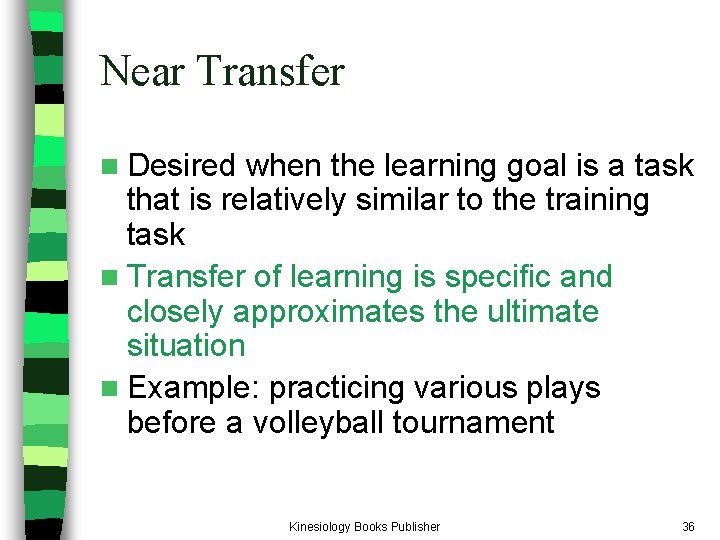
Near Transfer n Desired when the learning goal is a task that is relatively similar to the training task n Transfer of learning is specific and closely approximates the ultimate situation n Example: practicing various plays before a volleyball tournament Kinesiology Books Publisher 36
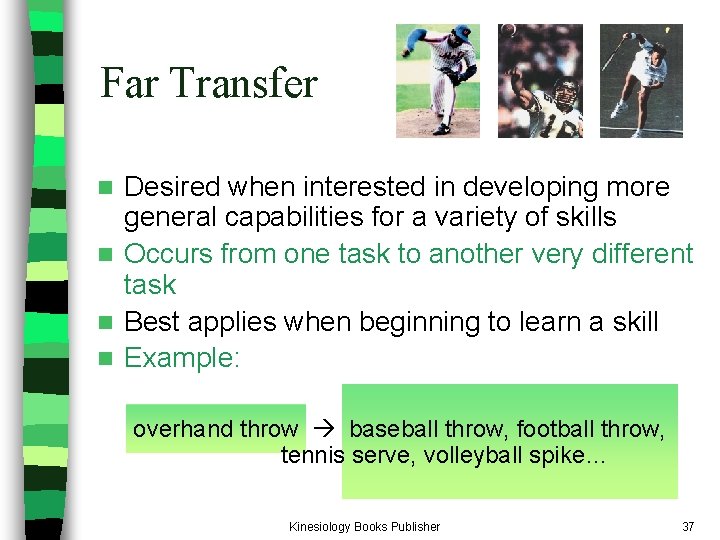
Far Transfer Desired when interested in developing more general capabilities for a variety of skills n Occurs from one task to another very different task n Best applies when beginning to learn a skill n Example: n overhand throw baseball throw, football throw, tennis serve, volleyball spike… Kinesiology Books Publisher 37
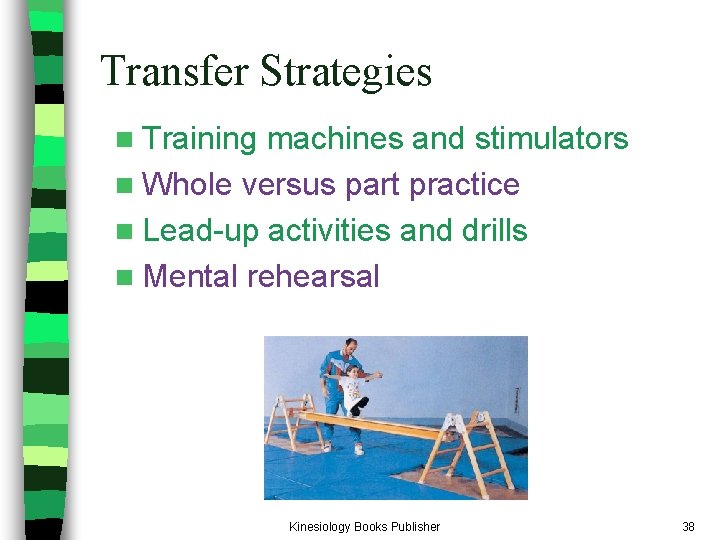
Transfer Strategies n Training machines and stimulators n Whole versus part practice n Lead-up activities and drills n Mental rehearsal Kinesiology Books Publisher 38
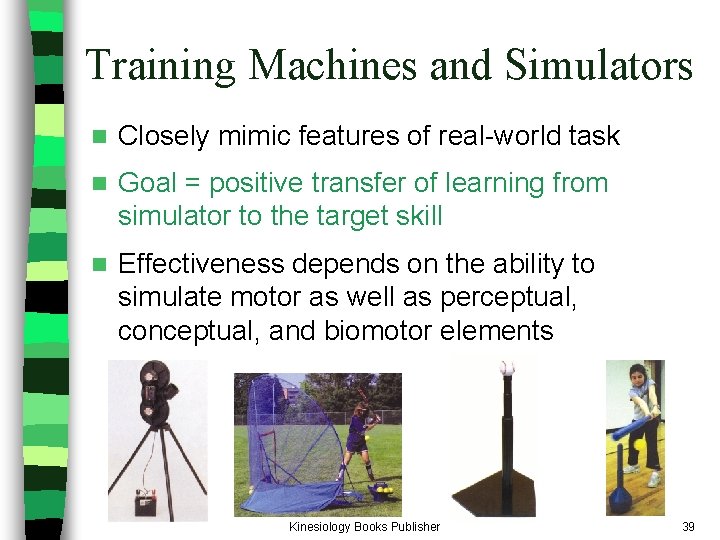
Training Machines and Simulators n Closely mimic features of real-world task n Goal = positive transfer of learning from simulator to the target skill n Effectiveness depends on the ability to simulate motor as well as perceptual, conceptual, and biomotor elements Kinesiology Books Publisher 39
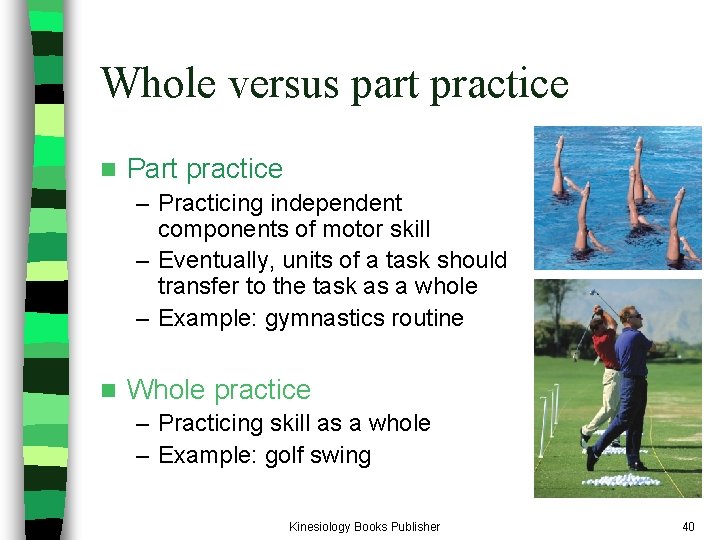
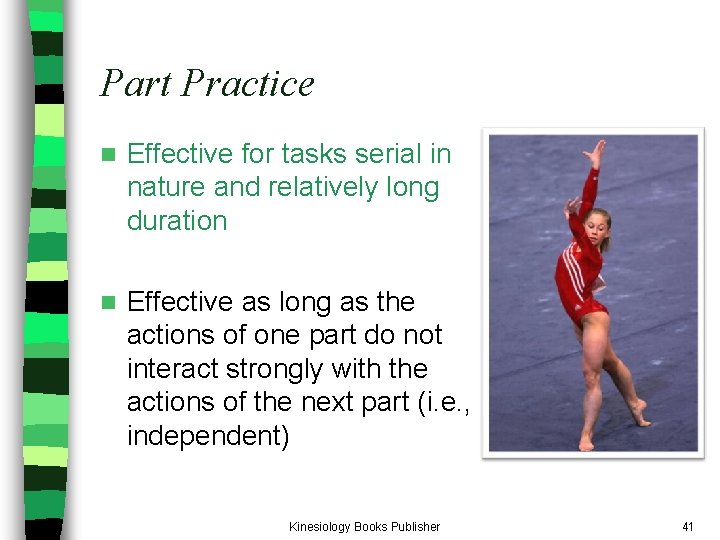
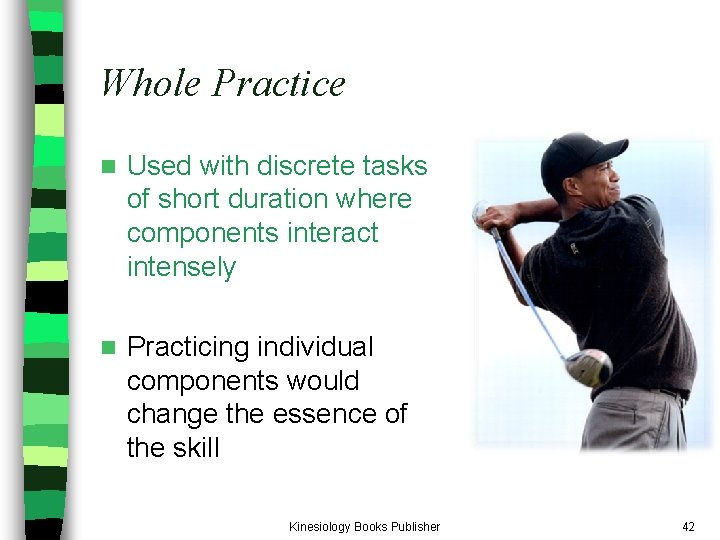
Whole versus part practice n Part practice – Practicing independent components of motor skill – Eventually, units of a task should transfer to the task as a whole – Example: gymnastics routine n Whole practice – Practicing skill as a whole – Example: golf swing Kinesiology Books Publisher 40
Part Practice n Effective for tasks serial in nature and relatively long duration n Effective as long as the actions of one part do not interact strongly with the actions of the next part (i. e. , independent) Kinesiology Books Publisher 41
Whole Practice n Used with discrete tasks of short duration where components interact intensely n Practicing individual components would change the essence of the skill Kinesiology Books Publisher 42
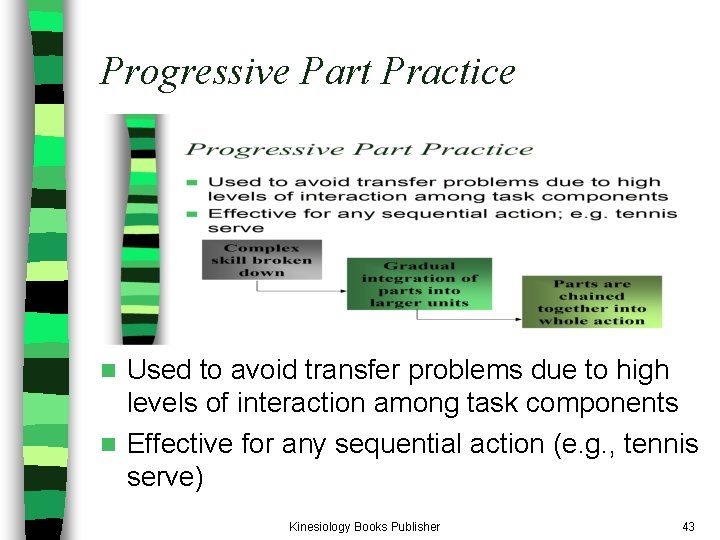
Progressive Part Practice Used to avoid transfer problems due to high levels of interaction among task components n Effective for any sequential action (e. g. , tennis serve) n Kinesiology Books Publisher 43
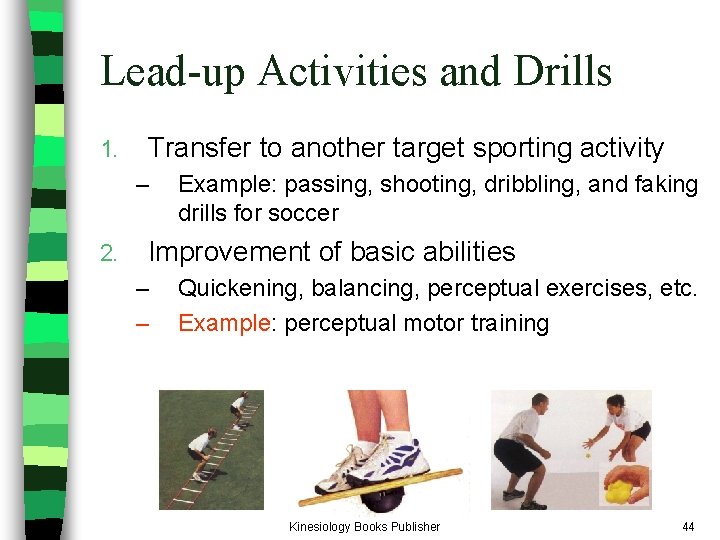
Lead-up Activities and Drills 1. Transfer to another target sporting activity – 2. Example: passing, shooting, dribbling, and faking drills for soccer Improvement of basic abilities – – Quickening, balancing, perceptual exercises, etc. Example: perceptual motor training Kinesiology Books Publisher 44
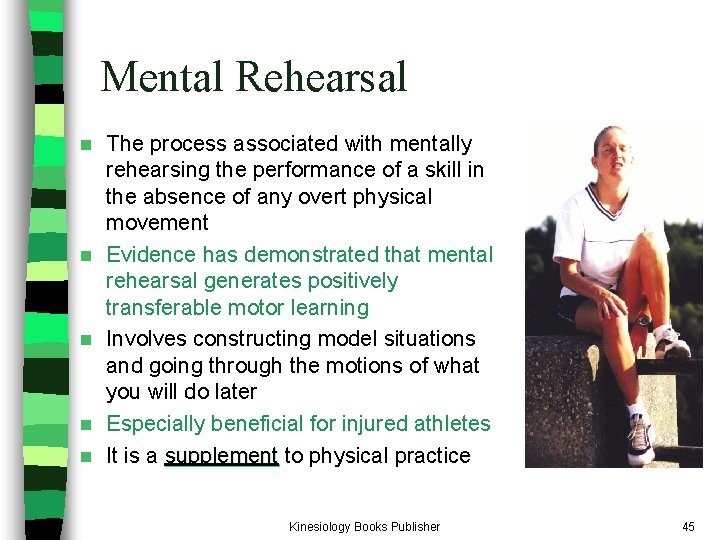
Mental Rehearsal n n n The process associated with mentally rehearsing the performance of a skill in the absence of any overt physical movement Evidence has demonstrated that mental rehearsal generates positively transferable motor learning Involves constructing model situations and going through the motions of what you will do later Especially beneficial for injured athletes It is a supplement to physical practice Kinesiology Books Publisher 45
Designing Effective Practice n Conditions of Practice: a) Blocked Practice - a given task is practiced on many consecutive trials before setting about the next task - enables the learners to correct specific problems and refine their skills one at a time - important early in practice when correct habits should be learned and established b) Random Practice - ordering of tasks is randomized in a way that tasks from different classes are mixed throughout the practice period - random practice is very effective once a skill has become more developed Kinesiology Books Publisher 46
Massed Versus Distributed Practice a)Massed Practice -a schedule in which the amount of rest between practice trials is short relative to the trial length -e. g. , 5 s of rest for a practice trial lasting 60 s b)Distributed Practice -practice that allows for more rest between trials relative to the trial length -the rest period may last as long as the trial itself Reducing the amount of rest between trials will also reduce the amount of time the body and central nervous system have to recover from physical and mental fatigue There is no single optimal practice-rest ratio for all learning tasks Kinesiology Books Publisher 47
Grouping for Practice n Designed to make learning suitable for everyone involved n Should be based on the learners’ skill levels, rather than a subjective determination of their underlying abilities n Other factors, such as maturity level, previous experience, and level of physical fitness need to be considered Kinesiology Books Publisher 48
Effects of Motivation on Learning Until the learner has been motivated, effective learning is not likely to occur n An instructor plays an important role in motivating his students (encouraging learners to set goals, providing excellent demonstrations, or using visual aids) n It’s a Fact: She who is motivated makes more of an effort during practice, can practice for longer periods of time, and learns more in the end n The Law of Effect: Organisms tend to repeat responses that are rewarded and to avoid responses that are not rewarded or punished n Kinesiology Books Publisher 49