
Motor Disabilities Angela Vujic CS 8803 Discussion Outline
Motor Disabilities Angela Vujic CS 8803

Discussion Outline • • • Definition General Statistics Types of Motor Disabilities Examples of disabilities, technologies ITA: Bonus Video

Definition • Physical impairments that can impede movement, coordination, or sensation

CDC National Health Survey • Difficulties in physical functioning • Example of measures included: – Very difficult or cannot walk a quarter of a mile – Very difficulty or cannot grasp or handle small objects – Very difficult or cannot push or pull large objects • For Adults aged 18 and over: – At least one basic actions difficulty or complex activity limitation: 74. 8 million or 32. 4% – Unable (or very difficult) to walk a quarter mile: 17. 1 million or 7. 1% – Any physical functioning difficulty: 36. 2 million or 15. 5%
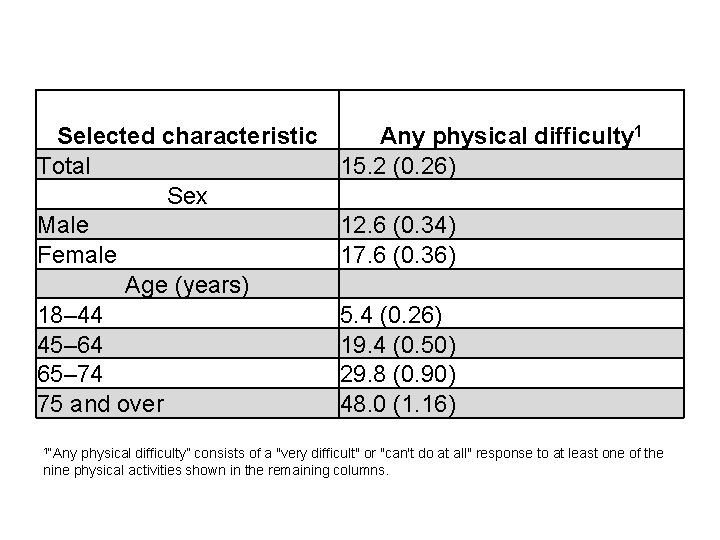
Selected characteristic Total Sex Male Female Age (years) 18– 44 45– 64 65– 74 75 and over 1“Any physical difficulty 1 15. 2 (0. 26) 12. 6 (0. 34) 17. 6 (0. 36) 5. 4 (0. 26) 19. 4 (0. 50) 29. 8 (0. 90) 48. 0 (1. 16) physical difficulty” consists of a "very difficult" or "can't do at all" response to at least one of the nine physical activities shown in the remaining columns.

CDC National Health Survey • Based on the format of the survey results, CDC is trying to say: strong positive correlation between age and motor disabilities
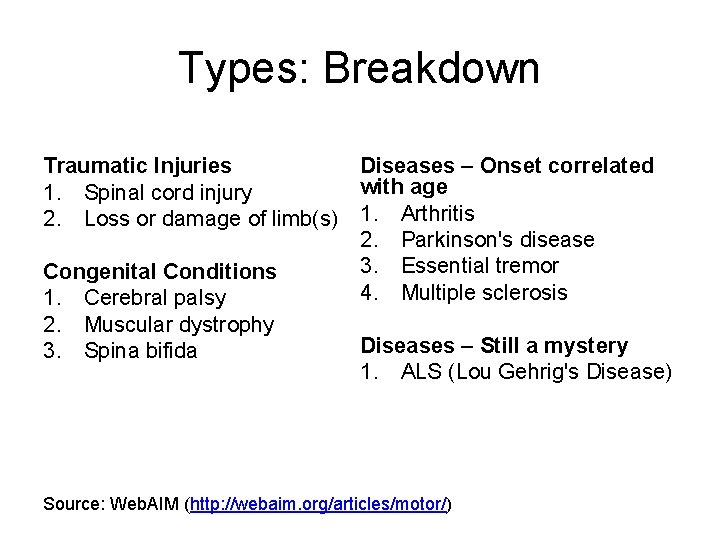
Types: Breakdown Traumatic Injuries Diseases – Onset correlated with age 1. Spinal cord injury 2. Loss or damage of limb(s) 1. Arthritis 2. Parkinson's disease 3. Essential tremor Congenital Conditions 4. Multiple sclerosis 1. Cerebral palsy 2. Muscular dystrophy Diseases – Still a mystery 3. Spina bifida 1. ALS (Lou Gehrig's Disease) Source: Web. AIM (http: //webaim. org/articles/motor/)
Types: Breakdown Traumatic Injuries Diseases – Onset correlated with age 1. Spinal cord injury 2. Loss or damage of limb(s) 1. Arthritis 2. Parkinson's disease 3. Essential tremor Congenital Conditions 4. Multiple sclerosis 1. Cerebral palsy 2. Muscular dystrophy Diseases – Still a mystery 3. Spina bifida 1. ALS (Lou Gehrig's Disease) Source: Web. AIM (http: //webaim. org/articles/motor/)
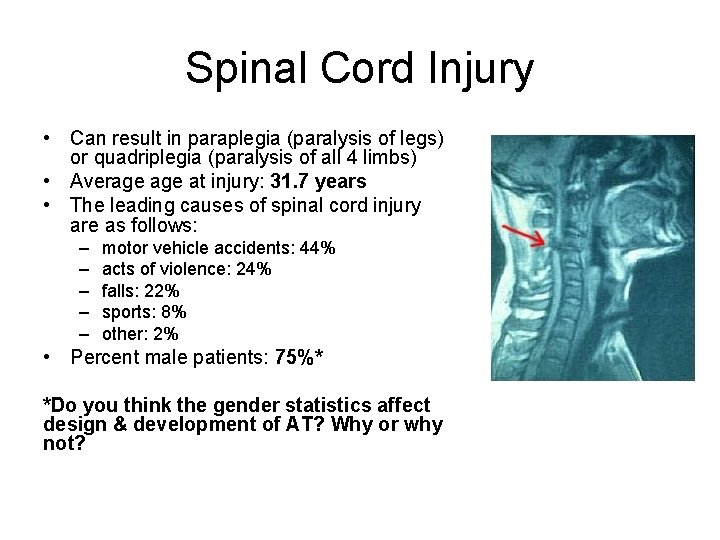
Spinal Cord Injury • Can result in paraplegia (paralysis of legs) or quadriplegia (paralysis of all 4 limbs) • Average at injury: 31. 7 years • The leading causes of spinal cord injury are as follows: – – – motor vehicle accidents: 44% acts of violence: 24% falls: 22% sports: 8% other: 2% • Percent male patients: 75%* *Do you think the gender statistics affect design & development of AT? Why or why not?
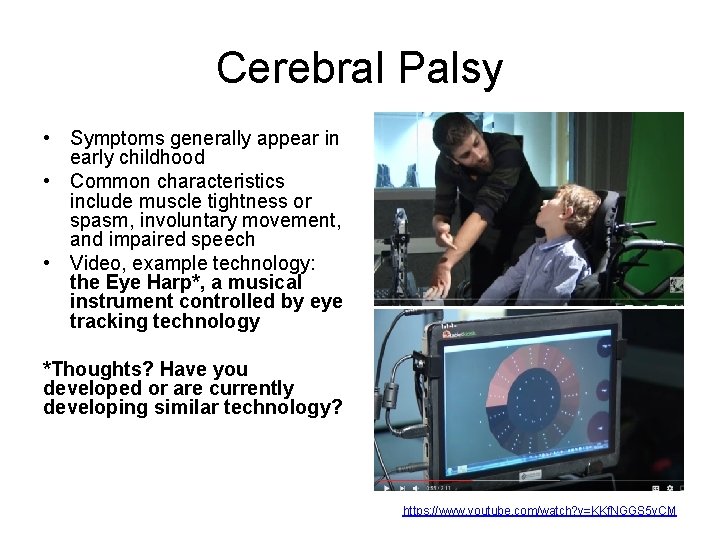
Cerebral Palsy • Symptoms generally appear in early childhood • Common characteristics include muscle tightness or spasm, involuntary movement, and impaired speech • Video, example technology: the Eye Harp*, a musical instrument controlled by eye tracking technology *Thoughts? Have you developed or are currently developing similar technology? https: //www. youtube. com/watch? v=KKf. NGGS 5 y. CM
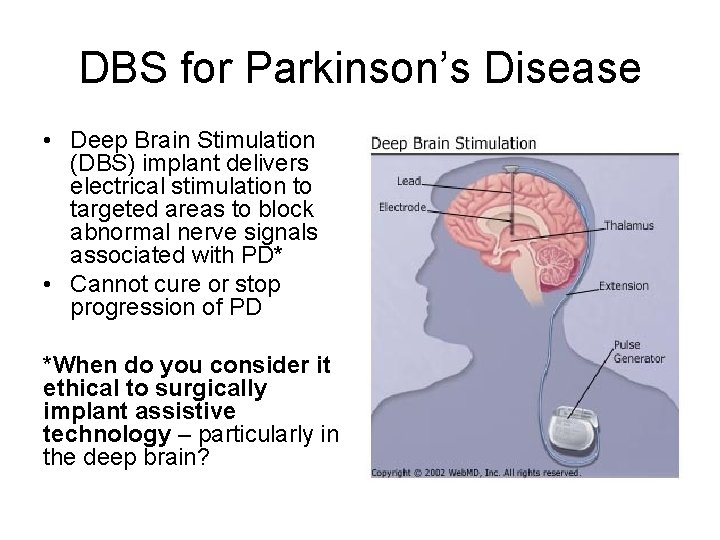
DBS for Parkinson’s Disease • Deep Brain Stimulation (DBS) implant delivers electrical stimulation to targeted areas to block abnormal nerve signals associated with PD* • Cannot cure or stop progression of PD *When do you consider it ethical to surgically implant assistive technology – particularly in the deep brain?
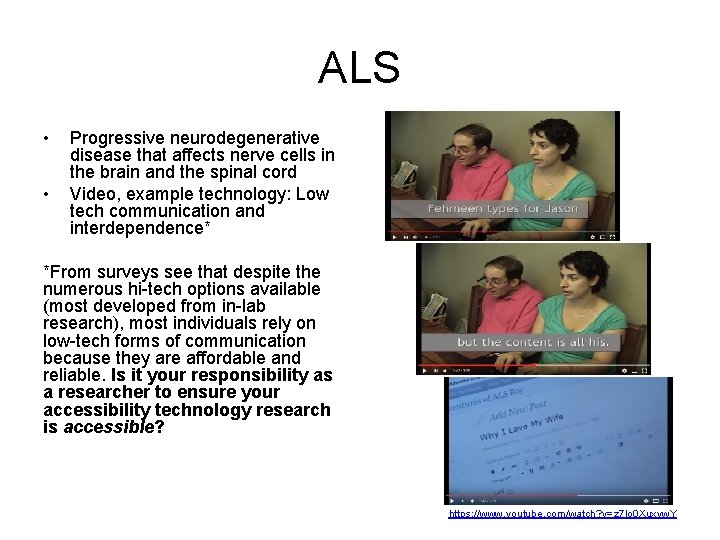
ALS • • Progressive neurodegenerative disease that affects nerve cells in the brain and the spinal cord Video, example technology: Low tech communication and interdependence* *From surveys see that despite the numerous hi-tech options available (most developed from in-lab research), most individuals rely on low-tech forms of communication because they are affordable and reliable. Is it your responsibility as a researcher to ensure your accessibility technology research is accessible? https: //www. youtube. com/watch? v=z 7 lo 0 Xuxyw. Y

Any other questions or comments?

Bonus • https: //www. youtube. com/watch? v=f 31 m 55 -x. UY * • *Why are dogs perfect?
- Slides: 14