
Motor control exercise for chronic nonspecific low back
Motor control exercise for chronic non-specific low back pain Saragiotto et al (2016) Trusted evidence. Informed decisions. Better health. This document is licensed under a Creative Commons Attribution Non. Commercial. No. Derivatives 4. 0 International License: http: //creativecommons. org/licenses/by-nc-nd/4. 0/ That means this document can be used and shared as long as IWH is credited as the source, the contents are not modified, and the contents are used for non-commercial purposes. If you wish to modify and/or use the contents for commercial purposes, please contact ip@iwh. on. ca.
Motor control exercise for chronic non-specific low back pain Saragiotto et al (2016) Overview of the study Objectives: • To evaluate the effectiveness of motor control exercises (MCE) for patients with chronic non-specific LBP Methods: • Evidence current up to 2 April 2015 • Participants: Non-specific or recurrent LBP lasting more than 12 weeks • Intervention: MCE performed alone or added as a supplement to other interventions. • Outcomes: o Primary: Pain and disability o Secondary: Function, quality of life, global impression of recovery, return to work, adverse events and recurrence
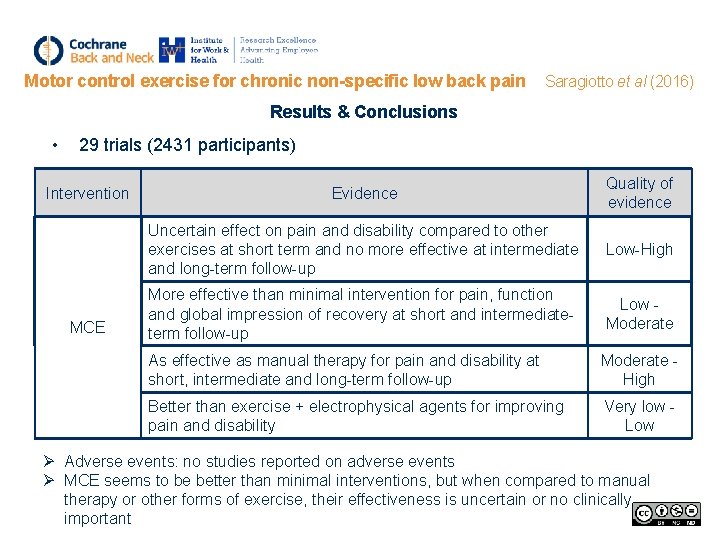
Motor control exercise for chronic non-specific low back pain Saragiotto et al (2016) Results & Conclusions • 29 trials (2431 participants) Intervention MCE Evidence Quality of evidence Uncertain effect on pain and disability compared to other exercises at short term and no more effective at intermediate and long-term follow-up Low-High More effective than minimal intervention for pain, function and global impression of recovery at short and intermediateterm follow-up Low Moderate As effective as manual therapy for pain and disability at short, intermediate and long-term follow-up Moderate High Better than exercise + electrophysical agents for improving pain and disability Very low Low Ø Adverse events: no studies reported on adverse events Ø MCE seems to be better than minimal interventions, but when compared to manual therapy or other forms of exercise, their effectiveness is uncertain or no clinically important
- Slides: 3