
Motor Control Circuit Push Button Station and Relay
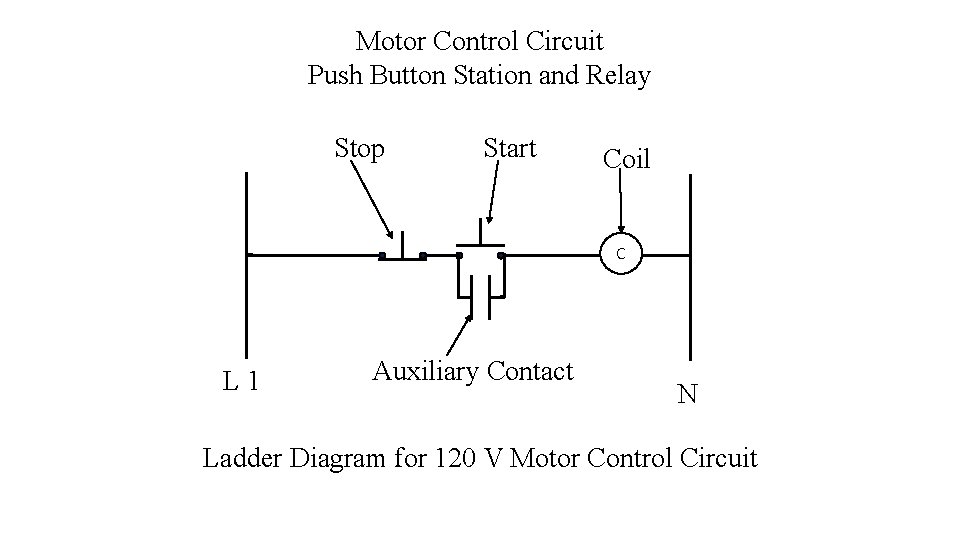
Motor Control Circuit Push Button Station and Relay Stop Start Coil C L 1 Auxiliary Contact N Ladder Diagram for 120 V Motor Control Circuit
Main Points Why use a motor control circuit? Motor controls allow for the use of lower amperage and/or lower voltage to control large loads. Safer – less arcing between switch contacts, lower amperage and lower voltage; safer for operators and maintenance More efficient - allows for use of smaller conductors in the control circuit wiring, connections easier to make, less expensive. Allows for a degree of automation in circuits i. e. thermostats, float switched, humidistats, timers, etc.
The basic components required by the NEC for motor control circuits are: Disconnect means to physically open the supply conductor(s) going to the motor circuit Controller to start and stop the motor Overload protection to prevent overheating that may result from motor loads that exceed the rated ampacity of the motor
How the circuit works The motor control (definite purpose contactor or relay in this application) employs the use of an electrically generated magnetic field to make or break contact between the supply conductors attached to the relay terminals L 1 and L 2 and the load conductors attached to relay terminals T 1 and T 2 that supply the load.

Basic Components and Operation Definite Purpose Contactor (Relay) - Source conductors from the over current protection device attach to L 1 and L 2 at the top of the relay. The load conductors attach to T 1 & T 2 at the bottom of the relay and send power to the motor load. A conductor tapped from one terminal on either L 1 or L 2 (Conductor #1 in diagram) will carry 120 volts to the bottom terminal of the normally closed STOP button on the push button station. L 1 (Line 1) Supply Terminals L 2 (Line 2) T 1 (terminal 1) Load Terminals T 2 (terminal 2)
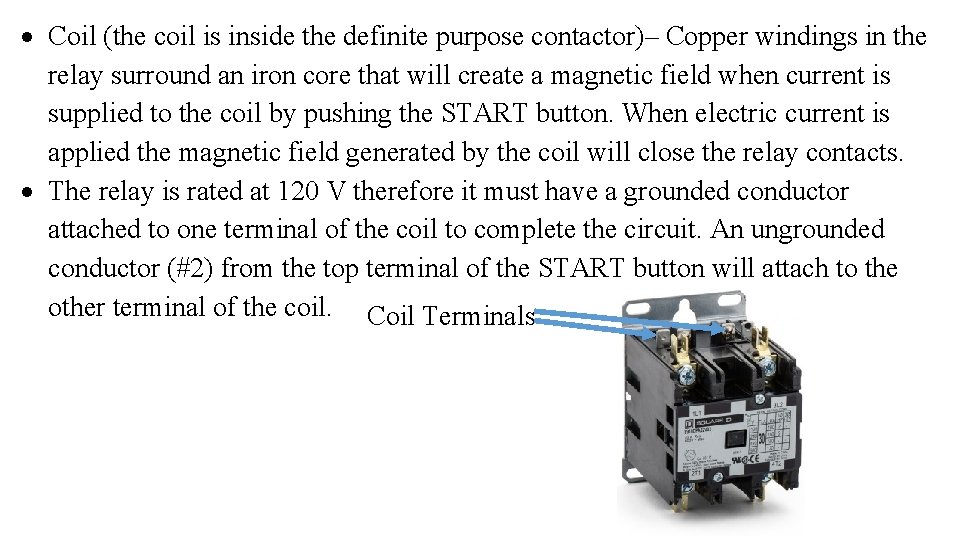
Coil (the coil is inside the definite purpose contactor)– Copper windings in the relay surround an iron core that will create a magnetic field when current is supplied to the coil by pushing the START button. When electric current is applied the magnetic field generated by the coil will close the relay contacts. The relay is rated at 120 V therefore it must have a grounded conductor attached to one terminal of the coil to complete the circuit. An ungrounded conductor (#2) from the top terminal of the START button will attach to the other terminal of the coil. Coil Terminals
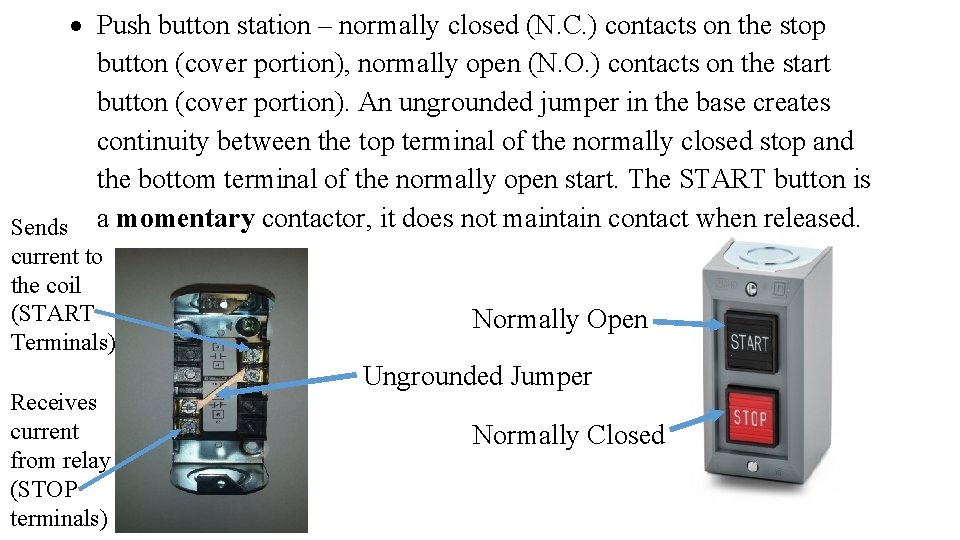
Push button station – normally closed (N. C. ) contacts on the stop button (cover portion), normally open (N. O. ) contacts on the start button (cover portion). An ungrounded jumper in the base creates continuity between the top terminal of the normally closed stop and the bottom terminal of the normally open start. The START button is Sends a momentary contactor, it does not maintain contact when released. current to the coil (START Terminals) Receives current from relay (STOP terminals) Normally Open Ungrounded Jumper Normally Closed
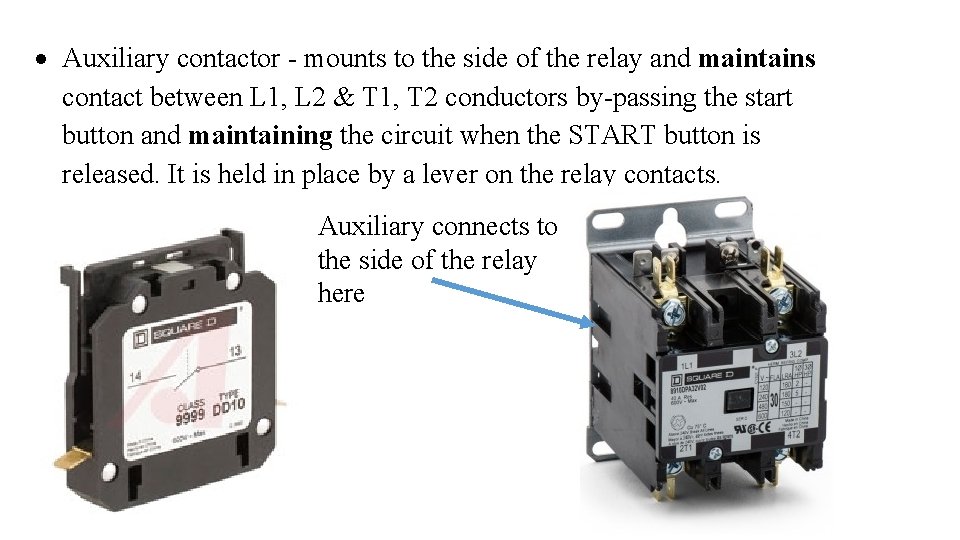
Auxiliary contactor - mounts to the side of the relay and maintains contact between L 1, L 2 & T 1, T 2 conductors by-passing the start button and maintaining the circuit when the START button is released. It is held in place by a lever on the relay contacts. Auxiliary connects to the side of the relay here
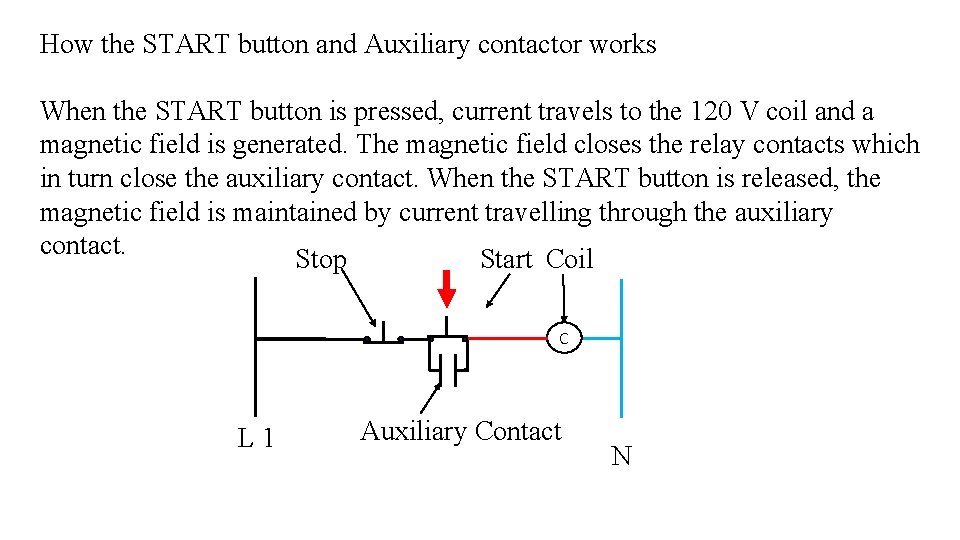
How the START button and Auxiliary contactor works When the START button is pressed, current travels to the 120 V coil and a magnetic field is generated. The magnetic field closes the relay contacts which in turn close the auxiliary contact. When the START button is released, the magnetic field is maintained by current travelling through the auxiliary contact. Stop Start Coil C L 1 Auxiliary Contact N
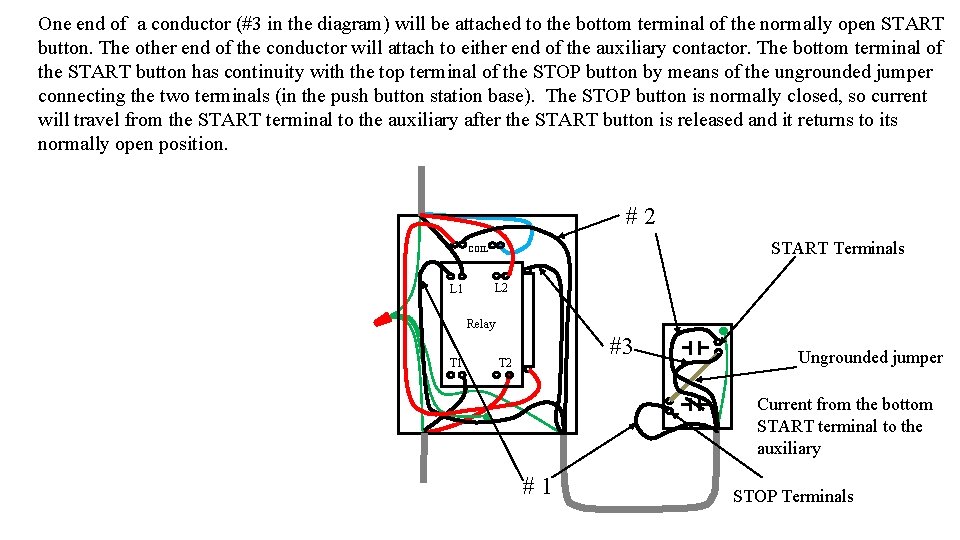
One end of a conductor (#3 in the diagram) will be attached to the bottom terminal of the normally open START button. The other end of the conductor will attach to either end of the auxiliary contactor. The bottom terminal of the START button has continuity with the top terminal of the STOP button by means of the ungrounded jumper connecting the two terminals (in the push button station base). The STOP button is normally closed, so current will travel from the START terminal to the auxiliary after the START button is released and it returns to its normally open position. #2 START Terminals COIL L 2 L 1 Relay T 1 #3 T 2 Ungrounded jumper Current from the bottom START terminal to the auxiliary #1 STOP Terminals

A conductor (red jumper in the relay enclosure) from the other terminal of the auxiliary will connect to the ungrounded terminal of the coil. When the START button is pressed, current travels from the top START terminal to the coil generating a magnetic field that closes the relay contacts. A lever attached to the contacts in the relay mechanically closes the auxiliary contacts and current by-passes the start button through the red jumper once the START button is released. Current travels through the auxiliary to the coil in order to maintain the magnetic field and keep the relay contacts closed and the motor circuit energized. Jumper from auxiliary to the coil COIL L 2 L 1 Relay T 1 T 2

Source Conductors Conductor #1 Ungrounded conductor from L 1 to N. C. STOP Red Jumper from the auxiliary to the ungrounded coil terminal. Bypasses the N. O. START Grounded Conductor #2 COIL #1 #3 L 2 L 1 Conductor # 2 Ungrounded conductor from the top terminal of N. O. START to the coil Relay T 1 Load Conductors T 2 Conductor # 3 Ungrounded from the bottom terminal of N. C. START to the auxiliary
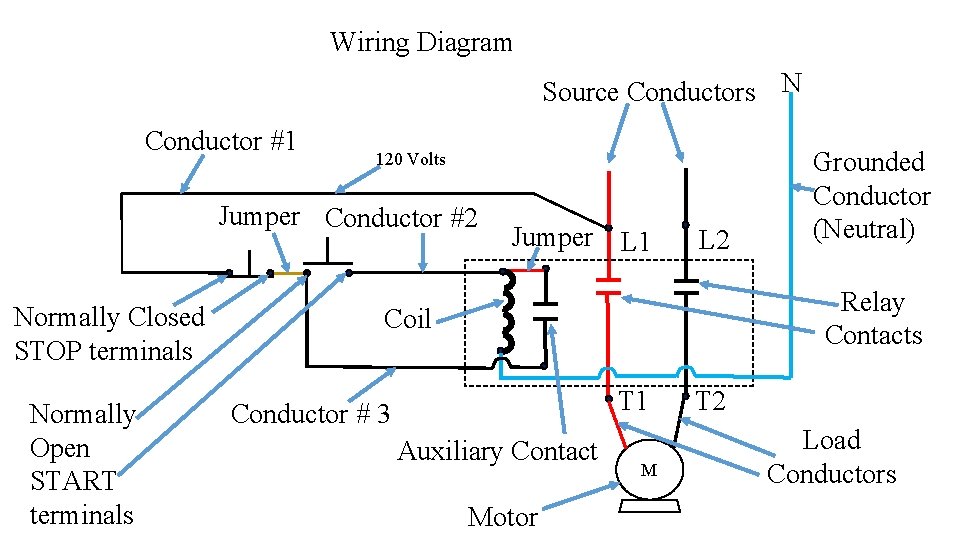
Wiring Diagram Source Conductors N Conductor #1 120 Volts Jumper Conductor #2 Normally Closed STOP terminals Normally Open START terminals Jumper L 1 L 2 Grounded Conductor (Neutral) Relay Contacts Coil T 1 Conductor # 3 Auxiliary Contact Motor M T 2 Load Conductors
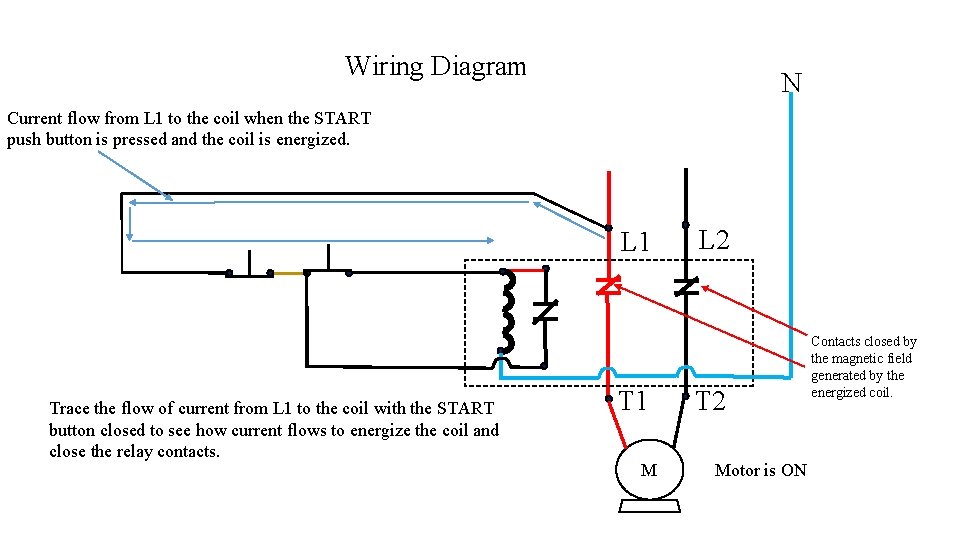
Wiring Diagram N Current flow from L 1 to the coil when the START push button is pressed and the coil is energized. L 1 Trace the flow of current from L 1 to the coil with the START button closed to see how current flows to energize the coil and close the relay contacts. T 1 M L 2 T 2 Motor is ON Contacts closed by the magnetic field generated by the energized coil.
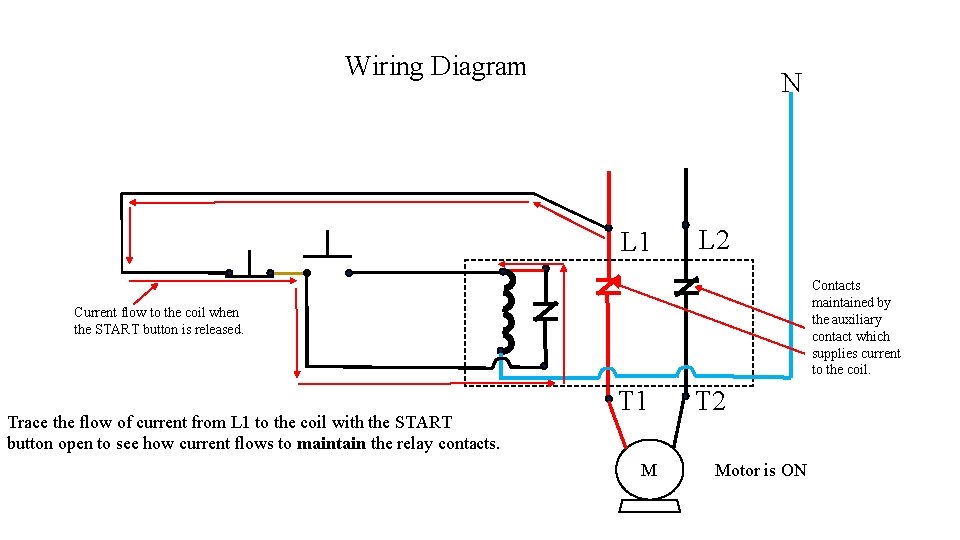
Wiring Diagram N L 1 L 2 Contacts maintained by the auxiliary contact which supplies current to the coil. Current flow to the coil when the START button is released. Trace the flow of current from L 1 to the coil with the START button open to see how current flows to maintain the relay contacts. T 1 M T 2 Motor is ON
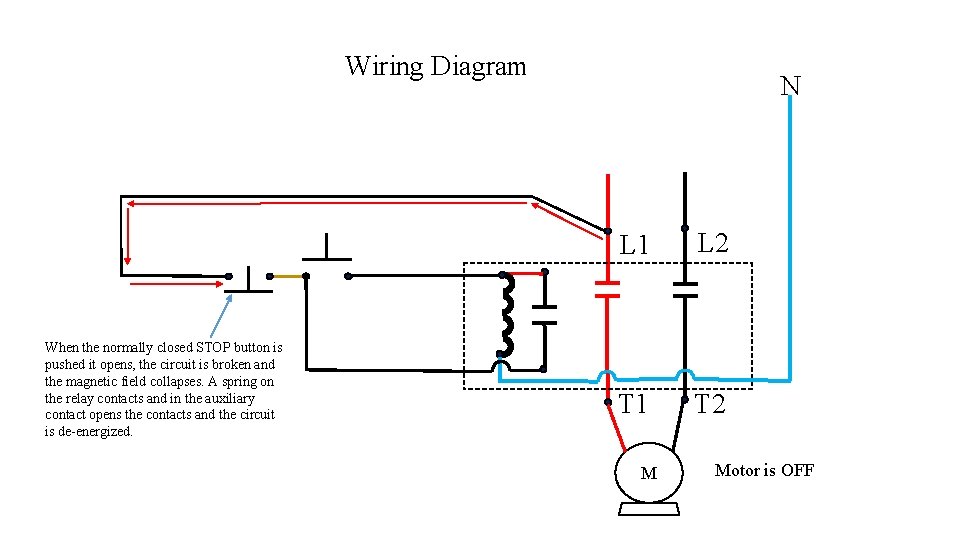
Wiring Diagram When the normally closed STOP button is pushed it opens, the circuit is broken and the magnetic field collapses. A spring on the relay contacts and in the auxiliary contact opens the contacts and the circuit is de-energized. N L 1 L 2 T 1 T 2 M Motor is OFF
- Slides: 16