
Motivational Interviewing to Improve Student Outcomes Russell Spieth
- Slides: 28
Motivational Interviewing to Improve Student Outcomes Russell Spieth, Ph. D, Licensed Psychologist Jessica Zavala, MPA, CDCA
MOTIVATIONAL INTERVIEWING (MI): LEARNING OBJECTIVES • Understand how MI can improve student health outcomes • Recognize how MI can improve student academic performance • Appreciate the dimensions of the MI Spirit • Identify the skills of MI to evoke change talk, to soften sustain talk and to create a change plan
MI DEFINITIONS: MI is a motivational approach that is evidence-based, brief, applicable across a wide range of problem areas, and learnable by a broad range of helpers (Miller & Rollnick, 2013). “Arranging conversations so people talk themselves into change based on their own values and interests” (Miller & Rollnick, 2013, p. 13)
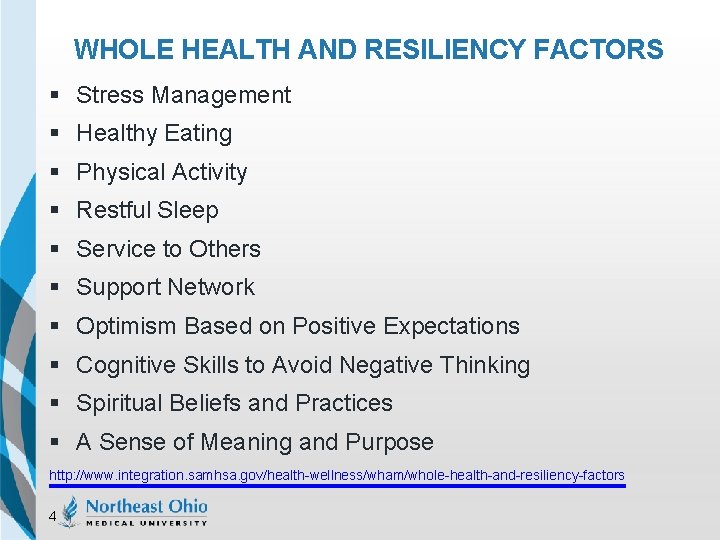
WHOLE HEALTH AND RESILIENCY FACTORS § Stress Management § Healthy Eating § Physical Activity § Restful Sleep § Service to Others § Support Network § Optimism Based on Positive Expectations § Cognitive Skills to Avoid Negative Thinking § Spiritual Beliefs and Practices § A Sense of Meaning and Purpose http: //www. integration. samhsa. gov/health-wellness/wham/whole-health-and-resiliency-factors 4
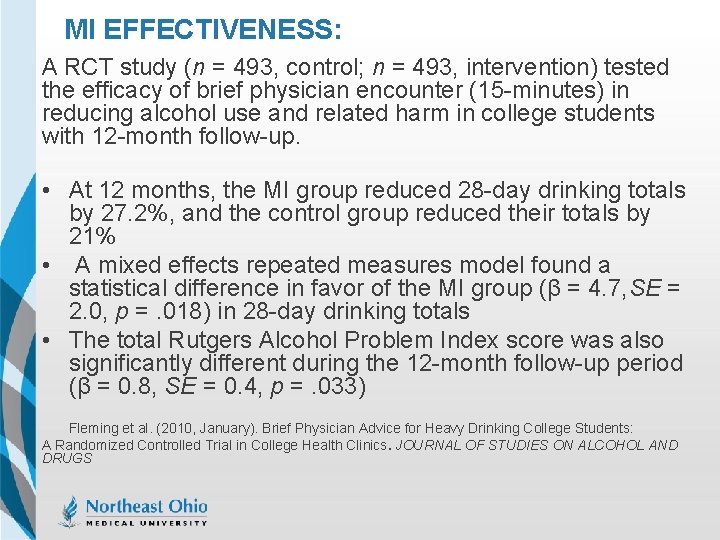
MI EFFECTIVENESS: A RCT study (n = 493, control; n = 493, intervention) tested the efficacy of brief physician encounter (15 -minutes) in reducing alcohol use and related harm in college students with 12 -month follow-up. • At 12 months, the MI group reduced 28 -day drinking totals by 27. 2%, and the control group reduced their totals by 21% • A mixed effects repeated measures model found a statistical difference in favor of the MI group (β = 4. 7, SE = 2. 0, p =. 018) in 28 -day drinking totals • The total Rutgers Alcohol Problem Index score was also significantly different during the 12 -month follow-up period (β = 0. 8, SE = 0. 4, p =. 033) Fleming et al. (2010, January). Brief Physician Advice for Heavy Drinking College Students: A Randomized Controlled Trial in College Health Clinics. JOURNAL OF STUDIES ON ALCOHOL AND DRUGS
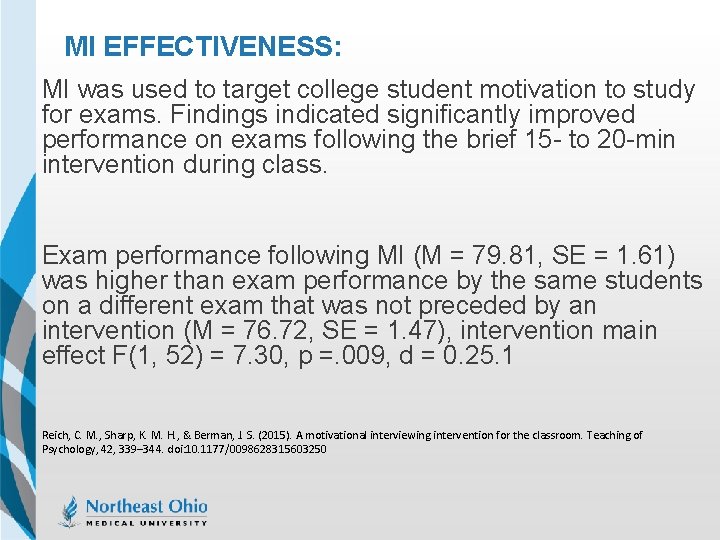
MI EFFECTIVENESS: MI was used to target college student motivation to study for exams. Findings indicated significantly improved performance on exams following the brief 15 - to 20 -min intervention during class. Exam performance following MI (M = 79. 81, SE = 1. 61) was higher than exam performance by the same students on a different exam that was not preceded by an intervention (M = 76. 72, SE = 1. 47), intervention main effect F(1, 52) = 7. 30, p =. 009, d = 0. 25. 1 Reich, C. M. , Sharp, K. M. H. , & Berman, J. S. (2015). A motivational interviewing intervention for the classroom. Teaching of Psychology, 42, 339– 344. doi: 10. 1177/0098628315603250
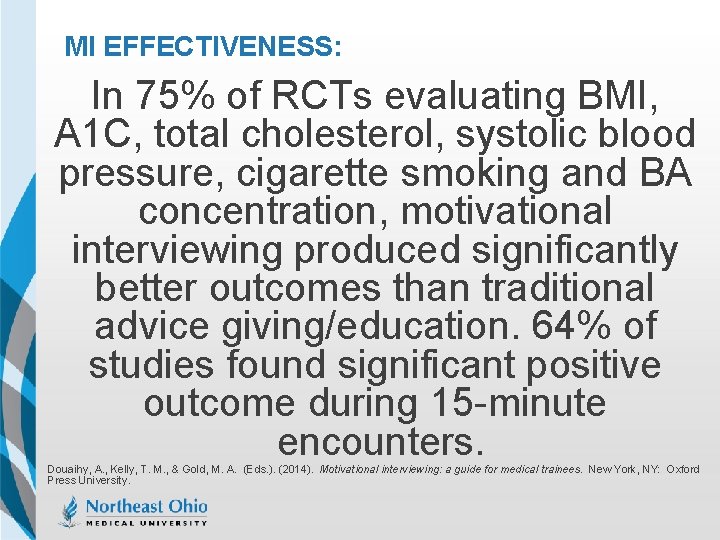
MI EFFECTIVENESS: In 75% of RCTs evaluating BMI, A 1 C, total cholesterol, systolic blood pressure, cigarette smoking and BA concentration, motivational interviewing produced significantly better outcomes than traditional advice giving/education. 64% of studies found significant positive outcome during 15 -minute encounters. Douaihy, A. , Kelly, T. M. , & Gold, M. A. (Eds. ). (2014). Motivational interviewing: a guide for medical trainees. New York, NY: Oxford Press University.
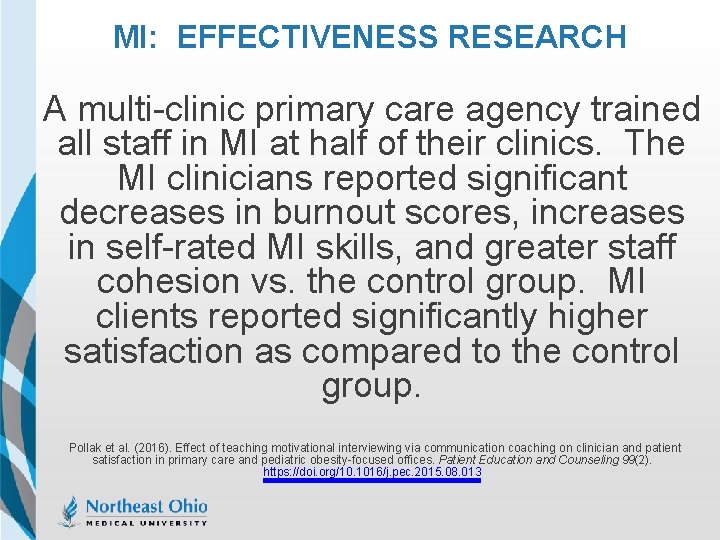
MI: EFFECTIVENESS RESEARCH A multi-clinic primary care agency trained all staff in MI at half of their clinics. The MI clinicians reported significant decreases in burnout scores, increases in self-rated MI skills, and greater staff cohesion vs. the control group. MI clients reported significantly higher satisfaction as compared to the control group. Pollak et al. (2016). Effect of teaching motivational interviewing via communication coaching on clinician and patient satisfaction in primary care and pediatric obesity-focused offices. Patient Education and Counseling 99(2). https: //doi. org/10. 1016/j. pec. 2015. 08. 013
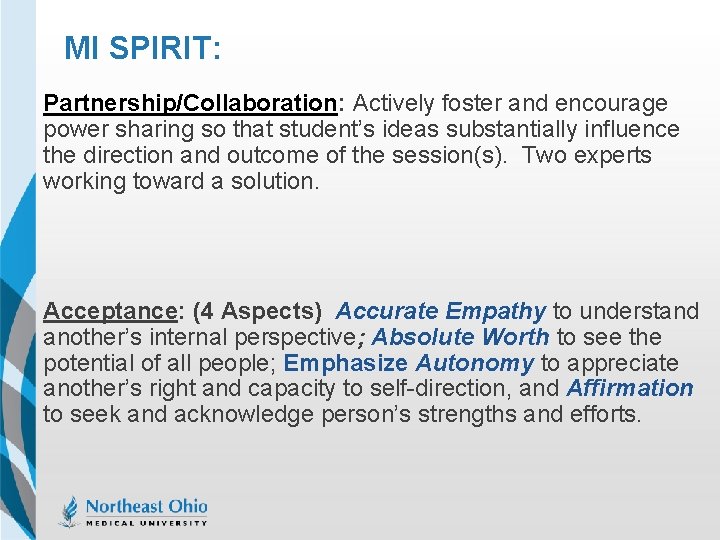
MI SPIRIT: Partnership/Collaboration: Actively foster and encourage power sharing so that student’s ideas substantially influence the direction and outcome of the session(s). Two experts working toward a solution. Acceptance: (4 Aspects) Accurate Empathy to understand another’s internal perspective; Absolute Worth to see the potential of all people; Emphasize Autonomy to appreciate another’s right and capacity to self-direction, and Affirmation to seek and acknowledge person’s strengths and efforts.
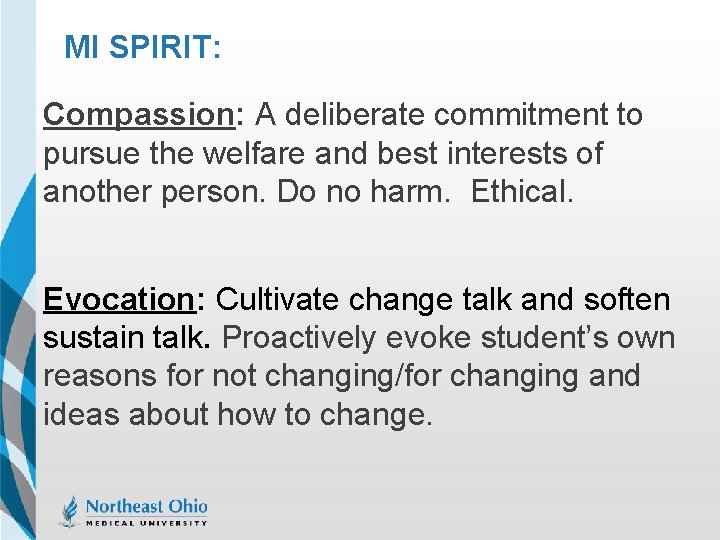
MI SPIRIT: Compassion: A deliberate commitment to pursue the welfare and best interests of another person. Do no harm. Ethical. Evocation: Cultivate change talk and soften sustain talk. Proactively evoke student’s own reasons for not changing/for changing and ideas about how to change.
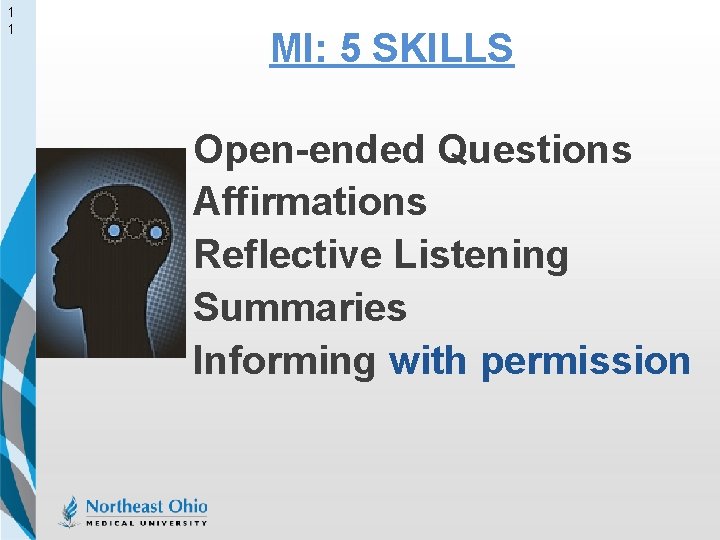
1 1 MI: 5 SKILLS Open-ended Questions Affirmations Reflective Listening Summaries Informing with permission
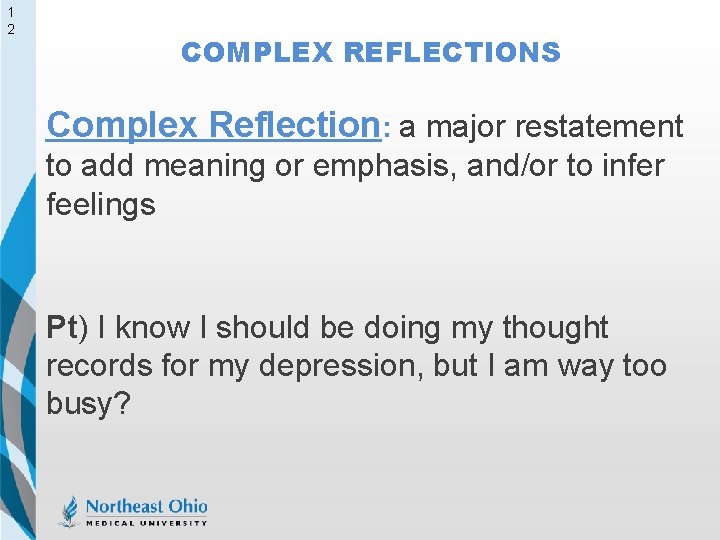
1 2 COMPLEX REFLECTIONS Complex Reflection: a major restatement to add meaning or emphasis, and/or to infer feelings Pt) I know I should be doing my thought records for my depression, but I am way too busy?
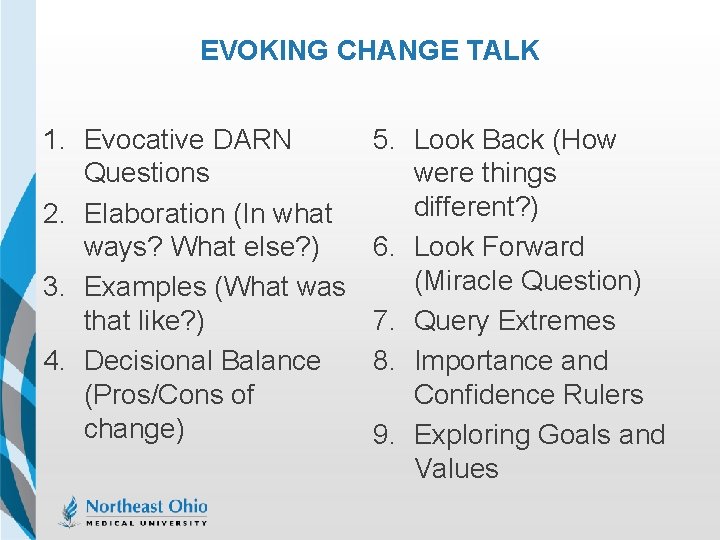
EVOKING CHANGE TALK 1. Evocative DARN Questions 2. Elaboration (In what ways? What else? ) 3. Examples (What was that like? ) 4. Decisional Balance (Pros/Cons of change) 5. Look Back (How were things different? ) 6. Look Forward (Miracle Question) 7. Query Extremes 8. Importance and Confidence Rulers 9. Exploring Goals and Values
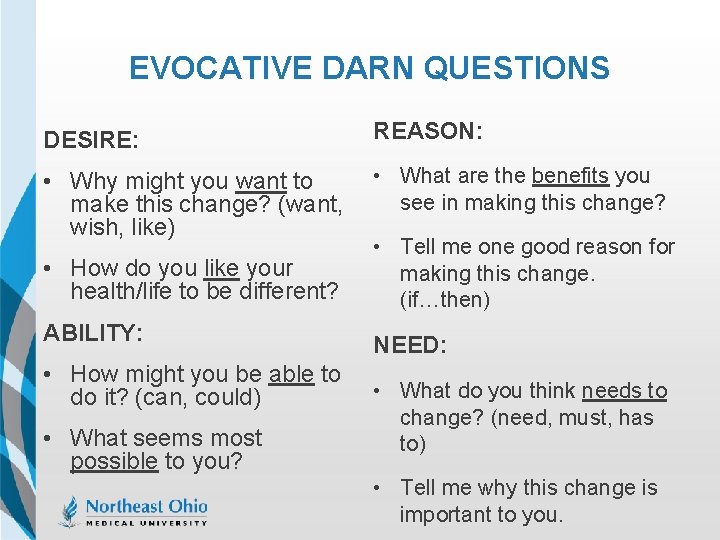
EVOCATIVE DARN QUESTIONS DESIRE: REASON: • Why might you want to make this change? (want, wish, like) • What are the benefits you see in making this change? • How do you like your health/life to be different? ABILITY: • How might you be able to do it? (can, could) • What seems most possible to you? • Tell me one good reason for making this change. (if…then) NEED: • What do you think needs to change? (need, must, has to) • Tell me why this change is important to you.
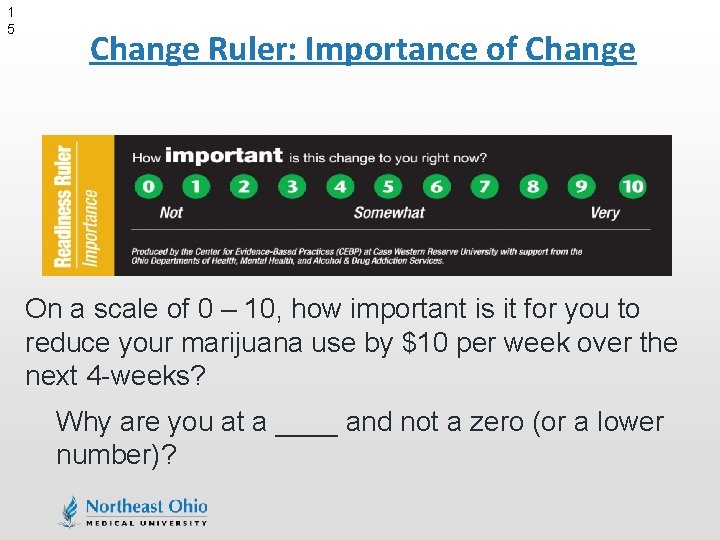
1 5 Change Ruler: Importance of Change On a scale of 0 – 10, how important is it for you to reduce your marijuana use by $10 per week over the next 4 -weeks? Why are you at a ____ and not a zero (or a lower number)?
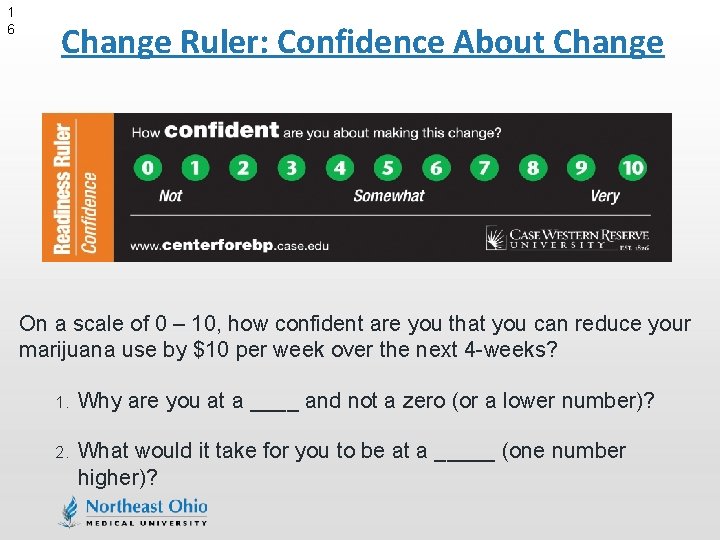
1 6 Change Ruler: Confidence About Change On a scale of 0 – 10, how confident are you that you can reduce your marijuana use by $10 per week over the next 4 -weeks? 1. Why are you at a ____ and not a zero (or a lower number)? 2. What would it take for you to be at a _____ (one number higher)?
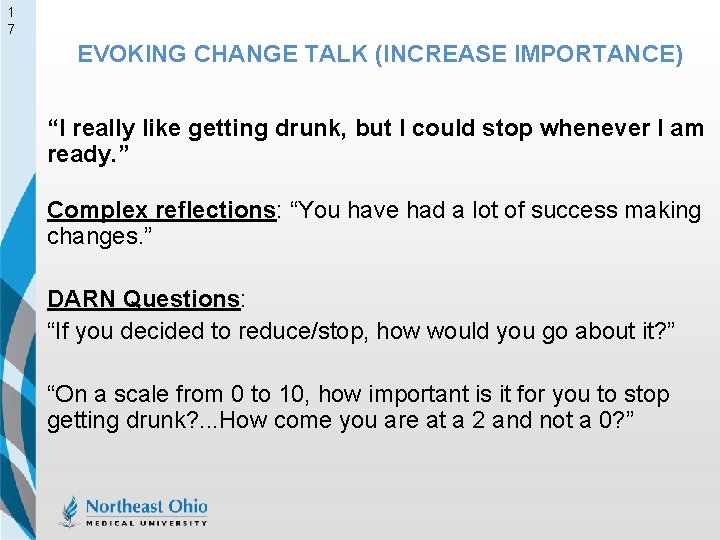
1 7 EVOKING CHANGE TALK (INCREASE IMPORTANCE) “I really like getting drunk, but I could stop whenever I am ready. ” Complex reflections: “You have had a lot of success making changes. ” DARN Questions: “If you decided to reduce/stop, how would you go about it? ” “On a scale from 0 to 10, how important is it for you to stop getting drunk? . . . How come you are at a 2 and not a 0? ”
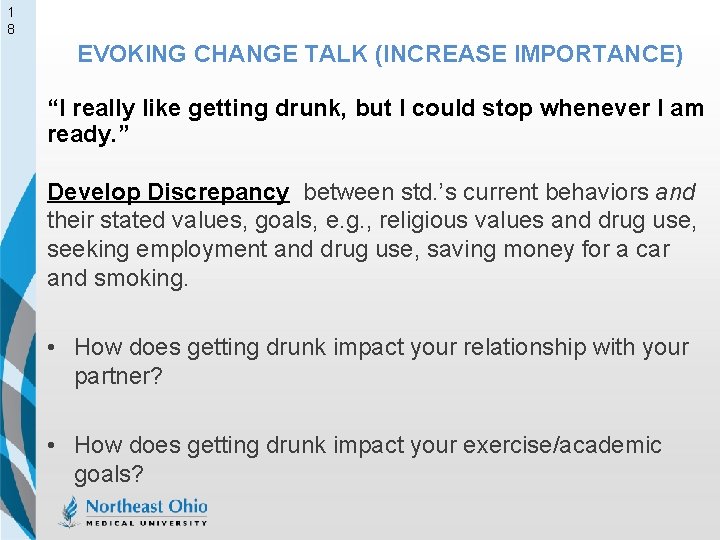
1 8 EVOKING CHANGE TALK (INCREASE IMPORTANCE) “I really like getting drunk, but I could stop whenever I am ready. ” Develop Discrepancy between std. ’s current behaviors and their stated values, goals, e. g. , religious values and drug use, seeking employment and drug use, saving money for a car and smoking. • How does getting drunk impact your relationship with your partner? • How does getting drunk impact your exercise/academic goals?
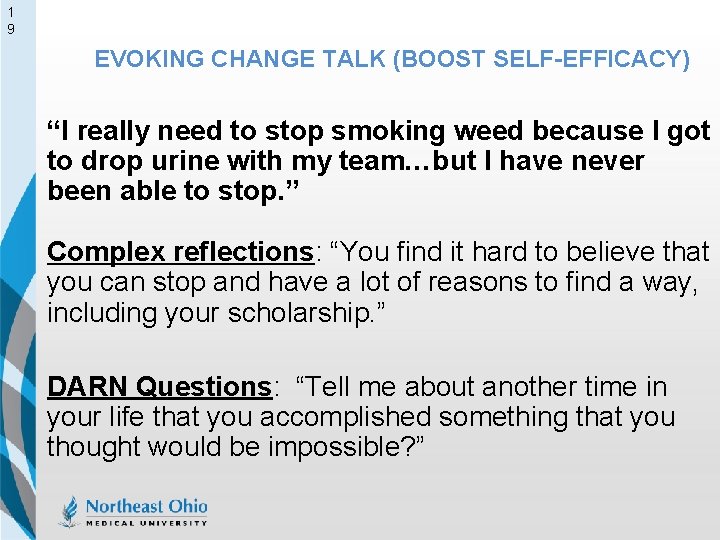
1 9 EVOKING CHANGE TALK (BOOST SELF-EFFICACY) “I really need to stop smoking weed because I got to drop urine with my team…but I have never been able to stop. ” Complex reflections: “You find it hard to believe that you can stop and have a lot of reasons to find a way, including your scholarship. ” DARN Questions: “Tell me about another time in your life that you accomplished something that you thought would be impossible? ”
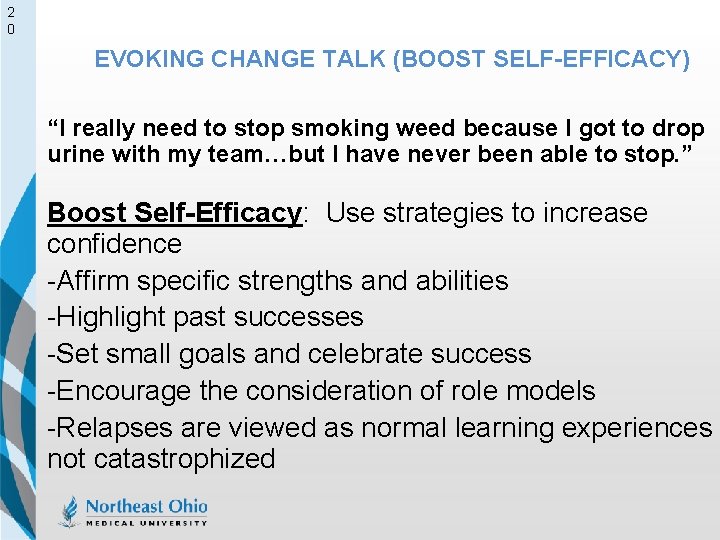
2 0 EVOKING CHANGE TALK (BOOST SELF-EFFICACY) “I really need to stop smoking weed because I got to drop urine with my team…but I have never been able to stop. ” Boost Self-Efficacy: Use strategies to increase confidence -Affirm specific strengths and abilities -Highlight past successes -Set small goals and celebrate success -Encourage the consideration of role models -Relapses are viewed as normal learning experiences not catastrophized
2 1 SOFTENING SUSTAIN TALK: EMPATHY § Amplified reflection: exaggerate client speech § Coming alongside: reflect no change, align w client § Emphasize Personal Choice: overt statement about patient’s right to self determination § Shifting focus: reflect and focus on another thing
2 2 SOFTENING SUSTAIN TALK: EMPATHY “I really like smoking weed, it helps me relax and be more creative…I couldn’t stop if I wanted to because everyone around me smokes. ” Amplified reflection: “You find that smoking really has a lot of benefits and you are not ready to find a way to stop. ” Coming Alongside: “You see little benefit to stopping smoking. ” Emphasize Personal Choice: “You will decide when and how to change, if ever. ” Shifting Focus: “Stopping smoking is not a priority. What else would you like to work on? ”
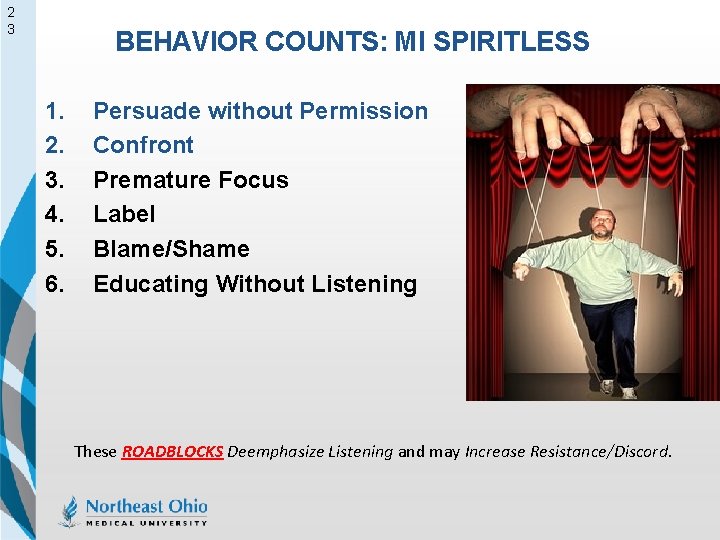
2 3 BEHAVIOR COUNTS: MI SPIRITLESS 1. 2. 3. 4. 5. 6. Persuade without Permission Confront Premature Focus Label Blame/Shame Educating Without Listening These ROADBLOCKS Deemphasize Listening and may Increase Resistance/Discord.
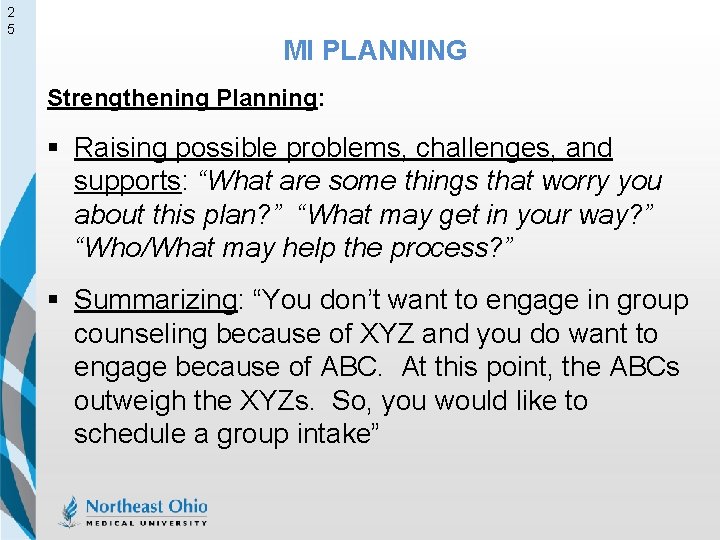
2 4 MI PLANNING Strengthening Planning: § Elaborating: “What reasons do you want to begin seeking tutoring? ” “What makes it important to start using your accommodations? ” § Affirming: “That was a great idea” “You were successful with smoking less in the past with support groups” § Reflecting: “You have many more reasons to access tutoring then to continue solo”
2 5 MI PLANNING Strengthening Planning: § Raising possible problems, challenges, and supports: “What are some things that worry you about this plan? ” “What may get in your way? ” “Who/What may help the process? ” § Summarizing: “You don’t want to engage in group counseling because of XYZ and you do want to engage because of ABC. At this point, the ABCs outweigh the XYZs. So, you would like to schedule a group intake”
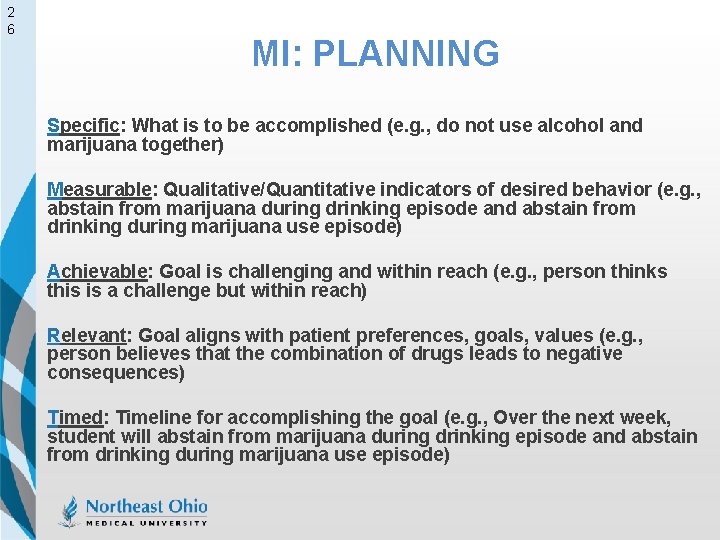
2 6 MI: PLANNING Specific: What is to be accomplished (e. g. , do not use alcohol and marijuana together) Measurable: Qualitative/Quantitative indicators of desired behavior (e. g. , abstain from marijuana during drinking episode and abstain from drinking during marijuana use episode) Achievable: Goal is challenging and within reach (e. g. , person thinks this is a challenge but within reach) Relevant: Goal aligns with patient preferences, goals, values (e. g. , person believes that the combination of drugs leads to negative consequences) Timed: Timeline for accomplishing the goal (e. g. , Over the next week, student will abstain from marijuana during drinking episode and abstain from drinking during marijuana use episode)
2 7 REFERENCES American Psychiatric Association (1968). American Psychiatric Association Diagnostic Manuel of Mental Disorders, 2 nd Ed. Washington DC: APA Carpenter, K. M. , Cheng, W. , Smith, J. L. , Brooks, A. C. , Amrheim, P. , Wain, R. M. , & Nunes, E. V. (2012). “Old Dogs” and new skills: how clinician characteristics relate to motivational interviewing skills before, during, and after training. Journal of Consulting and Clinical Psychology, 80(4), 560 -573. Douaihy, A. , Kelly, T. M. , & Gold, M. A. (Eds. ). (2014). Motivational interviewing: a guide for medical trainees. New York, NY: Oxford Press University. Health and Human Services (2016). Facing Addiction in America: The Surgeon General’s Report on Alcohol, Drugs, and Health. Washington DC. Health and Human Services (2016). Theory of Industrial Society and Cultural Schemata: Does the “Cultural Myth of Stigma” underlie the WHO schizophrenia paradox? Retrieved from: www. ncbi. nlm. nih. gov/pmc/articles/PMC 4667798 Hettema, J. , Steele, J. , & Miller, W. R. (2005). Motivational interviewing. Annual Review of Clinical Psychology , 1, 91 -111. Jackson, Y. (2006). Encyclopedia of Multicultural Psychology. Thousand Oaks, CA: Sage. Lundahl, B. W. , Kunz, C. , Brownell, C. , Tollefson, D. , & Burke, B. L. (2010). A meta-analysis of motivational interviewing: Twenty-five years of empirical studies. Research on Social Work Practice, 20, 137 -160. Martino, S. & Moyers, T. B. (2008). Motivational interviewing with dually diagnosed patients. In H. Arkowitz, H. A. Westra, W. R. Miller, & S. Rollnick (Eds. ), Motivational interviewing in the treatment of psychological problems. New York: The Guilford Press. Miller, W. R. , & Rollnick, S. (2013). Motivational interviewing: helping people change (3 rd ed. ). New York, NY: The Guilford Press. Rollnick, S. , Miller, W. R. , & Butler, C. C. (2008). Motivational interviewing in health care. New York, NY: the Guilford Press. SAMHSA-Trauma and Justice Strategic Initiative (2014). SAMHSA’s concept of trauma and guidance for a trauma-informed approach. Available from: http: //store. samhsa. gov/shin/content/SMA 14 -4884. pdf Great Resource: www. motivationalinterviewing. org
2 8 REFERENCES Dimeff, L. A. , Baer, J. S. , Kivlahan, D. R. , & Marlatt, G. A. (1999). Brief alcohol screening and intervention for college students: A harm reduction approach. New York, NY: The Guilford Press. Gollwitzer, P. M. (1999). Implementation intentions: Simple effects of simple plans. American Psychologist, 54, 493 -503. Hettema, J. , Steele, J. , & Miller, W. R. (2005). Motivational interviewing. Annual Review of Clinical Psychology, 1, 91 -111. Lundahl, B. W. , Kunz, C. , Brownell, C. , Tollefson, D. , & Burke, B. L. (2010). A meta-analysis of motivational interviewing: Twenty-five years of empirical studies. Research on Social Work Practice, 20, 137 -160. Marlatt, G. A. (1998). Harm Reduction: Pragmatic strategies for managing high-risk behaviors. New York, NY: The Guilford Press. Miller, W. R. , & Rollnick, S. (2013). Motivational interviewing: helping people change (3 rd ed. ). New York, NY: The Guilford Press. Prochaska, J. O. , & Diclemente, C. C. (1983). Stages and processes of self-change of smoking: Toward an integrative model of change. Journal of Consulting and Clinical Psychology, 51, 390 -395. Rollnick, S. , Miller, W. R. , & Butler, C. C. (2008). Motivational interviewing in health care. New York, NY: the Guilford Press.