
Motivational Interviewing Strategies to Promote Change Part 4
- Slides: 17
Motivational Interviewing: Strategies to Promote Change Part 4 – Advanced M. I. Skills: Promoting Change Talk PREVENT Curriculum
Objectives • Identify different types of change talk • Describe strategies to promote change talk
Advancing Change Talk
Change Talk • Opposite of sustain talk • The more a person makes arguments for change, the stronger the commitment • MI encourages as much change talk as possible, with opportunities to explore and expand on it
Types of Change Talk Desire Ability Reasons Need Commitment (Amrhein & Miller, 2003)
Types of Change Talk • Desire: I really want to be a good father and I know I should make some changes. • Ability: I really changed my eating habits when I decided I was ready and I think I can do this too. • Reasons: I know I would be able to get better sleep if my baby slept through the night. • Need: I really need to follow through on what I tell my kids. • Commitment: Having a healthy family is important to me and I'm ready to make changes.
Techniques for Eliciting Change Talk • Exploring the problem • Looking backward • Looking forward • Considering importance • Exploring values and discrepancy with behavior • Considering the pros and cons (decisional balance) • Importance/Confidence ruler • Exploring extremes • Planning and committing
Exploring the Problem • Asking open-ended questions, reflecting, providing an opportunity to explore the problem from the person’s perspective. • For example: – Tell me a little more about… – What do you think about…? – Who influenced you…?
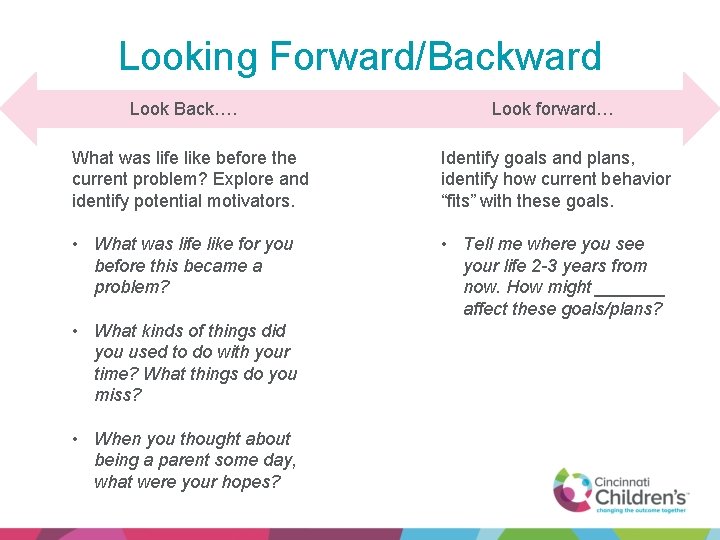
Looking Forward/Backward Look Back…. Look forward… What was life like before the current problem? Explore and identify potential motivators. Identify goals and plans, identify how current behavior “fits” with these goals. • What was life like for you before this became a problem? • Tell me where you see your life 2 -3 years from now. How might _______ affect these goals/plans? • What kinds of things did you used to do with your time? What things do you miss? • When you thought about being a parent some day, what were your hopes?
Considering Importance • Identify reasons that a change is important to the person. – You seem pretty committed to making a change. What motivates you? – I can see that you have been through a lot. Tell me in what ways making a change may help.
Exploring Values & Discrepancy with Current Behavior Conflict with values is often the strongest motivator for change. • Can account for our misunderstanding of a person who isn’t changing, despite the consequences of their behavior. Example questions: – What is the most important to you? – How does ___ affect the things in your life that you value? – When you look at your life, what are most proud of? Least proud of?
Decisional Balance • Weigh the costs and benefits of the behavior in order to identify ambivalence and move in the direction of positive change. – What are the good things about ____ and what are the not so good things? – When you look at the list of pros and cons, what do you think?
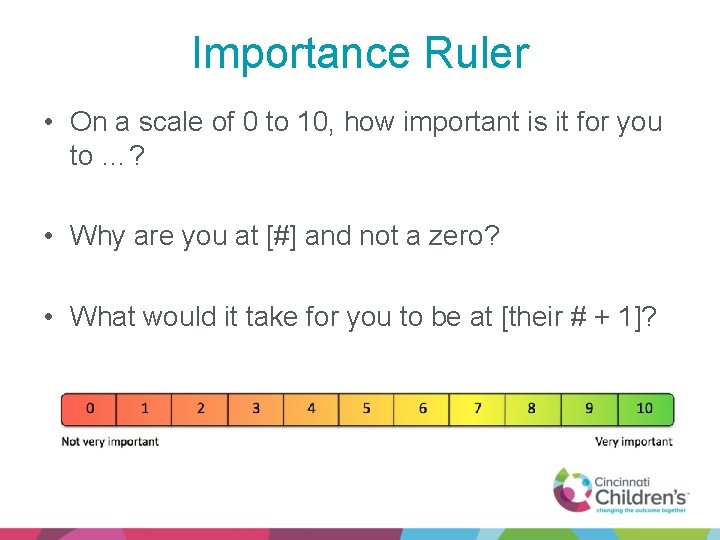
Importance Ruler • On a scale of 0 to 10, how important is it for you to …? • Why are you at [#] and not a zero? • What would it take for you to be at [their # + 1]?
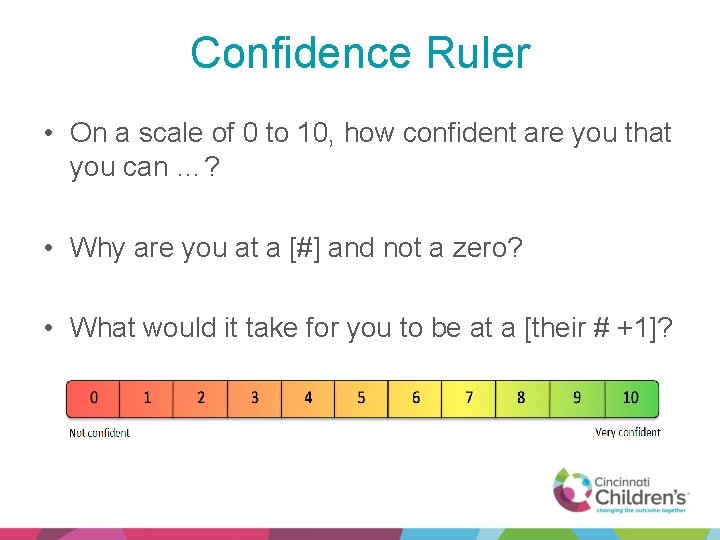
Confidence Ruler • On a scale of 0 to 10, how confident are you that you can …? • Why are you at a [#] and not a zero? • What would it take for you to be at a [their # +1]?
When Readiness is Low… • Consider hypothetical questions: – If you were to ____, what might be some benefits? – How would it you know it was time for you to make that change? – What’s the worst thing that could happen if things stay the same?
Exploring Extremes • What is the worst that could happen if you continue your current behavior pattern? • What is the best thing that could happen if you changed your behavior?
Planning & Committing • Includes talking with a person about how to make a change – If you were to decide to make a change, what steps might you take? – We have talked about a lot of reasons you think a change is important. Tell me how you will know that you are ready.