
MOTIVATIONAL INTERVIEWING SESSION THREE CHANGE PLANS AND REVIEW







- Slides: 31
MOTIVATIONAL INTERVIEWING SESSION THREE: CHANGE PLANS AND REVIEW Jayne Josephsen, Ed. D, RN, CCCTM, CHPN 1
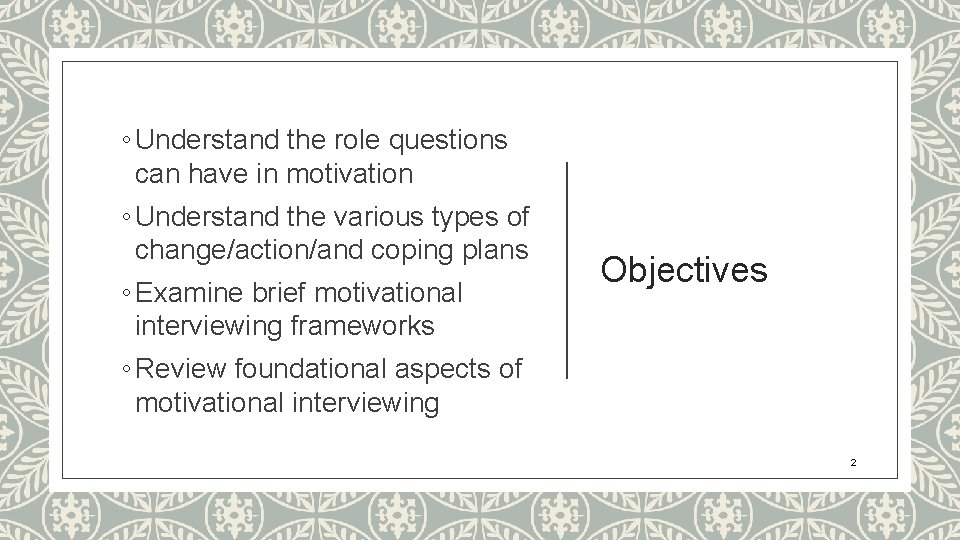
◦ Understand the role questions can have in motivation ◦ Understand the various types of change/action/and coping plans ◦ Examine brief motivational interviewing frameworks ◦ Review foundational aspects of motivational interviewing Objectives 2
HOMEWORK/CASE STUDY REVIEW Questions, Comments, Reflections 3
QUESTIONS TO SUPPORT MOTIVATION 4
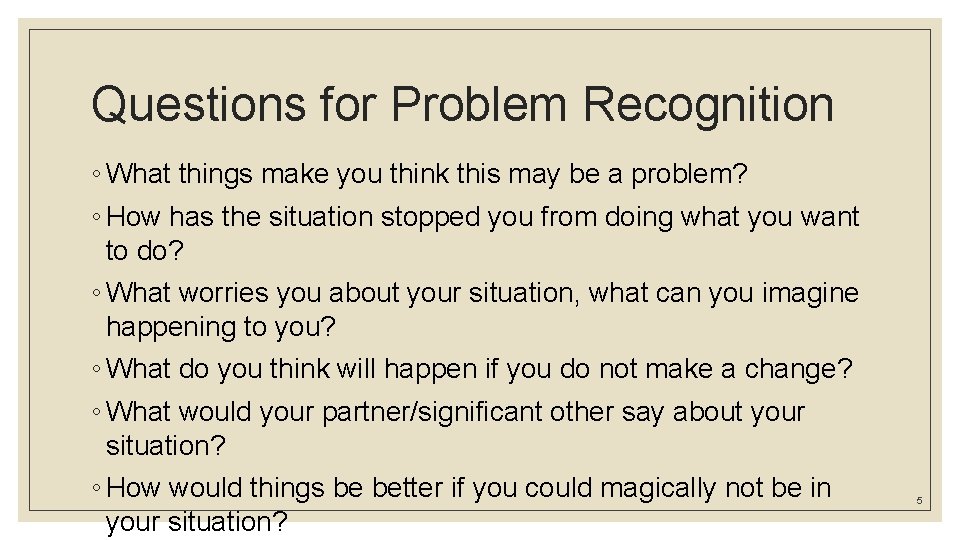
Questions for Problem Recognition ◦ What things make you think this may be a problem? ◦ How has the situation stopped you from doing what you want to do? ◦ What worries you about your situation, what can you imagine happening to you? ◦ What do you think will happen if you do not make a change? ◦ What would your partner/significant other say about your situation? ◦ How would things be better if you could magically not be in your situation? 5
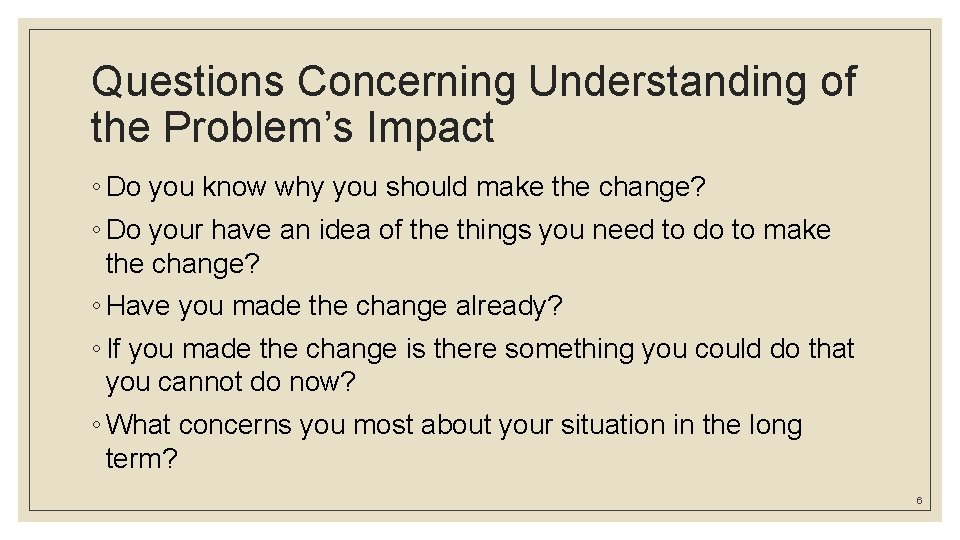
Questions Concerning Understanding of the Problem’s Impact ◦ Do you know why you should make the change? ◦ Do your have an idea of the things you need to do to make the change? ◦ Have you made the change already? ◦ If you made the change is there something you could do that you cannot do now? ◦ What concerns you most about your situation in the long term? 6
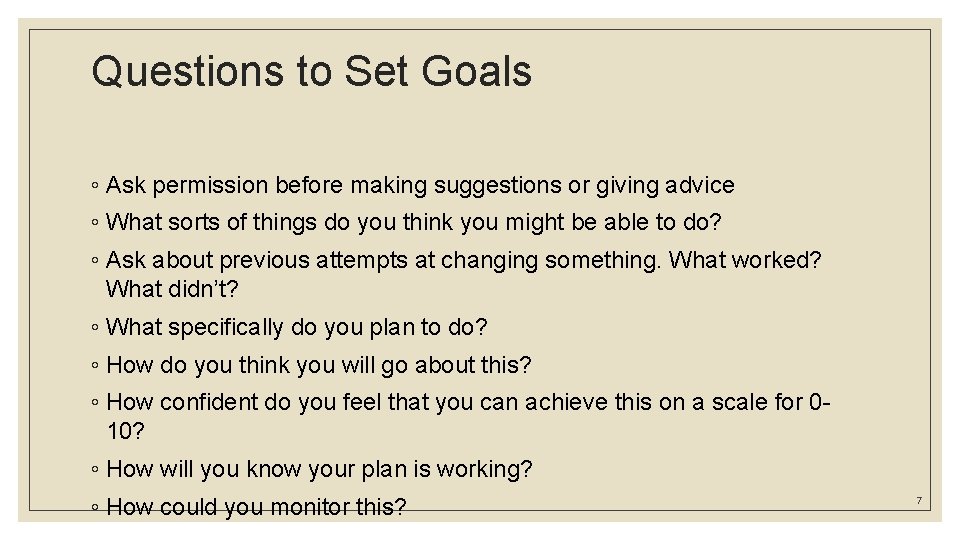
Questions to Set Goals ◦ Ask permission before making suggestions or giving advice ◦ What sorts of things do you think you might be able to do? ◦ Ask about previous attempts at changing something. What worked? What didn’t? ◦ What specifically do you plan to do? ◦ How do you think you will go about this? ◦ How confident do you feel that you can achieve this on a scale for 010? ◦ How will you know your plan is working? ◦ How could you monitor this? 7
Questions for Problem Solving and Planning for Difficulties ◦ Ask questions that give the person the opportunity to think ahead and make contingency plans for identified difficulties ◦ If ______ happens then I will ____ instead ◦ If the person has a lapse discuss what led up to the lapse, how did they feel after the lapse, etc. ◦ If they were confronted with this roadblock again what would they like to do instead ◦ What do they think they will do now? 8
Questions to Build Confidence to Change ◦ What makes you think that if you did decide to make a change you could do it? ◦ What do you think would work for you if you decide to change? ◦ What personal strengths do you have that will help you succeed? ◦ Who could offer you helpful support in making this change? 9
Supportive Behaviors Establish rapport prior to change conversations Provide understanding non-judgmentally and hear the person’s perspective Converse collaboratively to understand what the person already knows and what they understand Offer choice and respect autonomy Collaboratively set goals and create plans Treat the person as the expert on themselves and what changes are realistic Focus on what the person has achieved and highlight Offer support Have follow up sessions Monitor progress 10
CHANGE PLANS Brief Action Plan and Coping Plan 11
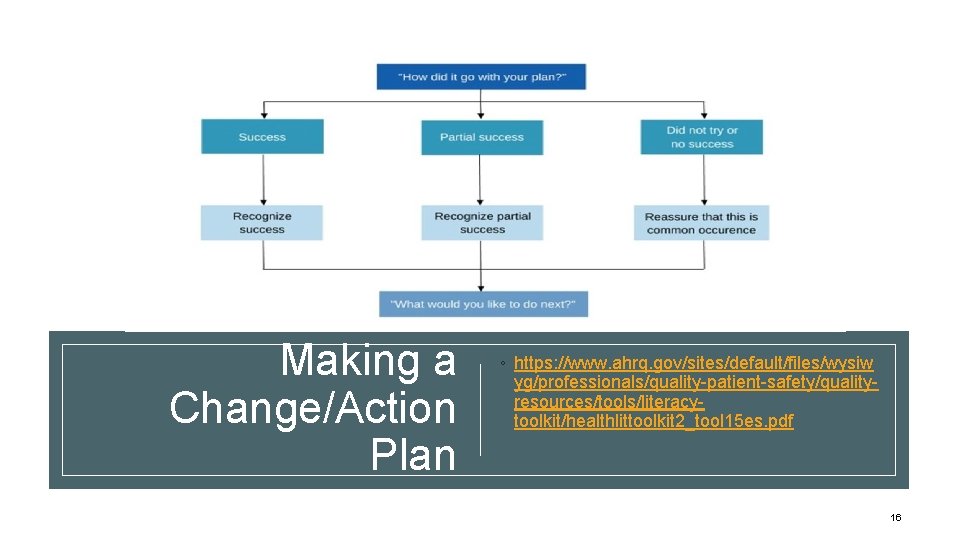
Making a Change/Action Plan ◦ What is the change the person wants to make/consider ◦ What are their main goals ◦ What are some obstacles/barriers to achieving the goal that can be identified ◦ How will the person respond to identified obstacles/barriers ◦ What is the specific action plan and timeline ◦ Are there others that can support them in their change and how ◦ How will they know that their action plan is working ◦ What results/outcomes are they working toward 12
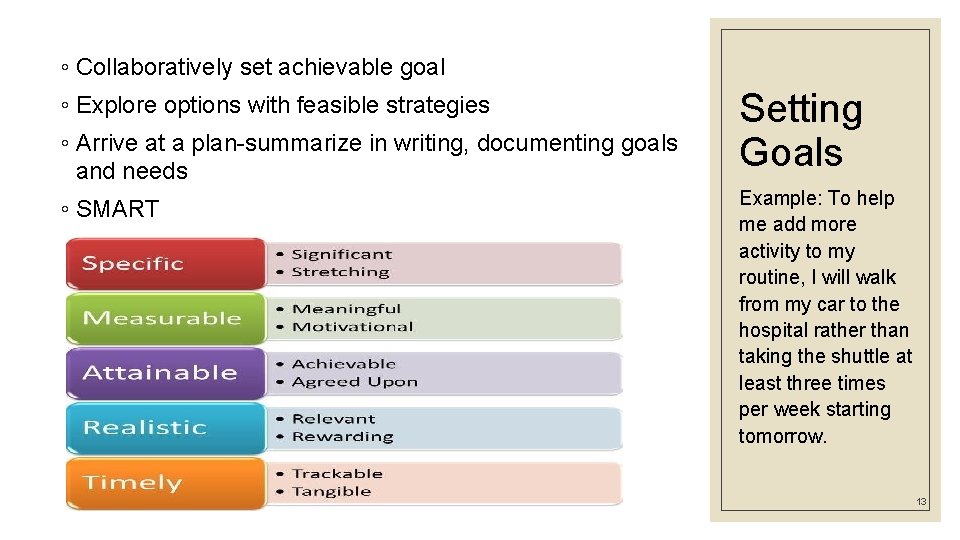
◦ Collaboratively set achievable goal ◦ Explore options with feasible strategies ◦ Arrive at a plan-summarize in writing, documenting goals and needs ◦ SMART Setting Goals Example: To help me add more activity to my routine, I will walk from my car to the hospital rather than taking the shuttle at least three times per week starting tomorrow. 13
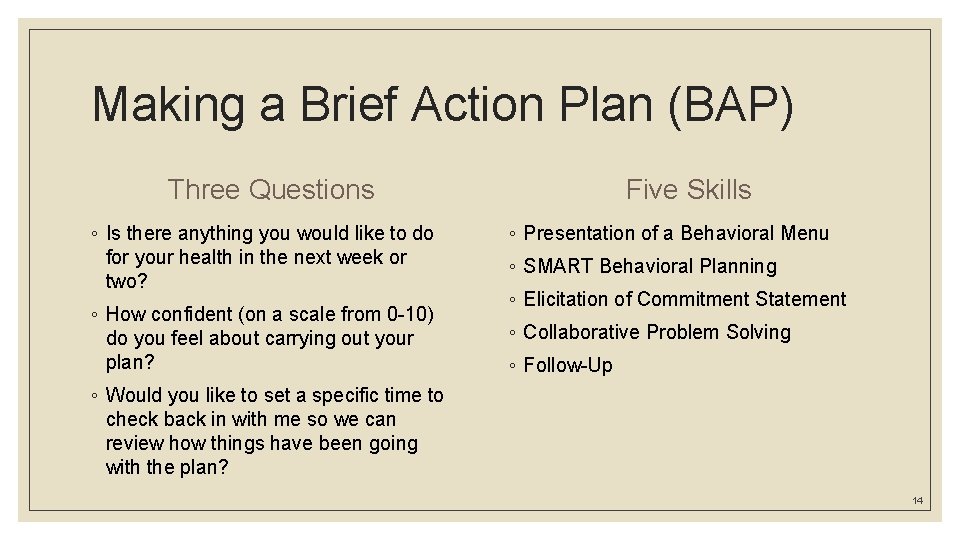
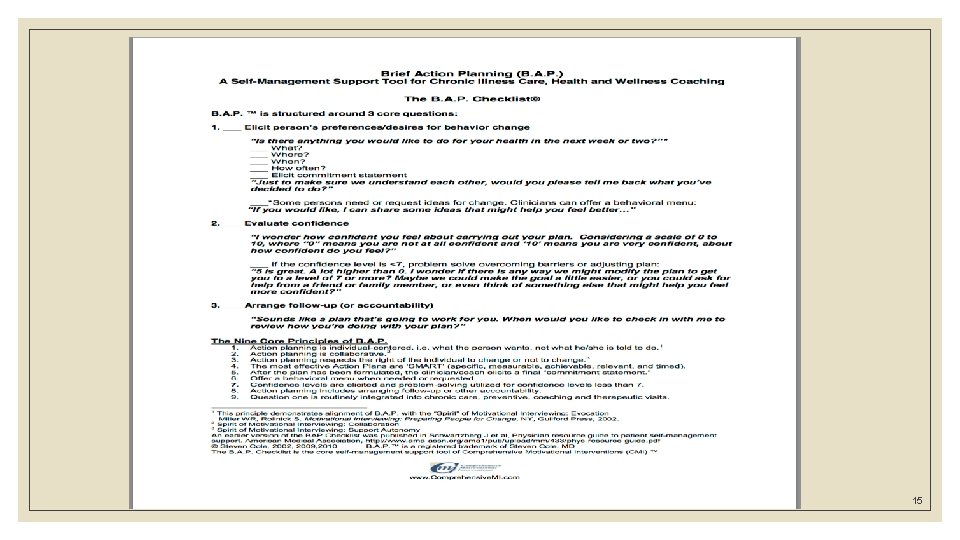
Making a Brief Action Plan (BAP) Three Questions ◦ Is there anything you would like to do for your health in the next week or two? ◦ How confident (on a scale from 0 -10) do you feel about carrying out your plan? Five Skills ◦ Presentation of a Behavioral Menu ◦ SMART Behavioral Planning ◦ Elicitation of Commitment Statement ◦ Collaborative Problem Solving ◦ Follow-Up ◦ Would you like to set a specific time to check back in with me so we can review how things have been going with the plan? 14
15
Making a Change/Action Plan ◦ https: //www. ahrq. gov/sites/default/files/wysiw yg/professionals/quality-patient-safety/qualityresources/tools/literacytoolkit/healthlittoolkit 2_tool 15 es. pdf 16
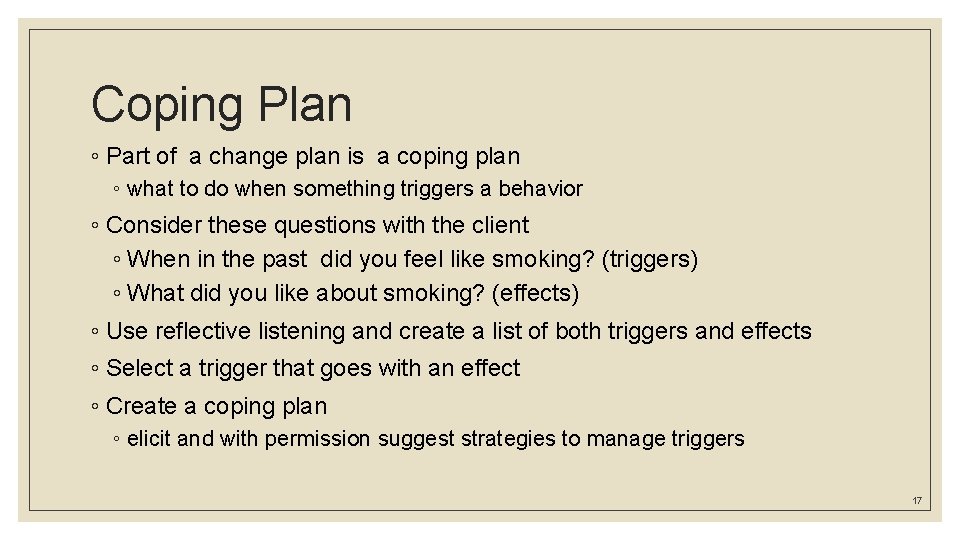
Coping Plan ◦ Part of a change plan is a coping plan ◦ what to do when something triggers a behavior ◦ Consider these questions with the client ◦ When in the past did you feel like smoking? (triggers) ◦ What did you like about smoking? (effects) ◦ Use reflective listening and create a list of both triggers and effects ◦ Select a trigger that goes with an effect ◦ Create a coping plan ◦ elicit and with permission suggest strategies to manage triggers 17
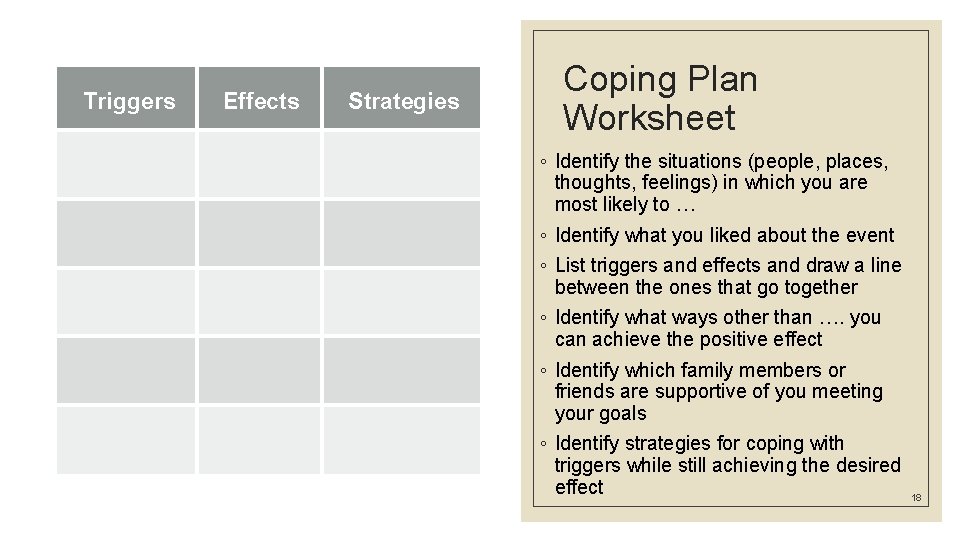
Triggers Effects Strategies Coping Plan Worksheet ◦ Identify the situations (people, places, thoughts, feelings) in which you are most likely to … ◦ Identify what you liked about the event ◦ List triggers and effects and draw a line between the ones that go together ◦ Identify what ways other than …. you can achieve the positive effect ◦ Identify which family members or friends are supportive of you meeting your goals ◦ Identify strategies for coping with triggers while still achieving the desired effect 18
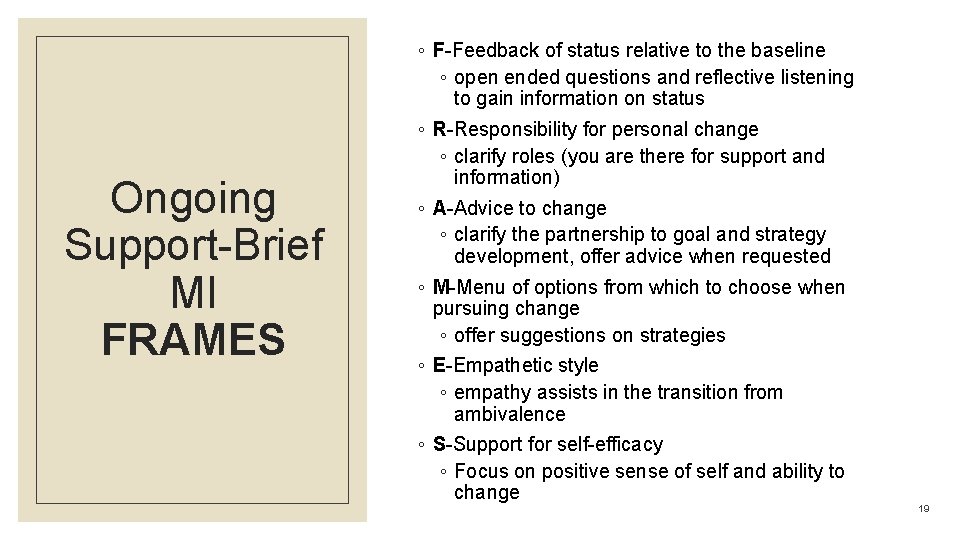
Ongoing Support-Brief MI FRAMES ◦ F-Feedback of status relative to the baseline ◦ open ended questions and reflective listening to gain information on status ◦ R-Responsibility for personal change ◦ clarify roles (you are there for support and information) ◦ A-Advice to change ◦ clarify the partnership to goal and strategy development, offer advice when requested ◦ M-Menu of options from which to choose when pursuing change ◦ offer suggestions on strategies ◦ E-Empathetic style ◦ empathy assists in the transition from ambivalence ◦ S-Support for self-efficacy ◦ Focus on positive sense of self and ability to change 19
CASE STUDY 20
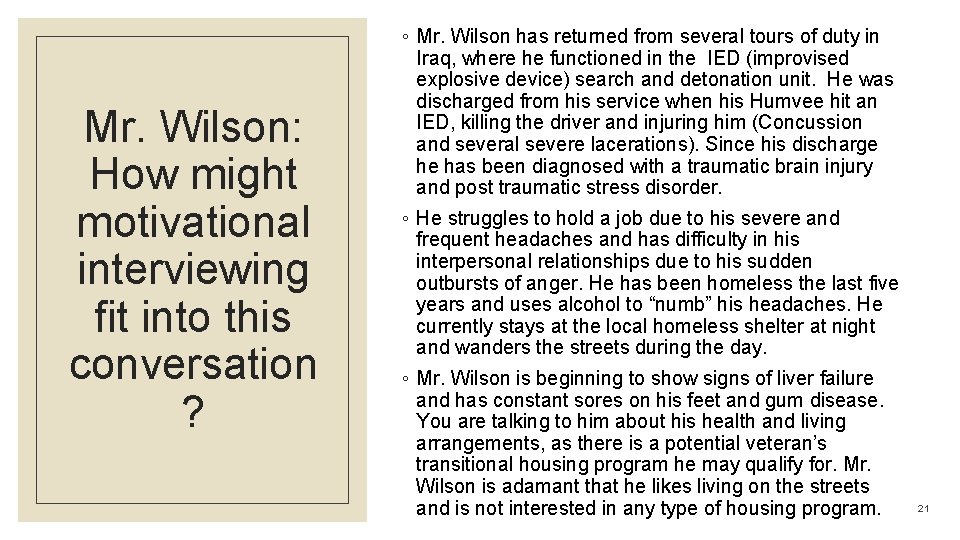
Mr. Wilson: How might motivational interviewing fit into this conversation ? ◦ Mr. Wilson has returned from several tours of duty in Iraq, where he functioned in the IED (improvised explosive device) search and detonation unit. He was discharged from his service when his Humvee hit an IED, killing the driver and injuring him (Concussion and several severe lacerations). Since his discharge he has been diagnosed with a traumatic brain injury and post traumatic stress disorder. ◦ He struggles to hold a job due to his severe and frequent headaches and has difficulty in his interpersonal relationships due to his sudden outbursts of anger. He has been homeless the last five years and uses alcohol to “numb” his headaches. He currently stays at the local homeless shelter at night and wanders the streets during the day. ◦ Mr. Wilson is beginning to show signs of liver failure and has constant sores on his feet and gum disease. You are talking to him about his health and living arrangements, as there is a potential veteran’s transitional housing program he may qualify for. Mr. Wilson is adamant that he likes living on the streets and is not interested in any type of housing program. 21
MOTIVATIONAL INTERVIEWING REVIEW 22
Activity ◦ What sort of things do you think makes it difficult to adhere to motivational interviewing sprit and principles? ◦ What kinds of things do you think you can do to overcome these difficulties? 23
Do’s of Motivational Interviewing ◦ Practice reflective listening ◦ Look for opportunities to empathize ◦ Look for opportunities to validate the person’s perspective ◦ Do look for opportunities to focus on current or past positive efforts ◦ Focus on the incentive for change 24
Don’t’s of Motivational Interviewing ◦ Scold ◦ Lecture ◦ Judge ◦ Accuse ◦ Assume to know what the person should do ◦ Examples: “Why haven’t you begun to exercise regularly? ” 25
RULE ◦ R: Resist the righting reflex ◦ focus on therapeutic relationship ◦ U: Understand the person’s motivations ◦ listen to their sustain and change talk ◦ L: Listen ◦ active listening not just reflection of content ◦ E: Empower ◦ reinforce strengths ◦ elicit what they think they can do to improve their situation 26
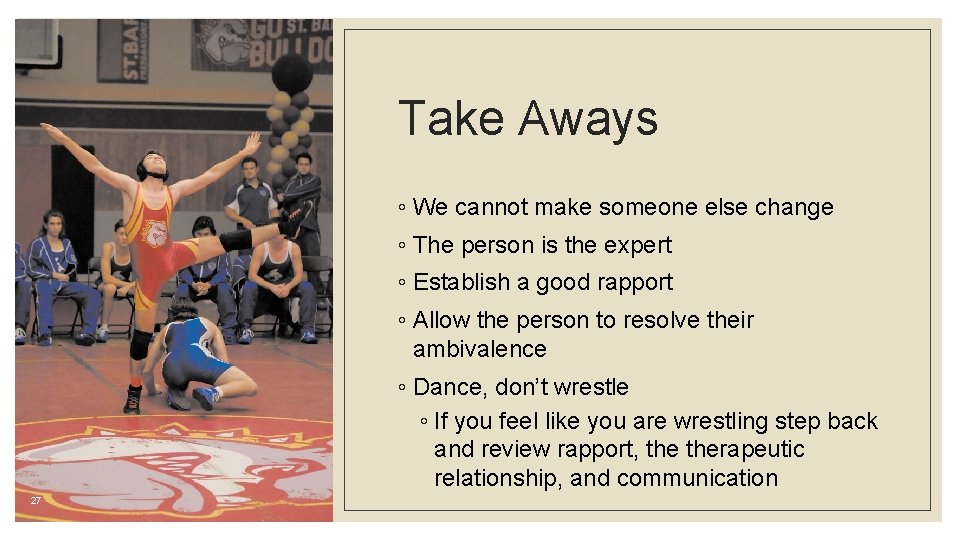
Take Aways ◦ We cannot make someone else change ◦ The person is the expert ◦ Establish a good rapport ◦ Allow the person to resolve their ambivalence ◦ Dance, don’t wrestle ◦ If you feel like you are wrestling step back and review rapport, therapeutic relationship, and communication 27
Post Knowledge Assessment ◦ Behaviors that suggest a person is ready to change are which of the following Asking increasing questions about change Missing appointments or participating in a limited way help The person begins reading a selfbook ◦ Goals of Motivational Interviewing are which of the following ◦ Decrease potential resistance to change ◦ Create a safe environment for conversation about change ◦ Clarify goals ◦ Motivate change by telling a person what needs changed 28
Open versus Closed Questions ◦ Are you happy with your situation? ◦ Isn’t quality of life important to you? ◦ What brings meaning to your life? ◦ What do you like about caring for you mother? ◦ Don’t you care about your own health? ◦ What concerns you most about the current situation? 29
Closing Reflection ◦ During these sessions ◦ I learned… ◦ I remembered. . . ◦ I noticed. . . ◦ I appreciated. . . ◦ In my work I. . . 30
QUESTIONS? Thank you! 31