
Motivational Interviewing in Peer Support Services Brad Schweitzer
Motivational Interviewing in Peer Support Services Brad Schweitzer, BA, CADC, CRS, CIP
Motivational Interviewing in Peer Support Services Training Objectives • Define Motivational Interviewing • Gain insight into the key components of Motivational Interviewing • Gain an understanding of the Stages of Change • Gain an understanding of how to use Motivational Interviewing in Recovery Support Services.
Motivational Interviewing in Peer Support Services What is Motivational Interviewing? “A person-centered goal-oriented approach for facilitating change through exploring and resolving ambivalence. ” Miller, W. R. Motivational Factors in Addiction Behavior. 2006
Motivational Interviewing in Peer Support Services What is Motivational Interviewing? –A Deeper Look • M. I. does not focus on teaching new coping skills, reshaping cognitions, or excavating the past. • It focuses on the person’s present interests and concerns. • Its directive in the sense that it intentionally focuses on resolving ambivalence as it relates to change. • It is a way of communicating that facilitates and motivates an individuals intrinsic motivation for change.

Motivational Interviewing in Peer Support Services Effectiveness of Motivational Interviewing The Research: • Studies show that MI is equivalent to other active treatments for substance use behaviors, and that these effects were often achieved in lower treatment doses, estimated at 2– 3 fewer sessions, hinting at better cost effectiveness of MI (Lundahl & Burke, 2009; Vasilaki et al. , 2006). • Spohr, Taxman, Rodriguez, and Walters (2016), found that individuals on probation seen by clinicians who demonstrated higher empathy and MI spirit, as measured by the Motivational Interviewing Treatment Integrity code (MITI), initiated treatment more than individuals on probation who had less empathic and MI-spirited clinicians.
Motivational Interviewing in Peer Support Services Effectiveness of Motivational Interviewing The Research: • MI has also been widely adopted for use with adolescents and young adults (Naar-King& Suarez, 2010). • MI has shown promise in decreasing youth substance use across a variety of settings (Baer, Garrett, Beadnell, Wells, & Peterson, 2007; Jensen et al. , 2011). • A large number of these studies have involved the use of MI to address risky drinking among college students with good effect (Carey, Scott. Sheldon, Carey, & De. Martini, 2007; Cronce & Larimer, 2011).
Motivational Interviewing in Peer Support Services Effectiveness of Motivational Interviewing The Research - Related to Peer Support Services: Limited Research Available – More Needed • Peer services and MI have been empirically supported separately in their respective bodies of research, and both have been promoted as ways to ensure that services are recovery oriented which has led to combining these practices. • For MI to be effective, providers must exhibit behaviors consistent with the principles of MI. Failure to do so is related to poor outcomes. • At this stage, we do not know whether shaping peer behaviors to fit MI principles would nullify the potential benefits of peer support. , since peers are effective precisely because they do not behave like traditional providers.
Motivational Interviewing in Peer Support Services Effectiveness of Motivational Interviewing The Research - Related to Peer Support Services: Limited Research Available – More Needed • Role confusion has been an ongoing struggle for peers because they have more permeable boundaries with consumers than traditional providers do. Peers disclose personal details to inspire trust, dispel stigma, and instill hope. • If peer-administered MI is to become formalized, peer providers will need to know how and when to use MI, and no guidelines are yet available.
Motivational Interviewing in Peer Support Services Effectiveness of Motivational Interviewing The Research - Related to Peer Support Services: Limited Research Available – More Needed • Because peers rarely receive supervision in MI, organizations should institute regular training sessions specifically modified to ensure that peers continue to use MI techniques appropriately and continue to embody the MI spirit while preserving the essential ingredients of peer support. • Future research should recruit peers and MI practitioners to engage in observational and modeling work to establish a theoretical and empirical basis for peer-administered MI.
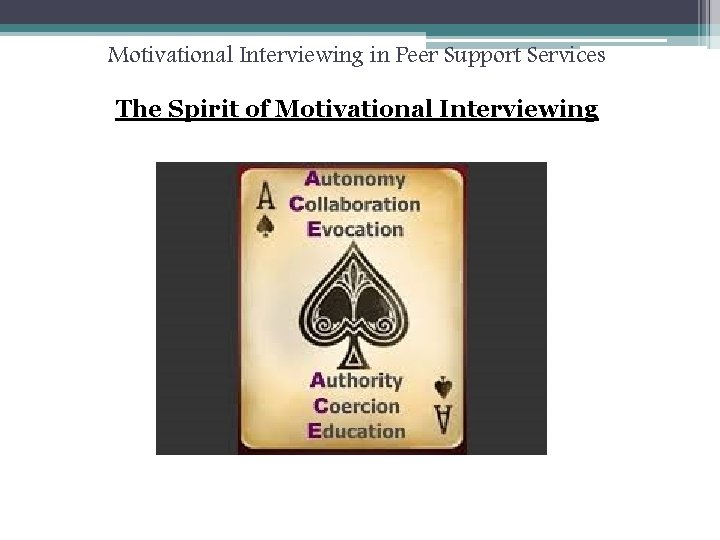
Motivational Interviewing in Peer Support Services The Spirit of Motivational Interviewing
Motivational Interviewing in Peer Support Services The Spirit of Motivational Interviewing Autonomy: • Responsibility for change is left with the individual. • The individual is always free to make his/her own choices. • The goals is always to increase the intrinsic motivation for change, rather than change that comes from being imposed upon.
Motivational Interviewing in Peer Support Services The Spirit of Motivational Interviewing Collaboration: • Avoid authoritarian stances. • Build upon a partnership-like relationship. • Honoring the individuals expertise and perspectives. • Create an atmosphere that is conducive rather than coercive to change.
Motivational Interviewing in Peer Support Services The Spirit of Motivational Interviewing Evocation: • Is not instilling knowledge or insight into the individual on the importance of changing. • It is drawing out the individual's own thoughts and ideas as motivation and commitment to change • Lasting change is more likely to come from the individual when he/she discovers their own reasons and determination to change.
Motivational Interviewing in Peer Support Services What the Spirit of Motivational Interviewing is Not! Authority: • The recovery specialist instructs the individuals to make changes. • Examples: • What particular recovery pathway to chose. • What job to chose. • Who should be a part of the support group. • Where to go to school. • Where to live.
Motivational Interviewing in Peer Support Services What the Spirit of Motivational Interviewing is Not! Confrontation: • the recovery specialist assumes the individual has an impaired perspective. • The recovery specialist consequently imposes the need for ‘insight’. • The recovery specialist tries to persuade and coerce an individual to change.
Motivational Interviewing in Peer Support Services What the Spirit of Motivational Interviewing is Not! Education: • The individual is presumed to lack the insight of the knowledge or skills required to change. • The recovery specialist tells the individual what to do.
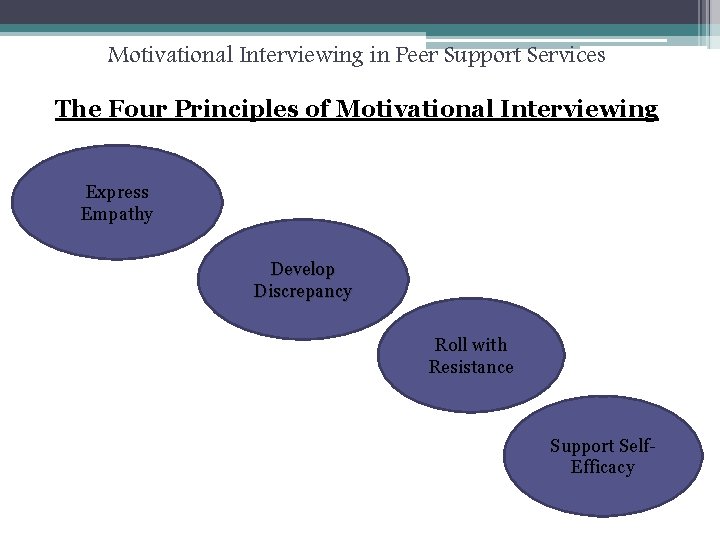
Motivational Interviewing in Peer Support Services The Four Principles of Motivational Interviewing Express Empathy Develop Discrepancy Roll with Resistance Support Self. Efficacy
Motivational Interviewing in Peer Support Services The Four Principles of Motivational Interviewing Express Empathy • Involves the use of reflective listening skills and accurate empathy, where the recovery specialist seeks to understand the individual’s perspective, thoughts and feelings without judging, criticizing or blaming. • Building empathy and understanding does not mean condoning the problematic behavior. • Instead, the recovery specialist seeks to create an open and respectful exchange with the individual, who they approach with genuine curiosity about their experiences, feelings and values.
Motivational Interviewing in Peer Support Services The Four Principles of Motivational Interviewing Express Empathy Examples: • I appreciate how difficult this is. • Yes, making change is hard work: VERY hard work! • That must have been hard on you. • I have an understanding with where you’re at with this. • If I were experiencing what you are, I can imagine that I would feel similarly.
Motivational Interviewing in Peer Support Services The Four Principles of Motivational Interviewing Develop Discrepancy • Involves assisting individuals in identifying discrepancies between their current behavior and future goals or values about themselves as a person, partner, parent, or worker is a powerful motivator that helps ‘tip the balance’ toward change. • Exploring the pros and cons of change can help an individual develop discrepancy. • These ‘decisional balance’ exercises are used effectively in MI to help individuals tease apart their ambivalence and help the individual express their concerns about the behavior
Motivational Interviewing in Peer Support Services The Four Principles of Motivational Interviewing Develop Discrepancy Examples: • “How do you think your life would be different if you were not ____? ” • “How do you imagine your life to be like if you don’t make changes and continue to ____? ” • “How does your _____ (risky behavior) fit in with your goals? ” • “On one hand, you say that your _____ are important to you, yet you continue to _____. ” “Help me to understand…”
Motivational Interviewing in Peer Support Services The Four Principles of Motivational Interviewing Roll with Resistance • Often when a recovery specialist attempts to move an individual toward change too quickly , they adopt a coercive or authoritative style, which is commonly met with resistance. • Resistance takes many forms: the individual interrupts or argues with the recovery specialist, makes excuses for their behavior, minimizes the effects of their behavior, blames other people for their behavior, etc. • In MI, rolling with this resistance involves approaching resistance without judgement and interpreting these responses as a sign that the individual holds a different perspective. • MI then uses strategies such as simple reflection of the resistance, emphasizing the individual’s choice to change or not.
Motivational Interviewing in Peer Support Services The Four Principles of Motivational Interviewing Roll with Resistance Examples: • “It’s ok if you don’t want to stop; it’s your choice. ” • “Perhaps this new plan is just too much to adopt all at once. ” • “Maybe you aren’t ready to stop. ” • “What do you want to do”? “How do you want to proceed? ” • “Where do you want to go from here? ”
Motivational Interviewing in Peer Support Services The Four Principles of Motivational Interviewing Support Self Efficacy • Individuals may have experience with not being able to make lasting changes. • By highlighting the individual’s strengths and reflecting on times in their life when they have successfully changed, even if just in one small area, self efficacy can be promoted. • The recovery specialist’s belief in an individual’s ability to change is a powerful way to promote self efficacy. • By promoting self efficacy, the recovery specialist can help the individual develop the confidence that they are capable of change.

Motivational Interviewing in Peer Support Services The Four Principles of Motivational Interviewing Support Self Efficacy Examples: • “It seems as though you have put a lot of thought into these goals. ” • “You have a good plan of action. ” • “You indicate that you are still struggling with making these changes, and yet you have had some success at making these things happen. ” • “It sounds like you have made real progress; how does that make you feel? ”
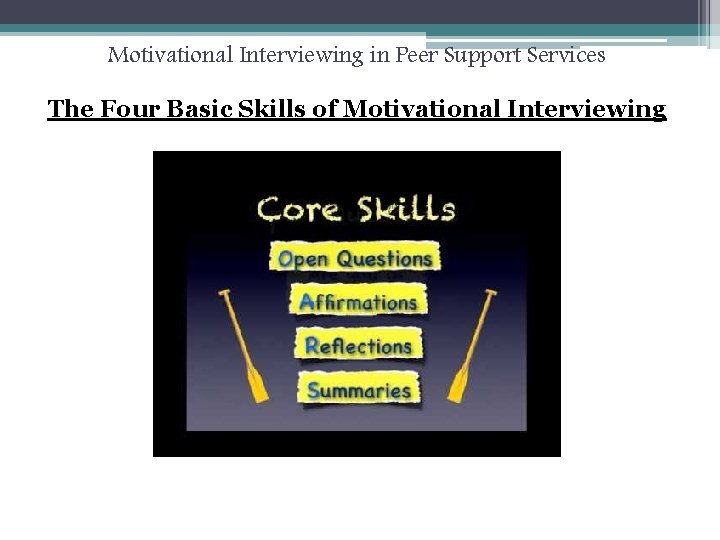
Motivational Interviewing in Peer Support Services The Four Basic Skills of Motivational Interviewing
Motivational Interviewing in Peer Support Services The Four Basic Skills of Motivational Interviewing Open-Ended Questions • Elicits descriptive information. • Requires more of a response than a simple yes or no. • Encourages the individual to do most of the talking. • Helps us avoid premature judgments. • Keeps communication moving forward.
Motivational Interviewing in Peer Support Services The Four Basic Skills of Motivational Interviewing Affirmations • Must be done sincerely. • Supports and promote self-efficacy. • Acknowledges the difficulties the individual has experienced. • Validates the individual’s experience and feelings. • Emphasizes past experiences that demonstrate strength and success to prevent discouragement.
Motivational Interviewing in Peer Support Services The Four Basic Skills of Motivational Interviewing Reflective Listening • A way of checking rather than assuming that you know what is meant. • Shows that you have an interest in and respect for what the individual has to say. • Demonstrates that you have accurately heard and understood the individual. • Encourages further exploration of problems and feelings.
Motivational Interviewing in Peer Support Services The Four Basic Skills of Motivational Interviewing Summarize • Reinforces what has been said. • Shows that you have been listening carefully. • Prepares the individual for transition. • Allows you to be strategic in what to include to reinforce talk that is in the direction of change. • Can highlight feelings of ambivalence and uncover discrepancies.
Motivational Interviewing in Peer Support Services The Philosophy of Motivational Interviewing R - Reject the righting reflex. U - Understand the person’s motivation. L - Listen to the person. E - Empower the person.
Motivational Interviewing in Peer Support Services The Philosophy of Motivational Interviewing R - Reject the righting reflex: The righting reflex describes the tendency of the recovery specialist to advise individuals about the right path for good health. This can often have a paradoxical effect in practice, inadvertently reinforcing the argument to maintain the current behavior. Essentially, most people resist persuasion when they are ambivalent about change and will respond by recalling their reasons for maintaining the behavior. Motivational interviewing in practice requires the recover specialist to suppress the initial righting reflex so that they can explore the individual's motivations for change.
Motivational Interviewing in Peer Support Services The Philosophy of Motivational Interviewing U - Understand the person’s motivation: It is the individual's own reasons for change, rather than the recovery specialist, that will ultimately result in behavior change. By approaching a individual's interests, concerns, and values with curiosity and openly exploring the patient's motivations for change, the recovery specialist will begin to get a better understanding of the individual's motivations and potential barriers to change.
Motivational Interviewing in Peer Support Services The Philosophy of Motivational Interviewing L - Listen to the person: Effective listening skills are essential to understand what will motivate the individual, as well as the pros and cons of their situation. A general ruleof-thumb in MI is that equal amounts of time in a session should be spent listening and talking.
Motivational Interviewing in Peer Support Services The Philosophy of Motivational Interviewing E - Empower the person: Individual outcomes improve when an individual is an active collaborator. Empowering an individual involves exploring their own ideas about how they can make changes to improve their health and drawing on their personal knowledge about how they have succeeded in the past. A truly collaborative recovery specialist and Peer relationship is a powerful motivator. Individuals benefit from this relationship the most when the recovery specialist also embodies hope that change is possible.
Motivational Interviewing in Peer Support Services Change Talk Self-motivational statements that indicate the person is oriented toward making positive change. • We listen for these comments. • Ask questions to elicit them. • Highlight them for the person.
Motivational Interviewing in Peer Support Services Listening for Change Talk • Desire to change - “I wish things were different. ” • Ability to change - “I know what I got to do, I just got to do it. ” • Reasons to change - “My family might be closer to me if __. ” • Need to change - “I’ve got to make things better. ” • Commitment to change – “I will stop _______ tomorrow!”
Motivational Interviewing in Peer Support Services Strategies for Evoking Change Talk 1. Ask Evocative Questions – Use Open-Ended Questions Examples: • • Why would you want to make this change? (Desire) How might you go about it, in order to succeed? (Ability) What are three best reasons for you to do it? (Reasons) How important is it for you to make this change? (Need) • So what do you think you’ll do? (Commitment)
Motivational Interviewing in Peer Support Services Strategies for Evoking Change Talk 2. Explore Decisional Balance by asking first for the good things about changing/not changing: • What would be some of the benefits of changing _____? • What could be the costs of changing______? • What would be the benefits of not changing ____? • What could be the costs of not changing _____?
Motivational Interviewing in Peer Support Services Strategies for Evoking Change Talk 3. Ask for Elaboration When a change talk theme emerges, ask for more detail: • In what ways? • How do you see this happening? • What have you changed in the past that you can relate to this issue?
Motivational Interviewing in Peer Support Services Strategies for Evoking Change Talk 4. Ask for Examples When a change talk theme emerges, ask for specific examples. • When was the last time that happened? • Describe a specific example of when this happens. • What else?
Motivational Interviewing in Peer Support Services Strategies for Evoking Change Talk 5. Looking Back Ask about a time before the current concern emerged: • How have things been better in the past? • What past events can you recall when things were different?
Motivational Interviewing in Peer Support Services Strategies for Evoking Change Talk 6. Look Forward Ask about how the future is viewed: • What may happen if things continue as they are? • If you were 100% successful in making the changes you want, what would be different? • How would you like your life to be in the future?
Motivational Interviewing in Peer Support Services Strategies for Evoking Change Talk 7. Query Extremes Ask about the best and worst case scenarios to elicit more information: • What are the worst things that might happen if you don't make this change? • What are the best things that might happen if you do make this change?
Motivational Interviewing in Peer Support Services Strategies for Evoking Change Talk 8. Use Change Rulers Ask open questions about where the client sees themselves on a scale from 1 – 10. • On a scale where one is not at all important, and ten is extremely important, how important (need) is it to you to change _______? • Follow up: Explain why are you at a ___ and not (lower number)? • What might happen that could move you from ____ to a _____[higher number]?
Motivational Interviewing in Peer Support Services Strategies for Evoking Change Talk 9. Explore Goals and Values Ask what the person's guiding values are. • What do they want in life? • What values are most important to you? • How does this behavior fit into your value system? • What ways does ____ (the behavior) conflict with your value system?
Motivational Interviewing in Peer Support Services Strategies for Evoking Change Talk 10. Come Alongside Explicitly side with the negative (status quo) side of ambivalence. • Perhaps ______ is so important to you that you won't give it up, no matter what the cost. • It may not be the main area that you need to focus on in our work together.
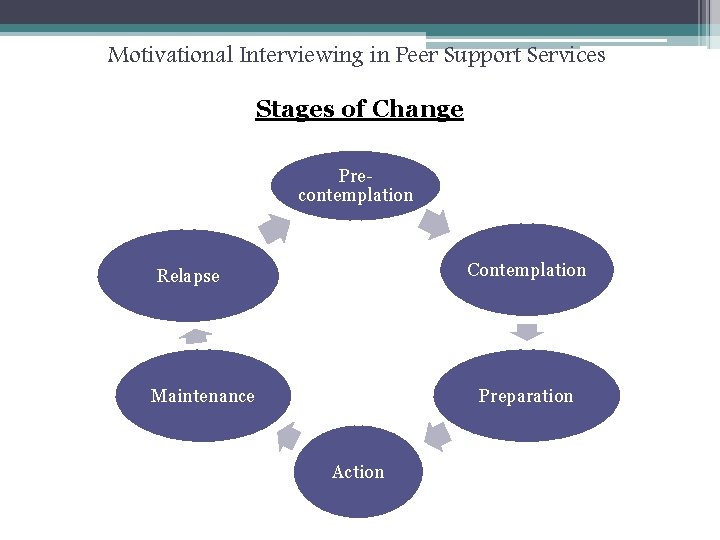
Motivational Interviewing in Peer Support Services Stages of Change Precontemplation Contemplation Relapse Maintenance Preparation Action
Motivational Interviewing in Peer Support Services Pre-contemplation • Individuals in the precontemplation stage of change are not even thinking about changing their behavior. • They may not see it as a problem, or they think that others who point out the problem are exaggerating. • Individuals in this stage present for help because of pressure from others.
Motivational Interviewing in Peer Support Services Pre-contemplation Recovery Specialists tasks: • Raise doubt – increase the persons understanding of the risks and problems with current behavior. • Increase awareness about possibilities. • Create a conversation within: • Exploring consequences. • Exploring desirable options/alternatives.
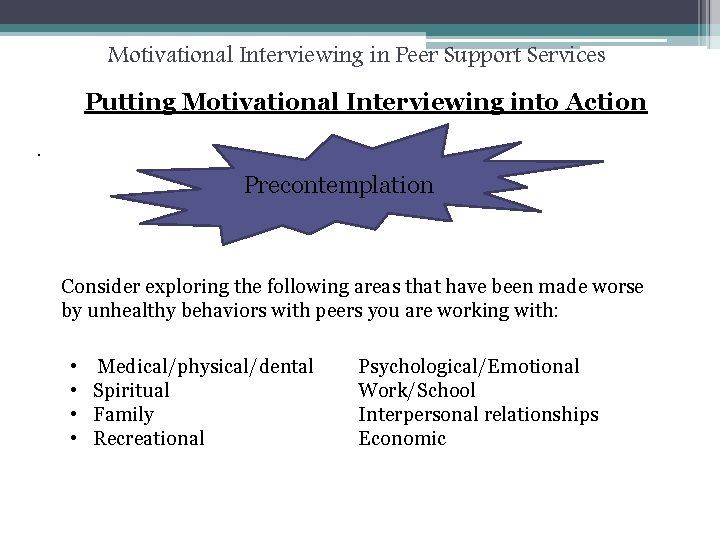
Motivational Interviewing in Peer Support Services Putting Motivational Interviewing into Action. Precontemplation Consider exploring the following areas that have been made worse by unhealthy behaviors with peers you are working with: • • Medical/physical/dental Spiritual Family Recreational Psychological/Emotional Work/School Interpersonal relationships Economic
Motivational Interviewing in Peer Support Services Contemplation • In this stage individuals are aware a problem exists and are seriously thinking about overcoming it, but have not yet made a commitment to take action. • Individuals can remain stuck in the contemplation stage for long periods. • Individuals in this stage struggle with their positive evaluations of their problematic behavior and the amount of effort, energy, and loss it will cost to overcome it.
Motivational Interviewing in Peer Support Services Contemplation Recovery Specialists tasks: • Explore reasons to change and the risks of not changing. • Reinforce any decisions/steps for positive change from persons past. • Explore rather than prescribe – don’t give solutions.
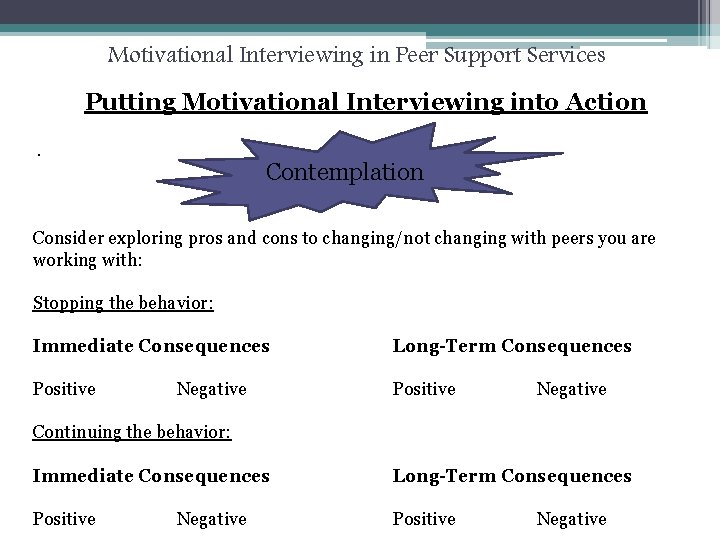
Motivational Interviewing in Peer Support Services Putting Motivational Interviewing into Action. Contemplation Consider exploring pros and cons to changing/not changing with peers you are working with: Stopping the behavior: Immediate Consequences Long-Term Consequences Positive Negative Continuing the behavior: Immediate Consequences Long-Term Consequences Positive Negative
Motivational Interviewing in Peer Support Services Preparation • This stage combines intention and behavioral criteria. • Individuals in this stage are intending to take action in the next month and have unsuccessfully taken action in the past year. • Individuals in this stage may have experience with attempts at behavioral change, such as reducing the problematic behavior, but have not maintained this behavioral change. • They are intending, however, to take such action in the very near future.
Motivational Interviewing in Peer Support Services Preparation Recovery Specialists tasks: • Respond positively to statements of intention. • Tip the balance from ambivalence toward taking action. • Prepare plan. • Help individual plan out goal setting that accounts for preferences and environment.

Motivational Interviewing in Peer Support Services Putting Motivational Interviewing into Action. Preparation Consider exploring goal planning with peers you are working with in the following domains: • • Medical/physical/dental Spiritual Family Recreational Goal: Psychological/Emotional Work/School Interpersonal relationships Economic Action Steps to Reach Goal:
Motivational Interviewing in Peer Support Services Action • This is the stage in which individuals modify their behavior, experiences, and/or environment in order to overcome their problems. • Action involves the most overt behavioral changes and requires considerable commitment of time and energy. • Behavioral changes in the action stage tend to be most visible and externally recognized. • Individuals are classified in the action stage if they have successfully altered the problematic behavior for a period from one day to six months
Motivational Interviewing in Peer Support Services Action Recovery Specialists tasks: • Support the person in taking steps in implementing the plan

Motivational Interviewing in Peer Support Services Putting Motivational Interviewing into Action Consider exploring life balance with peers you are working to support them in modifying behavioral change: Examples: Physical: Are you getting enough rest? Do you follow a reasonable diet? Do you get regular medical/dental/vision check ups? Mental/Emotional: Are you able to express your emotions to others? Do you have strategies to reduce your stress? Personal Relationships: Do you have friends you can rely on for support? Are there any relationships that are causing you significant stress?
Motivational Interviewing in Peer Support Services Maintenance • In this stage people work to prevent relapse and consolidate the gains attained during action. • The maintenance stage extends from six months to an indeterminate period past the initial action. • For some behaviors, maintenance can be considered to last a lifetime.
Motivational Interviewing in Peer Support Services Maintenance Recovery Specialists tasks: • Help the person to identify and use strategies to prevent relapse. • Help develop knowledge and skills to support progress. • Biological-Psychological-Social Triggers. • Expectations that helped motivate the person to take action.
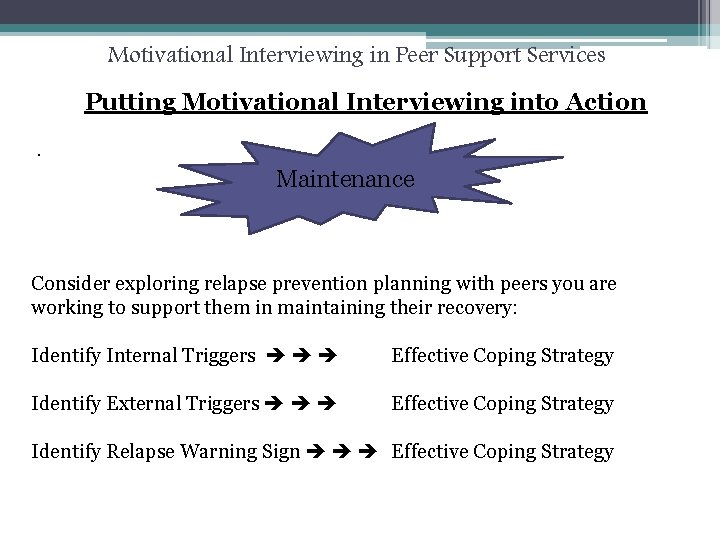
Motivational Interviewing in Peer Support Services Putting Motivational Interviewing into Action. Maintenance Consider exploring relapse prevention planning with peers you are working to support them in maintaining their recovery: Identify Internal Triggers Effective Coping Strategy Identify External Triggers Effective Coping Strategy Identify Relapse Warning Sign Effective Coping Strategy
Motivational Interviewing in Peer Support Services Relapse • Long standing change often involves setbacks. • Person may step back into previous patterns • Goals: return to process of change as soon as possible
Motivational Interviewing in Peer Support Services Relapse Recovery Specialist’s tasks: • Help the person to renew the process of contemplation, preparation (decision making), and action. • Help person recognize relapse is a normal part of achieving goals. • Focus on learning and positive reinforcement rather than punishment.
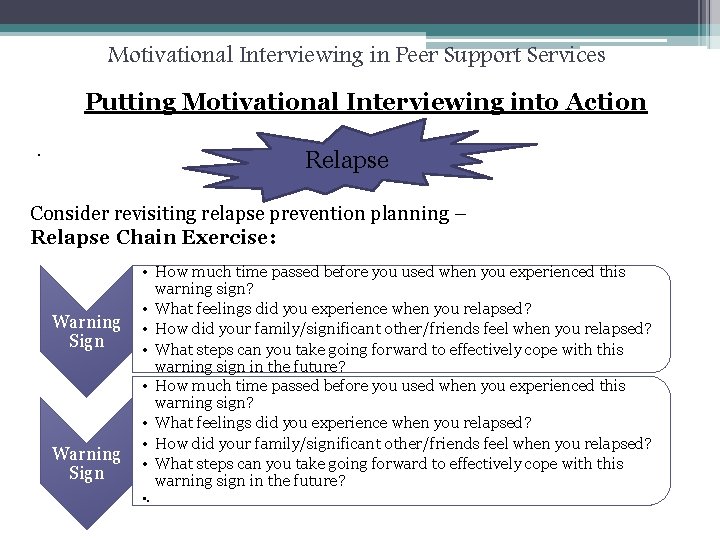
Motivational Interviewing in Peer Support Services Putting Motivational Interviewing into Action. Relapse Consider revisiting relapse prevention planning – Relapse Chain Exercise: • How much time passed before you used when you experienced this warning sign? • What feelings did you experience when you relapsed? Warning • How did your family/significant other/friends feel when you relapsed? Sign • What steps can you take going forward to effectively cope with this warning sign in the future? • How much time passed before you used when you experienced this warning sign? • What feelings did you experience when you relapsed? • How did your family/significant other/friends feel when you relapsed? Warning • What steps can you take going forward to effectively cope with this Sign warning sign in the future? • .
Motivational Interviewing in Peer Support Services Review of Training Objectives • Defined Motivational Interviewing • Gained insight into the key components of Motivational Interviewing • Gained an understanding of the Stages of Change • Gained an understanding of how to use Motivational Interviewing in Peer Support Services.
Motivational Interviewing in Peer Support Services References Daley, D. C. , and Marlatt, G. A. (2006). Overcoming Your Alcohol or Drug Problem: Workbook: Effective recovery strategies (2 ed. ). Oxford University Press. Hall, K. , Gibbie, T. , and Lubman D. (2012). Motivational interviewing Techniques: Facilitating behaviour change in the general practice setting. Retrieved from http: //www. racgp. org. au/afp/2012/september/motivationalinterviewing-techniques/ Madson, M. B. , Schumacher, J. A. , Baer, J. S. , and Martino, S. (2016). Motivational Interviewing for Substance Use: Mapping Out the Next Generation of Research. Journal of substance abuse treatment. DOI: 10. 1016/j. jsat. 2016. 02. 003
Motivational Interviewing in Peer Support Services References Miller, R. W. and Rollnik, S. (2012). Motivational Interviewing: Preparing people for change. (2 nd ed. ), New York, NY: The Guilford Press. Oh, H. (2015). Peer-Administered Motivational Interviewing: Conceptualizing a New Practice. Psychiatric Services, 66(5), p. 558 Winarski, J. (n. d. ). Motivational interviewing for peer specialists. Mental Health America.
- Slides: 69