
Motivational Interviewing for Weight Loss Exercise Frank J
- Slides: 32
Motivational Interviewing for Weight Loss & Exercise Frank J. Domino, M. D. Professor Frank. domino@umassmemorial. org
By the end of this session, the learner will: • Understand the basic components of Motivational Interviewing • Learn how to apply Motivational Interviewing to weight loss and exercise • Review the current literature on what is effective in helping patients lose weight
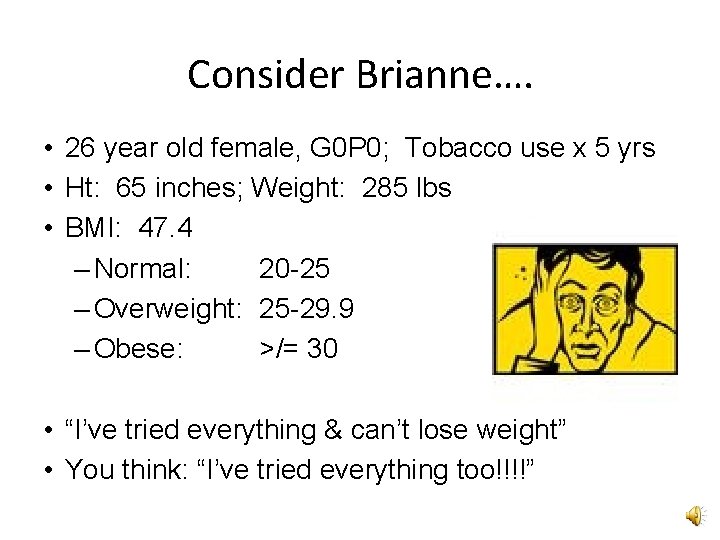
Consider Brianne…. • 26 year old female, G 0 P 0; Tobacco use x 5 yrs • Ht: 65 inches; Weight: 285 lbs • BMI: 47. 4 – Normal: 20 -25 – Overweight: 25 -29. 9 – Obese: >/= 30 • “I’ve tried everything & can’t lose weight” • You think: “I’ve tried everything too!!!!”
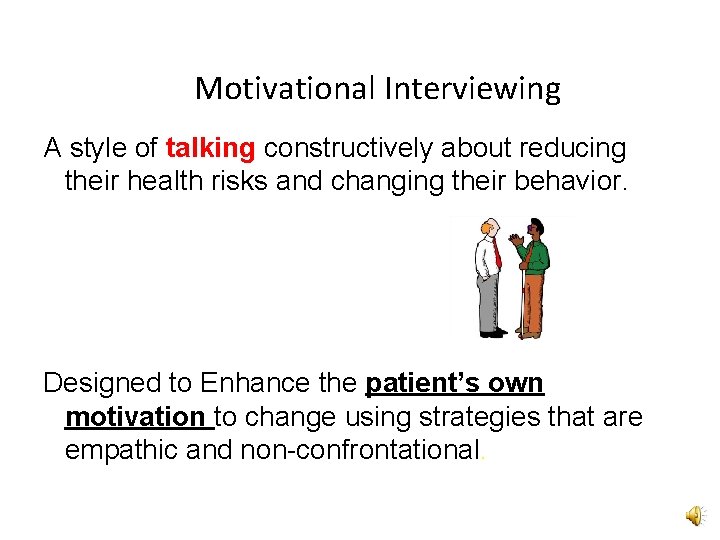
Motivational Interviewing A style of talking constructively about reducing their health risks and changing their behavior. Designed to Enhance the patient’s own motivation to change using strategies that are empathic and non-confrontational.
Behavioral Problems Addressed by MI • Lifestyle • Chemical dependency • Non-adherence to treatment • Miscellaneous risky or unsafe behaviors
Reasons for MI’s Popularity ü Carefully defined and rigorously studied psychosocial substance abuse treatments. ü Is a relatively brief intervention. ü Positively impacts treatment and retention. ü Has wide application to behavioral domains ü Compatible with many different approaches.
Efficacy of MI in Obesity & Exercise § Improved weight control program behavioral adherence, glucose control and weight loss outcomes among Type 2 diabetic patients. Smith et al. Diabetes Care; 1997; 20: 52 -4; Harland et al. , Brit Med J. 1999; 319: 828 -31. § Increased physical activity and exercise energy expenditure among cardiac rehabilitation patients Scales R, Miller JH. Current Sports Medicine Reports. 2003; 2: 166 -72. Bowen
Efficacy of MI in Habits § Increased fruit & vegetable consumption Bowen et al. 2002; Resnicow et al. Am J Pub Health. 2001; 91: 1686 -93; Resnicow et al. Health Psych. 2005; 24: 339 -48; § Motivational interviewing was 5 times as effective as brief advice for achieving sustained smoking cessation. Soria, R. ; A randomised controlled trial of motivational interviewing for smoking cessation, Br. J. Gen. Pract. , 2006, 531, 768 -774 • Helped patients change behaviors related to hypertension. Woollard J et al. Clin Exp Pharm Phys. 1995; 23: 466 -8.
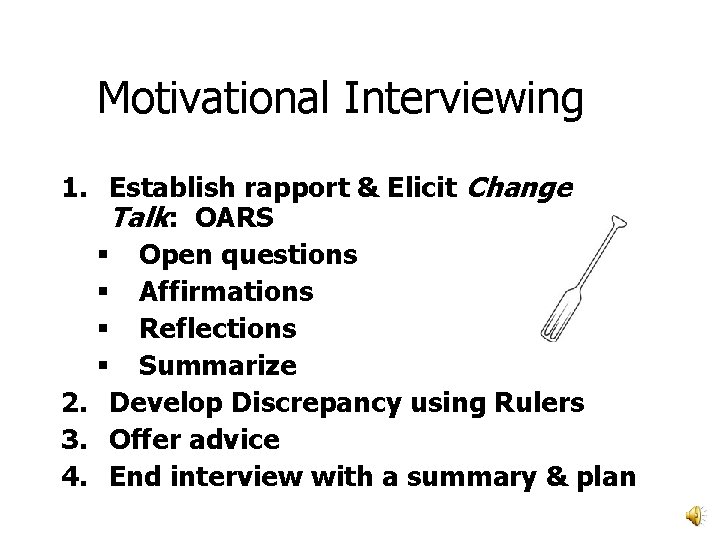
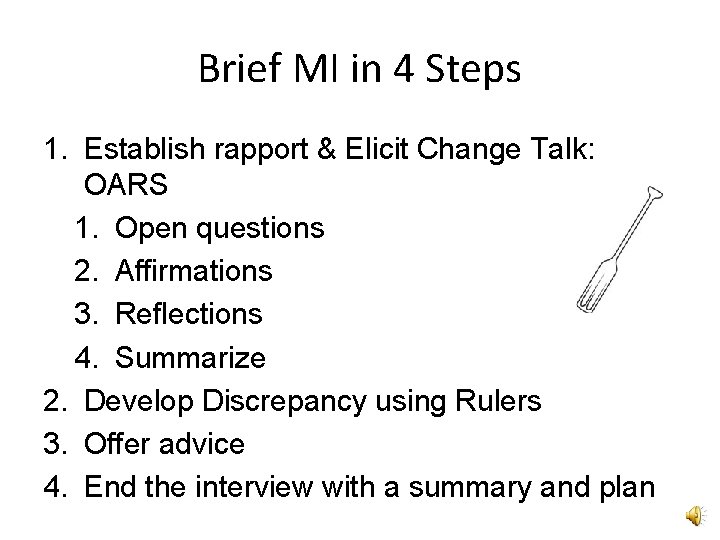
Motivational Interviewing 1. Establish rapport & Elicit Change Talk: OARS § Open questions § Affirmations § Reflections § Summarize 2. Develop Discrepancy using Rulers 3. Offer advice 4. End interview with a summary & plan
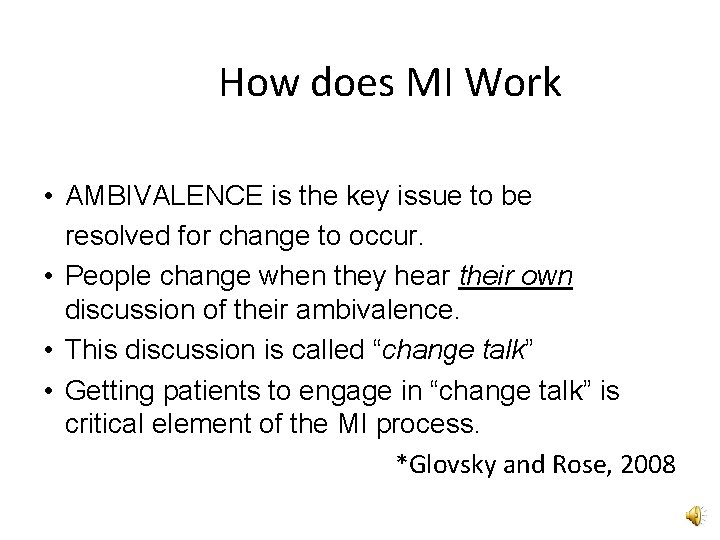
How does MI Work • AMBIVALENCE is the key issue to be resolved for change to occur. • People change when they hear their own discussion of their ambivalence. • This discussion is called “change talk” • Getting patients to engage in “change talk” is critical element of the MI process. *Glovsky and Rose, 2008
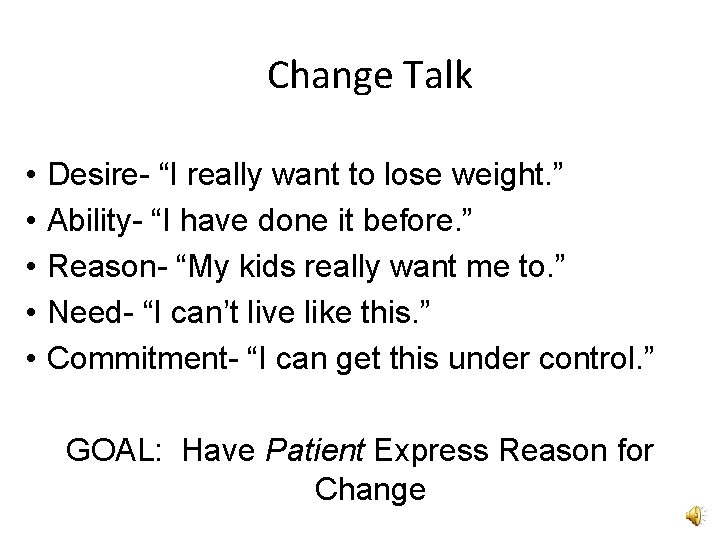
Change Talk • • • Desire- “I really want to lose weight. ” Ability- “I have done it before. ” Reason- “My kids really want me to. ” Need- “I can’t live like this. ” Commitment- “I can get this under control. ” GOAL: Have Patient Express Reason for Change
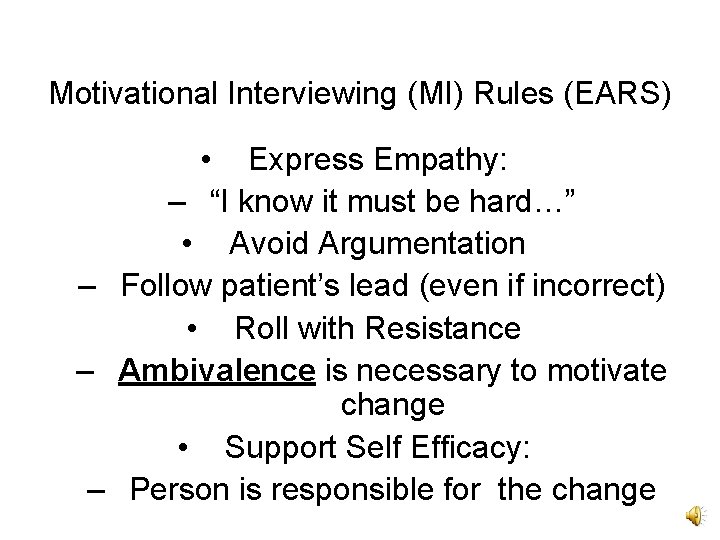
Motivational Interviewing (MI) Rules (EARS) • Express Empathy: – “I know it must be hard…” • Avoid Argumentation – Follow patient’s lead (even if incorrect) • Roll with Resistance – Ambivalence is necessary to motivate change • Support Self Efficacy: – Person is responsible for the change
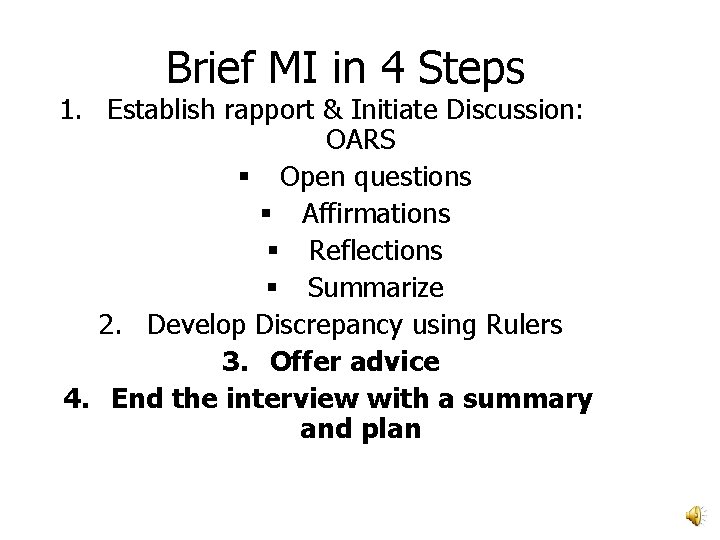
Brief MI in 4 Steps 1. Establish rapport & Elicit Change Talk: OARS 1. Open questions 2. Affirmations 3. Reflections 4. Summarize 2. Develop Discrepancy using Rulers 3. Offer advice 4. End the interview with a summary and plan
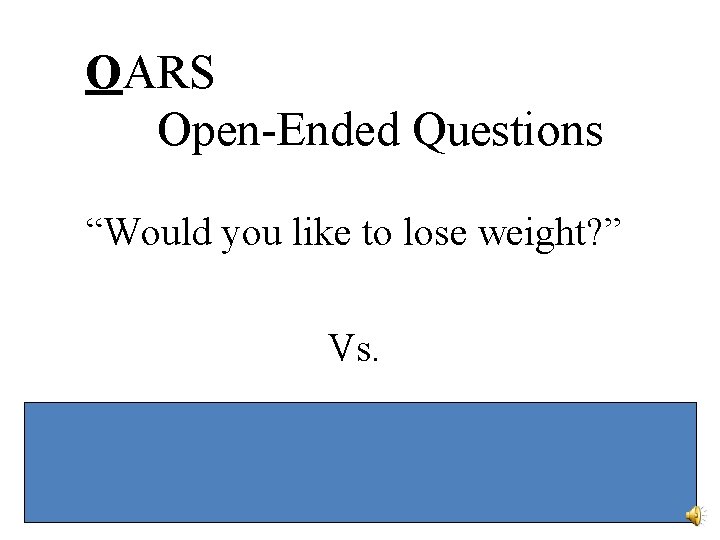
OARS Open-Ended Questions “Would you like to lose weight? ” Vs. How do you feel about your weight?
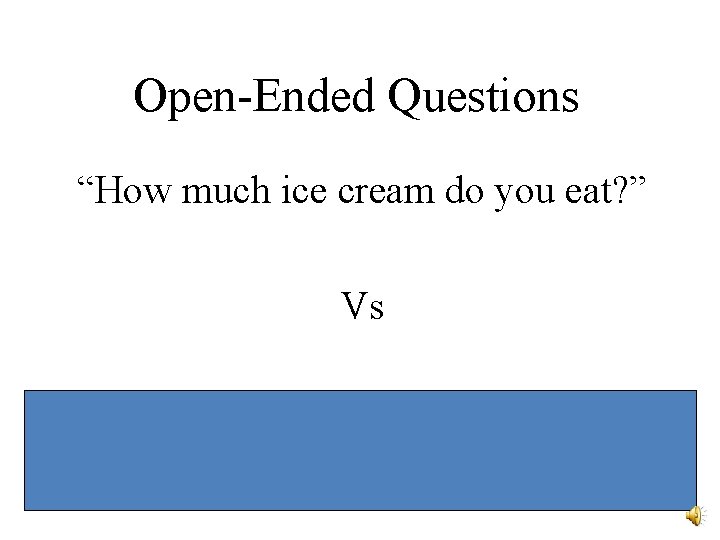
Open-Ended Questions “How much ice cream do you eat? ” Vs “Please tell me more about what you eat for dessert? ”
OARS Affirmations • Support the patient • Convey respect & understanding • Help patients reveal less positive aspects of themselves
Affirmations (continued) • “Dealing with weight issues is difficult” • “You have worked so hard. ” • “I can understand why eating feels good to you. ”
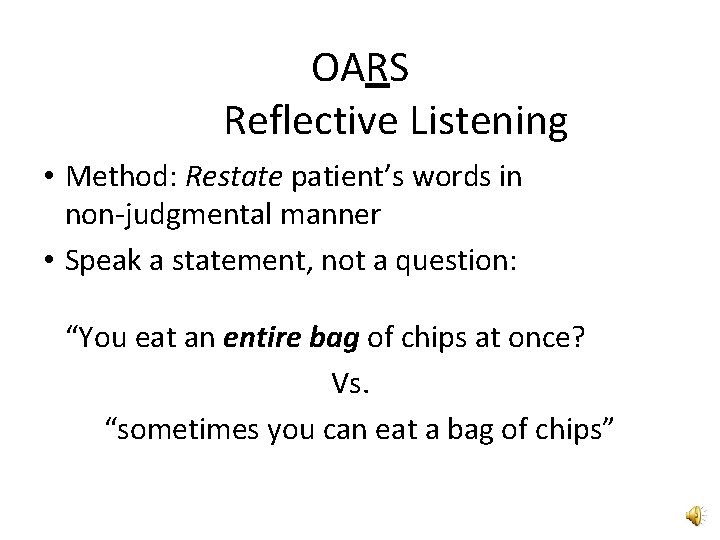
OARS Reflective Listening • Method: Restate patient’s words in non-judgmental manner • Speak a statement, not a question: “You eat an entire bag of chips at once? Vs. “sometimes you can eat a bag of chips”
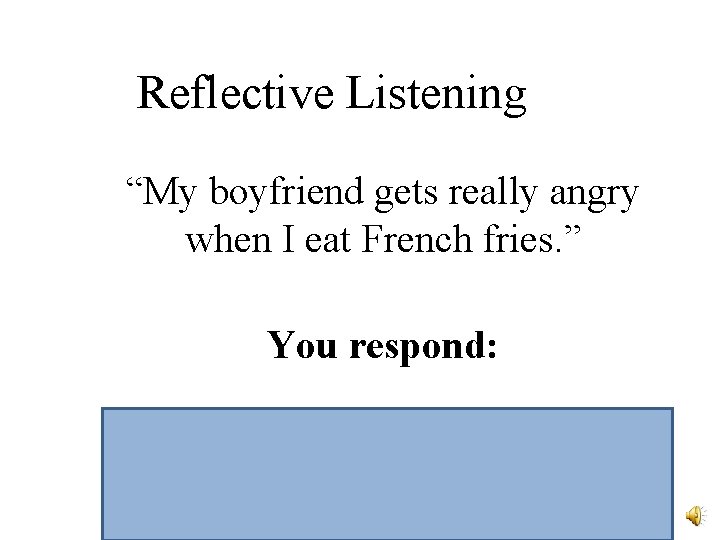
Reflective Listening “My boyfriend gets really angry when I eat French fries. ” You respond: “So, he gets mad when you eat French Fries”
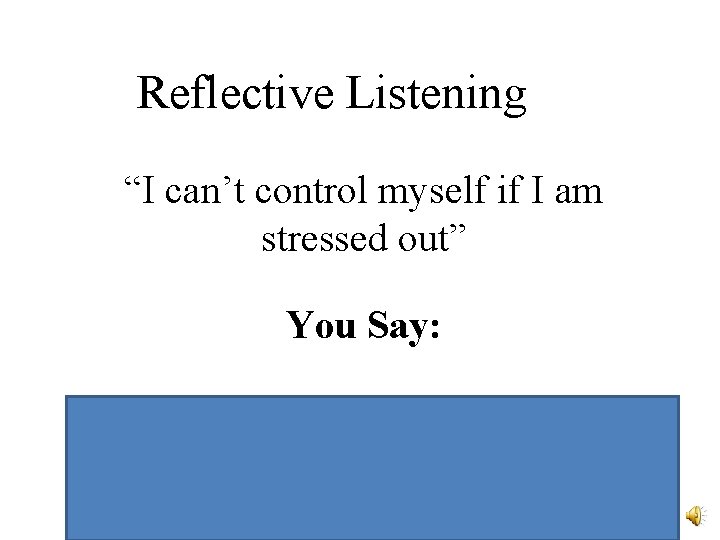
Reflective Listening “I can’t control myself if I am stressed out” You Say: “It must be hard to control yourself when you are worried”
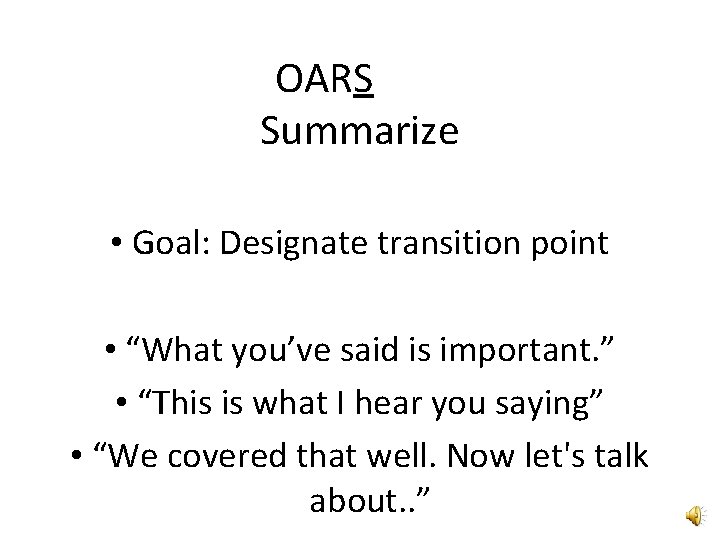
OARS Summarize • Goal: Designate transition point • “What you’ve said is important. ” • “This is what I hear you saying” • “We covered that well. Now let's talk about. . ”
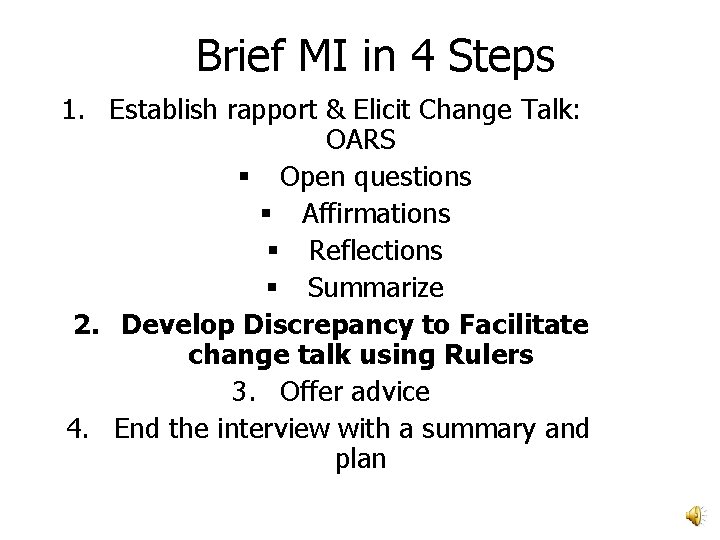
Brief MI in 4 Steps 1. Establish rapport & Elicit Change Talk: OARS § Open questions § Affirmations § Reflections § Summarize 2. Develop Discrepancy to Facilitate change talk using Rulers 3. Offer advice 4. End the interview with a summary and plan
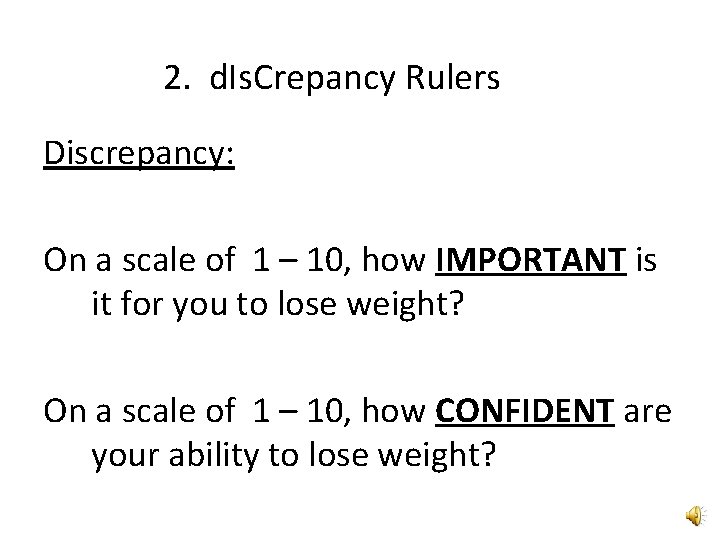
2. d. Is. Crepancy Rulers Discrepancy: On a scale of 1 – 10, how IMPORTANT is it for you to lose weight? On a scale of 1 – 10, how CONFIDENT are your ability to lose weight?
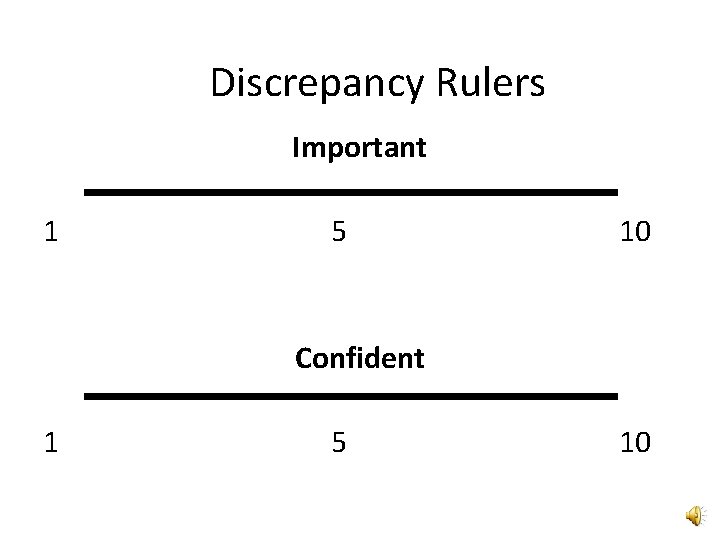
Discrepancy Rulers Important 1 5 10 Confident 1 5 10
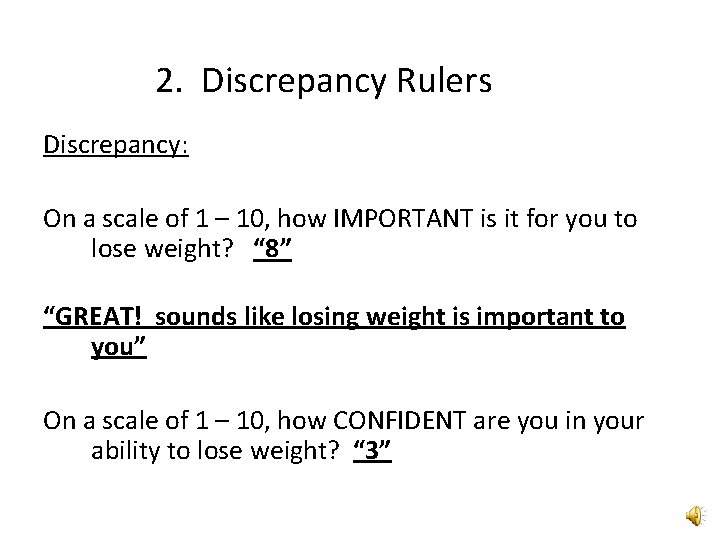
2. Discrepancy Rulers Discrepancy: On a scale of 1 – 10, how IMPORTANT is it for you to lose weight? “ 8” “GREAT! sounds like losing weight is important to you” On a scale of 1 – 10, how CONFIDENT are you in your ability to lose weight? “ 3”
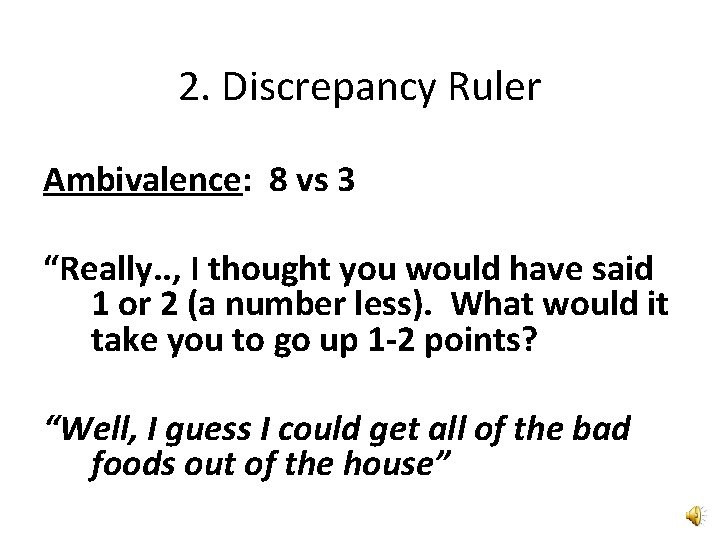
2. Discrepancy Ruler Ambivalence: 8 vs 3 “Really. . , I thought you would have said 1 or 2 (a number less). What would it take you to go up 1 -2 points? “Well, I guess I could get all of the bad foods out of the house”
Brief MI in 4 Steps 1. Establish rapport & Initiate Discussion: OARS § Open questions § Affirmations § Reflections § Summarize 2. Develop Discrepancy using Rulers 3. Offer advice 4. End the interview with a summary and plan
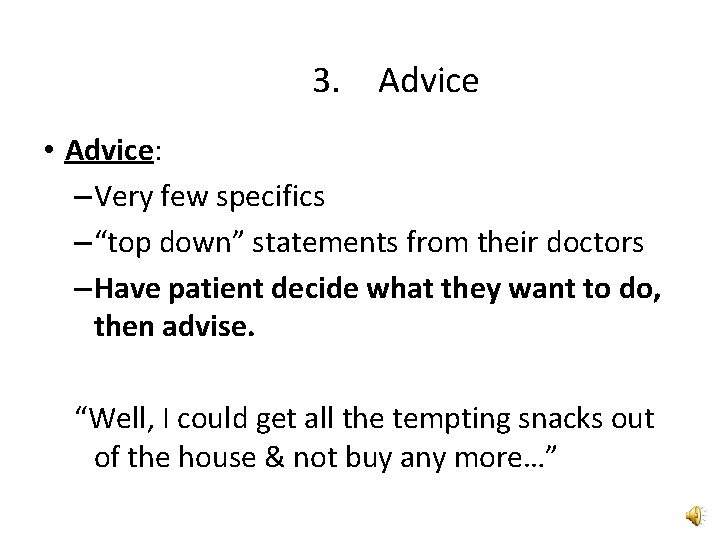
3. Advice • Advice: – Very few specifics – “top down” statements from their doctors – Have patient decide what they want to do, then advise. “Well, I could get all the tempting snacks out of the house & not buy any more…”
4. Action Plan • Action Plan –Based upon patient’s suggestion –Provide options for patient –Be open to whatever they suggest –ALWAYS schedule Follow up with agreed upon Goal
3/4: Advice & Action Plan • “Terrific! Getting snacks out of the house is a great start. But, what will you do when you get the urge to snack? What do you know about healthy snacks? ” • “None, really…” • “Well, we have a few options. • I can give you a few ideas, refer you to a dietician, or would you consider a group like Weight Watchers? • GOAL SETTING: “Let me see you back in a month. How much weight will you try lost by then? ”
Summary MI in 4 Steps 1. Establish rapport & Elicit Change Talk: OARS § Open questions § Affirmations § Reflections § Summarize 2. Develop Discrepancy using Rulers 3. Offer advice 4. End the interview with a plan
Useful References & Resources Miller, W. R. , & Rollnick, S. (2002). Motivational Interviewing: Preparing People for Change (New York, Guilford Press). Rollnick, S. , Mason, P. , & Butler, C. (1999). Health Behavior Change: A Guide for Practitioners (London, Churchhill Livingstone). Rollnick, S. , Miller, W. R. , & Dunn, C. (2008). Motivational Interviewing in Health Care (New York: Guilford Press). www. motivationalinterview. org and www. casaa. unm. edu