
Motivation Values Chapter 4 Sessions 7 8 The
- Slides: 11
Motivation & Values Chapter 4 Sessions 7 -8
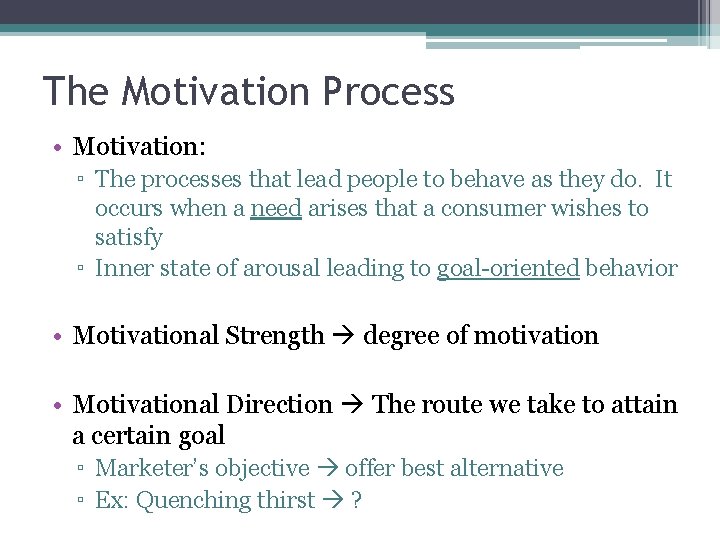
The Motivation Process • Motivation: ▫ The processes that lead people to behave as they do. It occurs when a need arises that a consumer wishes to satisfy ▫ Inner state of arousal leading to goal-oriented behavior • Motivational Strength degree of motivation • Motivational Direction The route we take to attain a certain goal ▫ Marketer’s objective offer best alternative ▫ Ex: Quenching thirst ?
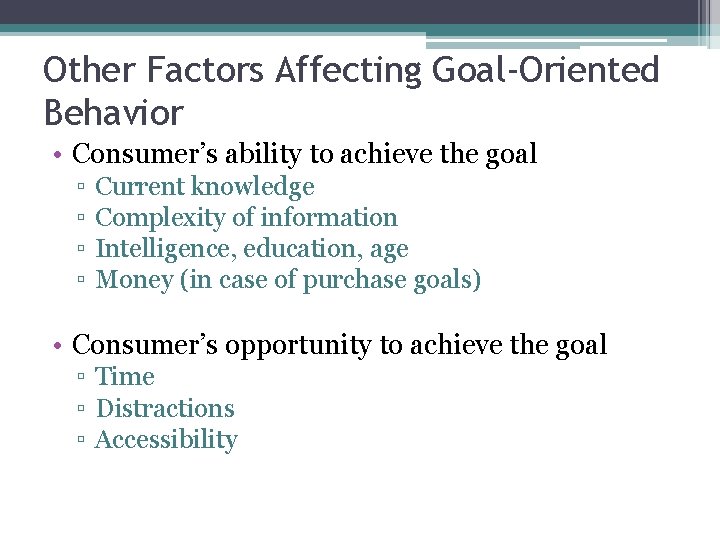
Other Factors Affecting Goal-Oriented Behavior • Consumer’s ability to achieve the goal ▫ ▫ Current knowledge Complexity of information Intelligence, education, age Money (in case of purchase goals) • Consumer’s opportunity to achieve the goal ▫ Time ▫ Distractions ▫ Accessibility
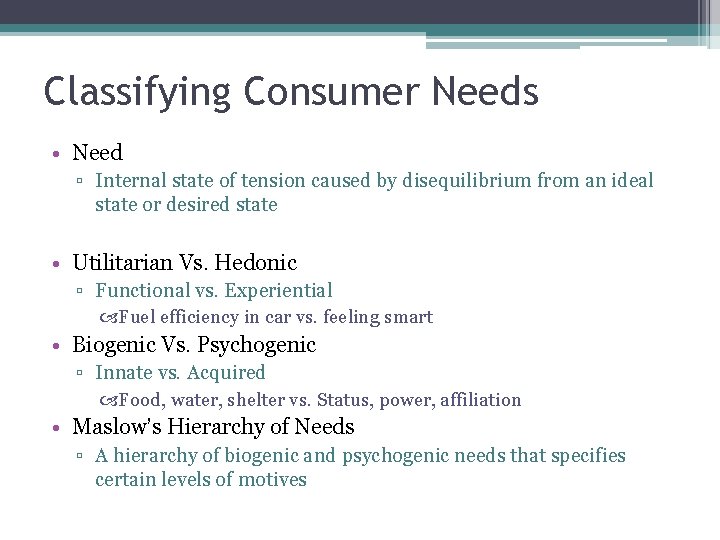
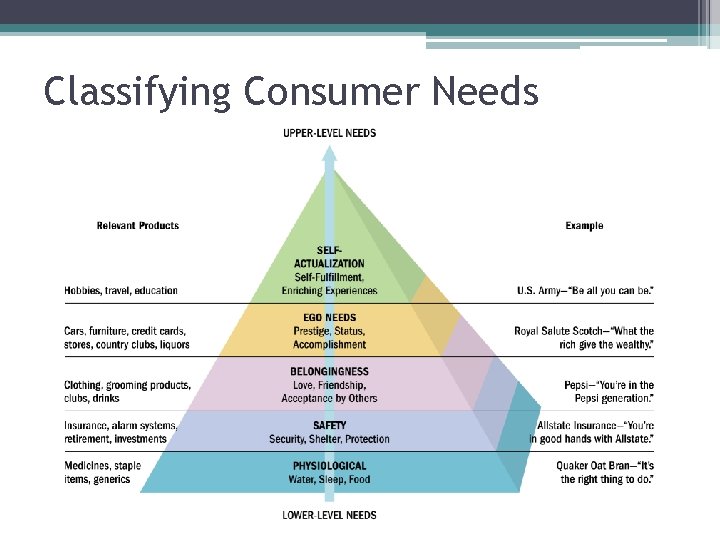
Classifying Consumer Needs • Need ▫ Internal state of tension caused by disequilibrium from an ideal state or desired state • Utilitarian Vs. Hedonic ▫ Functional vs. Experiential Fuel efficiency in car vs. feeling smart • Biogenic Vs. Psychogenic ▫ Innate vs. Acquired Food, water, shelter vs. Status, power, affiliation • Maslow’s Hierarchy of Needs ▫ A hierarchy of biogenic and psychogenic needs that specifies certain levels of motives
Classifying Consumer Needs
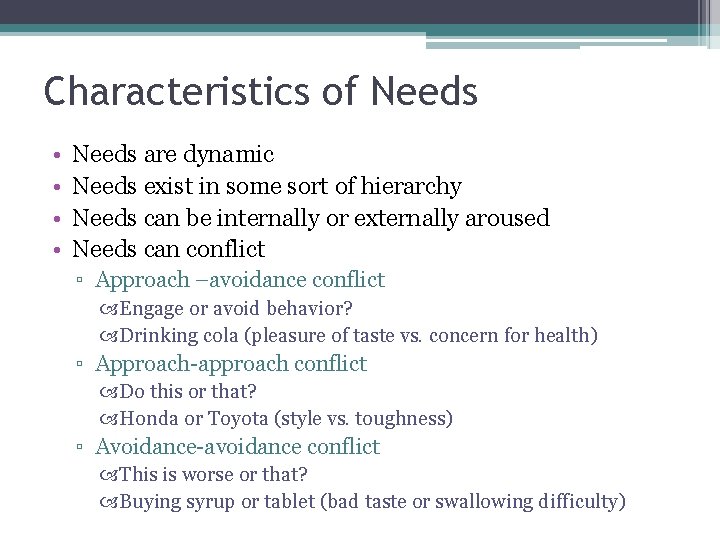
Characteristics of Needs • • Needs are dynamic Needs exist in some sort of hierarchy Needs can be internally or externally aroused Needs can conflict ▫ Approach –avoidance conflict Engage or avoid behavior? Drinking cola (pleasure of taste vs. concern for health) ▫ Approach-approach conflict Do this or that? Honda or Toyota (style vs. toughness) ▫ Avoidance-avoidance conflict This is worse or that? Buying syrup or tablet (bad taste or swallowing difficulty)
Why Understand Needs? • • • Helps in market segmentation Helps in new product development Helps in creating need-satisfying offerings Helps manage conflicting consumer needs Helps enhance effectiveness of communication • Marketers also create new needs at times
Consumer Involvement • A person’s perceived relevance of & level of interest in the object ▫ Object: A product, brand, message, or purchase situation • Types of involvement ▫ Enduring Showing interest in an activity or product for a long period of time ▫ Situational Temporarily higher levels of interest ▫ Cognitive Thinking about & processing info related to goal ▫ Affective Expending emotional energy / having heightened feelings about an offering
Enhancing Consumer Involvement • Involvement with Product ▫ Related to a consumer’s level of interest in a particular product Mass customization (user-generated product ideas) Enhancing risk perceptions • Involvement with Message ▫ Refers to a consumer’s interest in processing marketing communications User-generated advertising content, blogs, etc. Interactive communication tools (on-site brand activations) Branded entertainment • Involvement with Purchase Situation ▫ Related to consumer’s level of interest in the buying situation / context Themed retailing environments Friendly & helpful salespeople
Values • Values ▫ Beliefs that guide what people regard as important, good or preferable • Value system ▫ A culture’s unique set of rankings of the relative importance of universal values • Values can be seen at many levels: ▫ Cultural Values (e. g. security or happiness) ▫ Consumption-Specific Values (e. g. convenient shopping or prompt service) ▫ Product-Specific Values (e. g. ease-of-use or durability) • Virtually all consumer research is ultimately related to identification and measurement of values
Hofstede’s Cultural Dimensions • Culture is made of 5 dimensions ▫ Individualism vs. Collectivism Represents a society in which there are weaker bonds between individuals, everyone is expected to look after oneself and his/her own immediate family only ▫ Masculinity vs. Femininity Represents a society in which social and gender roles are clearly distinct ▫ Power Distance The extent to which the less powerful members of a society accept the inherent inequalities in their society ▫ Uncertainty Avoidance the extent to which the members of a particular culture feel endangered by uncertain or unknown situations