
Motivation Part 1 Keys to Motivation Flow Successful
- Slides: 13
Motivation Part 1 Keys to Motivation Flow Successful Motivation
Keys to motivation • How and why are people motivated? • People are motivated to fulfill their needs • If you understand what your athletes needs are, you can then help them fulfill those needs • Examples – athlete needs (from your own experiences)? • Sports Psychologists have learned that the 2 most important needs of athletes are: 1. to have FUN (includes need for stimulation and excitement) 2. to FEEL WORTHY (includes to feel competent / successful) *think rewards program design (2 goals + 2 types + why + steps to achieve (how’s in portfolio = concrete examples)
Ability to motivate • Motivation is the key to learning – only when your student-athletes are ready to learn (readiness). • Therefore – the primary task for coaches in motivating athletes is to make them want to learn how to become better. • Coaches questions to answer with motivation: 1. Why are some athletes so motivated – others unmotivated? 2. How do we motivate athletes to be the best they can be? V 1 - classic football half-time talk? Funny http: //www. youtube. com/watch? v=ZEb. N 6 Vnr 1 g 8 *genuine – transparent realism *do is have to be like this? Maybe some Balance Legally ok? “if you cannot say ok right away – then maybe not” (no grey area) “Standard of practice meets standard of care”
Optimal arousal • Flow experience – what is it / why important? / ever feel it? • Flow experience occurs when we are totally immersed in an activity – we lose our sense of time, feeling everything is going just right because we are neither bored nor anxious. • When feeling flow, our attention is so intensely centered on the activity that concentration is automatic. • The flow experience is so pleasing that it is intrinsically rewarding (agree or disagree? )
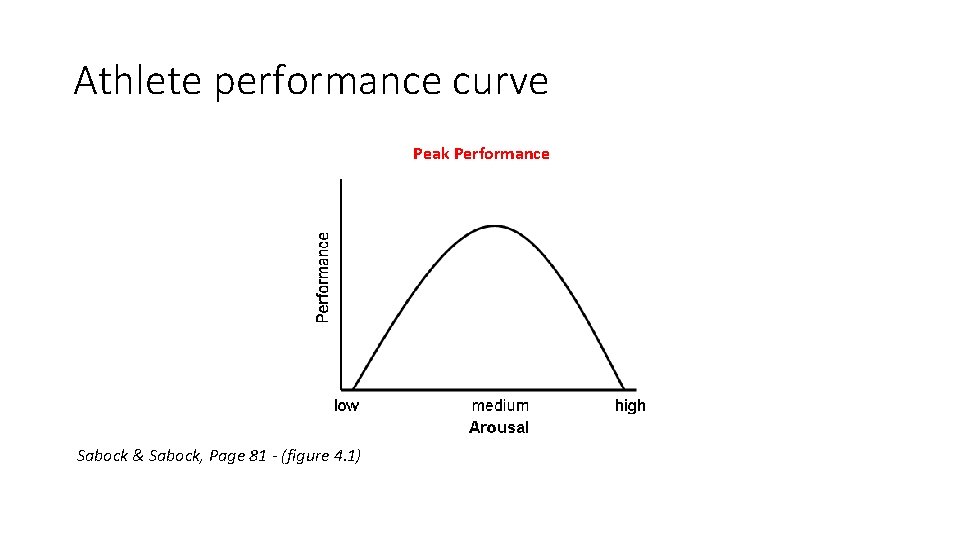
Athlete performance curve Peak Performance Sabock & Sabock, Page 81 - (figure 4. 1)
How to coach flow • How do you create flow for your athletes? • Key is increasing the probability of experiencing flow is to match the challenge of the task to the ability of the athletes • Ideas what that means? • Think of how when kids on the playground we learned – why that environment existed – what can we learn when coaching? • Specific ideas how to create? • Legal Duty – “duty to match athletes”
Creating flow – teaching mechanics • Keep practice stimulating buy using a wide variety of drills or creating fun challenges – new games within the drills you need to teach for sound skill performances. • Let your athletes design some of the activities that will help them learn new skills. • Keep everyone active rather than standing around for long period waiting their turns. Make practices as much fun as games (key concept – balance of drills and games) • Avoid constant instruction during practices and games. Give athletes time when they don’t have to pay attention to you. Your constant yelling of instructions does not allow flow! • Do not constantly evaluate - especially during contest (flow)
Motivation workshop 5 PER • Groups of 5 – teams • Develop a motivational plan of attack – outline of ways you can proactively motivate your athletes / team (design of rewards)? • Examples – separate by timing-readiness (team management) ***pre-season / in-season / post-season play / off-season Must address all 3 phases for Portfolio (1 year plan as HC) • Next – expand / explain / create / specific examples ***be creative / pull from past likes / dislikes / new ideas as well (shopping cart session – fill up cart with several meals/ideas to pull from for athletesteam). • Last – remember 2 keys to motivation / 2 types / Flow / How’s • Share ideas with class
Need to feel worthy • We learn quickly in our society that our worth depends largely on our ability to achieve. Children as young as 5 years old understand this. • With respect to sports – we translate it to mean? • Winning = success and Losing = failure • • Winning / success and losing / failure is a state of mind. Emerging from early success and failures are 2 athletes Those that are motivated to achieve success Those that are motivated to avoid failure
How do they think – feel? • How do winners (successful individuals) think? • When successful thinkers encounter occasional failure – they blame it on insufficient EFFORT, thus robbing failure of its threat to the athletes selfworth because it doesn’t reflect on their ability – to succeed – they simply need to try harder – thus, failure increases her motivation versus reduce it. • Strive for Excellence – enjoy the struggle – better - stronger • How do losers (unsuccessful individuals) think? • Unsuccessful thinkers are filled with self-doubts and anxiety. They attribute failures with a lack of ability and lack of success to weak or incompetent opponents – thus, blaming themselves for failures and taking no or little credit for successes. • They believe they are powerless to change
How to create successful thinking • Emphasis on learning-improving – NOT performance based. How do you create – examples – ideas? • Key to increasing the probability of experiencing flow is to match the challenge of the task to the ability of the athletes. Realistic goals (personal and team) Use extrinsic rewards to create intrinsic motivation Success is not winning Success must be in terms of achieving their own goals rather than surpassing the performances of others (IMPROVEMENT) • Recognizing athletes limitations • •
From motivation to anxiety • More motivation is not better – Balance is the key • Balance of arousal with performance relationship – key • Higher precision sport skills require find motor control = are best performed with lower levels of arousal – Balance • examples? • Large muscle movement skills are best done with higher levels of arousal • examples?
Motivation wrap up • Therefore – understand your athletes individual arousal levels and your sports optimal arousal level to provide the proper motivation. • Helping your athletes focus on achieving personal goals within a team mind set (not winning) will help them be less anxious and have less fear of failure. • Focus on the process and not the score • Encourage your athletes to compete with same intensity-desire-fun-effort regardless of what the scoreboard says. • Another Look @ Motivational Talks (movies – not real) *V 2 – greatest sports pep talks ever – you tube (fun 2: 40 min) http: //www. youtube. com/watch? v=s. ODWr. EHPZFY