
Motivation for full automation we need it yesterday





![Energy to overcome rolling resistance d. W/dt = CV/η Σm·g[CR+s/100+a/g(1+m. W/Σm)] CV: Speed of](https://slidetodoc.com/presentation_image/9fec4a4b2aad906ceb325b1546c29baa/image-13.jpg "Energy to overcome rolling resistance d. W/dt = CV/η Σm·g[CR+s/100+a/g(1+m. W/Σm)] CV: Speed of")

- Slides: 19
Motivation for full automation – we need it … yesterday & tomorrow Energy Efficiency through Automation Tyler Folsom, Ph. D, PE QUEST Integrated, Inc. 91 st Meeting of the Transportation Research Board of the National Academy Jan. 22, 2012, Washington DC
Time Frames • • Business: Next quarter; fiscal year Politics: Next election Transportation planners: 30 years Iroquois nation: 7 th generation
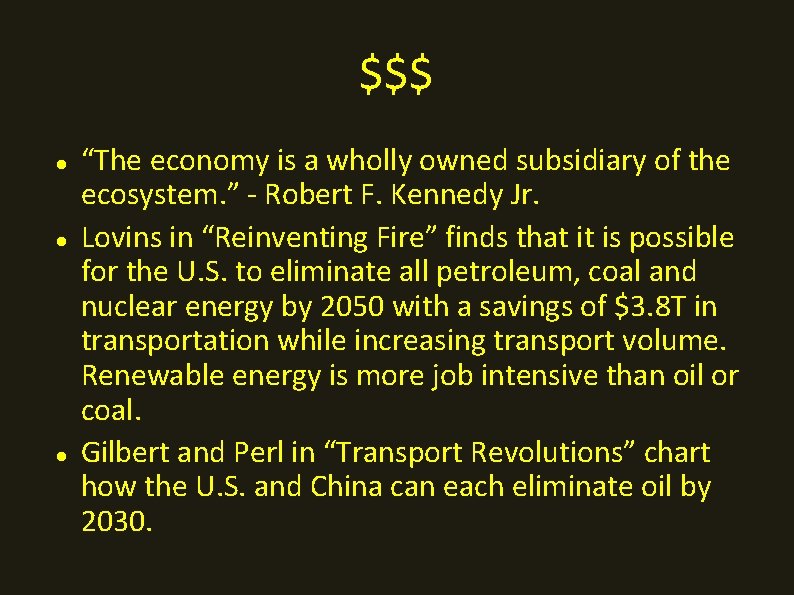
$$$ “The economy is a wholly owned subsidiary of the ecosystem. ” - Robert F. Kennedy Jr. Lovins in “Reinventing Fire” finds that it is possible for the U. S. to eliminate all petroleum, coal and nuclear energy by 2050 with a savings of $3. 8 T in transportation while increasing transport volume. Renewable energy is more job intensive than oil or coal. Gilbert and Perl in “Transport Revolutions” chart how the U. S. and China can each eliminate oil by 2030.
National Security European countries fought wars over access to salt. Making oil no more strategic than salt eliminates the need to protect resources militarily. There is evidence that the demand for oil is peaking before the supply peaks. A gallon of gasoline delivered to Afghanistan costs $25 to $45.
Reasons to eliminate oil Environmental: Pollution, sustainability, global warming National security: Devalue the principal asset of unfriendly countries Business: High oil prices, high oil volatility, better opportunities elsewhere
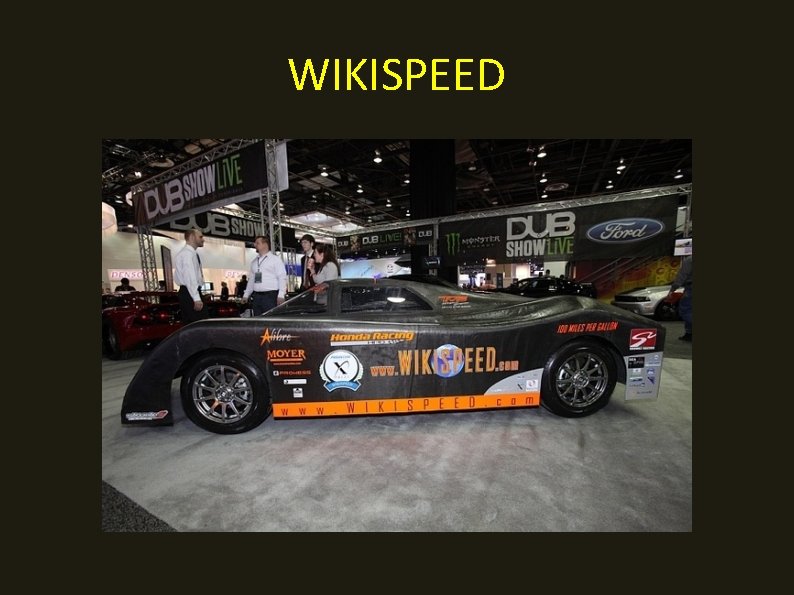
WIKISPEED
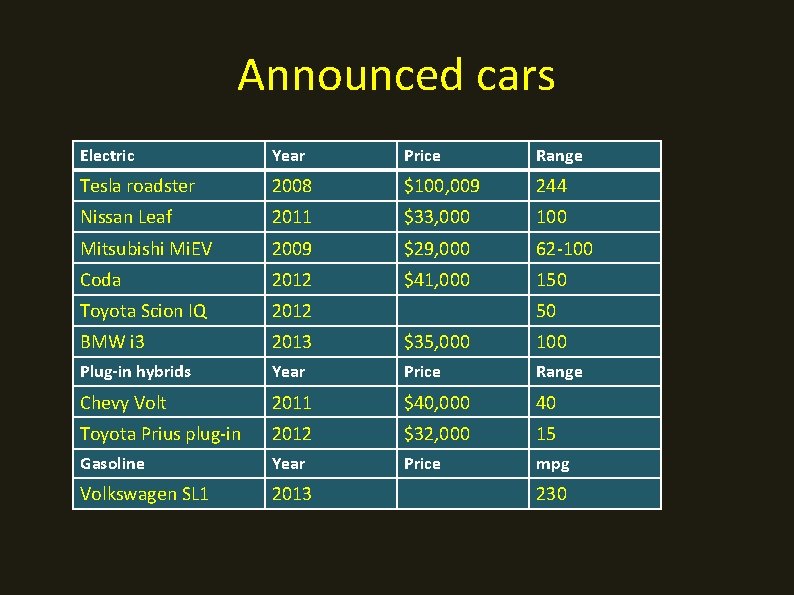
Announced cars Electric Year Price Range Tesla roadster 2008 $100, 009 244 Nissan Leaf 2011 $33, 000 100 Mitsubishi Mi. EV 2009 $29, 000 62 -100 Coda 2012 $41, 000 150 Toyota Scion IQ 2012 BMW i 3 2013 $35, 000 100 Plug-in hybrids Year Price Range Chevy Volt 2011 $40, 000 40 Toyota Prius plug-in 2012 $32, 000 15 Gasoline Year Price mpg Volkswagen SL 1 2013 50 230
Transport Revolutions Britain's move to railways, starting in 1830. Substantial reversal of automobile travel in the U. S. during World War II. The change from ships to planes for transatlantic travel. The introduction of high speed rail from 1960 to 1985. The use of air freight starting in 1980.
U. S. driving habits • • 5% use mass transit. Average bus occupancy is 8. 8 people. 88% drive to work with 76% traveling alone. Average trip to work is 12 mi @ 28 mph. 19% of trips are to work. 30% of trips are social and recreational. Average car occupancy is 1. 57 people. 65% of miles driven are urban.
Energy to move vehicle Power = K 1*V + K 2 * V 3 For a car, rolling resistance is dominant until 35 mph. For a light vehicle, air drag takes over at 12 mph.
Energy to overcome rolling resistance d. W/dt = CV/η Σm·g[CR+s/100+a/g(1+m. W/Σm)] CV: Speed of vehicle η: Overall mechanical efficiency of transmission Σm: Total mass of vehicle, rider and baggage g: Gravitational acceleration CR: Coefficient of rolling resistance s: Upslope (%) a: vehicle acceleration m. W: Effective rotational mass of wheels
Safety allows smaller vehicles • 93% of accidents are caused wholly or in part by human factors. • 41% of fatal accidents involve alcohol. • Annual U. S. economic cost of accidents is $230 B. • Autonomous trains are an order of magnitude safer than manual trains. • When all vehicles are computer controlled, a motorcycle is almost as safe as an SUV.
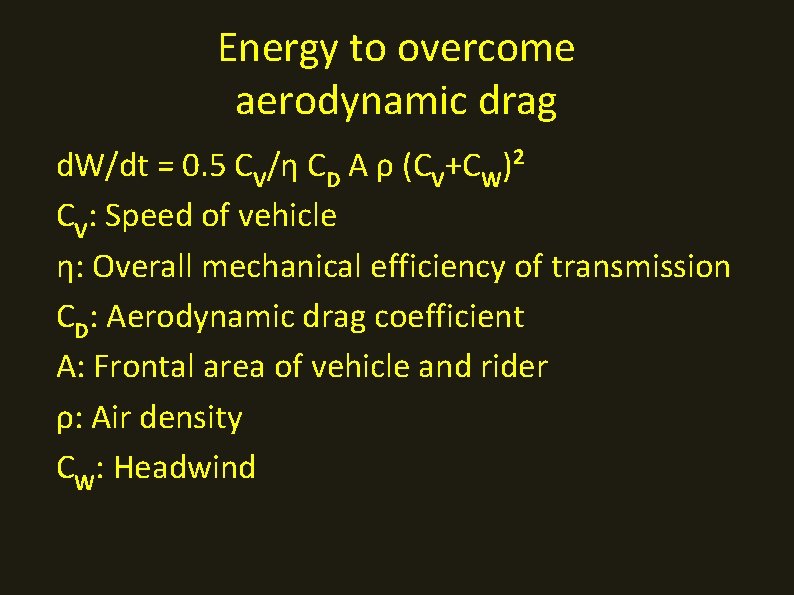
Energy to overcome aerodynamic drag d. W/dt = 0. 5 CV/η CD A ρ (CV+CW)2 CV: Speed of vehicle η: Overall mechanical efficiency of transmission CD: Aerodynamic drag coefficient A: Frontal area of vehicle and rider ρ: Air density CW: Headwind
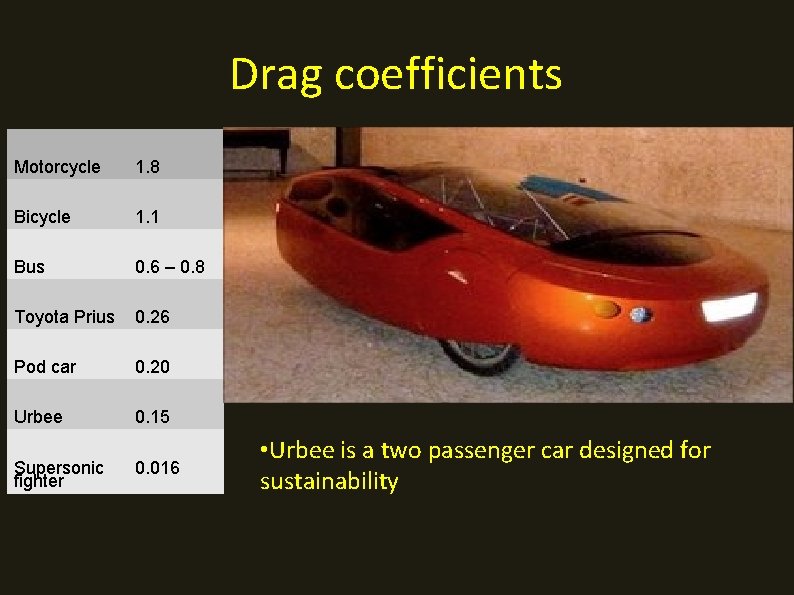
Drag coefficients Motorcycle 1. 8 Bicycle 1. 1 Bus 0. 6 – 0. 8 Toyota Prius 0. 26 Pod car 0. 20 Urbee 0. 15 Supersonic fighter 0. 016 • Urbee is a two passenger car designed for sustainability
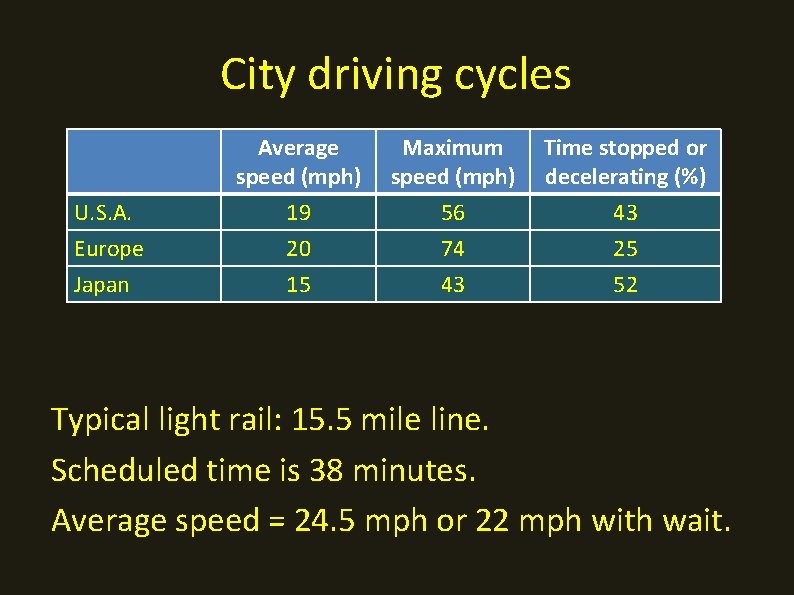
City driving cycles U. S. A. Europe Japan Average speed (mph) Maximum speed (mph) Time stopped or decelerating (%) 19 20 15 56 74 43 43 25 52 Typical light rail: 15. 5 mile line. Scheduled time is 38 minutes. Average speed = 24. 5 mph or 22 mph with wait.
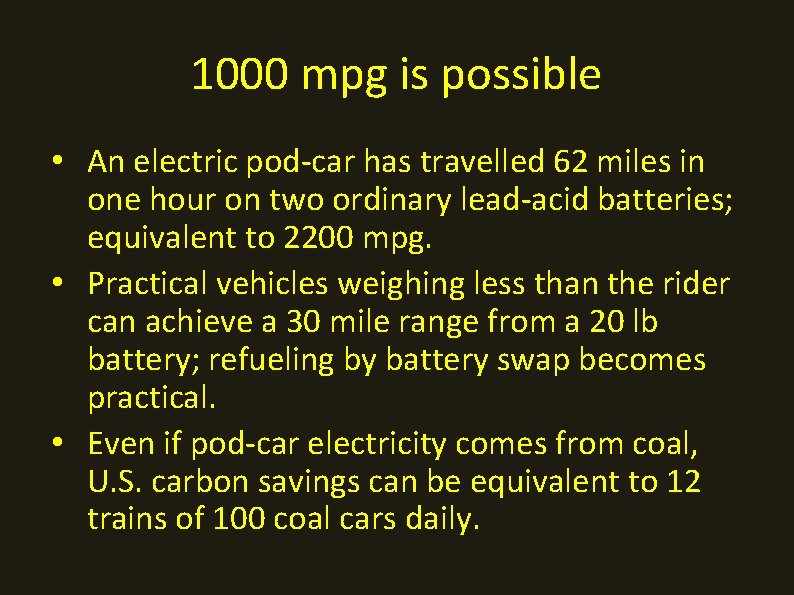
1000 mpg is possible • An electric pod-car has travelled 62 miles in one hour on two ordinary lead-acid batteries; equivalent to 2200 mpg. • Practical vehicles weighing less than the rider can achieve a 30 mile range from a 20 lb battery; refueling by battery swap becomes practical. • Even if pod-car electricity comes from coal, U. S. carbon savings can be equivalent to 12 trains of 100 coal cars daily.
Details and references T. C. Folsom, Social Implications of Autonomous Urban Land Vehicles, IEEE Technology and Society Magazine, Spring, 2012. T. Folsom @ qi 2. com www. enviroteach. com