
Motivation financial and non financial Introduce the aims

- Slides: 40
Motivation financial and non financial Introduce the aims and objectives for the session. Discuss the financial methods of motivation and give examples. Analyse the financial methods of motivation in a written task. Arrange the financial methods of motivation definition cards. Explain the non-financial methods of motivation. Complete a written analysis of the non-financial methods of motivation. • Show You. Tube videos from various motivational theorists. • Recap the aims and objectives for the session. • • •
Financial and non-financial motivation When we examine methods of motivation that can actually be applied in the workplace, we normally subdivide them into financial and non-financial methods. Financial methods directly involve monetary rewards e. g. bonuses, pay increases, improved pensions etc. Non-financial methods, though perhaps indirectly bringing monetary rewards, are targeted at providing psychological benefits for workers.
It must be remembered that both financial and non-financial methods have costs to the employer: • Either through direct costs such as extra pay, • Indirectly through the provision of training or management time.
Financial methods of motivation: • Piece rate wages • Wages • Salaries • Profit related pay • Bonus schemes • Fringe benefits
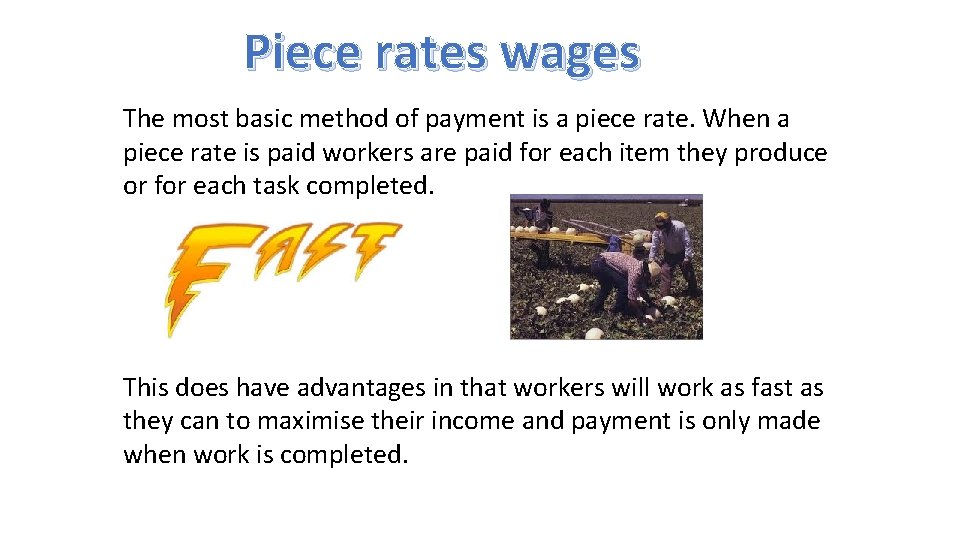
Piece rates wages The most basic method of payment is a piece rate. When a piece rate is paid workers are paid for each item they produce or for each task completed. This does have advantages in that workers will work as fast as they can to maximise their income and payment is only made when work is completed.
However, there are disadvantages for both employer and employee. For the employer there must be a great deal of supervision and checking of quality as workers are motivated to achieve speed of output, not quality of output. From the employees point of view there is no guarantee of income and production may be halted by matters beyond the workers’ control.
Wages are paid hourly, for example £ 8 an hour, and the vast majority of unskilled workers in the UK are still paid wages. There is some security in being paid a wage and those who earn wages will probably be able to work overtime to increase incomes. Lower levels of Maslow’s hierarchy are quite often satisfied by a decent wage, but what does matter is the level of the wage.
Minimum wage / living wage A minimum wage of £ 6. 70 an hour (1 October 2015) cannot truthfully be regarded as an income likely to provide a decent standard of living. Some people argue that employers should pay a living wage of £ 7. 85 an hour.
For many big businesses there is one large group of manual or production workers who are paid hourly and a group of administrative and marketing workers who are paid a salary. This difference in methods of payment can cause resentment and prevent the breakdown of barriers within businesses. A ‘them and us’ attitude can be reinforced by the artificially created separation of waged and salaried employees, when in fact the only difference may be that one group wear suits to work and the other does not.
Salaries are paid at an annual rate, for example £ 25 000 per year. Salaried incomes are paid monthly, directly into a bank account. Salaries make good financial sense for businesses because they are paid monthly in arrears which means that workers will have to wait up to a month to receive income for work performed. This leads to an improved cash flow and bank balance for the business.
Also it is simpler and safer to pay money by bank transfer rather than in cash. Salaried workers are not normally paid overtime but may receive other financial benefits. This non-payment of overtime does not mean that they do not work more than their contracted hours – they often do, but it does mean that employers may not be liable to pay for this extra work.
Profit-related pay links part of an employee’s income to the profits of a company. Those who receive profit related pay will have a lower salary than they might otherwise expect but will benefit overall by receiving a share of company profits. When profit-related pay schemes were first encouraged during the 1980 s it was hoped that they would catch on with all types of worker.
However, in the main, they are only applied to senior management; although some businesses, such as Asda and the John Lewis Partnership, have schemes which allow all employees to share in company profits. The major problem in encouraging workers to take part in the schemes is that income is uncertain. Workers may believe that they have little influence on the profitability of the business, so they do not see why their income should fluctuate as profits fluctuate.
Bonus schemes There a wide variety of bonus schemes available, each designed to be suitable for different employees doing different jobs. These schemes include the following: • Sales bonus – this is normally paid if a sales target has been reached. For sales people this may make up a significant part of their salary.
Bonus schemes • Performance bonus – this can be paid to an individual or on a group or factory-wide basis. It is often paid for reaching targets of output and quality. This method of payment is an important part of Human Resource management. • Christmas bonus – often called the 13 th month salary – paid for loyalty to the business. In some countries (for example, Germany) virtually all companies will pay a Christmas bonus.
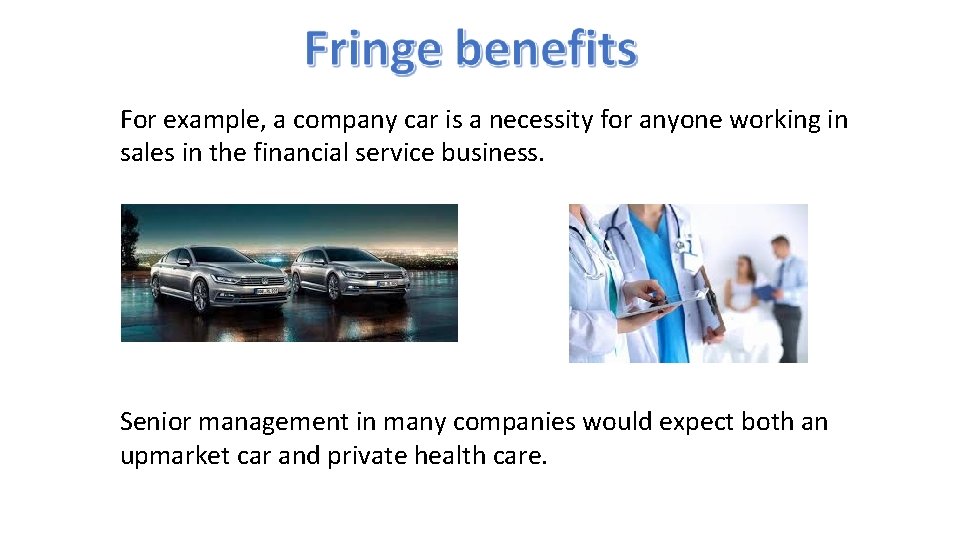
Fringe benefits Other forms of financial motivation include company cars, pension schemes, sickness benefits, subsidised meals and travel, and staff discounts. These are often grouped together under the heading of fringe benefits or perks (perquisites). Some of these fringe benefits can be regarded as essential in encouraging the right applicants for certain types of vacancies.
For example, a company car is a necessity for anyone working in sales in the financial service business. Senior management in many companies would expect both an upmarket car and private health care.
Activity 1 Task: Written evaluation - of financial methods of motivation. Time: 20 mins
Activity 2 Task: Arrange definitions of financial motivation methods. Time: 15 mins
Non-financial methods of motivation The use of non-financial methods of motivation demonstrates attempts by employers to apply the ideas behind theories of the likes of Mayo, Maslow and Herzberg.
Examination of these theories has shown us that motivation to achieve quality of output is best achieved through satisfaction of higher needs (Maslow), awareness of the role of groups in the workplace (Mayo) and the need to provide motivators (Herzberg). The non-financial methods of motivation outlined below can be linked to one of more of these theories.
Non financial methods of motivation • Job enrichment • Job enlargement • Job rotation • Job design and communication • Empowerment • Quality circles • Training • Flexible working
Job enrichment This means giving workers more control over the tasks that they complete, and allowing workers to complete tasks that have a meaning and are complete in themselves. For example, a worker who has a job fitting a circuit board to a TV may have his job enriched by testing the board and being able to make adjustments so that the required level of quality is achieved.
The ability to do this range of tasks means that the worker becomes more committed to achieving quality. Effective job enrichment depends on workers having interesting tasks to complete. Job design is a key part of Herzberg’s ideas.
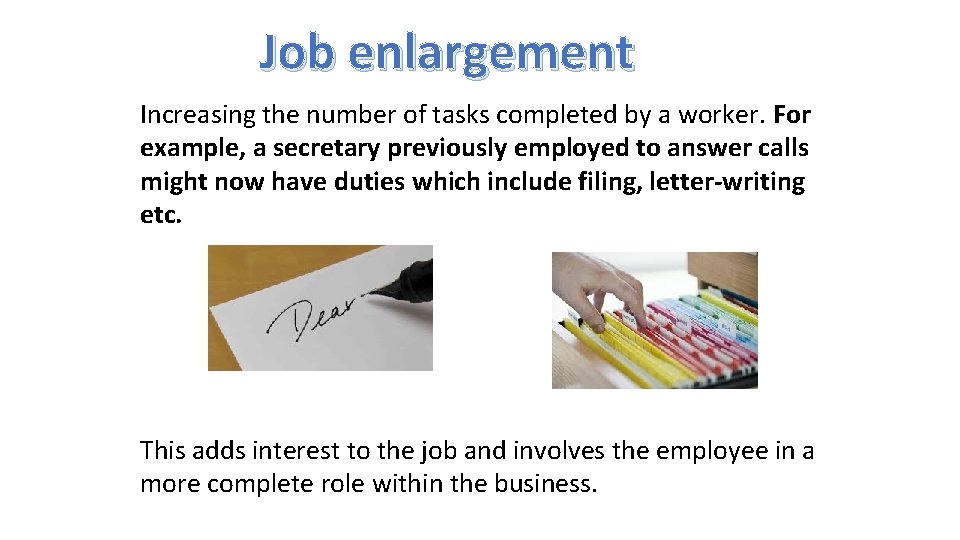
Job enlargement Increasing the number of tasks completed by a worker. For example, a secretary previously employed to answer calls might now have duties which include filing, letter-writing etc. This adds interest to the job and involves the employee in a more complete role within the business.
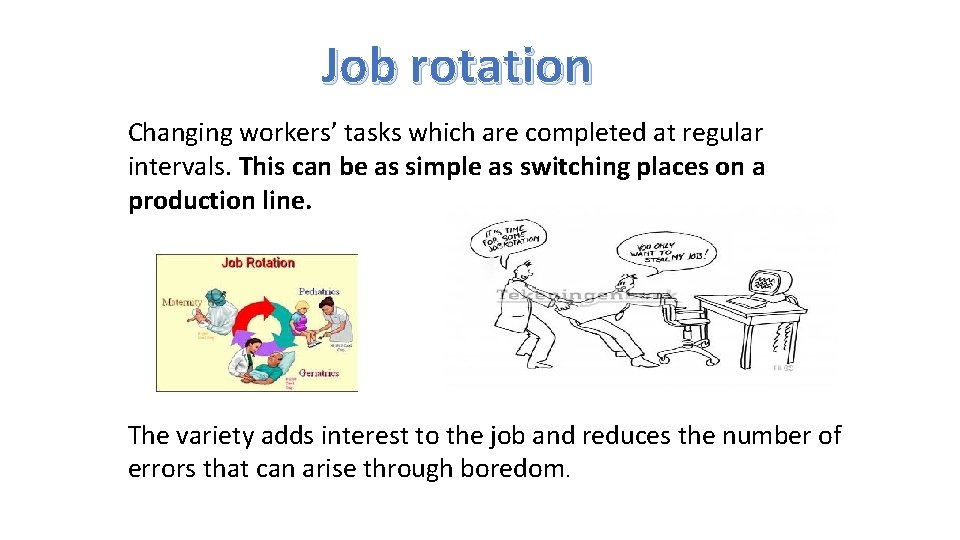
Job rotation Changing workers’ tasks which are completed at regular intervals. This can be as simple as switching places on a production line. The variety adds interest to the job and reduces the number of errors that can arise through boredom.
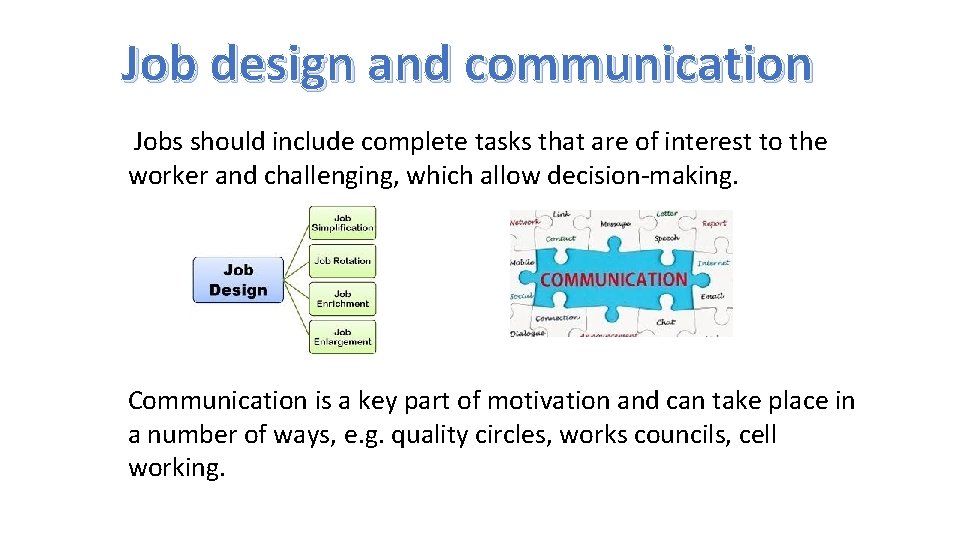
Job design and communication Jobs should include complete tasks that are of interest to the worker and challenging, which allow decision-making. Communication is a key part of motivation and can take place in a number of ways, e. g. quality circles, works councils, cell working.
Empowerment This means giving workers the power to control their own jobs, make decisions and implement their own ideas. It is often used in an artificial way; for example, allowing counter workers in burger bars to decide the greeting they use when they meet customers.
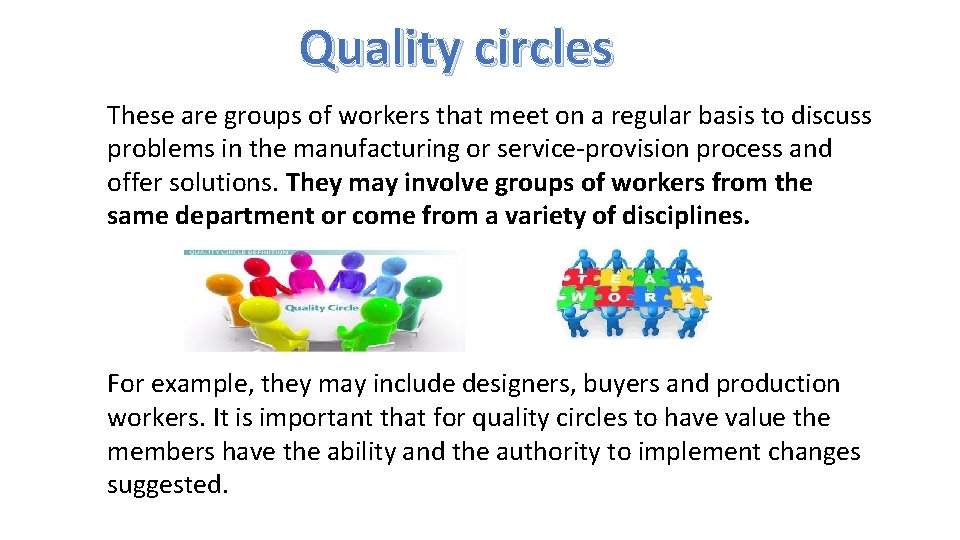
Quality circles These are groups of workers that meet on a regular basis to discuss problems in the manufacturing or service-provision process and offer solutions. They may involve groups of workers from the same department or come from a variety of disciplines. For example, they may include designers, buyers and production workers. It is important that for quality circles to have value the members have the ability and the authority to implement changes suggested.
Training The provision of a formal training scheme is important. As Herzberg stated, without training, workers will not be able to fulfil their potential. Training can be on-the-job, learning by doing; or off-thejob, such as studying for NVQs at a local college. On-the-job training has costs such as management or supervisor time spent training. Off-the-job training means lost production and disruption. Also the newly-qualified workers may seek to use their qualifications to seek better employment elsewhere.
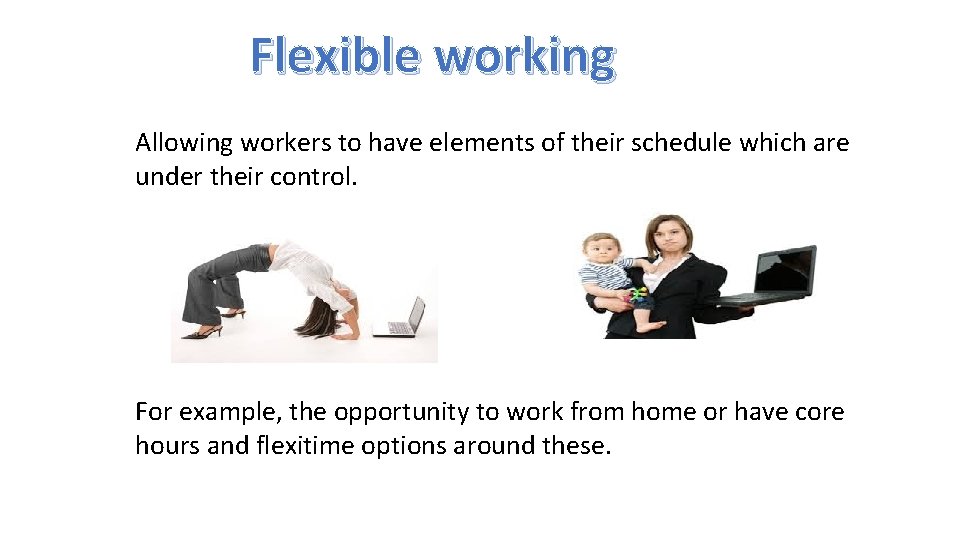
Flexible working Allowing workers to have elements of their schedule which are under their control. For example, the opportunity to work from home or have core hours and flexitime options around these.
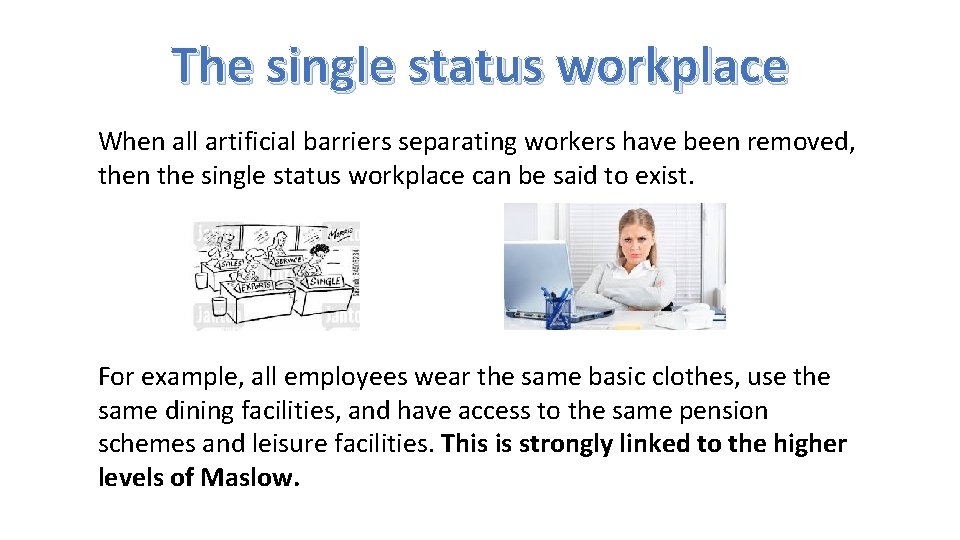
The single status workplace When all artificial barriers separating workers have been removed, then the single status workplace can be said to exist. For example, all employees wear the same basic clothes, use the same dining facilities, and have access to the same pension schemes and leisure facilities. This is strongly linked to the higher levels of Maslow.
Problems with non-financial methods of motivation • Existence of Theory X managers – These managers will see no value in using expensive methods of motivation when workers have no commitment to the business or quality of the product. • Cost – All these methods are expensive in terms of management time, systems implementation and training. To effectively use these methods there is a high level of cost. Managers must balance cost against increased output and quality.
• External factors – Once workers are used to having their jobs enriched, enlarged etc. , it may be difficult to remotivate them when financial circumstances, caused by recession or competitors’ actions, force cost cutting on a business. Unavoidable redundancies can have a negative effect on those workers that remain as they may feel less secure in their jobs.
• The structure of the workforce – If a large part of the workforce is not core to producing the added value of the business, there is probably no need to apply many of the methods given above. In the retail, hospitality and tourist industries many workers stay for only a short period of time, so motivating these workers would be very difficult.
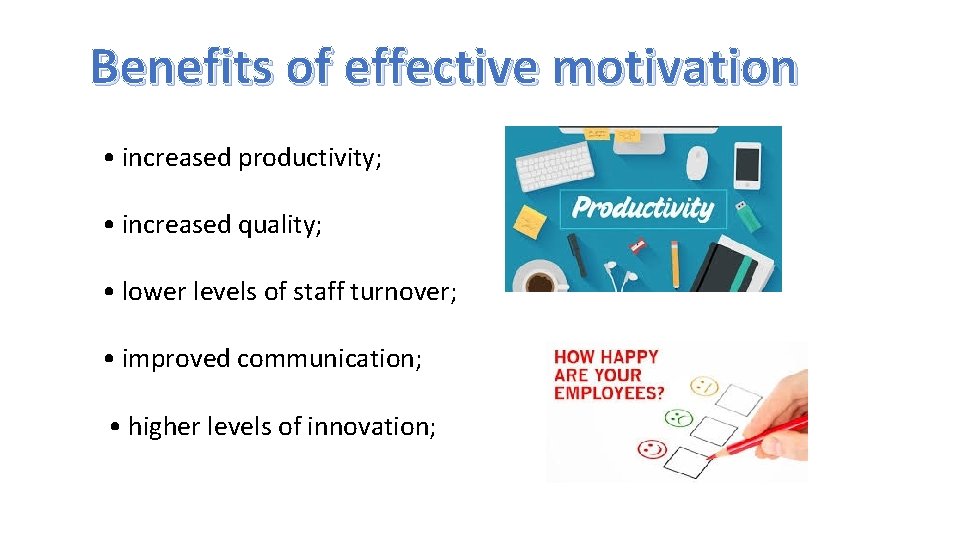
Benefits of effective motivation • increased productivity; • increased quality; • lower levels of staff turnover; • improved communication; • higher levels of innovation;
• greater worker satisfaction; • lower levels of industrial action; • improved customer service; • better reputation – easier to attract quality staff.
Activity 3 Task: Non-financial motivators – written task Time: 20 mins
You. Tube videos – Motivation Frederick Herzberg – Jumping for the Jellybeans lecture www. youtube. com/watch? v=o 87 s-2 Yt. G 4 Y Microsoft and motivation www. youtube. com/watch? v=o. Ky. V-l 8 i 5 lg
Motivation financial and non financial Introduce the aims and objectives for the session. Discuss the financial methods of motivation and give examples. Analyse the financial methods of motivation in a written task. Arrange the financial methods of motivation definition cards. Explain the non-financial methods of motivation. Complete a written analysis of the non-financial methods of motivation. • Show You. Tube videos from various motivational theorists. • Recap the aims and objectives for the session. • • •