
Motivation Emotion Behavior tied to Motivation We learn
Motivation & Emotion
Behavior tied to Motivation We learn behavior through observing others in Social Learning Theory. Our mental state of our internal (intrinsic) motivation feelings of satisfaction, pride, and feelings of accomplishment plays an important role in learned behavior. Learning does not mean a behavior will necessary change.
Social Learning through Motivation Attention- pay attention to behavior (encoding) the information. Retention- Store the information (behavior), Storage. Reproduction- Perform and practice the Behavior. Duplicate the behavior. Motivation- Learning the behavior has to have a motivating incentive.
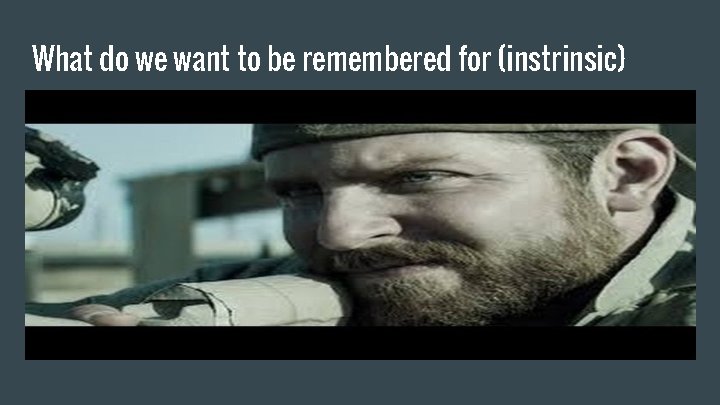
What do we want to be remembered for (instrinsic)
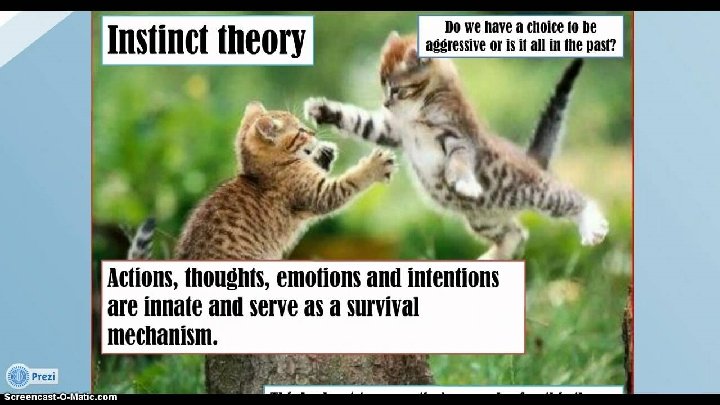
Instinct Theory The Instinct Theory of Motivation views biological or genetic programming as the cause of motivation. This claim means that all humans have the same motivations due to our similar biological programming. This theory says that the root of all motivations is the motivation to survive. UNLEARNED BEHAVIOR!

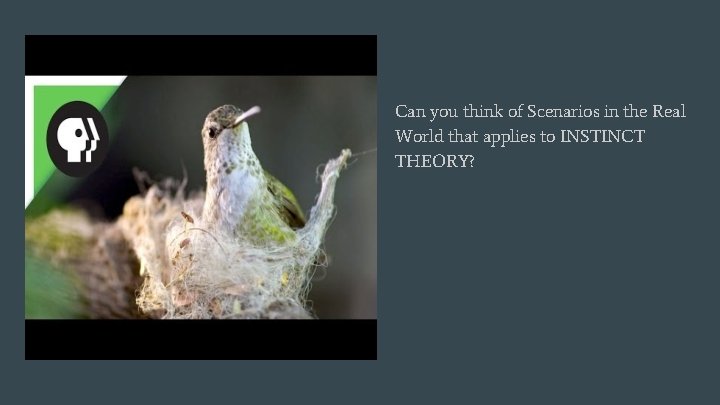
Can you think of Scenarios in the Real World that applies to INSTINCT THEORY?
Key Ideas 1. automatic 2. irresistible 3. happens at some point in one’s development 4. triggered by an environmental occurrence
Criticisms of Instinct Theory -Instincts can explain not all behaviors -Instincts are not something that can be readily observed and scientifically tested -Just labeling something as an instinct does nothing to explain why some behaviors appear in certain instances but not in others.
Cognitive Theory is an approach to psychology that attempts to explain human behavior by understanding your thought processes. Thoughts are the primary determinants of emotions and behavior. Learning is based on thinking. mental processes as they are influenced by both intrinsic and extrinsic factors, which eventually bring about learning in an individual.
Power of Positive Thinking

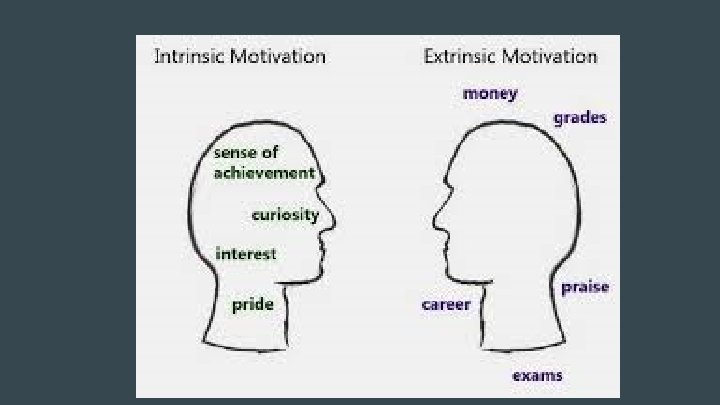
Intrinsic Vs Extrinsic Motivation Extrinsic motivation occurs when we are motivated to perform a behavior or engage in an activity to earn a reward or avoid punishment. Examples of behaviors that are the result of extrinsic motivation include: Studying because you want to get a good grade Cleaning your room to avoid being reprimanded by your parents Participating in a sport to win awards Competing in a contest to win a scholarship In each of these examples, the behavior is motivated by a desire to gain a reward or avoid an adverse outcome.
Continued…. Intrinsic Motivation Intrinsic motivation involves engaging in a behavior because it is personally rewarding; essentially, performing an activity for its own sake rather than the desire for some external reward. Examples of actions that are the result of intrinsic motivation include: Participating in a sport because you find the activity enjoyable Solving a word puzzle because you find the challenge fun and exciting Playing a game because you find it exciting In each of these instances, the person's behavior is motivated by an internal desire to participate in an activity for its own sake.
Work-Sheet Extrinsic motivation can be beneficial in some situations, however: External rewards can induce interest and participation in something in which the individual had no initial interest. Extrinsic rewards can be used to motivate people to acquire new skills or knowledge. Once these early skills have been learned, people may then become more intrinsically motivated to pursue the activity. External rewards can also be a source of feedback, allowing people to know when their performance has achieved a standard deserving of reinforcement. Extrinsic motivators should be avoided in situations where: The individual already finds the activity intrinsically rewarding Offering a reward might make a "play" activity seem more like "work"
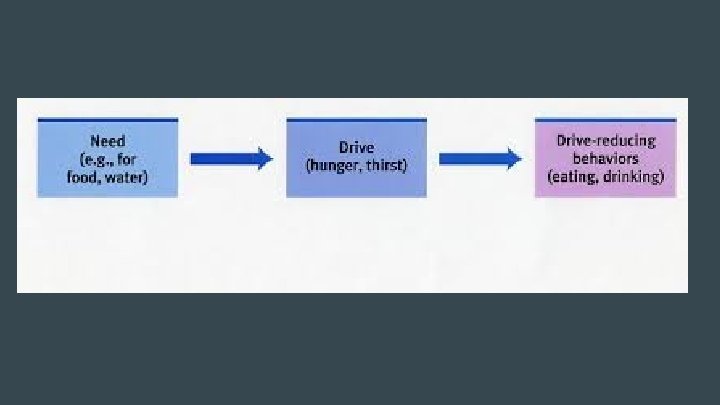
Drive-Reduction Theory We have needs that produce drives (an internal condition that orients an individual toward a specific goal). Examples: • Hunger drives us to eat. • Fatigue drives us to rest. • Thirst drives us to drink. Can you name anymore?
Homeostasis relating to Drive-Reduction Theory -the tendency toward a relatively stable equilibrium - the human body maintains steady levels of temperature and other vital conditions such as the water, salt, sugar, protein, fat, calcium and oxygen contents of the blood. - An Internal Balance.
Primary vs Secondary Drive Primary drives are innate biological needs (e. g. , thirst, hunger, and desire for sex) that are usually necessary for survival. Secondary drives, on the other hand, are not usually necessary for survival and are often linked to social or identity factors (e. g. , the desire for wealth). Secondary drives are associated with primary drives because the satisfaction of secondary drives indirectly satisfies primary drives. You are motivated to reduce the “drive” for food, hunger, thrist, etc. A drive creates an unpleasant state; a tension that needs to be reduced.
Main Ideas Drive Reduction Theory -Our biological drives’ purpose is to balance our Homeostasis. - We are only motivated towards learned (conditioned) behaviors that satisfy a drive. - Behaviors are geared towards satisfying a immediate need (drive). - The drive to satisfy the need is reduced when satisfied. -Primary drives deals with biological needs. -Secondary drives deals with social, or identity factors.
Criticisms of Drive- Reduction Theory Another major criticism of the drive reduction theory of learning is that it does not explain why people engage in behaviors that do not reduce drives. For example, people often eat when they’re not hungry or drink when they’re not thirsty.
Criticisms of Drive Reduction Theory
Incentive Theory Incentives are an external pleasant stimulus, reinforcer, or reward that motivates behavior. Hunger may cause you to walk to the café (drive). The incentive is the cheese steak. people are pulled toward behaviors that offer positive incentives and pushed away from behaviors associated with negative incentives.
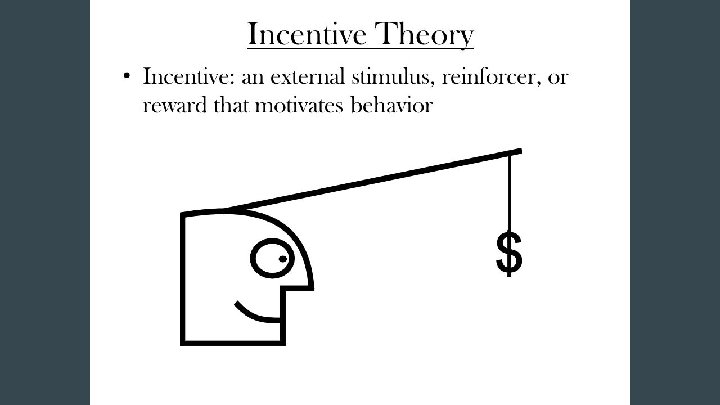
Main Concepts -Driven to pleasant stimulus relating to Operant Conditioning. - External rewards motivate us. -Not all incentives are created equal. - The same incentives doesn’t work in all situations. -Used to motivate individuals towards certain behaviors. -Used also to stop certain behaviors. -Only works if individuals place an importance on the incentives. - Incentives have to be obtainable for it to be motivating.
Power of Incentives in Video Games
Motivation Ted Talk
Plan for the Day 1. Short story tied to Intrinsic and Extrinsic. 2. Motivation video on “you’re not special. ” 3. Maslow’s Hierarchy of Needs Deserted Island. 4. Maslow’s main concepts. 5. Ted Talk on Work Motivation. 6. Group Activity, Exit Slip.

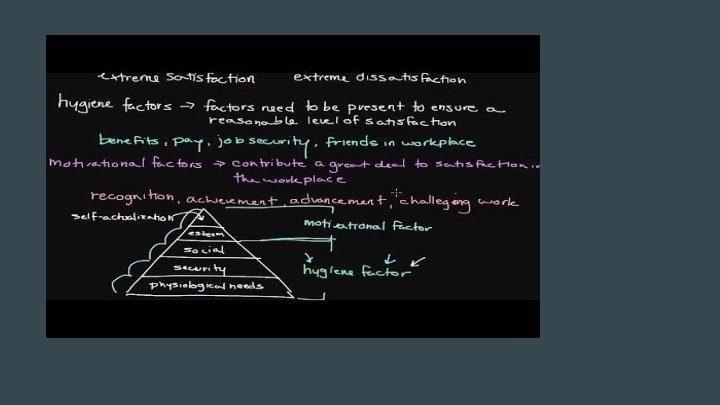
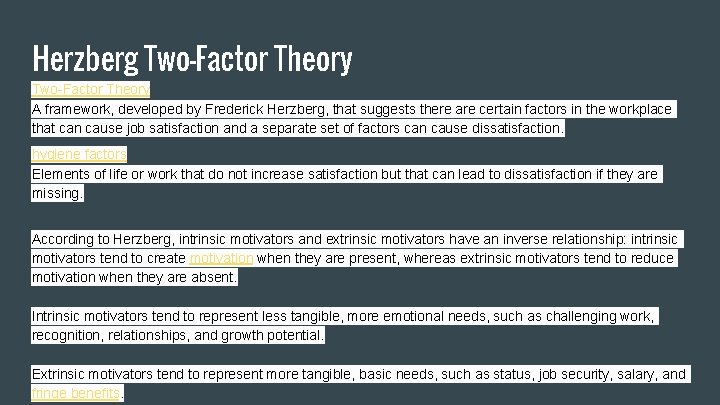
Herzberg Two-Factor Theory A framework, developed by Frederick Herzberg, that suggests there are certain factors in the workplace that can cause job satisfaction and a separate set of factors can cause dissatisfaction. hygiene factors Elements of life or work that do not increase satisfaction but that can lead to dissatisfaction if they are missing. According to Herzberg, intrinsic motivators and extrinsic motivators have an inverse relationship: intrinsic motivators tend to create motivation when they are present, whereas extrinsic motivators tend to reduce motivation when they are absent. Intrinsic motivators tend to represent less tangible, more emotional needs, such as challenging work, recognition, relationships, and growth potential. Extrinsic motivators tend to represent more tangible, basic needs, such as status, job security, salary, and fringe benefits.
Extrinsic and Instrinc Factors Extrinsic motivators include status, job security, salary, and fringe benefits. Managers must realize that not providing the appropriate and expected extrinsic motivators will slow dissatisfaction and unmotivated behavior among employees. Intrinsic motivators include challenging work, recognition, relationships, and growth potential. Managers must recognize that while these needs may be outside the more traditional scope of what the workplace should provide, they are absolutely critical in empowering strong individual and team performance.
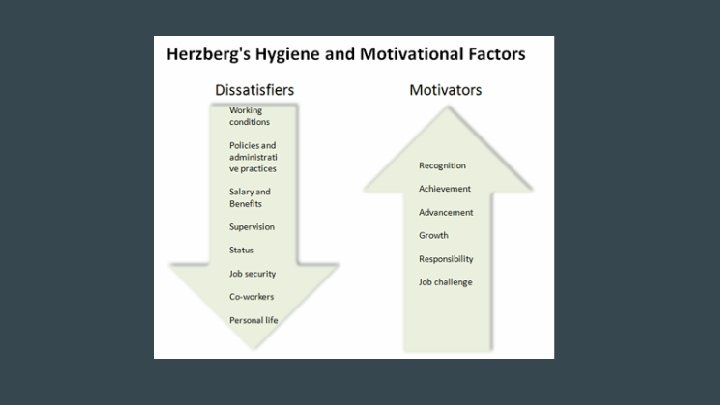
Main Ideas -Intrinsic motivators tend to inspire motivation when they are present, while extrinsic motivators tend to reduce motivation when they are absent. -Extrinsic motivators (e. g. , salary, benefits) are expected and so will not increase motivation when they are in place, but they will cause dissatisfaction when they are missing. Intrinsic motivators (e. g. , challenging work), on the other hand, can be a source of additional motivation.
How can management increase Job Satisfaction If management wants to increase employees' job satisfaction, they should be concerned with the nature of the work itself— the opportunities it presents employees for gaining status, assuming responsibility, and achieving self-realization. If, on the other hand, management wishes to reduce dissatisfaction, then it must focus on the job environment— policies, procedures, supervision, and working conditions. To ensure a satisfied and productive workforce, managers must pay attention to both sets of job factors.
Ted Talk Group Instructions In groups of 3 -4, write a response in relating to the principles and ideas of the Ted Talk, how can we apply those motivation concepts to students in our public school systems? Will these concepts be effective? What will students and teachers have to do for it to work? Can it work? Incorporate the motivation concepts covered in class to reach your conclusions and hypothesis. Be able to articulate your ideas and share with the class.
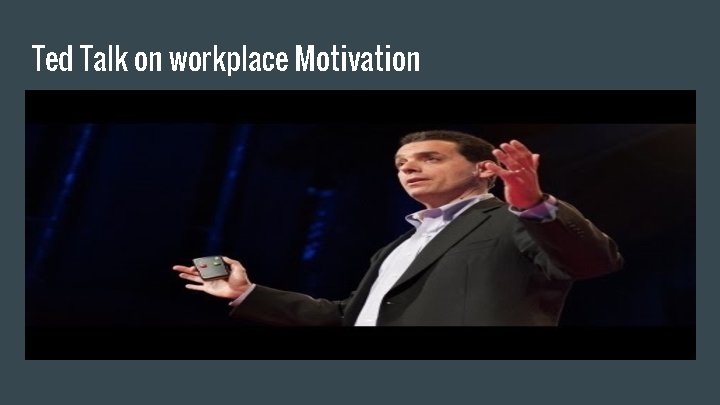
Ted Talk on workplace Motivation
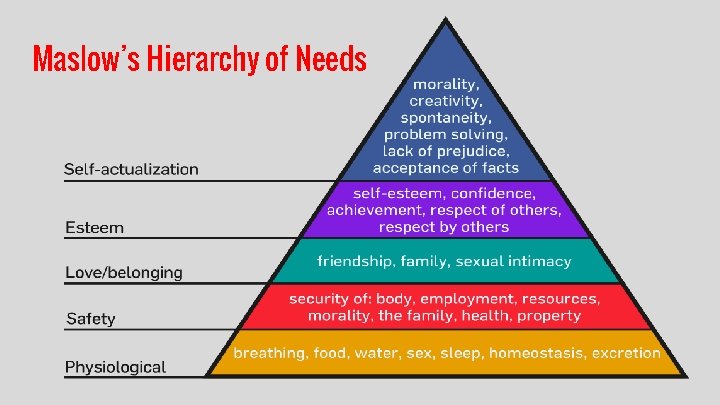
Maslow’s Hierarchy of Needs
Maslow’s Hierarchy of Needs -Needs play an important role in motivating a person to behave a certain way. -The more the basic need, the lower it is on the pyramid. The higher the need is, the higher it is on the pyramid. -In order to move up the pyramid, the bottom needs must be satisfied first. Physiological, then moving up to Psychological and Social.
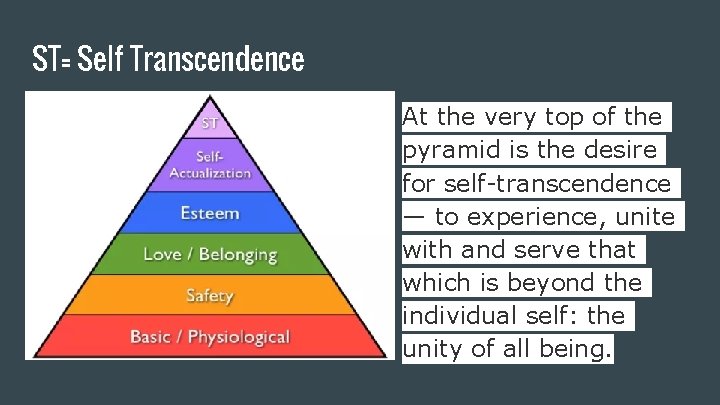
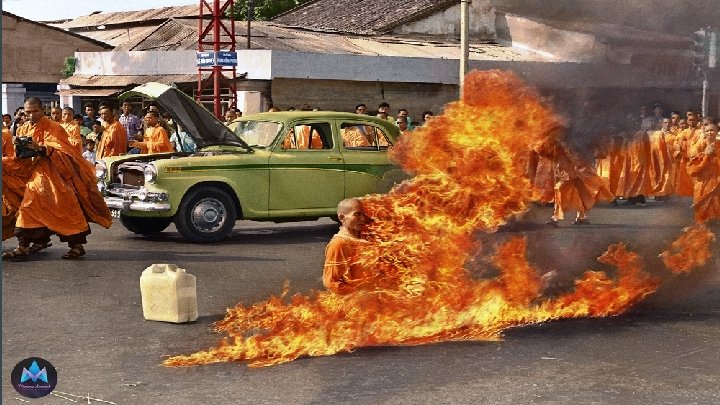
ST= Self Transcendence At the very top of the pyramid is the desire for self-transcendence — to experience, unite with and serve that which is beyond the individual self: the unity of all being.
Arousal Theory The arousal theory of motivation suggests that people are driven to perform actions in order to maintain an optimum level of physiological arousal. Optimum Level: A level that is most Favorable to the individual that produces the best conditions and results.
Continued… According to the arousal theory of motivation, each person has a unique arousal level that is right for them. When our arousal levels drop below these individually mandated optimal levels, we seek stimulation to elevate them. Depending on our comfort level, we may select go to a movie, or a night club, for some go sky diving. When levels of Arousal becomes too stimulated, we are motivated towards more relaxing activities such as going for a walk, hike, go lay on the beach. Take a nap even.
Main Concepts - One of the key assumptions of the arousal theory is that we are motivated to pursue actions that help us maintain an ideal balance. - When we become overly aroused, we seek soothing activities that help calm and relax us. If we become bored, we head in search of more invigorating activities that will energize and arouse us. It's all about striking the right balance, but that balance is unique to each individual.



Yerkes- Dodson Law Yerkes-Dodson Law. The law states that increased levels of arousal will improve performance, but only up until the optimum arousal level is reached. At that point, performance begins to suffer as arousal levels increase. Increased arousal can lead to better test performance by helping you stay alert, focused, and attentive. Excessive arousal can lead to test anxiety and leave you nervous and unable to concentrate on the test. When arousal levels are very high or very low, performance tends to be worse.
Arousal An increase in reactivity, or wakefulness that primes (propels, pushes) us to some kind of action (behavior).
Homeostasis The need to maintain Equilibrium= An internal Balance in the body. Our motivations and behaviors are towards maintaining our equilibrium. Homeostasis involves three key features: 1. A clear set point 2. The ability to detect deviations from this set point 3. Behavioral and physiological responses designed to return the body to the set point Your body has set points for a variety of things including
Bystander Effect
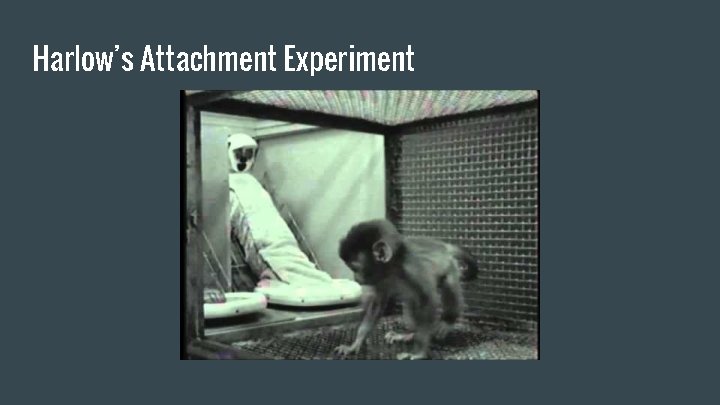
Harlow’s Attachment Experiment
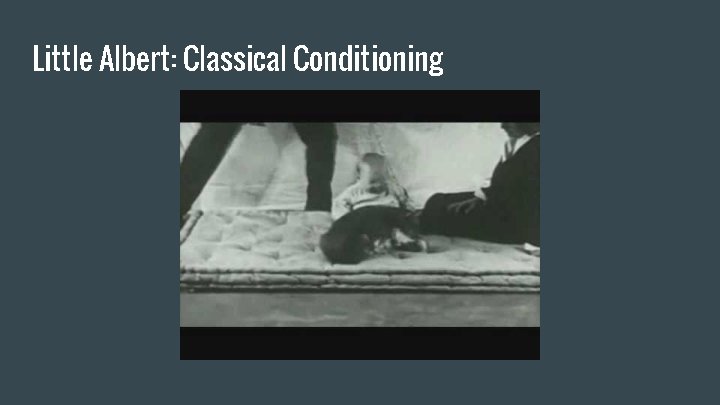
Little Albert: Classical Conditioning
Exit Slip: Hand in after class, GRADED! In a Paragraph define what Motivation is? How are our instincts tied to Motivation? Why is there a need to reduce our drives? How are incentives tied to behavior? Which motivation relating to Extrinsic, Intrinsic, or both is most successful in driving towards a goal (objective)? When do we become aroused? What do we do with that arousal? What happens when we become too aroused?
Exit Slip : Hand in after Class, GRADED! How are theories we covered in Psychology help us understand the link between motivation and behavior? How does Maslow’s Hierarchy of Needs relate to motivation? What is the best way to utilize motivation in an individual, or a group towards an objective? When do we become aroused? What do we do with that arousal? What happens when we
Emotions : James Lange Theory James-Lange theory of emotion suggests that emotions occur as a result of physiological reactions to events. EX: I see a bear. My muscles tense, my heart races. I feel afraid.
Example you are walking in the woods, and you see a grizzly bear. You begin to tremble, and your heart begins to race. The James-Lange theory proposes that you will interpret your physical reactions and conclude that you are frightened ("I am trembling. Therefore I am afraid. " Can you think of any?
Continued Imagine that you are walking through a dark parking garage toward your car. You notice a dark figure trailing behind you and your heart begins to race. According to the James-Lange theory, you then interpret your physical reactions to the stimulus as fear. Therefore, you feel frightened and rush to your car as quickly as you can.
Canon Bard Theory Cannon-Bard theory states that we feel emotions and experience physiological reactions such as sweating, trembling and muscle tension simultaneously. For example: I see a snake --> I am afraid, and I begin to tremble. According to the Cannon-Bard theory of emotion, we react to a stimulus and experience the associated emotion at the same time.
Example For example, imagine that you are walking to your car through a darkened parking garage. You hear the sounds of footsteps trailing behind you, and spot a shadowy figure slowly following you as you make your way to your car. According to the Cannon-Bard theory of emotion, you will experience feelings of fear and physical reaction at the same time. You will begin to feel fearful, and your heart will begin to race. You rush to your car, lock the doors behind you and rush out of the parking garage to head home. The Cannon-Bard theory differs from other theories of emotion such as the James-Lange theory of emotion, which argues that physiological responses occur first and result and are the cause of emotions.
Schachter-Singer Theory To experience emotion, we have to first: 1. Be Physically (physiologically) aroused and 2. cognitively label (identify) the arousal.
Example: So, imagine you are alone in a dark parking lot walking toward your car. A strange man suddenly emerges from a nearby row of trees and rapidly approaches. The sequence that follows, according to the two-factor theory, would be much like this: 1. I see a strange man walking toward me. 2. My heart is racing and I am trembling. 3. My rapid heart rate and trembling are caused by fear. 4. I am frightened! The process begins with the stimulus (the strange man), which is followed by the physical arousal (rapid heartbeat and trembling). Added to this is the cognitive label (associating the physical reactions to fear), which is immediately followed by the conscious experience of the emotion (fear).
- Slides: 66